AI in Smart Home Market Size, Share, Trends and Growth Analysis, By Offering (AI Smart Voice Assistants, AI Smart Security, & Others), By AI Technology (NLP, Computer Vision, ML, & Others), By Connectivity Protocol, By Interoperability Standard, By Deployment Architecture, By Installation Type, By Distribution Channel, By Revenue Model, By End User (Single Family Homes, Multi-Family Homes, & Other Residential Properties), and Region - Global Industry Report and Forecast, 2026–2035
Industry: ICT & Media | Publishing Date: July 28, 2026 | Last Updated: September 30, 2026 | No of Pages: N/A | No. of Tables: N/A | No. of Figures: N/A | Format: PDF | Report Code: IC5444
What Is the AI in Smart Home Market Size?
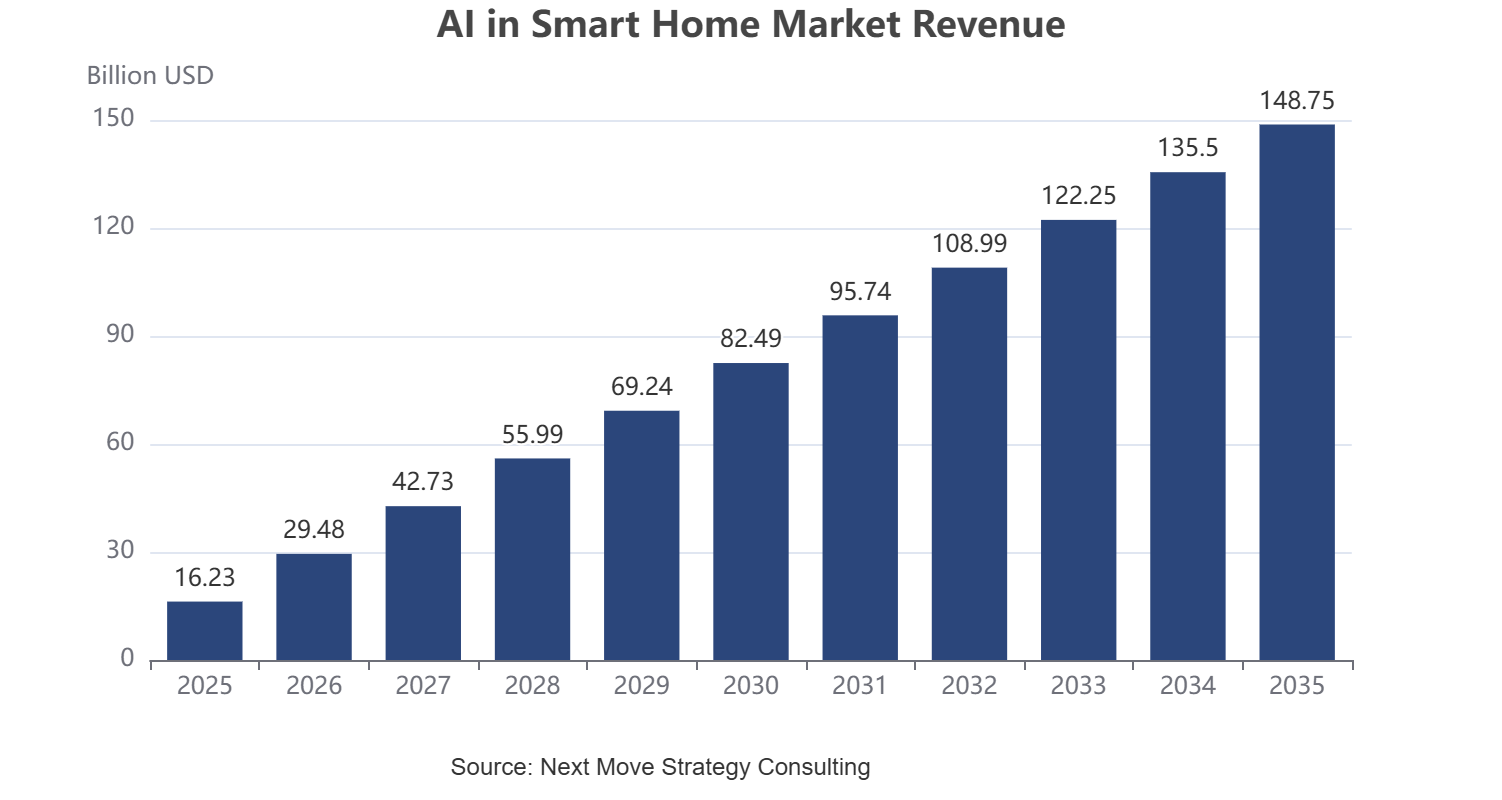
The global AI in Smart Home Market size was valued at USD 16.23 billion in 2025 and is estimated at USD 20.26 billion in 2026, forecast to reach USD 148.75 billion by 2035, expanding at a 24.8% CAGR between 2026 and 2035. North America leads with approximately a 36% share, while AI Smart Security dominates all other offering categories with approximately a 19% share.
We observed that growth is broad-based across every segmentation axis, with generative AI adoption and Matter-based interoperability driving the dominant structural shifts through 2035.
|
Key Takeaways |
|
By Offering: AI Smart Security held the largest share of approximately 19% (USD 3.08 billion) in 2025; AI Smart Home Services is the fastest-growing sub-segment at 37.9% CAGR from 2026–2035. |
|
By AI Technology: ML held the largest share of approximately 24% (USD 3.90 billion) in 2025; Generative AI is the fastest-growing sub-segment at 42.6% CAGR from 2026–2035. |
|
By Connectivity Protocol: Wi-Fi held the largest share of approximately 38% (USD 6.17 billion) in 2025; Thread is the fastest-growing sub-segment at 36.4% CAGR from 2026–2035. |
|
By Interoperability Standard: Proprietary Standards held the largest share of approximately 78% (USD 12.66 billion) in 2025; Matter is the fastest-growing sub-segment at 39.0% CAGR from 2026–2035. |
|
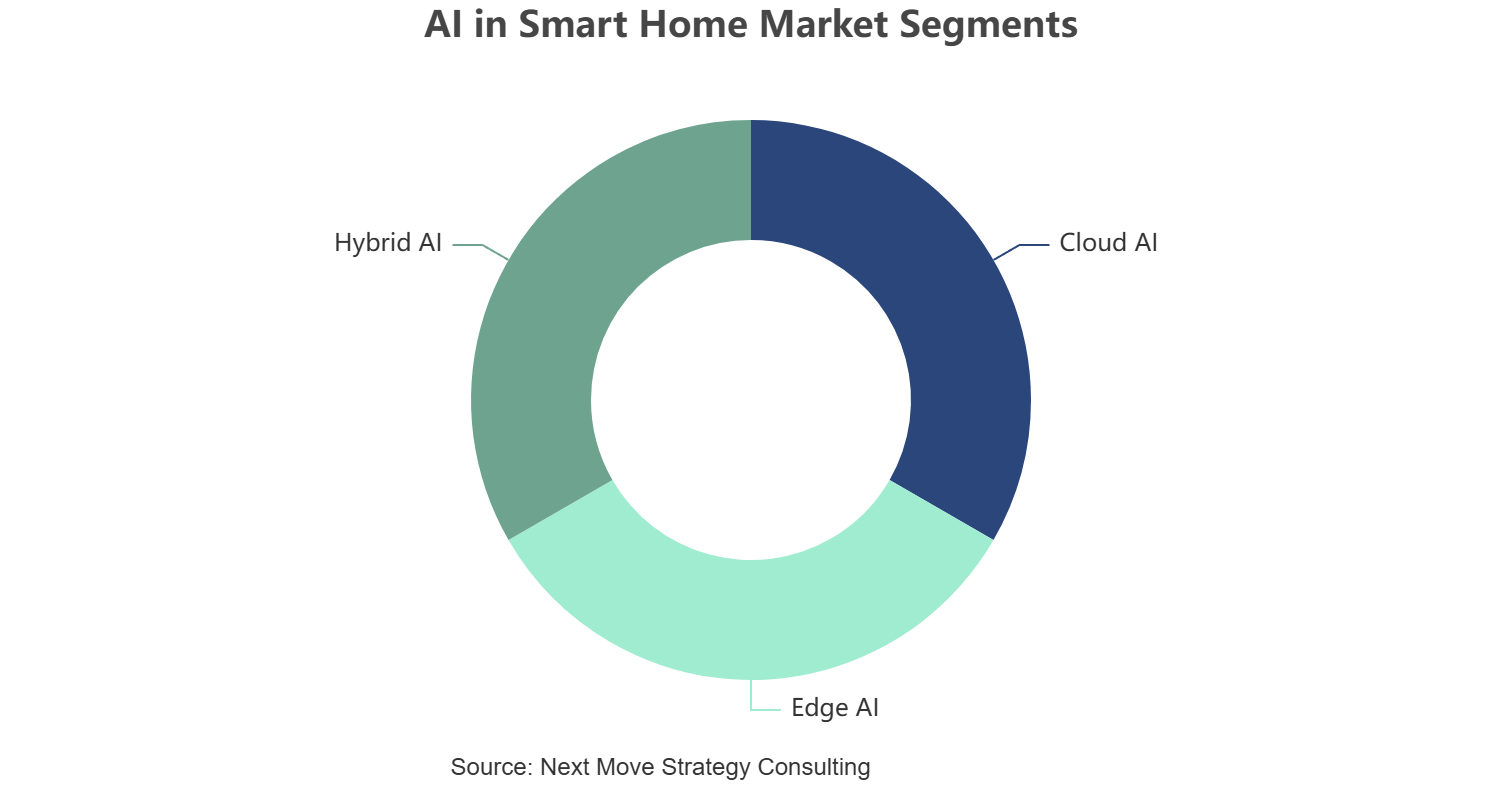
By Deployment Architecture: Cloud AI held the largest share of approximately 52% (USD 8.44 billion) in 2025; Hybrid AI is the fastest-growing sub-segment at 30.6% CAGR from 2026–2035. |
|
By Installation Type: New Installation held the largest share of approximately 61% (USD 9.90 billion) in 2025; Retrofit Installation is the fastest-growing sub-segment at 26.2% CAGR from 2026–2035. |
|
By Distribution Channel: E-Commerce Marketplaces held the largest share of approximately 28% (USD 4.54 billion) in 2025; Security Service Providers is the fastest-growing sub-segment at 27.0% CAGR from 2026–2035. |
|
By Revenue Model: Hardware Revenue held the largest share of approximately 64% (USD 10.39 billion) in 2025; Subscription Revenue is the fastest-growing sub-segment at 31.9% CAGR from 2026–2035. |
|
By End User: Single-Family Homes held the largest share of approximately 68% (USD 11.04 billion) in 2025; Multi-Family Homes is the fastest-growing sub-segment at 27.3% CAGR from 2026–2035. |
|
Dominant Region: North America dominated with approximately 36% revenue share (USD 5.84 billion) in 2025. |
|
Fastest-Growing Region: Asia-Pacific is expected to register the highest CAGR of 28.1% during 2026–2035. |
|
Dominant Country: The U.S. led with approximately USD 4.96 billion in 2025. |
|
Fastest-Growing Country: India is the fastest-growing country at approximately 29.6% CAGR from 2026–2035. |
Market Opportunity: The AI in Smart Home Market is expected to create an absolute dollar opportunity of USD 128.49 billion between 2026 and 2035, presenting significant investment potential across the connected home, generative AI assistant, and Matter-enabled interoperability value chain.
According to NMSC analysis, device makers are increasingly bundling hardware sales with subscription-based monitoring and software services to build recurring revenue streams, a shift that favors platform-integrated ecosystem providers over single-device manufacturers as generative AI assistants become the primary interface for home automation through 2035.
Ecosystem Analysis of the AI in Smart Home Industry

The above infographic presents an ecosystem analysis of the AI in smart home market, covering device manufacturers, AI platform providers, connectivity providers, system integrators, and end users. Intelligent connected devices and automation solutions are being developed to enhance interoperability and personalization across smart ecosystems, supported by secure cloud platforms that enable real-time data storage and device synchronization. AI-driven analytics are improving decision-making and home automation performance, while connectivity providers ensure uninterrupted network communication between devices. At the same time, system integrators simplify installation and optimize performance, and smart home standards promote secure and responsible AI adoption. Looking ahead, we observed that end users are increasingly adopting these solutions for enhanced comfort, convenience, and security across their daily lives.
What Does the AI in Smart Home Market Encompass?
The AI in Smart Home Market encompasses the voice assistants, security devices, climate management systems, lighting, appliances, robotics, entertainment devices, control hubs, software, and services that embed artificial intelligence into residential automation. Our assessment indicates that the scope spans device manufacturers, cloud platform providers, chipset makers enabling edge inference, and home automation software developers serving single-family and multi-family residential properties worldwide.
Regulatory frameworks addressing data privacy, such as the European Union's General Data Protection Regulation, shape how AI models process in-home voice and video data, while the Connectivity Standards Alliance's Matter protocol increasingly informs device interoperability requirements. We observed that technology adoption is shifting from cloud-dependent voice commands toward conversational, context-aware generative AI assistants capable of multi-step task execution. NMSC's analysis indicates that this structural shift, combined with rising Matter certification and edge AI chipset adoption, is redefining vendor selection criteria across the AI in Smart Home Market.
|
Field |
Details |
|
Market Size in 2025 |
USD 16.23 Billion |
|
Market Size in 2026 |
USD 20.26 Billion |
|
Revenue Forecast in 2035 |
USD 148.75 Billion |
|
Growth Rate |
CAGR of 24.8% from 2026 to 2035 |
|
Analysis Period |
2025–2035 |
|
Base Year Considered |
2025 |
|
Forecast Period |
2026–2035 |
|
Market Size Estimation |
USD Billion |
|
Companies Profiled |
20 |
|
Countries Covered |
38 |
|
Market Share |
Available for Top 10 Companies |
Key Emerging Trends
Based on research conducted by NMSC, we found that four structural trends are reshaping device design, platform strategy, and stakeholder engagement across the industry.
How Are Conversational AI Assistants Transforming Voice Control?
Conversational, large language model-powered assistants are replacing rigid command-response voice interfaces across the smart home. We observed that Amazon introduced Alexa Plus alongside refreshed Echo Show displays and speakers, enabling the assistant to hold conversations, understand context, and manage complex automation scenarios without users memorizing exact phrases. Google responded with Gemini for Home, replacing the legacy Google Assistant. Device makers are redesigning hardware to handle the processing demands of on-device and cloud-based large language models.
Why Is Matter Adoption Accelerating Cross-Ecosystem Interoperability?
Matter protocol adoption is accelerating as consumers demand devices that work across Apple, Google, Amazon, and Samsung ecosystems without separate hubs. Our findings suggest that a Thread-enabled light bulb can now be set up through Google Home, controlled by Alexa, and automated through Samsung SmartThings, illustrating the interoperability Matter enables. Platform providers are expanding Matter certification across product lines, positioning cross-ecosystem compatibility as a baseline consumer expectation rather than a premium feature.
How Is Edge AI Processing Addressing Smart Home Privacy Concerns?
Edge AI processing that keeps voice and video data on-device is emerging as a direct response to privacy concerns that have historically limited smart home adoption. We observed that ambient AI systems increasingly process behavioral patterns locally rather than transmitting continuous data to cloud servers. NMSC's analysis indicates that this shift is elevating demand for edge AI chipsets capable of running inference workloads within power and thermal constraints of consumer smart home hardware.
How Is Vision AI Reshaping Smart Appliance Functionality?
Computer vision-enabled appliances are moving from passive, command-driven devices to proactive systems that recognize context and act autonomously. We observed that LG Electronics' expanded SIGNATURE lineup at CES 2026 featured vision-powered ovens that recognize food and automatically adjust cooking settings alongside conversational AI refrigerators. Appliance makers are embedding computer vision and predictive analytics directly into premium product lines to differentiate on proactive, context-aware functionality.
Growth Drivers and Restraints
Growth Catalyst and Risk Assessment Matrix
|
Factors |
Type |
(+/−) % Impact on CAGR |
Geographic Relevance |
Impact Timeline |
|
Generative AI assistant adoption across major ecosystems |
Driver |
+6.4% |
Global |
2026-2035 |
|
Matter protocol certification and cross-ecosystem interoperability |
Driver |
+5.1% |
Global |
2026-2035 |
|
Rising smart security device penetration in single-family homes |
Driver |
+3.8% |
North America, Europe |
2026-2035 |
|
Edge AI chipset advancement enabling on-device inference |
Driver |
+3.2% |
Global |
2026-2032 |
|
Subscription-based monitoring and service revenue expansion |
Driver |
+2.4% |
North America, Europe |
2026-2035 |
|
Smart appliance replacement cycles in Asia-Pacific |
Driver |
+1.8% |
Asia-Pacific |
2026-2035 |
|
Consumer data privacy concerns limiting cloud-based adoption |
Restraint |
-2.1% |
Global |
2026-2035 |
|
Ecosystem fragmentation across proprietary platforms |
Restraint |
-1.6% |
Global |
2026-2030 |
|
High upfront cost of whole-home AI automation systems |
Restraint |
-1.1% |
Middle East & Africa, Latin America |
2026-2032 |
|
Cybersecurity vulnerabilities in connected home devices |
Restraint |
-0.9% |
Global |
2026-2035 |
What Is the Primary Growth Driver of the AI in Smart Home Market?
Generative AI assistant adoption across major ecosystems is the primary driver of the market. Amazon disclosed that its Alexa platform reached 500 million Alexa-capable devices in use by 2025, and the company's 2026 Alexa Plus launch extends this installed base toward conversational, context-aware automation. We observed that this scale advantage, reinforced by Google's parallel Gemini for Home rollout, continues to anchor consumer demand for AI-enabled voice control across the smart home.
How Is Matter Standardization Driving AI in Smart Home Market Growth?
Matter standardization is accelerating market growth by removing the cross-brand compatibility barriers that historically fragmented consumer adoption. The Connectivity Standards Alliance's Matter protocol enables devices from different manufacturers to interoperate without proprietary hubs, directly expanding the addressable market for AI-enabled devices. NMSC's analysis indicates that this interoperability shift, combined with major ecosystem providers moving toward unified frameworks, is compressing purchase-decision friction for consumers evaluating multi-brand smart home setups.
What Is Restraining AI in Smart Home Market Expansion?
Consumer data privacy concerns restrain adoption among households wary of continuous in-home voice and video data collection. Industry sources have identified privacy as the leading barrier to smart home adoption, directly motivating the shift toward local, edge-based AI processing. We found that vendors unable to demonstrate credible on-device processing capability face particular exposure, as privacy-conscious consumers increasingly favor platforms offering transparent, local data handling over cloud-dependent alternatives.
Segmentation Analysis
Segment Sizing: By Offering
|
Segment |
2025 (USD) |
2035 (USD) |
CAGR% (2026–2035) |
|
AI Smart Voice Assistants |
USD 2.60 Billion |
USD 14.88 Billion |
18.4% |
|
AI Smart Security |
USD 3.08 Billion |
USD 25.29 Billion |
23.3% |
|
AI Smart Climate Management |
USD 1.62 Billion |
USD 13.39 Billion |
23.4% |
|
AI Smart Lighting |
USD 1.14 Billion |
USD 8.92 Billion |
22.6% |
|
AI Smart Appliances |
USD 2.43 Billion |
USD 20.83 Billion |
23.9% |
|
AI Home Robotics |
USD 1.46 Billion |
USD 16.36 Billion |
27.6% |
|
AI Smart Entertainment |
USD 1.62 Billion |
USD 11.90 Billion |
21.8% |
|
AI Smart Home Control |
USD 0.97 Billion |
USD 8.92 Billion |
24.8% |
|
AI Smart Home Software |
USD 0.65 Billion |
USD 13.39 Billion |
36.5% |
|
AI Smart Home Services |
USD 0.66 Billion |
USD 14.87 Billion |
37.9% |
|
Total |
USD 16.23 Billion |
USD 148.75 Billion |
24.8% |
Which Offering Segment Dominates the AI in Smart Home Market?
AI Smart Security, encompassing smart cameras, video doorbells, and smart locks, led the market with USD 3.08 billion in 2025, reflecting consumer prioritization of home automation safety applications. Our findings suggest that AI Smart Home Services is the fastest-growing offering, registering a 37.9% CAGR from 2026 to 2035, as device makers shift toward recurring monitoring and subscription revenue models to complement hardware sales.
Segment Sizing: By AI Technology
|
Segment |
2025 (USD) |
2035 (USD) |
CAGR% (2026–2035) |
|
NLP |
USD 3.57 Billion |
USD 22.31 Billion |
19.6% |
|
Computer Vision |
USD 3.25 Billion |
USD 28.26 Billion |
24.1% |
|
ML |
USD 3.90 Billion |
USD 29.75 Billion |
22.3% |
|
Predictive Analytics |
USD 1.95 Billion |
USD 16.36 Billion |
23.6% |
|
Context Awareness |
USD 1.30 Billion |
USD 13.39 Billion |
26.4% |
|
Edge AI |
USD 1.46 Billion |
USD 20.83 Billion |
31.1% |
|
Generative AI |
USD 0.49 Billion |
USD 14.88 Billion |
42.6% |
|
Residual AI Technologies |
USD 0.31 Billion |
USD 2.97 Billion |
25.4% |
|
Total |
USD 16.23 Billion |
USD 148.75 Billion |
24.8% |
Which AI Technology Is Most Widely Used in Smart Home Deployments?
ML remained the leading technology within the market, reaching USD 3.90 billion in 2025 on sustained demand for pattern recognition across security, climate, and appliance applications, closely trailed by computer vision use cases. Based on research conducted by NMSC, we found that Generative AI is the fastest-growing technology at a 42.6% CAGR from 2026 to 2035, reflecting rapid adoption of conversational, large language model-powered assistants like Alexa Plus and Gemini for Home.
Segment Sizing: By Interoperability Standard
|
Segment |
2025 (USD) |
2035 (USD) |
CAGR% (2026–2035) |
|
Matter |
USD 3.57 Billion |
USD 86.27 Billion |
39.0% |
|
Proprietary Standards |
USD 12.66 Billion |
USD 62.48 Billion |
16.5% |
|
Total |
USD 16.23 Billion |
USD 148.75 Billion |
24.8% |
Which Interoperability Standard Leads AI in Smart Home Market Demand?
Proprietary Standards remained the leading interoperability category within the market, valued at USD 12.66 billion in 2025 on continued reliance on brand-specific ecosystems such as Apple HomeKit and Amazon Alexa. Our findings suggest that Matter is the fastest-growing standard, registering a 39.0% CAGR from 2026 to 2035, as Samsung, Google, Amazon, and Apple expand certified device support to address consumer demand for cross-brand compatibility.
Growth Opportunities
Our analysis shows that three forward-looking opportunities stand out for stakeholders positioning within the AI in Smart Home Market over the 2026-2035 forecast period.
How Can Subscription Monitoring Services Unlock Recurring Revenue for Security Providers?
Subscription-based monitoring and analytics services present a whitespace opportunity for security device makers seeking to shift from one-time hardware sales to recurring revenue. Providers that bundle AI-powered threat detection with monthly monitoring subscriptions stand to capture predictable, multi-year revenue as consumers increasingly expect proactive security alerts beyond basic camera recording.
Where Does Multi-Family Housing Create New Demand for AI Smart Home Platforms?
Multi-family housing operators seeking centralized, scalable automation represent an underpenetrated opportunity for platform providers offering property-wide AI management. Vendors that deliver unit-level personalization within a centrally managed building framework can secure long-term contracts with property managers, differentiating from single-family-focused consumer product lines.
How Can Edge AI Chipsets Benefit Privacy-Focused Device Makers?
Privacy-conscious consumers seeking local data processing create an opportunity for device makers offering edge AI-enabled hardware. Early movers that deliver on-device inference without cloud dependency can differentiate on transparent data handling, capturing share from privacy-sensitive households that have historically delayed smart home adoption over data collection concerns.
Regional Outlook
Geographic Performance Snapshot
|
Region |
2025 (USD) |
2035 (USD) |
CAGR% (2026–2035) |
Key Driver |
|
North America |
USD 5.84 Billion |
USD 44.62 Billion |
22.3% |
Generative AI assistant launches and high smart security penetration |
|
Europe |
USD 3.90 Billion |
USD 31.24 Billion |
22.9% |
GDPR-driven edge AI adoption and energy management demand |
|
Asia-Pacific |
USD 4.87 Billion |
USD 56.52 Billion |
28.1% |
Expanding smart appliance manufacturing and consumer electronics adoption |
|
Middle East & Africa |
USD 0.97 Billion |
USD 10.41 Billion |
27.0% |
Growing luxury residential smart home installation demand |
|
Latin America |
USD 0.65 Billion |
USD 5.96 Billion |
24.8% |
Rising middle-class smart device adoption and e-commerce penetration |
|
Total |
USD 16.23 Billion |
USD 148.75 Billion |
24.8% |
– |
North America
North America's market maturity reflects the highest global penetration of AI-enabled voice assistants and connected security devices. Regulatory influence is moderate, with state-level data privacy laws shaping vendor data handling practices. Technology adoption favors generative AI assistants following Amazon's Alexa Plus and Google's Gemini for Home launches. NMSC's analysis indicates a strategic outlook centered on subscription service expansion and continued security device penetration through 2035.
Europe
Europe's market maturity is shaped by stringent data privacy expectations under the General Data Protection Regulation, pushing vendors toward edge AI processing architectures. Regulatory influence is pronounced, with national energy efficiency programs supporting smart climate management adoption in Germany and the UK. Technology adoption spans established voice assistant platforms and expanding energy optimization software. Our assessment indicates a strategic outlook centered on privacy-compliant, locally processed AI deployment.
Asia-Pacific
Asia-Pacific's market maturity spans both established consumer electronics manufacturing hubs and rapidly expanding household adoption. Regulatory influence is strengthening as China, Japan, and South Korea formalize data governance frameworks for connected devices. Technology adoption is shifting rapidly toward AI-embedded appliances following CES 2026 launches from regional manufacturers. We observed that competitive intensity is rising as domestic vendors scale AI-enabled product lines, supporting the fastest regional CAGR through 2035.
Middle East & Africa
The Middle East & Africa market remains earlier-stage, shaped by growing luxury residential development and smart building integration in Gulf Cooperation Council markets. Regulatory influence is limited but emerging as national smart city initiatives incorporate connected home standards. Technology adoption centers on premium security and climate management systems supplied by global brands. Our findings suggest a strategic outlook of steady, luxury-linked growth through the forecast period.
Latin America
Latin America's market maturity trails other regions, with demand concentrated in urban middle-class households adopting entry-level smart security and voice assistant devices. Regulatory influence is nascent, with technology adoption favoring affordable Wi-Fi-based devices distributed through expanding e-commerce channels. Competitive intensity remains moderate, dominated by global brands with limited regional manufacturing presence. NMSC's analysis indicates a strategic outlook of steady, e-commerce-driven growth tied to rising disposable income.
U.S.
Based on our estimates, the U.S. AI in Smart Home Market was valued at approximately USD 4.96 billion in 2025, projected to reach USD 37.20 billion by 2035 at a 22.0% CAGR. Demand structure is anchored in generative AI voice assistant adoption and high smart security device penetration. Adoption levels are high, regulatory influence is moderate under state privacy laws, technology penetration favors conversational AI platforms, and competitive intensity is elevated among global ecosystem providers and domestic device makers.
Canada
The market in Canada was valued at approximately USD 876 million in 2025, projected to reach USD 7.42 billion by 2035 at a 23.7% CAGR. Demand structure is concentrated in smart security and climate management devices suited to regional weather conditions. Regulatory influence stems from federal privacy legislation aligned with international standards. Technology penetration favors established voice assistant ecosystems, with competitive intensity moderate and strategic outlook tied to continued suburban housing smart device adoption.
UK
As per our estimate, the UK AI in Smart Home Market was valued at approximately USD 897 million in 2025, projected to reach USD 7.19 billion by 2035 at a 23.0% CAGR. Demand structure centers on smart security and energy monitoring devices amid rising energy cost awareness. Regulatory influence is substantial under GDPR-aligned data protection rules, technology penetration spans major voice assistant ecosystems, and competitive intensity is elevated as global vendors compete for domestic retail distribution.
Germany
According to our analysis, the German market was valued at approximately USD 1.37 billion in 2025, projected to reach USD 10.93 billion by 2035 at a 22.9% CAGR. Demand structure reflects strong smart energy management adoption tied to national efficiency incentives. Regulatory influence is strong under GDPR, technology penetration favors privacy-compliant edge AI devices, and competitive intensity is high given Germany's concentration of engineering-focused smart home brands.
France
Based on our estimates, the French market was valued at approximately USD 683 million in 2025, projected to reach USD 6.25 billion by 2035 at a 24.8% CAGR. Demand structure is supported by growing smart lighting and climate management adoption in urban households. Regulatory influence is significant under GDPR, technology penetration is moderate to advanced, and competitive intensity centers on established European and global brands serving domestic retail channels.
China
The market in China was valued at approximately USD 1.95 billion in 2025, projected to reach USD 22.61 billion by 2035 at a 28.1% CAGR. Demand structure is driven by domestic manufacturers' AI appliance integration and expanding e-commerce distribution. Regulatory influence is strengthening under national data governance standards, technology penetration favors domestically developed AI ecosystems, and competitive intensity is rising as local vendors scale computer vision and generative AI capability.
India
As per our estimate, the Indian AI in Smart Home Market was valued at approximately USD 877 million in 2025, projected to reach USD 11.30 billion by 2035 at a 29.6% CAGR, the fastest among countries covered. Demand structure centers on affordable smart security and lighting devices sold through e-commerce marketplaces. Regulatory influence is emerging, technology penetration is accelerating rapidly among urban households, and competitive intensity is increasing as domestic and global brands compete for market share.
Japan
According to our analysis, the Japanese market was valued at approximately USD 877 million in 2025, projected to reach USD 8.48 billion by 2035 at a 25.5% CAGR. Demand structure reflects strong smart appliance integration tied to an aging population's independent living needs. Regulatory influence is well established, technology penetration favors proven Japanese-engineered appliance ecosystems, and competitive intensity remains concentrated among established domestic and global brands.
South Korea
Based on our estimates, the South Korean market was valued at approximately USD 633 million in 2025, projected to reach USD 6.78 billion by 2035 at a 27.0% CAGR. Demand structure is supported by high smartphone and AI ecosystem penetration integrated with home appliances. Regulatory influence is growing, technology penetration is among the most advanced globally, and competitive intensity centers on domestic conglomerates competing directly with global ecosystem providers.
Australia
The market in Australia was valued at approximately USD 243 million in 2025, projected to reach USD 2.83 billion by 2035 at a 28.2% CAGR. Demand structure is concentrated in smart security and climate management devices suited to regional climate variability. Regulatory influence stems from national privacy law alignment with international standards, technology penetration favors established global ecosystems, and competitive intensity remains moderate with global vendors serving domestic retail channels.
UAE
As per our estimate, the UAE AI in Smart Home Market was valued at approximately USD 194 million in 2025, projected to reach USD 2.08 billion by 2035 at a 27.0% CAGR. Demand structure is anchored in luxury residential and smart building integration projects. Regulatory influence is emerging under national smart city initiatives, technology penetration favors premium global ecosystem devices, and competitive intensity is elevated among global brands pursuing high-value residential developments.
Saudi Arabia
According to our analysis, the Saudi Arabian market was valued at approximately USD 291 million in 2025, projected to reach USD 3.12 billion by 2035 at a 27.0% CAGR. Demand structure reflects growing smart residential development under national diversification and giga-project programs. Regulatory influence is emerging, technology penetration favors premium security and climate systems, and competitive intensity is concentrated among global brands supporting new residential developments.
South Africa
Based on our estimates, the South African market was valued at approximately USD 117 million in 2025, projected to reach USD 1.25 billion by 2035 at a 26.9% CAGR. Demand structure is supported by growing urban middle-class adoption of smart security devices. Regulatory influence remains limited, technology penetration is concentrated in entry-level security and lighting devices, and competitive intensity is centered on global brands distributed through regional retailers.
Brazil
The market in Brazil was valued at approximately USD 390 million in 2025, projected to reach USD 3.58 billion by 2035 at a 24.8% CAGR. Demand structure is driven by rising e-commerce-enabled smart security and voice assistant adoption. Regulatory influence is growing under national data protection legislation. Technology penetration favors affordable Wi-Fi-based devices, and competitive intensity centers on global brands with expanding regional e-commerce distribution.
Argentina
As per our estimate, Argentina's AI in Smart Home Market was valued at approximately USD 130 million in 2025, projected to reach USD 1.19 billion by 2035 at a 24.8% CAGR. Demand structure is supported by urban household adoption of entry-level smart lighting and security devices. Regulatory influence remains limited, technology penetration is modest, and competitive intensity is centered on global brands distributed through e-commerce marketplaces serving domestic consumers.
Competitive Landscape
We observed that the AI in Smart Home Market features a moderately consolidated competitive landscape, with global technology and ecosystem providers competing alongside diversified appliance and building technology conglomerates on platform reach, AI model quality, and device portfolio breadth.
|
Key Takeaways |
|
Market Structure: Moderately consolidated; the top ecosystem providers, including Amazon, Alphabet, Samsung, Apple, and LG, collectively account for a majority of global AI in smart home Industry revenue, while specialized security and lighting brands serve category-specific demand. |
|
Innovation Focus: Generative AI voice assistants, computer vision-enabled appliances, and Matter-certified interoperability dominate current innovation pipelines across leading ecosystem providers. |
|
M&A Activity: Selective platform partnerships and ecosystem expansion, exemplified by Samsung's integration of Google Gemini AI vision capability into its SmartThings and appliance product lines. |
How Do Companies Compete in the AI in Smart Home Market?
Companies compete primarily on ecosystem breadth, AI model conversational quality, and cross-device interoperability across the industry. Global platform providers such as Amazon and Alphabet leverage massive installed device bases and proprietary large language models to serve consumers seeking unified voice control, while diversified appliance makers such as Samsung Electronics and LG Electronics compete through vertically integrated AI Home Industry visions spanning appliances, displays, and climate systems.
Which Competitive Archetypes Dominate the AI In Smart Home Industry?
Two archetypes dominate the market: platform ecosystem providers offering voice assistant and hub-centric control spanning third-party devices, and vertically integrated appliance conglomerates embedding AI directly into branded product lines. Amazon and Alphabet exemplify the platform ecosystem archetype, while Samsung Electronics and LG Electronics exemplify the vertically integrated appliance archetype competing on proprietary AI Home visions showcased at major consumer electronics events.
How Are Companies Differentiating Through Innovation in AI Smart Home Technology?
Innovation and differentiation strategy increasingly center on conversational AI depth and computer vision-enabled proactive functionality. Amazon's Alexa Plus and LG's vision-powered ovens that recognize food and adjust cooking settings both illustrate how vendors move beyond reactive commands toward anticipatory automation. Our analysis shows that vendors unable to demonstrate credible generative AI or computer vision capability risk losing premium product positioning as proactive, context-aware functionality becomes the primary differentiator.
What M&A and Expansion Activity Is Shaping the AI in Smart Home Market?
Strategic technology partnerships and platform expansion continue to shape competitive positioning within the industry. Samsung's integration of Google Gemini AI vision capability into its kitchen and SmartThings product lines, announced ahead of CES 2026, illustrates how appliance makers pursue external AI partnerships to accelerate capability without full in-house model development, while Amazon and Google's parallel 2026 ecosystem launches demonstrate continued platform-level competitive escalation.
Key Market Players
Our assessment indicates that the following 20 companies are actively shaping ecosystem platform strategy, appliance integration, and device portfolio breadth within the global AI in Smart Home Market.
-
Amazon.com, Inc.
-
Alphabet Inc.
-
Samsung Electronics Co., Ltd.
-
Apple Inc.
-
Haier Smart Home Co., Ltd.
-
Xiaomi Corporation
-
Honeywell International Inc.
-
Robert Bosch GmbH
-
Schneider Electric SE
-
Signify N.V.
-
ASSA ABLOY AB
-
ADT Inc.
-
ABB Ltd.
-
Sony Group Corporation
-
Panasonic Holdings Corporation
-
Legrand SA
-
Lutron Electronics Co., Inc.
-
Aqara Home Co., Ltd.
Latest Developments
We found that recent milestones within the AI in Smart Home Market are concentrated on generative AI assistant launches and vision-enabled appliance integration, reflecting the industry's shift toward conversational, proactive automation.
|
Date |
Event |
|
January 2026 |
Samsung Electronics outlined its AI-powered smart home vision at CES 2026, positioning connected appliances as Home Companion that can use voice recognition, screens, and cameras to perceive and understand users and proactively respond to their needs. |
|
September 2025 |
Samsung unveiled its 'AI Home: Future Living, Now' vision at IFA 2025, demonstrating personalized AI experiences connecting Samsung and third-party devices through SmartThings. |
Expert Insights
 “Samsung is building a more unified, more personal experience across mobile, visual display, home appliances and services. With our global connected ecosystem, and by embedding AI across categories, Samsung is leading the way to offer more meaningful everyday AI experiences.”
— TM Roh, CEO and Head of Samsung's Device eXperience (DX) Division, Samsung Electronics
Statement made in January 2026 during Samsung's CES 2026 event.
Market Interpretation
The insight highlights the industry's transition toward unified, AI-enabled smart home ecosystems, where artificial intelligence is embedded across multiple connected devices rather than operating as an isolated feature. NMSC's analysis indicates that the integration of AI across home appliances, displays, and connected services is expected to accelerate the development of more personalized and context-aware smart home experiences. This shift is supporting the evolution of smart homes toward seamless device interoperability, personalized automation, and more meaningful everyday AI interactions.
Consumer Behavior Analysis of the AI in Smart Home Industry

The above infographic presents a consumer behavior analysis of the AI in smart home market, mapping the journey from awareness to loyalty. Consumers discover AI solutions through trusted online recommendations, leading them to evaluate security, compatibility, pricing, and features before selecting devices that offer seamless automation and reliability. Once purchased, users continue subscriptions after experiencing personalized, secure, and convenient home automation consistently. Looking ahead, we observed that satisfaction is reinforced by daily reliability and enhanced comfort, encouraging long-term engagement and ecosystem expansion across the residential sector.
Investment Opportunities
What Capital Inflows Are Targeting the AI in Smart Home Market?
Capital inflows into the AI in Smart Home Market are increasingly directed toward generative AI model development and cross-platform interoperability engineering. Amazon and Google's parallel 2026 ecosystem overhauls illustrate continued heavy capital commitment toward large language model integration into consumer hardware. We observed that investors favor vendors demonstrating validated conversational AI capability, viewing installed device base scale as a proxy for long-term platform revenue retention.
How Significant Is Infrastructure Investment in the Market?
Infrastructure investment tied to edge AI chipset development and cloud inference capacity is a critical enabler of AI in smart home platform scalability. Continued investment in on-device processing hardware supports the shift toward privacy-compliant, locally processed AI features. Our assessment indicates that ecosystem providers increasingly condition platform roadmap decisions on availability of both cloud-based large language model capacity and edge inference hardware to balance capability with privacy expectations.
What ESG Considerations Are Shaping AI In Smart Home Investment?
Environmental, social, and governance considerations increasingly influence AI in smart home investment through energy efficiency and data privacy priorities. Smart energy monitoring and optimization software directly supports household carbon footprint reduction goals, while edge AI processing addresses growing data privacy governance expectations. NMSC's analysis indicates that ESG-aligned product positioning, particularly around energy optimization and transparent data handling, is becoming a meaningful factor in consumer and investor vendor evaluation.
Key Benefits for Stakeholders
How Does This Report Benefit Consumer Electronics Industry Leaders?
Consumer electronics industry leaders gain access to validated segmentation, technology benchmarking, and regional regulatory analysis that supports AI smart home product strategy decisions. The report's offering and AI technology breakdowns help executives evaluate voice assistant, security, appliance, and software investment priorities against evolving consumer adoption patterns, supporting more informed portfolio decisions across generative AI and edge AI product categories.
How Does This Report Benefit Investors and Financial Analysts?
Investors and financial analysts benefit from consolidated market sizing, regional growth forecasts, and competitive positioning data that inform capital allocation across the AI in smart home value chain. The report's country-level revenue estimates and growth catalyst matrix support due diligence on ecosystem providers, appliance makers, and software vendors positioned to capture forecast demand growth through 2035.
How Does This Report Benefit Technology Vendors and Product Teams?
Technology vendors and product teams gain competitive intelligence on generative AI adoption trends, Matter interoperability momentum, and recent developments among the 20 companies profiled. This supports product roadmap decisions around conversational assistant design, computer vision integration, and subscription service bundling aligned with the fastest-growing offering and regional segments identified in this report.
Key Market Segments
By Offering
-
AI Smart Voice Assistants
-
Smart Speakers
-
Smart Displays
-
-
AI Smart Security
-
Smart Cameras
-
Video Doorbells
-
Smart Locks
-
Smart Alarm Systems
-
Access Control Devices
-
Security Sensors
-
-
AI Smart Climate Management
-
Smart Thermostats
-
Smart Energy Monitors
-
Smart Plugs
-
Smart Ventilation Controls
-
Smart Water Management Devices
-
-
AI Smart Lighting
-
Smart Bulbs
-
Smart Switches
-
Smart Dimmers
-
Smart Lighting Systems
-
-
AI Smart Appliances
-
Smart Refrigerators
-
Smart Laundry Appliances
-
Smart Dishwashers
-
Smart Cooking Appliances
-
Smart Air Purifiers
-
Residual Smart Appliances
-
-
AI Home Robotics
-
Robotic Vacuum Cleaners
-
Robotic Floor Cleaners
-
Robotic Lawn Mowers
-
Personal Home Robots
-
-
AI Smart Entertainment
-
Smart Televisions
-
Streaming Devices
-
Smart Audio Systems
-
Smart Projectors
-
-
AI Smart Home Control
-
Smart Home Hubs
-
Smart Controllers
-
Smart Remotes
-
Automation Gateways
-
Centralized Control Panels
-
-
AI Smart Home Software
-
Device Management Software
-
Home Automation Software
-
Energy Optimization Software
-
Security Analytics Software
-
-
AI Smart Home Services
-
Monitoring Services
-
Subscription Services
-
Installation Services
-
Maintenance Services
-
By AI Technology
-
NLP
-
Computer Vision
-
ML
-
Predictive Analytics
-
Context Awareness
-
Edge AI
-
Generative AI
-
Residual AI Technologies
By Connectivity Protocol
-
Wi-Fi
-
Bluetooth
-
Zigbee
-
Z-Wave
-
Thread
-
Cellular
-
Ethernet
-
Residual Connectivity Protocols
By Interoperability Standard
-
Matter
-
Proprietary Standards
By Deployment Architecture
-
Cloud AI
-
Edge AI
-
Hybrid AI
By Installation Type
-
New Installation
-
Retrofit Installation
By Distribution Channel
-
Brand Direct Sales
-
Brand Online Stores
-
E-Commerce Marketplaces
-
Consumer Electronics Retailers
-
Telecom Operators
-
Professional Installers
-
Security Service Providers
By Revenue Model
-
Hardware Revenue
-
Software Revenue
-
Subscription Revenue
-
Service Revenue
By End User
-
Single Family Homes
-
Multi-Family Homes
-
Other Residential Properties
By Region
-
North America: U.S., Canada, Mexico.
-
Europe: UK, Germany, France, Italy, Spain, Sweden, Denmark, Finland, Netherlands, Rest of Europe.
-
Asia-Pacific: China, India, Japan, South Korea, Taiwan, Indonesia, Vietnam, Australia, Philippines, Malaysia, Rest of APAC.
-
Middle East & Africa: Saudi Arabia, UAE, Egypt, Israel, Turkey, Nigeria, South Africa, Rest of MEA.
-
Latin America: Brazil, Argentina, Chile, Colombia, Rest of LATAM.
Conclusion & Recommendations
What Is the Long-Term Outlook for the AI in Smart Home Market?
The long-term outlook for the AI in Smart Home Market remains structurally positive, supported by a USD 128.49 billion absolute dollar opportunity between 2026 and 2035 and accelerating generative AI assistant adoption across all major consumer ecosystems. We found that AI Smart Security and AI Smart Home Services will continue to command significant revenue share as monitoring subscriptions and proactive automation features mature into standard consumer expectations through the forecast period.
What Strategic Positioning Should Stakeholders Pursue?
Stakeholders should pursue strategic positioning that combines proprietary AI model capability with Matter-certified interoperability to serve both ecosystem-loyal and multi-brand households. NMSC's analysis indicates that vendors bundling hardware sales with subscription monitoring and software services are best positioned to capture recurring, multi-year revenue across the AI in Smart Home Market.
How Attractive Is the AI in Smart Home Market for New Investment?
The AI in smart home industry presents an attractive investment case, supported by a USD 128.49 billion absolute dollar opportunity between 2026 and 2035 and above-average growth in Asia-Pacific and AI Smart Home Software categories. We found that investment attractiveness is highest for vendors combining validated generative AI capability with broad Matter-certified device portfolios, positioning them to serve both mature and emerging regional markets simultaneously.
What Market Shifts and Key Risks Should Stakeholders Monitor?
Stakeholders should monitor consumer data privacy sensitivity, ecosystem fragmentation risk, and cybersecurity vulnerabilities in connected devices as key risks to the AI in Smart Home Market. Our analysis shows that vendors unable to demonstrate credible on-device, privacy-compliant AI processing risk losing share to competitors offering validated edge AI alternatives, particularly across Europe's increasingly regulated data protection landscape.
What Are the Key Growth Pathways for the AI in Smart Home Market?
Key growth pathways include scaling generative AI assistant capability, expanding Matter-certified device portfolios, and deepening penetration into multi-family housing and subscription service categories. NMSC's analysis indicates that vendors pursuing these pathways while maintaining cost competitiveness in core hardware categories will be best positioned to capture the AI in Smart Home Market's projected growth through 2035.
About the Author
 Mayurima Roy
— Mayurima Roy is Research Analyst at Next Move Strategy Consulting, where she has spent 4 years working across the firm's full industry coverage rather than a single fixed vertical. Her work centers on structured research, ongoing trend tracking, competitive assessment, and insight-led content development, translating complex market data into clear, decision-ready narratives that support informed client decision-making across diverse global industries, market sectors, and world regions every day.
Mayurima Roy
— Mayurima Roy is Research Analyst at Next Move Strategy Consulting, where she has spent 4 years working across the firm's full industry coverage rather than a single fixed vertical. Her work centers on structured research, ongoing trend tracking, competitive assessment, and insight-led content development, translating complex market data into clear, decision-ready narratives that support informed client decision-making across diverse global industries, market sectors, and world regions every day.
About the Reviewer
 Supradip Baul
— Supradip Baul is an accomplished business consultant and strategist with over a decade of rich experience in market intelligence, strategy, technology, and business transformation. His work has included rigorous qualitative and quantitative analysis across multiple industries, helping clients shape investment decisions and long-term roadmaps. Earlier in his career, he was associated with Gartner, where he contributed to industry-leading reports and market share analyses. He has worked with leading global companies and holds an MBA with a dual specialization in Marketing and Finance.
Supradip Baul
— Supradip Baul is an accomplished business consultant and strategist with over a decade of rich experience in market intelligence, strategy, technology, and business transformation. His work has included rigorous qualitative and quantitative analysis across multiple industries, helping clients shape investment decisions and long-term roadmaps. Earlier in his career, he was associated with Gartner, where he contributed to industry-leading reports and market share analyses. He has worked with leading global companies and holds an MBA with a dual specialization in Marketing and Finance.
At Next Move Strategy Consulting, we understand that insightful market research is the cornerstone of successful business decisions. That's why we employ a robust and multifaceted approach, combining various methodologies to deliver the most accurate and actionable data for our clients.

Research Landscape
We navigate the world of research with two primary approaches:
Qualitative Approach
Our qualitative research methodologies involve immersive techniques such as in-depth interviews, focus groups, and observational studies. By engaging directly with individuals and stakeholders, we uncover valuable insights that quantitative data alone may overlook.

Quantitative Research
In tandem with qualitative methodologies, NMSC leverages the power of Quantitative Research to provide a robust foundation of numerical insights. Through systematic data collection and analysis, we quantify patterns, preferences, and market trends, offering a comprehensive view of the business landscape.
Our quantitative research approach employs diverse tools, including surveys, experiments, and statistical modelling. These methodologies enable us to gather data from a large and representative sample, ensuring the statistical significance of our findings. By employing structured questionnaires and standardized data collection methods, we guarantee the reliability and validity of the information we present to our clients.
Quantitative research is particularly effective in measuring the prevalence of trends, assessing market size, and gauging the impact of various factors on consumer behavior. The numerical precision attained through this approach equips our clients with actionable insights, facilitating data-driven decision-making and strategy formulation.


Our Specialized Toolbox for Industry-Specific Market Research
We deploy a specialized arsenal of techniques tailored to meet your unique requirements. Here's a glimpse into our comprehensive toolbox:

Information Procurement
The stage entails acquiring market data or relevant information through various sources and methodologies.


Market Research Approach
We utilize both top-down and bottom-up approaches in market research analysis to achieve a comprehensive understanding of the market dynamics, leveraging the broad perspective of industry trends and macroeconomic factors alongside detailed insights from specific segments and individual companies.

Porters Five Forces Analysis
We conduct Porter's Five Forces analysis to evaluate the competitive landscape of an industry, providing us with insights into factors that affect profitability and strategic positioning.

SWOT Analysis

Forecasting
We utilize a forecasting model to predict future consumption by considering parameters like population, economics, regulations, market competition, drivers, constraints, technology, and pricing. We also employ statistical techniques such as multilinear regression, exponential smoothing, moving average, ARIMA, and Monte Carlo simulations for accurate predictions. In econometric forecasting, we analyzed short-term and long-term event impacts, attributing values based on regulatory frameworks, economic factors, and market events.





 Speak to Our Analyst