Solid Electrolyte Market Size, Share, Trends and Growth Analysis, By Chemistry (Oxide, Sulfide, Halide, Polymer, and Composite), By Product Form (Powder, Granule, Pellet, Sheet, Membrane, Thin Film, Sputtering Target, Dispersion, Suspension, and Other Form), By Buyer Type, By Sales Channel, By Application (EVs, Consumer Electronics, Energy Storage System, Industrial Battery, Medical Device, and Others), and Region — Global Industry Report and Forecast, 2026–2035
Industry: Materials and Chemical | Publishing Date: July 24, 2026 | Last Updated: September 30, 2026 | No of Pages: N/A | No. of Tables: N/A | No. of Figures: N/A | Format: PDF | Report Code: MC5371
What Is the Solid Electrolyte Market Size?
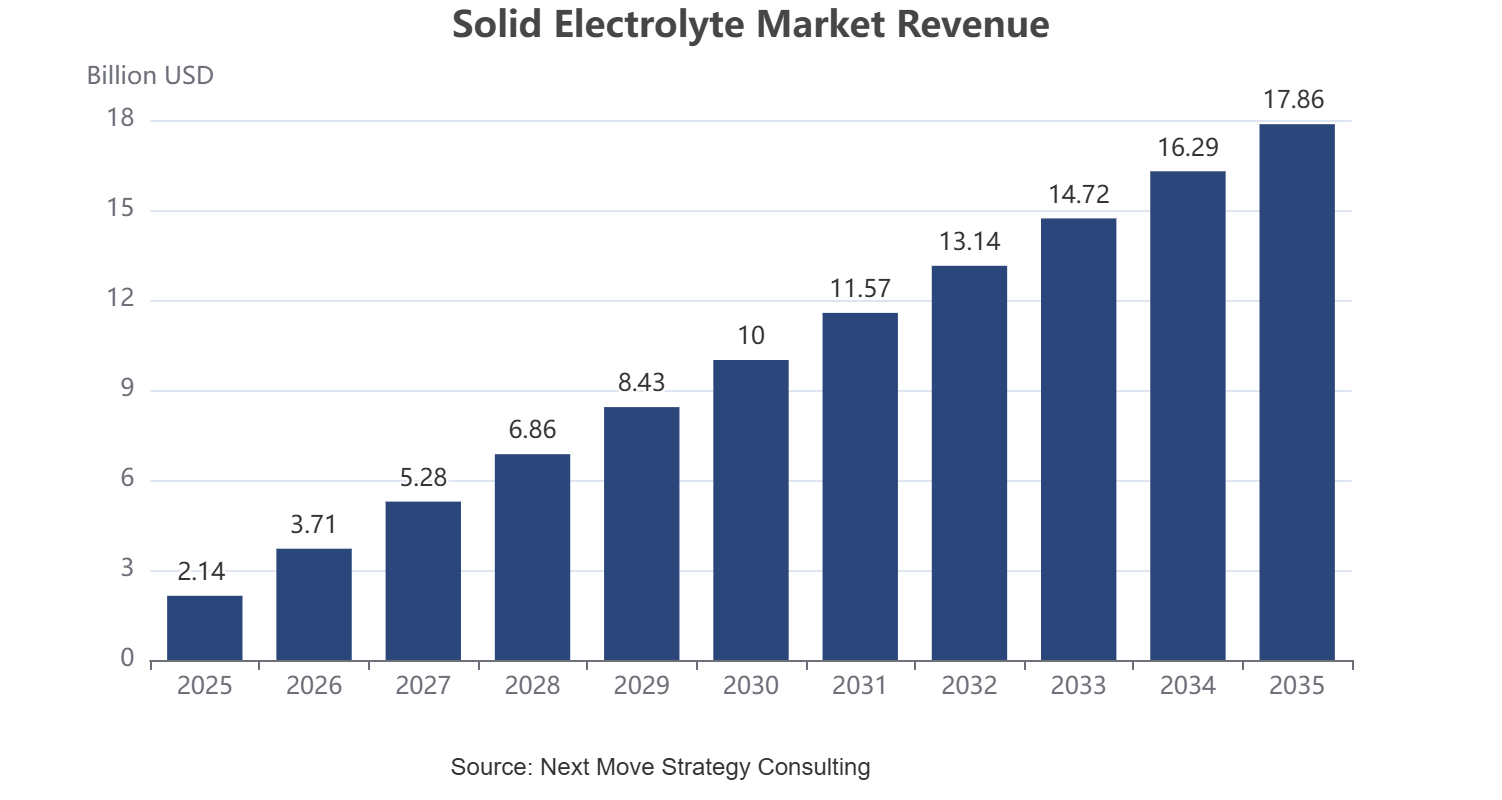
The global solid electrolyte market size was valued at USD 2.14 billion in 2025 and is estimated at USD 2.68 billion in 2026, forecast to reach USD 17.86 billion by 2035, expanding at a 23.5% CAGR between 2026 and 2035. Asia-Pacific leads with approximately 42% share, while sulfide chemistry dominates with approximately 30% share.
We observed that growth is concentrated around next-generation electric vehicle battery programs, with sulfide and oxide chemistries driving the dominant structural shifts through 2035.
|
Key Takeaways |
|
By Chemistry: Sulfide held the largest share of approximately 30% (USD 0.64 Billion) in 2025; Composite is the fastest-growing sub-segment at 27.8% CAGR from 2026–2035. |
|
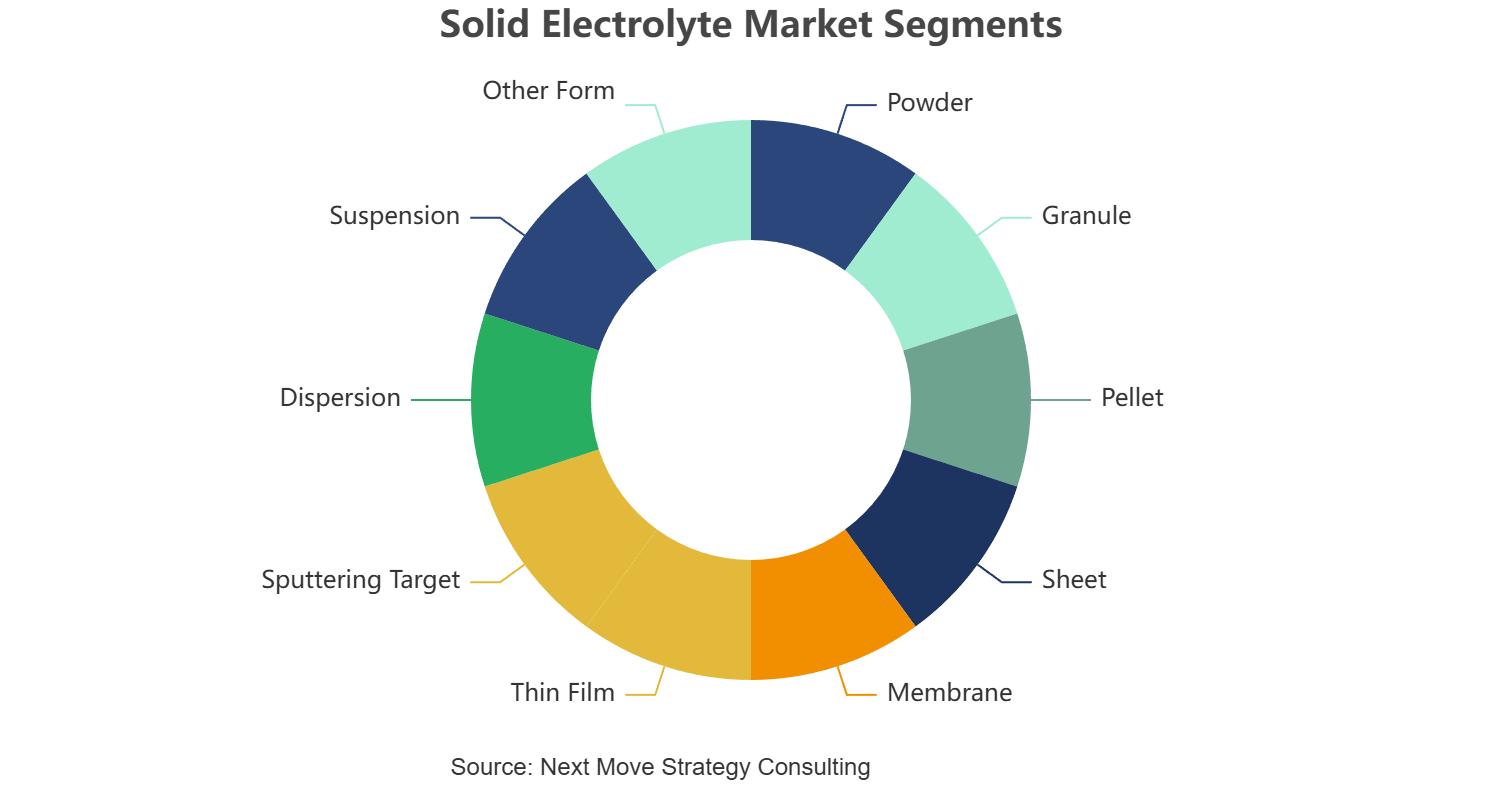
By Product Form: Powder held the largest share of approximately 20% (USD 0.43 Billion) in 2025; Thin Film is the fastest-growing sub-segment at 27.7% CAGR from 2026–2035. |
|
By Buyer Type: Cell Manufacturer held the largest share of approximately 41% (USD 0.88 Billion) in 2025; Battery Developer is the fastest-growing sub-segment at 25.9% CAGR from 2026–2035. |
|
By Sales Channel: Direct Sales held the largest share of approximately 46% (USD 0.98 Billion) in 2025; Licensed Manufacturing is the fastest-growing sub-segment at 26.4% CAGR from 2026–2035. |
|
By Application: EVs held the largest share of approximately 38% (USD 0.81 Billion) in 2025; EVs is also the fastest-growing sub-segment at 26.2% CAGR from 2026–2035. |
|
Dominant Region: Asia-Pacific dominated with approximately 42% revenue share (USD 0.90 Billion) in 2025. |
|
Fastest-Growing Region: Asia-Pacific is expected to register the highest CAGR of 25.0% during 2026–2035. |
|
Dominant Country: China led with approximately USD 0.46 Billion in 2025. |
|
Fastest-Growing Country: China is the fastest-growing country at approximately 27.1% CAGR from 2026–2035. |
Market Opportunity: The solid electrolyte market is expected to create an absolute dollar opportunity of USD 15.18 billion between 2026 and 2035, presenting significant investment potential across the next-generation electric vehicle and advanced energy storage battery value chain.
According to Next Move Strategy Consulting analysis, cell manufacturers are increasingly securing long-term supply agreements with sulfide and oxide electrolyte producers to de-risk pilot-line scale-up, a shift that favors vertically integrated materials suppliers over single-chemistry specialists as commercialization timelines compress through 2035.
What Does the Solid Electrolyte Market Encompass?
The solid electrolyte market encompasses ion-conducting materials that replace liquid electrolytes in next-generation batteries, spanning oxide, sulfide, halide, polymer, and composite chemistries. Our assessment indicates that the scope covers powder, sheet, membrane, and thin film product forms supplied to cell manufacturers, battery material manufacturers, and research institutes. The category has evolved from laboratory-scale ionic conductivity research into pilot and early commercial manufacturing, driven by electric vehicle range and safety requirements.
Regulatory frameworks such as the U.S. Department of Energy's battery materials research programs and the European Union's Battery Regulation increasingly shape sourcing and recyclability requirements, while national critical minerals strategies influence supply chain localization. We observed that technology adoption is shifting toward sulfide electrolytes for their high ionic conductivity, alongside growing pilot investment in composite formats that balance conductivity with manufacturability. Next Move Strategy Consulting's analysis indicates that this structural shift is redefining sourcing criteria across the global battery energy storage systems (ESS) market as electrode-electrolyte interface engineering becomes a central commercialization bottleneck.
|
Parameters |
Details |
|
Market Size in 2025 |
USD 2.14 Billion |
|
Market Size in 2026 |
USD 2.68 Billion |
|
Revenue Forecast in 2035 |
USD 17.86 Billion |
|
Growth Rate |
CAGR of 23.5% from 2026 to 2035 |
|
Analysis Period |
2025–2035 |
|
Base Year Considered |
2025 |
|
Forecast Period |
2026–2035 |
|
Market Size Estimation |
Revenue (USD Billion) |
|
Companies Profiled |
20 |
|
Countries Covered |
33 |
|
Market Share |
Available for Top 10 Companies |
Key Emerging Trends
We found that four structural trends are reshaping material design, manufacturing scale-up, and commercialization strategy across the solid electrolyte industry.
How Is Sulfide Chemistry Transforming Ionic Conductivity Benchmarks?
Manufacturers are advancing argyrodite and LPS glass ceramic sulfide formulations that achieve ionic conductivity approaching liquid electrolytes, transforming cell design assumptions for fast-charging applications. This transformation affects material developers, cell manufacturers, and equipment suppliers adapting dry-room processing lines. Solid Power, Inc.'s sulfide electrolyte pilot line illustrates how sulfide chemistry is being commercialized at scale, enabling higher energy density cell architectures for electric vehicle programs.
How Is Dry-Room Manufacturing Infrastructure Influencing Scale-Up?
Moisture-sensitive sulfide and halide electrolytes require dedicated dry-room manufacturing infrastructure, influencing capital investment decisions across cell and material producers. This adoption trend impacts battery material manufacturers, equipment vendors, and government laboratories supporting pilot facility development. Idemitsu Kosan Co., Ltd.'s expanded sulfide electrolyte production capacity demonstrates how infrastructure investment is becoming a prerequisite for commercial-scale solid electrolyte supply.
What Role Does Oxide Electrolyte Play in High-Temperature and Safety-Critical Applications?
Rising demand for thermally stable, non-flammable battery chemistries is expanding garnet and NASICON oxide electrolyte adoption across aerospace, defense, and medical device applications. This shift affects defense organizations, medical device manufacturers, and research institutes prioritizing safety over volumetric energy density. Ohara Inc.'s garnet-type oxide electrolyte portfolio reflects how oxide chemistry is securing niche high-reliability applications ahead of broader EV commercialization.
How Is Polymer-Ceramic Composite Design Bridging Manufacturability and Performance?
Composite electrolytes combining polymer flexibility with ceramic ionic conductivity are emerging as a manufacturability bridge for roll-to-roll cell production. This trend involves polymer material suppliers, cell manufacturers, and battery developers seeking near-term commercialization pathways. Mitsubishi Chemical Group Corporation's polymer-ceramic composite research illustrates how hybrid material design is reducing interfacial resistance while preserving compatibility with existing lithium-ion manufacturing equipment.
Supply Chain Structure of the Solid Electrolyte Market
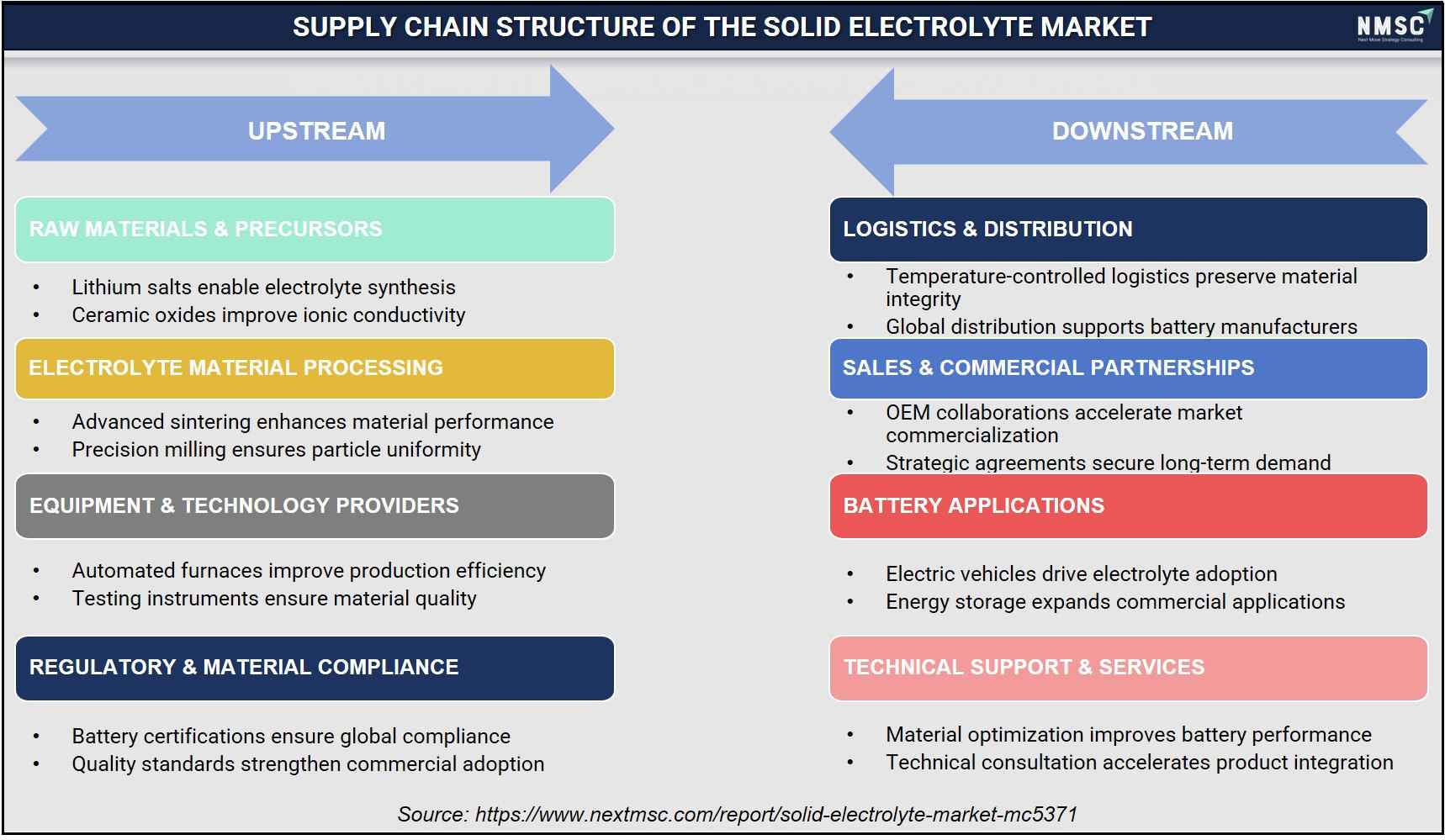
In our observation, the Solid Electrolyte Market is supported by a robust supply chain spanning advanced raw materials, precision material processing, and specialized production technologies. Furthermore, strategic OEM partnerships, temperature-controlled logistics, and global distribution networks accelerate commercialization and ensure reliable supply. Consequently, growing battery applications in electric vehicles and energy storage, together with technical support and regulatory compliance, strengthen product performance and enable long-term market expansion.
Growth Drivers & Restraints
|
Factors |
Type |
(+/−) % Impact on CAGR |
Geographic Relevance |
Impact Timeline |
|
Electric vehicle range and safety requirements |
Driver |
+5.8% |
Global |
2026–2035 |
|
Government-funded battery materials R&D programs |
Driver |
+3.4% |
North America, Asia-Pacific |
2026–2032 |
|
Consumer electronics demand for higher energy density |
Driver |
+2.1% |
Asia-Pacific |
2026–2033 |
|
Critical minerals supply chain localization policies |
Driver |
+1.6% |
North America, Europe |
2026–2035 |
|
Aerospace and defense investment in safety-critical batteries |
Driver |
+1.2% |
North America, Europe |
2026–2034 |
|
High manufacturing cost of dry-room production infrastructure |
Restraint |
-2.4% |
Global |
2026–2035 |
|
Interfacial resistance and cycle-life engineering challenges |
Restraint |
-1.8% |
Global |
2026–2032 |
|
Limited large-scale commercial production capacity |
Restraint |
-1.3% |
Asia-Pacific, Europe |
2026–2031 |
|
Raw material supply constraints for lithium and sulfide precursors |
Restraint |
-0.9% |
Global |
2026–2033 |
What Is the Primary Growth Driver of the Solid Electrolyte Market?
The primary growth driver is intensifying electric vehicle range and safety requirements, which are pushing cell manufacturers toward solid-state architectures that eliminate flammable liquid electrolytes. The U.S. Department of Energy's Vehicle Technologies Office continues funding solid-state battery research targeting improved energy density and reduced thermal runaway risk. This regulatory and R&D momentum is compounding with automaker commercialization roadmaps to sustain rapid growth in solid electrolyte procurement volumes through 2035.
How Is Government-Funded Battery Materials Research Driving Market Growth?
Government-funded battery materials research is driving market growth as national laboratories and universities accelerate ionic conductivity and interface engineering breakthroughs. The U.S. Department of Energy's Advanced Research Projects Agency-Energy has supported multiple solid-state battery material programs targeting commercial viability. This public investment is prompting private manufacturers to scale pilot production lines, reducing time-to-market for sulfide and oxide electrolyte formulations across automotive and industrial applications.
What Is Restraining the Solid Electrolyte Market?
High manufacturing cost associated with moisture-controlled dry-room production infrastructure is restraining broader market penetration, particularly for sulfide and halide chemistries. Industry-derived estimates indicate that dry-room facility construction and operation can represent a substantial share of total production cost relative to conventional liquid electrolyte manufacturing. This cost burden is slowing adoption among smaller battery developers lacking capital access to build dedicated moisture-controlled manufacturing capacity.
Segmentation Analysis
Segment Sizing: By Chemistry
|
Segment |
2025 (USD) |
2035 (USD) |
CAGR% (2026–2035) |
|
Oxide |
0.71 Billion |
5.18 Billion |
21.6% |
|
Sulfide |
0.64 Billion |
6.07 Billion |
25.2% |
|
Halide |
0.21 Billion |
2.32 Billion |
27.4% |
|
Polymer |
0.47 Billion |
3.04 Billion |
20.0% |
|
Composite |
0.11 Billion |
1.25 Billion |
27.8% |
|
Total |
2.14 Billion |
17.86 Billion |
23.5% |
Which Chemistry Segment Dominates the Market?
Sulfide chemistry dominates the chemistry segment, supported by its superior ionic conductivity and growing pilot-line commitments from leading cell manufacturers. Our findings suggest that composite electrolytes, though smaller in absolute size, are the fastest-growing category as developers pursue polymer-ceramic hybrid designs that ease manufacturability constraints, reflecting rising near-term commercialization investment ahead of broader sulfide production scale-up through 2035.
Segment Sizing: By Product Form
|
Segment |
2025 (USD) |
2035 (USD) |
CAGR% (2026–2035) |
|
Powder |
0.43 Billion |
2.86 Billion |
20.4% |
|
Granule |
0.21 Billion |
1.43 Billion |
20.7% |
|
Pellet |
0.26 Billion |
1.79 Billion |
20.8% |
|
Sheet |
0.19 Billion |
1.43 Billion |
22.1% |
|
Membrane |
0.17 Billion |
1.25 Billion |
21.7% |
|
Thin Film |
0.30 Billion |
3.39 Billion |
27.7% |
|
Sputtering Target |
0.15 Billion |
1.61 Billion |
27.0% |
|
Dispersion |
0.17 Billion |
1.61 Billion |
25.2% |
|
Suspension |
0.15 Billion |
1.43 Billion |
25.3% |
|
Other Form |
0.11 Billion |
1.06 Billion |
25.4% |
|
Total |
2.14 Billion |
17.86 Billion |
23.5% |
Which Product Form Segment Is Growing the Fastest?
Powder form leads the product form segment, given its widespread use as the primary feedstock for solid electrolyte processing and compatibility with multiple battery manufacturing routes. Based on research conducted by Next Move Strategy Consulting, we found that Thin Film formats are the fastest-growing product form as developers target precision-coated architectures for consumer electronics and medical device applications, with sputtering targets following closely as physical vapor deposition adoption expands across specialty manufacturing lines.
Segment Sizing: By Application
|
Segment |
2025 (USD) |
2035 (USD) |
CAGR% (2026–2035) |
|
EVs |
0.81 Billion |
8.22 Billion |
26.2% |
|
Consumer Electronics |
0.47 Billion |
2.86 Billion |
19.2% |
|
Energy Storage System |
0.34 Billion |
3.04 Billion |
24.4% |
|
Industrial Battery |
0.19 Billion |
1.25 Billion |
20.2% |
|
Medical Device |
0.11 Billion |
0.71 Billion |
20.0% |
|
Aerospace and Defense |
0.13 Billion |
0.89 Billion |
20.8% |
|
Research and Prototyping |
0.09 Billion |
0.89 Billion |
25.8% |
|
Total |
2.14 Billion |
17.86 Billion |
23.5% |
Why Does the EV Application Segment Show the Strongest Growth?
EV applications dominate segment revenue and also register the fastest growth given automaker commitments to solid-state battery commercialization for range and safety improvements. During our market evaluation, we noticed that energy storage system applications are growing second-fastest as utility-scale operators evaluate solid electrolyte chemistries for improved thermal stability, reducing fire risk in dense grid-connected battery installations while supporting broader electrification of stationary storage infrastructure.
Growth Opportunities
We observed three forward-looking whitespace opportunities positioned to shape competitive differentiation through 2035.
Can Halide Electrolytes Unlock High-Voltage Cathode Compatibility?
Halide electrolytes present a mechanism to unlock compatibility with high-voltage nickel-rich cathodes, addressing a key limitation of sulfide chemistries. Material developers commercializing chloride and bromide formulations stand to capture premium EV cell manufacturer partnerships seeking improved oxidative stability and energy density.
Will Licensed Manufacturing Accelerate Regional Production Capacity?
Licensed manufacturing agreements present a scalable mechanism for material innovators to accelerate regional production capacity without direct capital investment in dry-room infrastructure. Battery material manufacturers and regional cell producers across Europe and North America stand to benefit from faster localization of sulfide and oxide electrolyte supply chains.
Can Thin Film Deposition Expand Medical Device and Wearable Applications?
Thin film and sputtering target deposition techniques offer a mechanism to expand solid electrolyte adoption into implantable medical devices and wearable electronics requiring miniaturized, leak-proof power sources. Electronics manufacturers and medical device developers stand to capture differentiated product positioning as micro-battery integration advances over the forecast period.
Regional Outlook
|
Region |
2025 (USD) |
2035 (USD) |
CAGR% (2026–2035) |
Key Driver |
|
North America |
0.51 Billion |
3.93 Billion |
22.4% |
Federal battery materials R&D investment |
|
Europe |
0.43 Billion |
3.21 Billion |
21.9% |
EU Battery Regulation and localization policy |
|
Asia-Pacific |
0.90 Billion |
8.39 Billion |
25.0% |
Concentrated EV and cell manufacturing base |
|
Middle East & Africa |
0.17 Billion |
1.25 Billion |
21.7% |
Emerging critical minerals investment |
|
Latin America |
0.13 Billion |
1.08 Billion |
23.4% |
Lithium resource development |
|
Total |
2.14 Billion |
17.86 Billion |
23.5% |
|
North America Solid Electrolyte Market
North America benefits from sustained U.S. Department of Energy funding for solid-state battery materials research and growing domestic cell manufacturing investment. Regulatory support for critical minerals localization is reinforcing regional supply chain development, while established research institutes maintain strong pilot-line partnerships with material developers. Technology adoption favors sulfide and oxide chemistries, positioning the region as a key innovation hub through 2035.
Europe Solid Electrolyte Market
Europe's market is shaped by the EU Battery Regulation's recyclability and traceability requirements, which are influencing material selection criteria among automotive cell manufacturers. Strong government support for domestic battery gigafactory development sustains solid electrolyte demand, while research institutes across Germany and France maintain active oxide and polymer electrolyte development programs aligned with regional decarbonization targets.
Asia-Pacific Solid Electrolyte Market
Asia-Pacific leads the market given its concentrated base of established lithium-ion cell manufacturers transitioning toward solid-state architectures. China, Japan, and South Korea maintain the world's most advanced sulfide and oxide electrolyte pilot production capacity. Technology adoption favors sulfide chemistries suited to high-volume EV cell integration, reinforcing the region's position as both the largest production and consumption hub through 2035.
Middle East & Africa Solid Electrolyte Market
The Middle East & Africa region remains an emerging market, supported by growing sovereign investment in critical minerals processing and early-stage battery manufacturing partnerships. Regulatory frameworks remain limited compared to established battery-producing regions, creating opportunity for foundational infrastructure investment. Technology adoption is nascent, with strategic outlook centered on securing upstream lithium and precursor material supply chains.
Latin America Solid Electrolyte Market
Latin America's market is anchored by significant lithium resource development in Argentina and Chile, positioning the region as a strategic upstream supplier to global electrolyte manufacturers. Regulatory bodies are gradually formalizing critical minerals export and processing frameworks. Technology adoption remains early-stage, with strategic outlook centered on forward integration into precursor and electrolyte material processing rather than downstream cell manufacturing.
The U.S. Solid Electrolyte Market
Based on our estimates, the U.S. solid electrolyte market was valued at approximately USD 0.38 billion in 2025 and is projected to reach USD 2.94 billion by 2035, growing at a 22.7% CAGR. Demand structure is anchored by federal battery materials research funding and growing domestic gigafactory investment. Regulatory support under the Department of Energy's Vehicle Technologies Office shapes research priorities, while technology penetration favors sulfide and oxide chemistries amid rising competitive intensity among material developers and cell manufacturers.
Canada Solid Electrolyte Market
The market in Canada's solid electrolyte sector was valued at approximately USD 0.13 billion in 2025 and is expected to reach USD 0.99 billion by 2035, expanding at a 22.5% CAGR. Demand is driven by domestic critical minerals processing investment supporting North American battery supply chains. Natural Resources Canada's critical minerals strategy shapes market entry, with technology adoption gradually favoring oxide and polymer formulations and steady competitive participation from research-affiliated material developers.
UK Solid Electrolyte Market
As per our estimate, the UK solid electrolyte market was valued at approximately USD 0.10 billion in 2025 and is forecast to reach USD 0.78 billion by 2035, at a 22.9% CAGR. Demand structure reflects growing domestic gigafactory ambitions and government-backed battery research consortia. Technology adoption favors oxide and polymer chemistries suited to safety-critical applications, and competitive intensity is shaped by emerging partnerships between material developers and automotive cell manufacturers nationwide.
Germany Solid Electrolyte Market
According to our analysis, Germany's solid electrolyte market was valued at approximately USD 0.14 billion in 2025 and is projected to reach USD 1.08 billion by 2035, growing at a 22.9% CAGR. Demand is anchored by the country's large automotive cell manufacturing base and strong government support for battery innovation. Technology adoption favors sulfide and oxide formats suited to premium EV programs, with strategic outlook centered on export-oriented battery supply chain leadership across the European single market.
France Solid Electrolyte Market
Based on our estimates, France's solid electrolyte market was valued at approximately USD 0.09 billion in 2025 and is expected to reach USD 0.71 billion by 2035, at a 22.9% CAGR. Demand structure reflects expanding domestic gigafactory capacity and national battery innovation funding programs. Regulatory alignment with EU Battery Regulation standards shapes material selection, while technology penetration is gradually shifting toward polymer and composite electrolytes amid steady competitive intensity from domestic material developers.
China Solid Electrolyte Market
The market in China's solid electrolyte market was valued at approximately USD 0.46 billion in 2025 and is forecast to reach USD 4.79 billion by 2035, expanding at a 27.1% CAGR, the fastest among covered countries. Demand is driven by the world's largest EV and lithium-ion cell manufacturing base rapidly transitioning toward solid-state architectures. Domestic regulatory bodies are prioritizing critical minerals self-sufficiency, with technology adoption favoring sulfide chemistries and rising competitive intensity among domestic producers such as Ganfeng Lithium Group and QingTao Energy Development.
India Solid Electrolyte Market
As per our estimate, India's solid electrolyte market was valued at approximately USD 0.08 billion in 2025 and is projected to reach USD 0.53 billion by 2035, growing at a 20.7% CAGR. Demand structure reflects emerging domestic EV manufacturing ambitions supported by national battery production incentive programs. Technology penetration remains at an early stage favoring imported oxide and polymer formulations, with competitive intensity gradually rising as domestic research institutes expand material development capabilities.
Japan Solid Electrolyte Market
According to our analysis, Japan's solid electrolyte market was valued at approximately USD 0.18 billion in 2025 and is expected to reach USD 1.34 billion by 2035, at a 22.5% CAGR. Demand is shaped by the country's pioneering role in sulfide and oxide electrolyte research alongside major automaker solid-state battery commercialization roadmaps. Regulatory oversight through the Ministry of Economy, Trade and Industry supports research funding, with technology adoption favoring sulfide chemistries and strong competitive presence from Idemitsu Kosan and Ohara Inc.
South Korea Solid Electrolyte Market
Based on our estimates, South Korea's solid electrolyte market was valued at approximately USD 0.13 billion in 2025 and is projected to reach USD 1.06 billion by 2035, growing at a 23.4% CAGR. Demand structure reflects intensive investment from major domestic battery manufacturers pursuing solid-state cell commercialization. Regulatory bodies maintain strong government-industry collaboration on battery innovation, with technology penetration favoring sulfide and composite formats and rising competitive intensity among domestic and international suppliers.
Australia Solid Electrolyte Market
The market in Australia's solid electrolyte market was valued at approximately USD 0.06 billion in 2025 and is forecast to reach USD 0.36 billion by 2035, at a 19.8% CAGR. Demand is anchored by the country's position as a major lithium resource supplier seeking downstream value-chain integration. Technology adoption favors early-stage polymer and oxide research collaborations, and competitive intensity remains moderate with strong reliance on partnerships with established international material developers.
UAE Solid Electrolyte Market
As per our estimate, the UAE solid electrolyte market was valued at approximately USD 0.03 billion in 2025 and is expected to reach USD 0.22 billion by 2035, growing at a 22.6% CAGR. Demand structure reflects growing sovereign investment in battery materials diversification beyond traditional energy exports. Regulatory oversight through national industrial strategy programs shapes early market development, with technology penetration limited but growing amid nascent competitive activity.
Saudi Arabia Solid Electrolyte Market
According to our analysis, Saudi Arabia's solid electrolyte market was valued at approximately USD 0.05 billion in 2025 and is projected to reach USD 0.35 billion by 2035, at a 21.9% CAGR. Demand is driven by national industrial diversification initiatives targeting battery materials manufacturing under Vision 2030. Regulatory bodies are formalizing critical minerals processing frameworks, with technology adoption favoring early-stage partnerships with established Asian and North American material developers.
South Africa Solid Electrolyte Market
Based on our estimates, South Africa's solid electrolyte market was valued at approximately USD 0.03 billion in 2025 and is forecast to reach USD 0.21 billion by 2035, growing at a 21.4% CAGR. Demand structure reflects the country's position as a regional critical minerals processing hub with growing battery materials interest. Regulatory oversight through national minerals beneficiation policy shapes market development, with technology penetration remaining nascent and competitive intensity limited to early-stage partnerships.
Brazil Solid Electrolyte Market
The market in Brazil's solid electrolyte market was valued at approximately USD 0.07 billion in 2025 and is projected to reach USD 0.58 billion by 2035, at a 23.6% CAGR. Demand is anchored by the country's growing lithium resource development and interest in downstream battery materials integration. Regulatory bodies are expanding critical minerals investment incentives, with technology adoption favoring partnerships with international material developers and rising competitive interest from regional producers.
Argentina Solid Electrolyte Market
As per our estimate, Argentina's solid electrolyte market was valued at approximately USD 0.04 billion in 2025 and is expected to reach USD 0.32 billion by 2035, growing at a 23.6% CAGR. Demand structure reflects the country's position within the Lithium Triangle, supporting upstream integration ambitions into electrolyte precursor materials. Regulatory oversight through national mining and critical minerals policy shapes investment flows, with technology penetration remaining early-stage amid growing competitive interest from global material developers.
PESTEL Analysis of the Solid Electrolyte Market
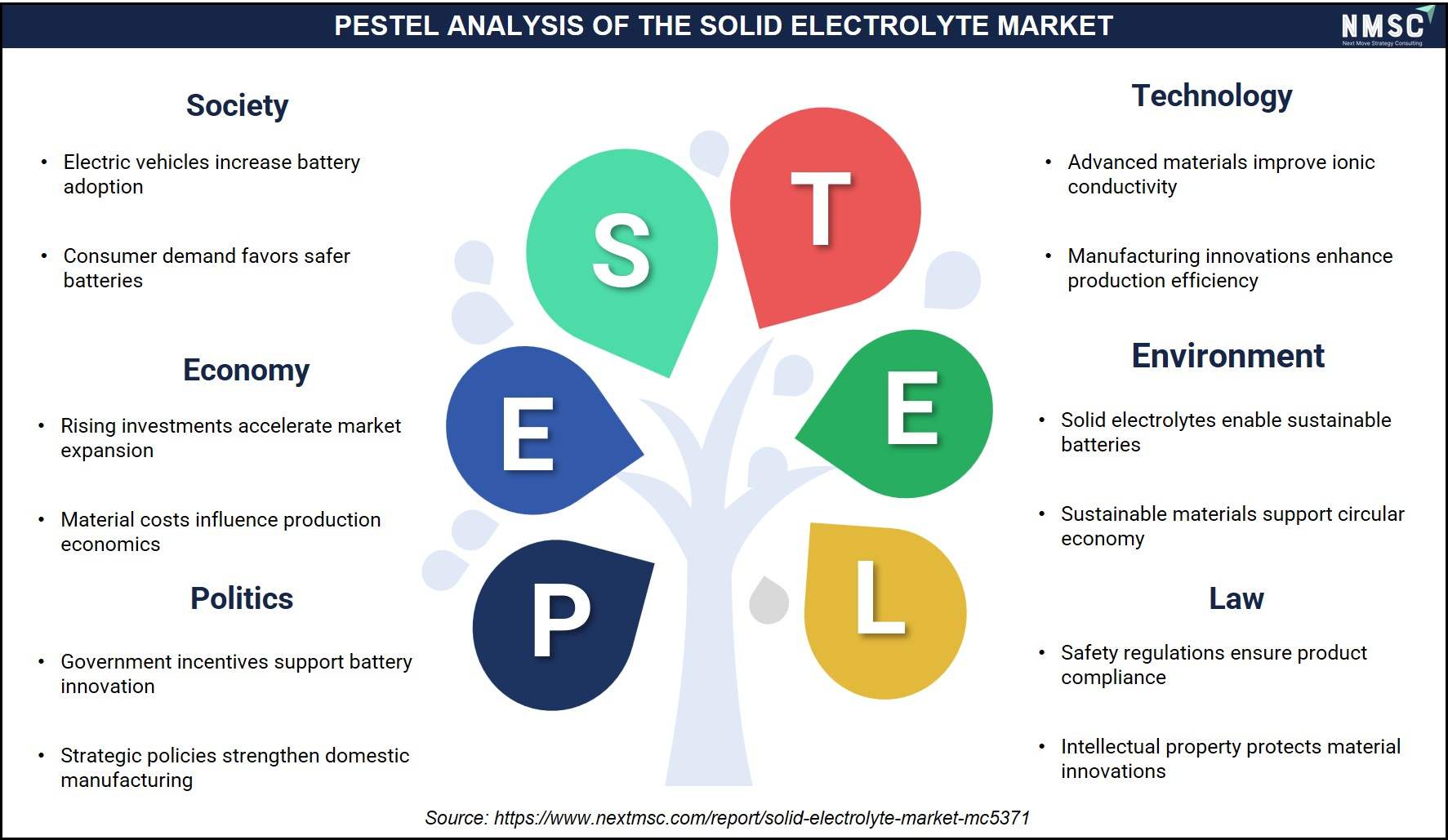
NMSC's findings suggest that the Solid Electrolyte Market is shaped by interconnected political, economic, social, technological, environmental, and legal factors that influence commercialization and innovation. Moreover, advances in electrolyte technology, supportive sustainability initiatives, and evolving regulatory frameworks encourage wider adoption across battery applications. Meanwhile, economic investments and environmental priorities reinforce research activities, enabling manufacturers to improve product reliability while supporting the global transition toward next-generation energy storage solutions.
Competitive Landscape
We observed that the competitive landscape spans established materials conglomerates with diversified chemical portfolios alongside specialized solid-state battery startups focused on single-chemistry commercialization.
|
Key Takeaways |
|
Market Structure Fragmented and pre-consolidation, with pilot-stage manufacturers competing alongside diversified materials conglomerates |
|
Innovation Focus Sulfide and oxide ionic conductivity improvement, dry-room manufacturing scale-up, and composite hybrid formulations |
|
M&A Activity Strategic partnership and licensing-driven expansion targeting cell manufacturer supply agreements and regional capacity |
How Do Companies Compete in the Solid Electrolyte Market?
Companies compete primarily through ionic conductivity performance, manufacturing scalability, and depth of strategic partnerships with cell manufacturers pursuing solid-state commercialization. Manufacturers with established dry-room production capacity secure preferential access to long-term supply agreements, while smaller research-stage players compete on differentiated chemistry performance and licensing arrangements with larger battery developers across regional markets.
Which Competitive Archetypes Dominate the Industry?
Two archetypes dominate the industry in the Solid Electrolyte Market: diversified Japanese and Korean materials conglomerates leveraging decades of ceramics and chemical manufacturing expertise, and specialized solid-state battery startups pursuing single-chemistry commercialization through strategic cell manufacturer partnerships. This dual structure allows established conglomerates to capture scale-driven cost advantages while startups maintain differentiated technology positioning in emerging sulfide and halide chemistries.
What Innovation and Differentiation Strategies Are Companies Pursuing?
Companies are differentiating through proprietary sulfide and oxide ionic conductivity formulations, dry-room manufacturing scale-up investment, and composite hybrid material design reducing interfacial resistance. Ampcera Inc. and Solid Ionics Co., Ltd. have expanded sulfide electrolyte production capabilities, while Mitsui Mining and Smelting Co., Ltd. continues investing in argyrodite formulations to reduce production cost per kilogram across commercial-scale manufacturing lines.
How Active Is M&A in the Solid Electrolyte Market?
Strategic partnership and licensing activity remains more prevalent than outright acquisitions, as cell manufacturers secure long-term supply agreements with material developers to de-risk pilot-line scale-up. Ganfeng Lithium Group Co., Ltd. and POSCO JK Solid Solution Co., Ltd. have pursued joint development partnerships strengthening regional manufacturing footprints, while smaller players pursue licensed manufacturing arrangements to accelerate market entry across Asia-Pacific and North American growth corridors.
Key Market Players
We found that the following companies represent the validated set of leading participants shaping material innovation, manufacturing scale, and strategic partnerships across the solid electrolyte industry.
-
Mitsui Mining and Smelting Co., Ltd.
-
Idemitsu Kosan Co., Ltd.
-
DOWA Electronics Materials Co., Ltd.
-
Solid Power, Inc.
-
Ohara Inc.
-
Ampcera Inc.
-
AGC Inc.
-
Shenzhen Capchem Technology Co., Ltd.
-
Guangzhou Tinci Materials Technology Co., Ltd.
-
Ganfeng Lithium Group Co., Ltd.
-
POSCO JK Solid Solution Co., Ltd.
-
Solid Ionics Co., Ltd.
-
Nuvvon, Inc.
-
NEI Corporation
-
CHEMFISH TOKYO Co., Ltd.
-
Mitsubishi Chemical Group Corporation
-
QingTao Energy Development Co., Ltd.
-
Tailan New Energy Co., Ltd.
-
Samyang Corporation
-
Tosoh Corporation
Latest Developments
Next Move Strategy Consulting's analysis indicates that recent capacity expansions and partnership announcements reflect sustained commercialization investment across the industry.
|
Date |
Event |
|
May 2026 |
Mitsui Mining & Smelting (Mitsui Kinzoku) announced a major commercial supply agreement for its proprietary A-SOLiD™ solid electrolyte, designated for use in a major customer's all-solid-state battery program targeting commercial application between 2027 and 2028 |
|
May 2026 |
Solid Power outlined its comprehensive manufacturing strategy to scale its sulfide-based solid electrolyte production capacity to 75 metric tons per year by the end of 2026 across dual pilot lines and an incoming continuous manufacturing facility, supplying tier-one battery makers and automotive OEMs |
|
May 2026 |
Ganfeng Lithium announced through corporate filing disclosures that its subsidiary Ganfeng LiEnergy has initiated small-scale production of advanced solid-state battery cells achieving an energy density of 500 Wh/kg, engineered specifically for high-end electric vehicles and next-generation low-altitude aerospace applications |
Expert Insights

"Our solid electrolyte technology is designed for stability and conductivity, and by working closely with global leaders in automotive and battery innovation, we strive to bring ASSB technology closer to widespread adoption."
— John Van Scoter, President & Chief Executive Officer, Solid Power
Statement made while announcing Solid Power's collaboration with Samsung SDI and BMW to advance all-solid-state battery (ASSB) technology, emphasizing the importance of high-performance solid electrolyte materials and strategic industry partnerships in accelerating commercialization.
Market Interpretation
The statement highlights the pivotal role of advanced solid electrolyte materials in enabling the commercialization of all-solid-state batteries. As automotive manufacturers and battery developers prioritize safer, higher-energy-density energy storage solutions, demand for solid electrolytes with superior ionic conductivity and electrochemical stability is accelerating. Furthermore, strategic collaborations between material innovators, battery manufacturers, and automotive OEMs are fostering technology validation, production scalability, and faster commercialization, thereby supporting sustained growth in the global Solid Electrolyte Market.
Investment Opportunities
Where Are Capital Inflows Concentrating Within the Industry?
Capital inflows are concentrating in sulfide electrolyte pilot-to-commercial scale-up and dry-room manufacturing infrastructure as investors target the highest-conductivity chemistry segment. Strategic and venture funding rounds increasingly favor companies with signed cell manufacturer supply agreements, reflecting investor confidence in near-term commercialization pathways over purely research-stage material development.
How Is Infrastructure Investment Shaping Manufacturing Capacity?
Infrastructure investment is expanding dry-room manufacturing capacity across Japan, South Korea, and China as companies scale from pilot to commercial production volumes. QingTao Energy Development Co., Ltd. and Tailan New Energy Co., Ltd. have expanded domestic facilities, reflecting a broader trend of regional manufacturing capacity investment supporting national battery supply chain self-sufficiency mandates.
What ESG Considerations Are Influencing Investment Decisions?
Environmental, social, and governance considerations are influencing investment decisions as solid electrolyte adoption reduces flammability risk and supports higher energy density, reducing per-kilowatt-hour material intensity relative to conventional liquid electrolyte cells. Investors increasingly evaluate critical minerals sourcing transparency and dry-room energy efficiency alongside financial performance, favoring companies demonstrating measurable supply chain traceability across their manufacturing operations.
Key Benefits for Stakeholders
How Does This Report Benefit Industry Leaders?
Industry leaders gain access to validated segmentation, competitive benchmarking, and regional demand forecasts that support portfolio prioritization and manufacturing capacity planning. Our analysis shows that this data enables leadership teams to align R&D investment with the fastest-growing chemistry and application segments while identifying underpenetrated geographic markets for expansion through 2035.
How Does This Report Benefit Investors and Financial Analysts?
Investors and financial analysts benefit from reconciled market sizing, CAGR projections, and company-level competitive positioning that support valuation and due-diligence workflows. The report's regional and segment-level forecasts provide a defensible basis for evaluating partnership and investment targets across the oxide, sulfide, halide, polymer, and composite chemistry categories through the 2026–2035 forecast window.
How Does This Report Benefit Technology and Product Teams?
Technology and product teams benefit from detailed chemistry and product form segment sizing that clarifies where sulfide and thin film formats are gaining share relative to established oxide and powder formulations. This insight supports pipeline prioritization decisions and helps product teams align development timelines with regional manufacturing and cell manufacturer partnership readiness across covered markets.
Key Market Segments
By Chemistry
-
Oxide
-
Garnet
-
NASICON
-
LISICON
-
Perovskite
-
Other Oxide
-
-
Sulfide
-
Argyrodite
-
LPS Glass Ceramic
-
Thio LISICON
-
Other Sulfide
-
-
Halide
-
Chloride
-
Bromide
-
Iodide
-
Other Halide
-
-
Polymer
-
Polyethylene Oxide Based
-
Polyvinylidene Fluoride Based
-
Polycarbonate Based
-
Polyacrylonitrile Based
-
Other Polymer
-
-
Composite
-
Polymer Ceramic
-
Glass Ceramic
-
Other Composite
-
By Product Form
-
Powder
-
Granule
-
Pellet
-
Sheet
-
Membrane
-
Thin Film
-
Sputtering Target
-
Dispersion
-
Suspension
-
Other Form
By Buyer Type
-
Cell Manufacturer
-
Battery Material Manufacturer
-
Battery Developer
-
Research Institute
-
Government Laboratory
-
Electronics Manufacturer
-
Defense Organization
By Sales Channel
-
Direct Sales
-
Distributor Sales
-
Strategic Partnership
-
Licensed Manufacturing
By Application
-
EVs
-
Passenger Vehicle
-
Commercial Vehicle
-
Two-Wheeler
-
Off-Highway Vehicle
-
Consumer Electronics
-
Smartphone
-
Tablet
-
Laptop
-
Wearable
-
Other Consumer Electronics
-
Energy Storage System
-
Residential
-
Commercial
-
Utility Scale
-
Industrial Battery
-
Medical Device
-
Implantable
-
Portable
-
Aerospace and Defense
-
Research and Prototyping
By Region
-
North America: U.S., Canada, Mexico
-
Europe: UK, Germany, France, Italy, Spain, Sweden, Denmark, Finland, Netherlands, Rest of Europe
-
Asia-Pacific: China, India, Japan, South Korea, Taiwan, Indonesia, Vietnam, Australia, Philippines, Malaysia, Rest of APAC
-
Middle East & Africa: Saudi Arabia, UAE, Egypt, Israel, Turkey, Nigeria, South Africa, Rest of MEA
-
Latin America: Brazil, Argentina, Chile, Colombia, Rest of LATAM
Conclusion & Recommendations
What Is the Long-Term Outlook for the Solid Electrolyte Market?
The long-term outlook remains strongly positive, with the market projected to expand more than eightfold from USD 2.14 billion in 2025 to USD 17.86 billion by 2035. Sustained electric vehicle commercialization timelines, government-funded battery materials research, and rising demand for safer, higher-density energy storage underpin durable growth. Our assessment indicates that sulfide and oxide chemistries will increasingly define competitive differentiation as the forecast period progresses toward 2035.
How Should Companies Position Strategically?
Companies should position strategically by scaling dry-room manufacturing infrastructure while securing long-term supply agreements with cell manufacturers pursuing solid-state commercialization. Building diversified chemistry portfolios spanning sulfide, oxide, and composite formats will support resilient revenue streams, while investment in licensed manufacturing partnerships can accelerate regional market entry across North America and Europe through 2035.
How Attractive Is the Market for Investment?
The market presents highly attractive investment characteristics given its 23.5% forecast CAGR, diversified end-use base spanning EVs, consumer electronics, and energy storage applications, and strong government-backed research funding supporting commercialization. Investors evaluating the sector benefit from reconciled segment and regional forecasts that highlight sulfide chemistry and Asia-Pacific geographic exposure as the strongest risk-adjusted growth opportunities.
What Market Shifts and Key Risks Should Stakeholders Monitor?
Stakeholders should monitor shifting commercialization timelines as manufacturers work through interfacial resistance and cycle-life engineering challenges that could delay large-scale production. Industry-derived estimates suggest that limited dry-room manufacturing capacity could constrain near-term supply growth in select chemistry segments, requiring sustained infrastructure investment to maintain projected growth trajectories through 2035.
What Are the Clearest Growth Pathways Through 2035?
The clearest growth pathways run through sulfide electrolyte commercial scale-up, halide chemistry development for high-voltage cathode compatibility, and licensed manufacturing partnerships accelerating regional production capacity. Companies that align manufacturing investment and cell manufacturer partnerships with these pathways are best positioned to capture the USD 15.18 billion absolute dollar opportunity emerging between 2026 and 2035.
About the Author
 Saista Faiyaz
— Saista Faiyaz is Research Associate at Next Move Strategy Consulting, where she has covered consumer markets and healthcare technologies for 3 years. Her work includes primary interview review, secondary-source validation, market sizing, and structured analysis of company and industry data. She supports research by comparing evidence across sources, organizing findings into market narratives, and documenting assumptions used in analysis. Her scope includes cross-market benchmarking, and reports.
Saista Faiyaz
— Saista Faiyaz is Research Associate at Next Move Strategy Consulting, where she has covered consumer markets and healthcare technologies for 3 years. Her work includes primary interview review, secondary-source validation, market sizing, and structured analysis of company and industry data. She supports research by comparing evidence across sources, organizing findings into market narratives, and documenting assumptions used in analysis. Her scope includes cross-market benchmarking, and reports.
About the Reviewer
 Supradip Baul
— Supradip Baul is an accomplished business consultant and strategist with over a decade of rich experience in market intelligence, strategy, technology, and business transformation. His work has included rigorous qualitative and quantitative analysis across multiple industries, helping clients shape investment decisions and long-term roadmaps. Earlier in his career, he was associated with Gartner, where he contributed to industry-leading reports and market share analyses. He has worked with leading global companies and holds an MBA with a dual specialization in Marketing and Finance.
Supradip Baul
— Supradip Baul is an accomplished business consultant and strategist with over a decade of rich experience in market intelligence, strategy, technology, and business transformation. His work has included rigorous qualitative and quantitative analysis across multiple industries, helping clients shape investment decisions and long-term roadmaps. Earlier in his career, he was associated with Gartner, where he contributed to industry-leading reports and market share analyses. He has worked with leading global companies and holds an MBA with a dual specialization in Marketing and Finance.
At Next Move Strategy Consulting, we understand that insightful market research is the cornerstone of successful business decisions. That's why we employ a robust and multifaceted approach, combining various methodologies to deliver the most accurate and actionable data for our clients.

Research Landscape
We navigate the world of research with two primary approaches:
Qualitative Approach
Our qualitative research methodologies involve immersive techniques such as in-depth interviews, focus groups, and observational studies. By engaging directly with individuals and stakeholders, we uncover valuable insights that quantitative data alone may overlook.

Quantitative Research
In tandem with qualitative methodologies, NMSC leverages the power of Quantitative Research to provide a robust foundation of numerical insights. Through systematic data collection and analysis, we quantify patterns, preferences, and market trends, offering a comprehensive view of the business landscape.
Our quantitative research approach employs diverse tools, including surveys, experiments, and statistical modelling. These methodologies enable us to gather data from a large and representative sample, ensuring the statistical significance of our findings. By employing structured questionnaires and standardized data collection methods, we guarantee the reliability and validity of the information we present to our clients.
Quantitative research is particularly effective in measuring the prevalence of trends, assessing market size, and gauging the impact of various factors on consumer behavior. The numerical precision attained through this approach equips our clients with actionable insights, facilitating data-driven decision-making and strategy formulation.


Our Specialized Toolbox for Industry-Specific Market Research
We deploy a specialized arsenal of techniques tailored to meet your unique requirements. Here's a glimpse into our comprehensive toolbox:

Information Procurement
The stage entails acquiring market data or relevant information through various sources and methodologies.


Market Research Approach
We utilize both top-down and bottom-up approaches in market research analysis to achieve a comprehensive understanding of the market dynamics, leveraging the broad perspective of industry trends and macroeconomic factors alongside detailed insights from specific segments and individual companies.

Porters Five Forces Analysis
We conduct Porter's Five Forces analysis to evaluate the competitive landscape of an industry, providing us with insights into factors that affect profitability and strategic positioning.

SWOT Analysis

Forecasting
We utilize a forecasting model to predict future consumption by considering parameters like population, economics, regulations, market competition, drivers, constraints, technology, and pricing. We also employ statistical techniques such as multilinear regression, exponential smoothing, moving average, ARIMA, and Monte Carlo simulations for accurate predictions. In econometric forecasting, we analyzed short-term and long-term event impacts, attributing values based on regulatory frameworks, economic factors, and market events.





 Speak to Our Analyst