Space Tourism Market Global Industry Analysis and Forecast (2026–2035)

The global Space Tourism Market size was valued at USD 1,250.0 million in 2025 and is estimated at USD 1,550.0 million in 2026, forecast to reach USD 10,200.0 million by 2035, expanding at a 23.3% CAGR from 2026 to 2035. Key drivers include rising deployment of reusable launch vehicles and growing commercial space station development, with North America leading the global market.
Download Free Sample PDF
Base Year (2025)
$1,250.0 Million
Forecast (2035)
$10,200.0 Million
CAGR (2026-2035)
23.3%
Top Region
North America

What Is the Space Tourism Market Size?
The global space tourism market size was valued at USD 1,250.0 Million in 2025 and is estimated at USD 1,550.0 Million in 2026, forecast to reach USD 10,200.0 Million by 2035, expanding at a 23.3% CAGR between 2026 and 2035. North America leads with approximately 60% share, while suborbital spaceflight dominates all other service types with approximately 50% share.

We observed that growth is accelerating across nearly every segmentation axis, with commercial space stations and lunar-destination missions driving the fastest structural gains through 2035.

Space Tourism Market Global Industry Analysis and Forecast (2026–2035) Revenue Forecast

Values in USD Million

2025 $1,250.0 Million
2025
2026 $1,541.3 Million
2026
2027 $1,900.4 Million
2027
2028 $2,343.1 Million
2028
2029 $2,889.1 Million
2029
2030 $3,562.3 Million
2030
2031 $4,392.3 Million
2031
2032 $5,415.7 Million
2032
2033 $6,677.5 Million
2033
2034 $8,233.4 Million
2034
2035 $10,200.0 Million
2035

Key Takeaways

By Service Type: Suborbital Spaceflight held the largest share of approximately 50% (USD 625.0 Million) in 2025; Deep Space Tourism is the fastest-growing sub-segment at 39.8% CAGR from 2026–2035.

By Flight Platform: Rocket Capsule held the largest share of approximately 55% (USD 687.5 Million) in 2025; Winged Spaceplane is the fastest-growing sub-segment at approximately 26.0% CAGR from 2026–2035.

By Mission Duration: Same Day held the largest share of approximately 62% (USD 775.0 Million) in 2025; Long Duration is the fastest-growing sub-segment at approximately 35.0% CAGR from 2026–2035.

By Destination: Suborbital Space held the largest share of approximately 50% (USD 625.0 Million) in 2025; Lunar Surface is the fastest-growing sub-segment at approximately 42.6% CAGR from 2026–2035.

By Passenger Configuration: Shared Cabin held the largest share of approximately 48% (USD 600.0 Million) in 2025; Dedicated Mission is the fastest-growing sub-segment at approximately 29.0% CAGR from 2026–2035.

By Revenue Stream: Experience Ticket held the largest share of approximately 58% (USD 725.0 Million) in 2025; Media Rights is the fastest-growing sub-segment at approximately 33.0% CAGR from 2026–2035.

By Sales Channel: Direct Sales held the largest share of approximately 46% (USD 575.0 Million) in 2025; Space Tourism Agency is the fastest-growing sub-segment at approximately 27.0% CAGR from 2026–2035.

By Customer Type: Individual Consumer held the largest share of approximately 70% (USD 875.0 Million) in 2025; Government Customer is the fastest-growing sub-segment at approximately 32.1% CAGR from 2026–2035.

Dominant Region: North America dominated with approximately 60% revenue share (USD 750.0 Million) in 2025.

Fastest-Growing Region: Asia-Pacific is expected to register the highest CAGR of approximately 35.1% during 2026–2035.

Dominant Country: U.S. led with approximately USD 450.0 Million in 2025.

Fastest-Growing Country: China is the fastest-growing country at approximately 37.0% CAGR from 2026–2035.

What Does the Space Tourism Market Encompass?

The space tourism market encompasses commercial suborbital, orbital, and ground-based experiences that allow private individuals and organizations to access space or space-adjacent environments for leisure, research, or experiential purposes. Our assessment indicates that the scope spans capsule and spaceplane suborbital flights, free-flying orbital missions, space station stays, stratospheric balloon tourism, parabolic microgravity flights, and ground-based astronaut training experiences. The category has evolved from single-operator experimental flights into a multi-provider commercial industry, with reusable launch vehicles and privately developed space stations reshaping the addressable customer base and pricing structure.
Regulatory frameworks such as the U.S. Federal Aviation Administration's commercial spaceflight licensing regime and national space agency launch-authorization processes shape safety and operating standards across providers. We observed that technology adoption is shifting toward reusable rocket systems, autonomous flight-control software, and modular commercial space station architecture. Next Move Strategy Consulting's analysis indicates that this structural shift, combined with rising integration of satellite internet connectivity aboard orbital habitats, is redefining passenger-experience standards across the space tourism market.

Ecosystem Analysis of the Space Tourism Market

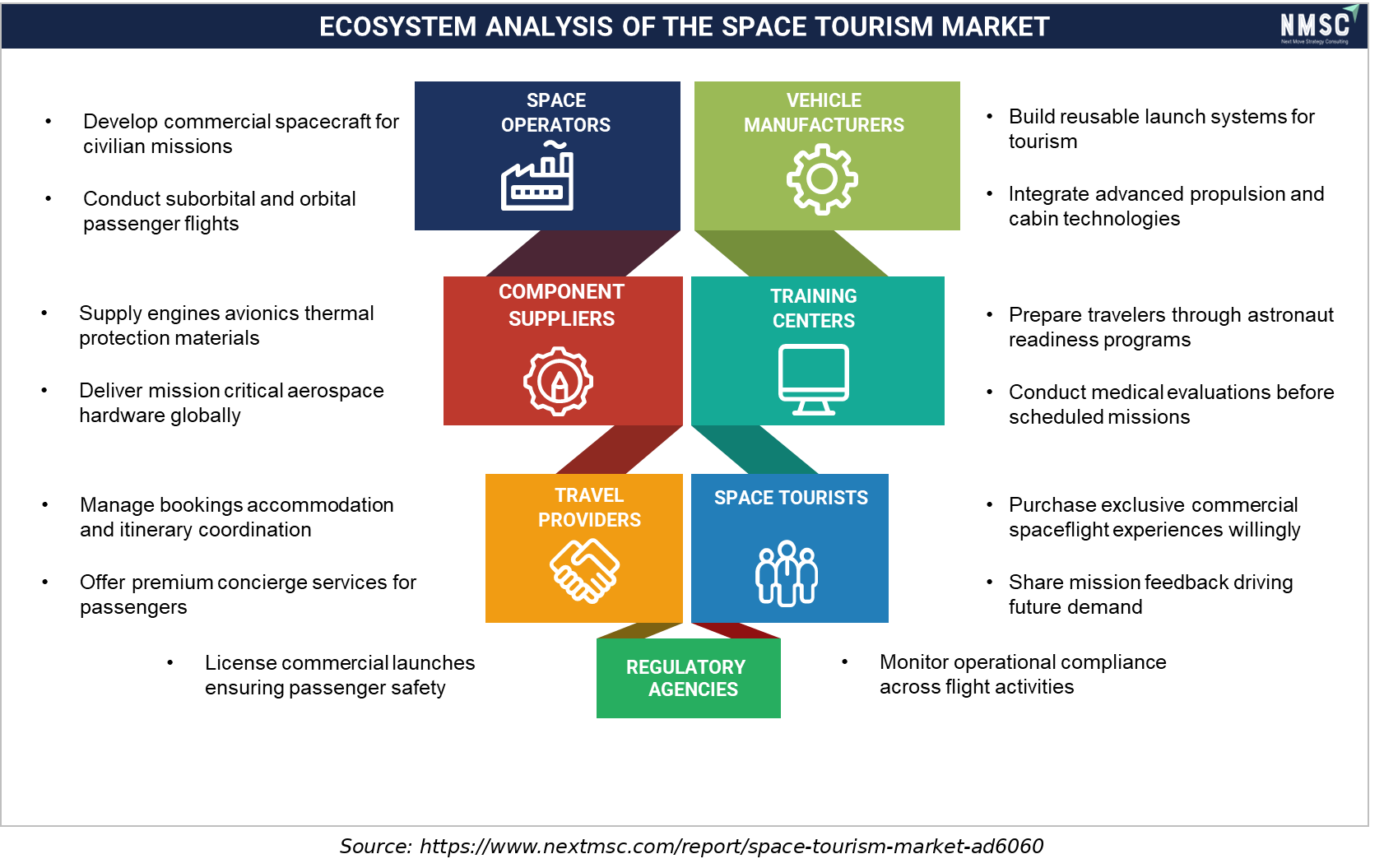
Based on our ecosystem assessment, we identified that the space tourism market operates through close collaboration among space operators, spacecraft manufacturers, component suppliers, astronaut training centers, travel providers, tourists, and regulatory agencies. Furthermore, our analysis indicates that spacecraft manufacturers and component suppliers enable vehicle development, training centers prepare passengers for flight readiness, travel providers manage customer engagement and bookings, while regulatory authorities ensure safety, licensing, and operational compliance to support sustainable commercial space tourism.

Market Drivers & Dynamics

Interactive Dataset
Rising reusable launch vehicle deployment driver +4.8% North America, Europe 2026–2035
Growth in commercial space station capacity driver +3.9% North America 2027–2035
Expanding high-net-worth individual customer base driver +3.1% Global 2026–2035
Rising government astronaut-program partnerships driver +2.4% Global 2026–2033
Growth of near-space balloon tourism accessibility driver +1.8% North America, Europe 2026–2032
High per-passenger flight and mission costs restraint −2.6% Global 2026–2032
Stringent commercial spaceflight safety certification restraint −1.9% North America, Europe 2026–2030
Limited launch and vehicle production capacity restraint −1.4% Global 2026–2029
Source: Next Move Strategy Consulting

Growth Drivers

What Is the Primary Growth Driver of the Space Tourism Market?

Rising deployment of reusable launch vehicles represents the primary growth driver, reducing per-flight costs and enabling higher suborbital flight cadence across operators. Data from the U.S. Federal Aviation Administration indicates a sustained increase in licensed commercial launch operations through 2025. This expanding launch cadence is prompting operators to scale ticket inventory and shared-cabin capacity to capture rising customer demand.

How Is Commercial Space Station Capacity Driving the Market Growth?

Growing commercial space station development is driving market growth, as operators prepare orbital habitats to serve both government astronaut missions and private tourism stays ahead of the International Space Station's retirement. NASA's Commercial Low Earth Orbit Destinations program data confirms continued government support for successor station development through 2025. Operators are responding by expanding multi-day and long-duration mission package offerings to capture this emerging demand.

Growth Inhibitors

What Is Restraining the Space Tourism Market Growth?

High per-passenger flight and mission costs restrain market growth by limiting the addressable customer base to high-net-worth individuals and well-funded institutional buyers. Federal Aviation Administration commercial launch data confirms that per-seat suborbital pricing remains substantially above conventional aviation benchmarks. These conditions are prompting operators to explore shared-cabin configurations and financing partnerships to broaden accessibility over the forecast period.

Segmentation Analysis

2025 (USD Million)
2035 (USD Million)
Suborbital Spaceflight 2025: $625.0 Million | 2035: $4,590.0 Million
Suborbital S
Orbital Spaceflight 2025: $87.5 Million | 2035: $1,632.0 Million
Orbital Spac
Near-Space Balloon Tourism 2025: $112.5 Million | 2035: $1,088.0 Million
Near-Space B
Parabolic Microgravity Flight 2025: $150.0 Million | 2035: $850.0 Million
Parabolic Mi
Ground-Based Space Experience 2025: $250.0 Million | 2035: $1,530.0 Million
Ground-Based
Deep Space Tourism 2025: $25.0 Million | 2035: $510.0 Million
Deep Space T
Suborbital Spaceflight $625.0 Million $4,590.0 Million 24.8%
Orbital Spaceflight $87.5 Million $1,632.0 Million 38.4%
Near-Space Balloon Tourism $112.5 Million $1,088.0 Million 28.7%
Parabolic Microgravity Flight $150.0 Million $850.0 Million 21.2%
Ground-Based Space Experience $250.0 Million $1,530.0 Million 22.3%
Deep Space Tourism $25.0 Million $510.0 Million 39.8%

Which Service Type Dominates the Space Tourism Market?

Service type segmentation divides the market into suborbital spaceflight, orbital spaceflight, near-space balloon tourism, parabolic microgravity flight, ground-based space experience, and deep space tourism. Suborbital spaceflight holds the dominant position, supported by established reusable-vehicle fleets and shorter mission-turnaround times relative to orbital alternatives. Deep space tourism is the fastest-growing sub-segment, driven by early commercial lunar-mission development and rising customer interest in beyond-orbit experiences as vehicle capability matures.

2025 (USD Million)
2035 (USD Million)
Rocket Capsu
Winged Space
Balloon Caps
Aircraft
Ground Facil
Segment Item 2025 (USD Million) 2035 (USD Million) CAGR
Rocket Capsule $10.0 USD Million $40.0 USD Million 19.0%
Winged Spaceplane $17.1 USD Million $51.1 USD Million 25.0%
Balloon Capsule $24.2 USD Million $62.2 USD Million 27.0%
Aircraft $31.3 USD Million $73.3 USD Million 9.0%
Ground Facility $38.4 USD Million $84.4 USD Million 22.0%

Segment-wise data is locked

Unlock complete segment-wise numbers for By Flight Platform.

Unlock Full Data
2025 (USD Million)
2035 (USD Million)
Same Day
Overnight
Multi-Day
Long Duratio
Segment Item 2025 (USD Million) 2035 (USD Million) CAGR
Same Day $10.0 USD Million $40.0 USD Million 13.0%
Overnight $17.1 USD Million $51.1 USD Million 11.0%
Multi-Day $24.2 USD Million $62.2 USD Million 17.0%
Long Duration $31.3 USD Million $73.3 USD Million 11.0%

Segment-wise data is locked

Unlock complete segment-wise numbers for By Mission Duration.

Unlock Full Data
2025 (USD Million)
2035 (USD Million)
Ground
Stratosphere
Suborbital S
Low Earth Or
Internationa
Segment Item 2025 (USD Million) 2035 (USD Million) CAGR
Ground $10.0 USD Million $40.0 USD Million 20.0%
Stratosphere $17.1 USD Million $51.1 USD Million 26.0%
Suborbital Space $24.2 USD Million $62.2 USD Million 16.0%
Low Earth Orbit $31.3 USD Million $73.3 USD Million 26.0%
International Space Station $38.4 USD Million $84.4 USD Million 21.0%

Segment-wise data is locked

Unlock complete segment-wise numbers for By Destination.

Unlock Full Data

Which Destination Leads Space Tourism Demand?

Destination segmentation spans ground, stratosphere, suborbital space, low Earth orbit, International Space Station, commercial space station, lunar orbit, lunar surface, and other deep space categories. Suborbital space dominates the segment, reflecting the largest existing fleet of operational vehicles serving this altitude tier. Lunar surface is the fastest-growing destination, supported by early commercial lunar-mission announcements and rising institutional interest in beyond-orbit tourism as vehicle development advances toward the end of the forecast period.

2025 (USD Million)
2035 (USD Million)
Individual S
Shared Cabin
Dedicated Mi
Segment Item 2025 (USD Million) 2035 (USD Million) CAGR
Individual Seat $10.0 USD Million $40.0 USD Million 13.0%
Shared Cabin $17.1 USD Million $51.1 USD Million 15.0%
Dedicated Mission $24.2 USD Million $62.2 USD Million 25.0%

Segment-wise data is locked

Unlock complete segment-wise numbers for By Passenger Configuration.

Unlock Full Data
2025 (USD Million)
2035 (USD Million)
Experience T
Mission Pack
Training
Accommodatio
Membership
Segment Item 2025 (USD Million) 2035 (USD Million) CAGR
Experience Ticket $10.0 USD Million $40.0 USD Million 15.0%
Mission Package $17.1 USD Million $51.1 USD Million 21.0%
Training $24.2 USD Million $62.2 USD Million 23.0%
Accommodation $31.3 USD Million $73.3 USD Million 21.0%
Membership $38.4 USD Million $84.4 USD Million 22.0%

Segment-wise data is locked

Unlock complete segment-wise numbers for By Revenue Stream.

Unlock Full Data
2025 (USD Million)
2035 (USD Million)
Direct Sales
Travel Agenc
Space Touris
Strategic Pa
Segment Item 2025 (USD Million) 2035 (USD Million) CAGR
Direct Sales $10.0 USD Million $40.0 USD Million 24.0%
Travel Agency $17.1 USD Million $51.1 USD Million 10.0%
Space Tourism Agency $24.2 USD Million $62.2 USD Million 8.0%
Strategic Partner $31.3 USD Million $73.3 USD Million 14.0%

Segment-wise data is locked

Unlock complete segment-wise numbers for By Sales Channel.

Unlock Full Data
2025 (USD Million)
2035 (USD Million)
Individual C
Corporate Cu
Government C
Research Org
Segment Item 2025 (USD Million) 2035 (USD Million) CAGR
Individual Consumer $10.0 USD Million $40.0 USD Million 12.0%
Corporate Customer $17.1 USD Million $51.1 USD Million 18.0%
Government Customer $24.2 USD Million $62.2 USD Million 16.0%
Research Organization $31.3 USD Million $73.3 USD Million 14.0%

Segment-wise data is locked

Unlock complete segment-wise numbers for By Customer Type.

Unlock Full Data

Which Customer Type Leads the Space Tourism Market?

Customer type segmentation covers individual consumers, corporate customers, government customers, and research organizations. Individual consumers dominate the segment, reflecting sustained high-net-worth demand for personal suborbital and orbital flight experiences. Government customers represent the fastest-growing category, driven by expanding national astronaut-training partnerships with commercial operators as space agencies increasingly outsource crew transport and orbital-stay logistics to private providers.

Growth Opportunities

Beyond current demand drivers, three forward-looking whitespace opportunities are positioned to reshape competitive positioning through 2035.

How Can Operators Capture Commercial Space Station Tourism Demand?

Operators can capture rising demand for multi-day orbital stays by securing docking and habitat capacity aboard emerging commercial space stations. Orbital spaceflight providers stand to benefit most, as station-based mission packages command substantially higher per-passenger revenue than single-flight suborbital experiences while building recurring long-duration mission demand.

What Opportunity Exists in Government Astronaut-Training Partnerships?

Expanding government astronaut-training and analog-mission partnerships presents a scalable growth mechanism as national space agencies increasingly outsource preparatory training. Ground-based space experience operators benefit directly, converting government training contracts into recurring, lower-volatility revenue streams that complement cyclical individual-consumer bookings.

How Can Balloon Tourism Expand Accessible Near-Space Access?

Expanding stratospheric balloon tourism into new regional markets creates a durable opportunity to broaden accessible near-space experiences beyond rocket-based operators. Near-space balloon tourism providers benefit most, as lower per-flight costs and gentler ascent profiles attract a broader customer base than capsule or spaceplane-based suborbital alternatives.

Regional Outlook

2025 (USD Million)
2035 (USD Million)
North Americ
Europe
Asia-Pacific
Middle East
Latin Americ
Region 2025 (USD Million) 2035 (USD Million) CAGR (%)
North America $10.0 USD Million $40.0 USD Million 9.0%
Europe $17.1 USD Million $51.1 USD Million 27.0%
Asia-Pacific $24.2 USD Million $62.2 USD Million 25.0%
Middle East & Africa $31.3 USD Million $73.3 USD Million 23.0%
Latin America $38.4 USD Million $84.4 USD Million 12.0%

Regional data is locked

Unlock complete regional numbers for this market.

Unlock Full Data

PESTEL Analysis of the Space Tourism Market

PESTEL Analysis of the Space Tourism Market

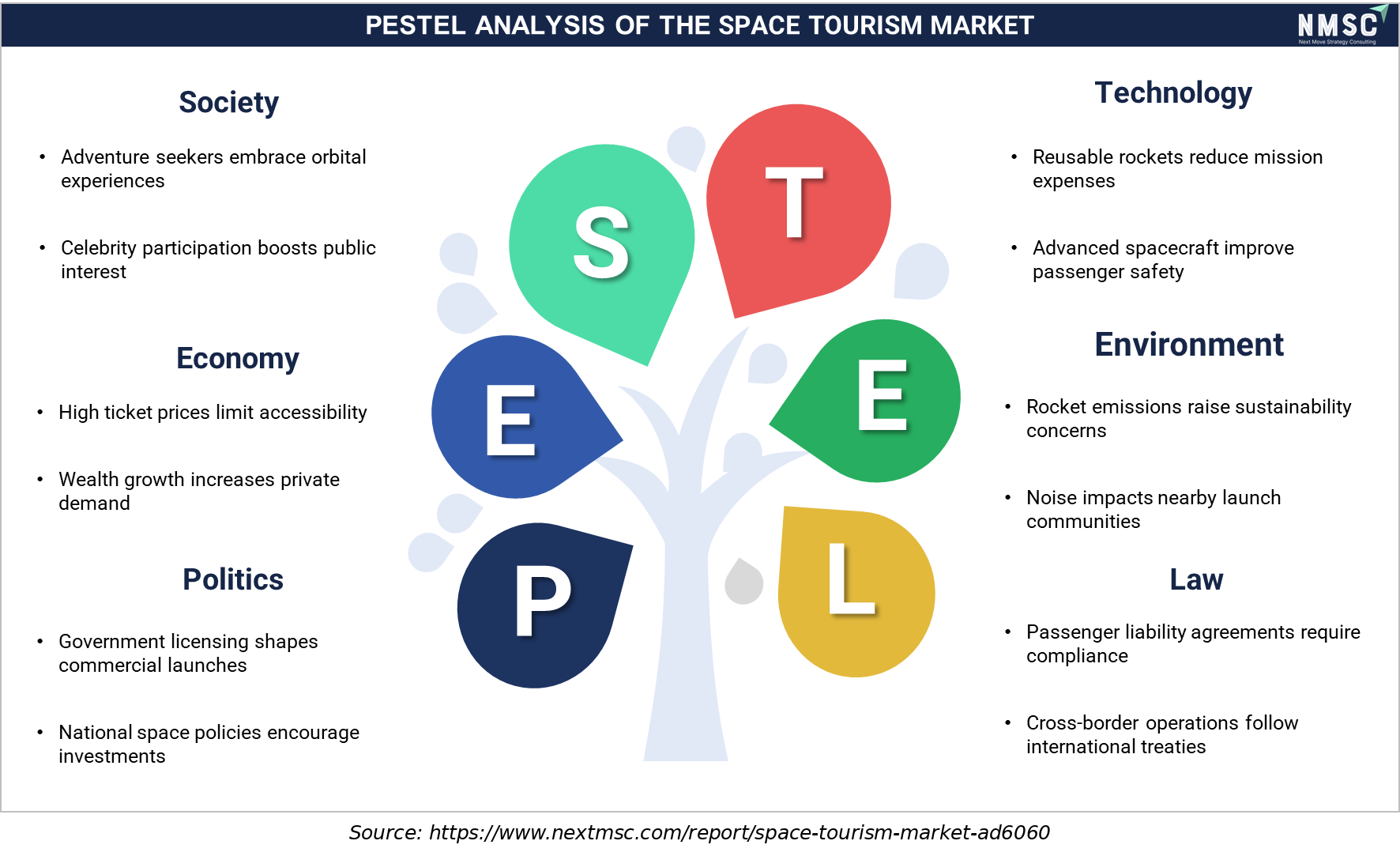
Based on our PESTEL assessment, we identified that the space tourism market is shaped by government space policies, increasing private investment, growing consumer interest in commercial space travel, advancements in reusable launch technologies, environmental considerations related to launch emissions, and evolving legal frameworks governing passenger safety and commercial operations. Furthermore, our analysis indicates that these political, economic, social, technological, environmental, and legal factors collectively influence market growth, investment decisions, innovation, regulatory compliance, and the long-term sustainability of the global space tourism industry.

Competitive Landscape

We observed that the competitive landscape is highly concentrated, with a small group of vertically integrated launch and habitat developers accounting for a substantial share of global operational capacity.

Dimension Description
Dimension Assessment
Market Structure Highly concentrated, led by vertically integrated launch-vehicle and habitat developers.
Innovation Focus Reusable launch systems, commercial space station modules, and autonomous flight-control software.
M&A Activity Selective strategic partnerships between launch operators and destination-habitat developers.

How Do Companies Compete in the Space Tourism Market?

Companies compete primarily on vehicle safety record, flight cadence, and destination-experience differentiation rather than on price alone. Reusable-vehicle turnaround speed and habitat-module capacity are key differentiators for orbital-focused operators, while suborbital providers compete on flight duration and passenger-experience design. Industry participants are increasingly investing in proprietary flight-control software to strengthen safety credentials with regulators and customers.

Which Competitive Archetypes Dominate the Space Tourism Market?

Two archetypes dominate the industry: vertically integrated launch-vehicle developers operating their own suborbital or orbital fleets, and specialized destination or experience providers focused on balloon tourism, parabolic flight, or ground-based training. The vertically integrated archetype benefits from end-to-end cost control across vehicle development and operations, while specialists differentiate through niche experience design. This dual structure explains why market share concentrates among a small number of well-capitalized operators.

What Innovation and Differentiation Strategies Are Companies Pursuing?

Companies are pursuing reusable-vehicle refurbishment efficiency, commercial space station module development, and autonomous flight-control upgrades as core differentiation strategies. Axiom Space's continued habitat-module development, advanced through 2025, illustrates a strategy of positioning early for post-ISS commercial station demand. Operators across the industry are prioritizing safety-certification transparency to strengthen customer and regulator confidence ahead of scaled commercial operations.

Key Market Players

We found that the competitive set below reflects the validated group of companies most active in shaping global space tourism supply as of 2026.

Blue Origin, LLC Virgin Galactic Holdings, Inc. Space Exploration Technologies Corp. Axiom Space, Inc. World View Enterprises, Inc. EOS-X Space HALO Space Flight S.L. Zephalto Zero 2 Infinity S.L.

Latest Developments

Our analysis shows that recent company activity reflects continued flight-cadence expansion and destination-capability development across the operator base.

Date Event
January 2026 Blue Origin announced a pause of New Shepard flights for no less than two years, redirecting resources toward accelerating the development of its human lunar capabilities and supporting the goal of returning to the Moon.
November 2025 World View Enterprises, Inc. completed a record-breaking 49-day stratospheric flight of its Gryphon high-altitude balloon system in partnership with SNC, validating advanced battery management systems and next-generation communications technologies for future commercial operations.
June 2025 Axiom Space, Inc., in collaboration with NASA and SpaceX, successfully completed Axiom Mission 4 (Ax-04), launching a four-member multinational commercial crew, including ISRO astronaut Shubhanshu Shukla, for an 18-day scientific and microgravity research mission aboard the International Space Station.

Expert Insights

Loizos Heracleous

Loizos Heracleous

Professor of Strategy and Organization | Warwick Business School

"It will take a long long time before space tourism can be a financially sustainable business available to the public at large."

Analyst Interpretation

The statement underscores one of the key challenges facing the global space tourism market—the high cost of spaceflight and the extended timeline required to achieve commercial scalability. Although private spaceflight companies continue to advance reusable launch technologies and expand flight operations, space tourism remains a premium offering accessible primarily to high-net-worth individuals. The insight suggests that broader market adoption will depend on significant reductions in launch costs, improvements in operational efficiency, technological innovation, and sustained investment in reusable spacecraft. As these developments mature over the coming years, the industry is expected to transition gradually from an exclusive luxury experience toward a more commercially sustainable market.

Investment Opportunities

What Capital Inflows Are Shaping the Space Tourism Market?

Capital inflows are concentrating on reusable-vehicle production capacity and commercial space station module development. Private equity and strategic investors are directing sustained capital toward launch-vehicle manufacturing and orbital-habitat construction across North America. This inflow pattern is enabling operators to accelerate fleet expansion while diversifying revenue between suborbital ticket sales and orbital mission-package income streams through 2035.

How Is Infrastructure Investment Supporting Market Expansion?

Infrastructure investment in spaceport facilities, launch pads, and astronaut-training centers is directly supporting space tourism expansion. Government-backed spaceport development programs across North America, Europe, and the Middle East are expanding capacity for commercial launch and passenger-processing operations, complementing broader space connects infrastructure investment. This buildout is reducing launch-scheduling constraints, reinforcing demand for expanded flight cadence across newly developed regional spaceports.

What ESG Considerations Are Influencing Investment Decisions?

Environmental, Social, and Governance considerations are increasingly shaping investment decisions, with investors scrutinizing launch-vehicle emissions and sustainable propellant sourcing. Operators demonstrating verified lower-emission propellant formulations are gaining preference among institutional investors evaluating long-term aerospace assets. This ESG-linked capital allocation is reinforcing demand for cleaner-burning propellant research across suborbital and orbital vehicle development programs.

Key Benefits for Stakeholders

How Does This Report Benefit Industry Leaders?

Industry leaders gain a validated view of segment-level revenue distribution, competitive positioning, and regional growth trajectories that inform fleet, habitat, and destination investment decisions. The report's segmentation and regional analysis clarify where demand is concentrating, enabling operator executives to prioritize capital allocation toward the highest-growth service types and destinations through 2035.

How Does This Report Benefit Investors and Financial Analysts?

Investors and financial analysts gain access to consistent market-sizing figures, CAGR forecasts, and competitive-landscape assessment that support valuation and portfolio-allocation decisions across aerospace and tourism assets. The report's regional and segmental breakdowns provide a defensible basis for evaluating growth-adjusted investment opportunities across the space tourism value chain through the 2026–2035 forecast period.

How Does This Report Benefit Technology and Product Vendors?

Technology and product vendors supplying propulsion systems, life-support equipment, and flight-control software gain insight into which service types and destinations are expanding fastest. This analysis helps vendors prioritize product roadmaps toward the highest-growth integration points, including commercial space station systems and autonomous flight-control technology favored by the dominant segments identified in this report.

Key Market Segments Evaluated

By Service Type

  • Suborbital Spaceflight
  • Orbital Spaceflight
  • Near-Space Balloon Tourism
  • Parabolic Microgravity Flight
  • Ground-Based Space Experience
  • Deep Space Tourism

By Flight Platform

  • Rocket Capsule
  • Winged Spaceplane
  • Balloon Capsule
  • Aircraft
  • Ground Facility

By Mission Duration

  • Same Day
  • Overnight
  • Multi-Day
  • Long Duration

By Destination

  • Ground
  • Stratosphere
  • Suborbital Space
  • Low Earth Orbit
  • International Space Station
  • Commercial Space Station
  • Lunar Orbit
  • Lunar Surface
  • Other Deep Space

By Passenger Configuration

  • Individual Seat
  • Shared Cabin
  • Dedicated Mission

By Revenue Stream

  • Experience Ticket
  • Mission Package
  • Training
  • Accommodation
  • Membership
  • Merchandise
  • Media Rights
  • Sponsorship
  • Other Ancillary Services

By Sales Channel

  • Direct Sales
  • Travel Agency
  • Space Tourism Agency
  • Strategic Partner

By Customer Type

  • Individual Consumer
  • Corporate Customer
  • Government Customer
  • Research Organization

Conclusion & Recommendations

Operators should prioritize reusable-vehicle turnaround efficiency, commercial space station partnership development, and government astronaut-training contracts to strengthen competitive positioning. Vertically integrated launch developers are advised to expand orbital habitat capacity, while specialized balloon and parabolic-flight operators should scale regional distribution to capture recurring demand across both established and emerging affluent customer segments.

How Attractive Is the Space Tourism Market for Investment?

The market presents strong investment attractiveness, supported by an absolute dollar opportunity of USD 8,650.0 Million between 2026 and 2035. Asia-Pacific offers the highest growth-adjusted returns given its 35.1% regional CAGR, while established North American and European markets provide stable, more mature exposure to reusable-launch and destination-habitat assets.

What Market Shifts and Key Risks Should Stakeholders Monitor?

Stakeholders should monitor stringent commercial spaceflight safety certification requirements, limited launch and vehicle production capacity, and high per-passenger costs that constrain broader market accessibility. Additionally, the shift toward destination-based orbital tourism requires continuous habitat-development investment, as operators unable to secure station capacity risk losing share to vertically integrated competitors controlling both transport and accommodation.

What Are the Key Growth Pathways Through 2035?

Key growth pathways include expanding reusable-vehicle flight cadence, scaling commercial space station habitat capacity, and deepening government astronaut-training partnerships across emerging regional markets. Operators pursuing coordinated expansion across these three pathways, supported by continued safety-certification investment, are best positioned to capture a disproportionate share of the USD 8,650.0 Million incremental opportunity through 2035.

FAQs

About the Author

Saista Faiyaz

Saista Faiyaz

Saista Faiyaz is Research Associate at Next Move Strategy Consulting, where she has covered consumer markets and healthcare technologies for 3 years. Her work includes primary interview review, secondary-source validation, market sizing, and structured analysis of company and industry data. She supports research by comparing evidence across sources, organizing findings into market narratives, and documenting assumptions used in analysis. Her scope includes cross-market benchmarking, and reports.

About the Reviewer

Supradip Baul

Supradip Baul

Supradip Baul is an accomplished business consultant and strategist with over a decade of rich experience in market intelligence, strategy, technology, and business transformation. His work has included rigorous qualitative and quantitative analysis across multiple industries, helping clients shape investment decisions and long-term roadmaps. Earlier in his career, he was associated with Gartner, where he contributed to industry-leading reports and market share analyses. He has worked with leading global companies and holds an MBA with a dual specialization in Marketing and Finance.

Download Free Sample

Ross J Mckenzie

ROSS J MCKENZIE

Business Insight Manager

Staysure Group

“Next MSC have been incredibly helpful in providing detailed & robust information on our market, alongside quantifying growth by different segments. The process to procure was simple and easy, with sample reports and regular contact to ensure we had what we needed. Succinct detail on their sources & methodologies is also greatly received, allowing transparency in this respect helps build trust in the detail you pay for. Joseph in particular was fantastic, and helped ensure efficient provision of the insight pack – thank you NMSC!”.

Nishant Awate

NISHANT AWATE

Business Development Global Sales

Zehnder Group Deutschland GmbH

Our experience working with Next Move Strategy Consulting was positive. The team was responsive, professional, and open to incorporating our specific requirements throughout the project. The India AHU market study was comprehensive and well structured, covering market value and volume forecasts, product and application segments, and key industry trends. The inclusion of both AHU and residential MVHR market insights made the study particularly relevant for our strategic market assessment. Overall, the report provides a solid foundation for evaluating market potential, identifying priority segments, and supporting business-development decisions in India.

Rishabh Jogani

RISHABH JOGANI

Strategy Analyst

Accenture Japan

We are incredibly impressed with the market report on the real estate market in India provided by Next Move Strategy Consulting. The report was thorough, insightful, and well-structured, offering deep analysis and actionable recommendations. It not only captured the current trends and dynamics but also provided a forward-looking perspective that has been invaluable for our strategic planning. Their team demonstrated exceptional professionalism, attention to detail, and a profound understanding of the industry. The data-driven insights and clarity of presentation exceeded our expectations, making complex market trends easy to understand. We highly recommend Next Move Strategy Consulting to anyone looking for reliable and comprehensive market research services. Their expertise has given us the confidence to navigate the complexities of the Indian real estate market with clarity and foresight.

Gaurav Jaiswal

GAURAV JAISWAL

Founder & CEO

Yano Charge Private Limited

The EV Charging market research report provided by the NextMSC was exceptionally detailed and insightful. It offered a comprehensive analysis that proved to be a game-changer for our strategic planning. Truly a testament to the NextMSC’s expertise and thoroughness in EV market landscape & analysis.

Mohit Agarwal

MOHIT AGARWAL

Chief Manager

DryChem India Pvt. Ltd.

Next Move Strategy Consulting is an amazing team of consultants. We required a market study report for our investors on top priority and the team went above and beyond our expectations to deliver the same with ample supporting data within a short time span enabling us to secure the investments and keep our project timeline maintained. Their professionalism, attention to detail, and timely delivery of actionable recommendations have left a lasting impression on our organization.

Custom Market Research Services

We will customize the research for you if the listed report does not fully match your requirements.

Get 30% Free Customization

Select License

This website uses cookies to ensure you get the best experience on our website. Learn more

✖