Space Defense Market Global Industry Analysis and Forecast (2026–2035)

The global Space Defense Market size was valued at USD 52.40 billion in 2025 and is estimated at USD 57.85 billion in 2026, forecast to reach USD 150.40 billion by 2035, expanding at a 12.4% CAGR from 2026 to 2035. Key drivers include rising national defense space budgets and proliferated small satellite architecture, with North America leading the global market.
Download Free Sample PDF
Base Year (2025)
$52.40 Billion
Forecast (2035)
$150.40 Billion
CAGR (2026-2035)
12.4%
Top Region
North America

What Is the Space Defense Market Size?
The global space defense market size was valued at USD 52.40 Billion in 2025 and is estimated at USD 57.85 Billion in 2026, forecast to reach USD 150.40 Billion by 2035, expanding at a 12.4% CAGR between 2026 and 2035. North America leads with approximately 38% share, while spacecraft dominate all other offering categories with approximately 30% share.

We observed that growth is broad-based across every segmentation axis, with proliferated low earth orbit constellations and hardened ground command infrastructure driving the dominant structural shifts through 2035.

Space Defense Market Global Industry Analysis and Forecast (2026–2035) Revenue Forecast

Values in USD Billion

2025 $52.40 Billion
2025
2026 $58.90 Billion
2026
2027 $66.20 Billion
2027
2028 $74.41 Billion
2028
2029 $83.64 Billion
2029
2030 $94.01 Billion
2030
2031 $105.66 Billion
2031
2032 $118.77 Billion
2032
2033 $133.49 Billion
2033
2034 $150.05 Billion
2034
2035 $150.40 Billion
2035

Key Takeaways

Dimension | Details

Market Structure | Moderately consolidated among diversified defense primes, with fragmented competition among small satellite and payload specialists

Innovation Focus | Proliferated architectures, laser inter-satellite links, software-defined payloads, and space domain awareness fusion software

M&A Activity | Primes acquiring small satellite manufacturers and space software firms to broaden proliferated architecture offerings

What Does the Space Defense Market Encompass?

The space defense market encompasses spacecraft, payloads, ground systems, launch systems, and associated services and software procured by defense ministries, intelligence agencies, and allied governments to secure satellite communications, earth observation, missile warning, navigation, and space domain awareness missions. Our assessment indicates that the scope spans hardware and service providers supplying military, intelligence, and dual-use commercial operators, and has evolved from single large geostationary platforms toward proliferated low earth orbit constellations that improve resilience against jamming, cyberattack, and kinetic counterspace threats.
Regulatory frameworks such as the U.S. International Traffic in Arms Regulations and the Federal Communications Commission spectrum licensing regime shape export control and orbital slot decisions, while the European Union Space Programme and national space agencies increasingly coordinate allied procurement standards. We observed that technology adoption is shifting toward laser inter-satellite links, onboard data processing, and software-defined payloads. Next Move Strategy Consulting’s analysis indicates that this structural shift, combined with rising commercial-with-defense-end-use contracting, is redefining sourcing criteria across the space defense market.

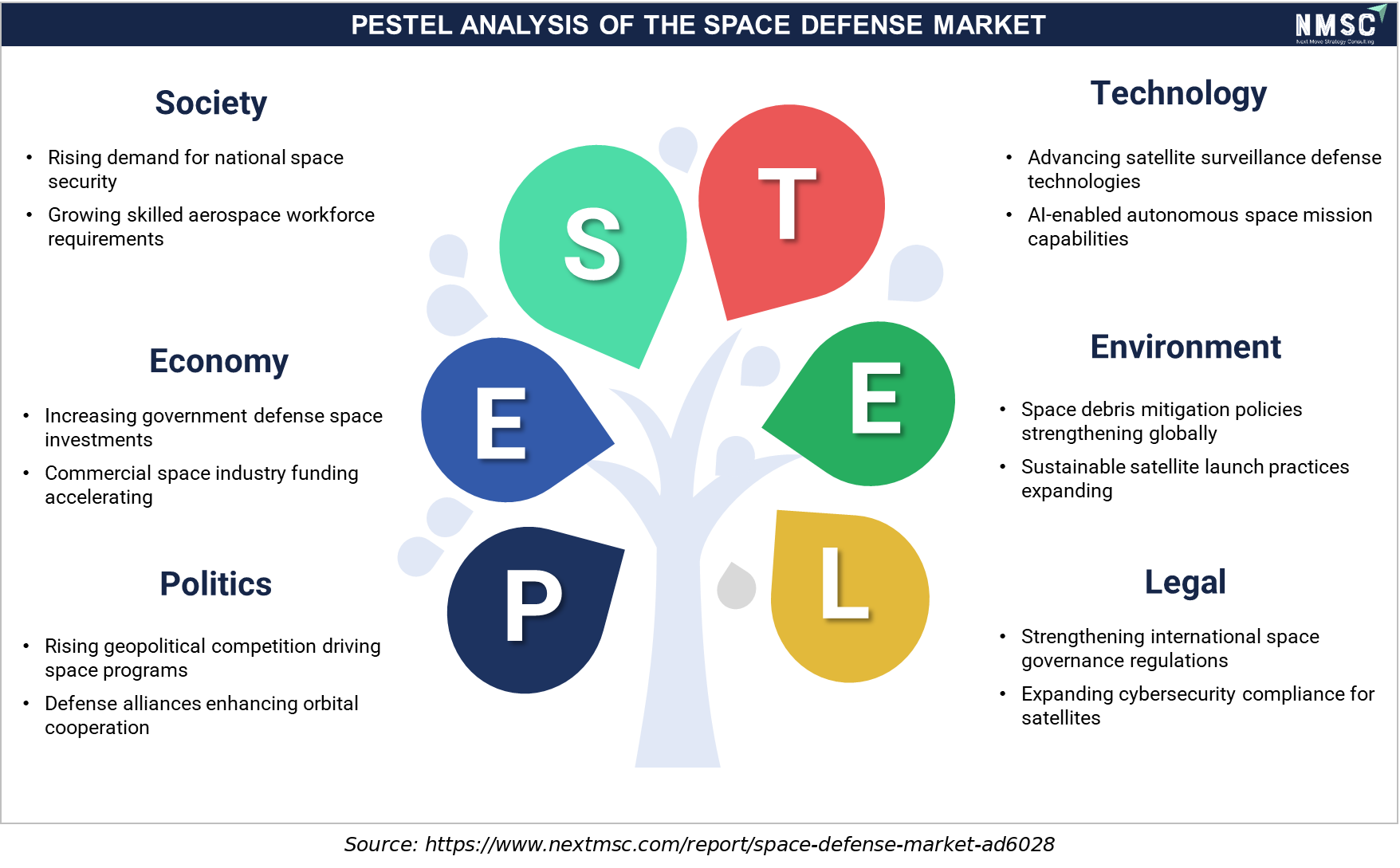
PESTEL Analysis of the Space Defense Industry

PESTEL Analysis of the Space Defense Industry
Based on our PESTEL assessment, we identified that the space defense market is influenced by national security priorities, defense budgets, technological innovation, environmental sustainability initiatives, geopolitical developments, and international space governance frameworks. Furthermore, our industry evaluation indicates that increasing investments in resilient space infrastructure, advanced satellite technologies, cybersecurity capabilities, and evolving regulatory policies strengthen operational readiness, enhance strategic capabilities, and support long-term market expansion.

Market Drivers & Dynamics

Interactive Dataset
Rising defense space budgets driver +2.4% North America, Europe 2026–2035
Proliferation of counterspace threats driver +2.0% Global 2026–2032
Allied co-development programs driver +1.6% Europe, Asia-Pacific 2026–2035
Commercial small satellite cost decline driver +1.5% North America, Asia-Pacific 2026–2033
Expansion of space domain awareness networks driver +1.1% Global 2026–2035
Rising demand for secure SATCOM capacity driver +0.9% Global 2026–2035
Export control and ITAR compliance burden restraint −1.2% North America, Europe 2026–2035
High cost of hardened, radiation-tolerant components restraint −0.8% Global 2026–2032
Orbital debris and spectrum congestion restraint −0.6% Global 2026–2035
Source: Next Move Strategy Consulting

Growth Drivers

What Is the Primary Growth Driver?

Rising national defense space budgets represent the primary growth driver for this market. The U.S. Department of Defense requested approximately USD 33.1 billion for space-related programs in its fiscal year 2026 budget submission, according to publicly disclosed budget documents. Based on research conducted by Next Move Strategy Consulting, we found that comparable budget growth across NATO members and Indo-Pacific allies is reinforcing multi-year procurement pipelines for spacecraft, payloads, and ground infrastructure.

How Is Proliferated Architecture Driving Market Growth?

Proliferated small satellite architecture is accelerating unit volumes across the spacecraft and launch systems segments. The Space Development Agency’s Tranche 2 Transport Layer contracts, publicly disclosed as multi-hundred-satellite awards, illustrate how resilience-driven design is multiplying procurement quantities relative to legacy single-satellite programs. Our findings suggest that this volume shift is compressing unit costs while expanding addressable demand for small lift launch vehicles and mission software.

Growth Inhibitors

What Is Restraining the Space Defense Market?

Stringent export control regimes, including the U.S. International Traffic in Arms Regulations, constrain cross-border technology transfer and lengthen program qualification timelines. We observed that compliance obligations disproportionately affect smaller suppliers seeking to participate in allied co-development programs. Next Move Strategy Consulting’s analysis indicates that this restraint is prompting some allied governments to prioritize sovereign or regional supply chains over globally sourced components.

Segmentation Analysis

2025 (USD Billion)
2035 (USD Billion)
Spacecraft 2025: $15.72 Billion | 2035: $40.61 Billion
Spacecraft
Payloads 2025: $10.48 Billion | 2035: $31.58 Billion
Payloads
Ground Systems 2025: $8.38 Billion | 2035: $22.56 Billion
Ground Syste
Launch Systems 2025: $7.34 Billion | 2035: $19.55 Billion
Launch Syste
Space Services 2025: $7.34 Billion | 2035: $22.56 Billion
Space Servic
Space Software and Digital 2025: $3.14 Billion | 2035: $13.54 Billion
Space Softwa
Spacecraft $15.72 Billion $40.61 Billion 11.1%
Payloads $10.48 Billion $31.58 Billion 13.0%
Ground Systems $8.38 Billion $22.56 Billion 11.6%
Launch Systems $7.34 Billion $19.55 Billion 11.5%
Space Services $7.34 Billion $22.56 Billion 13.3%
Space Software and Digital $3.14 Billion $13.54 Billion 17.6%

Which Offering Segment Dominates the Space Defense Market?

Spacecraft held the largest offering share at approximately 30% (USD 15.72 Billion) in 2025, reflecting sustained procurement of both large exquisite platforms and proliferated small satellite constellations across allied defense programs. We found that space software and digital is the fastest-growing sub-segment at 17.6% CAGR, driven by demand for mission software, ground command and control software, and cybersecurity tools incorporating artificial intelligence in military anddefense analytics that support increasingly autonomous and reconfigurable spacecraft operations through 2035.

2025 (USD Billion)
2035 (USD Billion)
Satellite Co
Earth Observ
Missile Warn
Navigation a
Space Domain
Segment Item 2025 (USD Billion) 2035 (USD Billion) CAGR
Satellite Communications $10.0 USD Billion $40.0 USD Billion 25.0%
Earth Observation and Intelligence $17.1 USD Billion $51.1 USD Billion 11.0%
Missile Warning and Tracking $24.2 USD Billion $62.2 USD Billion 25.0%
Navigation and Timing $31.3 USD Billion $73.3 USD Billion 11.0%
Space Domain Awareness $38.4 USD Billion $84.4 USD Billion 16.0%

Segment-wise data is locked

Unlock complete segment-wise numbers for By Mission Area.

Unlock Full Data

Which Mission Area Is Growing Fastest?

Satellite communications remained the dominant mission area at approximately 26% (USD 13.62 Billion) share in 2025, underpinned by secure narrowband and protected broadband capacity demand alongside emerging 5G from space connectivity for tactical networks. Our assessment indicates that Cyber is the fastest-growing mission area at 17.6% CAGR, as rising orbital congestion and counterspace testing push allied governments to expand tracking, cataloguing, and threat-characterization capability through 2035.

2025 (USD Billion)
2035 (USD Billion)
Defense Mini
Intelligence
Civil Space
Allied Gover
Commercial O
Segment Item 2025 (USD Billion) 2035 (USD Billion) CAGR
Defense Ministry $10.0 USD Billion $40.0 USD Billion 27.0%
Intelligence Agency $17.1 USD Billion $51.1 USD Billion 9.0%
Civil Space Agency $24.2 USD Billion $62.2 USD Billion 19.0%
Allied Government $31.3 USD Billion $73.3 USD Billion 17.0%
Commercial Operator $38.4 USD Billion $84.4 USD Billion 18.0%

Segment-wise data is locked

Unlock complete segment-wise numbers for By Customer Type.

Unlock Full Data

Which Customer Type Leads Space Defense Spending?

Defense ministries accounted for approximately 38% (USD 19.91 Billion) share of spending in 2025, consistent with their role as primary program owners and budget holders. We observed that commercial-with-defense-end-use customers form the fastest-growing category at 20.4% CAGR, reflecting expanding hosted payload, data-as-a-service, and hybrid architecture contracts between commercial operators and defense agencies through 2035.

2025 (USD Billion)
2035 (USD Billion)
Low Earth Or
Medium Earth
Geostationar
Highly Ellip
Cislunar
Segment Item 2025 (USD Billion) 2035 (USD Billion) CAGR
Low Earth Orbit $10.0 USD Billion $40.0 USD Billion 14.0%
Medium Earth Orbit $17.1 USD Billion $51.1 USD Billion 24.0%
Geostationary Earth Orbit $24.2 USD Billion $62.2 USD Billion 22.0%
Highly Elliptical Orbit $31.3 USD Billion $73.3 USD Billion 12.0%
Cislunar $38.4 USD Billion $84.4 USD Billion 27.0%

Segment-wise data is locked

Unlock complete segment-wise numbers for By Orbit Class.

Unlock Full Data
2025 (USD Billion)
2035 (USD Billion)
Upfront Hard
Program Mile
Recurring Se
Subscription
License
Segment Item 2025 (USD Billion) 2035 (USD Billion) CAGR
Upfront Hardware Sale $10.0 USD Billion $40.0 USD Billion 24.0%
Program Milestone $17.1 USD Billion $51.1 USD Billion 22.0%
Recurring Service $24.2 USD Billion $62.2 USD Billion 20.0%
Subscription $31.3 USD Billion $73.3 USD Billion 22.0%
License $38.4 USD Billion $84.4 USD Billion 13.0%

Segment-wise data is locked

Unlock complete segment-wise numbers for By Revenue Stream.

Unlock Full Data
2025 (USD Billion)
2035 (USD Billion)
Direct Gover
Direct Comme
Partner or C
Wholesale Ca
Framework Co
Segment Item 2025 (USD Billion) 2035 (USD Billion) CAGR
Direct Government Prime $10.0 USD Billion $40.0 USD Billion 23.0%
Direct Commercial $17.1 USD Billion $51.1 USD Billion 9.0%
Partner or Consortium $24.2 USD Billion $62.2 USD Billion 19.0%
Wholesale Capacity $31.3 USD Billion $73.3 USD Billion 13.0%
Framework Contract $38.4 USD Billion $84.4 USD Billion 10.0%

Segment-wise data is locked

Unlock complete segment-wise numbers for By Sales Channel.

Unlock Full Data

Growth Opportunities

Our analysis shows that three forward-looking opportunities stand out as whitespace areas for vendors positioning ahead of 2035 demand.

Can Hosted Payload Models Unlock New Revenue for Commercial Operators?

Commercial operators can capture recurring revenue by hosting defense payloads on existing or planned commercial buses rather than requiring dedicated military spacecraft. This mechanism lowers fielding cost for defense ministries while diversifying commercial operator revenue beyond traditional capacity leasing, benefiting satellite internet and earth observation operators seeking defense-adjacent contracts.

Can Ground Segment Modernization Create Aftermarket Software Demand?

Legacy ground control infrastructure across allied militaries requires modernization to support proliferated constellations, creating a multi-year aftermarket opportunity for mission control and data processing software vendors. This mechanism favors software and digital engineering firms capable of retrofitting open-architecture command and control systems onto existing antenna and mission control networks.

Can Allied Co-Development Programs Expand Market Access for Mid-Tier Suppliers?

Multinational co-development frameworks, such as those coordinated through NATO and the European Union Space Programme, create structured entry points for mid-tier payload and component suppliers that lack scale to win prime contracts independently. This mechanism benefits specialized payload and ground equipment manufacturers seeking qualified access to allied government procurement pipelines.

Regional Outlook

2025 (USD Billion)
2035 (USD Billion)
North Americ
Europe
Asia-Pacific
Middle East
Latin Americ
Region 2025 (USD Billion) 2035 (USD Billion) CAGR (%)
North America $10.0 USD Billion $40.0 USD Billion 9.0%
Europe $17.1 USD Billion $51.1 USD Billion 27.0%
Asia-Pacific $24.2 USD Billion $62.2 USD Billion 25.0%
Middle East & Africa $31.3 USD Billion $73.3 USD Billion 23.0%
Latin America $38.4 USD Billion $84.4 USD Billion 12.0%

Regional data is locked

Unlock complete regional numbers for this market.

Unlock Full Data

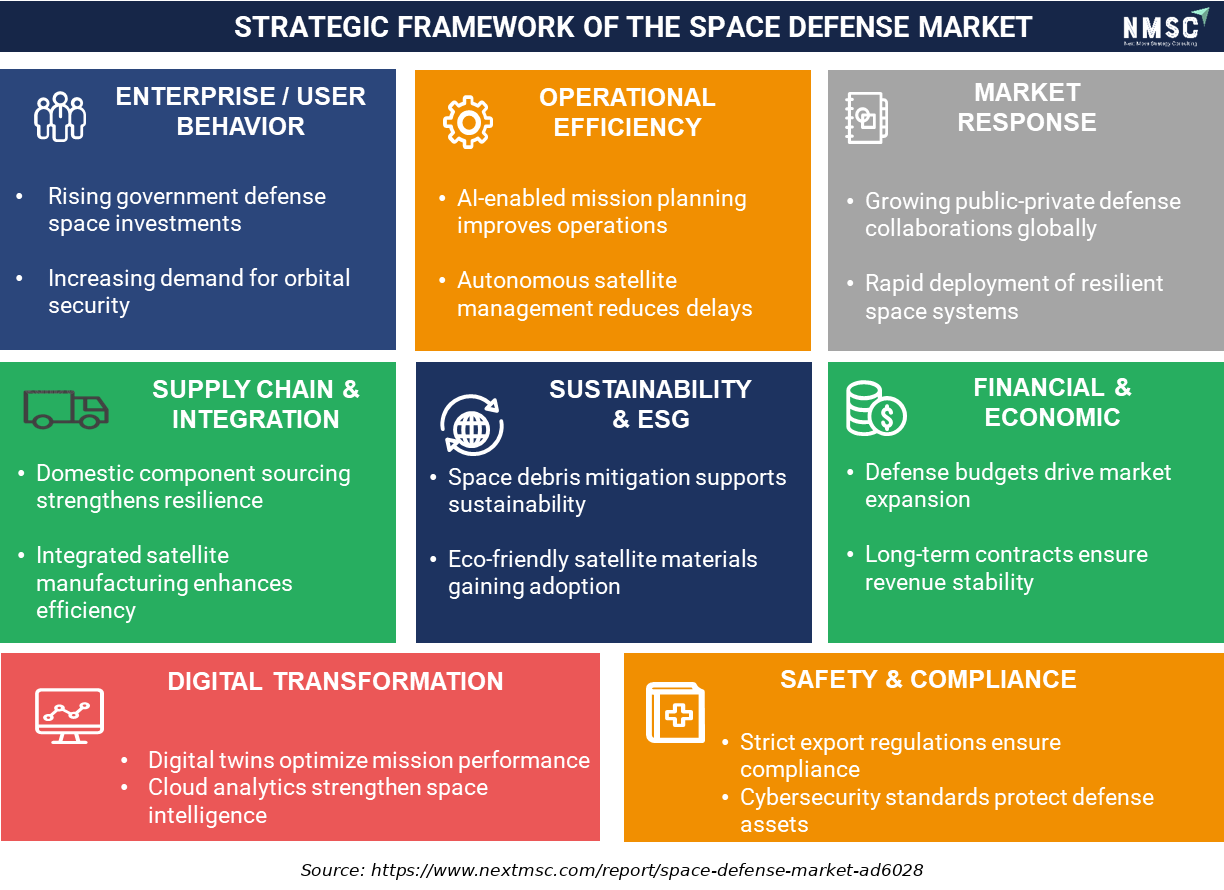
Strategic Framework of the Space Defense Market

Strategic Framework of the Space Defense Market

Based on our strategic assessment, we identified that the space defense market is shaped by user demand, operational efficiency, market responsiveness, supply chain integration, sustainability initiatives, financial strategies, digital transformation, and regulatory compliance. Furthermore, our industry evaluation indicates that artificial intelligence, digital twins, resilient supply chains, long-term defense investments, and cybersecurity frameworks improve mission effectiveness, accelerate innovation, strengthen strategic resilience, and enhance overall market competitiveness.

Competitive Landscape

Our assessment indicates that the space defense Industry remains moderately consolidated at the prime contractor level while exhibiting rising fragmentation among specialized payload, software, and launch service providers competing for allied government contracts. Key Takeaways

Dimension Description
Market Structure Moderately consolidated among diversified defense primes, with fragmented competition among small satellite and payload specialists
Innovation Focus Proliferated architectures, laser inter-satellite links, software-defined payloads, and space domain awareness fusion software
M&A Activity Primes acquiring small satellite manufacturers and space software firms to broaden proliferated architecture offerings

How Do Companies Compete in the Space Defense Market?

Companies compete primarily on program past performance, security clearance depth, and demonstrated ability to meet stringent reliability and cybersecurity requirements. We observed that pricing strategies favor fixed-price milestone contracts for mature hardware alongside cost-plus arrangements for developmental payloads, while geographic expansion strategies increasingly emphasize establishing local manufacturing or integration facilities to satisfy allied offset requirements.

Which Competitive Archetypes Dominate the Market?

Three archetypes dominate: diversified defense primes offering full-stack spacecraft-to-ground solutions, specialized small satellite and payload manufacturers competing on cost and schedule agility, and vertically integrated launch providers extending into spacecraft manufacturing. Our analysis shows that this differentiation reflects the market’s bifurcation between exquisite legacy programs and proliferated architecture procurement.

What Innovation and Differentiation Strategies Are Companies Pursuing?

Companies are differentiating through proprietary software-defined payload platforms, in-house laser communications terminals, and digital engineering toolchains that compress development cycles. We found that innovation investment is increasingly directed toward autonomous mission operations software, reflecting customer demand for reduced ground segment staffing requirements across proliferated constellations.

Key Market Players

We observed that the following 20 companies represent the validated set of key market players profiled in this space defense market report, reflecting a mix of diversified defense primes, satellite manufacturers, launch providers, and space software specialists.

Lockheed Martin Corporation Northrop Grumman Corporation The Boeing Company RTX Corporation Airbus SE L3Harris Technologies, Inc. BAE Systems plc Thales S.A. Leonardo S.p.A. Space Exploration Technologies Corp. Israel Aerospace Industries Ltd. General Dynamics Corporation Sierra Nevada Corporation SES S.A. Viasat, Inc. Iridium Communications Inc. Leidos Holdings, Inc. Rocket Lab USA, Inc. OHB SE HENSOLDT AG

Latest Developments

Our findings suggest that recent corporate and program-level developments illustrate accelerating investment in proliferated architectures, laser communications, and allied co-development across the space defense market.

Date Event
July 2026 Rocket Lab USA, Inc. was awarded a record $266 million multi-launch contract by the U.S. Space Force Space Systems Command's Rocket Systems Launch Program (RSLP). Under the agreement, Rocket Lab will execute 12 suborbital missions starting in late 2026 from the Pacific Spaceport Complex in Alaska to accelerate national missile defense testing.
June 2026 Northrop Grumman Corporation partnered with Apex to advance space-based interceptor capabilities for the U.S. Space Force. The collaboration supports a competition to demonstrate space-based missile-defense systems and establish a network of interceptors. Northrop Grumman completed ground testing in 2026 and plans to deliver an on-orbit capability by 2027.
May 2026 Lockheed Martin Corporation was selected by the U.S. Space Force Space Systems Command to develop core capabilities for the Space-Based Interceptor (SBI) program. The initiative accelerates the integration of an early engagement layer designed to strengthen multi-domain layered homeland defense architectures against emerging threats.

Expert Insights

Dr. John F. Plumb

Dr. John F. Plumb

Assistant Secretary of Defense for Space Policy | U.S. Department of Defense

"The commercial space sector is driving innovation. But the impact on national security will be measured by how well the department can integrate commercial capabilities into the way we operate, both in peacetime and in conflict."

Analyst Interpretation

The statement highlights the increasing integration of commercial space technologies into defense operations, reflecting a broader shift toward public-private collaboration in national security. As defense organizations expand investments in commercial satellite communications, Earth observation, space domain awareness, and resilient space infrastructure, demand for advanced space defense solutions is expected to grow, supporting the continued expansion of the global Space Defense Market.

Investment Opportunities

Where Are Capital Inflows Concentrated?

Capital inflows are concentrated in small satellite manufacturing, laser communications terminals, and space domain awareness software companies attracting both government and private funding. We observed that U.S. Space Force and Space Development Agency multi-hundred-satellite contract awards are catalyzing venture and private equity interest in proliferated architecture suppliers positioned to scale production.

What Infrastructure Investment Is Underway?

Infrastructure investment is expanding across launch pad capacity, satellite manufacturing lines, and hardened ground station networks needed to support higher-cadence proliferated constellation deployment. Our analysis shows that allied governments are co-funding sovereign launch and ground infrastructure to reduce reliance on single-nation supply chains through the forecast period.

How Do ESG Considerations Factor Into Investment Decisions?

Environmental, Social, and Governance considerations increasingly factor into investment decisions through orbital debris mitigation requirements and end-of-life deorbiting compliance under Federal Communications Commission and international guidelines. We found that investors are also weighing governance factors tied to export control compliance and supply chain transparency when evaluating space defense suppliers.

Key Benefits for Stakeholders

How Does This Report Benefit Defense Industry Leaders?

This report equips defense industry leaders with segmented revenue forecasts, competitive positioning analysis, and regional demand patterns needed to prioritize investment across offering, mission area, and customer type categories. Our data-driven segmentation and regional outlook support informed capacity planning and go-to-market prioritization through 2035.

How Does This Report Benefit Investors and Financial Analysts?

Investors and financial analysts gain access to market sizing, CAGR benchmarks, and company-level competitive context that support valuation and due diligence across the space defense value chain. Our forecasts and growth catalyst analysis clarify which offering and regional segments present the strongest risk-adjusted growth trajectories through 2035.

How Does This Report Benefit Technology Vendors and Product Teams?

Technology vendors and product teams benefit from granular segmentation across payload, ground system, and software categories that clarify where customer demand is shifting fastest. Our trend and opportunity analysis helps product teams align roadmap investment with emerging proliferated architecture and software-defined payload requirements through 2035.

Key Market Segments Evaluated

By Offering

  • Spacecraft
  • Payloads
  • Ground Systems
  • Launch Systems
  • Space Services
  • Space Software and Digital

By Mission Area

  • Satellite Communications
  • Earth Observation and Intelligence
  • Missile Warning and Tracking
  • Navigation and Timing
  • Space Domain Awareness
  • Launch Support
  • Cyber
  • Multi Mission

By Customer Type

  • Defense Ministry
  • Intelligence Agency
  • Civil Space Agency
  • Allied Government
  • Commercial Operator
  • Commercial with Defense End Use

By Orbit Class

  • Low Earth Orbit
  • Medium Earth Orbit
  • Geostationary Earth Orbit
  • Highly Elliptical Orbit
  • Cislunar
  • Ground Only
  • Multi Orbit

By Revenue Stream

  • Upfront Hardware Sale
  • Program Milestone
  • Recurring Service
  • Subscription
  • License
  • Support and Maintenance

By Sales Channel

  • Direct Government Prime
  • Direct Commercial
  • Partner or Consortium
  • Wholesale Capacity
  • Framework Contract
  • Application Programming Interface or Portal

Conclusion & Recommendations

The long-term outlook for the space defense market remains firmly expansionary, with revenue projected to grow from USD 52.40 Billion in 2025 to USD 150.40 Billion by 2035 at a 12.4% CAGR. We observed that sustained allied defense budget growth and proliferated architecture adoption underpin this trajectory, positioning the market for durable double-digit expansion through the forecast period.

What Strategic Positioning Do We Recommend?

We recommend that suppliers prioritize proliferated architecture compatibility, software-defined payload capability, and allied co-development partnerships to align with shifting procurement patterns. Our assessment indicates that vendors combining hardware manufacturing scale with mission software capability are best positioned to capture cross-segment demand through 2035.

How Attractive Is the Market for Investment?

Investment attractiveness remains high, supported by an absolute dollar opportunity of USD 92.55 Billion between 2026 and 2035 and consistent double-digit growth across most offering and mission area segments. Our findings suggest that space software and digital, alongside commercial-with-defense-end-use contracting, present the most attractive risk-adjusted entry points for new capital.

What Market Shifts and Key Risks Should Stakeholders Monitor?

Stakeholders should monitor export control policy shifts, orbital debris regulation, and potential budget volatility tied to national fiscal cycles as key risks. We found that geopolitical tensions affecting allied technology-sharing agreements could also alter regional demand patterns, warranting close monitoring of procurement policy developments through 2035.

What Are the Primary Growth Pathways?

Primary growth pathways include expanding proliferated small satellite production capacity, deepening space domain awareness service offerings, and scaling software-defined ground and mission control platforms. Next Move Strategy Consulting’s analysis indicates that vendors pursuing these pathways alongside allied co-development participation are best positioned for sustained share gains through 2035.

FAQs

About the Author

Saista Faiyaz

Saista Faiyaz

Saista Faiyaz is Research Associate at Next Move Strategy Consulting, where she has covered consumer markets and healthcare technologies for 3 years. Her work includes primary interview review, secondary-source validation, market sizing, and structured analysis of company and industry data. She supports research by comparing evidence across sources, organizing findings into market narratives, and documenting assumptions used in analysis. Her scope includes cross-market benchmarking, and reports.

About the Reviewer

Supradip Baul

Supradip Baul

Supradip Baul is an accomplished business consultant and strategist with over a decade of rich experience in market intelligence, strategy, technology, and business transformation. His work has included rigorous qualitative and quantitative analysis across multiple industries, helping clients shape investment decisions and long-term roadmaps. Earlier in his career, he was associated with Gartner, where he contributed to industry-leading reports and market share analyses. He has worked with leading global companies and holds an MBA with a dual specialization in Marketing and Finance.

Download Free Sample

Nishant Awate

NISHANT AWATE

Business Development Global Sales

Zehnder Group Deutschland GmbH

Our experience working with Next Move Strategy Consulting was positive. The team was responsive, professional, and open to incorporating our specific requirements throughout the project. The India AHU market study was comprehensive and well structured, covering market value and volume forecasts, product and application segments, and key industry trends. The inclusion of both AHU and residential MVHR market insights made the study particularly relevant for our strategic market assessment. Overall, the report provides a solid foundation for evaluating market potential, identifying priority segments, and supporting business-development decisions in India.

Robert Sean Trevino

ROBERT SEAN TREVINO

Sr. Director, Head of Strategic Insights & Analytics

Foundation Medicine

I realized that it was a reliable source of information. These days, there are many people who are looking for authentic data, and this is one of the only sources that can offer them with what they need;

Rishabh Jogani

RISHABH JOGANI

Strategy Analyst

Accenture Japan

We are incredibly impressed with the market report on the real estate market in India provided by Next Move Strategy Consulting. The report was thorough, insightful, and well-structured, offering deep analysis and actionable recommendations. It not only captured the current trends and dynamics but also provided a forward-looking perspective that has been invaluable for our strategic planning. Their team demonstrated exceptional professionalism, attention to detail, and a profound understanding of the industry. The data-driven insights and clarity of presentation exceeded our expectations, making complex market trends easy to understand. We highly recommend Next Move Strategy Consulting to anyone looking for reliable and comprehensive market research services. Their expertise has given us the confidence to navigate the complexities of the Indian real estate market with clarity and foresight.

Henri Knyphausen

HENRI KNYPHAUSEN

Partner at Singulier [Ex-BCG]

Singulier

I recently engaged NEXTMSC.com for a commercial due diligence project within the intralogistics sector, and I am pleased to provide a reference based on my experience. In utilizing NEXTMSC.com's services, I found their report to offer valuable insights into market dynamics and key industry players. The initial report provided a solid foundation for our analysis. However, as we were investigating a smaller target in the market, and I had specific customization requests requiring additional research. These requests included detailed information on product portfolios of various players and sub-market sizes, both inclusive and exclusive of certain product categories. NEXTMSC.com demonstrated commendable responsiveness and agility in accommodating these customization requests. Within a timeframe of 1-2 weeks, they delivered a revised report that met our specific needs. Furthermore, they were receptive to my follow-up inquiries, ensuring clarity and understanding of the data provided. The final deliverable significantly contributed to our due diligence efforts. One of NEXTMSC.com's notable strengths lies in their qualitative research capabilities. However, for future engagements, I would recommend the inclusion of a quantified market model in Excel format. Such a model would offer the ability to conduct in-depth analyses and explore various market segments, including country-specific data and subcomponent breakdowns. Based on my positive experience, I would not hesitate to work with NEXTMSC.com again. Their responsiveness, willingness to accommodate customization requests, and commitment to delivering actionable insights make them a reliable partner for commercial research projects.

Kevin Coker

KEVIN COKER

Founder, CEO and Board Diector

Proxima Clinical Research

I have been using Next MSC reports for product positioning in a new geography for a long time. They have by far the best reports I have found and the price is reasonable too!

Custom Market Research Services

We will customize the research for you if the listed report does not fully match your requirements.

Get 30% Free Customization

Select License

This website uses cookies to ensure you get the best experience on our website. Learn more

✖