Spain Aerospace Foam Market By Foam Chemistry (Polyurethane, Polyolefin, PMI, Polyimide, PVC, PET, and Others), By Product Form (Block, Sheet, Roll, Molded Part, Machined Part, Kit, and Other Form), By Application (Structural Core, Seating and Comfort, Cabin Insulation, Acoustic Damping, Sealing and Gasketing, and Others), By Aircraft Platform (Commercial, Military, Business, and Space), By Sales Channel (OEM Installation and Aftermarket) – Analysis & Forecast, 2025-2035
Industry: Materials and Chemical | Latest Edition: August 4, 2026 | No of Pages: 176 | No. of Tables: 65 | No. of Figures: 60 | Format: PDF | Report Code: MC5563
Spain Aerospace Foam Market Size & Forecast
|
Parameters |
Details |
|
Market Size in 2026 |
USD 172.6 million |
|
Revenue Forecast in 2035 |
USD 261 million |
|
Growth Rate |
CAGR of 4.7% from 2026 to 2035 |
|
Analysis Period |
2025–2035 |
|
Base Year Considered |
2025 |
|
Forecast Period |
2026–2035 |
|
Market Size Estimation |
Million (USD) |
|
Companies Profiled |
15 |
|
Market Share |
Available for 10 companies |
Industry Outlook
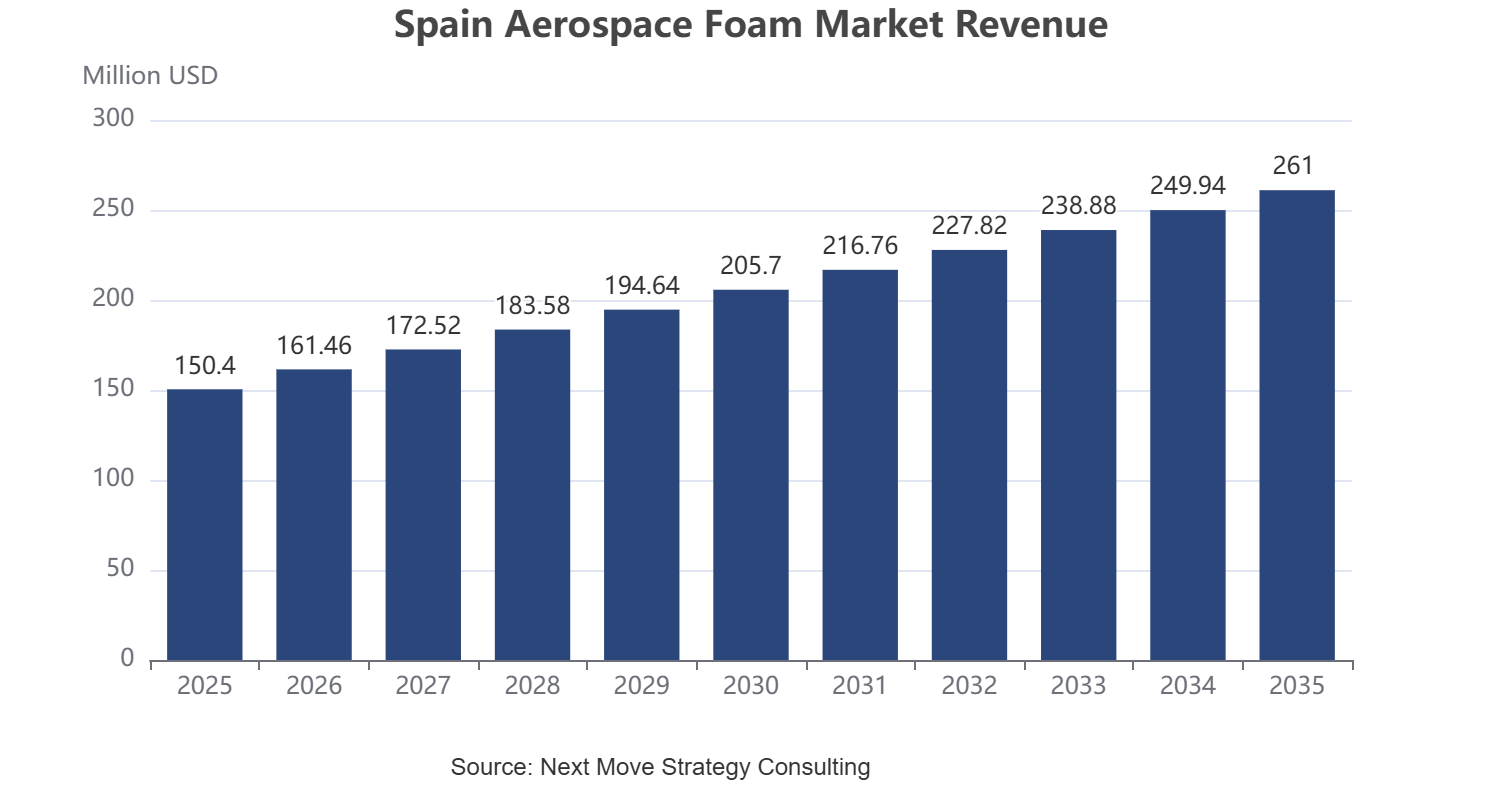
The Spain Aerospace Foam Market size was valued at USD 150.4 million in 2025, and is expected to be valued at USD 172.6 million by the end of 2026. The industry is projected to grow, hitting USD 261 million by 2035, with a CAGR of 4.7% between 2026 and 2035.
What are the Key Market Drivers, Breakthroughs, and Investment Opportunities that will Shape the Spain Aerospace Foam Industry in the Next Decade?
Growth Catalyst & Risk Assessment Matrix
|
Drivers / Trends / Restraints |
(+/–) % Impact on CAGR Forecast |
Geographic Relevance |
Impact Timeline |
|
Aerospace manufacturing cluster development improving coordination and foam adoption |
+4.22% |
Madrid, Andalusia, Basque aerospace clusters |
Medium to Long term (3–6 years) |
|
Strong Airbus program participation ensuring stable OEM-linked foam demand |
+4.38% |
Airbus-linked production hubs (Seville, Madrid) |
Long term (4–8 years) |
|
Aerostructures manufacturing expansion increasing lightweight foam integration |
+3.91% |
Basque Country, Andalusia aerospace base |
Medium to Long term (3–7 years) |
|
Industrial capability expansion improving aerospace material integration |
+3.74% |
National aerospace manufacturing zones |
Long term (4–8 years) |
|
Dependence on external aerospace technologies limiting innovation autonomy |
-3.82% |
Spain-wide aerospace ecosystem |
Short to Medium term (1–4 years) |
The Spain aerospace foam market is evolving within a steadily expanding aerospace ecosystem supported by growing manufacturing clusters, increasing participation in Airbus programs, dependence on external technologies, and gradual expansion of industrial capabilities. Our research indicates that aerospace foams are widely used across seating systems, cabin insulation, acoustic management structures, vibration-damping applications, and lightweight interior assemblies where performance efficiency and certification compliance are essential. Spain plays a key role in the European aerospace value chain through its integration into Airbus programs and aerostructures production networks. However, reliance on external technologies and imported advanced materials continues to shape structural dependency within the market. Despite these constraints, Spain is steadily strengthening its aerospace manufacturing base through program-linked production and cluster-led industrial development. Overall, the market reflects a growing but partially externally dependent aerospace ecosystem with stable long-term demand visibility.
Growth Driver:
How is Growing Aerospace Manufacturing Cluster Development Strengthening the Spain Aerospace Foam Market?
Growing aerospace manufacturing clusters are a key structural driver for the Spain aerospace foam market, as they are improving industrial coordination, production efficiency, and supply chain integration across aerospace activities. These clusters bring together OEMs, Tier-1 suppliers, and specialized component manufacturers within concentrated industrial zones, enabling stronger collaboration in aircraft production and material integration. Aerospace foams are increasingly utilized within these clusters across seating systems, insulation applications, acoustic panels, and lightweight structural assemblies where consistent material performance is required. We observed that cluster-based development is also improving standardisation in procurement and accelerating the adoption of certified aerospace-grade materials across production workflows. Over time, this integrated industrial environment is strengthening steady demand for aerospace foam solutions within Spain’s growing aerospace manufacturing ecosystem.
How is Increasing Participation in Airbus Programs Driving Foam Demand in Spain?
Based on our market evaluation, we noticed that increasing participation in Airbus aircraft programs is significantly reinforcing aerospace foam demand in Spain due to the country’s strong integration into Airbus manufacturing and assembly operations. Spain contributes to multiple aircraft platforms through component manufacturing, aerostructures production, and subsystem integration, all of which require advanced interior materials. Aerospace foams are widely used in seating systems, cabin insulation, vibration control, and acoustic management applications across these programs. Program-linked production cycles create stable and predictable demand streams for aerospace materials, ensuring consistent consumption across both production and assembly phases. Additionally, Spain’s embedded position within Airbus supply chains strengthens long-term material visibility and reinforces continuous procurement of certified aerospace foam solutions aligned with evolving aircraft platform requirements.
How is the Expansion of Aerostructures Manufacturing Supporting Foam Integration?
Expansion of aerostructures manufacturing is emerging as an important incremental driver for aerospace foam demand in Spain as the country strengthens its role in structural aircraft component production. Aerostructures manufacturing requires advanced lightweight materials that support structural integrity, vibration resistance, and thermal efficiency, creating multiple integration points for aerospace foams. We observed that increasing use of composite-based structures within aircraft programs is further driving demand for foam materials that enhance performance while reducing overall structural weight. Spain’s growing industrial capabilities in aerostructures production are also improving material standardization and increasing adoption of engineered foam solutions across both commercial and defense aviation applications. Over time, this expansion is expected to strengthen long-term structural demand for aerospace foam materials within Spain’s aerospace manufacturing ecosystem.
Growth Inhibitor:
How is Dependence on External Technologies Constraining the Spain Aerospace Foam Market?
Dependence on external aerospace technologies remains a structural constraint for the Spain aerospace foam market, primarily due to reliance on imported advanced materials, proprietary technologies, and high-end aerospace engineering solutions. This dependency limits domestic control over critical material innovation cycles and increases exposure to external supply chain and technological decision-making frameworks. Our assessment indicates that reliance on external technology providers also affects speed of innovation adoption and reduces flexibility in customizing aerospace foam solutions for specialized applications. Additionally, this dependence creates procurement sensitivity to international supply chain conditions and regulatory alignment within broader European aerospace networks. While Spain maintains strong manufacturing capabilities, technological dependency continues to influence long-term industrial autonomy and limits full-scale material innovation within the domestic aerospace ecosystem.
Growth Opportunity:
How is the Expansion of Industrial Capabilities Creating New Opportunities in Spain?
Based on our analysis, we found that the expansion of industrial capabilities represents a significant long-term opportunity for the Spain aerospace foam market as the country continues to strengthen its aerospace manufacturing infrastructure and technical expertise. Increasing investment in aerospace production facilities, engineering capabilities, and advanced manufacturing technologies is enhancing Spain’s ability to support higher-value aerospace activities. This industrial expansion is improving integration between material suppliers and aircraft manufacturers, creating stronger adoption pathways for aerospace foams across production and assembly processes. Additionally, growing capabilities in aerostructures and subsystem manufacturing are increasing the complexity and material intensity of aerospace applications, thereby strengthening demand for advanced foam solutions. Over time, continued industrial capability development is expected to reduce external dependency and enhance Spain’s position within the European aerospace supply chain.
PESTEL Analysis of the Spain Aerospace Foam Market:
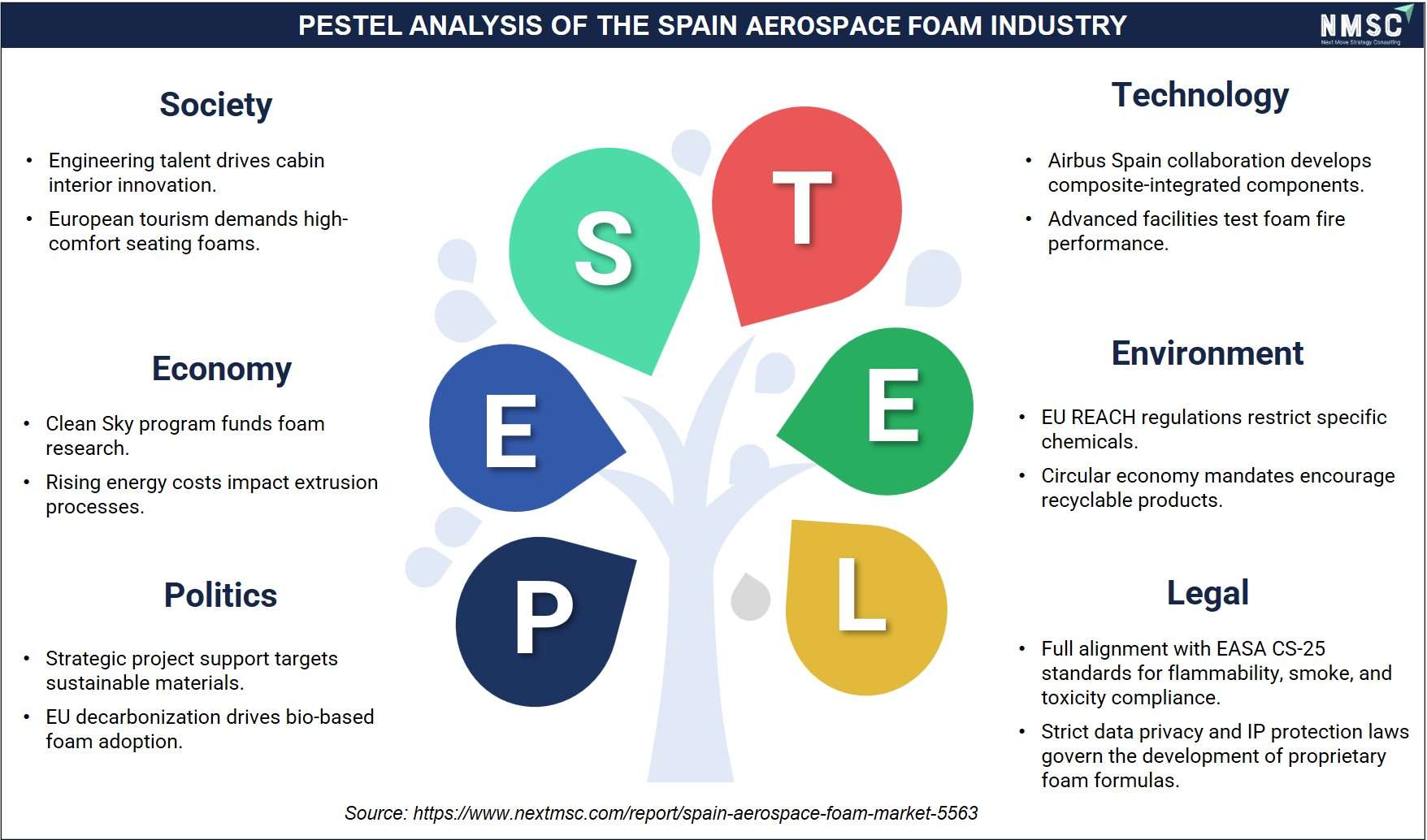
The infographic presents a PESTEL analysis framework of the Spain aerospace foam industry, mapping the key macro-environmental forces shaping sector development. It highlights political support through aerospace policies and EU funding, economic drivers from aviation demand and investment incentives, and social factors linked to workforce skills and technical education. Technological progress is driven by material innovation and automation, while environmental pressures stem from sustainability mandates and recyclable material requirements. Legal factors focus on EASA compliance and EU-aligned certification standards. Overall, our analysis indicates that these combined forces collectively shape strategic planning, risk assessment, and long-term growth across Spain’s aerospace foam sector.
How is the Spain Aerospace Foam Industry segmented in this report, and what are the key insights from the segmentation analysis?
By Aircraft Platform Insights
How do Aircraft Platforms Shape Demand Trends in the Spain Aerospace Foam Market?
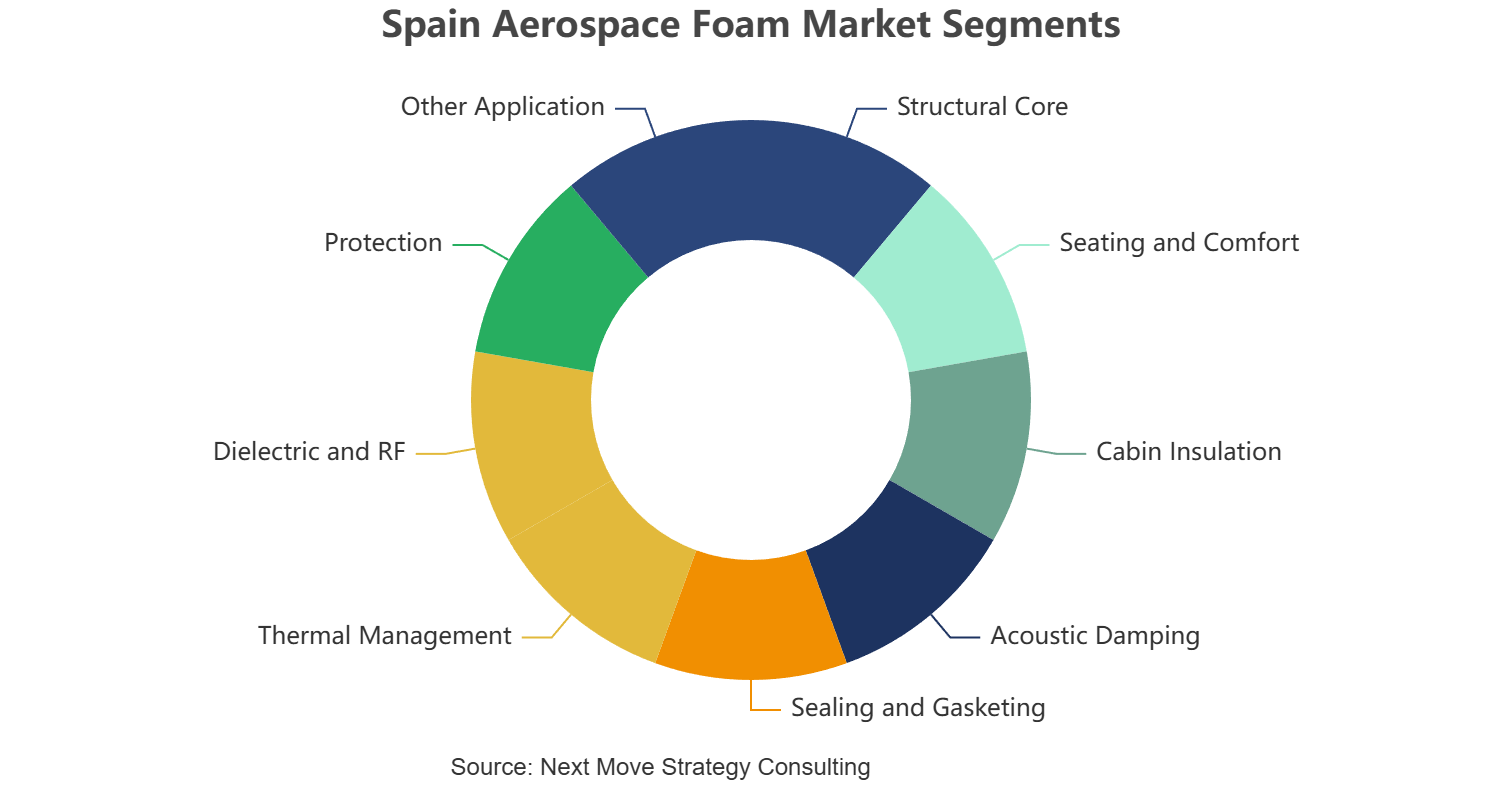
Based on aircraft platform, the Spain Aerospace Foam Market is segmented into commercial aviation, military aviation, business aviation, and space.
Aircraft platform dynamics in the Spain market are closely tied to the country’s integration into European aerospace manufacturing programs and its expanding aviation maintenance ecosystem. Commercial aviation drives steady demand for lightweight foam solutions used in seating, insulation, and cabin efficiency applications, supported by ongoing fleet optimization and passenger comfort priorities. In parallel, military aviation contributes to the demand for high-performance foams designed for durability, thermal resistance, and vibration control in mission-critical environments. Business aviation adds another layer of demand through premium interior applications focused on acoustic insulation and cabin refinement. Meanwhile, space-related applications are gradually developing through Spain’s participation in satellite and aerospace innovation programs requiring advanced thermal and structural materials. Overall, we found that Spain’s aerospace ecosystem continues to align platform-specific requirements with diversified foam adoption across both established and emerging aviation segments.
By Sales Channel Insights
How do Sales Channels Influence Demand Structure in the Spain Aerospace Foam Market?
Based on sales channel, the Spain Aerospace Foam Market is segmented into OEM installation and aftermarket.
Sales channel dynamics in the Spain aerospace foam market are closely linked to the country’s integration within European aerospace manufacturing networks and its expanding aircraft maintenance capabilities. OEM installation demand is driven by aircraft production and system integration activities, where foams are incorporated into structural, insulation, and cabin applications to meet strict performance and certification standards. In parallel, the aftermarket segment is gaining importance through maintenance, repair, overhaul, and retrofit operations across commercial and defense aviation fleets, reflecting increasing focus on aircraft lifecycle extension and cabin modernization. OEM procurement typically relies on long-term certified supplier contracts, while aftermarket demand is more responsive to maintenance cycles and replacement needs. Spain’s aerospace ecosystem, therefore, continues to maintain a balanced contribution from both OEM and aftermarket channels, supporting stable and sustained demand growth.
Competitive Landscape
Based on our competitive assessment, we found that Spain’s aerospace foam market is positioned within a broader European aviation manufacturing network, where demand is increasingly shaped by aircraft interior modernisation, weight-optimisation programs, and sustained MRO activity across regional hubs. Rather than rapid expansion, the market reflects a steady deepening of application sophistication, particularly in thermal insulation, acoustic control, and safety-critical cabin components. Competitive pressure is reinforced by stringent certification pathways and the need for materials that balance performance consistency with evolving sustainability expectations across commercial and defense aviation platforms.
Key Players of the Spain Aerospace Foam Market:
-
DuPont Ibérica S.L.
-
Hexcel Fibers S.L.
-
Boyd Spain S.L.
-
Saint-Gobain Cristalería S.A.
-
Zotefoams Inc. (Spain Branch)
-
Hybo Technology S.L.
-
BASF Española S.L.
-
Diab Spain S.L.
-
Hutchinson Industrias del Caucho S.A.
-
Armacell Iberia S.A.
-
SABIC Innovative Plastics España S.C.P.A.
-
Greiner Aerospace S.L.
-
Gurit Spain S.A.
Within this environment, the competitive field is anchored by Evonik España y Portugal S.A., DuPont Ibérica S.L., Hexcel Fibers S.L., Boyd Spain S.L., Saint-Gobain Cristalería S.A., Zotefoams Inc., and Solvay Química S.L., each contributing through differentiated material science capabilities and application-specific aerospace solutions. Instead of purely volume-driven competition, positioning is increasingly shaped by engineering collaboration with OEMs, qualification depth, and the ability to tailor foam systems to program-specific requirements. Strategic emphasis is gradually moving toward lifecycle performance, recyclability considerations, and tighter integration with composite and cabin system architectures, reflecting how European aerospace procurement priorities are shifting from material supply toward full-system performance outcomes.
Consumer Behaviour Analysis of the Spain Aerospace Foam Market:
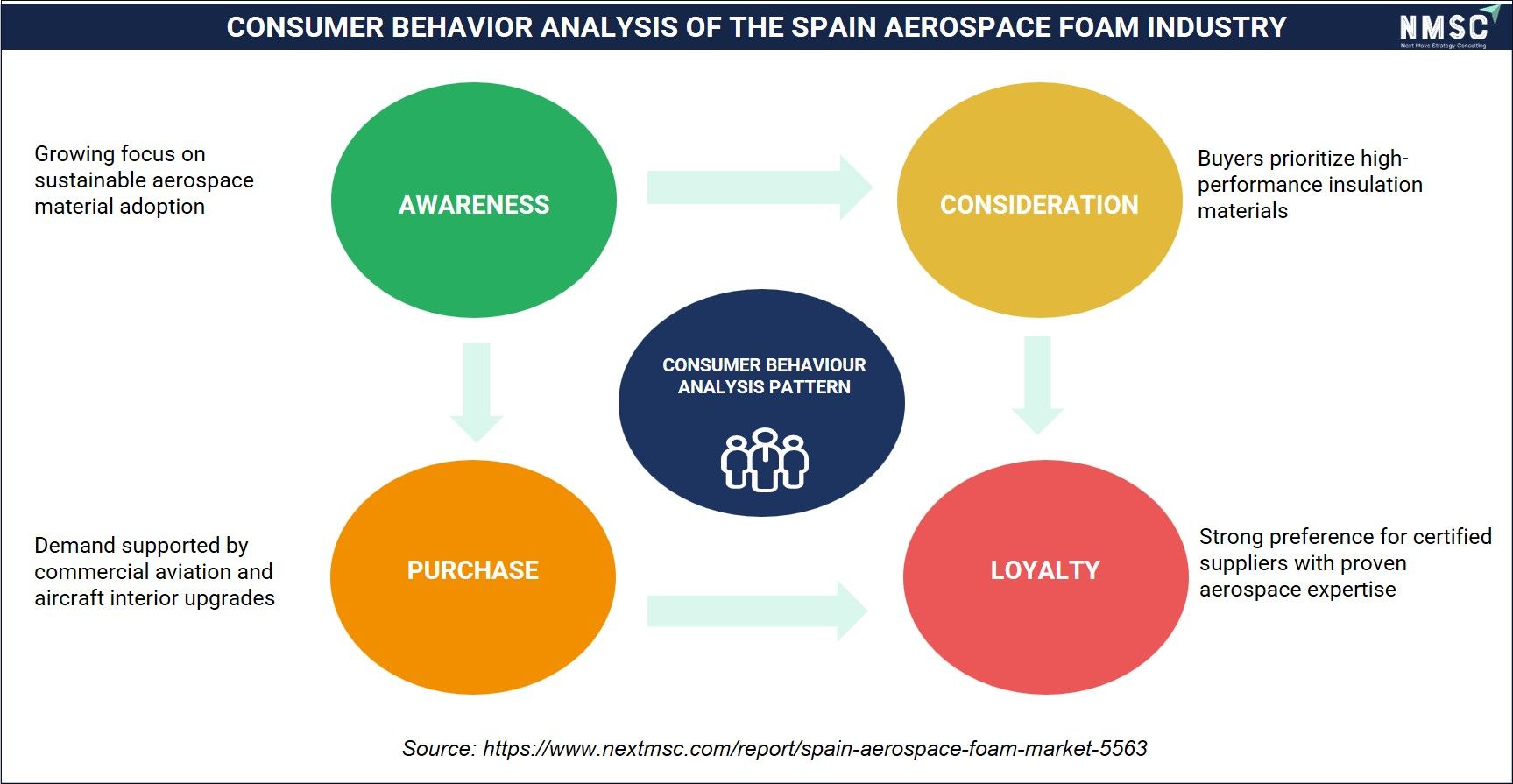
The infographic presents a consumer behaviour analysis of the Spain aerospace foam industry, mapping a four-stage decision-making journey. It begins with awareness, where we observe rising focus on sustainable aerospace materials. In the consideration stage, buyers prioritize high-performance insulation that meets strict safety and efficiency standards. Further, the purchase stage is driven by aircraft interior upgrades and fleet modernisation programs, influencing procurement activity. In the loyalty stage, preference strengthens for certified suppliers with proven aerospace expertise and compliance reliability. Overall, our analysis indicates that sustainability focus, performance requirements, and certification standards collectively shape purchasing behaviour and competitive dynamics across Spain’s aerospace foam sector.
Key Segments
By Foam Chemistry
-
Polyurethane Foam
-
Flexible Polyurethane
-
Rigid Polyurethane
-
Integral Skin Polyurethane
-
-
Polyolefin Foam
-
Polyethylene Foam
-
Polypropylene Foam
-
-
PMI Foam
-
Polyimide Foam
-
PVC Foam
-
PET Foam
-
Melamine Foam
-
Silicone Foam
-
Elastomeric Foam
-
Metal Foam
-
Aluminum Foam
-
Copper Foam
-
Other Metal Foam
-
-
Other Specialty Foam
By Product Form
-
Block
-
Sheet
-
Roll
-
Molded Part
-
Machined Part
-
Kit
-
Other Forms
By Application
-
Structural Core
-
Seating and Comfort
-
Cabin Insulation
-
Acoustic Damping
-
Sealing and Gasketing
-
Thermal Management
-
Dielectric and RF
-
Protection
-
Other Application
By Aircraft Platform
-
Commercial Aviation
-
Narrow-Body Aircraft
-
Wide-Body Aircraft
-
Regional Jets
-
-
Military Aviation
-
Fixed-Wing
-
Rotary-Wing
-
-
Business Aviation
-
Space
-
Launch Vehicles
-
Satellites
-
Space Habitats & Modules
-
By Sales Channel
-
OEM Installation
-
Aftermarket
Key Benefits for Stakeholders:
Next Move Strategy Consulting (NMSC) presents a comprehensive analysis of the Spain Aerospace Foam Market, covering historical trends from 2020 through 2025 and offering detailed forecasts through 2035. Our study examines the market at regional and country levels, providing quantitative projections and insights into key growth drivers, challenges, and investment opportunities across all major aerospace foam segments.
NMSC's analysis indicates that Spain’s aerospace foam demand is closely tied to its evolving role within Europe’s broader aircraft manufacturing network, where participation in major OEM programs and expanding aerostructure capabilities are steadily strengthening industrial relevance. Investment interest is increasingly shaped by the country’s ability to support mid-tier aerospace production while aligning with high-specification European aviation requirements. Within this environment, airlines, OEMs, and MRO operators are prioritizing aerospace foam solutions that improve cabin efficiency, reduce structural weight, and enhance thermal and acoustic performance across diverse fleet categories. Regulatory alignment with EU aviation standards provides an additional layer of consistency, ensuring material reliability and reinforcing confidence in advanced aerospace applications across Spain’s integrated aerospace ecosystem.
|
Parameters |
Details |
|
Customization Scope |
Free customization (equivalent to up to 80 analyst-working hours) after purchase. |
|
Pricing and Purchase Options |
Avail customized purchase options to meet your exact research needs. |
|
Approach |
In-depth primary and secondary research; proprietary databases; rigorous quality control and validation measures. |
|
Analytical Tools |
Porter's Five Forces, SWOT, value chain, and Harvey ball analysis to assess competitive intensity, stakeholder roles, and relative impact of key factors. |
About the Author
 Mayurima Roy
— Mayurima Roy is Research Analyst at Next Move Strategy Consulting, where she has spent 4 years working across the firm's full industry coverage rather than a single fixed vertical. Her work centers on structured research, ongoing trend tracking, competitive assessment, and insight-led content development, translating complex market data into clear, decision-ready narratives that support informed client decision-making across diverse global industries, market sectors, and world regions every day.
Mayurima Roy
— Mayurima Roy is Research Analyst at Next Move Strategy Consulting, where she has spent 4 years working across the firm's full industry coverage rather than a single fixed vertical. Her work centers on structured research, ongoing trend tracking, competitive assessment, and insight-led content development, translating complex market data into clear, decision-ready narratives that support informed client decision-making across diverse global industries, market sectors, and world regions every day.
About the Reviewer
 Supradip Baul
— Supradip Baul is an accomplished business consultant and strategist with over a decade of rich experience in market intelligence, strategy, technology, and business transformation. His work has included rigorous qualitative and quantitative analysis across multiple industries, helping clients shape investment decisions and long-term roadmaps. Earlier in his career, he was associated with Gartner, where he contributed to industry-leading reports and market share analyses. He has worked with leading global companies and holds an MBA with a dual specialization in Marketing and Finance.
Supradip Baul
— Supradip Baul is an accomplished business consultant and strategist with over a decade of rich experience in market intelligence, strategy, technology, and business transformation. His work has included rigorous qualitative and quantitative analysis across multiple industries, helping clients shape investment decisions and long-term roadmaps. Earlier in his career, he was associated with Gartner, where he contributed to industry-leading reports and market share analyses. He has worked with leading global companies and holds an MBA with a dual specialization in Marketing and Finance.
At Next Move Strategy Consulting, we understand that insightful market research is the cornerstone of successful business decisions. That's why we employ a robust and multifaceted approach, combining various methodologies to deliver the most accurate and actionable data for our clients.

Research Landscape
We navigate the world of research with two primary approaches:
Qualitative Approach
Our qualitative research methodologies involve immersive techniques such as in-depth interviews, focus groups, and observational studies. By engaging directly with individuals and stakeholders, we uncover valuable insights that quantitative data alone may overlook.

Quantitative Research
In tandem with qualitative methodologies, NMSC leverages the power of Quantitative Research to provide a robust foundation of numerical insights. Through systematic data collection and analysis, we quantify patterns, preferences, and market trends, offering a comprehensive view of the business landscape.
Our quantitative research approach employs diverse tools, including surveys, experiments, and statistical modelling. These methodologies enable us to gather data from a large and representative sample, ensuring the statistical significance of our findings. By employing structured questionnaires and standardized data collection methods, we guarantee the reliability and validity of the information we present to our clients.
Quantitative research is particularly effective in measuring the prevalence of trends, assessing market size, and gauging the impact of various factors on consumer behavior. The numerical precision attained through this approach equips our clients with actionable insights, facilitating data-driven decision-making and strategy formulation.


Our Specialized Toolbox for Industry-Specific Market Research
We deploy a specialized arsenal of techniques tailored to meet your unique requirements. Here's a glimpse into our comprehensive toolbox:

Information Procurement
The stage entails acquiring market data or relevant information through various sources and methodologies.


Market Research Approach
We utilize both top-down and bottom-up approaches in market research analysis to achieve a comprehensive understanding of the market dynamics, leveraging the broad perspective of industry trends and macroeconomic factors alongside detailed insights from specific segments and individual companies.

Porters Five Forces Analysis
We conduct Porter's Five Forces analysis to evaluate the competitive landscape of an industry, providing us with insights into factors that affect profitability and strategic positioning.

SWOT Analysis

Forecasting
We utilize a forecasting model to predict future consumption by considering parameters like population, economics, regulations, market competition, drivers, constraints, technology, and pricing. We also employ statistical techniques such as multilinear regression, exponential smoothing, moving average, ARIMA, and Monte Carlo simulations for accurate predictions. In econometric forecasting, we analyzed short-term and long-term event impacts, attributing values based on regulatory frameworks, economic factors, and market events.





 Speak to Our Analyst