Styrene Monomer Market

Styrene Monomer Market size was USD 65.65 Billion in 2025, projected to reach USD 107.28 Billion by 2035, growing at a CAGR of 4.89% from 2026 to 2035. Key drivers include rising polystyrene and ABS demand across Asia-Pacific, expanding packaging, appliance, and construction manufacturing, and increasing styrene butadiene rubber demand for tire production, with Asia-Pacific leading the market .

Download Free Sample PDF
Base Year (2025)
$65.65 Billion
Forecast (2035)
$107.28 Billion
CAGR (2026-2035)
4.9%
Top Country
Asia-Pacific

What Is the Styrene Monomer Market Size?

The Styrene Monomer Market size was valued at USD 65.65 Billion in 2025. It is estimated at USD 69.81 Billion in 2026 and is forecast to reach USD 107.28 Billion by 2035, expanding at a 4.89% CAGR between 2026 and 2035. Asia-Pacific leads with approximately 58% share, while Polystyrene dominates all other application categories with approximately 32% share.

We observed that growth remains steady across every segment. Chemical recycling technology and Asia-Pacific polystyrene capacity expansion are driving the dominant structural shifts through 2035.

Styrene Monomer Market Revenue Forecast

Values in USD Billion

2025 $65.65 Billion
2025
2026 $68.86 Billion
2026
2027 $72.23 Billion
2027
2028 $75.76 Billion
2028
2029 $79.46 Billion
2029
2030 $83.35 Billion
2030
2031 $87.43 Billion
2031
2032 $91.70 Billion
2032
2033 $96.19 Billion
2033
2034 $100.89 Billion
2034
2035 $107.28 Billion
2035

Key Takeaways

By Application: Polystyrene held the largest share of approximately 32% (USD 21.01 billion) in 2025; Styrene-Based Elastomers is the fastest-growing sub-segment at 5.7% CAGR from 2026–2035.

By Production Technology: Ethylbenzene Dehydrogenation held the largest share of approximately 71% (USD 46.61 billion) in 2025; Other Technologies is the fastest-growing sub-segment at 8.4% CAGR from 2026–2035.

By Feedstock Integration: Integrated Production held the largest share of approximately 64% (USD 42.02 billion) in 2025; Non-Integrated Production is the fastest-growing sub-segment at approximately 5.3% CAGR from 2026–2035.

By Sales Type: Contract Sales held the largest share of approximately 68% (USD 44.64 billion) in 2025; Spot Sales is the fastest-growing sub-segment at approximately 5.6% CAGR from 2026–2035.

Dominant Region: Asia-Pacific dominated with approximately 58% revenue share (USD 38.08 billion) in 2025.

Fastest-Growing Region: Middle East & Africa is expected to register the highest CAGR of 6.4% during 2026–2035.

Dominant Country: China led with approximately USD 21.70 billion in 2025.

Fastest-Growing Country: India is the fastest-growing country at approximately 7.6% CAGR from 2026–2035.

Ecosystem Analysis of the Styrene Monomer Industry

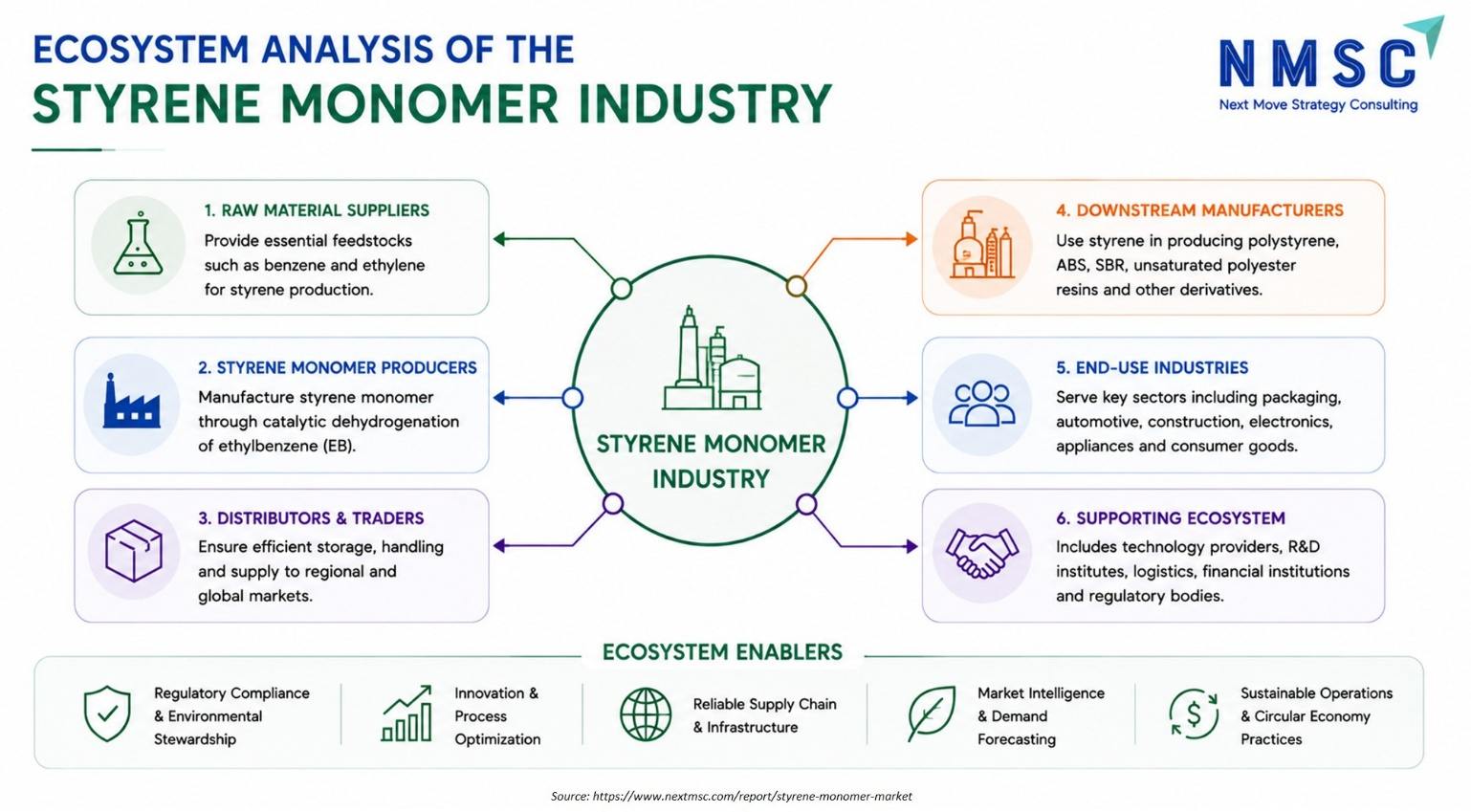
The above infographic provides a detailed ecosystem analysis of the styrene monomer industry, mapping out six key segments from raw material suppliers to the supporting ecosystem. It illustrates how producers, distributors, and downstream manufacturers interact within a connected network to transform feedstocks like benzene and ethylene into essential materials for packaging, automotive, and consumer goods. The analysis further highlights crucial ecosystem enablers, such as regulatory compliance, reliable infrastructure, and sustainable operations, that support the industry. Ultimately, it demonstrates how this interconnected chain drives innovation, market intelligence, and efficient supply across global markets .

What Does the Styrene Monomer Market Encompass?

The Styrene Monomer Market covers the production and sale of styrene, a key petrochemical feedstock made mainly through ethylbenzene dehydrogenation. This monomer feeds downstream production of polystyrene, ABS, styrene butadiene rubber, and unsaturated polyester resins. Our assessment indicates that the scope spans integrated petrochemical producers, non-integrated converters, and merchant suppliers serving polystyrene, styrenic copolymer, and synthetic rubber manufacturers worldwide.

The industry has evolved from a fragmented, regionally isolated business into a globally traded commodity chemical with active spot and contract markets. Regulatory frameworks are reshaping the industry. The International Agency for Research on Cancer classified styrene as Group 2A, probably carcinogenic to humans, and the European Food Safety Authority finalized its 2025 assessment of styrene in plastic food-contact materials, concluding that the evaluated 40 µg/kg food-specific migration level was not a safety concern . We observed that technology adoption is shifting toward chemical recycling and bio-attributed feedstock. NMSC's analysis indicates that this shift, combined with capacity rationalization in mature regions, is redefining competitive priorities across themarket.

Market Drivers & Dynamics

Interactive Dataset
Rising polystyrene and ABS demand across Asia-Pacific driver +1.3% Asia-Pacific 2026-2035
Growth of styrene butadiene rubber tire applications driver +0.9% Global 2026-2035
Bio-attributed and chemical recycling feedstock investment driver +0.7% Europe, North America 2026-2032
Capacity rationalization improving mature-region utilization rates driver +0.5% North America, Europe 2026-2032
Rising unsaturated polyester resin demand in construction driver +0.4% Asia-Pacific, Middle East & Africa 2026-2035
Regulatory scrutiny of styrene carcinogenicity classification restraint -0.9% Europe, North America 2026-2033
Volatile benzene and ethylene feedstock pricing restraint -0.8% Global 2026-2033
Overcapacity pressure compressing regional operating margins restraint -0.6% Asia-Pacific 2026-2032
Substitution pressure from alternative polymer materials restraint -0.4% Global 2026-2035
Source: Next Move Strategy Consulting

Growth Drivers

What Is the Primary Growth Driver of the Styrene Monomer Market?

Rising polystyrene and ABS demand across Asia-Pacific is the primary driver. China and India continue expanding packaging, appliance, and construction manufacturing capacity. We observed that this shift, combined with growing consumer goods production, continues to anchor baseline demand growth for styrene monomer as the key feedstock behind these downstream materials.

How Is Styrene Butadiene Rubber Demand Driving Market Growth?

Styrene butadiene rubber demand in tire manufacturing is accelerating growth by widening the industry's downstream base beyond polystyrene alone. Global tire production continues expanding alongside rising vehicle ownership in emerging markets. Our assessment indicates that this shift is compressing the gap between styrene monomer supply and rubber-grade demand, particularly across Asia-Pacific manufacturing hubs.

Growth Inhibitors

What Is Restraining Styrene Monomer Market Expansion?

Regulatory scrutiny of styrene's carcinogenicity classification restrains growth in food-contact and consumer-facing applications. The International Agency for Research on Cancer classified styrene as Group 2A, probably carcinogenic to humans, in 2019. The European Food Safety Authority continues re-evaluating migration limits for food packaging use. We found that manufacturers serving food-contact applications face particular exposure to this ongoing regulatory review relative to industrial-grade producers.

Segmentation Analysis

2025 (USD Billion)
2035 (USD Billion)
Polystyrene
General Purp
High Impact
Expandable P
Styrenic Cop
Segment Item 2025 (USD Billion) 2035 (USD Billion) CAGR
Polystyrene $10.0 USD Billion $40.0 USD Billion 18.0%
General Purpose Polystyrene (GPPS) $17.1 USD Billion $51.1 USD Billion 16.0%
High Impact Polystyrene (HIPS) $24.2 USD Billion $62.2 USD Billion 22.0%
Expandable Polystyrene (EPS) $31.3 USD Billion $73.3 USD Billion 12.0%
Styrenic Copolymers $38.4 USD Billion $84.4 USD Billion 19.0%

Segment-wise data is locked

Unlock complete segment-wise numbers for By Application.

Unlock Full Data

Which Application Segment Dominates the Market?

Polystyrene led with USD 21.01 billion in 2025. Polystyrene remains the largest single downstream use for styrene monomer across packaging, appliances, and disposable consumer goods. We observed that Styrene-Based Elastomers is the fastest-growing application, expanding at a 5.7% CAGR from 2026 to 2035. Rising tire demand and expanding styrenic block copolymer use in adhesives and footwear are driving this category forward.

2025 (USD Billion)
2035 (USD Billion)
Ethylbenzene
Adiabatic De
Isothermal D
Styrene Mono
Conventional
Segment Item 2025 (USD Billion) 2035 (USD Billion) CAGR
Ethylbenzene Dehydrogenation $10.0 USD Billion $40.0 USD Billion 16.0%
Adiabatic Dehydrogenation $17.1 USD Billion $51.1 USD Billion 22.0%
Isothermal Dehydrogenation $24.2 USD Billion $62.2 USD Billion 24.0%
Styrene Monomer Propylene Oxide Co-Production $31.3 USD Billion $73.3 USD Billion 14.0%
Conventional Process $38.4 USD Billion $84.4 USD Billion 17.0%

Segment-wise data is locked

Unlock complete segment-wise numbers for By Production Technology.

Unlock Full Data

Which Production Technology Leads Styrene Monomer Market Supply?

Ethylbenzene Dehydrogenation remained the leading production technology, valued at USD 46.61 billion in 2025. This route remains widely deployed globally because of its established industrial infrastructure and integration with ethylbenzene supply. Our findings suggest that Other Technologies, including chemical recycling routes, represent the fastest-growing category at a stated 8.4% CAGR from 2026 to 2035. Increasing commercial activity in recycled styrene production is supporting interest in circular feedstock pathways and expanding the technology landscape beyond conventional production routes .

2025 (USD Billion)
2035 (USD Billion)
Integrated P
Refinery Int
Petrochemica
Non-Integrat
Purchased Et
Segment Item 2025 (USD Billion) 2035 (USD Billion) CAGR
Integrated Production $10.0 USD Billion $40.0 USD Billion 11.0%
Refinery Integrated $17.1 USD Billion $51.1 USD Billion 17.0%
Petrochemical Integrated $24.2 USD Billion $62.2 USD Billion 19.0%
Non-Integrated Production $31.3 USD Billion $73.3 USD Billion 25.0%
Purchased Ethylbenzene $38.4 USD Billion $84.4 USD Billion 18.0%

Segment-wise data is locked

Unlock complete segment-wise numbers for By Feedstock Integration.

Unlock Full Data

Which Feedstock Integration Model Is Most Widely Used in the Market?

Integrated Production remained the dominant feedstock model, reaching USD 42.02 billion in 2025. Refinery-integrated and petrochemical-integrated producers benefit from captive ethylbenzene supply and lower input cost volatility. Based on research conducted by NMSC, we found that Non-Integrated Production is the fastest-growing model at a 5.3% CAGR from 2026 to 2035. Merchant ethylbenzene availability is expanding as more converters enter the market without upstream investment.

2025 (USD Billion)
2035 (USD Billion)
Contract Sal
Formula-Base
Fixed-Price
Spot Sales
Domestic Spo
Segment Item 2025 (USD Billion) 2035 (USD Billion) CAGR
Contract Sales $10.0 USD Billion $40.0 USD Billion 24.0%
Formula-Based Contracts $17.1 USD Billion $51.1 USD Billion 18.0%
Fixed-Price Contracts $24.2 USD Billion $62.2 USD Billion 16.0%
Spot Sales $31.3 USD Billion $73.3 USD Billion 14.0%
Domestic Spot Sales $38.4 USD Billion $84.4 USD Billion 21.0%

Segment-wise data is locked

Unlock complete segment-wise numbers for By Sales Type.

Unlock Full Data
2025 (USD Billion)
2035 (USD Billion)
Polystyrene
GPPS Produce
HIPS Produce
EPS Producer
Styrenic Pol
Segment Item 2025 (USD Billion) 2035 (USD Billion) CAGR
Polystyrene Producers $10.0 USD Billion $40.0 USD Billion 26.0%
GPPS Producers $17.1 USD Billion $51.1 USD Billion 16.0%
HIPS Producers $24.2 USD Billion $62.2 USD Billion 18.0%
EPS Producers $31.3 USD Billion $73.3 USD Billion 8.0%
Styrenic Polymer Producers $38.4 USD Billion $84.4 USD Billion 23.0%

Segment-wise data is locked

Unlock complete segment-wise numbers for By End User.

Unlock Full Data

Supply Chain Analysis of the Styrene Monomer Market

Supply Chain Analysis of the Styrene Monomer Market
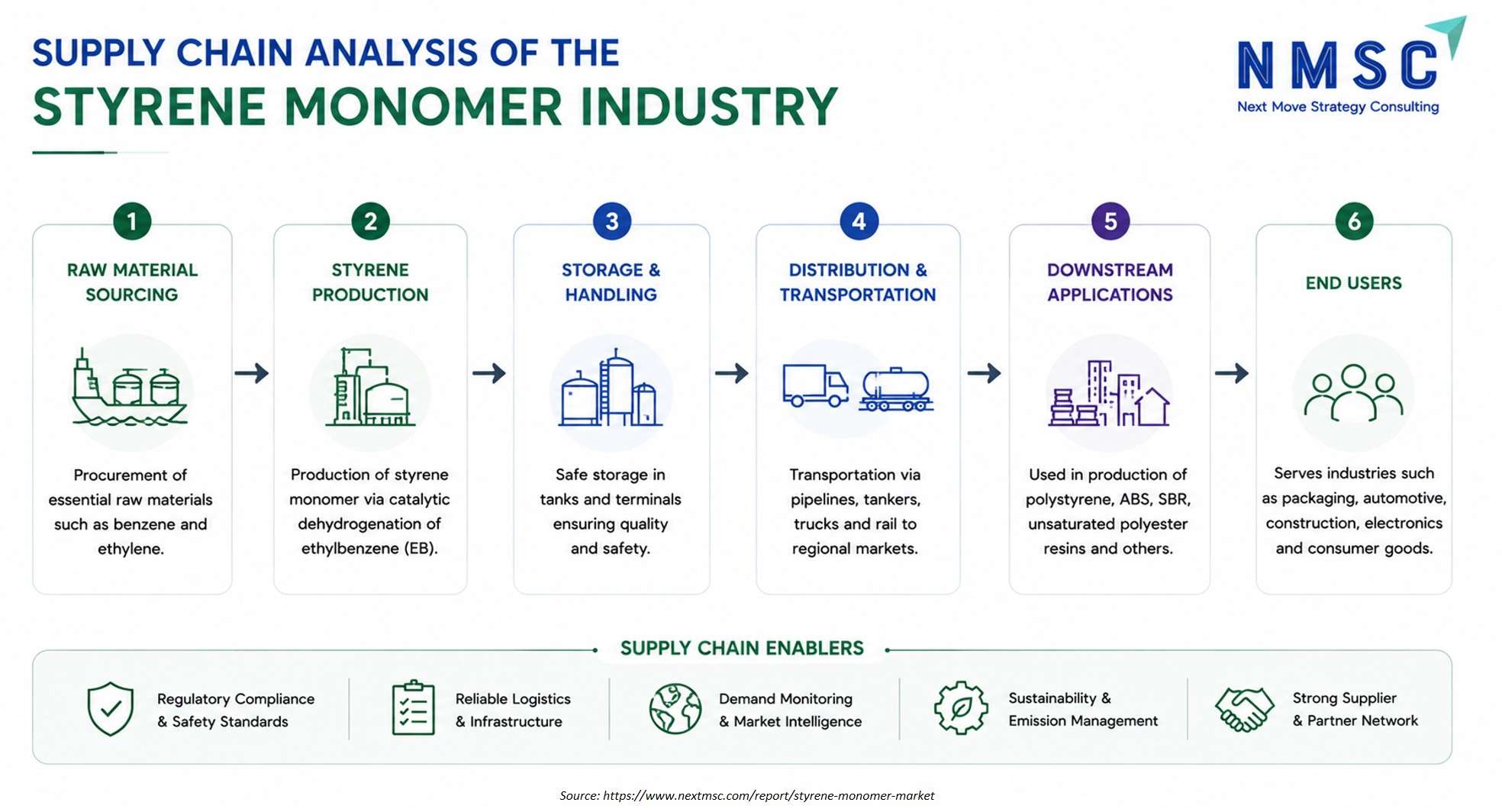
The above infographic provides a detailed supply chain analysis of the styrene monomer industry, outlining a six-step flow from raw material sourcing to end users. It traces the process from the procurement of benzene and ethylene through catalytic production, storage, and distribution to downstream applications like polystyrene and ABS resins. Supported by key enablers such as reliable logistics and regulatory compliance, the chain ensures efficient delivery. Ultimately, the analysis highlights how this interconnected network supplies essential materials to diverse sectors, including packaging, automotive, and construction .

Growth Opportunities

Our analysis shows that three forward-looking opportunities stand out for stakeholders positioning within the Styrene Monomer Market over the 2026-2035 forecast period.

How Can Chemical Recycling Capacity Unlock Value for Producers?

Chemical recycling presents an opportunity for styrene producers to develop circular feedstock pathways and respond to rising demand for recycled-content materials. Recent commercial activity, including INEOS Styrolution's receipt of recycled styrene monomer from Indaver's Antwerp depolymerization plant, demonstrates progress in integrating recycled styrene into commercial supply chains. Expanding access to recycled feedstock can strengthen producers' sustainability offerings while supporting downstream customers seeking certified circular material solutions .

Where Does Asia-Pacific Capacity Expansion Create New Supply Opportunities?

Asia-Pacific downstream demand growth creates an underpenetrated opportunity for producers expanding integrated capacity. Companies that build refinery-integrated production near China and India's growing polystyrene and ABS manufacturing hubs can secure long-term supply contracts as regional demand continues outpacing domestic capacity growth.

How Can Bio-Attributed Certification Benefit Food Packaging Suppliers?

Food packaging manufacturers navigating styrene's regulatory review represent an opportunity for suppliers offering certified, lower-migration alternatives. Early movers that secure validated bio-attributed or recycled-content credentials can differentiate with packaging customers pursuing regulatory-compliant, sustainability-aligned material sourcing through the forecast period.

Regional Outlook

2025 (USD Billion)
2035 (USD Billion)
Asia-Pacific
North Americ
Europe
Middle East
Latin Americ
Region 2025 (USD Billion) 2035 (USD Billion) CAGR (%)
Asia-Pacific $10.0 USD Billion $40.0 USD Billion 9.0%
North America $17.1 USD Billion $51.1 USD Billion 27.0%
Europe $24.2 USD Billion $62.2 USD Billion 25.0%
Middle East & Africa $31.3 USD Billion $73.3 USD Billion 23.0%
Latin America $38.4 USD Billion $84.4 USD Billion 12.0%

Regional data is locked

Unlock complete regional numbers for this market.

Unlock Full Data

Competitive Landscape

We observed that the Styrene Monomer Market features a moderately consolidated competitive landscape. Large integrated petrochemical producers compete alongside specialized styrenics manufacturers across theindustry.

Dimension Description
Market Structure Moderately consolidated; integrated petrochemical majors including SABIC, Shell, and TotalEnergies compete alongside specialized styrenics producers such as INEOS Styrolution and LyondellBasell.
Innovation Focus Chemical recycling, bio-attributed feedstock, and integrated capacity optimization dominate current innovation pipelines across leading producers.
M&A Activity Selective capacity consolidation, exemplified by LyondellBasell and Covestro's joint 2025 decision to close their Maasvlakte co-production unit.

How Do Companies Compete in the Styrene Monomer Market?

Companies compete primarily on feedstock integration, production efficiency, and geographic proximity to downstream demand. Integrated majors including SABIC and Shell leverage captive ethylbenzene supply. Specialized producers such as INEOS Styrolution compete through deep application expertise across polystyrene, ABS, and advanced styrenics . Regional producers in China compete on domestic feedstock access and proximity to manufacturing hubs.

Which Competitive Archetypes Dominate the Styrene Monomer Market?

Two archetypes dominate this market: integrated petrochemical majors with captive feedstock, and specialized styrenics producers with deep downstream application expertise. SABIC and Shell exemplify the integrated archetype. INEOS Styrolution exemplifies the specialized archetype, competing through its broad styrenics portfolio spanning styrene monomer, polystyrene, and advanced ABS grades.

How Are Companies Differentiating Through Innovation?

Innovation and differentiation strategy increasingly center on bio-attributed feedstock and chemical recycling. INEOS Styrolution's bio-attributed polystyrene launch illustrates this shift toward lower-carbon, drop-in materials. Our analysis shows that producers unable to demonstrate credible sustainable chemistry roadmaps risk losing differentiation against more sustainability-forward competitors.

What M&A and Expansion Activity Is Shaping This Market?

Capacity consolidation continues to shape competitive positioning in the Styrene Monomer Market. LyondellBasell and Covestro's decision to permanently close the PO11 propylene oxide and styrene monomer co-production unit at Maasvlakte represents a direct styrene monomer supply-side development. Separately, INEOS Styrolution's Channahon and Wingles closures involve downstream polystyrene production and indicate broader asset rationalization across the styrenics value chain. Together, these developments highlight increasing emphasis on production efficiency and portfolio optimization across mature markets .

Key Market Players

Our assessment indicates that the following 20 companies are actively shaping production technology, capacity strategy, and commercial positioning within the global Styrene Monomer Market.

China Petroleum & Chemical Corporation PetroChina Company Limited Saudi Basic Industries Corporation INEOS Styrolution Group GmbH Formosa Chemicals & Fibre Corporation LG Chem, Ltd. LOTTE Chemical Corporation Shell plc LyondellBasell Industries N.V. Idemitsu Kosan Co., Ltd. TotalEnergies SE Versalis S.p.A. Americas Styrenics LLC Jubail Chevron Phillips Company Nippon Steel Chemical & Material Co., Ltd. Denka Company Limited Yeochun NCC Co., Ltd. Repsol, S.A. Unigel Participações S.A.

Latest Developments

We found that recent developments are concentrated on capacity rationalization and bio-attributed product launches, reflecting the industry's structural transition.

Date Event
September 2025 INEOS Styrolution received the first commercial-scale deliveries of recycled styrene monomer from Indaver’s Antwerp depolymerisation plant.
March 2025 AmSty announced that its first sales of PolyRenew ® certified recycled styrene had occurred in calendar year 2024. The company highlighted the product in a March 2025 announcement, noting that it uses an ISCC PLUS-verified mass-balance approach and can incorporate recycled or sustainable feedstocks, extending AmSty’s circular styrenics portfolio to recycled styrene monomer.

Investment Opportunities

What Capital Inflows Are Targeting the Styrene Monomer Market?

Capital allocation is increasingly focused on production efficiency, circular feedstock pathways, and lower-carbon styrenics across the value chain. Recent commercial-scale recycled styrene activity, including INEOS Styrolution's receipt of recycled styrene monomer from Indaver , demonstrates investment in circular production pathways. Bio-attributed downstream products, including INEOS Styrolution's certified bio-attributed polystyrene, further indicate growing customer interest in lower-carbon styrenics . These developments support investment opportunities in technologies and supply chains that improve feedstock flexibility and sustainability performance .

How Significant Is Infrastructure Investment in This Market?

Infrastructure investment is shifting from new capacity toward efficiency and rationalization at existing sites. INEOS Styrolution's closures at Channahon and Wingles , alongside LyondellBasell and Covestro's Maasvlakte shutdown, illustrate this trend. This scale of rationalization supports producers' focus on utilization rates over raw capacity expansion in mature regions.

What ESG Considerations Are Shaping Investment Decisions?

Environmental, social, and governance considerations center on carbon footprint reduction and regulatory compliance. INEOS Styrolution's ISCC PLUS-certified bio-attributed products exemplify this trend toward verified circular economy credentials. We found that investors increasingly favor producers with transparent, third-party-certified sustainability documentation.

Key Benefits for Stakeholders

How Does This Report Benefit Chemical Industry Leaders?

Chemical industry leaders gain access to validated segmentation, competitive benchmarking, and regional demand forecasts that support capacity planning decisions across the Styrene Monomer Market. Our analysis shows that detailed application and production technology breakdowns help portfolio teams prioritize investment in higher-growth categories.

How Does This Report Benefit Investors and Financial Analysts?

Investors and financial analysts benefit from consistent, single-point market size and CAGR estimates that support valuation decisions across the styrene monomer supply chain. We observed that the report's regional growth differentials help identify which producers and geographies are best positioned to capture above-market growth through 2035.

How Does This Report Benefit Downstream Manufacturers?

Downstream polystyrene, ABS, and rubber manufacturers gain insight into emerging supply trends, including capacity rationalization and bio-attributed feedstock availability, that are reshaping the industry. Our findings suggest that this analysis helps procurement teams prioritize supplier selection around validated supply reliability.

Key Market Segments Evaluated

By Application

  • Polystyrene
  • Styrenic Copolymers
  • Styrene-Based Elastomers
  • Unsaturated Polyester Resins
  • Other Styrene-Based Products

By Production Technology

  • Ethylbenzene Dehydrogenation
  • Styrene Monomer Propylene Oxide Co-Production
  • Other Technologies

By Feedstock Integration

  • Integrated Production
  • Non-Integrated Production

By Sales Type

  • Contract Sales
  • Formula-Based Contracts
  • Fixed-Price Contracts
  • Spot Sales
  • Domestic Spot Sales
  • Export Spot Sales

By End User

  • Polystyrene Producers
  • GPPS Producers
  • HIPS Producers
  • EPS Producers
  • Styrenic Polymer Producers
  • ABS Producers
  • SAN Producers
  • ASA Producers
  • MBS Producers
  • SMMA Producers
  • Synthetic Rubber Producers
  • SBR Producers
  • Styrene Butadiene Latex Producers
  • SBC Producers
  • Resin Producers
  • UPR Producers
  • Styrenated Resin Producers
  • Specialty Chemical Producers
  • Ion Exchange Resin Producers
  • Specialty Styrene Product Producers

Conclusion & Recommendations

The long-term outlook remains steady. Global revenue is projected to expand from USD 65.65 Billion in 2025 to USD 107.28 Billion by 2035 at a 4.89% CAGR. We observed that rising Asia-Pacific polystyrene demand, chemical recycling investment, and capacity rationalization in mature regions will continue shaping the Styrene Monomer Market through the forecast period.

What Strategic Positioning Should Producers Pursue?

Producers should prioritize integrated feedstock access and bio-attributed product development to secure long-term customer contracts. Our assessment indicates that companies investing early in chemical recycling and certified sustainability credentials will be best positioned to capture premium pricing within the Styrene Monomer Market.

How Attractive Is This Market for New Investment?

The Styrene Monomer industry presents an attractive investment case. It is supported by a USD 37.47 Billion absolute dollar opportunity between 2026 and 2035, with above-average growth in Middle East & Africa and Styrene-Based Elastomers categories. We found that investment attractiveness is highest for producers combining integrated feedstock access with sustainability credentials.

What Market Shifts and Key Risks Should Stakeholders Monitor?

Stakeholders should monitor regulatory scrutiny of styrene's carcinogenicity classification, volatile benzene and ethylene feedstock pricing, and overcapacity pressure as key risks to the Styrene Monomer Market. Our analysis shows that producers unable to demonstrate credible sustainability progress risk losing contract share to more compliance-forward competitors.

What Are the Key Growth Pathways for This Market?

Key growth pathways include expanding chemical recycling capacity, scaling bio-attributed feedstock production, and deepening penetration into Asia-Pacific and Middle East & Africa markets. NMSC's analysis indicates that producers pursuing these pathways will be best positioned to capture the Styrene Monomer Market's projected growth through 2035.

FAQs

About the Author

Mayurima Roy

Mayurima Roy

Mayurima Roy is Research Analyst at Next Move Strategy Consulting, where she has spent 4 years working across the firm's full industry coverage rather than a single fixed vertical. Her work centers on structured research, ongoing trend tracking, competitive assessment, and insight-led content development, translating complex market data into clear, decision-ready narratives that support informed client decision-making across diverse global industries, market sectors, and world regions every day.

About the Reviewer

Supradip Baul

Supradip Baul

Supradip Baul is an accomplished business consultant and strategist with over a decade of rich experience in market intelligence, strategy, technology, and business transformation. His work has included rigorous qualitative and quantitative analysis across multiple industries, helping clients shape investment decisions and long-term roadmaps. Earlier in his career, he was associated with Gartner, where he contributed to industry-leading reports and market share analyses. He has worked with leading global companies and holds an MBA with a dual specialization in Marketing and Finance.

Download Free Sample

Amos Chang

AMOS CHANG

Strategy Consultant

Kardex Group

I have bought the intralogistics market reports from NMSC two times so far. Joseph and his team are always very helpful and flexible in responding to any customization requirements on the report. Their expertise in market reports really helps us steer the day-to-day business. I will definitely recommend and come back myself whenever there is a need.

Henri Knyphausen

HENRI KNYPHAUSEN

Partner at Singulier [Ex-BCG]

Singulier

I recently engaged NEXTMSC.com for a commercial due diligence project within the intralogistics sector, and I am pleased to provide a reference based on my experience. In utilizing NEXTMSC.com's services, I found their report to offer valuable insights into market dynamics and key industry players. The initial report provided a solid foundation for our analysis. However, as we were investigating a smaller target in the market, and I had specific customization requests requiring additional research. These requests included detailed information on product portfolios of various players and sub-market sizes, both inclusive and exclusive of certain product categories. NEXTMSC.com demonstrated commendable responsiveness and agility in accommodating these customization requests. Within a timeframe of 1-2 weeks, they delivered a revised report that met our specific needs. Furthermore, they were receptive to my follow-up inquiries, ensuring clarity and understanding of the data provided. The final deliverable significantly contributed to our due diligence efforts. One of NEXTMSC.com's notable strengths lies in their qualitative research capabilities. However, for future engagements, I would recommend the inclusion of a quantified market model in Excel format. Such a model would offer the ability to conduct in-depth analyses and explore various market segments, including country-specific data and subcomponent breakdowns. Based on my positive experience, I would not hesitate to work with NEXTMSC.com again. Their responsiveness, willingness to accommodate customization requests, and commitment to delivering actionable insights make them a reliable partner for commercial research projects.

Robert Sean Trevino

ROBERT SEAN TREVINO

Sr. Director, Head of Strategic Insights & Analytics

Foundation Medicine

I realized that it was a reliable source of information. These days, there are many people who are looking for authentic data, and this is one of the only sources that can offer them with what they need;

Ross J Mckenzie

ROSS J MCKENZIE

Business Insight Manager

Staysure Group

“Next MSC have been incredibly helpful in providing detailed & robust information on our market, alongside quantifying growth by different segments. The process to procure was simple and easy, with sample reports and regular contact to ensure we had what we needed. Succinct detail on their sources & methodologies is also greatly received, allowing transparency in this respect helps build trust in the detail you pay for. Joseph in particular was fantastic, and helped ensure efficient provision of the insight pack – thank you NMSC!”.
Nishant Awate

NISHANT AWATE

Business Development Global Sales

Zehnder Group Deutschland GmbH

Our experience working with Next Move Strategy Consulting was positive. The team was responsive, professional, and open to incorporating our specific requirements throughout the project. The India AHU market study was comprehensive and well structured, covering market value and volume forecasts, product and application segments, and key industry trends. The inclusion of both AHU and residential MVHR market insights made the study particularly relevant for our strategic market assessment. Overall, the report provides a solid foundation for evaluating market potential, identifying priority segments, and supporting business-development decisions in India.

Custom Market Research Services

We will customize the research for you if the listed report does not fully match your requirements.
Get 30% Free Customization

Select License

This website uses cookies to ensure you get the best experience on our website. Learn more

✖