Turkey Propylene Market By Grade (Polymer Grade, Chemical Grade, Refinery Grade, and Other Grade), By Production Route (Steam Cracking, Fluid Catalytic Cracking (FCC), Propane Dehydrogenation (PDH), Metathesis, Methanol to Olefins (MTO) and Other Routes), By Derivative (Polypropylene, Propylene Oxide, Cumene, Acrylonitrile), By Sales Model (Merchant, Captive, and Tolling), and By Application (Packaging, Automotive & Others) – Opportunity Analysis and Industry Forecast, 2025–2035.
Industry: Materials and Chemical | Latest Edition: August 5, 2026 | No of Pages: 297 | No. of Tables: 172 | No. of Figures: 162 | Format: PDF | Report Code: MC5585
Turkey Propylene Market Size & Forecast 2025–2035.
|
Parameters |
Details |
|
Market Size in 2025 |
USD 519.27 Million |
|
Market Size in 2026 |
USD 545.22 Million |
|
Revenue Forecast in 2035 |
USD 774.76 Million |
|
Growth Rate (Revenue) |
CAGR of 3.98% from 2026 to 2035 |
|
Market Volume in 2025 |
468 Kilo Tons |
|
Market Volume in 2026 |
514 Kilo Tons |
|
Volume Forecast in 2035 |
1,009 Kilo Tons |
|
Growth Rate (Volume) |
CAGR of 7.77% from 2026 to 2035 |
|
Forecast Period |
2026–2035 |
Industry Outlook
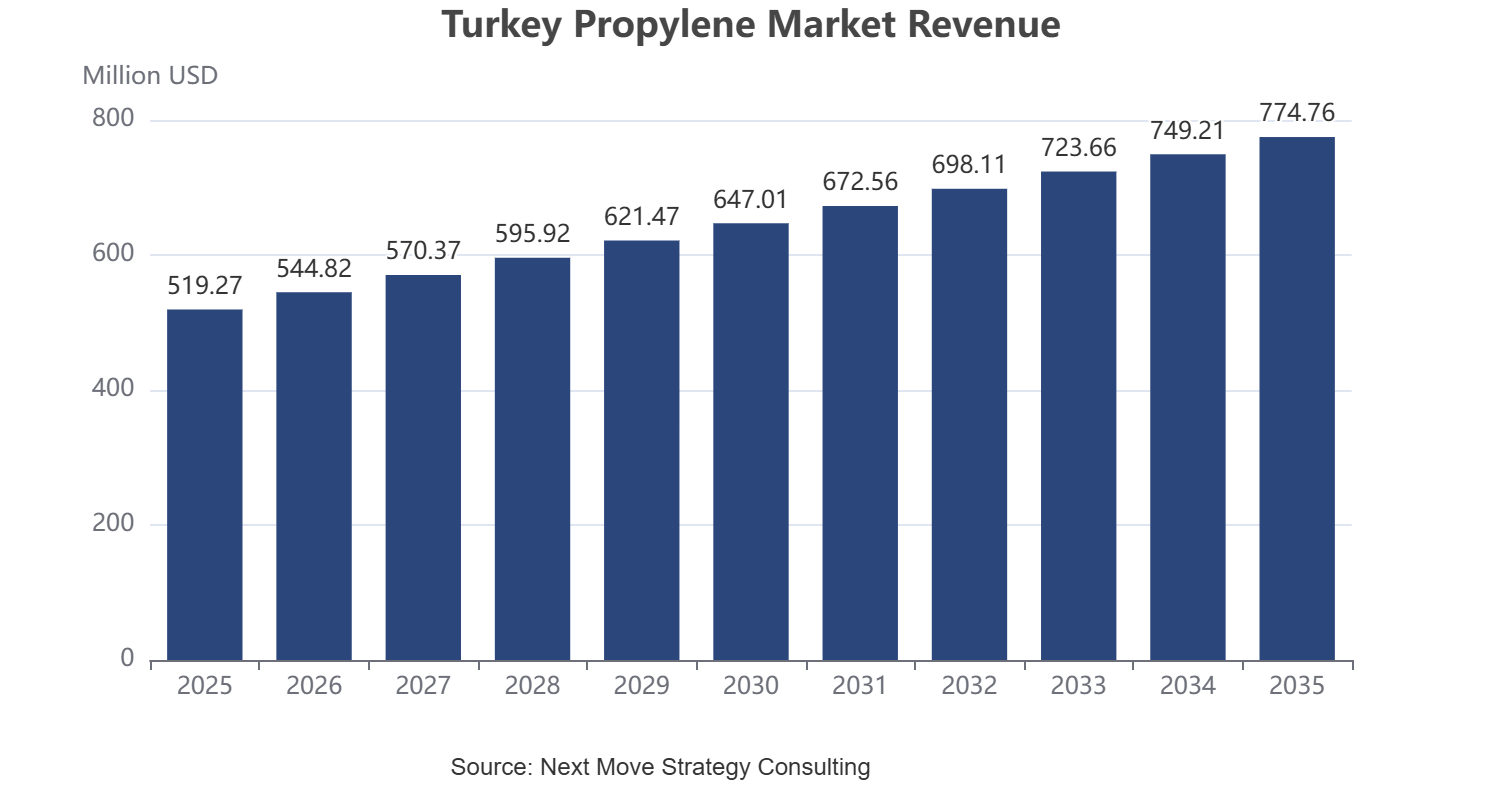
The Turkey Propylene Market size was valued at USD 519.27 million in 2025 and is estimated to reach USD 545.22 million in 2026. Looking ahead, the industry is projected to grow steadily, reaching USD 774.76 million by 2035, registering a CAGR of 3.98% from 2026 to 2035. In terms of volume, the market recorded 468 kilo tons in 2025, with forecasts indicating growth to 514 kilo tons by 2026 and further to 1,009 kilo tons by 2035, reflecting a CAGR of 7.77% over the same period.
What Are the Key Market Drivers, Restraints, and Opportunities Shaping the Turkey Propylene Market Through 2035?
Growth Catalyst & Risk Assessment Matrix
|
Drivers / Trends / Restraints |
(+/–) % Impact on CAGR Forecast |
Geographic Relevance |
Impact Timeline |
|
Growing packaging, automotive, and textile industries are driving market growth by increasing polypropylene demand across downstream manufacturing sectors |
+1.4% |
National, particularly Istanbul and Kocaeli industrial belts |
Short to medium term (1–5 years) |
|
Rising industrial production and manufacturing activities are driving market growth by supporting downstream petrochemical consumption across multiple end-use industries |
+1.2% |
National |
Medium term (2–6 years) |
|
Increasing investments in petrochemical complex expansions and propane dehydrogenation capacity are driving market growth by strengthening domestic propylene supply and reducing import reliance |
+1.1% |
Izmir and Kocaeli petrochemical hubs |
Medium to long term (3–7 years) |
|
High import dependence for feedstocks and currency volatility are restraining market expansion by increasing cost pressures across the value chain |
–1.3% |
National |
Short to medium term (1–5 years) |
|
Expansion of domestic petrochemical investments is creating opportunities for market growth by strengthening self-sufficiency and supply chain resilience |
+1.0% |
National |
Long term (4–10 years) |
Through our market assessment, we observed that the Turkey Propylene Market is witnessing steady growth driven by expanding packaging, automotive, and textile industries, rising industrial production, and increasing investments in petrochemical capacity. Growing manufacturing activity is supporting downstream consumption of propylene derivatives across the country. Meanwhile, high import dependence for feedstocks and currency volatility continue to pose challenges for market participants. Additionally, expansion of domestic petrochemical investments is creating long-term opportunities for propylene producers operating within the Turkish market.
Growth Driver:
How Is Growing Demand from Packaging, Automotive, and Textile Industries Driving the Turkey Propylene Market Growth?
Through our market assessment, we observed that growing packaging, automotive, and textile industries are significantly increasing polypropylene demand across Turkey, thereby driving propylene consumption. Polypropylene remains widely utilized in flexible and rigid packaging, automotive interior and exterior components, and synthetic fiber production. Rising consumer demand for lightweight and durable packaging materials, combined with expanding automotive manufacturing and textile export activities, continues to strengthen downstream propylene requirements. Furthermore, growth in domestic apparel and industrial fiber production is reinforcing sustained demand across the propylene value chain.
How Are Rising Industrial Production and Manufacturing Activities Supporting Turkey Propylene Market Growth?
Based on our market evaluation, rising industrial production and manufacturing activities across Turkey are substantially supporting downstream petrochemical consumption and propylene market growth. Expanding manufacturing output across construction, consumer products, and industrial sectors is increasing requirements for propylene derivatives such as polypropylene, propylene oxide, and acrylic acid. Additionally, growing industrial output is encouraging capacity utilization across domestic petrochemical complexes. This sustained manufacturing expansion is expected to continue reinforcing propylene demand throughout the forecast period, supporting broader downstream value chain development across the country.
How Are Investments in Petrochemical Capacity and Propane Dehydrogenation Strengthening Turkey Propylene Market Growth?
Through NMSC's assessment, we found that increasing investments in petrochemical complex expansions and propane dehydrogenation capacity are strengthening domestic propylene supply across Turkey. Producers are increasingly pursuing on-purpose production technologies to reduce dependence on imported propylene and feedstocks. Expansion of domestic production infrastructure is improving supply reliability and enabling manufacturers to better address rising downstream demand. This trend toward capacity expansion and production diversification is expected to support long-term competitiveness and supply chain resilience across the Turkish propylene industry.
Growth Inhibitor:
How Is High Import Dependence and Currency Volatility Restraining the Turkey Propylene Market?
High import dependence for feedstocks and currency volatility continues acting as significant constraints for the Turkey Propylene Market by creating uncertainty in production economics. Through our market analysis, we observed that fluctuations in the Turkish lira and reliance on imported naphtha and propane directly affect production costs and profit margins across the value chain. Unpredictable currency movements and supply chain disruptions can influence operating expenses and investment planning decisions. These pressures may also delay capacity expansion projects and reduce investment confidence among small and mid-sized market participants.
Growth Opportunity:
How Is Expansion of Domestic Petrochemical Investments Creating Opportunities for the Turkey Propylene Market?
Through our market assessment, we found that expansion of domestic petrochemical investments is creating significant growth opportunities for the Turkey Propylene Market. Rising government and private sector focus on strengthening domestic production infrastructure is encouraging producers to invest in capacity expansion and feedstock diversification initiatives. These investments are reducing reliance on imported propylene while improving supply chain resilience across the value chain. Furthermore, growing emphasis on self-sufficiency in petrochemical production is creating long-term opportunities for producers to enhance competitiveness within the domestic and regional markets.
Supply Chain Structure of the Turkey Propylene Market
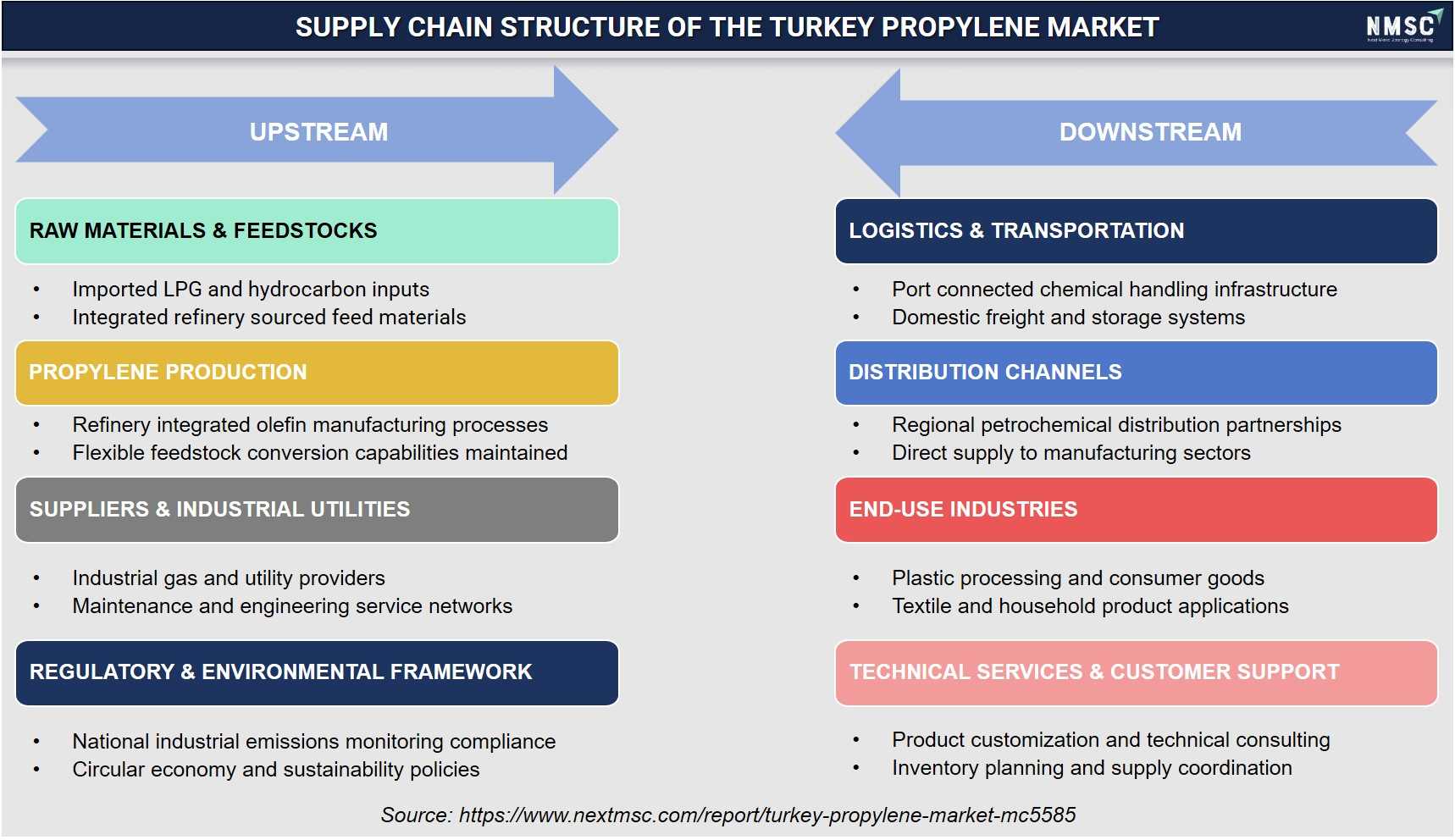
The supply chain structure of the propylene market is supported by a network of feedstock suppliers, production facilities, logistics providers, distributors, and downstream industries. Raw materials such as LPG and refinery-derived hydrocarbons serve as key feedstocks for propylene production. Efficient transportation, storage, and distribution systems ensure a stable supply to end-use sectors including plastics, consumer goods, and industrial manufacturing. Regulatory compliance, sustainability initiatives, and technical support services further enhance operational efficiency and supply chain resilience across the market.
How Is the Turkey Propylene Market Segmented in This Report, and What Are the Key Insights From the Segmentation Analysis?
By Derivative Insights
Is Derivative Segmentation Influencing Demand Patterns Across the Israel Propylene Market?
Based on derivative, the market is segmented into polypropylene, propylene oxide, cumene, acrylonitrile, oxo alcohols, isopropanol, acrylic acid and acrylates, and other derivatives.
Based on our analysis, we observed that derivative demand across the Israel propylene market is largely influenced by the requirements of downstream petrochemical, packaging, automotive, healthcare, and industrial sectors. Polypropylene represents the dominant derivative segment owing to its extensive utilization in packaging materials, consumer goods, and industrial applications, with both homo polypropylene and copolymer polypropylene grades witnessing steady demand. Propylene oxide supports the production of polyether polyols, propylene glycol, and glycol ethers used in polyurethane, construction, and specialty chemical applications. Meanwhile, derivatives such as cumene, acrylonitrile, oxo alcohols, isopropanol, and acrylic acid continue to contribute to market growth through their applications in plastics, coatings, solvents, adhesives, synthetic fibers, and pharmaceutical products.
By Sales Model Insights
Is Sales Model Segmentation Influencing Commercial Dynamics Across the Israel Propylene Market?
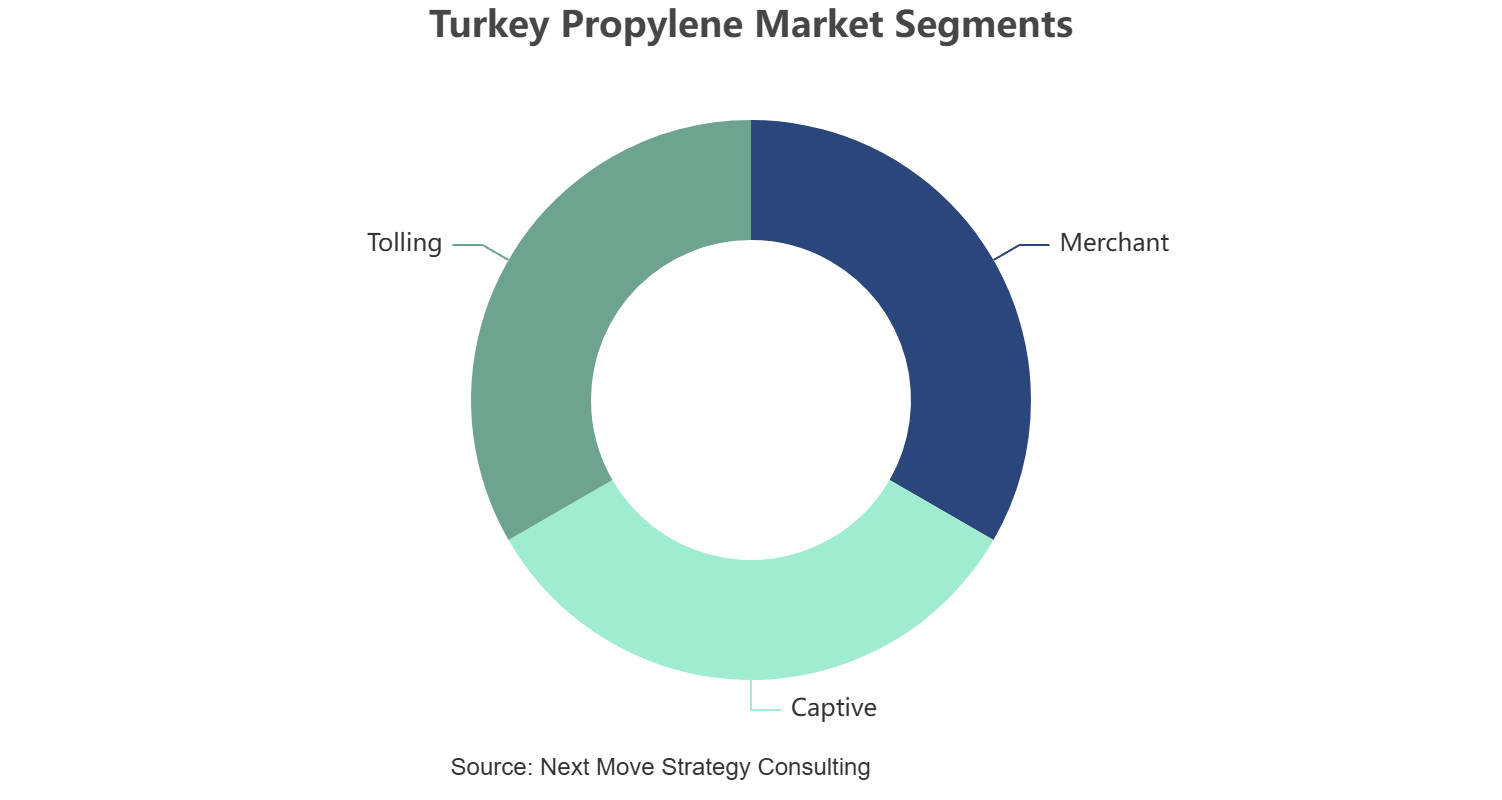
Based on sales model, the market is segmented into merchant, captive, and tolling.
Based on our evaluation, we identified that sales model selection across the Israel propylene market is influenced by production integration levels, supply chain strategies, and end-user procurement requirements. Captive consumption remains significant among integrated petrochemical producers that utilize propylene internally for the manufacturing of polypropylene and other downstream derivatives, ensuring operational efficiency and feedstock security. Merchant sales support independent chemical manufacturers and processors through direct market transactions, providing flexibility in procurement. Meanwhile, tolling arrangements enable companies to optimize production assets and processing capabilities while reducing capital investment requirements, contributing to improved supply chain efficiency and market competitiveness.
Key Segments
By Grade
-
Polymer Grade
-
Chemical Grade
-
Refinery Grade
-
Other Grade
By Production Route
-
Steam Cracking
-
Fluid Catalytic Cracking (FCC)
-
Propane Dehydrogenation (PDH)
-
Metathesis
-
Methanol to Olefins (MTO)
-
Coal to Olefins (CTO)
-
Other Routes
By Derivative
-
Polypropylene
-
Homo PP
-
Copolymer PP
-
Random
-
Block
-
-
-
Propylene Oxide
-
Polyether Polyols
-
Propylene Glycol
-
Glycol Ethers
-
-
Cumene
-
Phenol
-
Acetone
-
-
Acrylonitrile
-
Acrylic Fibers
-
ABS
-
Nitrile Rubber
-
-
Oxo Alcohols
-
n-Butanol
-
Isobutanol
-
2-Ethylhexanol
-
-
Isopropanol
-
Solvents
-
Pharma
-
Sanitizers
-
-
Acrylic Acid and Acrylates
-
SAP
-
Coatings
-
Adhesives
-
-
Other Derivatives
By Sales Model
-
Merchant
-
Captive
-
Tolling
By Application
-
Packaging
-
Rigid Packaging
-
Flexible Packaging
-
-
Automotive
-
Interior Components
-
Exterior Components
-
Under-the-hood Parts
-
-
Building & Construction
-
Insulation
-
Pipes & Fittings
-
Architectural Coatings
-
-
Textiles and Fibers
-
Apparel Fibers
-
Industrial Fibers
-
-
Consumer Products
-
Appliances
-
Household Goods
-
Personal Care
-
-
Healthcare
-
Medical Plastics
-
Disinfectants
-
Pharma Solvents
-
-
Electronics
-
Electronic Components
-
Equipment Housings
-
-
Industrial Applications
-
Industrial Solvents
-
Lubricants
-
Industrial Coatings and Adhesives
-
Other Industrial End‑Uses
-
-
Other Applications
Pestel Analysis of the Turkey Propylene Market
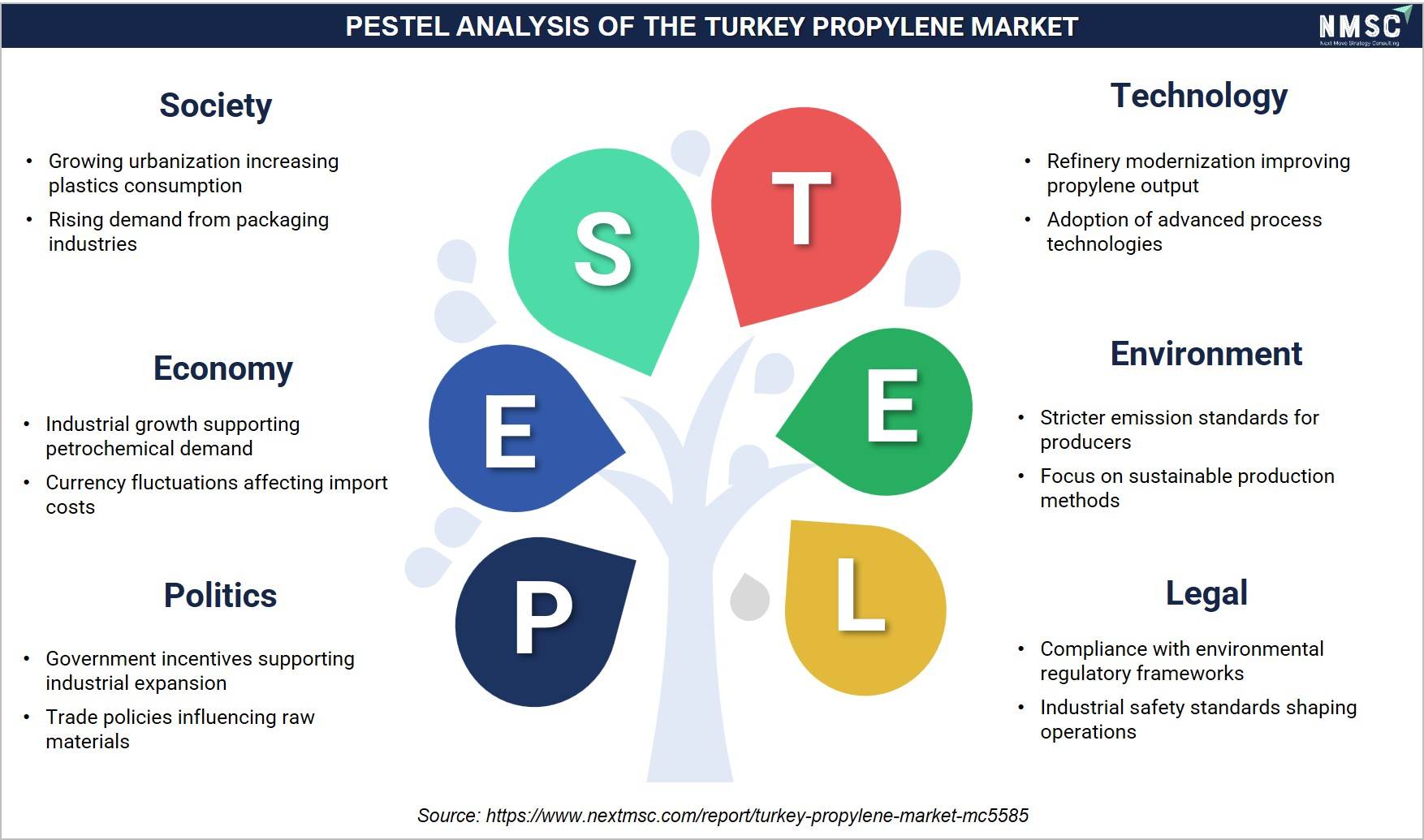
The PESTEL analysis of the propylene market highlights the influence of political stability, economic conditions, and industrial policies on market development. Economic growth and expanding manufacturing activities support propylene demand, while technological advancements improve production efficiency and operational performance. Environmental regulations encourage sustainable production practices and emissions reduction initiatives. Social trends drive demand for packaging and consumer products, whereas legal frameworks ensure compliance with safety, quality, and environmental standards. Collectively, these factors shape investment decisions, competitiveness, and long-term growth prospects within the market.
Competitive Landscape
The Turkey Propylene Market is characterized by a moderately consolidated structure, supported by the presence of integrated petrochemical producers, refinery operators, and multinational chemical manufacturers. Market growth is being driven by rising demand for polypropylene and other propylene derivatives, expanding investments in domestic petrochemical capacity, and growing consumption across packaging, automotive, construction, and textile sectors. In addition, advancements in production technologies, feedstock optimization strategies, and investments in supply chain resilience are enhancing operational efficiency and supporting broader market expansion across the country.
Key Players
-
ExxonMobil Exploration and Production Turkey B.V.
-
Basell Polyolefin Istanbul Ticaret Limited Sirketi
-
Dow Turkiye Kimya Sanayi ve Ticaret Limited Sirketi
-
Chevron Phillips Chemicals Kimya Urunleri Ticaret Limited Sirketi
-
LG Chem TK Kimya Sanayi ve Ticaret Limited Sirketi
-
Borealis AG
-
Shell Company of Turkiye Limited
-
Guzel Enerji Akaryakit A.S.
-
Petkim Petrokimya Holding A.S.
-
SASA Polyester Sanayi Anonim Sirketi
NMSC's analysis indicates that competitive dynamics in the Turkey Propylene Market are increasingly shaped by capacity expansion, feedstock optimization, and value chain integration. Key companies such as ExxonMobil Exploration and Production Turkey B.V., Basell Polyolefin Istanbul Ticaret Limited Sirketi, Dow Turkiye Kimya Sanayi ve Ticaret Limited Sirketi, Chevron Phillips Chemicals Kimya Urunleri Ticaret Limited Sirketi, LG Chem TK Kimya Sanayi ve Ticaret Limited Sirketi, Borealis AG, Shell Company of Turkiye Limited, Guzel Enerji Akaryakit A.S., Petkim Petrokimya Holding A.S., and SASA Polyester Sanayi Anonim Sirketi are strengthening their positions through strategic investments and technology upgrades.
Key Benefits for Stakeholders
Next Move Strategy Consulting (NMSC) presents a comprehensive analysis of the Turkey Propylene Market, covering historical developments and providing forecasts through 2035. Our study evaluates the market at the national level, delivering quantitative outlooks alongside qualitative insights into propylene production trends, feedstock dynamics, petrochemical capacity expansions, and derivative demand growth. The report further examines technological advancements in production processes and evolving regulatory considerations shaping the domestic petrochemical industry, offering stakeholders a clear understanding of competitive dynamics and emerging growth opportunities across the value chain.
Investors benefit from expanding opportunities in domestic petrochemical capacity and downstream derivative applications, while propylene producers, refinery operators, petrochemical manufacturers, distributors, and technology providers gain insights into growing demand across packaging, automotive, construction, and textile industries. End-use manufacturers benefit from a clearer understanding of supply dynamics and feedstock availability across Turkey. Policymakers and trade associations can leverage these findings to support strategic planning around domestic production capacity, import substitution initiatives, and long-term industry competitiveness within the regional petrochemical landscape.
|
Parameters |
Details |
|
Customization Scope |
Free customization (equivalent to up to 80 analyst-working hours) after purchase. |
|
Pricing and Purchase Options |
Avail customized purchase options to meet your exact research needs. |
|
Approach |
In-depth primary and secondary research; proprietary databases; rigorous quality control and validation measures. |
|
Analytical Tools |
Porter's Five Forces, SWOT, value chain, and Harvey ball analysis to assess competitive intensity, stakeholder roles, and relative impact of key factors. |
Conclusion
The Turkey Propylene Market is poised for steady growth through 2035, supported by expanding packaging, automotive, and textile industries, rising industrial production, and increasing investments in petrochemical capacity and propane dehydrogenation infrastructure. While high import dependence for feedstocks and currency volatility continue to pose challenges, expansion of domestic petrochemical investments is creating significant long-term opportunities for market participants. The competitive landscape remains shaped by capacity expansion, feedstock optimization, and strategic partnerships among integrated producers and multinational manufacturers, positioning the market for sustained value chain development across the forecast period.
About the Author
 Saista Faiyaz
— Saista Faiyaz is Research Associate at Next Move Strategy Consulting, where she has covered consumer markets and healthcare technologies for 3 years. Her work includes primary interview review, secondary-source validation, market sizing, and structured analysis of company and industry data. She supports research by comparing evidence across sources, organizing findings into market narratives, and documenting assumptions used in analysis. Her scope includes cross-market benchmarking, and reports.
Saista Faiyaz
— Saista Faiyaz is Research Associate at Next Move Strategy Consulting, where she has covered consumer markets and healthcare technologies for 3 years. Her work includes primary interview review, secondary-source validation, market sizing, and structured analysis of company and industry data. She supports research by comparing evidence across sources, organizing findings into market narratives, and documenting assumptions used in analysis. Her scope includes cross-market benchmarking, and reports.
About the Reviewer
 Supradip Baul
— Supradip Baul is an accomplished business consultant and strategist with over a decade of rich experience in market intelligence, strategy, technology, and business transformation. His work has included rigorous qualitative and quantitative analysis across multiple industries, helping clients shape investment decisions and long-term roadmaps. Earlier in his career, he was associated with Gartner, where he contributed to industry-leading reports and market share analyses. He has worked with leading global companies and holds an MBA with a dual specialization in Marketing and Finance.
Supradip Baul
— Supradip Baul is an accomplished business consultant and strategist with over a decade of rich experience in market intelligence, strategy, technology, and business transformation. His work has included rigorous qualitative and quantitative analysis across multiple industries, helping clients shape investment decisions and long-term roadmaps. Earlier in his career, he was associated with Gartner, where he contributed to industry-leading reports and market share analyses. He has worked with leading global companies and holds an MBA with a dual specialization in Marketing and Finance.
At Next Move Strategy Consulting, we understand that insightful market research is the cornerstone of successful business decisions. That's why we employ a robust and multifaceted approach, combining various methodologies to deliver the most accurate and actionable data for our clients.

Research Landscape
We navigate the world of research with two primary approaches:
Qualitative Approach
Our qualitative research methodologies involve immersive techniques such as in-depth interviews, focus groups, and observational studies. By engaging directly with individuals and stakeholders, we uncover valuable insights that quantitative data alone may overlook.

Quantitative Research
In tandem with qualitative methodologies, NMSC leverages the power of Quantitative Research to provide a robust foundation of numerical insights. Through systematic data collection and analysis, we quantify patterns, preferences, and market trends, offering a comprehensive view of the business landscape.
Our quantitative research approach employs diverse tools, including surveys, experiments, and statistical modelling. These methodologies enable us to gather data from a large and representative sample, ensuring the statistical significance of our findings. By employing structured questionnaires and standardized data collection methods, we guarantee the reliability and validity of the information we present to our clients.
Quantitative research is particularly effective in measuring the prevalence of trends, assessing market size, and gauging the impact of various factors on consumer behavior. The numerical precision attained through this approach equips our clients with actionable insights, facilitating data-driven decision-making and strategy formulation.


Our Specialized Toolbox for Industry-Specific Market Research
We deploy a specialized arsenal of techniques tailored to meet your unique requirements. Here's a glimpse into our comprehensive toolbox:

Information Procurement
The stage entails acquiring market data or relevant information through various sources and methodologies.


Market Research Approach
We utilize both top-down and bottom-up approaches in market research analysis to achieve a comprehensive understanding of the market dynamics, leveraging the broad perspective of industry trends and macroeconomic factors alongside detailed insights from specific segments and individual companies.

Porters Five Forces Analysis
We conduct Porter's Five Forces analysis to evaluate the competitive landscape of an industry, providing us with insights into factors that affect profitability and strategic positioning.

SWOT Analysis

Forecasting
We utilize a forecasting model to predict future consumption by considering parameters like population, economics, regulations, market competition, drivers, constraints, technology, and pricing. We also employ statistical techniques such as multilinear regression, exponential smoothing, moving average, ARIMA, and Monte Carlo simulations for accurate predictions. In econometric forecasting, we analyzed short-term and long-term event impacts, attributing values based on regulatory frameworks, economic factors, and market events.





 Speak to Our Analyst