China Propylene Market By Grade (Polymer, Chemical, Refinery, and Other Grades), By Production Route (Steam Cracking, FCC, PDH, Metathesis, MTO, CTO, and Other Routes), By Derivative (Polypropylene, Propylene Oxide, Cumene, Acrylonitrile, Oxo Alcohols, Isopropanol), By Sales Model (Merchant, Captive, and Tolling), and By Application (Packaging, Automotive, Building & Construction, Textiles and Fibers & Others) – Opportunity Analysis and Industry Forecast, 2025–2035.
Industry: Materials and Chemical | Latest Edition: September 30, 2026 | No of Pages: 303 | No. of Tables: 172 | No. of Figures: 162 | Format: PDF | Report Code: MC4932
China Propylene Market Size & Forecast 2025–2035
|
Parameters |
Details |
|
Market Size in 2025 |
USD 41.70 Billion |
|
Market Size in 2026 |
USD 44.17 Billion |
|
Revenue Forecast in 2035 |
USD 68.59 Billion |
|
Growth Rate |
CAGR of 5.01% from 2026 to 2035 |
|
Market Volume in 2025 |
32 Million Tons |
|
Market Volume in 2026 |
35 Million Tons |
|
Volume Forecast in 2035 |
60 Million Tons |
|
Growth Rate |
CAGR of 6.29% from 2026 to 2035 |
|
Analysis Period |
2025–2035 |
|
Base Year Considered |
2025 |
|
Forecast Period |
2026–2035 |
|
Market Size Estimation |
Billion (USD) |
|
Companies Profiled |
15 |
|
Market Share |
Available for 10 Companies |
Industry Outlook
The China Propylene Market size was valued at USD 41.70 billion in 2025 and reached USD 44.17 billion by 2026. Looking ahead, the industry is projected to grow steadily, reaching USD 68.59 billion by 2035, registering a CAGR of 5.01% from 2026 to 2035. In terms of volume, the market recorded 32 million tons in 2025, with forecasts indicating growth to 35 million tons by 2026 and further to 60 million tons by 2035, reflecting a CAGR of 6.29% over the same period. The analysis covers the period from 2025 to 2035, with 2025 considered as the base year.
What Are the Key Market Drivers, Emerging Trends, and Investment Opportunities That Will Shape the China Propylene Market in the Next Decade?
|
Drivers / Trends / Restraints |
(+/–) % Impact on CAGR Forecast |
Geographic Relevance |
Impact Timeline |
|
Rising demand for polypropylene across packaging, automotive, and consumer goods industries is increasing propylene consumption throughout China’s domestic manufacturing sector |
+1.6% |
National, particularly Zhejiang, Jiangsu, and Shandong |
Short to medium term (1–5 years) |
|
Expansion of propane dehydrogenation (PDH) and coal-to-olefins (CTO) capacity is strengthening domestic feedstock diversification and supply security |
+1.4% |
Eastern coastal provinces and Northwest coal-rich regions |
Medium term (2–6 years) |
|
Growing demand for propylene derivatives such as propylene oxide, acrylonitrile, and cumene from construction, electronics, and healthcare sectors is supporting market expansion |
+1.1% |
National |
Medium to long term (3–7 years) |
|
Overcapacity and volatility in naphtha, propane, and coal feedstock prices are creating margin pressure for producers and limiting investment certainty |
–1.2% |
National |
Short to medium term (1–5 years) |
|
Increasing investments in low-carbon propylene production, carbon capture integration, and circular economy initiatives are creating new growth opportunities across the value chain |
+1.0% |
Eastern coastal provinces, Northwest China |
Long term (4–10 years) |
Through our market assessment, we observed that the China Propylene Market is witnessing robust growth driven by rising polypropylene demand, large-scale capacity additions across propane dehydrogenation and coal-to-olefins routes, and increasing consumption of propylene derivatives across multiple downstream industries. Growing demand from packaging, automotive, construction, and electronics sectors is supporting continuous capacity expansion across eastern coastal provinces and northwestern coal-rich regions. Meanwhile, overcapacity and feedstock price volatility continue to challenge producer margins. Additionally, investments in low-carbon and circular petrochemical manufacturing are creating long-term opportunities for propylene producers operating across the domestic value chain.
Growth Drivers:
How Is Rising Polypropylene Demand Driving the China Propylene Market Growth?
Through our market assessment, we observed that growing demand for polypropylene is a major factor driving propylene consumption across China. Polypropylene remains the largest derivative of propylene and is extensively utilized in packaging materials, automotive components, household goods, and consumer electronics housings. Rising demand for lightweight, durable, and cost-effective plastics is encouraging polypropylene production, thereby boosting upstream propylene requirements. Furthermore, expanding e-commerce-driven packaging consumption and continued automotive lightweighting initiatives across domestic manufacturing hubs are reinforcing sustained demand for polymer-grade propylene throughout the forecast period.
How Are Investments in PDH and Coal-to-Olefins Capacity Strengthening the China Propylene Market?
Expansion of propane dehydrogenation and coal-to-olefins capacity is significantly contributing to growth in the China propylene market by diversifying feedstock sources and reducing dependence on traditional steam cracking output. Based on our market evaluation, domestic producers are increasingly investing in on-purpose propylene technologies to strengthen supply security and capitalize on relatively low-cost coal and propane feedstocks. These facilities offer greater production flexibility, enabling manufacturers to address rising downstream demand while improving operational efficiency across both coastal refining hubs and inland coal-chemical production bases.
How Is Rising Demand for Propylene Derivatives Supporting China Propylene Market Development?
Based on research conducted by NMSC, increasing consumption of propylene derivatives such as propylene oxide, acrylonitrile, cumene, oxo alcohols, and acrylic acid is substantially supporting market growth across China. These derivatives serve as essential feedstocks for industries including construction, electronics, textiles, and healthcare. Rising demand for polyurethane foams, engineering plastics, synthetic fibers, and specialty coatings is expanding derivative production volumes and creating sustained pull-through demand for propylene across the domestic chemical value chain, reinforcing long-term expansion opportunities throughout the forecast period.
Growth Inhibitor:
How Is Overcapacity and Feedstock Price Volatility Constraining the China Propylene Market?
Overcapacity and feedstock price volatility continue acting as significant constraints for the China Propylene Market by creating margin pressure and pricing uncertainty across the value chain. Through our market analysis, we observed that rapid capacity additions across steam cracking, PDH, and coal-to-olefins routes have intensified domestic competition, compressing producer profitability. In addition, fluctuations in naphtha, propane, and coal prices directly affect production economics, influencing investment planning decisions. These pressures may delay further capacity expansion projects and reduce near-term investment confidence among small and mid-sized petrochemical participants operating across the country.
Growth Opportunity:
How Are Low-Carbon and Green Propylene Production Investments Unlocking New Opportunities in the China Propylene Market?
According to our assessment, increasing investment in low-carbon propylene production technologies, including bio-based feedstocks and carbon capture integration with coal-to-olefins facilities, is unlocking significant growth opportunities for the China Propylene Market. Rising regulatory emphasis on China’s dual carbon goals is encouraging producers to adopt cleaner manufacturing processes and circular economy practices. Advanced recycling initiatives are enabling recovery of valuable feedstocks for polypropylene and other derivatives, improving resource efficiency. Growing corporate sustainability commitments are creating long-term opportunities for propylene producers to enhance competitiveness while supporting national environmental objectives.
Supply Chain Structure Of The China Propylene Market
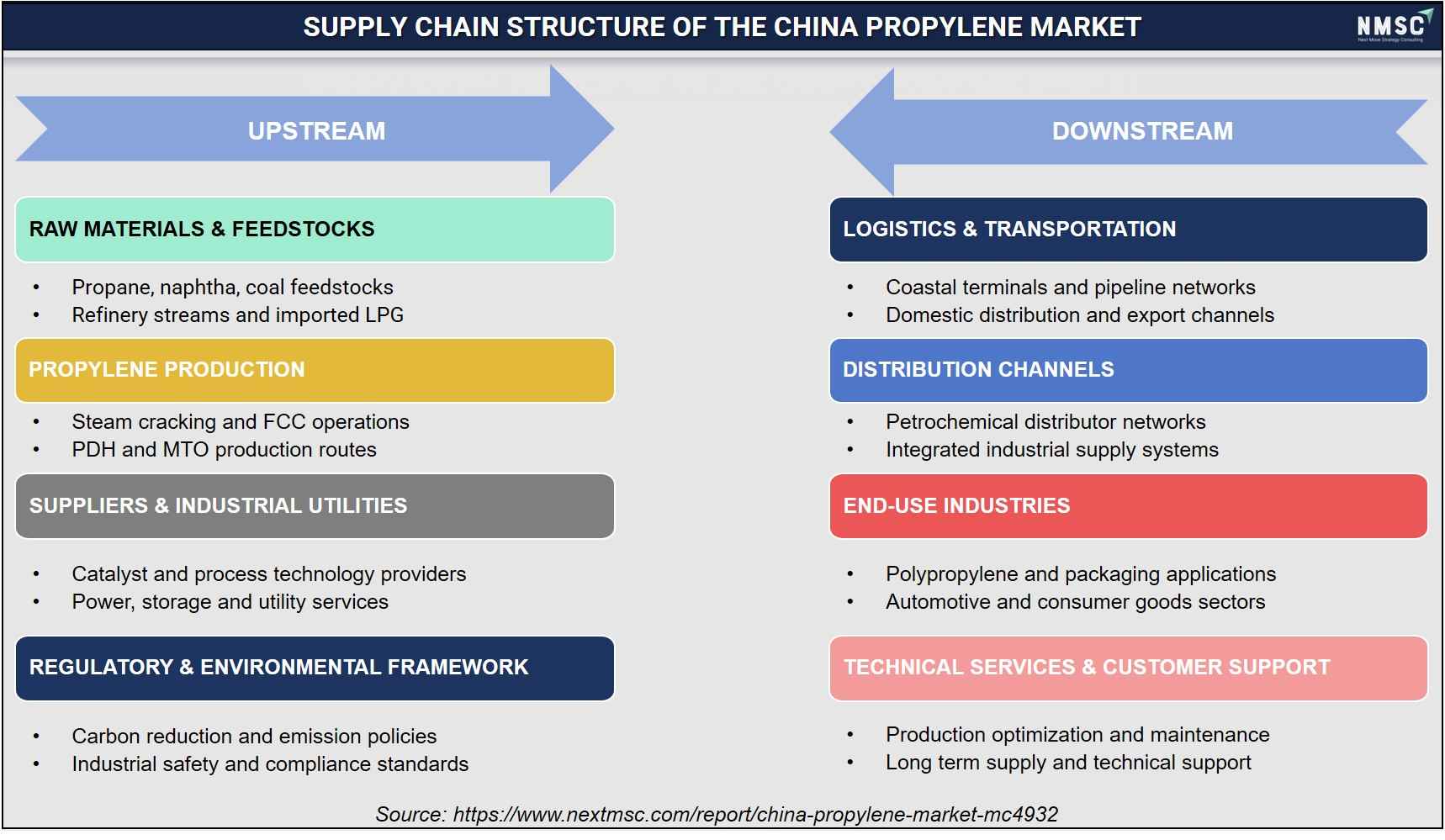
The China propylene market operates through an integrated supply chain encompassing feedstock procurement, production, distribution, and end-use consumption. Upstream activities rely on raw materials such as propane, naphtha, coal feedstocks, refinery streams, and imported LPG. Propylene is primarily produced through steam cracking, fluid catalytic cracking (FCC), propane dehydrogenation (PDH), and methanol-to-olefins (MTO) processes, supported by catalyst suppliers, utility providers, and industrial service companies. Downstream, established logistics networks, distribution channels, and petrochemical supply systems facilitate product movement to key end-use industries including polypropylene, packaging, automotive, and consumer goods. Regulatory frameworks focused on emissions reduction, industrial safety, and environmental compliance further influence market operations and supply chain efficiency.
How Is the China Propylene Market Segmented in This Report, and What Are the Key Insights From the Segmentation Analysis?
By Grade Insights
Is Grade Segmentation Influencing Product Utilization Across the China Propylene Market?
Based on grade, the market is segmented into polymer grade, chemical grade, refinery grade, and other grades.
According to our assessment, grade preferences within the China propylene market are primarily driven by purity requirements, downstream processing needs, and industry-specific applications. Polymer-grade propylene accounts for a significant share of consumption due to its widespread use in polypropylene manufacturing, serving sectors such as packaging, automotive, construction, and consumer goods. Chemical-grade propylene is extensively utilized in the production of value-added derivatives including propylene oxide, acrylonitrile, cumene, and oxo-alcohols. Refinery-grade propylene remains important for captive consumption and further processing within refining facilities, while other grades are increasingly being adopted for niche industrial and specialty chemical applications.
By Production Route Insights
Is Production Route Segmentation Shaping Supply Dynamics Across the China Propylene Market?
Based on production route, the market is segmented into steam cracking, fluid catalytic cracking (FCC), propane dehydrogenation (PDH), metathesis, methanol to olefins (MTO), coal to olefins (CTO), and other routes.
Based on our analysis, production route selection in the China propylene market is strongly influenced by feedstock economics, resource availability, and strategic industrial development initiatives. Steam cracking and FCC continue to represent key sources of propylene supply through integrated petrochemical and refining operations. At the same time, PDH capacity expansion is strengthening China’s on-purpose propylene production capabilities, supported by increasing access to imported propane. MTO and CTO technologies maintain a notable position in the market due to the country’s substantial coal reserves and established coal chemical industry. Additionally, metathesis and other advanced production technologies are contributing to greater supply diversification and operational flexibility across the propylene value chain.
Key Segments
By Grade
-
Polymer Grade
-
Chemical Grade
-
Refinery Grade
-
Other Grade
By Production Route
-
Steam Cracking
-
Fluid Catalytic Cracking (FCC)
-
Propane Dehydrogenation (PDH)
-
Metathesis
-
Methanol to Olefins (MTO)
-
Coal to Olefins (CTO)
-
Other Routes
By Derivative
-
Polypropylene
-
Homo PP
-
Copolymer PP
-
Random
-
Block
-
-
-
Propylene Oxide
-
Polyether Polyols
-
Propylene Glycol
-
Glycol Ethers
-
-
Cumene
-
Phenol
-
Acetone
-
-
Acrylonitrile
-
Acrylic Fibers
-
ABS
-
Nitrile Rubber
-
-
Oxo Alcohols
-
n-Butanol
-
Isobutanol
-
2-Ethylhexanol
-
-
Isopropanol
-
Solvents
-
Pharma
-
Sanitizers
-
-
Acrylic Acid and Acrylates
-
SAP
-
Coatings
-
Adhesives
-
-
Other Derivatives
By Sales Model
-
Merchant
-
Captive
-
Tolling
By Application
-
Packaging
-
Rigid Packaging
-
Flexible Packaging
-
-
Automotive
-
Interior Components
-
Exterior Components
-
Under-the-hood Parts
-
-
Building & Construction
-
Insulation
-
Pipes & Fittings
-
Architectural Coatings
-
-
Textiles and Fibers
-
Apparel Fibers
-
Industrial Fibers
-
-
Consumer Products
-
Appliances
-
Household Goods
-
Personal Care
-
-
Healthcare
-
Medical Plastics
-
Disinfectants
-
Pharma Solvents
-
-
Electronics
-
Electronic Components
-
Equipment Housings
-
-
Industrial Applications
-
Industrial Solvents
-
Lubricants
-
Industrial Coatings and Adhesives
-
Other Industrial End–Uses
-
-
Other Applications
Porter’s Five Forces Analysis Of The China Propylene Market
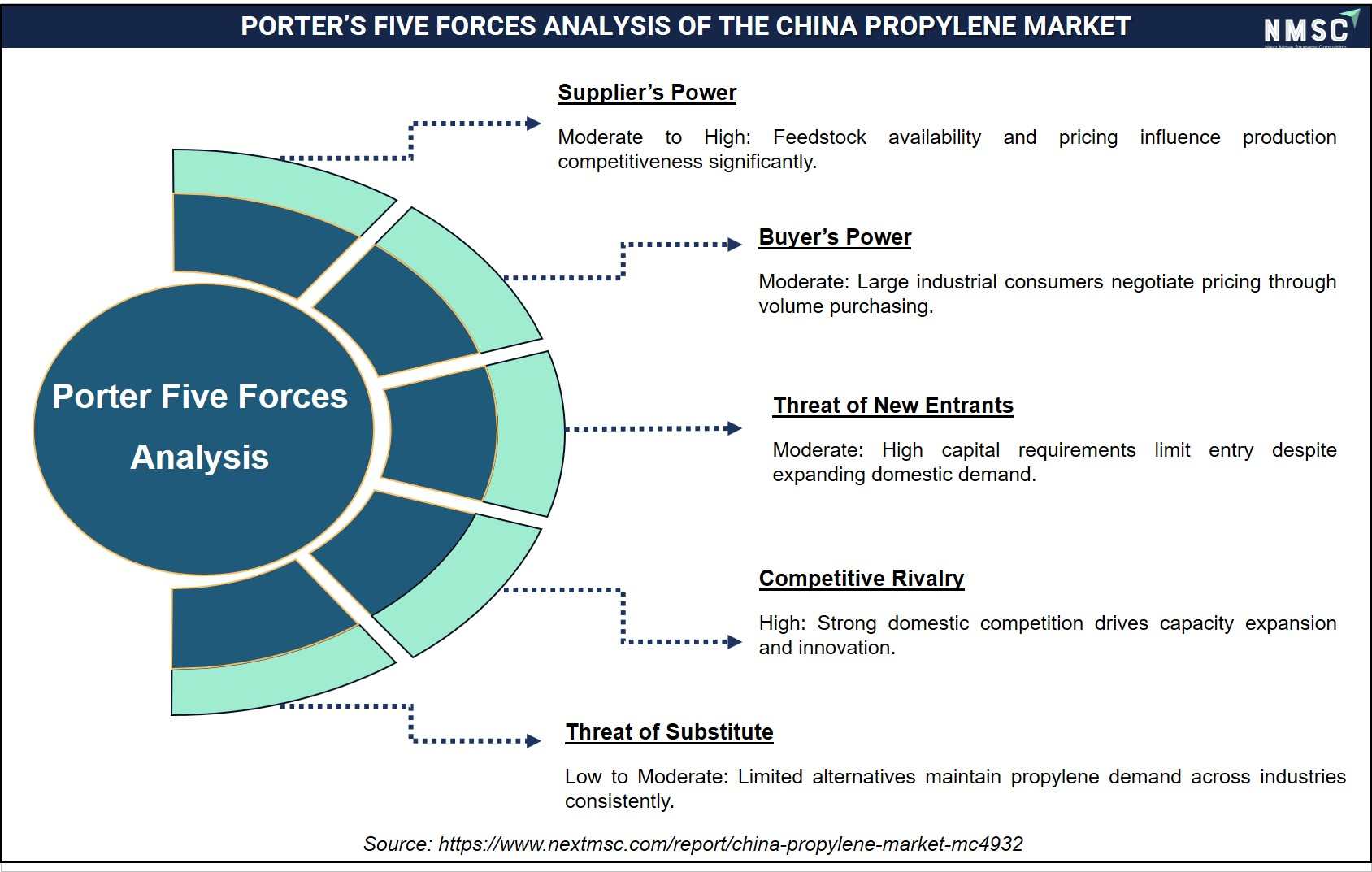
The China propylene market is characterized by moderate to high competitive rivalry due to the presence of large integrated petrochemical producers and expanding production capacities. Supplier bargaining power varies depending on feedstock availability and import dependence for propane and other raw materials. Buyer power remains moderate, supported by strong demand from polypropylene and chemical manufacturers. The threat of new entrants is constrained by high capital requirements, regulatory compliance, and technological barriers. Meanwhile, the threat of substitutes remains relatively low, as propylene continues to be a critical feedstock for numerous petrochemical and industrial applications.
Competitive Landscape Overview
The China Propylene Market is characterized by a highly integrated and competitive structure, supported by the presence of large state-owned petrochemical conglomerates, multinational chemical producers, and private refining-petrochemical integrators. Market growth is being driven by rising demand for polypropylene and other propylene derivatives, expanding propane dehydrogenation and coal-to-olefins capacity, and growing consumption across packaging, automotive, construction, and electronics sectors. Advancements in production technologies, feedstock optimization strategies, and investments in low-carbon petrochemical manufacturing are enhancing operational efficiency and strengthening supply chain resilience across the domestic value chain.
Strategic Developments:
-
November 2024 – China Petroleum & Chemical Corporation (Sinopec), Saudi Aramco, and Fujian Petrochemical commenced construction of the Gulei Phase II refining and petrochemical complex in Fujian, China. The USD 10 billion project includes a 16 million tonnes-per-year refinery, a 1.5 million tonnes-per-year ethylene facility, and associated petrochemical units that will provide approximately 5 million tonnes of petrochemical feedstocks annually, strengthening China’s olefins value chain and supporting downstream propylene-based products such as polypropylene, acrylonitrile, and propylene oxide.
Key Players
-
ExxonMobil (China) Investment Co., Ltd.
-
INEOS Styrolution Advanced Materials (Foshan) Co., Ltd.
-
Dow Chemical (China) Investment Company Limited
-
Chevron Phillips Chemicals (Shanghai) Co., Ltd.
-
LG Chem (China) Investment Co., Ltd.
-
Mitsubishi Chemical (China) Co., Ltd.
-
SABIC Innovative Plastics (China) Co., Ltd.
-
LyondellBasell Polyolefin (Shanghai) Co., Ltd.
-
TotalEnergies (China) Investment Co., Ltd.
-
Sumitomo Chemical (Shanghai) Co., Ltd.
-
China Petroleum & Chemical Corporation (Sinopec Corp.)
-
Formosa Plastics (Ningbo) Ltd.
-
Lotte Chemical Engineering Plastics (Jiaxing) Co., Ltd.
-
Rongsheng Petrochemical Co., Ltd.
-
SP Chemicals (Taixing) Co., Ltd.
Key companies including ExxonMobil (China) Investment Co., Ltd., INEOS Styrolution Advanced Materials (Foshan) Co., Ltd., Dow Chemical (China) Investment Company Limited, Chevron Phillips Chemicals (Shanghai) Co., Ltd., LG Chem (China) Investment Co., Ltd., Mitsubishi Chemical (China) Co., Ltd., SABIC Innovative Plastics (China) Co., Ltd., LyondellBasell Polyolefin (Shanghai) Co., Ltd., TotalEnergies (China) Investment Co., Ltd., Sumitomo Chemical (Shanghai) Co., Ltd., China Petroleum & Chemical Corporation (Sinopec Corp.), Formosa Plastics (Ningbo) Ltd., Lotte Chemical Engineering Plastics (Jiaxing) Co., Ltd., Rongsheng Petrochemical Co., Ltd., and SP Chemicals (Taixing) Co., Ltd. are strengthening positions via capacity expansion.
Key Benefits for Stakeholders
Next Move Strategy Consulting (NMSC) presents a comprehensive analysis of the China Propylene Market, covering historical developments through 2025 and providing forecasts through 2035. Our study evaluates the market at national and regional levels, delivering quantitative outlooks alongside qualitative insights into propylene production trends, feedstock dynamics, petrochemical capacity expansions, derivative demand growth, technological advancements in production processes, and sustainability initiatives shaping the domestic chemicals industry across China’s diverse manufacturing regions.
Investors benefit from expanding opportunities in on-purpose propylene production and downstream petrochemical applications, while propylene producers, refinery operators, petrochemical manufacturers, derivative producers, distributors, technology providers, and end-use industries benefit from growing demand across packaging, automotive, construction, healthcare, electronics, and industrial applications throughout China. The report further equips stakeholders with actionable insights to support capacity planning, feedstock sourcing strategies, and long-term investment decisions across the propylene value chain.
|
Parameters |
Details |
|
Customization Scope |
Free customization (equivalent to up to 80 analyst-working hours) after purchase. |
|
Pricing and Purchase Options |
Avail customized purchase options to meet your exact research needs. |
|
Approach |
In-depth primary and secondary research; proprietary databases; rigorous quality control and validation measures. |
|
Analytical Tools |
Porter’s Five Forces, SWOT, value chain, and Harvey ball analysis to assess competitive intensity, stakeholder roles, and relative impact of key factors. |
Conclusion
Overall, the China Propylene Market is poised for steady growth through 2035, supported by rising polypropylene demand, expanding propane dehydrogenation and coal-to-olefins capacity, and growing consumption of propylene derivatives across packaging, automotive, construction, and electronics sectors. While overcapacity and feedstock price volatility present near-term challenges, increasing investments in low-carbon and circular petrochemical production are unlocking new opportunities. The competitive landscape remains shaped by capacity expansion and feedstock optimization strategies among leading state-owned and multinational producers operating across the country’s value chain.
About the Author
 Liza Phukan
— Liza Phukan is Research Associate at Next Move Strategy Consulting, where she has covered emerging industries and market research across sectors for 3.5 years. Her work includes analyzing industry developments, validating market data, and developing structured business content from research findings. She uses secondary research and data-validation practices to turn complex market information into clear decision-useful market analysis for business audiences and support report development and B2B.
Liza Phukan
— Liza Phukan is Research Associate at Next Move Strategy Consulting, where she has covered emerging industries and market research across sectors for 3.5 years. Her work includes analyzing industry developments, validating market data, and developing structured business content from research findings. She uses secondary research and data-validation practices to turn complex market information into clear decision-useful market analysis for business audiences and support report development and B2B.
About the Reviewer
 Supradip Baul
— Supradip Baul is an accomplished business consultant and strategist with over a decade of rich experience in market intelligence, strategy, technology, and business transformation. His work has included rigorous qualitative and quantitative analysis across multiple industries, helping clients shape investment decisions and long-term roadmaps. Earlier in his career, he was associated with Gartner, where he contributed to industry-leading reports and market share analyses. He has worked with leading global companies and holds an MBA with a dual specialization in Marketing and Finance.
Supradip Baul
— Supradip Baul is an accomplished business consultant and strategist with over a decade of rich experience in market intelligence, strategy, technology, and business transformation. His work has included rigorous qualitative and quantitative analysis across multiple industries, helping clients shape investment decisions and long-term roadmaps. Earlier in his career, he was associated with Gartner, where he contributed to industry-leading reports and market share analyses. He has worked with leading global companies and holds an MBA with a dual specialization in Marketing and Finance.
At Next Move Strategy Consulting, we understand that insightful market research is the cornerstone of successful business decisions. That's why we employ a robust and multifaceted approach, combining various methodologies to deliver the most accurate and actionable data for our clients.

Research Landscape
We navigate the world of research with two primary approaches:
Qualitative Approach
Our qualitative research methodologies involve immersive techniques such as in-depth interviews, focus groups, and observational studies. By engaging directly with individuals and stakeholders, we uncover valuable insights that quantitative data alone may overlook.

Quantitative Research
In tandem with qualitative methodologies, NMSC leverages the power of Quantitative Research to provide a robust foundation of numerical insights. Through systematic data collection and analysis, we quantify patterns, preferences, and market trends, offering a comprehensive view of the business landscape.
Our quantitative research approach employs diverse tools, including surveys, experiments, and statistical modelling. These methodologies enable us to gather data from a large and representative sample, ensuring the statistical significance of our findings. By employing structured questionnaires and standardized data collection methods, we guarantee the reliability and validity of the information we present to our clients.
Quantitative research is particularly effective in measuring the prevalence of trends, assessing market size, and gauging the impact of various factors on consumer behavior. The numerical precision attained through this approach equips our clients with actionable insights, facilitating data-driven decision-making and strategy formulation.


Our Specialized Toolbox for Industry-Specific Market Research
We deploy a specialized arsenal of techniques tailored to meet your unique requirements. Here's a glimpse into our comprehensive toolbox:

Information Procurement
The stage entails acquiring market data or relevant information through various sources and methodologies.


Market Research Approach
We utilize both top-down and bottom-up approaches in market research analysis to achieve a comprehensive understanding of the market dynamics, leveraging the broad perspective of industry trends and macroeconomic factors alongside detailed insights from specific segments and individual companies.

Porters Five Forces Analysis
We conduct Porter's Five Forces analysis to evaluate the competitive landscape of an industry, providing us with insights into factors that affect profitability and strategic positioning.

SWOT Analysis

Forecasting
We utilize a forecasting model to predict future consumption by considering parameters like population, economics, regulations, market competition, drivers, constraints, technology, and pricing. We also employ statistical techniques such as multilinear regression, exponential smoothing, moving average, ARIMA, and Monte Carlo simulations for accurate predictions. In econometric forecasting, we analyzed short-term and long-term event impacts, attributing values based on regulatory frameworks, economic factors, and market events.





 Speak to Our Analyst