Taiwan Healthcare Cybersecurity Market By Component (Software, Hardware, and Services), By Deployment Model (Cloud, On-Premises, and Hybrid), By Organization Size (Small, Medium, and Large), By Commercial Model (Subscription, Perpetual License, Consumption Based, Appliance Sale, Project-Based, Managed Service Contract, and Support Contract), By Customer Type, By Buyer Type, and By Sales Channel – Opportunity Analysis & Forecast, 2025-2035
Industry: Healthcare | Latest Edition: August 12, 2026 | No of Pages: 312 | No. of Tables: 164 | No. of Figures: 157 | Format: PDF | Report Code: HC4100
What Is the Taiwan Healthcare Cybersecurity Market Size?
The Taiwan Healthcare Cybersecurity Market was valued at USD 140.69 million in 2025, is estimated at USD 196.19 million in 2026, and is projected to reach USD 1,124.26 million by 2035, expanding at a CAGR of 21.41% from 2026 to 2035. Software is the dominant component because hospitals, payers, and public health bodies need scalable identity, endpoint, cloud, and security operations controls across digital care delivery.
|
Key Takeaways |
|
By Component: Software is the dominant segment, while Services is the fastest-growing segment. |
|
By Deployment Model: On-Premises is the dominant segment, while Cloud is the fastest-growing segment. |
|
By Organization Size: Large is the dominant segment, while Medium is the fastest-growing segment. |
|
By Commercial Model: Subscription is the dominant segment, while Managed Service Contract is the fastest-growing segment. |
|
By Customer Type: Healthcare Providers is the dominant segment, while Medical Technology is the fastest-growing segment. |
|
By Buyer Type: Chief Information Security Officer is the dominant segment, while Clinical Engineering is the fastest-growing segment. |
|
By Sales Channel: Direct Sales is the dominant segment, while Managed Security Service Providers is the fastest-growing segment. |
Market Opportunity: The absolute dollar opportunity created between 2026 and 2035 is USD 928.07 million, making recurring software, managed services, and compliance automation attractive investment themes.
According to NMSC’s analysis, Taiwan’s health digitization push is shifting buyers away from isolated point tools and toward integrated security stacks that combine identity, monitoring, response, and governance.
What does the Taiwan Healthcare Cybersecurity Market Encompass?
The Taiwan Healthcare Cybersecurity Market encompasses software, hardware, and services designed to protect clinical records, connected medical devices, health network traffic, cloud applications, and identity workflows. We observed that the market has evolved from perimeter defense into a broader architecture built around access control, monitoring, response, and compliance automation. That shift reflects the digital intensity of hospitals, health authorities, payers, medtech firms, and public sector health bodies.
Regulatory pressure is a defining feature of this market report. Taiwan’s health AI validation programs, data standardization efforts, and sovereign health cloud discussions point toward stronger controls for authentication, data handling, and resilience. During our market evaluation, we noticed that this environment is accelerating demand for zero trust, managed security services, and device-level protection across clinical and administrative systems.
|
Parameters |
Details |
|
Market Size in 2025 |
USD 140.69 Million |
|
Market Size in 2026 |
USD 196.19 Million |
|
Revenue Forecast in 2035 |
USD 1,124.26 Million |
|
Growth Rate |
CAGR of 21.41% from 2026 to 2035 |
|
Analysis Period |
2025–2035 |
|
Base Year Considered |
2025 |
|
Forecast Period |
2026–2035 |
|
Market Size Estimation |
USD Million |
|
Companies Profiled |
10 |
|
Market Share |
Available for Top 10 Companies |
Key Emerging Trends
Based on research conducted by NMSC, we found that four structural trends are reshaping procurement, adoption, and competitive positioning across the market.
How Is Zero Trust Reshaping Healthcare Identity Security in Taiwan?
We found that zero trust is moving from a technical concept to an operating requirement as Taiwanese health systems expand secure access to digital records, telehealth services, and shared care workflows. The shift matters because every access request is increasingly tied to identity assurance, device posture, and role based authorization. Taiwan’s health AI and governance agenda makes stronger authentication and least privilege controls more important for hospitals and agencies.
Why Is Data Standardization Raising Security Expectations?
Taiwan’s focus on SNOMED CT, interoperable records, and structured health data is increasing demand for access governance, encryption, monitoring, and auditability. We observed that the government’s emphasis on clinically usable data and trustworthy AI is shaping how hospitals and health authorities approach cybersecurity. The result is a market that values resilience, interoperability, and compliance rather than only perimeter defense.
How Are Medical Device and Connected Care Controls Expanding?
During our market evaluation, we noticed that hospitals and medtech firms are treating connected devices, gateways, and remote monitoring tools as critical cyber assets. Patient care continuity depends on this equipment staying available and trustworthy, so buyers are strengthening segmentation, logging, and incident response. The rapid growth in AI validation and medical device oversight reinforces that device-linked protection is becoming a procurement priority.
What Is Driving the Shift Toward Managed Security Services?
Our assessment indicates that healthcare buyers are outsourcing more monitoring and response work because internal teams cannot staff round-the-clock coverage at scale. This is especially visible in hospitals, regional provider groups, and digital health organizations that need predictable cost structures. Managed security services reduce implementation friction, provide faster response, and let buyers access specialist expertise without building large in-house security operations centers.
Supply Chain Structure of the Taiwan Healthcare Cybersecurity Market
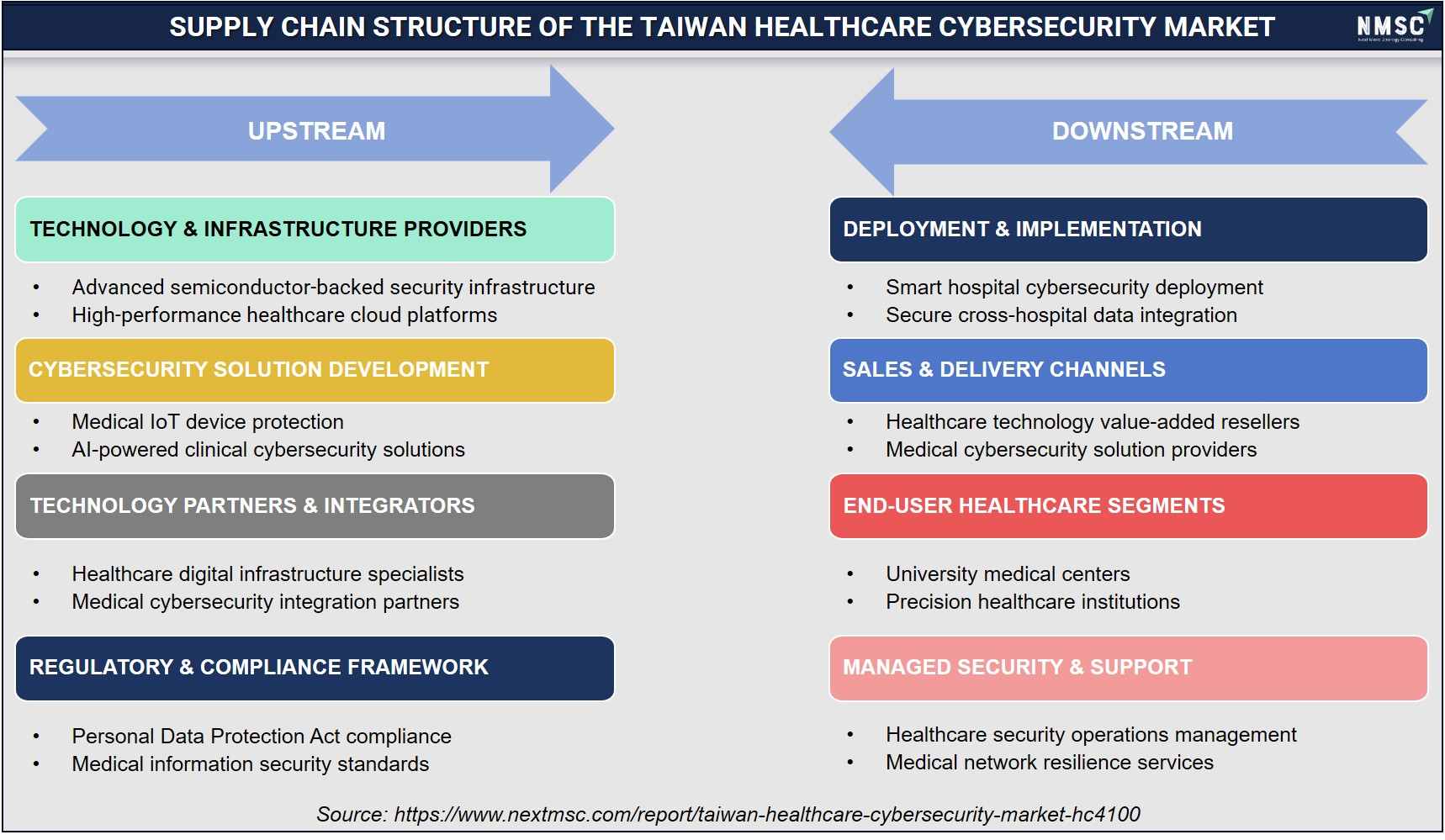
This infographic illustrates the supply chain structure of the market, outlining the flow from upstream technology providers to downstream healthcare security services. It highlights key stages including advanced security infrastructure, cybersecurity solution development, technology integration, regulatory compliance, deployment, sales channels, healthcare end users, and managed security services. The framework demonstrates how semiconductor-driven innovation, AI-powered security solutions, secure healthcare data integration, and continuous network resilience services collectively strengthen cybersecurity and support the digital transformation of Taiwan’s healthcare ecosystem.
Growth Drivers & Restraints
Growth Catalyst & Risk Assessment Matrix
|
Factors |
Type |
(+/−) % Impact on CAGR |
Geographic Relevance |
Impact Timeline |
|
Expansion of electronic medical records and connected care workflows |
Driver |
+2.8% |
Taiwan nationwide |
2025–2029 |
|
Health AI validation and data standardization programs |
Driver |
+2.2% |
Taiwan and medical centers |
2025–2030 |
|
National cybersecurity and governance initiatives |
Driver |
+2.0% |
Public sector and healthcare networks |
2025–2031 |
|
Managed detection, response, and SOC outsourcing |
Driver |
+1.9% |
Providers, payers, and life sciences |
2025–2035 |
|
Legacy systems and procurement inertia |
Restraint |
−1.7% |
Public and mid-market providers |
2025–2029 |
|
Integration complexity and cybersecurity skills shortages |
Restraint |
−1.5% |
Taiwan nationwide |
2025–2030 |
What Is the Primary Growth Driver of the Taiwan Healthcare Cybersecurity Market?
The primary growth driver is the accelerating digitization of health records and clinical workflows. Taiwan’s Ministry of Health has been expanding trustworthy AI validation, data standardization, and interoperable health information systems, while the sovereign health cloud discussion now links security to future care delivery. Those initiatives are widening demand for identity, access, endpoint, and monitoring controls across hospitals, public health institutions, and medtech vendors.
How Are EMR, Clinical AI, and Health Data Programs Driving Market Growth?
We observed that digital health programs are turning cybersecurity into a mandatory design layer rather than an optional add-on. EMR modernization, clinical AI validation, and data standardization all increase the volume of sensitive records moving between systems, which raises the need for encryption, audit logging, privileged access, and managed detection. This is especially important in Taiwan, where high interoperability expectations magnify the impact of any security weakness.
What Is Restraining the Taiwan Healthcare Cybersecurity Market?
Legacy systems, procurement complexity, and integration overhead remain the main restraints. This is best treated as an industry-derived estimate because public datasets do not isolate cybersecurity adoption friction in Taiwanese healthcare with precision. In practice, many organizations still need to balance security upgrades with clinical uptime, budget approval, and interoperability requirements, which slows replacement cycles and makes implementation services as important as product features.
Segmentation Analysis
By Component Insights
How Is the Taiwan Healthcare Cybersecurity Market Segmented by Component?
Based on Component, the Taiwan Healthcare Cybersecurity Market is segmented into software, hardware, and services. Software covers identity security, endpoint security, network security, cloud security, application security, data security, email security, security operations, exposure management, operational technology security, and other security software. Hardware supports appliance-based control, while services include managed security, professional services, and support and maintenance across healthcare environments.
We found that software is the dominant component because Taiwanese buyers need scalable control across identities, devices, cloud workloads, and compliance monitoring. Services are the fastest-growing component because hospitals and healthcare vendors increasingly outsource deployment, incident response, and managed detection to reduce skills pressure. Hardware remains relevant in network and OT security, but software and services capture the strongest recurring demand.
By Deployment Model Insights
How Is the Taiwan Healthcare Cybersecurity Market Segmented by Deployment Model?
Based on Deployment Model, the market is segmented into cloud, on-premises, and hybrid deployments. On-premises remains important because many hospitals and regulated health systems still operate legacy systems and localized control environments. Hybrid deployments are growing as providers balance compliance, uptime, and mobility. Cloud deployment is advancing as buyers seek centralized monitoring, flexible scaling, and subscription based protection models.
Our analysis shows that on-premises is still the dominant deployment model, while cloud is the fastest-growing model because it supports modern security operations, analytics, and faster policy updates. Hybrid adoption is rising where organizations need both local control for clinical systems and cloud-based governance for distributed users. This balance is reshaping procurement around interoperability and operational resilience rather than single-environment security.
Growth Opportunities
Our analysis shows that three forward-looking whitespace opportunities stand out for stakeholders operating in the market over the 2026–2035 forecast period.
How Can Managed Security Contracts Expand Recurring Revenue in Taiwanese Healthcare?
Managed security contracts create a recurring revenue model by combining monitoring, response, compliance reporting, and help-desk support into a single service layer. The beneficiary segment is healthcare providers, particularly hospitals and regional care networks that need 24/7 oversight but cannot staff large teams. Vendors that package MDR, SOC support, and incident handling can deepen retention and reduce buyer hesitation around complex deployments.
Where Will Medical Device Security Create New Budget Pools?
Medical device security creates new budget pools by linking patient safety, device lifecycle assurance, and operational continuity. The beneficiary segment is medical technology and healthcare providers, especially hospitals with large installed bases of connected equipment. Vendors that provide visibility, segmentation, firmware assurance, and asset monitoring can position cybersecurity as a clinical resilience investment rather than a discretionary IT upgrade.
How Can Identity Automation Unlock Growth in Payer and Public Sector Accounts?
Identity automation can unlock growth by reducing access risk, simplifying user governance, and improving audit trails across distributed healthcare organizations. The beneficiary segments are healthcare payers and the healthcare public sector, both of which face heavy documentation and governance needs. Vendors that combine MFA, privileged access, and identity threat detection with workflow integration can capture larger deals tied to compliance and productivity improvements.
Strategic Framework of the Taiwan Healthcare Cybersecurity Market
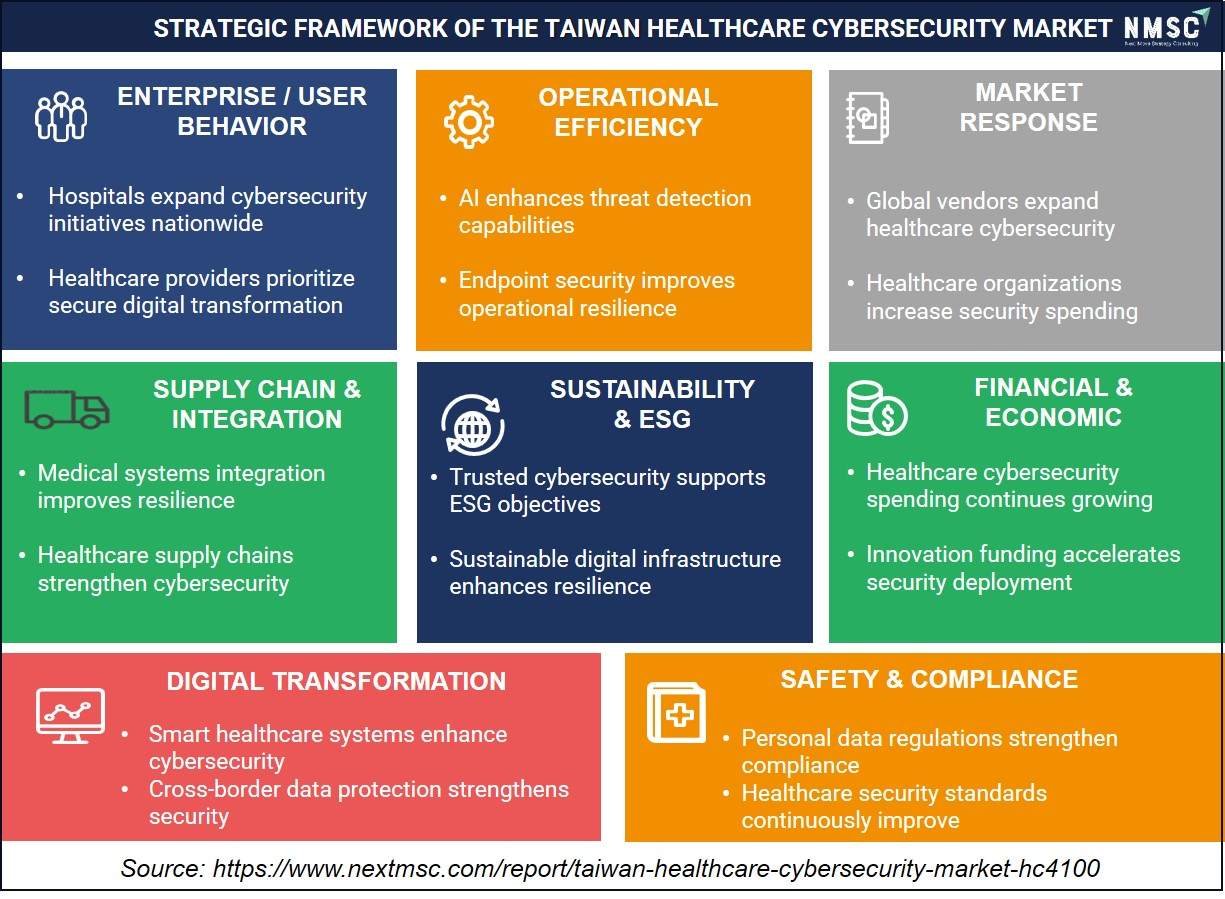
This infographic presents the strategic framework of the market, highlighting the key factors driving market growth and cyber resilience. It demonstrates how expanding cybersecurity initiatives, AI-enabled threat detection, increasing security investments, integrated healthcare supply chains, sustainable digital infrastructure, and ongoing digital transformation strengthen the protection of healthcare systems. The framework also emphasizes the importance of regulatory compliance, personal data protection, endpoint security, and innovation funding in supporting the secure modernization of Taiwan’s healthcare ecosystem.
Competitive Landscape
We observed that the Taiwan Healthcare Cybersecurity Market is highly competitive, with platform vendors, identity specialists, device security firms, and managed security partners all targeting the same healthcare budgets.
|
Dimension |
Description |
|
Market Structure |
Competitive intensity is rising as platform vendors, identity specialists, device security firms, and managed service providers all target the same healthcare budgets. |
|
Innovation Focus |
AI assisted detection, zero trust, access governance, device visibility, and compliance automation dominate product roadmaps across the industry. |
|
M&A Activity |
Acquisitions and portfolio expansion remain important as larger vendors fill capability gaps and broaden regulated healthcare coverage. |
How Do Companies Compete in the Taiwan Healthcare Cybersecurity Market?
Companies compete through regulatory fit, implementation speed, and operational simplicity. Platform vendors win larger accounts by bundling identity, endpoint, cloud, and response capabilities, while specialists win when device protection, policy enforcement, or compliance depth is the priority. Pricing strategy also matters: buyers increasingly prefer subscription and managed service models that spread costs, reduce procurement friction, and align security spending with operational budgets.
Which Competitive Archetypes Dominate the Taiwan Healthcare Cybersecurity Market?
Platform vendors, identity specialists, OT and medical device specialists, and managed security providers dominate the market. Platform vendors usually lead because they simplify procurement and give buyers a broader control plane. Identity specialists are strong where access governance is the first control layer, while device security specialists matter in clinical environments. Managed service providers gain share by offering round-the-clock coverage and predictable costs.
How Are Vendors Differentiating Through Innovation and Pricing?
Differentiation increasingly comes from AI-enabled detection, policy automation, secure access design, and integrations with healthcare workflows. Vendors are also segmenting pricing by user, device, workload, and service tier so buyers can match expenses to operational reality. In Taiwan, the winners are those that can show secure interoperability, clear compliance reporting, and minimal disruption to clinical operations while still delivering faster response and easier administration.
What M&A Activity Is Reshaping the Taiwan Healthcare Cybersecurity Market?
M&A continues to be a speed strategy for larger vendors that want to close capability gaps in cloud security, AI security, and device protection. For Taiwanese healthcare buyers, consolidation can reduce vendor sprawl and improve integration across identity, response, and endpoint controls. The most effective deals tend to expand regulated industry coverage, strengthen local support, and improve the buyer experience rather than simply adding product count.
Key Market Players
Our assessment indicates that the following 12 companies are actively shaping product innovation, portfolio expansion, and competitive dynamics within the Taiwan Healthcare Cybersecurity Market.
-
Fortinet Taiwan Co., Ltd.
-
Check Point Software Technologies Taiwan Co., Ltd.
-
Microsoft Taiwan Corporation
-
International Business Machines Taiwan Corporation
-
Trend Micro Incorporated
-
Akamai Technologies Taiwan Co., Ltd
-
Sophos Taiwan Co., Ltd.
-
CyberArk Taiwan Co., Ltd.
-
Tenable Taiwan Co., Ltd.
-
Kaspersky Lab Taiwan Co., Ltd.
Investment Opportunities
What Capital Inflows Are Targeting the Taiwan Healthcare Cybersecurity Market?
Capital inflows are concentrating on platforms that can prove compliance, reduce tool sprawl, and deliver recurring revenue through subscription and managed service contracts. The strongest interest is in vendors that can secure identities, cloud access, and connected devices in one operating model. Investors are favoring companies that align cybersecurity with clinical reliability, because the market rewards solutions that reduce risk without adding friction to care delivery.
How Is Infrastructure Investment Supporting the Taiwan Healthcare Cybersecurity Market?
Infrastructure investment is expanding secure access gateways, monitoring systems, SOC tooling, and device level controls across hospitals and digital health providers. We found that buyers are also upgrading integration layers so they can connect EMR, health data platforms, and legacy clinical applications more securely. These investments matter because they improve visibility, reduce response times, and make future zero trust transitions easier to execute.
What ESG Considerations Are Shaping Investment Decisions in the Taiwan Healthcare Cybersecurity Market?
ESG considerations are increasingly tied to patient safety, data stewardship, and governance quality. Investors prefer companies that can demonstrate responsible handling of sensitive health data, transparent security governance, and resilient service delivery. The social dimension is especially important in healthcare because cyber incidents can affect treatment continuity and trust, while the governance dimension influences how clearly firms manage access, auditability, and accountability.
Key Benefits for Stakeholders
How Does This Report Benefit Enterprise and Industry Leaders?
Enterprise and industry leaders gain a structured view of the Taiwan Healthcare Cybersecurity Market’s demand drivers, segment priorities, and competitive structure. Our analysis helps them align security roadmaps with EMR adoption, health data governance, and public sector digitization plans. That makes it easier to prioritize investments, choose deployment models, and coordinate procurement across IT, clinical engineering, and compliance teams.
How Does This Report Benefit Investors and Financial Analysts?
Investors and financial analysts gain a clear view of the 2025 to 2035 market size path, the 21.41% CAGR, and the largest monetization opportunities across software and managed services. The report helps them evaluate which vendors are best positioned for recurring revenue, stronger margins, and durable growth. It also gives a practical basis for comparing platform strategy, service intensity, and exposure to Taiwanese healthcare regulation.
How Does This Report Benefit Technology Vendors and Product Teams?
Technology vendors and product teams gain insight into where product demand is shifting next, especially in zero trust, identity governance, medical device security, and managed response. We observed that this helps teams prioritize feature development, partner strategy, and service packaging. It also supports go-to-market planning because the report shows which buyer groups and channels are most likely to value compliance, uptime, and simplification.
Key Market Segments
By Component
-
Software
-
Identity Security
-
Identity Governance and Administration
-
Privileged Access Management
-
Multi-Factor Authentication
-
Single Sign-On
-
Identity Threat Detection and Response
-
-
Endpoint Security
-
Endpoint Protection
-
Endpoint Detection and Response
-
Extended Detection and Response
-
Mobile Threat Defense
-
-
Network Security
-
Network Firewall
-
Network Detection and Response
-
Network Access Control
-
Secure Remote Access
-
Network Segmentation
-
-
Cloud Security
-
Cloud Security Posture Management
-
Cloud Workload Protection
-
Cloud Access Security Broker
-
Container Security
-
Kubernetes Security
-
-
Application Security
-
Web Application Firewall
-
API Security
-
Runtime Application Protection
-
Application Security Testing
-
-
Data Security
-
Data Loss Prevention
-
Encryption
-
Database Security
-
File Security
-
Tokenization
-
-
Email Security
-
Secure Email Gateway
-
Anti-Phishing
-
Business Email Protection
-
Email Encryption
-
-
Security Operations
-
Security Information and Event Management
-
Automation and Response
-
Threat Intelligence
-
Log Management
-
Threat Hunting
-
-
Exposure Management
-
Vulnerability Management
-
Attack Surface Management
-
Configuration Compliance
-
Security Validation
-
-
Operational Technology Security
-
Medical Device Security
-
Clinical Internet of Things Security
-
Network Monitoring
-
Biomedical Asset Protection
-
-
Other Security Software
-
-
Hardware
-
Network Security Appliances
-
Firewall Appliances
-
Secure Web Gateways
-
Secure Remote Access Appliances
-
-
Identity Security Appliances
-
Hardware Security Modules
-
Authentication Appliances
-
-
OT Security Appliances
-
Passive Network Sensors
-
Dedicated Monitoring Appliances
-
-
Other Security Hardware
-
-
Services
-
Managed Security Services
-
Detection and Response
-
Security Operations Center
-
Firewall
-
Endpoint Security
-
Cloud Security
-
Exposure Management
-
Other Managed Security Services
-
-
Professional Services
-
Security Consulting
-
Risk Assessment
-
Compliance Advisory
-
Security Architecture
-
Deployment
-
System Integration
-
Incident Response
-
Digital Forensics
-
Security Awareness Training
-
Other Professional Services
-
-
Support and Maintenance
-
Technical Support
-
Software Maintenance
-
Hardware Maintenance
-
Premium Support
-
-
By Deployment Model
-
Cloud
-
On-Premises
-
Hybrid
By Organization Size
-
Small
-
Medium
-
Large
By Commercial Model
-
Subscription
-
Perpetual License
-
Consumption Based
-
Appliance Sale
-
Project-Based
-
Managed Service Contract
-
Support Contract
By Customer Type
-
Healthcare Providers
-
Integrated Delivery Networks
-
General Hospitals
-
Specialty Hospitals
-
Physician Practices
-
Ambulatory Surgery Centers
-
Diagnostic Imaging Centers
-
Long-Term Care Facilities
-
Home Healthcare Providers
-
-
Healthcare Payers
-
Commercial Health Insurers
-
Government Health Payers
-
-
Life Sciences
-
Pharmaceutical Companies
-
Biotechnology Companies
-
Contract Research Organizations
-
-
Medical Technology
-
Medical Device Manufacturers
-
Digital Health Companies
-
-
Healthcare Public Sector
-
Public Health Agencies
-
Academic Medical Centers
-
Research Institutes
-
By Buyer Type
-
Chief Information Officer
-
Chief Information Security Officer
-
Information Technology Infrastructure
-
Security Operations Center
-
Clinical Engineering
-
Biomedical Engineering
-
Risk and Compliance
-
Procurement
By Sales Channel
-
Direct Sales
-
Value-Added Resellers
-
Systems Integrators
-
Managed Security Service Providers
-
Cloud Marketplaces
-
Original Equipment Manufacturer Partners
Conclusion & Recommendations
What Is the Long-Term Outlook for the Taiwan Healthcare Cybersecurity Market?
The long-term outlook remains positive because Taiwan is digitizing patient records, identity processes, and clinical workflows at the same time. We observed that this will keep cybersecurity spending elevated through 2035 as organizations expand zero trust, managed response, and device protection. The market’s growth is also supported by the need to preserve care continuity while securing more connected and data intensive operations.
What Strategic Positioning Recommendations Should Market Participants Follow?
Vendors should prioritize integration, clinical workflow fit, and compliance proof. Our assessment indicates that the strongest suppliers will combine identity, endpoint, cloud, and response functions while keeping deployment simple for buyers. In Taiwan, vendors that can support EMR rollouts, health AI validation, and regulated provider workflows will be better positioned than those selling isolated controls without operational context.
Why Is the Taiwan Healthcare Cybersecurity Market Attractive to Investors?
The market is attractive because it combines recurring revenue potential, high switching costs, and strong digitalization tailwinds. We found that the USD 928.07 million absolute opportunity between 2026 and 2035 leaves room for both scale platforms and specialized niche providers. Investor interest is likely to remain strongest in companies that can prove measurable risk reduction, service quality, and long-term customer retention.
What Market Shifts and Key Risks Should Stakeholders Monitor?
Stakeholders should monitor procurement delays, legacy integration constraints, and the pace of digital health implementation. Our analysis shows that vendors that cannot prove interoperability, stability, and value for money may lose ground even if their tools are technically strong. The key risk is fragmentation across systems and stakeholders, which can slow adoption and increase operational complexity for hospitals and care networks.
What Growth Pathways Offer the Strongest Upside?
The strongest growth pathways are managed security contracts, identity automation, medical device security, and AI assisted security operations. We found that these areas fit Taiwanese buyer priorities because they improve resilience, reduce workload, and help manage regulatory expectations. Vendors that pair strong technology with deployment support and compliance reporting are best positioned to capture durable growth through 2035.


About the Author
 Liza Phukan
— Liza Phukan is Research Associate at Next Move Strategy Consulting, where she has covered emerging industries and market research across sectors for 3.5 years. Her work includes analyzing industry developments, validating market data, and developing structured business content from research findings. She uses secondary research and data-validation practices to turn complex market information into clear decision-useful market analysis for business audiences and support report development and B2B.
Liza Phukan
— Liza Phukan is Research Associate at Next Move Strategy Consulting, where she has covered emerging industries and market research across sectors for 3.5 years. Her work includes analyzing industry developments, validating market data, and developing structured business content from research findings. She uses secondary research and data-validation practices to turn complex market information into clear decision-useful market analysis for business audiences and support report development and B2B.
About the Reviewer
 Supradip Baul
— Supradip Baul is an accomplished business consultant and strategist with over a decade of rich experience in market intelligence, strategy, technology, and business transformation. His work has included rigorous qualitative and quantitative analysis across multiple industries, helping clients shape investment decisions and long-term roadmaps. Earlier in his career, he was associated with Gartner, where he contributed to industry-leading reports and market share analyses. He has worked with leading global companies and holds an MBA with a dual specialization in Marketing and Finance.
Supradip Baul
— Supradip Baul is an accomplished business consultant and strategist with over a decade of rich experience in market intelligence, strategy, technology, and business transformation. His work has included rigorous qualitative and quantitative analysis across multiple industries, helping clients shape investment decisions and long-term roadmaps. Earlier in his career, he was associated with Gartner, where he contributed to industry-leading reports and market share analyses. He has worked with leading global companies and holds an MBA with a dual specialization in Marketing and Finance.
At Next Move Strategy Consulting, we understand that insightful market research is the cornerstone of successful business decisions. That's why we employ a robust and multifaceted approach, combining various methodologies to deliver the most accurate and actionable data for our clients.

Research Landscape
We navigate the world of research with two primary approaches:
Qualitative Approach
Our qualitative research methodologies involve immersive techniques such as in-depth interviews, focus groups, and observational studies. By engaging directly with individuals and stakeholders, we uncover valuable insights that quantitative data alone may overlook.

Quantitative Research
In tandem with qualitative methodologies, NMSC leverages the power of Quantitative Research to provide a robust foundation of numerical insights. Through systematic data collection and analysis, we quantify patterns, preferences, and market trends, offering a comprehensive view of the business landscape.
Our quantitative research approach employs diverse tools, including surveys, experiments, and statistical modelling. These methodologies enable us to gather data from a large and representative sample, ensuring the statistical significance of our findings. By employing structured questionnaires and standardized data collection methods, we guarantee the reliability and validity of the information we present to our clients.
Quantitative research is particularly effective in measuring the prevalence of trends, assessing market size, and gauging the impact of various factors on consumer behavior. The numerical precision attained through this approach equips our clients with actionable insights, facilitating data-driven decision-making and strategy formulation.


Our Specialized Toolbox for Industry-Specific Market Research
We deploy a specialized arsenal of techniques tailored to meet your unique requirements. Here's a glimpse into our comprehensive toolbox:

Information Procurement
The stage entails acquiring market data or relevant information through various sources and methodologies.


Market Research Approach
We utilize both top-down and bottom-up approaches in market research analysis to achieve a comprehensive understanding of the market dynamics, leveraging the broad perspective of industry trends and macroeconomic factors alongside detailed insights from specific segments and individual companies.

Porters Five Forces Analysis
We conduct Porter's Five Forces analysis to evaluate the competitive landscape of an industry, providing us with insights into factors that affect profitability and strategic positioning.

SWOT Analysis

Forecasting
We utilize a forecasting model to predict future consumption by considering parameters like population, economics, regulations, market competition, drivers, constraints, technology, and pricing. We also employ statistical techniques such as multilinear regression, exponential smoothing, moving average, ARIMA, and Monte Carlo simulations for accurate predictions. In econometric forecasting, we analyzed short-term and long-term event impacts, attributing values based on regulatory frameworks, economic factors, and market events.





 Speak to Our Analyst