Telemedicine Market Size, Share, Trends and Growth Analysis, By Clinical Services (Real-Time Consultations, Asynchronous Services, Remote Patient Monitoring, Institutional Telehealth, and Direct-to-Consumer), By Enabling Products and Services, By Delivery Mode (Cloud/SaaS, On-Premise, Mobile Apps, and Hybrid), By Clinical Specialty, By End User (Hospitals, Clinics, Payers, Employers, Patients, and Government), and Region — Global Industry Report and Forecast, 2026-2035
Industry: Healthcare | Publishing Date: September 9, 2025 | Last Updated: September 30, 2026 | No of Pages: N/A | No. of Tables: N/A | No. of Figures: N/A | Format: PDF | Report Code: HC2976
What Is the Telemedicine Market Size?
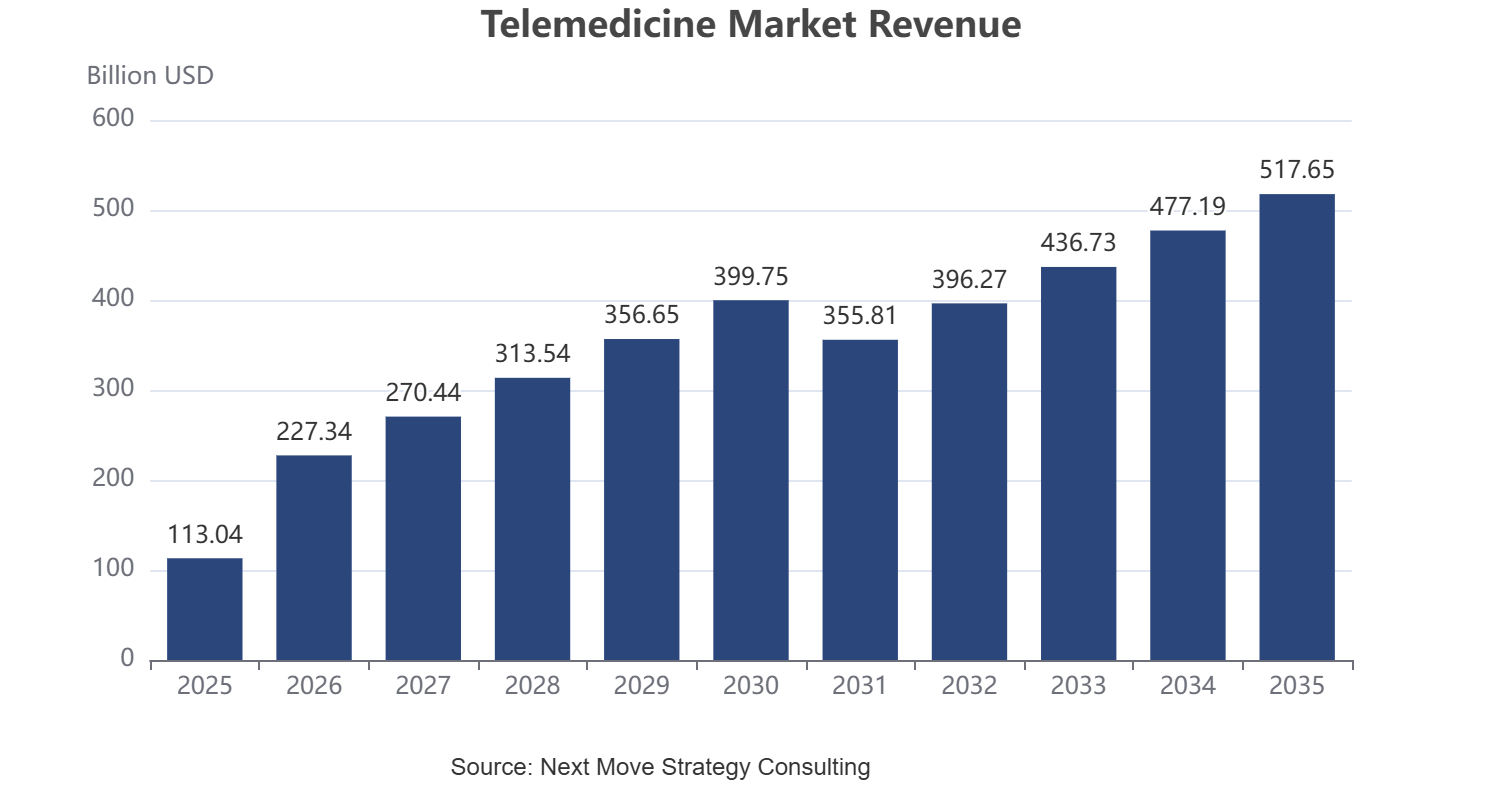
The global telemedicine market size was valued at USD 113.04 billion in 2025 and is estimated at USD 123.39 billion in 2026, forecast to reach USD 517.65 billion by 2035, expanding at a 17.3% CAGR between 2026 and 2035. North America leads with approximately 42% share, while Real-Time Consultations dominates all other clinical service categories with approximately 34% share.
We observed that the growth is broad-based across every segmentation axis, with cloud-based delivery and remote patient monitoring adoption driving the dominant structural shifts through 2035.
|
Key Takeaways |
|
By Clinical Services: Real-Time Consultations held the largest share of approximately 34% (USD 38.43 billion) in 2025; Remote Patient Monitoring (RPM) is the fastest-growing sub-segment at 19.9% CAGR from 2026-2035. |
|
By Enabling Products and Services: Software Solutions held the largest share of approximately 42% (USD 47.48 billion) in 2025; Connectivity and Compliance is the fastest-growing sub-segment at 21.0% CAGR from 2026-2035. |
|
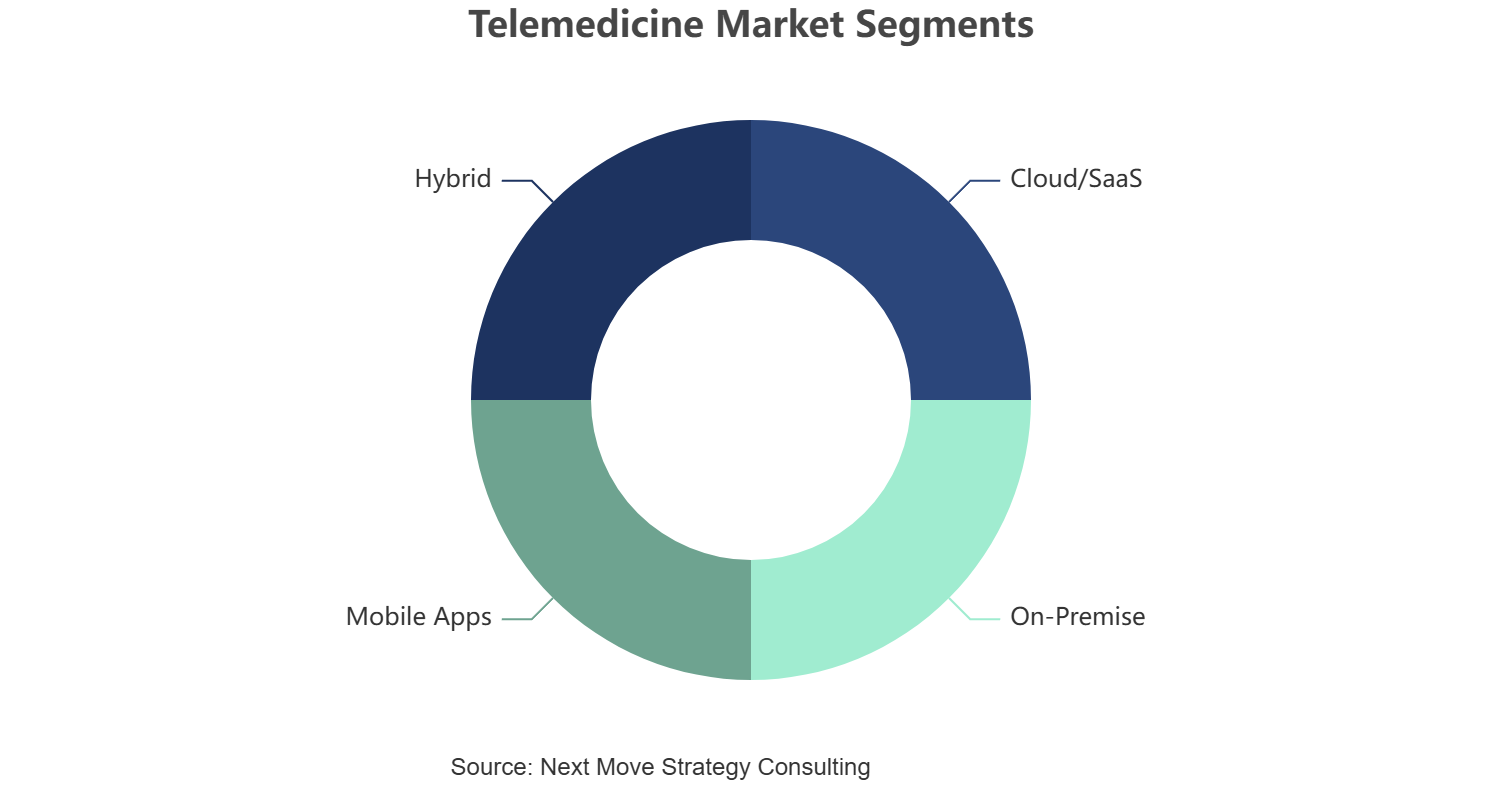
By Delivery Mode: Cloud/SaaS held the largest share of approximately 52% (USD 58.78 billion) in 2025; Mobile Apps is the fastest-growing sub-segment at 20.2% CAGR from 2026-2035. |
|
By Clinical Specialty: Mental Health held the largest share of approximately 26% (USD 29.39 billion) in 2025; Cardiology is the fastest-growing sub-segment at 19.5% CAGR from 2026-2035. |
|
By End User: Hospitals held the largest share of approximately 30% (USD 33.91 billion) in 2025; Employers is the fastest-growing sub-segment at 19.7% CAGR from 2026-2035. |
|
Dominant Region: North America dominated with approximately 42% revenue share (USD 47.48 billion) in 2025. |
|
Fastest-Growing Region: Asia-Pacific is expected to register the highest CAGR of 20.7% during 2026-2035. |
|
Dominant Country: U.S. led with approximately USD 38.93 billion in 2025. |
|
Fastest-Growing Country: India is the fastest-growing country at approximately 26.2% CAGR from 2026-2035. |
Market Opportunity: The telemedicine market is expected to create an absolute dollar opportunity of USD 394.26 billion between 2026 and 2035, presenting significant investment potential across the cloud-based virtual care and remote patient monitoring value chain.
According to Next Move Strategy Consulting analysis, payers and employers are increasingly bundling virtual-first primary care into benefit packages to reduce downstream claims costs, a shift that favors integrated platform providers over single-service point solutions as purchasers consolidate vendor relationships through 2035.
What Does the Telemedicine Market Encompass?
The market encompasses clinical services, software, hardware, and support services that enable remote diagnosis, consultation, and monitoring between patients and healthcare providers. Our assessment indicates that the scope spans real-time video consultations, asynchronous eConsults, remote patient monitoring, and institutional telehealth contracts supplied to hospitals, clinics, payers, employers, and direct-to-consumer patients across mental health, cardiology, radiology, primary care, dermatology, and oncology specialties. The category has evolved from a pandemic-era convenience tool into permanent healthcare infrastructure, closely intersecting with the broader digital healthcare ecosystem worldwide.
Regulatory frameworks such as the U.S. Centers for Medicare & Medicaid Services' telehealth reimbursement rules and the European Union's Digital Services Act shape licensure and reimbursement parity across state and national lines, while data-privacy regulations increasingly influence platform architecture. We observed that technology adoption is shifting toward AI-assisted triage and integrated remote monitoring devices that extend care beyond the consultation visit. Next Move Strategy Consulting's analysis indicates that this structural shift, combined with payer reimbursement expansion, is redefining sourcing criteria across the telemedicine market.
|
Field |
Details |
|
Market Size in 2025 |
USD 113.04 Billion |
|
Market Size in 2026 |
USD 123.39 Billion |
|
Revenue Forecast in 2035 |
USD 517.65 Billion |
|
Growth Rate |
CAGR of 17.3% from 2026 to 2035 |
|
Analysis Period |
2025–2035 |
|
Base Year Considered |
2025 |
|
Forecast Period |
2026–2035 |
|
Market Size Estimation |
USD Billion |
|
Companies Profiled |
20 |
|
Countries Covered |
33 |
|
Market Share |
Available for Top 10 Companies |
Key Emerging Trends
Based on research conducted by Next Move Strategy Consulting, we found that four structural trends are reshaping product development, sourcing, and stakeholder engagement across the industry.
How Is AI-Assisted Triage Transforming Telemedicine Workflows?
AI-assisted triage and clinical decision support tools are reducing time-to-consultation by routing patients to the appropriate care pathway before a visit begins. We observed that 98point6 Technologies has expanded automated intake capability to streamline primary care access. Health systems are adopting these tools to manage rising visit volumes, while platform vendors retool workflows to embed triage logic ahead of live or asynchronous consultations.
Why Is Remote Patient Monitoring Gaining Adoption Among Payers?
Remote patient monitoring for chronic disease management is gaining share as payers respond to rising costs from uncontrolled diabetes and hypertension. Our findings suggest that health plans increasingly reimburse connected devices paired with virtual coaching to reduce avoidable hospitalizations. Vendors such as TELUS Health are expanding RPM device portfolios, positioning these formats as a premium, higher-margin category within the broader market segmentation structure.
How Is Employer-Sponsored Virtual Care Reshaping Distribution?
Employer and payer bundled virtual care benefits are pushing platform vendors toward integrated, multi-specialty offerings rather than single-condition point solutions. We observed that Included Health's combined navigation and virtual care model reflects this direction, consolidating mental health, primary care, and specialist access under one employer contract. This trend is elevating demand for platform interoperability among employer and payer distribution channels.
What Role Does Direct-to-Consumer Subscription Care Play in Telemedicine Innovation?
Direct-to-consumer subscription telemedicine is emerging as a consumer-driven response to primary care access gaps. Our analysis shows that PlushCare and similar platforms are expanding subscription-based membership models that bundle unlimited virtual visits with prescription management. Talkspace's continued expansion of subscription-based teletherapy access exemplifies this direction, engineered to reduce friction for recurring mental health and primary care engagement.
Consumer Behavior Analysis of the Telemedicine Market
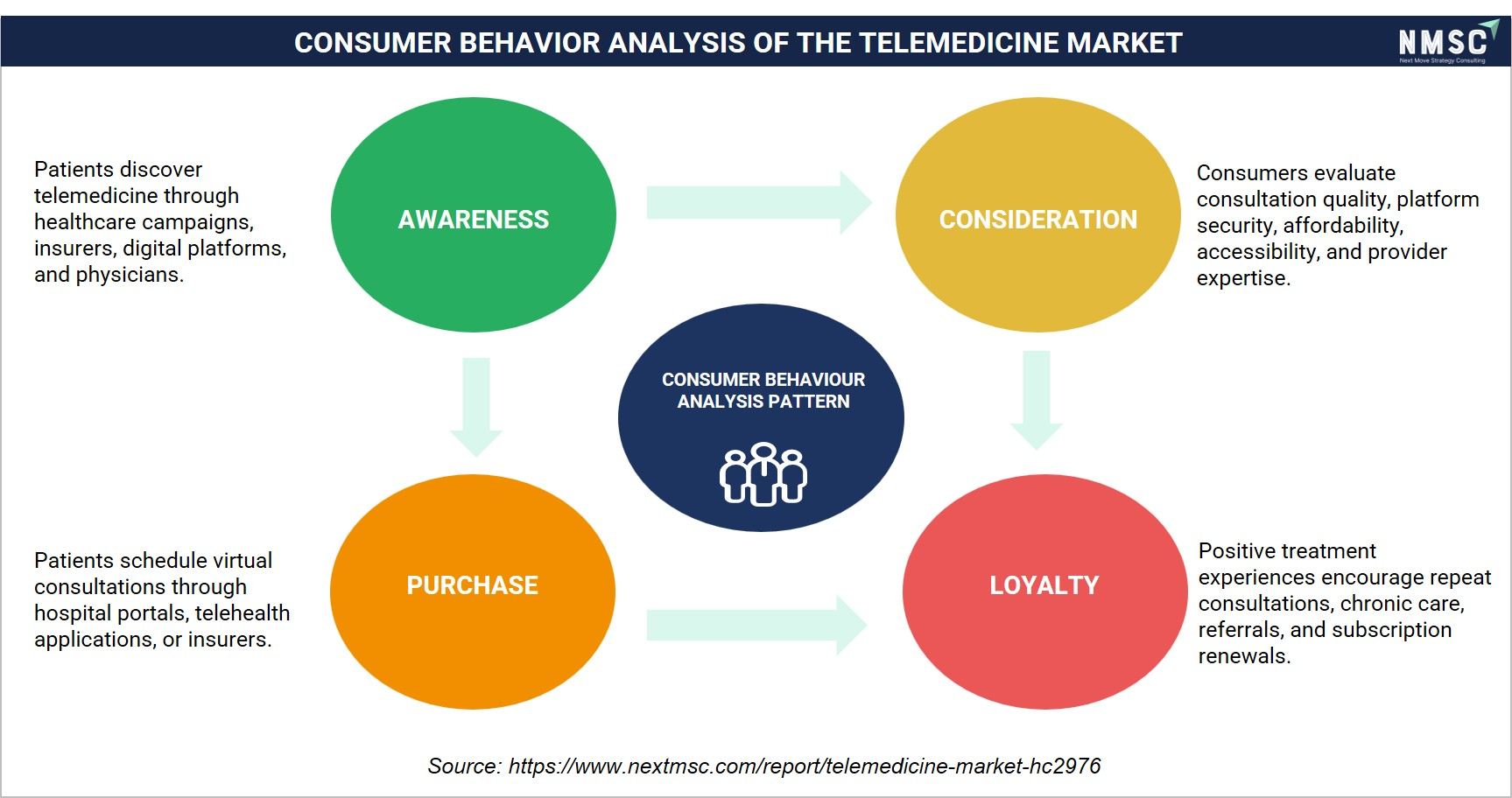
The infographic illustrates the consumer behaviour journey in the market across four stages: Awareness, Consideration, Purchase, and Loyalty. Patients first learn about telemedicine through healthcare providers, insurers, digital platforms, and awareness campaigns. They then assess service quality, affordability, security, accessibility, and provider expertise before booking virtual consultations. Positive treatment experiences encourage repeat usage, chronic care engagement, referrals, subscription renewals, and long-term patient loyalty, supporting sustained growth in telemedicine adoption.
Growth Drivers and Restraints
Growth Catalyst and Risk Assessment Matrix
|
Factors |
Type |
(+/-) % Impact on CAGR |
Geographic Relevance |
Impact Timeline |
|
Expanding payer reimbursement for virtual consultations |
Driver |
+3.2% |
Global |
2026–2035 |
|
Rising chronic disease prevalence requiring remote monitoring |
Driver |
+2.4% |
Global |
2026–2035 |
|
Employer-sponsored virtual-first benefit adoption |
Driver |
+1.8% |
North America, Europe |
2026–2035 |
|
Physician shortages in rural and underserved regions |
Driver |
+1.6% |
North America, Asia-Pacific |
2026–2035 |
|
Government digital health infrastructure investment |
Driver |
+1.4% |
Asia-Pacific, MEA |
2026–2035 |
|
AI-enabled clinical decision support adoption |
Driver |
+1.1% |
Global |
2026–2032 |
|
State and cross-border licensure fragmentation |
Restraint |
-1.3% |
North America, Europe |
2026–2032 |
|
Data privacy and cybersecurity compliance costs |
Restraint |
-1.0% |
Global |
2026–2035 |
|
Reimbursement parity uncertainty beyond pandemic-era waivers |
Restraint |
-0.8% |
North America |
2026–2030 |
What Is the Primary Growth Driver of the Telemedicine Market?
Expanding payer reimbursement for virtual consultations is the primary driver of the market. The U.S. Centers for Medicare & Medicaid Services continues to extend telehealth coverage flexibilities, sustaining commercial and government payer demand for virtual visit reimbursement parity. We observed that this reimbursement expansion, reinforced by employer benefit-design changes, continues to anchor baseline consumption of real-time and asynchronous consultation services across developed and emerging economies alike.
How Is Chronic Disease Prevalence Driving Telemedicine Market Growth?
Rising chronic disease prevalence is accelerating market growth toward remote patient monitoring and medication adherence services. The U.S. Centers for Disease Control and Prevention reports that a majority of U.S. adults live with at least one chronic condition, sustaining demand for connected monitoring devices paired with virtual care coordination. Our assessment indicates that this disease burden, combined with payer cost-containment priorities, is compressing adoption timelines for RPM-enabled chronic disease management programs.
What Is Restraining Telemedicine Market Expansion?
Fragmented state and cross-border physician licensure requirements restrain scalability across the telemedicine supply chain. The Federation of State Medical Boards continues to track inconsistent interstate licensure compact adoption, which compresses platform vendors' ability to serve patients across state lines. We found that smaller regional providers face particular exposure, as limited scale reduces their ability to navigate multi-state compliance compared with larger, nationally licensed platform operators.
Segmentation Analysis
Segment Sizing: By Clinical Services
|
Segment |
2025 (USD) |
2035 (USD) |
CAGR% (2026-2035) |
|
Real-Time Consultations |
USD 38.43 Billion |
USD 160.47 Billion |
16.1% |
|
Asynchronous Services |
USD 13.56 Billion |
USD 51.77 Billion |
14.9% |
|
Remote Patient Monitoring (RPM) |
USD 30.52 Billion |
USD 170.82 Billion |
19.9% |
|
Institutional Telehealth |
USD 16.96 Billion |
USD 72.47 Billion |
16.4% |
|
Direct-to-Consumer (DTC) |
USD 13.56 Billion |
USD 62.12 Billion |
17.3% |
|
Total |
USD 113.04 Billion |
USD 517.65 Billion |
17.3% |
Which Clinical Services Segment Dominates the Telemedicine Market?
Real-Time Consultations, encompassing scheduled primary care, urgent and on-demand care, and specialist consults, led the market with USD 38.43 billion in 2025, supported by broad payer reimbursement and near-universal patient familiarity. We observed that Remote Patient Monitoring is the fastest-growing clinical service, expanding at a 19.9% CAGR from 2026 to 2035, as chronic disease and post-acute care programs scale connected-device deployment.
Segment Sizing: By Delivery Mode
|
Segment |
2025 (USD) |
2035 (USD) |
CAGR% (2026-2035) |
|
Cloud/SaaS |
USD 58.78 Billion |
USD 289.88 Billion |
18.2% |
|
On-Premise |
USD 18.09 Billion |
USD 41.41 Billion |
8.6% |
|
Mobile Apps |
USD 27.13 Billion |
USD 155.29 Billion |
20.2% |
|
Hybrid |
USD 9.04 Billion |
USD 31.06 Billion |
13.6% |
|
Total |
USD 113.04 Billion |
USD 517.65 Billion |
17.3% |
Which Delivery Mode Segment Leads Telemedicine Deployment?
Cloud/SaaS remained the leading delivery mode within the market, valued at USD 58.78 billion in 2025 on sustained platform-vendor preference for scalable, subscription-based infrastructure. Our findings suggest that Mobile Apps is the fastest-growing delivery mode, registering a 20.2% CAGR from 2026 to 2035, as direct-to-consumer and employer-sponsored programs increasingly route patients through smartphone-native access points.
Segment Sizing: By End User
|
Segment |
2025 (USD) |
2035 (USD) |
CAGR% (2026-2035) |
|
Hospitals |
USD 33.91 Billion |
USD 139.77 Billion |
15.9% |
|
Clinics |
USD 24.87 Billion |
USD 103.53 Billion |
16.0% |
|
Payers |
USD 18.09 Billion |
USD 88.00 Billion |
18.1% |
|
Employers |
USD 11.30 Billion |
USD 62.12 Billion |
19.7% |
|
Patients (B2C) |
USD 18.09 Billion |
USD 93.18 Billion |
18.8% |
|
Government |
USD 6.78 Billion |
USD 31.06 Billion |
17.3% |
|
Total |
USD 113.04 Billion |
USD 517.65 Billion |
17.3% |
Which End User Segment Generates the Most Telemedicine Revenue?
Hospitals remained the leading end user, valued at USD 33.91 billion in 2025 as health systems expand virtual specialty coverage to extend service lines beyond physical facilities. Based on research conducted by Next Move Strategy Consulting, we found that Employers is the fastest-growing end user at a 19.7% CAGR from 2026 to 2035, reflecting expanding virtual-first benefit adoption as companies seek to manage healthcare cost inflation.
Growth Opportunities
Our analysis shows that three forward-looking opportunities stand out for stakeholders positioning within the market over the 2026-2035 forecast period.
How Can AI Clinical Support Tools Unlock Value for Health Systems?
AI-enabled clinical support tools present a whitespace opportunity for health systems seeking to manage rising consultation volumes without proportional staffing increases. Vendors that commercialize validated triage and documentation-assist software stand to capture recurring platform-license revenue as hospitals and clinics shift toward AI-augmented virtual care delivery models.
Where Do Employer-Sponsored Mental Health Benefits Create New Demand?
Employers represent an underpenetrated opportunity for mental health-focused teletherapy platforms engineered to integrate with existing benefit administration systems. Providers that develop validated, outcomes-tracked mental health technology offerings can secure long-term employer contracts, benefiting from recurring per-employee-per-month revenue tied to expanding behavioral health benefit mandates.
How Can Remote Monitoring Devices Benefit Post-Acute Care Providers?
Post-acute and home-based care providers seeking readmission reduction create an opportunity for connected remote monitoring device manufacturers. Early movers that secure integration partnerships with hospital discharge-planning systems can differentiate with health systems pursuing value-based care contracts across post-acute and chronic disease management programs.
Regulatory Framework Impacting the Telemedicine Market
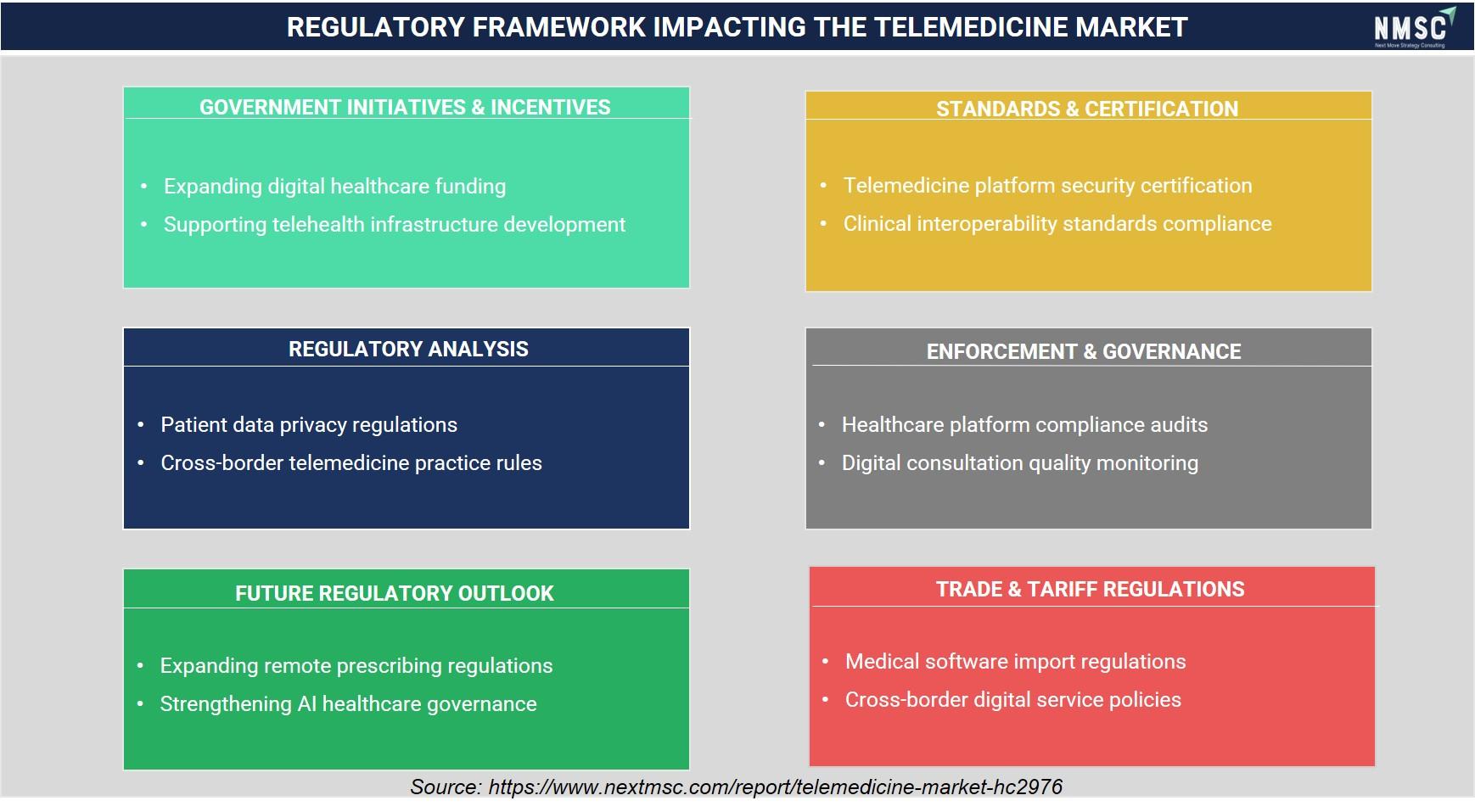
The Infographic Outlines The Regulatory Framework Shaping The Market Through Government Initiatives, Standards, Governance, And Future Policy Developments. It Highlights Investments In Digital Health Infrastructure, Platform Security Certification, Patient Data Privacy Regulations, Compliance Audits, And Cross-border Practice Rules. Emerging Regulations Supporting Remote Prescribing, Ai Governance, And Digital Healthcare Interoperability Are Expected To Strengthen Trust, Improve Service Quality, And Accelerate The Adoption Of Secure, Compliant Telemedicine Services Worldwide.
Regional Outlook
Geographic Performance Snapshot
|
Region |
2025 (USD) |
2035 (USD) |
CAGR% (2026-2035) |
Key Driver |
|
North America |
USD 47.48 Billion |
USD 186.35 Billion |
15.3% |
CMS reimbursement expansion and employer virtual-first adoption |
|
Europe |
USD 24.87 Billion |
USD 98.35 Billion |
15.4% |
Digital Services Act and cross-border care initiatives |
|
Asia-Pacific |
USD 27.13 Billion |
USD 160.47 Billion |
20.7% |
Government digital health infrastructure investment |
|
Middle East & Africa |
USD 7.91 Billion |
USD 41.41 Billion |
19.0% |
Vision 2030-linked healthcare digitization |
|
Latin America |
USD 5.65 Billion |
USD 31.06 Billion |
19.7% |
Expanding public health telehealth programs |
|
Total |
USD 113.04 Billion |
USD 517.65 Billion |
17.3% |
-- |
North America Telemedicine Market Outlook
North America leads the market with an established payer reimbursement framework and mature employer benefit-distribution network. We observed that Centers for Medicare & Medicaid Services telehealth flexibilities sustain demand for real-time and RPM-enabled services, while employers increasingly specify integrated virtual-first platforms. Technology adoption remains concentrated in cloud-based consultation platforms, with regulatory attention shifting toward interstate licensure compact expansion as demand scales toward 2035.
Europe Telemedicine Market Outlook
Europe's market is shaped by the Digital Services Act's push to standardize cross-border digital health data flows. We observed that national health systems are tightening interoperability requirements, favoring platform vendors with proven multi-country compliance. Technology adoption is shifting toward integrated platforms combining consultation and remote monitoring, while regulatory scrutiny of patient data handling under GDPR shapes vendor selection across the region.
Asia-Pacific Telemedicine Market Outlook
Asia-Pacific is the fastest-growing region, propelled by government digital health infrastructure investment in China and India's expanding national telehealth programs. We observed that regional platform providers are scaling multilingual, mobile-first applications to reach underserved rural populations. Technology adoption favors mobile app delivery, with government procurement increasingly requiring domestic data-hosting compliance across the region.
Middle East & Africa Telemedicine Market Outlook
Middle East & Africa is advancing on the strength of Saudi Arabia's Vision 2030 healthcare digitization program and UAE telehealth licensing reforms. We observed that governments are procuring national telehealth platforms to extend specialist access to remote regions. Technology adoption is concentrated in institutional telehealth contracts, with regulatory frameworks increasingly requiring data residency compliance for new platform deployments.
Latin America Telemedicine Market Outlook
Latin America's market is advancing on the back of expanding public health telehealth programs in Brazil and growing private insurer virtual care coverage. We observed that regulators are introducing telemedicine-specific licensure frameworks that formalize previously informal virtual consultation practices. Technology adoption favors mobile app delivery, with regional payers increasingly issuing virtual-care-specific reimbursement codes to address rural access gaps.
U.S. Telemedicine Market Outlook
The market in the U.S. market benefits from Centers for Medicare & Medicaid Services reimbursement flexibilities and expanding employer-sponsored virtual-first benefit adoption. Demand structure is concentrated in real-time consultations and remote patient monitoring, with technology adoption favoring cloud-based platforms. Regulatory influence from state licensure compacts and competitive intensity among national platform operators continue to shape strategic sourcing decisions. The country's market was valued at approximately USD 38.93 billion in 2025 and is projected to reach approximately USD 149.08 billion by 2035, expanding at a 15.0% CAGR from 2026 to 2035.
Canada Telemedicine Market Outlook
Based on our estimates, Canada's market is supported by provincial virtual care reimbursement expansion and growing rural physician-shortage mitigation programs. Demand structure favors institutional telehealth contracts paired with primary care access, while technology penetration of mobile app delivery continues to rise. Regulatory influence from provincial health authority guidelines and moderate competitive intensity shape a steady strategic outlook through 2035. The country's market was valued at approximately USD 6.65 billion in 2025 and is projected to reach approximately USD 27.95 billion by 2035, expanding at a 16.2% CAGR from 2026 to 2035.
UK Telemedicine Market Outlook
As per our estimate, the UK market is advancing on the back of NHS digital-first primary care initiatives and expanding GP video consultation adoption. Demand structure is concentrated in real-time consultations, with technology adoption favoring integrated platforms linked to national health records. Regulatory influence from NHS England digital standards and rising competitive intensity among platform vendors support a favorable strategic outlook. The country's market was valued at approximately USD 5.97 billion in 2025 and is projected to reach approximately USD 22.62 billion by 2035, expanding at a 14.8% CAGR from 2026 to 2035.
Germany Telemedicine Market Outlook
According to our analysis, Germany's market benefits from statutory health insurance reimbursement for digital health applications under the DiGA framework. Demand structure spans hospital and clinic segments, with technology adoption favoring cloud-based consultation platforms. Regulatory influence from the Federal Institute for Drugs and Medical Devices' DiGA approval process and high competitive intensity shape a technology-forward strategic outlook. The country's market was valued at approximately USD 5.47 billion in 2025 and is projected to reach approximately USD 21.64 billion by 2035, expanding at a 15.4% CAGR from 2026 to 2035.
France Telemedicine Market Outlook
The market in France's market is expanding alongside national health insurance teleconsultation reimbursement reforms. Demand structure favors real-time consultations integrated with primary care, with technology penetration of mobile app platforms rising steadily. Regulatory influence from Haute Autorite de Sante guidelines and moderate competitive intensity support continued strategic expansion. The country's market was valued at approximately USD 3.98 billion in 2025 and is projected to reach approximately USD 15.74 billion by 2035, expanding at a 15.4% CAGR from 2026 to 2035.
China Telemedicine Market Outlook
Based on our estimates, China's market leads Asia-Pacific on the strength of national internet hospital licensing reforms and large-scale platform consolidation. Demand structure is dominated by mobile app-based consultations, with technology penetration of AI-assisted triage near-universal among leading platforms. Regulatory influence from National Health Commission internet hospital rules and intense domestic competitive pressure define the strategic outlook. The country's market was valued at approximately USD 10.31 billion in 2025 and is projected to reach approximately USD 64.19 billion by 2035, expanding at a 21.3% CAGR from 2026 to 2035.
India Telemedicine Market Outlook
As per our estimate, India's market is the fastest-growing country market, propelled by the national eSanjeevani telehealth program and expanding rural physician-access initiatives. Demand structure favors institutional telehealth and direct-to-consumer segments, with technology penetration rising rapidly from a smaller base. Regulatory influence from Telemedicine Practice Guidelines and growing competitive intensity underpin an aggressive strategic outlook. The country's market was valued at approximately USD 4.34 billion in 2025 and is projected to reach approximately USD 38.51 billion by 2035, expanding at a 26.2% CAGR from 2026 to 2035.
Japan Telemedicine Market Outlook
According to our analysis, Japan's market benefits from Ministry of Health, Labour and Welfare online consultation reimbursement expansion. Demand structure spans hospital and clinic segments, with technology adoption favoring secure cloud-hosted platforms. Regulatory influence from national telemedicine guidelines and moderate competitive intensity support a stable strategic outlook through 2035. The country's telemedicine market was valued at approximately USD 3.80 billion in 2025 and is projected to reach approximately USD 17.65 billion by 2035, expanding at a 17.5% CAGR from 2026 to 2035.
South Korea Telemedicine Market Outlook
The market in South Korea benefits from pilot telemedicine reimbursement expansion under the Ministry of Health and Welfare. Demand structure favors real-time consultations in urban centers, with technology penetration of domestically developed platforms rising. Regulatory influence from evolving Medical Service Act provisions and high competitive intensity among domestic vendors shape continued strategic growth. The country's telemedicine market was valued at approximately USD 2.17 billion in 2025 and is projected to reach approximately USD 11.23 billion by 2035, expanding at a 18.9% CAGR from 2026 to 2035.
Australia Telemedicine Market Outlook
Based on our estimates, Australia's market is advancing on the back of Medicare Benefits Schedule telehealth item number expansion. Demand structure spans rural and metropolitan segments, with technology adoption favoring cloud-based consultation platforms. Regulatory influence from Department of Health telehealth guidelines and rising competitive intensity among integrators support sustained strategic expansion. The country's telemedicine market was valued at approximately USD 1.90 billion in 2025 and is projected to reach approximately USD 9.63 billion by 2035, expanding at a 18.6% CAGR from 2026 to 2035.
UAE Telemedicine Market Outlook
As per our estimate, the UAE market benefits from Dubai Health Authority telehealth licensing reforms and expanding private-sector virtual care adoption. Demand structure favors institutional telehealth contracts, with technology penetration of cloud-based platforms rising. Regulatory influence from national digital health strategy targets and moderate competitive intensity support a favorable strategic outlook. The country's market was valued at approximately USD 1.90 billion in 2025 and is projected to reach approximately USD 9.94 billion by 2035, expanding at a 19.0% CAGR from 2026 to 2035.
Saudi Arabia Telemedicine Market Outlook
According to our analysis, Saudi Arabia's market is propelled by Vision 2030's healthcare digitization targets and the national Seha virtual hospital platform. Demand structure is concentrated in institutional telehealth deployment, with technology penetration of platforms accelerating from a small base. Regulatory influence from Ministry of Health telehealth regulations underpins an aggressive strategic outlook. The country's telemedicine market was valued at approximately USD 2.37 billion in 2025 and is projected to reach approximately USD 13.25 billion by 2035, expanding at a 19.9% CAGR from 2026 to 2035.
South Africa Telemedicine Market Outlook
The market in South Africa benefits from expanding private insurer telehealth coverage and growing rural physician-shortage mitigation programs. Demand structure favors direct-to-consumer consultation platforms, with technology penetration rising steadily. Regulatory influence from the Health Professions Council of South Africa's telehealth guidance and growing competitive intensity support continued strategic expansion. The country's telemedicine market was valued at approximately USD 1.11 billion in 2025 and is projected to reach approximately USD 5.80 billion by 2035, expanding at a 19.0% CAGR from 2026 to 2035.
Brazil Telemedicine Market Outlook
Based on our estimates, Brazil's market is advancing on the back of federal telemedicine law formalizing virtual consultation practice nationwide. Demand structure spans public health program and private payer segments, with technology adoption of mobile app platforms rising. Regulatory influence from Federal Council of Medicine guidelines and moderate competitive intensity support a positive strategic outlook. The country's telemedicine market was valued at approximately USD 2.60 billion in 2025 and is projected to reach approximately USD 14.29 billion by 2035, expanding at a 19.7% CAGR from 2026 to 2035.
Argentina Telemedicine Market Outlook
As per our estimate, Argentina's telemedicine market benefits from expanding public health telehealth programs addressing regional physician-access gaps. Demand structure favors institutional telehealth contracts, with technology penetration of platforms rising from a modest base. Regulatory influence from national telehealth framework guidelines and moderate competitive intensity shape continued strategic development. The country's telemedicine market was valued at approximately USD 0.85 billion in 2025 and is projected to reach approximately USD 4.97 billion by 2035, expanding at a 20.5% CAGR from 2026 to 2035.
Competitive Landscape
We observed that the telemedicine market remains moderately fragmented, with global platform operators, regional specialists, and specialty-focused providers competing across overlapping segments of the value chain.
|
Market Structure |
Details |
|
Market Structure |
Moderately fragmented among top 10 global platform operators, with a long tail of regional and specialty-focused providers |
|
Innovation Focus |
AI-assisted triage, integrated remote patient monitoring, and multi-specialty platform consolidation |
|
M&A Activity |
Consolidation of point-solution vendors into integrated platforms, and behavioral health acquisitions |
How Do Companies Compete in the Telemedicine Market?
Companies compete primarily on network breadth, payer contract coverage, and platform interoperability within the telemedicine market. We observed that vertically integrated platforms combining consultation, monitoring, and pharmacy services can offer more competitive employer and payer bids than single-service vendors. Clinical outcomes data and licensure coverage across states increasingly differentiate proposals in institutional procurement, alongside data-security certification for buyers seeking compliance assurance.
Which Competitive Archetypes Dominate the Telemedicine Industry?
Two archetypes dominate the telemedicine industry: large multi-specialty platform operators with broad payer contract networks, and specialty-focused providers concentrated in mental health or chronic disease management. We found that the first group competes primarily on breadth and employer bundling, while the second differentiates through clinical depth and outcomes-based contracting that lock in recurring per-member-per-month revenue across targeted specialty populations.
What Innovation and Differentiation Strategies Define Market Leaders?
Market leaders differentiate through AI-assisted triage, integrated device partnerships, and patient engagement solutions that extend care beyond the consultation visit. Our analysis shows that companies investing in remote monitoring device integration and outcomes-tracking software are positioning to capture value-based care contracts, while multilingual and mobile-first platform design increasingly forms a core part of competitive bids across emerging-market tenders.
How Active Is M&A in the Telemedicine Market?
M&A activity remains active as platform operators pursue consolidation of point-solution vendors to build integrated, multi-specialty offerings. We found that behavioral health acquisitions continue to expand platform breadth, while regional providers pursue geographic-expansion partnerships to enter new government and institutional procurement markets across Asia-Pacific and the Middle East.
Key Market Players
We observed that the following companies represent the leading participants shaping the competitive structure of the telemedicine market.
-
Teladoc Health, Inc.
-
American Well Corporation (Amwell)
-
Ping An Good Doctor
-
Kry Digital Health AB (Kry / Livi)
-
Practo Technologies Pvt. Ltd.
-
Halodoc (PT Halodoc)
-
WeDoctor (Hangzhou WeDoctor)
-
Docplanner Group S.A.
-
TELUS Health (TELUS Corporation)
-
Included Health, Inc. (Grand Rounds + Doctor On Demand)
-
Doxy.me, LLC
-
VSee Health, Inc.
-
eClinicalWorks, LLC (healow TeleVisits)
-
eVisit, Inc.
-
Zocdoc, Inc.
-
98point6 Technologies
-
Talkspace, Inc.
-
AMC Health, Inc.
Latest Developments
Our assessment indicates that recent corporate activity reflects continued platform consolidation and specialty expansion across the telemedicine market.
|
Date |
Event |
|
April 2025 |
Teladoc Health acquired UpLift, expanding its mental healthcare offerings through BetterHelp and strengthening access to covered mental health benefits. |
|
Mar 2025 |
Expanded the Connected Care Partnerships ecosystem by adding specialty care, digestive health, fertility and family-building partners to its Prism platform. |
Expert Insights
 "Early generations of telehealth have really been about convenience... The revolution that's going on right now is where people are beginning to utilize these technologies to interact with their regular caretakers. Patients with very difficult conditions like cancer and deep chronic conditions are becoming the frequent flyers of telehealth. That's going to continue to evolve."
— Dr. Roy Schoenberg, Co-Founder & Co-CEO, Amwell
Statement made during an interview with the Associated Press discussing the future evolution of telemedicine (February 2024).
Market Interpretation
The statement highlights the telemedicine market's transition from on-demand virtual consultations to continuous, relationship-based healthcare. As providers increasingly use telemedicine for chronic disease management, oncology, and long-term patient monitoring, demand is shifting toward integrated virtual care ecosystems supported by AI and remote monitoring technologies. This evolution is expected to drive sustained market growth by expanding telemedicine beyond urgent care into routine, value-based healthcare delivery.
Investment Opportunities
Where Are Capital Inflows Concentrated in the Telemedicine Market?
Capital inflows are concentrated in AI-enabled clinical support software and remote patient monitoring device manufacturing. We observed that private equity and strategic investors are increasingly funding behavioral health and chronic disease management platforms to capture recurring subscription revenue, reflecting growing investor confidence in telemedicine as a durable healthcare-delivery category rather than a pandemic-era anomaly.
How Significant Is Infrastructure Investment in Telemedicine Platforms?
Infrastructure investment in secure cloud hosting and interoperability is accelerating as health systems integrate virtual care with electronic health records. Our findings suggest that teleradiology integration is emerging as an adjacent infrastructure investment theme, with hospitals piloting remote diagnostic imaging review to supplement in-person specialist capacity during peak demand periods.
What ESG Considerations Shape Telemedicine Investment?
Environmental, social, and governance considerations increasingly shape investment decisions, with investors prioritizing platforms that demonstrably expand healthcare access in underserved and rural populations. We observed that data-privacy governance and algorithmic-bias auditing in AI triage tools are drawing heightened lender and investor scrutiny, reflecting growing attention to equitable access and responsible AI deployment across the telemedicine value chain.
Key Benefits for Stakeholders
How Does This Report Benefit Health System and Industry Leaders?
Health system and industry leaders gain access to segment-level revenue forecasts and technology-adoption trends that inform virtual care service-line planning. Our analysis shows that the report's regional breakdowns support market-entry and licensure-strategy decisions, helping stakeholders align investment with the fastest-growing clinical services and end-user segments through 2035.
How Does This Report Benefit Investors and Financial Analysts?
Investors and financial analysts benefit from consolidated market-sizing data, competitive-landscape mapping, and CAGR-level growth drivers that support valuation and due-diligence work. We found that the report's country-level forecasts help identify markets with the strongest risk-adjusted return profiles, particularly across the fastest-growing Asia-Pacific and Middle East & Africa regions.
How Does This Report Benefit Technology Vendors and Product Teams?
Technology vendors and product teams gain segmentation-level insight into delivery mode, clinical specialty, and end-user preferences that inform roadmap prioritization. Our assessment indicates that the report's trend analysis highlights AI clinical support tools as a high-growth adjacency, helping product teams align development resources with the fastest-growing sub-segments identified in this market report.
Key Market Segments
By Clinical Services
-
Real-Time Consultations
-
Scheduled Primary Care
-
Urgent/On-Demand Care
-
Specialist Consults
-
Multidisciplinary Coordination
-
-
Asynchronous Services
-
Diagnostic Interpretation
-
eConsults
-
-
Remote Patient Monitoring (RPM)
-
Chronic Disease Management
-
Acute/Post-Acute Care
-
Medication Adherence
-
-
Institutional Telehealth
-
Specialty Coverage Contracts
-
Public Health Programs
-
-
Direct-to-Consumer (DTC)
-
Subscription Services
-
Employer/Payer Bundles
-
Retail/Pharmacy Consults
-
By Enabling Products and Services
-
Hardware and Devices
-
RPM Devices
-
Clinical Peripherals
-
Telecarts/Kiosks
-
-
Software Solutions
-
Integrated Platforms
-
Standalone Applications
-
AI/Clinical Support Tools
-
-
Support Services
-
Implementation and Integration
-
Training/Change Management
-
Data Analytics
-
-
Connectivity and Compliance
-
Secure Hosting/Cloud
-
Bandwidth/IoT Services
-
Regulatory Solutions
-
-
Government-Specific Enablers
-
Public Infrastructure
-
National Interoperability
-
By Delivery Mode
-
Cloud/SaaS
-
On-Premise
-
Mobile Apps
-
Hybrid
By Clinical Specialty
-
Mental Health
-
Cardiology
-
Radiology
-
Primary Care
-
Dermatology
-
Oncology
By End User
-
Hospitals
-
Clinics
-
Payers
-
Employers
-
Patients (B2C)
-
Government
By Region
-
North America: U.S., Canada, Mexico
-
Europe: UK, Germany, France, Italy, Spain, Sweden, Denmark, Finland, Netherlands, Rest of Europe
-
Asia-Pacific: China, India, Japan, South Korea, Taiwan, Indonesia, Vietnam, Australia, Philippines, Malaysia, Rest of APAC
-
Middle East & Africa: Saudi Arabia, UAE, Egypt, Israel, Turkey, Nigeria, South Africa, Rest of MEA
-
Latin America: Brazil, Argentina, Chile, Colombia, Rest of LATAM
Conclusion and Recommendations
What Is the Long-Term Outlook for the Telemedicine Market?
The long-term outlook remains strongly positive, with the market projected to grow more than fourfold from USD 123.39 billion in 2026 to USD 517.65 billion by 2035. We observed that this trajectory is underpinned by structural payer reimbursement expansion and chronic disease burden rather than pandemic-era anomaly alone, positioning telemedicine as a permanent healthcare-delivery category through 2035 and beyond.
What Strategic Positioning Should Stakeholders Pursue?
Stakeholders should pursue integrated positioning that combines real-time consultation, remote patient monitoring, and AI-enabled clinical support within a single platform. Our analysis shows that vendors investing early in multi-specialty breadth and payer contract coverage, spanning mental health, cardiology, and primary care, will be best positioned to capture premium employer and institutional contract awards within the telemedicine market.
How Attractive Is the Telemedicine Market for New Investment?
The telemedicine industry presents a highly attractive investment case, supported by a USD 394.26 billion absolute dollar opportunity between 2026 and 2035 and above-average growth in Asia-Pacific and Middle East & Africa. We found that investment attractiveness is highest for platforms combining clinical breadth with AI-driven differentiation, positioning them to serve both cost-sensitive government tenders and premium employer segments simultaneously.
What Market Shifts and Key Risks Should Stakeholders Monitor?
Stakeholders should monitor licensure fragmentation, reimbursement parity uncertainty, and data-privacy compliance costs as key risks to the telemedicine market. Our analysis shows that vendors unable to navigate multi-state and multi-country regulatory complexity risk losing institutional contracts to competitors with established compliance infrastructure, particularly as demand accelerates across regulated payer and government channels through 2035.
What Are the Key Growth Pathways for the Telemedicine Market?
Key growth pathways include expanding remote patient monitoring portfolios, scaling AI-enabled clinical support capability, and deepening penetration into employer and government payer segments. Next Move Strategy Consulting's analysis indicates that vendors pursuing these pathways while maintaining cost competitiveness in core consultation categories will be best positioned to capture the telemedicine market's projected growth through 2035.
About the Author
 Liza Phukan
— Liza Phukan is Research Associate at Next Move Strategy Consulting, where she has covered emerging industries and market research across sectors for 3.5 years. Her work includes analyzing industry developments, validating market data, and developing structured business content from research findings. She uses secondary research and data-validation practices to turn complex market information into clear decision-useful market analysis for business audiences and support report development and B2B.
Liza Phukan
— Liza Phukan is Research Associate at Next Move Strategy Consulting, where she has covered emerging industries and market research across sectors for 3.5 years. Her work includes analyzing industry developments, validating market data, and developing structured business content from research findings. She uses secondary research and data-validation practices to turn complex market information into clear decision-useful market analysis for business audiences and support report development and B2B.
About the Reviewer
 Supradip Baul
— Supradip Baul is an accomplished business consultant and strategist with over a decade of rich experience in market intelligence, strategy, technology, and business transformation. His work has included rigorous qualitative and quantitative analysis across multiple industries, helping clients shape investment decisions and long-term roadmaps. Earlier in his career, he was associated with Gartner, where he contributed to industry-leading reports and market share analyses. He has worked with leading global companies and holds an MBA with a dual specialization in Marketing and Finance.
Supradip Baul
— Supradip Baul is an accomplished business consultant and strategist with over a decade of rich experience in market intelligence, strategy, technology, and business transformation. His work has included rigorous qualitative and quantitative analysis across multiple industries, helping clients shape investment decisions and long-term roadmaps. Earlier in his career, he was associated with Gartner, where he contributed to industry-leading reports and market share analyses. He has worked with leading global companies and holds an MBA with a dual specialization in Marketing and Finance.
At Next Move Strategy Consulting, we understand that insightful market research is the cornerstone of successful business decisions. That's why we employ a robust and multifaceted approach, combining various methodologies to deliver the most accurate and actionable data for our clients.

Research Landscape
We navigate the world of research with two primary approaches:
Qualitative Approach
Our qualitative research methodologies involve immersive techniques such as in-depth interviews, focus groups, and observational studies. By engaging directly with individuals and stakeholders, we uncover valuable insights that quantitative data alone may overlook.

Quantitative Research
In tandem with qualitative methodologies, NMSC leverages the power of Quantitative Research to provide a robust foundation of numerical insights. Through systematic data collection and analysis, we quantify patterns, preferences, and market trends, offering a comprehensive view of the business landscape.
Our quantitative research approach employs diverse tools, including surveys, experiments, and statistical modelling. These methodologies enable us to gather data from a large and representative sample, ensuring the statistical significance of our findings. By employing structured questionnaires and standardized data collection methods, we guarantee the reliability and validity of the information we present to our clients.
Quantitative research is particularly effective in measuring the prevalence of trends, assessing market size, and gauging the impact of various factors on consumer behavior. The numerical precision attained through this approach equips our clients with actionable insights, facilitating data-driven decision-making and strategy formulation.


Our Specialized Toolbox for Industry-Specific Market Research
We deploy a specialized arsenal of techniques tailored to meet your unique requirements. Here's a glimpse into our comprehensive toolbox:

Information Procurement
The stage entails acquiring market data or relevant information through various sources and methodologies.


Market Research Approach
We utilize both top-down and bottom-up approaches in market research analysis to achieve a comprehensive understanding of the market dynamics, leveraging the broad perspective of industry trends and macroeconomic factors alongside detailed insights from specific segments and individual companies.

Porters Five Forces Analysis
We conduct Porter's Five Forces analysis to evaluate the competitive landscape of an industry, providing us with insights into factors that affect profitability and strategic positioning.

SWOT Analysis

Forecasting
We utilize a forecasting model to predict future consumption by considering parameters like population, economics, regulations, market competition, drivers, constraints, technology, and pricing. We also employ statistical techniques such as multilinear regression, exponential smoothing, moving average, ARIMA, and Monte Carlo simulations for accurate predictions. In econometric forecasting, we analyzed short-term and long-term event impacts, attributing values based on regulatory frameworks, economic factors, and market events.





 Speak to Our Analyst