Twin Screw Extruders Market Global Industry Analysis and Forecast (2026–2035)

The global Twin Screw Extruders Market size was valued at USD 4.90 billion in 2025 and is estimated at USD 5.19 billion in 2026, forecast to reach USD 7.79 billion by 2035, expanding at a 4.63% CAGR between 2026 and 2035. Asia-Pacific leads with approximately 43% share, while Co-Rotating Extruders dominate all other extruder types with approximately 78% share.

Download Free Sample PDF
Base Year (2025)
$4.90 Billion
Forecast (2035)
$7.79 Billion
CAGR (2026-2035)
4.6%
Top Region
Asia-Pacific

What Is the Twin Screw Extruders Market Size?

The Twin Screw Extruders Market reached USD 4.90 Billion in 2025 and is estimated at USD 5.19 Billion in 2026. It is forecast to reach USD 7.79 Billion by 2035, expanding at a 4.63% CAGR from 2026–2035. Asia-Pacific leads with roughly 43% share, while co-rotating extruders contribute about 78% of revenue.
Our findings suggest that the following headline indicators summarize where value is concentrated and where growth is accelerating.

Twin Screw Extruders Market Global Industry Analysis and Forecast (2026–2035) Revenue Forecast

Values in USD Billion

2025 $4.90 Billion
2025
2026 $5.19 Billion
2026
2027 $5.43 Billion
2027
2028 $5.68 Billion
2028
2029 $5.94 Billion
2029
2030 $6.22 Billion
2030
2031 $6.51 Billion
2031
2032 $6.81 Billion
2032
2033 $7.12 Billion
2033
2034 $7.45 Billion
2034
2035 $7.79 Billion
2035

Key Takeaways

By Screw Rotation Type: Co-rotating twin screw extruders held the largest share, expanding from USD 3.81 Billion in 2025 to USD 6.23 Billion by 2035; they are also the fastest growing at 4.9% CAGR from 2026–2035.

By Application: Plastics compounding and masterbatch held the largest share, expanding from USD 2.13 Billion in 2025 to USD 3.06 Billion by 2035; plastics recycling is the fastest growing at 6.7% CAGR from 2026–2035.

By Capacity Class: Mid scale (40–100 mm) held the largest share, expanding from USD 2.86 Billion in 2025 to USD 4.35 Billion by 2035; laboratory scale (below 40 mm) is the fastest growing at 5.5% CAGR from 2026–2035.

Dominant Region: Asia-Pacific accounted for USD 2.11 Billion in 2025, rising to USD 3.75 Billion by 2035.

Fastest-Growing Region: Asia-Pacific is the fastest growing region at 5.8% CAGR from 2026–2035.

Dominant Country: China led with USD 1.09 Billion in 2025, rising to USD 1.99 Billion by 2035.

Fastest-Growing Country: India is the fastest growing country at 8.0% CAGR from 2026–2035, rising from USD 0.21 Billion in 2025 to USD 0.46 Billion by 2035.

Between 2026 and 2035 the market adds an absolute opportunity of USD 2.60 Billion, which signals a durable investment case for equipment makers that pair extruders with recycling, protein and pharmaceutical process know how. The largest share of that increment comes from Asia-Pacific, where new compounding and recycling capacity is being commissioned each year.

According to NMSC analysis, aftermarket screws, barrels and gearbox refurbishment grow faster than new machine shipments because processors extend asset life while recycled feedstock accelerates wear. This pattern means suppliers with strong service networks capture recurring revenue even in years when new machine orders are delayed by financing or project timing.

What Does the Twin Screw Extruders Market Encompass?

Our assessment indicates that the Twin Screw Extruders Market covers co-rotating and counter-rotating machines used to convey, melt, mix, devolatilize and process materials across plastics, food, feed, pharmaceutical and specialty chemical applications. It includes associated screws, barrels, gearboxes and process controls. Aftermarket replacement parts, refurbishment and lifecycle services are included in the market valuation only where they fall within the defined revenue scope. The market excludes single-screw extruders and downstream pelletizing lines sold independently.

The regulatory environment shapes demand through recycled content rules, food contact and hygienic design standards, and pharmaceutical good manufacturing practice. Technology adoption centers on energy efficient drives, modular screw elements, inline sensors and digital twins for scale up. Structural evolution is visible in the move from standalone machines to turnkey lines, where suppliers bundle feeding, extrusion, pelletizing and service contracts to secure recurring revenue.

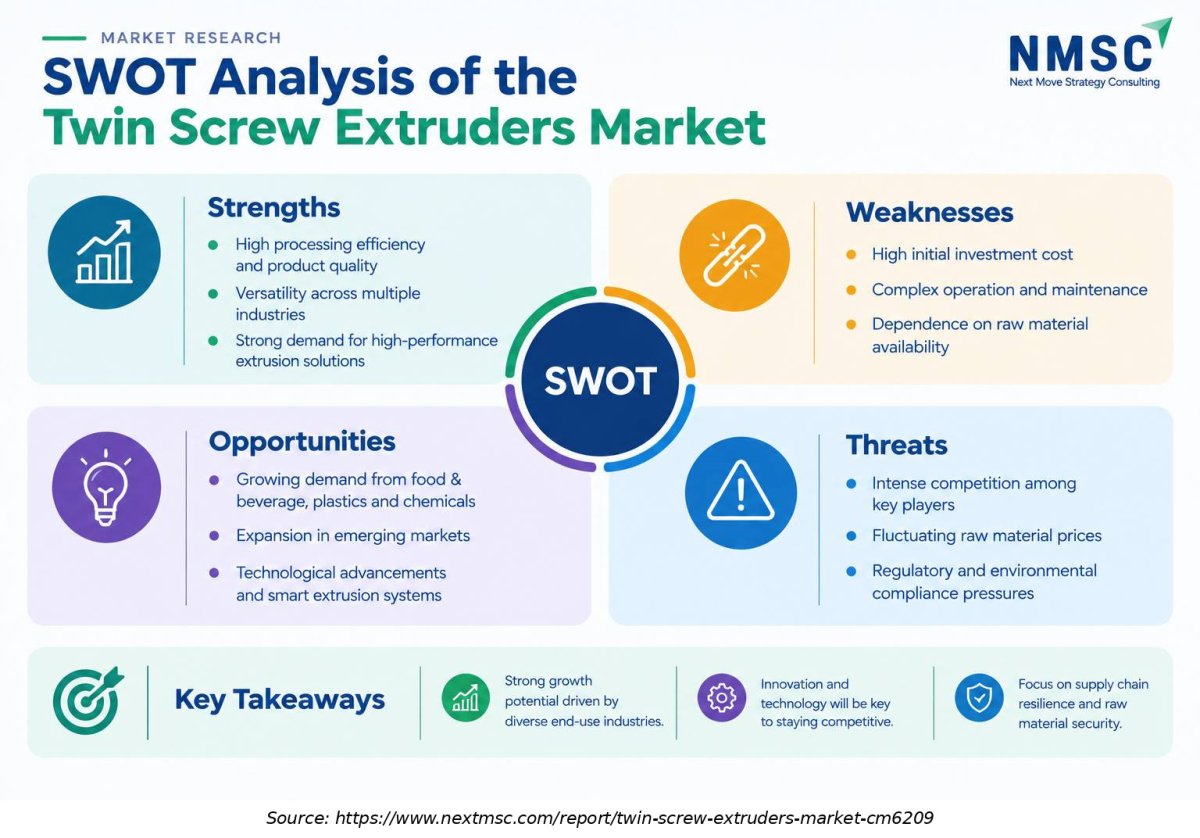
SWOT Analysis

This SWOT view highlights structural strengths, strategic gaps, expansion headroom, and external risks shaping outcomes in the Twin Screw Extruders Market Global Industry Analysis and Forecast (2026–2035).

Strengths

Weaknesses

Opportunities

Threats

Market Drivers & Dynamics

Interactive Dataset
Plastics recycling mandates and recycled content targets driver +0.9% Europe, North America, Asia-Pacific 2026–2032
Engineered compounds for electric vehicles and electronics driver +0.7% Asia-Pacific, Europe 2026–2035
Pet food, feed and plant protein extrusion expansion driver +0.5% North America, Europe, Latin America 2026–2033
Hot melt extrusion adoption in solid dose manufacturing driver +0.3% North America, Europe 2026–2035
Cyclical capital spending and project delays restraint −0.6% Global 2026–2028
Low cost regional competition and price pressure restraint −0.5% Asia-Pacific, Middle East & Africa 2026–2035
Wear costs and shortage of skilled process engineers restraint −0.3% Global 2026–2030
Source: Next Move Strategy Consulting

Growth Drivers

What Is the Primary Growth Driver in the Twin Screw Extruders Market?

Global plastics production exceeded 390 million tonnes in 2021, and a rising portion must be compounded with fillers, fibers and additives before conversion. Twin screw machines handle this compounding task with the dispersive mixing that single screw units cannot match. Our analysis shows that engineered polymer demand from vehicles, electronics and packaging sustains steady replacement and capacity orders across every major producing region.

How Is Circular Economy Policy Driving Market Growth?

Recycled content obligations in Europe and similar targets elsewhere push converters to buy machines able to process variable post consumer feedstock. Recyclers invest in extruders with strong venting, melt filtration and screw designs tolerant of contamination. We found that retrofit demand follows new capacity, because older lines struggle with moisture and volatile residues. This makes recycling the fastest growing application at 6.7% CAGR over 2026–2035.

Growth Inhibitors

What Is Restraining the Twin Screw Extruders Market?

Capital equipment demand is cyclical, and recent results show how quickly orders can soften. Hillenbrand reported fiscal 2025 net revenue of USD 2.67 Billion, down 16%, and its Advanced Process Solutions segment fell 10% on lower capital equipment volume. Price competition from regional builders in Asia adds pressure on margins. Buyers therefore delay large projects until financing and polymer spreads improve.

What Are the Growth Opportunities?

How Can Battery Materials Processing Open a New Revenue Stream?

Twin screw extrusion supports continuous electrode slurry mixing and solid electrolyte processing, replacing batch mixers with lower solvent use. Suppliers that qualify machines for abrasive, moisture sensitive powders can address cell makers and battery recycling operators expanding in Asia, Europe and North America. The chemical and battery materials segment grows 5.4% CAGR from 2026–2035, and early qualified vendors secure repeat orders for screws and barrels.

Where Does Aftermarket and Retrofit Service Create Value?

Installed machines wear faster when processing recycled or glass filled material, so replacement screws, barrels and gearbox overhauls recur every few years. Vendors that offer remanufacturing, condition monitoring and performance upgrades capture margin that new machine sales cannot match. Processors with aging lines benefit from higher uptime, and suppliers smooth revenue across the capital equipment cycle.

Why Are Emerging Economies a Growth Opportunity?

India, Saudi Arabia and the United Arab Emirates are building compounding, packaging and recycling capacity to localize polymer value chains. Local assembly, application laboratories and financing partnerships help global suppliers compete with domestic builders. Compounders in these countries gain access to proven process know how, and vendors with regional service networks win share as rising output requires dependable support.

Segmentation Analysis

2025 (USD Billion)
2035 (USD Billion)
Co-rotating twin screw extruders 2025: $3.81 Billion | 2035: $6.23 Billion
Co-rotating
Counter-rotating twin screw extruders 2025: $1.09 Billion | 2035: $1.56 Billion
Counter-rota
Co-rotating twin screw extruders $3.81 Billion $6.23 Billion 4.9%
Counter-rotating twin screw extruders $1.09 Billion $1.56 Billion 3.4%

Which Screw Rotation Type Leads the Twin Screw Extruders Market?

Co-rotating machines hold about 78% of 2025 revenue because they combine high torque, self wiping screws and modular elements suited to compounding, recycling and reactive processing. Counter rotating units remain important for PVC pipe and profile extrusion, where gentle shear protects heat sensitive compounds. Our findings suggest co-rotating designs also grow faster at 4.9% CAGR, while counter rotating machines expand at 3.4% as construction demand moderates.

2025 (USD Billion)
2035 (USD Billion)
Plastics com
Plastics rec
Food and fee
Pharmaceutic
Chemical and
Segment Item 2025 (USD Billion) 2035 (USD Billion) CAGR
Plastics compounding and masterbatch $10.0 USD Billion $40.0 USD Billion 25.0%
Plastics recycling $17.1 USD Billion $51.1 USD Billion 11.0%
Food and feed processing $24.2 USD Billion $62.2 USD Billion 25.0%
Pharmaceutical and life sciences $31.3 USD Billion $73.3 USD Billion 11.0%
Chemical and battery materials $38.4 USD Billion $84.4 USD Billion 16.0%

Segment-wise data is locked

Unlock complete segment-wise numbers for By Application.

Unlock Full Data
2025 (USD Billion)
2035 (USD Billion)
Laboratory s
Mid scale (4
Large scale
Segment Item 2025 (USD Billion) 2035 (USD Billion) CAGR
Laboratory scale (below 40 mm) $10.0 USD Billion $40.0 USD Billion 27.0%
Mid scale (40–100 mm) $17.1 USD Billion $51.1 USD Billion 9.0%
Large scale (above 100 mm) $24.2 USD Billion $62.2 USD Billion 19.0%

Segment-wise data is locked

Unlock complete segment-wise numbers for By Capacity Class.

Unlock Full Data

Growth Opportunities

Our assessment indicates that three opportunity pools offer the clearest route to above market growth.

How Can Battery Materials Processing Open a New Revenue Stream?

Twin screw extrusion supports continuous electrode slurry mixing and solid electrolyte processing, replacing batch mixers with lower solvent use. Suppliers that qualify machines for abrasive, moisture sensitive powders can address cell makers and battery recycling operators expanding in Asia, Europe and North America. The chemical and battery materials segment grows 5.4% CAGR from 2026–2035, and early qualified vendors secure repeat orders for screws and barrels.

Where Does Aftermarket and Retrofit Service Create Value?

Installed machines wear faster when processing recycled or glass filled material, so replacement screws, barrels and gearbox overhauls recur every few years. Vendors that offer remanufacturing, condition monitoring and performance upgrades capture margin that new machine sales cannot match. Processors with aging lines benefit from higher uptime, and suppliers smooth revenue across the capital equipment cycle.

Why Are Emerging Economies a Growth Opportunity?

India, Saudi Arabia and the United Arab Emirates are building compounding, packaging and recycling capacity to localize polymer value chains. Local assembly, application laboratories and financing partnerships help global suppliers compete with domestic builders. Compounders in these countries gain access to proven process know how, and vendors with regional service networks win share as rising output requires dependable support.

Regional Outlook

2025 (USD Billion)
2035 (USD Billion)
North Americ
Europe
Asia-Pacific
Middle East
Latin Americ
Region 2025 (USD Billion) 2035 (USD Billion) CAGR (%)
North America $10.0 USD Billion $40.0 USD Billion 9.0%
Europe $17.1 USD Billion $51.1 USD Billion 27.0%
Asia-Pacific $24.2 USD Billion $62.2 USD Billion 25.0%
Middle East & Africa $31.3 USD Billion $73.3 USD Billion 23.0%
Latin America $38.4 USD Billion $84.4 USD Billion 12.0%

Regional data is locked

Unlock complete regional numbers for this market.

Unlock Full Data

Competitive Landscape

During our market evaluation, we noticed that the competitive landscape blends global engineering groups, diversified industrial companies and specialist food extrusion builders.

Dimension Description
Market Structure Moderately consolidated at the high end, with a long tail of regional builders in Asia
Innovation Focus Energy efficient drives, recycling capable screw designs, digital twins and pilot scale flexibility
M&A Activity Private equity ownership changes and portfolio consolidation, including Lone Star's 2026 acquisition of Hillenbrand

How Do Companies Compete in the Twin Screw Extruders Market?

In extrusion machinery, suppliers compete on throughput per kilowatt, process know how, delivery time and lifetime service rather than machine price alone. Premium builders defend share through application laboratories and customer trials, while regional players undercut on cost. JSW launched a fast delivery TEX series with standardized components to answer buyers who want shorter lead times at intermediate specifications, a response to pricing pressure.

Which Competitor Archetypes Dominate the Market?

Three archetypes stand out: global plastics process specialists such as Coperion, Leistritz and KraussMaffei; diversified groups such as Bühler and Japan Steel Works that pair extrusion with other industrial technology; and food and feed specialists including Clextral and Wenger. A fourth group, represented by Davis-Standard, combines extrusion with converting equipment. Differentiation themes are scale range, hygienic design and turnkey capability.

What Role Does M&A Play in Market Structure?

Ownership changes reshape the field. Davis-Standard completed its acquisition of the Extrusion Technology Group, including battenfeld-cincinnati, in January 2024, and Lone Star completed its acquisition of Hillenbrand, parent of Coperion, on February 10, 2026 at an enterprise value of about USD 3.8 Billion. Investors seek aftermarket revenue and consolidation synergies, and further bolt on deals among mid sized builders appear likely.

Key Market Players

Our analysis shows that the following eight companies form the verified key player set for this report, listed in ranked order.

Hillenbrand, Inc. Bühler Holding AG Leistritz AG Japan Steel Works, Ltd. KraussMaffei Group GmbH Davis-Standard, LLC Clextral SAS Wenger Manufacturing, Inc.

Latest Developments

We observed that recent corporate events centered on ownership change and financial performance at the leading suppliers.

Date Event
February 2026 Hillenbrand and an affiliate of Lone Star Funds completed the previously announced all-cash acquisition at an enterprise value of approximately USD 3.8 billion. Hillenbrand became a wholly owned subsidiary of Lone Star’s acquisition vehicle, while continuing its operations under the Hillenbrand name and serving customers through its processing-equipment businesses.

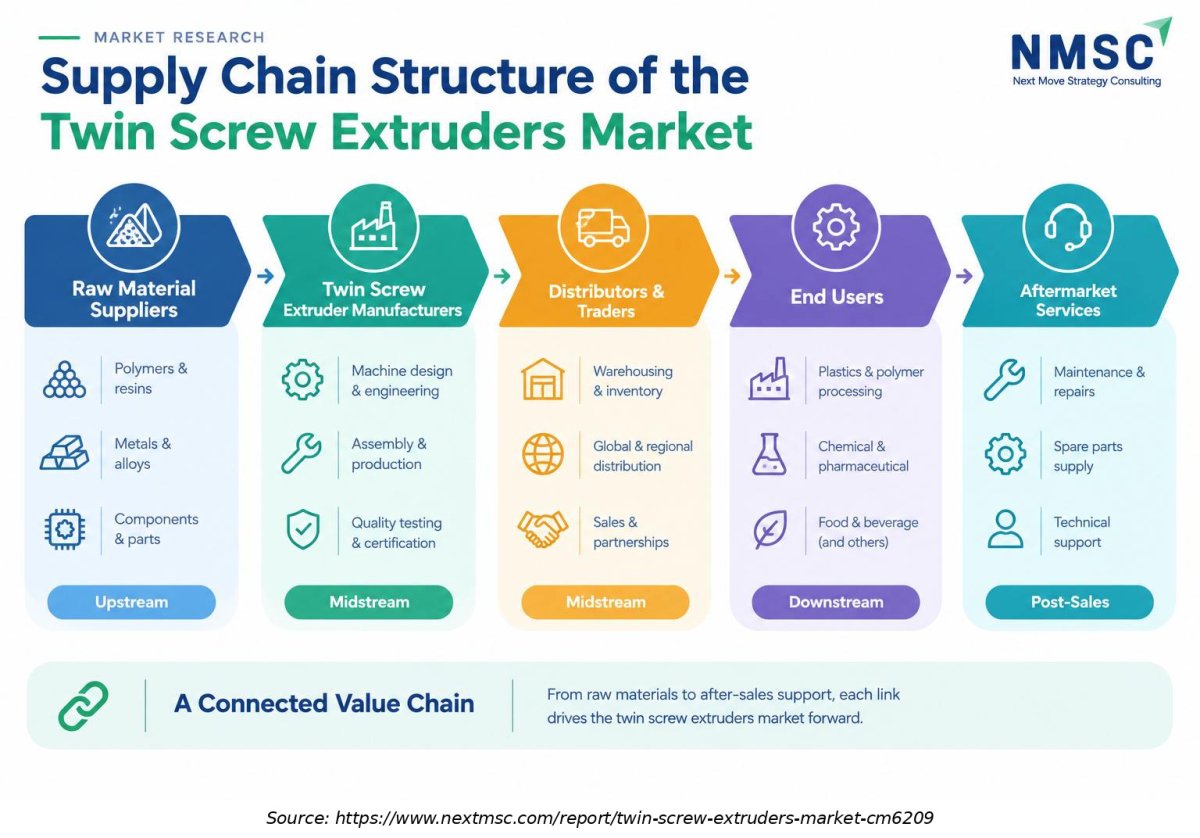
Supply Chain Structure of the Twin Screw Extruders Market
Supply Chain Structure of the Twin Screw Extruders Market

The supply chain structure outlines the movement from raw material suppliers and twin screw extruder manufacturers through distributors to end users and aftermarket service providers. Each stage contributes to equipment quality, production efficiency, distribution reach, and lifecycle support. Effective coordination across the value chain helps manufacturers manage component availability, maintain quality standards, strengthen customer relationships, and improve long-term operational reliability.

Investment Opportunities

Where Are Capital Inflows Concentrating in the Twin Screw Extruders Market?

Private equity is active, as shown by Lone Star's acquisition of Hillenbrand and the earlier Extrusion Technology Group deal with Davis-Standard. Investors target aftermarket revenue, recycling exposure and pharmaceutical niches. Strategic capital also flows into application laboratories and regional assembly. These inflows give suppliers funds for innovation and give processors confidence in long term parts and service availability.

What Infrastructure Investment Supports Market Expansion?

Suppliers are building technology centers and test laboratories near customers. KraussMaffei opened a new extrusion and recycling technology center in Laatzen, and JSW operates extrusion technical centers in Japan, the United States and Germany. Customers use these facilities to trial recycled blends and food recipes before purchase. Such infrastructure shortens sales cycles and builds loyalty among compounders and processors.

How Do ESG Considerations Influence Investment Decisions?

Environmental criteria increasingly shape capital allocation. Machines that cut specific energy use, process higher recycled content and reduce scrap support customer sustainability targets. Pharmaceutical continuous manufacturing lowers solvent waste, and battery materials extrusion supports electrification goals. Investors reward suppliers that quantify these benefits, and lenders offer favorable terms for efficiency upgrades, which accelerates replacement of older, power hungry extruders.

Key Benefits for Stakeholders

How Does This Report Benefit Enterprise and Industry Leaders?

Plant owners and compounders gain a clear view of segment growth, regional demand and supplier positioning. The analysis helps them time capacity additions, choose between co-rotating and counter rotating platforms and anticipate recycling driven specification changes. Leaders upgrading industrial automation can benchmark machine classes against the 4.63% market CAGR and align procurement with expected pricing and delivery conditions.

How Does This Report Support Investors and Financial Analysts?

Investors receive segment level forecasts reconciled to USD 7.79 Billion in 2035, along with analysis of cyclicality and aftermarket exposure. The competitive assessment highlights ownership changes and consolidation themes. Analysts can screen suppliers by recycling, food and pharmaceutical exposure, test growth assumptions against regional outlooks and judge valuation risk linked to capital equipment cycles.

How Does This Report Help Technology Vendors and Product Teams?

Product managers see which capacity classes and applications grow fastest and where specification gaps remain. The report points to opportunities in laboratory scale machines, recycling configurations and battery materials processing. Teams can prioritize digital features, plan regional service footprints and position offers against global and regional competitors, using country level insights to sequence market entry.

Key Market Segments Evaluated

By Screw Rotation Type

  • Co-rotating twin screw extruders
  • Counter-rotating twin screw extruders

By Application

  • Plastics compounding and masterbatch
  • Plastics recycling
  • Food and feed processing
  • Pharmaceutical and life sciences
  • Chemical and battery materials

By Capacity Class

  • Laboratory scale (below 40 mm)
  • Mid scale (40–100 mm)
  • Large scale (above 100 mm)

By Region

  • North America 
    • U.S.
    • Canada
    • Mexico
  • Europe 
    • UK
    • Germany
    • France
    • Italy
    • Spain
    • Sweden
    • Denmark
    • Finland
    • Netherlands
    • Rest of Europe
  • Asia-Pacific 
    • China
    • India
    • Japan
    • South Korea
    • Taiwan
    • Indonesia
    • Vietnam
    • Australia
    • Philippines
    • Malaysia
    • Rest of APAC
  • Middle East & Africa 
    • Saudi Arabia
    • UAE
    • Egypt
    • Israel
    • Turkey
    • Nigeria
    • South Africa
    • Rest of MEA
  • Latin America 
    • Brazil
    • Argentina
    • Chile
    • Colombia
    • Rest of LATAM

Conclusion & Recommendations

The outlook is steady rather than explosive. Revenue rises from USD 5.19 Billion in 2026 to USD 7.79 Billion by 2035, supported by recycling, protein and pharmaceutical demand. Replacement of aging machines provides a base, while new applications add incremental volume. Growth will be uneven by region, with Asia-Pacific contributing the largest absolute gain and Europe expanding more slowly.

What Strategic Positioning Recommendations Does NMSC Offer?

We recommend that suppliers prioritize recycling capable designs, laboratory scale platforms and regional service hubs. Pairing machines with application laboratories converts trials into orders. Processors should negotiate energy performance guarantees and spare part commitments at purchase. Vendors facing price competition in Asia can defend margins by emphasizing lifetime cost, digital support and proven process know how over headline price.

What Is the Investment Attractiveness of the Twin Screw Extruders Market?

Attractiveness is moderate to high. The market adds USD 2.60 Billion between 2026 and 2035, and aftermarket revenue offers resilience. Ownership transactions among leading suppliers show financial buyers see value. Returns depend on managing cyclical order intake, so investors should favor companies with diversified end markets, strong service income and exposure to the faster growing recycling and pharmaceutical segments.

What Are the Market Shifts and Key Risks in the Twin Screw Extruders Market?

Key shifts include rising recycled feedstock, stricter energy expectations and growing digital service content. Risks include delayed capital projects, trade tariffs, currency swings and low cost competition. Reported declines in fiscal 2025 revenue at leading groups show how fast orders can slow. Suppliers that hold healthy backlogs and diversified regions are better placed to absorb these shocks.

What Are the Primary Growth Pathways Through 2035?

Primary pathways are recycling capacity additions, laboratory and pilot machine demand, battery materials processing and expansion in India and the Gulf. Aftermarket services and retrofits form a fifth pathway that raises margin. Companies able to combine technology leadership with local presence can target the fastest growing niches while protecting core compounding business, which still generates the largest share of revenue.

FAQs

About the Author

Mayurima Roy

Mayurima Roy

Mayurima Roy is Research Analyst at Next Move Strategy Consulting, where she has spent 4 years working across the firm's full industry coverage rather than a single fixed vertical. Her work centers on structured research, ongoing trend tracking, competitive assessment, and insight-led content development, translating complex market data into clear, decision-ready narratives that support informed client decision-making across diverse global industries, market sectors, and world regions every day.

About the Reviewer

Supradip Baul

Supradip Baul

Supradip Baul is an accomplished business consultant and strategist with over a decade of rich experience in market intelligence, strategy, technology, and business transformation. His work has included rigorous qualitative and quantitative analysis across multiple industries, helping clients shape investment decisions and long-term roadmaps. Earlier in his career, he was associated with Gartner, where he contributed to industry-leading reports and market share analyses. He has worked with leading global companies and holds an MBA with a dual specialization in Marketing and Finance.

Download Free Sample

Gustaf Hummel Burstrom

GUSTAF HUMMEL BURSTROM

Founder

Revline Tools AB

Joseph and the team at Next Move Strategy Consulting have been excellent to work with, in supplying us with relevant market data and forecasts for our specific category. We had some special requirements and they were able to do a custom package to suit our needs. We would definitely recommend them to any other company needing market data and forecasts

Ross J Mckenzie

ROSS J MCKENZIE

Business Insight Manager

Staysure Group

“Next MSC have been incredibly helpful in providing detailed & robust information on our market, alongside quantifying growth by different segments. The process to procure was simple and easy, with sample reports and regular contact to ensure we had what we needed. Succinct detail on their sources & methodologies is also greatly received, allowing transparency in this respect helps build trust in the detail you pay for. Joseph in particular was fantastic, and helped ensure efficient provision of the insight pack – thank you NMSC!”.

Semih Kavaklioglu

SEMIH KAVAKLIOGLU

Co-Founder & Sales Manager

Decortie

I work a lot in the marketing industry and I know that research is an essential part of any campaign. I have used Market research reports for my own products and I found them to be very informative and well-researched. The team here produces insightful reports for a good price

Mohit Agarwal

MOHIT AGARWAL

Chief Manager

DryChem India Pvt. Ltd.

Next Move Strategy Consulting is an amazing team of consultants. We required a market study report for our investors on top priority and the team went above and beyond our expectations to deliver the same with ample supporting data within a short time span enabling us to secure the investments and keep our project timeline maintained. Their professionalism, attention to detail, and timely delivery of actionable recommendations have left a lasting impression on our organization.

Melanie Samko

MELANIE SAMKO

Director of Marketing

TOSOH BIOSCIENCE, INC.

The information provided by NMSC is incredibly valuable, thank you so much for such a excellent work. I really appreciate it. I will make sure to reference all of it, in my summary document.

Custom Market Research Services

We will customize the research for you if the listed report does not fully match your requirements.

Get 30% Free Customization

Select License

This website uses cookies to ensure you get the best experience on our website. Learn more

✖