Asset Digital Twin Market Size, Share, Growth & Forecast by Offering (Software: Perpetual License, SaaS Subscription; Services: Professional, Managed, Support & Maintenance; Data & Content), Deployment (Cloud: Public, Private; On-Premises; Hybrid), Asset Scope (Single Asset, Asset Fleet, System, Site, Network), End User (Manufacturing, Energy & Utilities, Transportation & Logistics, and others), Sales Channel, and Technology Enabler — Global Analysis 2025–2035
Industry: ICT & Media | Publishing Date: July 6, 2026 | Last Updated: September 30, 2026 | No of Pages: N/A | No. of Tables: N/A | No. of Figures: N/A | Format: PDF | Report Code: IC4970
What Is the Asset Digital Twin Market Size?
The global Asset Digital Twin Market was valued at USD 8.7 billion in 2025 and is projected to reach USD 10.3 billion in 2026. Accelerating industrial digitalization, rapid adoption of IoT sensor networks, and rising enterprise demand for real-time asset performance optimization are set to propel the market to USD 55.2 billion by 2035, advancing at a CAGR of 18.6% from 2026 to 2035. Key growth drivers include the widespread deployment of connected industrial assets, increasing integration of AI and machine learning for predictive maintenance, growing regulatory mandates for infrastructure monitoring, and the expansion of cloud-native platforms enabling scalable digital twin deployments across manufacturing, energy, and transportation sectors.
|
Parameters |
Details |
|
Market Size in 2025 |
USD 8.7 Billion |
|
Market Size in 2026 |
USD 10.3 Billion |
|
Revenue Forecast in 2035 |
USD 55.2 Billion |
|
Growth Rate |
CAGR of 18.6% from 2026 to 2035 |
|
Analysis Period |
2025–2035 |
|
Base Year Considered |
2025 |
|
Forecast Period |
2026–2035 |
|
Market Size Estimation |
Industry-Derived Estimate |
|
Companies Profiled |
20 |
|
Countries Covered |
37 |
|
Market Share |
Top 10 |
Asset Digital Twin Market Overview
What Is the Asset Digital Twin Market?
The Asset Digital Twin Market encompasses software, services, and data solutions that create and maintain virtual replicas of physical assets — ranging from individual machines and equipment to entire industrial facilities, networks, and infrastructure systems. An asset digital twin integrates real-time sensor data, physics-based simulation models, AI-driven analytics, and 3D visualization to mirror the operational state and lifecycle of a physical counterpart. This market supports predictive maintenance, performance optimization, lifecycle management, and remote monitoring across sectors including manufacturing, energy, transportation, and infrastructure.
How Has the Asset Digital Twin Market Evolved?
The Asset Digital Twin Market has evolved through three distinct phases. The first phase involved CAD-based 3D modeling and simulation used primarily in aerospace and defense engineering. The second phase integrated IoT connectivity and sensor data, enabling real-time synchronization between physical assets and their virtual counterparts. NMSC's analysis indicates that the current phase is defined by AI-native twin platforms that support autonomous anomaly detection, federated model learning across asset fleets, and integration with industrial data platforms such as OSIsoft PI and AVEVA Data Hub, enabling cross-enterprise asset intelligence.
How Do Regulations Influence the Asset Digital Twin Market?
Regulatory frameworks across global jurisdictions are increasingly shaping the Asset Digital Twin Market. The European Union's Industrial Strategy and the EU Digital Twin initiative promote interoperability standards for critical infrastructure monitoring. The U.S. Department of Energy's Grid Modernization Initiative mandates digital infrastructure monitoring capabilities that align with digital twin deployment requirements. Safety standards from bodies such as IEC, ISO 55000 (asset management), and IEC 61511 (functional safety) are compelling asset-intensive industries to adopt digital twin platforms that ensure compliance, traceability, and condition-based maintenance protocols.
How Is Technology Adoption Expanding Across the Asset Digital Twin Market?
Technology adoption across the Asset Digital Twin Market is broadening rapidly as cloud-native deployments reduce implementation barriers for mid-market organizations. Our assessment indicates that the convergence of IoT edge computing, 5G connectivity, AI-driven simulation, and augmented reality interfaces is enabling real-time, high-fidelity asset monitoring at scale. Industrial data platforms such as Siemens' MindSphere, GE Vernova's Predix, and Microsoft Azure IoT Hub are accelerating enterprise onboarding. Subscription-based SaaS delivery models are also lowering upfront capital requirements, expanding adoption beyond large enterprises to asset-intensive SMBs and public infrastructure operators.
|
Key Takeaways |
|
By offering, Software solutions held the largest share in the market at USD 3.9 billion in 2025, driven by widespread adoption of digital twin platforms for asset performance monitoring, predictive maintenance, and operational optimization. Data & Content is the fastest-growing offering segment at a CAGR of 21.2% from 2026 to 2035, supported by increasing demand for real-time operational data, digital asset libraries, and contextualized industrial intelligence. |
|
By deployment model, Cloud deployment accounted for the largest market share at USD 5.4 billion in 2025, reflecting enterprise preference for scalable, remotely accessible, and continuously updated digital twin environments. Hybrid deployment is the fastest-growing deployment model at a CAGR of 27.7% from 2026 to 2035, driven by the need to combine cloud scalability with on-premises control over sensitive operational data. |
|
By asset scope, Single Asset Digital Twins generated the highest revenue at USD 3.8 billion in 2025, supported by strong adoption across equipment monitoring and predictive maintenance applications. Network Digital Twins are the fastest-growing asset scope segment at a CAGR of 27.6% from 2026 to 2035, driven by increasing deployment across utilities, transportation networks, and large-scale infrastructure systems. |
|
By end user, Manufacturing represented the largest market segment at USD 2.6 billion in 2025, reflecting extensive use of digital twins for production optimization, quality control, and asset lifecycle management. Public Sector is the fastest-growing end-user segment at a CAGR of 34.3% from 2026 to 2035, supported by smart city initiatives, digital infrastructure modernization, and increasing adoption of digital twin technologies across public utilities and transportation systems. |
|
By sales channel, Direct Sales generated the largest revenue contribution at USD 3.8 billion in 2025, reflecting the consultative and enterprise-focused nature of digital twin deployments. Cloud Marketplace is the fastest-growing sales channel at a CAGR of 27.0% from 2026 to 2035, supported by growing enterprise procurement through hyperscaler ecosystems and cloud-native software marketplaces. |
|
By technology enabler, Internet of Things (IoT) technologies accounted for the largest market share at USD 3.2 billion in 2025, forming the foundational data collection layer for digital twin environments. Artificial Intelligence and Machine Learning (AI/ML) is the fastest-growing technology enabler at a CAGR of 22.6% from 2026 to 2035, driven by increasing adoption of predictive analytics, autonomous optimization, and intelligent simulation capabilities. |
|
North America held the largest regional share in the market at USD 3.5 billion in 2025, projected to reach USD 21.1 billion by 2035 at a CAGR of 19.6%, supported by advanced industrial automation infrastructure, strong enterprise technology spending, and the presence of leading digital twin platform providers. |
|
Asia-Pacific is the fastest-growing region in the market at a CAGR of 21.3% from 2026 to 2035, driven by rapid industrial digitization, smart manufacturing investments, large-scale infrastructure modernization programs, and expanding adoption of Industry 4.0 technologies across China, India, Japan, and South Korea. |
|
The United States is the largest country market, supported by extensive deployment of industrial IoT platforms, advanced manufacturing technologies, and significant investments in digital transformation initiatives across multiple sectors. |
|
China is the fastest-growing country market within Asia-Pacific, advancing at a CAGR of 22.4%, driven by large-scale smart manufacturing initiatives, government-backed industrial modernization programs, rapid expansion of industrial automation, and increasing deployment of digital twin technologies across energy, infrastructure, and manufacturing sectors. |
Key Emerging Trends in the Asset Digital Twin Market
How Is the Integration of Generative AI Transforming Asset Digital Twin Capabilities?
Generative AI is fundamentally advancing the analytical depth of asset digital twin platforms by enabling autonomous scenario generation, failure mode simulation, and maintenance recommendation synthesis. Our findings suggest that industrial vendors including Siemens and GE Vernova are embedding large language model interfaces within their digital twin ecosystems, allowing plant engineers to query asset behavior and failure risks in natural language. This integration reduces reliance on specialized simulation expertise, accelerates root-cause analysis, and enables dynamic what-if scenario modeling for operational risk management across manufacturing plants, power grids, and offshore energy assets.
How Are Physics-Informed Neural Networks Elevating the Accuracy of Asset Digital Twin Models?
Physics-informed neural networks (PINNs) are emerging as a critical differentiator within the Asset Digital Twin Market by combining first-principles engineering models with machine learning to produce higher-fidelity, data-efficient simulations. Through our market assessment, we observed that companies such as Ansys and Dassault Systèmes are integrating PINNs into structural mechanics, fluid dynamics, and thermal behavior models, enabling digital twins to extrapolate asset behavior beyond the limits of observed sensor data. This advancement is particularly impactful for aerospace engine health monitoring, offshore wind turbine fatigue analysis, and petrochemical reactor performance optimization.
How Is Edge-to-Cloud Architecture Reshaping the Deployment Model for Asset Digital Twins?
The convergence of edge computing and cloud platforms is redefining how asset digital twins are deployed and synchronized. From our research, we found that industrial edge devices from companies such as Siemens SIMATIC, Rockwell Automation, and Honeywell are enabling real-time digital twin computation at the asset level, reducing latency for time-critical monitoring use cases such as rotating machinery fault detection and pipeline pressure monitoring. Cloud synchronization then aggregates edge-computed twin data for fleet-wide analytics, predictive maintenance scheduling, and executive dashboarding, creating a hybrid architecture that combines sub-millisecond local response with unlimited cloud-scale analysis.
How Is the Emergence of Open Interoperability Standards Accelerating Asset Digital Twin Adoption?
The development and adoption of open interoperability standards are removing historical integration barriers that constrained enterprise-wide digital twin deployments. Based on NMSC's research, we found that the Asset Administration Shell (AAS) standard, promoted by the Industry 4.0 platform and implemented by organizations including Bosch, ABB, and Festo, provides a vendor-neutral digital twin descriptor format enabling seamless data exchange across heterogeneous asset ecosystems. The Eclipse Foundation's Digital Twin Definition Language (DTDL), used by Microsoft Azure Digital Twins, is further promoting multi-vendor interoperability and accelerating deployment across complex industrial environments with mixed equipment inventories.
Ecosystem Analysis of the Asset Digital Twin Market
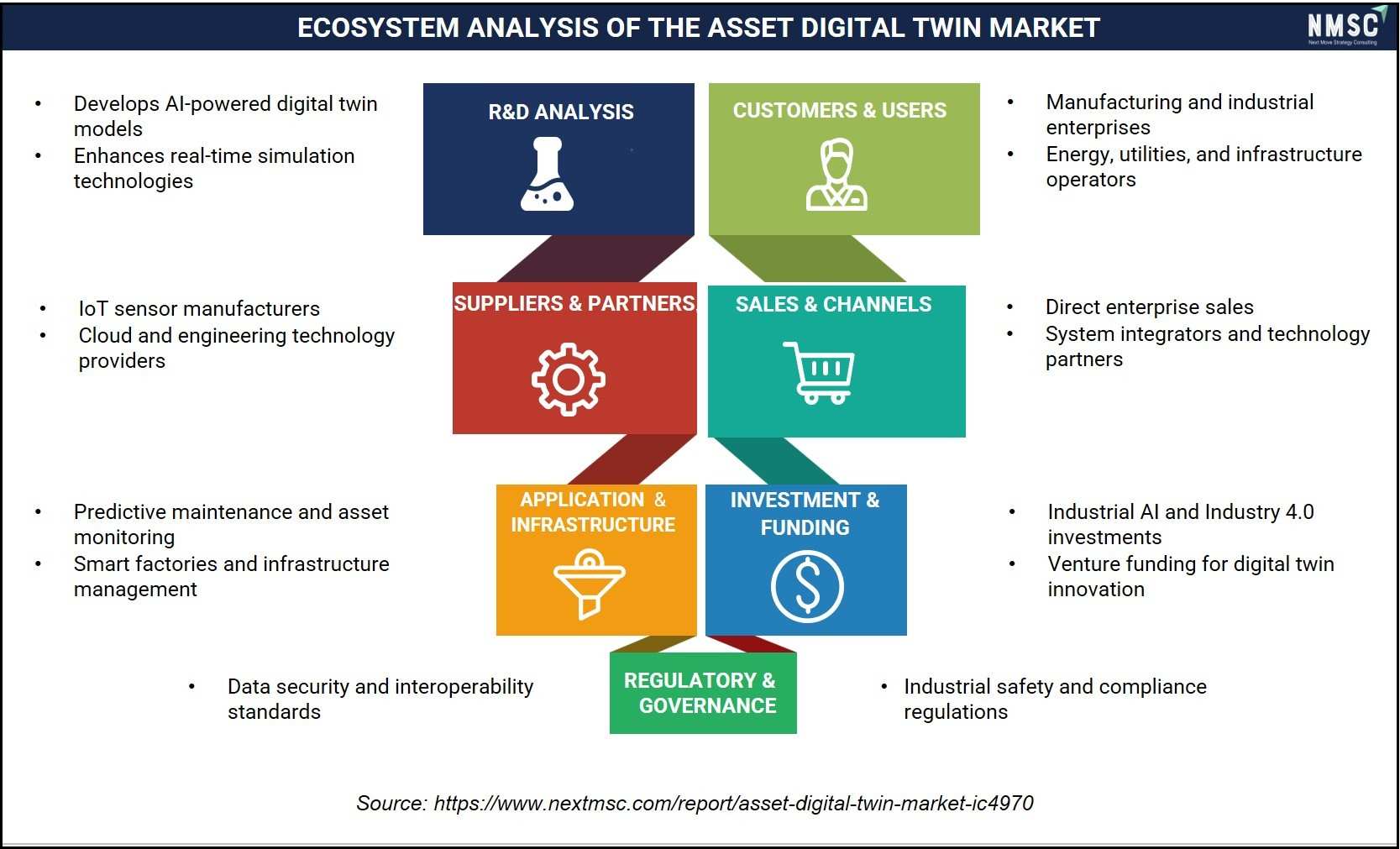
Based on our comprehensive assessment, we found that the Asset Digital Twin Market is supported by a connected ecosystem of technology providers, industrial enterprises, IoT vendors, cloud platform developers, system integrators, and regulatory bodies. Advanced analytics, AI, and simulation technologies enable real-time asset monitoring and predictive maintenance. Our analysis indicates that strategic investments and digital transformation initiatives are accelerating market adoption.
What Are the Key Market Drivers, Breakthroughs, and Investment Opportunities that Will Shape the Asset Digital Twin Industry in the Next Decade?
|
Drivers / Trends / Restraints |
(+/-) % Impact on CAGR Forecast |
Geographic Relevance |
Impact Timeline |
|
Accelerating Industrial IoT Sensor Deployment |
+2.4% |
Global (led by North America, APAC) |
2025–2030 |
|
AI-Driven Predictive Maintenance Adoption |
+2.1% |
North America, Europe, Japan |
2025–2032 |
|
Cloud-Native Digital Twin Platform Expansion |
+1.8% |
Global (all regions) |
2025–2035 |
|
Government Smart Infrastructure Mandates |
+1.4% |
Europe, MEA, APAC |
2026–2035 |
|
Open Interoperability Standards Adoption |
+1.2% |
Europe, North America |
2026–2033 |
|
Physics-Based Simulation Integration with AI |
+1.6% |
North America, Europe |
2025–2035 |
|
High Implementation and Integration Costs |
-1.4% |
SMB, Mid-market globally |
2025–2028 |
|
Data Security and Cybersecurity Concerns |
-1.1% |
All regions |
Ongoing |
|
Shortage of Qualified Digital Twin Talent |
-0.7% |
MEA, Latin America, Southeast Asia |
Ongoing |
|
Edge Computing Infrastructure Investments |
+1.3% |
North America, APAC, Europe |
2026–2035 |
|
ESG and Sustainability Asset Monitoring Demand |
+1.0% |
Europe, North America |
2026–2035 |
What Are the Growth Drivers of the Asset Digital Twin Market?
How Is the Proliferation of Industrial IoT Sensors Driving Demand for Asset Digital Twin Solutions?
The rapid deployment of industrial sensors across manufacturing plants, power generation facilities, and infrastructure assets is the primary demand catalyst for the Asset Digital Twin Market. Based on our market evaluation, we noticed that the U.S. Department of Energy's Grid Modernization Initiative has committed over USD 11 billion to grid infrastructure modernization, a program that fundamentally requires real-time sensor networks and digital monitoring platforms consistent with digital twin architectures. As connected assets generate terabytes of operational data daily, enterprises require digital twin platforms to contextualize, analyze, and act on this sensor data at operational speed.
How Is the Demand for Predictive Maintenance and Unplanned Downtime Reduction Fueling Asset Digital Twin Market Growth?
Unplanned equipment downtime continues to impose severe financial losses across manufacturing and energy industries, creating structural demand for predictive maintenance solutions enabled by asset digital twins. Our analysis shows that the U.S. Department of Energy has documented that industrial motor-driven systems — representing a significant portion of manufacturing energy consumption — experience considerable efficiency losses due to inadequate condition monitoring. Asset digital twin platforms that combine vibration analysis, thermal imaging data, and AI-driven degradation modeling are enabling maintenance teams to detect early-stage failure signatures weeks before physical breakdown, directly reducing unplanned maintenance costs and extending asset service life.
How Are Government Smart Infrastructure and Industry 4.0 Mandates Accelerating Asset Digital Twin Market Adoption?
Government-led industrial digitalization programs across North America, Europe, and Asia Pacific are creating structural demand for the Asset Digital Twin Market. The European Commission's Horizon Europe program, with a total budget of EUR 95.5 billion for 2021–2027, funds multiple digital twin research and deployment initiatives within its key enabling technologies cluster. Germany's Platform Industrie 4.0, a government-industry consortium, has established the Asset Administration Shell standard as a national framework for digital twin implementation, directly influencing procurement standards across European industrial enterprises and their global supply chains.
What Are the Growth Inhibitors of the Asset Digital Twin Market?
How Do High Implementation and Integration Costs Constrain Asset Digital Twin Market Penetration Among Mid-Market Enterprises?
Despite declining software licensing costs, the total implementation cost of enterprise-grade asset digital twin deployments remains a significant barrier for mid-market and SMB organizations. Deployment expenses encompass IoT sensor retrofitting, edge computing hardware, systems integration engineering, data pipeline development, and workforce upskilling. Our assessment indicates that the U.S. Government Accountability Office (GAO) has documented in federal agency technology transformation assessments that legacy system complexity and integration costs consistently extend project timelines and inflate total cost of ownership beyond initial projections — dynamics that also characterize commercial digital twin deployments in asset-intensive industries.
How Do Cybersecurity Vulnerabilities in Connected Asset Environments Impede Asset Digital Twin Market Adoption?
The expanded attack surface created by IoT-connected industrial assets presents a significant cybersecurity concern that is slowing asset digital twin adoption in critical infrastructure sectors. The U.S. Cybersecurity and Infrastructure Security Agency (CISA) has identified operational technology (OT) and industrial control system vulnerabilities as a national security priority, issuing multiple advisories regarding risks in connected industrial environments. As digital twin platforms aggregate sensitive operational data from critical infrastructure assets, security requirements around encrypted data transmission, zero-trust access control, and OT-IT network segmentation add implementation complexity and extend enterprise due diligence cycles.
What Are the Growth Opportunities in the Asset Digital Twin Market?
How Does the Expansion of Renewable Energy Infrastructure Create a Multi-Billion Dollar Opportunity for the Asset Digital Twin Market?
The global acceleration of renewable energy deployments is creating substantial new demand for asset digital twin solutions across wind, solar, and battery storage asset classes. The U.S. Department of Energy's Office of Energy Efficiency and Renewable Energy has funded research programs specifically exploring digital twin applications for wind turbine performance optimization and lifetime extension. Each utility-scale wind farm containing hundreds of turbines requires per-turbine health monitoring, blade fatigue analysis, and predictive maintenance scheduling — use cases precisely served by asset digital twin platforms with fleet-level scope and AI-driven anomaly detection capabilities.
How Do Smart City and Public Infrastructure Programs Present a Structural Growth Opportunity for the Asset Digital Twin Market?
National smart city and digital infrastructure programs are creating new public-sector demand streams for the Asset Digital Twin Market. The U.S. Infrastructure Investment and Jobs Act allocates USD 65 billion for broadband, USD 110 billion for roads and bridges, and USD 73 billion for power grid modernization — all categories requiring continuous asset condition monitoring and lifecycle management capabilities aligned with digital twin architectures. NMSC's analysis indicates that municipalities and transportation authorities in Europe and APAC are increasingly mandating digital asset monitoring for bridges, tunnels, water treatment plants, and public transit networks, creating government-funded recurring revenue streams for digital twin vendors.
How Does the Growing Adoption of Sustainability and ESG Asset Monitoring Create Revenue Opportunities in the Asset Digital Twin Market?
The integration of environmental, social, and governance metrics into industrial operations is driving demand for asset digital twins capable of monitoring energy consumption, carbon emissions, and environmental compliance in real time. The U.S. Environmental Protection Agency's (EPA) mandatory greenhouse gas reporting requirements for industrial facilities are compelling large asset operators to deploy connected monitoring solutions — creating an adoption pathway for asset digital twins that bundle emissions tracking with operational performance analytics. European enterprises subject to the EU Corporate Sustainability Reporting Directive (CSRD) face analogous requirements, amplifying demand for digital twin platforms with integrated ESG reporting modules.
How Is the Asset Digital Twin Market Segmented in This Report, and What Are the Key Insights from the Segmentation Analysis?
How Does the Offering Segmentation Define Revenue Distribution Across the Asset Digital Twin Market?
|
Offering Segment |
2025 (USD Bn) |
2035 (USD Bn) |
CAGR (%) |
|
Software |
3.9 |
22.1 |
19.0% |
|
Perpetual License |
1.4 |
5.2 |
14.0% |
|
SaaS Subscription |
2.5 |
16.9 |
21.0% |
|
Services |
3.1 |
21.3 |
19.4% |
|
Professional Services |
1.4 |
8.8 |
20.2% |
|
Managed Services |
1.1 |
8.3 |
22.3% |
|
Support and Maintenance |
0.6 |
4.2 |
21.5% |
|
Data and Content |
1.7 |
11.8 |
21.2% |
|
Asset Models |
0.7 |
4.9 |
21.5% |
|
Reality Capture |
0.5 |
3.7 |
22.0% |
|
Digital Content |
0.5 |
3.2 |
20.4% |
Based on our analysis of enterprise technology procurement patterns and platform deployment trends, the Asset Digital Twin Market is segmented by offering into Software, Services, and Data and Content. The Software segment dominates at USD 3.9 billion in 2025, driven by widespread enterprise adoption of SaaS-based digital twin platforms that bundle real-time asset monitoring, simulation, and analytics capabilities within cloud-native subscription architectures. Within Software, SaaS Subscription is the fastest-growing model as enterprises migrate away from perpetual license models toward flexible, consumption-based access. The Services segment is the fastest-growing primary offering category, with Managed Services — particularly Remote Monitoring and Analytics Operations — recording the strongest growth as asset operators outsource digital twin management to specialized service providers. The Data and Content segment, encompassing Asset Models, Reality Capture data, and Digital Content, is expanding as 3D laser scanning, photogrammetry, and point cloud data become foundational inputs for high-fidelity digital twin construction.
How Does Deployment Mode Shape Revenue Distribution Across the Asset Digital Twin Market?
|
Deployment Segment |
2025 (USD Bn) |
2035 (USD Bn) |
CAGR (%) |
|
Cloud |
5.4 |
30.8 |
19.1% |
|
Public Cloud |
3.2 |
18.8 |
19.4% |
|
Private Cloud |
2.2 |
12.0 |
18.5% |
|
On-Premises |
1.9 |
8.4 |
16.1% |
|
Hybrid |
1.4 |
16.0 |
27.7% |
Through our market assessment, we observed that the Asset Digital Twin Market is segmented by deployment mode into Cloud (Public and Private), On-Premises, and Hybrid. The Cloud segment dominates at USD 5.4 billion in 2025, reflecting enterprise preference for scalable, platform-integrated, and subscription-accessible architectures supported by leading hyperscalers. Public Cloud leads within the Cloud segment, driven by the broad availability of pre-integrated IoT services, digital twin development kits, and AI analytics capabilities on AWS, Azure, and Google Cloud platforms. On-Premises deployment remains relevant for highly regulated industries, including defense, nuclear energy, and financial services, where data residency and airgap security requirements preclude external cloud connectivity. The Hybrid deployment model is the fastest-growing category at a CAGR of 27.7%, as enterprises seek to combine edge-level real-time asset monitoring with cloud-scale fleet analytics — creating architecture patterns that balance low-latency OT requirements with unlimited cloud data processing capacity.
How Does Asset Scope Segmentation Reveal Adoption Patterns in the Asset Digital Twin Market?
|
Asset Scope Segment |
2025 (USD Bn) |
2035 (USD Bn) |
CAGR (%) |
|
Single Asset |
3.8 |
19.8 |
17.9% |
|
Asset Fleet |
2.1 |
13.2 |
20.2% |
|
System |
1.4 |
9.6 |
21.1% |
|
Site |
0.9 |
6.8 |
22.4% |
|
Network |
0.5 |
5.8 |
27.6% |
From our assessment, the Asset Digital Twin Market is segmented by Asset Scope into Single Asset, Asset Fleet, System, Site, and Network. The Single Asset scope dominates at USD 3.8 billion in 2025, supported by the large installed base of individual equipment monitoring deployments — particularly rotating machinery, industrial motors, compressors, and discrete CNC machines — where digital twins have the longest commercial history and the most mature tooling. Asset Fleet scope is the second-largest segment, driven by transportation, aviation, and utility companies managing populations of similar assets that benefit from comparative performance benchmarking across the fleet. The System and Site scopes are gaining traction as enterprises expand digital twin programs from individual assets to process units and entire plant facilities. The Network scope is the fastest-growing segment at a CAGR of 27.6%, driven by smart grid deployments, intelligent transportation networks, and municipal water utility digitalization programs that require network-level simulation and performance management.
Which End User Verticals Are Driving Demand Across the Asset Digital Twin Market?
|
End User Segment |
2025 (USD Bn) |
2035 (USD Bn) |
CAGR (%) |
|
Manufacturing |
2.6 |
13.4 |
17.8% |
|
Discrete Manufacturing |
1.5 |
7.8 |
18.0% |
|
Process Manufacturing |
1.1 |
5.6 |
17.6% |
|
Energy and Utilities |
2.0 |
13.8 |
20.4% |
|
Power |
0.7 |
4.6 |
20.8% |
|
Oil and Gas |
0.6 |
3.9 |
20.5% |
|
Water and Wastewater |
0.3 |
2.2 |
22.0% |
|
Renewable Energy |
0.4 |
3.1 |
22.7% |
|
Transportation and Logistics |
1.3 |
8.1 |
20.0% |
|
Buildings and Real Estate |
0.9 |
6.4 |
21.6% |
|
Infrastructure and Construction |
0.7 |
5.2 |
22.2% |
|
Mining and Metals |
0.4 |
2.8 |
21.5% |
|
Healthcare |
0.3 |
2.6 |
24.1% |
|
Agriculture |
0.2 |
1.6 |
23.1% |
|
Telecom |
0.2 |
1.4 |
21.5% |
|
Public Sector |
0.1 |
1.9 |
34.3% |
Based on NMSC's research, we found that the Asset Digital Twin Market is segmented by end user into Manufacturing, Energy and Utilities, Transportation and Logistics, Buildings and Real Estate, Infrastructure and Construction, Mining and Metals, Healthcare, Agriculture, Telecom, Public Sector, and Other Industries. The Manufacturing segment dominates at USD 2.6 billion in 2025, with Discrete Manufacturing leading due to high adoption of digital twins for CNC machine health monitoring, assembly line simulation, and quality optimization. Energy and Utilities is the fastest-growing major vertical at a CAGR of 20.4%, driven by power grid modernization, offshore wind farm monitoring, and oil and gas pipeline digital twin deployments. Transportation and Logistics is witnessing strong growth as railway operators, airlines, and maritime fleets deploy digital twins for asset lifecycle management and predictive maintenance. Buildings and Real Estate adoption is accelerating within commercial and industrial facilities for energy efficiency monitoring and facilities management optimization.
How Are Sales Channels Shaping Go-to-Market Strategies in the Asset Digital Twin Market?
|
Sales Channel Segment |
2025 (USD Bn) |
2035 (USD Bn) |
CAGR (%) |
|
Direct Sales |
3.8 |
19.5 |
17.9% |
|
System Integrator |
2.4 |
14.9 |
20.0% |
|
OEM and Reseller |
1.5 |
9.8 |
20.6% |
|
Cloud Marketplace |
1.0 |
11.0 |
27.0% |
Source: www.nextmsc.com
Our findings suggest that the Asset Digital Twin Market is segmented by sales channel into Direct Sales, System Integrator, OEM and Reseller, and Cloud Marketplace. The Direct Sales channel holds the dominant position at USD 3.8 billion in 2025, driven by enterprise preference for consultative sales processes, tailored digital twin architecture design, and dedicated implementation support from platform vendors such as Siemens, GE Vernova, and Honeywell. System Integrators are the second-largest channel, playing a critical role in connecting digital twin platforms with existing industrial control systems, SCADA infrastructure, and ERP environments. OEM and Reseller channels are important for specialized vertical applications, with industrial automation OEMs embedding digital twin capabilities into machine-level offerings. The Cloud Marketplace channel is the fastest-growing at a CAGR of 27.0%, as vendors list standardized digital twin applications on AWS Marketplace, Azure Marketplace, and Google Cloud Marketplace to access large enterprise cloud buyers through existing cloud spend commitments.
How Do Technology Enablers Define the Competitive Differentiation in the Asset Digital Twin Market?
|
Technology Enabler Segment |
2025 (USD Bn) |
2035 (USD Bn) |
CAGR (%) |
|
IoT and Connectivity |
3.2 |
17.0 |
18.2% |
|
Physics-Based Simulation |
1.8 |
10.2 |
19.0% |
|
AI and Machine Learning |
1.4 |
10.7 |
22.6% |
|
3D Visualization |
1.2 |
8.6 |
21.7% |
|
AR and VR |
0.5 |
4.4 |
24.3% |
|
Industrial Data Platform |
0.6 |
4.3 |
21.8% |
Through NMSC's assessment, we found that the Asset Digital Twin Market is segmented by technology enabler into IoT and Connectivity, Physics-Based Simulation, AI and Machine Learning, 3D Visualization, AR and VR, and Industrial Data Platform. The IoT and Connectivity segment dominates at USD 3.2 billion in 2025, as sensor networks, edge gateways, and industrial communication protocols form the foundational data ingestion layer for all digital twin architectures. Physics-Based Simulation is the second-largest technology component, integrating finite element analysis, computational fluid dynamics, and thermodynamic models that replicate real-world asset behavior. AI and Machine Learning is the fastest-growing technology enabler at a CAGR of 22.6%, driven by expanding adoption of predictive analytics, deep learning-based anomaly detection, and reinforcement learning algorithms for autonomous asset optimization. AR and VR interfaces are gaining traction as technician guidance, maintenance workflow simulation, and remote collaboration tools within digital twin platforms.
Regional Outlook
Geographic Performance Snapshot
|
Region |
2025 (USD Bn) |
2035 (USD Bn) |
CAGR (%) |
Key Driver |
|
North America |
3.5 |
21.1 |
19.6% |
Enterprise AI spend, industrial IoT leadership |
|
Europe |
2.4 |
13.9 |
19.2% |
Industry 4.0, regulatory compliance, sustainability |
|
Asia Pacific |
1.9 |
13.0 |
21.3% |
Smart manufacturing, infrastructure digitalization |
|
Middle East & Africa |
0.5 |
3.8 |
22.4% |
Vision 2030, oil and gas asset modernization |
|
Latin America |
0.4 |
3.4 |
23.8% |
Infrastructure investment, energy sector growth |
North America Asset Digital Twin Market
North America holds the largest regional share in the Asset Digital Twin Market at USD 3.5 billion in 2025, forecast to reach USD 21.1 billion by 2035 at a CAGR of 19.6%. The region benefits from the headquarters concentration of leading platform vendors including Siemens, GE Vernova, Microsoft, and PTC, combined with the world's deepest enterprise technology investment budgets. Regulatory frameworks such as the U.S. DOE Grid Modernization Initiative and the Infrastructure Investment and Jobs Act are creating sustained public-sector demand. Advanced adoption of cloud platforms, industrial IoT, and AI-driven analytics across manufacturing and energy sectors reinforces North America's market leadership.
U.S. Asset Digital Twin Market
Based on our engagements with enterprise technology stakeholders, the United States represents approximately 80% of the North American Asset Digital Twin Market and is the world's largest single national market for digital twin deployments. The U.S. market benefits from the highest concentration of asset-intensive Fortune 500 companies, the headquarters of major platform vendors, and significant federal investment programs under the DOE and Department of Defense digital modernization agendas. The U.S. National Institute of Standards and Technology (NIST) has published frameworks supporting digital thread and digital twin integration within manufacturing operations, providing institutional guidance that accelerates enterprise adoption across the industrial base.
Canada Asset Digital Twin Market
Through our analysis, Canada represents approximately 13% of the North American Asset Digital Twin Market. Canadian energy sector organizations — particularly oil sands operators and electricity utilities — are among the most advanced digital twin adopters in the region, driven by the high asset criticality and significant operational cost pressures of their industries. The Government of Canada's Digital Ambition strategy and the National Research Council's industrial AI programs are supporting digital twin research and enterprise deployment. Canada's robust mining and natural resources sector is also generating growing demand for site-level and network-scope digital twin platforms for remote asset monitoring.
Mexico Asset Digital Twin Market
From our assessment, Mexico is the fastest-growing market within North America for Asset Digital Twin solutions, driven by accelerating manufacturing nearshoring activity, growth of automotive and electronics production clusters, and the government's National Digital Strategy promoting industrial digitalization. The IMMEX maquiladora manufacturing program, which encompasses thousands of manufacturing plants across northern Mexico, is generating demand for production asset monitoring and process optimization digital twin deployments. Mexico's energy sector reform and PEMEX modernization initiatives are also creating demand for oil and gas asset digital twin applications.
Europe Asset Digital Twin Market
Europe is the second-largest region in the Asset Digital Twin Market at USD 2.4 billion in 2025, forecast to reach USD 13.9 billion by 2035 at a CAGR of 19.2%. Germany's Platform Industrie 4.0 and the Asset Administration Shell standard are establishing Europe as the global leader in digital twin interoperability frameworks. The European Commission's Horizon Europe program funds digital twin research across energy, manufacturing, and infrastructure sectors. Sustainability compliance requirements under the EU Green Deal and CSRD are further compelling industrial asset operators to deploy digital twins for energy consumption monitoring and carbon footprint reduction.
U.K. Asset Digital Twin Market
According to evaluation of regional digital technology investments, the United Kingdom holds a leading position in the European Asset Digital Twin Market, with particular strength in infrastructure and built environment digital twin applications. The Centre for Digital Built Britain (CDBB) at the University of Cambridge has established a National Digital Twin Programme promoting digital twin adoption for national infrastructure assets. The UK government's Infrastructure and Projects Authority mandates Building Information Modeling (BIM) and digital twin documentation for government-funded construction projects. The energy sector, including offshore wind and nuclear, represents a major growth area for asset digital twin deployments.
Germany Asset Digital Twin Market
Based on our market evaluation, we noticed that Germany is the largest individual country market for asset digital twins in continental Europe, driven by the world's most advanced Industry 4.0 ecosystem and the highest density of automotive, mechanical engineering, and chemical processing companies among major economies. Germany's Platform Industrie 4.0 consortium — co-led by Siemens, Bosch, and BASF — has established the Asset Administration Shell standard as the primary digital twin interoperability framework for German manufacturing. The German federal government's High-Tech Strategy 2025 explicitly targets digital twin deployment in manufacturing and infrastructure as a national competitiveness priority.
France Asset Digital Twin Market
Through our analysis, France represents a significant and growing contributor to the European Asset Digital Twin Market, with particular strength in aerospace, defense, nuclear energy, and railway infrastructure sectors. Dassault Systèmes, a French company and global leader in 3D simulation and digital twin platforms, serves as a major commercial anchor for domestic adoption. EDF, France's state-owned electric utility, has implemented digital twin programs for nuclear reactor asset monitoring and lifecycle management. The French government's France 2030 industrial strategy allocates EUR 30 billion for industrial technology modernization, including digital twin deployment in targeted industrial sectors.
Italy Asset Digital Twin Market
From our assessment, Italy's Asset Digital Twin Market is experiencing growing adoption driven by the country's extensive manufacturing base, particularly in industrial machinery, specialty chemicals, and automotive components. Italy's National Industry 4.0 Plan (Industria 4.0) introduced investment tax incentives for digital manufacturing technologies including digital twin platforms, significantly accelerating enterprise adoption across small and medium-sized manufacturing enterprises. The energy sector, including ENI's oil and gas operations and Enel's renewable energy portfolio, represents a significant demand source for asset monitoring and digital twin deployments across the country.
Spain Asset Digital Twin Market
According to evaluation of Spain's industrial technology investment landscape, the country's Asset Digital Twin Market is expanding on the back of infrastructure modernization, renewable energy expansion, and manufacturing competitiveness programs. Spain's Strategic Projects for Economic Recovery and Transformation (PERTE) program, backed by EU Recovery and Resilience Facility funds, targets digital manufacturing and energy sector transformation — both areas requiring digital twin deployment. Spain is one of Europe's leading wind energy markets, with Iberdrola deploying digital twin monitoring solutions for its onshore and offshore wind portfolios to optimize turbine performance and maintenance scheduling.
Sweden Asset Digital Twin Market
Based on our engagements, Sweden is a digitally advanced market for Asset Digital Twin solutions, with particularly strong adoption in heavy manufacturing, mining, forestry, and energy sectors. Volvo Group and SKF are among the Swedish industrial conglomerates that have implemented advanced digital twin programs for vehicle and bearing asset monitoring. Sweden's national Digitalization Strategy emphasizes industrial digitalization as a competitiveness priority. The Swedish mining sector, led by LKAB, is deploying site-level digital twins for underground mine asset management and operational safety monitoring.
Denmark Asset Digital Twin Market
Through our analysis, Denmark's Asset Digital Twin Market is characterized by strong adoption in offshore wind energy, shipping, and maritime sectors. Ørsted, the world's largest offshore wind developer, has deployed digital twin solutions for wind turbine health monitoring and performance optimization across its global wind portfolio. Denmark's maritime industry, supported by Maersk and other shipping operators, is adopting vessel digital twins for fleet performance management. The Danish government's Digitalization Strategy for 2022–2025 supports business adoption of digital technologies including asset monitoring and simulation platforms.
Finland Asset Digital Twin Market
From our assessment, Finland is an emerging hub for industrial digital twin innovation, with particular strengths in forest industry, energy, and telecommunications equipment manufacturing. Fortum, Finland's energy utility, has implemented digital twin programs for power plant asset monitoring and grid management. Nokia's telecommunications network infrastructure expertise contributes to domestic demand for network-level digital twin solutions. Finland's Business Finland innovation funding agency supports digital twin R&D through its Industrial Digitalization program, providing grant financing that is accelerating commercial adoption across Finnish manufacturing and energy enterprises.
Netherlands Asset Digital Twin Market
According to evaluation of Dutch industrial technology investments, the Netherlands hosts a sophisticated Asset Digital Twin Market driven by its world-class port infrastructure, chemical processing industry, and high-tech equipment manufacturing sector. The Port of Rotterdam — Europe's largest port — has implemented a comprehensive digital twin of its entire port infrastructure, encompassing quay cranes, terminal equipment, vessel traffic, and water management systems. Shell's Rotterdam refinery complex and BASF's chemical operations are advanced users of process digital twin technologies. Dutch government investment in Rijkswaterstaat infrastructure digital twins for waterway and road network asset management further sustains public-sector demand.
Rest of Europe Asset Digital Twin Market
Based on our market evaluation, we noticed that the rest of Europe — encompassing markets such as Poland, Belgium, Switzerland, Austria, and the Nordic countries beyond Sweden, Denmark, and Finland — represents a growing segment of the European Asset Digital Twin Market. Poland's manufacturing expansion, Switzerland's precision engineering and pharmaceutical manufacturing base, and Belgium's chemical and logistics hub positions are all generating demand for digital twin solutions. EU Digital Single Market regulations and access to Horizon Europe funding are accelerating adoption across Eastern and Southern European markets.
Asia Pacific Asset Digital Twin Market
Asia Pacific is the fastest-growing major region in the Asset Digital Twin Market at a CAGR of 21.3%, advancing from USD 1.9 billion in 2025 to USD 13.0 billion by 2035. China's Made in China 2025 and New Infrastructure initiatives, India's National Manufacturing Competitiveness Programme, Japan's Society 5.0 industrial transformation strategy, and South Korea's Digital New Deal are all creating large-scale demand for industrial digital twin platforms. The region's rapid expansion of renewable energy, smart manufacturing, and urban infrastructure is reinforcing its position as the primary growth engine for the global Asset Digital Twin Market.
China Asset Digital Twin Market
Based on our engagements, China is the largest and fastest-growing national market within Asia Pacific for Asset Digital Twin solutions, driven by the government's Made in China 2025 industrial modernization program and the New Infrastructure Initiative committing trillions of yuan to 5G, industrial IoT, and smart manufacturing infrastructure. The State Grid Corporation of China has deployed digital twin programs for power grid asset monitoring across its vast national transmission network. Domestic vendors including Huawei and Alibaba Cloud are developing industrial IoT and digital twin platforms designed for Chinese manufacturing environments, complementing global vendors such as Siemens and ABB operating in the country.
India Asset Digital Twin Market
Through our analysis, India's Asset Digital Twin Market is experiencing accelerating adoption driven by the government's Production Linked Incentive (PLI) schemes for manufacturing, the National Infrastructure Pipeline (NIP) committing INR 111 trillion to infrastructure development through 2025, and the Smart Cities Mission creating urban infrastructure monitoring demand. India's rapidly growing renewable energy sector, targeting 500 GW of non-fossil fuel capacity by 2030 as per official government commitments, is generating significant demand for solar and wind farm asset digital twin monitoring solutions. NMSC's analysis indicates that the presence of global IT services companies in India is also enabling domestic digital twin integration and managed services capabilities.
Japan Asset Digital Twin Market
From our assessment, Japan is a technologically advanced market for Asset Digital Twin solutions, with deep adoption in automotive manufacturing, electronics production, infrastructure monitoring, and nuclear energy management. Mitsubishi Electric, Hitachi, and Fujitsu are among the Japanese corporations that have developed proprietary digital twin platforms for their manufacturing and infrastructure asset portfolios. Japan's Society 5.0 strategy emphasizes the integration of cyber-physical systems — the conceptual foundation of digital twin technology — across industry and urban infrastructure. The aging infrastructure challenge in Japan, with many civil structures approaching end-of-design-life, is also driving public-sector investment in bridge, tunnel, and water utility digital twin monitoring.
South Korea Asset Digital Twin Market
According to evaluation of South Korea's industrial digitalization landscape, the country's Asset Digital Twin Market is driven by semiconductor manufacturing, shipbuilding, steel, and electronics sectors that collectively represent some of the world's most advanced manufacturing environments. Hyundai Heavy Industries has deployed digital twin solutions for ship design and construction monitoring. Samsung Electronics utilizes digital twin platforms for semiconductor fabrication equipment monitoring and yield optimization. The South Korean government's Digital New Deal 2.0 and Korean New Deal investment programs allocate significant funding for industrial IoT and smart factory digitalization aligned with digital twin adoption requirements.
Taiwan Asset Digital Twin Market
Based on our engagements, Taiwan's Asset Digital Twin Market is primarily driven by the country's world-leading semiconductor manufacturing industry, advanced electronics production ecosystem, and growing renewable energy infrastructure. TSMC, a global leader in contract semiconductor manufacturing, employs sophisticated equipment monitoring and digital simulation systems functionally equivalent to asset digital twins for yield improvement and equipment uptime optimization. Taiwan's government has committed to offshore wind energy targets requiring asset monitoring capabilities, creating demand for wind turbine digital twin deployments. Industrial Technology Research Institute (ITRI) conducts active digital twin research supporting commercial adoption.
Indonesia Asset Digital Twin Market
Through our analysis, Indonesia is an emerging market for Asset Digital Twin solutions, with adoption concentrated in mining, oil and gas, and power generation sectors. PT Pertamina, Indonesia's state-owned oil company, and PT PLN, the national electricity utility, represent the primary enterprise buyers for energy sector digital twin deployments. Indonesia's National Medium-Term Development Plan (RPJMN) emphasizes industrial digitalization and infrastructure modernization, creating a supportive policy environment for digital twin adoption. The nickel mining sector — a critical supplier to global electric vehicle battery supply chains — is beginning to adopt site-level digital twin solutions for mine asset monitoring and operational safety management.
Vietnam Asset Digital Twin Market
From our assessment, Vietnam's Asset Digital Twin Market is at an early stage of development, with adoption driven by the country's rapidly expanding manufacturing sector, growing foreign direct investment in electronics production, and government infrastructure development programs. Vietnam's National Digital Transformation Program 2025–2030 establishes digital technology adoption targets across industries including manufacturing and energy. The growing presence of Samsung, LG, Intel, and other electronics manufacturers in Vietnam is expected to introduce digital twin practices from parent company operations, creating demand for local implementation and managed services capabilities.
Australia Asset Digital Twin Market
According to evaluation of Australia's infrastructure and mining technology landscape, the country is a sophisticated adopter of Asset Digital Twin solutions, particularly in mining, infrastructure, utilities, and energy sectors. BHP, Rio Tinto, and Fortescue Metals Group have all deployed advanced digital twin programs for mine asset monitoring, autonomous equipment management, and operational safety optimization. Infrastructure Australia's frameworks for infrastructure procurement and management promote digital twin adoption for public infrastructure lifecycle management. Australia's National Hydrogen Strategy and transition to renewable energy are also generating demand for energy asset digital twin deployments.
Philippines Asset Digital Twin Market
Based on our market evaluation, we noticed that the Philippines is an early-stage adopter of Asset Digital Twin technology, with demand concentrated in the power generation, telecommunications, and building facilities management sectors. The Philippine government's Build Better More infrastructure program and its digital transformation agenda are creating foundational demand for asset monitoring capabilities. The country's rapidly growing business process outsourcing and technology sector is supporting domestic digital skills development relevant to digital twin implementation. Manila's vulnerability to natural disasters is also driving interest in infrastructure digital twin monitoring for disaster risk management and critical asset resilience assessment.
Malaysia Asset Digital Twin Market
Through our analysis, Malaysia is an advancing market for Asset Digital Twin solutions, with adoption driven by oil and gas, semiconductor manufacturing, telecommunications, and smart city development sectors. PETRONAS, Malaysia's national oil company, has implemented digital twin programs for upstream and downstream asset management and integrity monitoring. Malaysia's National 4IR Policy and the Malaysia Digital Economy Blueprint provide policy frameworks supporting industrial digital twin adoption. The Multimedia Super Corridor (MSC Malaysia) initiative and growing data center infrastructure investment are expanding the cloud and digital ecosystem foundations required for scalable asset digital twin deployments.
Rest of Asia Pacific Asset Digital Twin Market
From our assessment, the rest of Asia Pacific — encompassing Thailand, Singapore, New Zealand, Pakistan, Bangladesh, and other APAC economies — represents a developing segment of the regional Asset Digital Twin Market. Singapore's Smart Nation initiative has positioned it as a regional testbed for digital twin applications in urban infrastructure, port management, and building facilities monitoring. Thailand's Eastern Economic Corridor (EEC) special economic zone is attracting advanced manufacturing investment that is generating demand for digital twin platforms. New Zealand's infrastructure renewal programs and agricultural sector digitalization are also contributing to regional adoption growth.
Middle East & Africa Asset Digital Twin Market
The Middle East & Africa region is the second-fastest-growing market for Asset Digital Twin solutions at a CAGR of 22.4%, advancing from USD 0.5 billion in 2025 to USD 3.8 billion by 2035. Saudi Arabia's Vision 2030 and the UAE's Operation 300Bn industrial strategy are driving large-scale investment in energy, manufacturing, and infrastructure asset digitalization. ARAMCO, ADNOC, and DEWA are among the region's most advanced digital twin adopters. Africa's emerging mining and utilities sectors represent early-stage but structurally significant demand opportunities for the global Asset Digital Twin Market.
Saudi Arabia Asset Digital Twin Market
Based on our engagements, Saudi Arabia is the largest and most advanced market for Asset Digital Twin solutions in the Middle East, driven by ARAMCO's extensive oil and gas asset monitoring programs, NEOM smart city digital twin deployments, and the government's Vision 2030 industrial diversification strategy. Saudi Aramco has implemented digital twin platforms across multiple offshore platforms, pipeline networks, and refinery assets as part of its industrial digitalization program. The Saudi Authority for Industrial Cities and Technology Zones (MODON) promotes digital manufacturing adoption in industrial cities, creating demand for factory-level asset digital twin deployments.
UAE Asset Digital Twin Market
Through our analysis, the UAE is a highly sophisticated adopter of Asset Digital Twin technology, with advanced implementations in infrastructure, utilities, real estate, and oil and gas sectors. Dubai has developed one of the world's most comprehensive city-level digital twins — the Dubai Pulse platform — encompassing infrastructure assets, utility networks, and urban systems. DEWA (Dubai Electricity and Water Authority) has deployed digital twin solutions for power generation and water distribution asset monitoring. Abu Dhabi's ADNOC operates digital twin platforms for upstream oil and gas asset management, while Masdar's renewable energy portfolio includes wind and solar digital twin monitoring systems.
Egypt Asset Digital Twin Market
From our assessment, Egypt's Asset Digital Twin Market is in an early but growing phase, with primary adoption concentrated in oil and gas, electricity, and infrastructure sectors. The Egyptian Electricity Holding Company and state-owned petroleum companies represent the primary enterprise buyers for energy sector digital twin deployments. Egypt's Vision 2030 and its National Digital Economy Strategy promote digitalization across industrial sectors. The development of New Administrative Capital and other new city projects is creating demand for building and infrastructure digital twin monitoring capabilities, providing a foundation for expanded commercial digital twin adoption.
Israel Asset Digital Twin Market
According to evaluation of Israel's technology ecosystem, the country occupies a distinctive position in the Asset Digital Twin Market as both an advanced adopter and an active technology innovation center. Israeli deep-tech companies developing AI, computer vision, and simulation technologies contribute to the global digital twin technology stack. The Israeli defense and aerospace sector — encompassing companies such as Rafael Advanced Defense Systems and Israel Aerospace Industries — employs advanced simulation and digital twin methodologies for complex asset lifecycle management. Israel's water utility sector, facing endemic resource scarcity, uses digital monitoring and simulation tools directly analogous to digital twin architectures for water distribution network management.
Turkey Asset Digital Twin Market
Based on our engagements, Turkey's Asset Digital Twin Market is advancing driven by the country's significant industrial base in automotive, steel, petrochemicals, and defense manufacturing. TÚPRAŞ, Turkey's largest oil refinery, and BOTAS, the national pipeline company, represent key energy sector digital twin adopters. Turkey's Ministry of Industry and Technology supports digitalization through the Teknofest innovation programs and Smart Factory initiatives targeting digital twin deployment in manufacturing. Turkey's growing renewable energy capacity, particularly in wind and solar, is also generating demand for asset monitoring and performance optimization solutions aligned with digital twin capabilities.
Nigeria Asset Digital Twin Market
Through our analysis, Nigeria's Asset Digital Twin Market is at an early stage of development, with adoption primarily concentrated in oil and gas, power generation, and telecommunications sectors. The Nigerian National Petroleum Corporation (NNPC) and international oil companies operating in Nigeria represent the primary potential buyers for asset digital twin solutions in upstream oil and gas operations. Nigeria's chronic power infrastructure deficiencies are driving government and investor attention to grid modernization, creating a future demand pathway for electricity distribution network digital twin monitoring. The Nigerian Communications Commission's broadband infrastructure expansion is also building the connectivity foundation required for IoT-enabled digital twin deployments.
South Africa Asset Digital Twin Market
From our assessment, South Africa is the most advanced market for Asset Digital Twin solutions in sub-Saharan Africa, driven by the mining sector's global technology leadership, the energy utility transformation at Eskom, and infrastructure development programs. Anglo American and Sibanye-Stillwater have deployed digital twin technologies for underground mine asset monitoring and autonomous equipment management. South Africa's National Development Plan 2030 emphasizes infrastructure investment and industrial competitiveness, with digital manufacturing technologies including digital twins identified as strategic priorities. The country's renewable energy transition, driven by the Renewable Energy Independent Power Producer Procurement Program (REIPPPP), is generating demand for wind and solar asset monitoring solutions.
Rest of Middle East & Africa Asset Digital Twin Market
According to evaluation of the broader MEA digital technology landscape, the rest of the Middle East & Africa — including Kuwait, Qatar, Oman, Bahrain, Morocco, Kenya, Ghana, and other markets — represents a developing segment of the regional Asset Digital Twin Market. Qatar's LNG infrastructure modernization and Kuwait's oil field digitalization programs are generating demand for energy sector digital twin deployments. Morocco's growing renewable energy sector and Kenya's infrastructure development programs under Vision 2030 represent early-stage demand opportunities for asset monitoring and digital twin platforms in Africa beyond South Africa.
Latin America Asset Digital Twin Market
Latin America is the fastest-growing region in the Asset Digital Twin Market at a CAGR of 23.8%, advancing from USD 0.4 billion in 2025 to USD 3.4 billion by 2035. Brazil's industrial manufacturing base, Chile's copper mining industry, Colombia's oil and gas sector, and Argentina's energy infrastructure represent the primary demand drivers. Improving cloud infrastructure, expanding 4G and 5G connectivity, and growing multinational enterprise technology investment are building the ecosystem foundations for scalable digital twin adoption across Latin American industries.
Brazil Asset Digital Twin Market
Based on our engagements, Brazil is the largest and most advanced market for Asset Digital Twin solutions in Latin America, driven by its extensive manufacturing sector, deep offshore oil and gas operations, and large agricultural and mining industries. Petrobras has implemented digital twin programs for offshore platform asset monitoring and integrity management across its pre-salt oil field developments. Embraer uses digital twin methodologies for aircraft design and lifecycle management in its commercial aviation manufacturing. Brazil's National Industry 4.0 Program, launched by the Ministry of Economy, provides policy and financial support for digital manufacturing technology adoption including digital twin platforms.
Argentina Asset Digital Twin Market
Through our analysis, Argentina's Asset Digital Twin Market is driven primarily by the energy sector — particularly the Vaca Muerta shale oil and gas formation, which requires advanced asset monitoring and production optimization solutions — as well as the country's agricultural commodity processing sector and expanding renewable energy infrastructure. YPF, Argentina's national oil company, is implementing digital technologies including asset monitoring platforms for Vaca Muerta operations. Argentina's government has committed to renewable energy targets that are driving wind and solar farm development requiring asset performance monitoring, aligned with digital twin deployment requirements.
Chile Asset Digital Twin Market
From our assessment, Chile's Asset Digital Twin Market is primarily driven by the copper and lithium mining industries, which represent some of the world's most asset-intensive and technologically advanced mining operations. Codelco, the world's largest copper producer, has implemented advanced asset monitoring and automation technologies that incorporate digital twin principles for underground and open-pit mining equipment management. Chile's energy transition targets, committing to 70% renewable energy by 2030, are generating significant demand for solar and wind asset monitoring digital twin solutions. The Chilean government's Digital Agenda and InnovaChile programs provide funding for industrial digital technology adoption.
Colombia Asset Digital Twin Market
According to evaluation of Colombia's industrial technology landscape, the country's Asset Digital Twin Market is driven by oil and gas, power generation, and mining sectors, complemented by growing manufacturing digitalization initiatives. Ecopetrol, Colombia's national oil company, is one of the primary enterprise buyers for energy sector digital twin deployments in the country. Colombia's National Digitalization Policy and the Ministry of Information Technologies and Communications programs are promoting industrial digital technology adoption across sectors. Expanding cloud infrastructure investment by AWS, Google Cloud, and Microsoft Azure in Colombia is improving the platform ecosystem foundations required for scalable digital twin deployments.
Rest of Latin America Asset Digital Twin Market
Based on our market evaluation, we noticed that the rest of Latin America — including Peru, Ecuador, Venezuela, Uruguay, Bolivia, and Central American markets — represents an early-stage but growing segment of the regional Asset Digital Twin Market. Peru's mining sector, hosting significant copper and gold operations, represents a key demand opportunity for asset digital twin solutions. Uruguay's advanced renewable energy infrastructure and high digital connectivity readiness create a favorable environment for digital technology adoption. Central American economies, benefiting from growing manufacturing FDI, represent longer-term demand opportunities for factory-level asset digital twin deployments.
Strategic Framework of the Asset Digital Twin Market
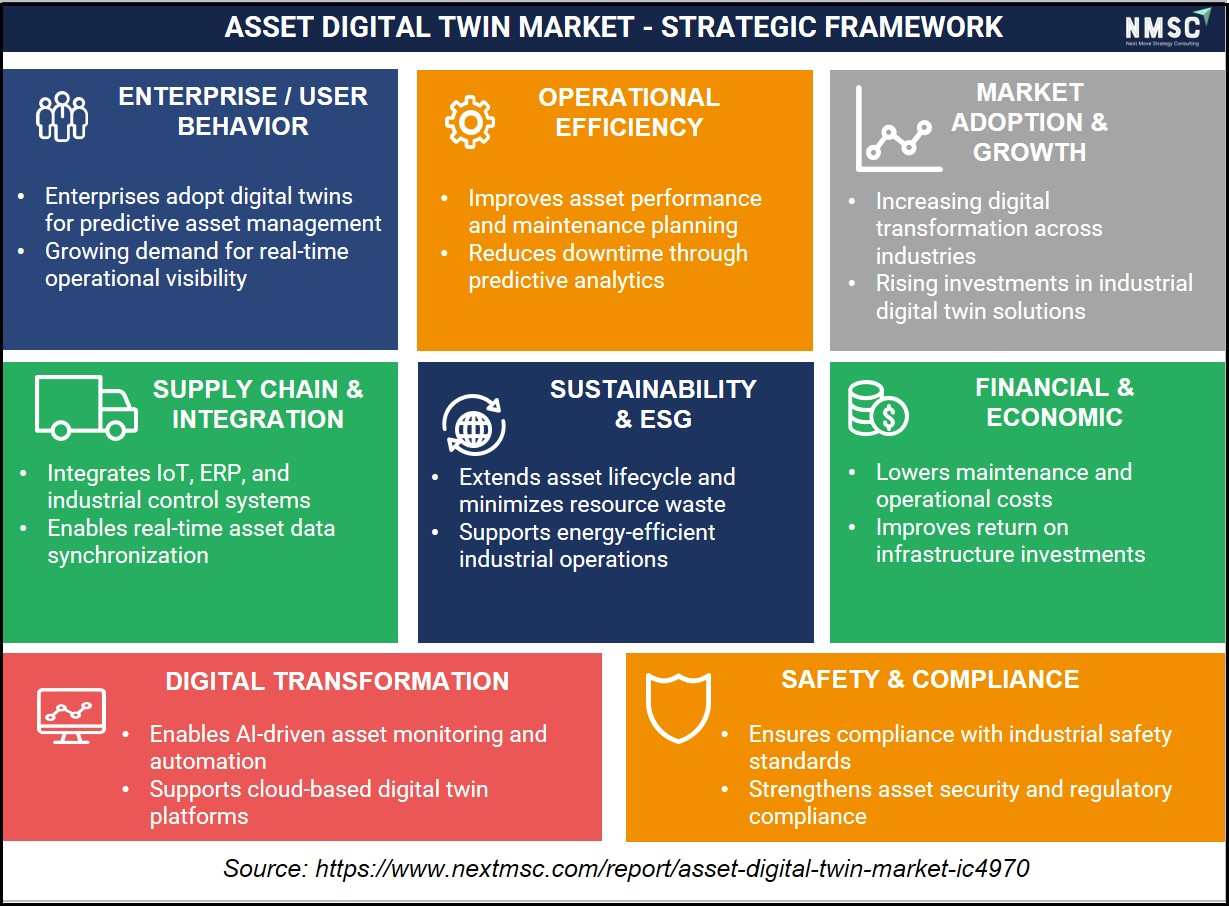
Based on our comprehensive assessment, we found that the Asset Digital Twin Market is driven by increasing demand for predictive asset management, operational visibility, and industrial automation. Digital twins integrate IoT, AI, ERP, and control systems to optimize performance and reduce downtime. Our analysis indicates that sustainability objectives, cloud-based deployment models, regulatory compliance requirements, and infrastructure modernization investments continue to strengthen market growth.
Competitive Landscape
Competitive Dynamics and M&A Landscape
|
Key Takeaways |
Details |
|
Market Structure |
The Asset Digital Twin industry is moderately concentrated at the enterprise software and industrial platform tier, with Siemens, GE Vernova, Microsoft, PTC, and Dassault Systèmes collectively holding a significant share of the high-value enterprise platform segment. The mid-market and specialist segments support a broader ecosystem of niche vendors and industrial IoT solution providers. |
|
Innovation Focus |
Leading companies are investing in AI-native digital twin capabilities, physics-AI hybrid simulation, open interoperability standards including Asset Administration Shell, cloud-native multi-tenant architectures, and AR/VR-enabled operator interfaces for maintenance and inspection workflows. |
|
M&A Activity |
The Asset Digital Twin Market has witnessed active consolidation, including notable acquisitions such as Siemens' acquisition of Wattsense for building IoT, PTC's acquisition of ServiceMax for asset service management, and Hexagon's acquisition of Romax Technology for rotating machinery simulation, reflecting strategic emphasis on expanding addressable asset class coverage and AI analytics capabilities. |
How Do Companies Compete in the Asset Digital Twin Market?
The competitive landscape of the Asset Digital Twin Market is characterized by platform breadth and vertical specialization as the two primary dimensions of differentiation. Our findings suggest that large industrial software vendors — including Siemens, PTC, and Dassault Systèmes — compete on the depth and scalability of their integrated digital twin ecosystems, spanning CAD, simulation, IoT connectivity, and AI analytics. Technology hyperscalers including Microsoft and Amazon Web Services compete on cloud platform integration, marketplace distribution, and AI services connectivity. Pricing strategies range from perpetual license models among traditional industrial software vendors to consumption-based SaaS pricing favored by cloud-native and IoT platform providers.
Which Kind of Companies Dominate the Asset Digital Twin Market?
The Asset Digital Twin Market is led by established industrial software and automation companies that have extended their platforms with digital twin capabilities, supplemented by technology hyperscalers offering cloud-based twin infrastructure. NMSC's analysis indicates that companies with deep domain expertise in specific industries — such as Honeywell in process manufacturing, Bentley Systems in infrastructure, and Cognite in oil and gas — command premium positioning in their target verticals. Asset intelligence companies that combine real-time IoT data ingestion with physics-based simulation and AI analytics represent the most defensible competitive positions in the evolving market landscape.
AI-Native Differentiation and Open Standards Drive Market Success in the Asset Digital Twin Market
AI-native capability and open interoperability standards are emerging as the two most important competitive differentiators within the Asset Digital Twin Market. Our assessment indicates that vendors embedding AI directly into digital twin simulation pipelines — enabling autonomous anomaly detection, failure prediction, and prescriptive maintenance recommendation without manual configuration — are capturing enterprise attention and commanding price premiums. Simultaneously, vendors supporting open standards including the Asset Administration Shell, DTDL, and Eclipse Ditto are gaining adoption among enterprise architects seeking to avoid vendor lock-in across complex, multi-vendor industrial asset ecosystems.
Market Players to Opt for Merger and Acquisition Strategies to Expand Their Presence in the Asset Digital Twin Market
Merger and acquisition activity is accelerating in the Asset Digital Twin Market as established vendors seek to expand addressable asset class coverage, acquire AI simulation capabilities, and consolidate IoT connectivity and managed services expertise. Based on NMSC's research, we found that strategic acquisitions are concentrating along three axes: acquiring domain-specific simulation expertise for new verticals, purchasing IoT platform and edge computing capabilities, and consolidating managed digital twin services providers to build recurring revenue streams. This consolidation trend is expected to intensify through 2030 as the market matures from platform experimentation to large-scale enterprise deployment programs.
Who Are the Key Market Players in the Asset Digital Twin Market?
-
Siemens AG
-
Schneider Electric SE
-
GE Vernova Inc.
-
International Business Machines Corporation
-
Microsoft Corporation
-
Amazon Web Services, Inc.
-
PTC Inc.
-
Dassault Systèmes SE
-
Bentley Systems, Incorporated
-
Honeywell International Inc.
-
Rockwell Automation, Inc.
-
Emerson Electric Co.
-
ABB Ltd
-
SAP SE
-
Oracle Corporation
-
Hexagon AB
-
Ansys, Inc.
-
Autodesk, Inc.
-
Hitachi, Ltd.
-
Cognite AS
What Are the Latest Developments in the Asset Digital Twin Market ?
|
Date |
Event |
|
March 2026 |
Dassault Systèmes and NVIDIA showcased their expanded collaboration at GTC 2026, focusing on "Industrial World Models." By integrating NVIDIA’s AI infrastructure with the 3DEXPERIENCE platform, they introduced new AI-powered "Virtual Companions" (Aura, Leo, and Marie) that assist engineers in reasoning through complex design and production challenges. |
|
January 2026 |
Siemens AG launched Digital Twin Composer at CES 2026. This platform allows enterprises to unify 2D/3D design, simulation, and real-time physical data into a single high-fidelity "Industrial Metaverse" environment, enabling organizations to validate products, processes, and entire factories virtually before physical execution. |
What Are the Investment Opportunities in the Asset Digital Twin Market?
Capital Inflows and Venture Activity
The Asset Digital Twin Market continues to attract substantial private and institutional capital as industrial organizations accelerate digital transformation initiatives and asset intelligence investments. Major industrial technology vendors, cloud platform providers, and industrial software developers are increasing investments in digital twin capabilities to strengthen predictive maintenance, operational optimization, and asset lifecycle management offerings. We noticed that venture capital activity is particularly strong among startups developing AI-powered simulation platforms, industrial digital twin software, and real-time asset monitoring solutions. Growing enterprise demand for intelligent asset management and operational efficiency improvements continues to support investor confidence across the broader digital twin ecosystem.
Infrastructure Investment
Infrastructure modernization investment is a foundational growth catalyst for the Asset Digital Twin Market. Governments and infrastructure operators worldwide are committing substantial capital toward transportation networks, energy systems, utilities, and smart city developments that increasingly require digital asset monitoring and lifecycle optimization capabilities. Moreover, we found that major public-sector investment programs, including the U.S. Infrastructure Investment and Jobs Act, the European Union’s Recovery and Resilience Facility, and large-scale infrastructure initiatives across Asia Pacific and the Middle East, are creating significant demand for digital twin technologies. These investments expand the addressable market for asset monitoring, predictive maintenance, and infrastructure performance management solutions globally.
ESG and Sustainable Asset Management
Environmental, Social, and Governance (ESG) considerations are increasingly influencing investment decisions across the Asset Digital Twin Market. Asset owners, infrastructure operators, and institutional investors are seeking technologies that improve resource efficiency, reduce emissions, and support sustainability reporting requirements. Digital twin platforms enable continuous monitoring of energy consumption, asset utilization, emissions performance, and environmental compliance metrics across industrial operations. Vendors incorporating sustainability analytics, carbon management capabilities, and energy optimization tools within their digital twin platforms are benefiting from growing demand among organizations pursuing ESG objectives and regulatory compliance initiatives.
Digital Transformation Enablement
Asset digital twin platforms serve as a critical foundation for broader industrial digital transformation programs, making them strategically important within long-term enterprise technology investment cycles. Organizations modernizing operational technology environments, deploying industrial IoT infrastructure, and implementing predictive maintenance strategies increasingly require digital twin capabilities to maximize operational visibility and decision-making effectiveness. We further analysed that smart manufacturing initiatives, intelligent infrastructure programs, and connected asset management strategies are creating durable multi-year demand for digital twin technologies. As enterprises continue integrating AI, IoT, cloud computing, and advanced analytics into operational environments, digital twin adoption is expected to remain a core investment priority.
Private Equity and Strategic M&A Activity
Private equity firms and strategic investors are actively pursuing opportunities within the Asset Digital Twin Market as digitalization becomes a competitive necessity across asset-intensive industries. Investment activity is increasingly focused on industrial software vendors, predictive analytics providers, simulation technology companies, and digital engineering platforms that enhance digital twin capabilities. Strategic acquisitions are accelerating as industrial automation providers, enterprise software companies, and cloud platform vendors seek to strengthen their digital twin portfolios through inorganic growth. We assessed that investors should closely monitor consolidation activity among industrial AI software developers, predictive maintenance solution providers, simulation technology specialists, and infrastructure analytics vendors as attractive acquisition targets throughout the 2025–2028 period within the Asset Digital Twin Market.
Key Benefits for Stakeholders
For Asset Operators and Industrial Enterprises
Asset operators and industrial enterprises gain comprehensive insights into the Asset Digital Twin Market trends, enabling more informed decisions regarding asset performance optimization, maintenance planning, and lifecycle management. The report provides detailed analysis across deployment models, asset categories, enterprise sizes, and end-use industries, helping organizations identify the highest-value digital twin applications. Market intelligence on technology adoption trends and implementation strategies supports efforts to improve operational efficiency, reduce unplanned downtime, optimize maintenance schedules, extend equipment service life, and maximize return on infrastructure and industrial asset investments.
For Technology Vendors and Platform Providers
Technology vendors and platform providers gain actionable intelligence regarding market size, competitive positioning, customer adoption patterns, and emerging growth opportunities within the Asset Digital Twin Market. Detailed segmentation analysis highlights the fastest-growing technology segments, deployment preferences, and industry-specific demand drivers, supporting product roadmap development and investment prioritization. Regional market assessments further enable vendors to identify expansion opportunities, optimize go-to-market strategies, and strengthen competitive differentiation across industrial, infrastructure, energy, and manufacturing sectors.
For Investors and Private Equity Sponsors
Investors, venture capital firms, and private equity sponsors gain access to a structured assessment of the Asset Digital Twin Market’s growth trajectory, competitive dynamics, and long-term revenue potential through 2035. Market sizing, CAGR forecasts, segment-level analysis, and regional outlooks support investment screening, valuation modeling, and portfolio development activities. Company benchmarking and strategic development analysis provide visibility into emerging market leaders, acquisition opportunities, and technology segments positioned for accelerated adoption across industrial and infrastructure environments.
For Government Agencies and Regulatory Bodies
Government agencies, infrastructure authorities, and regulatory organizations gain a comprehensive understanding of how digital twin technologies are supporting industrial modernization, infrastructure resilience, and asset performance improvement initiatives. The report provides insights into regulatory influences, technology adoption trends, and standards development activities shaping the Asset Digital Twin Market. Country-level and regional analysis supports evidence-based policy formulation, smart infrastructure planning, and digital transformation strategies designed to improve operational efficiency, sustainability outcomes, and national industrial competitiveness.
For System Integrators and Consulting Firms
System integrators and consulting organizations benefit from detailed visibility into enterprise adoption trends, implementation priorities, and technology investment patterns across the Asset Digital Twin Market. The segmentation and regional analysis help service providers identify high-growth consulting opportunities, develop specialized implementation capabilities, and strengthen expertise across digital twin deployment, IoT integration, predictive maintenance, and industrial analytics. These insights support business development initiatives and long-term expansion of digital transformation service portfolios.
For Research and Academic Institutions
Research institutions, universities, and industry think tanks gain access to a comprehensive analysis of technology adoption trends, market evolution, and innovation priorities within the Asset Digital Twin Market. The report provides structured insights into digital twin architectures, artificial intelligence integration, simulation technologies, IoT connectivity, and industrial digitalization strategies. This intelligence supports academic research programs, industry collaboration initiatives, standards development activities, and future studies focused on advancing next-generation asset management and operational intelligence technologies.
Asset Digital Twin Market Key Segments
By Offering
-
Software
-
Perpetual License
-
SaaS Subscription
-
-
Services
-
Professional Services
-
Consulting and Advisory
-
Implementation and Integration
-
Data Engineering and Model Development
-
Training and Change Management
-
-
Managed Services
-
Remote Monitoring
-
Model Operations
-
Performance Tuning
-
Analytics Operations
-
-
Support and Maintenance
-
Technical Support
-
Software Updates
-
Subscription Maintenance
-
-
-
Data and Content
-
Asset Models
-
Reality Capture
-
Digital Content
-
By Deployment
-
Cloud
-
Public Cloud
-
Private Cloud
-
-
On-Premises
-
Hybrid
By Asset Scope
-
Single Asset
-
Asset Fleet
-
System
-
Site
-
Network
By End User
-
Manufacturing
-
Discrete Manufacturing
-
Process Manufacturing
-
-
Energy and Utilities
-
Power
-
Oil and Gas
-
Water and Wastewater
-
Renewable Energy
-
-
Transportation and Logistics
-
Rail
-
Aviation
-
Maritime
-
Fleet
-
-
Buildings and Real Estate
-
Commercial Buildings
-
Industrial Facilities
-
Data Centres
-
-
Infrastructure and Construction
-
Transportation Infrastructure
-
Public Infrastructure
-
Industrial Infrastructure
-
-
Mining and Metals
-
Healthcare
-
Agriculture
-
Telecom
-
Public Sector
-
Other Industries
By Sales Channel
-
Direct Sales
-
System Integrator
-
OEM and Reseller
-
Cloud Marketplace
By Technology Enabler
-
IoT and Connectivity
-
Physics-Based Simulation
-
AI and Machine Learning
-
3D Visualization
-
AR and VR
-
Industrial Data Platform
By Region
-
North America: U.S., Canada, and Mexico
-
Europe: UK, Germany, France, Italy, Spain, Sweden, Denmark, Finland, the Netherlands, and the Rest of Europe
-
Asia Pacific: China, India, Japan, South Korea, Taiwan, Indonesia, Vietnam, Australia, Philippines, Malaysia, and the Rest of APAC
-
Middle East & Africa: Saudi Arabia, UAE, Egypt, Israel, Turkey, Nigeria, South Africa, and the Rest of MEA
-
Latin America: Brazil, Argentina, Chile, Colombia, and the Rest of LATAM
Conclusion and Recommendations
Long-Term Outlook
The Asset Digital Twin Market is entering a decade of sustained structural expansion, driven by accelerating industrial digitalization, increasing deployment of industrial IoT infrastructure, growing adoption of AI-powered predictive analytics, and rising demand for real-time asset performance optimization across asset-intensive industries. The market is forecast to grow from USD 8.7 billion in 2025 to USD 55.2 billion by 2035, at a CAGR of 18.6%. We further analysed that this growth reflects the transition from isolated digital twin pilot projects toward enterprise-wide asset intelligence platforms capable of supporting predictive maintenance, lifecycle optimization, operational efficiency improvement, and sustainability management across increasingly complex industrial environments.
Strategic Positioning Recommendations
Platform vendors should prioritize AI-native digital twin capabilities, open interoperability frameworks, and scalable cloud-edge integration architectures to strengthen long-term competitive positioning. Organizations that combine real-time asset monitoring, simulation, predictive analytics, and autonomous decision-support capabilities within unified digital twin environments will capture greater enterprise adoption and recurring revenue opportunities. Investment in Asset Administration Shell compatibility, digital thread integration, and industry-specific solution development is becoming increasingly important for vendors targeting manufacturing, energy, infrastructure, transportation, and healthcare customers. Strategic partnerships with industrial automation providers, cloud hyperscalers, and OT cybersecurity specialists will further enhance market competitiveness.
Investment Attractiveness
The Asset Digital Twin Market represents a highly attractive investment environment supported by long-term digital transformation spending, recurring software revenue models, and expanding demand for intelligent asset management solutions. We assessed that the highest-conviction investment opportunities include SaaS Software platforms, Managed Services offerings, AI-enabled predictive maintenance applications, and hybrid cloud deployment architectures that bridge edge computing with centralized analytics environments. Energy and Utilities, Infrastructure and Construction, Transportation and Logistics, and Healthcare sectors present particularly attractive growth opportunities due to increasing operational complexity, asset criticality, and regulatory performance requirements. Investors should also monitor consolidation opportunities among specialized digital twin software providers and industrial analytics vendors.
Market Shifts and Key Risks
The most significant market shift underway is the evolution from project-based digital twin implementations toward enterprise-scale digital twin ecosystems managing thousands of interconnected physical assets through unified platforms. This transition increasingly favors vendors capable of supporting interoperability across heterogeneous asset environments and operational technologies. Key risks for the Asset Digital Twin Market include cybersecurity vulnerabilities associated with connected industrial systems, fragmented regulatory requirements across global markets, integration challenges with legacy operational infrastructure, and persistent shortages of skilled digital twin engineering and industrial AI talent. Organizations must proactively address governance, security, and workforce readiness requirements to maximize long-term deployment success.
Growth Pathways
Organizations seeking to maximize value from the Asset Digital Twin Market should adopt a phased digital transformation strategy. In the near term (2025–2027), focus on asset connectivity, data integration, and predictive maintenance deployment to establish foundational digital twin capabilities. In the mid-term (2027–2031), expand toward enterprise-wide digital twin platforms integrating simulation, AI analytics, and lifecycle optimization capabilities across multiple asset classes. In the long term (2031–2035), prioritize autonomous operations, sustainability optimization, and digital thread interoperability across industrial ecosystems. Asia Pacific, particularly China, India, Japan, and South Korea, alongside the Middle East, represents the strongest long-term growth pathway as governments and enterprises accelerate investments in industrial modernization, smart infrastructure, and large-scale digital transformation initiatives.
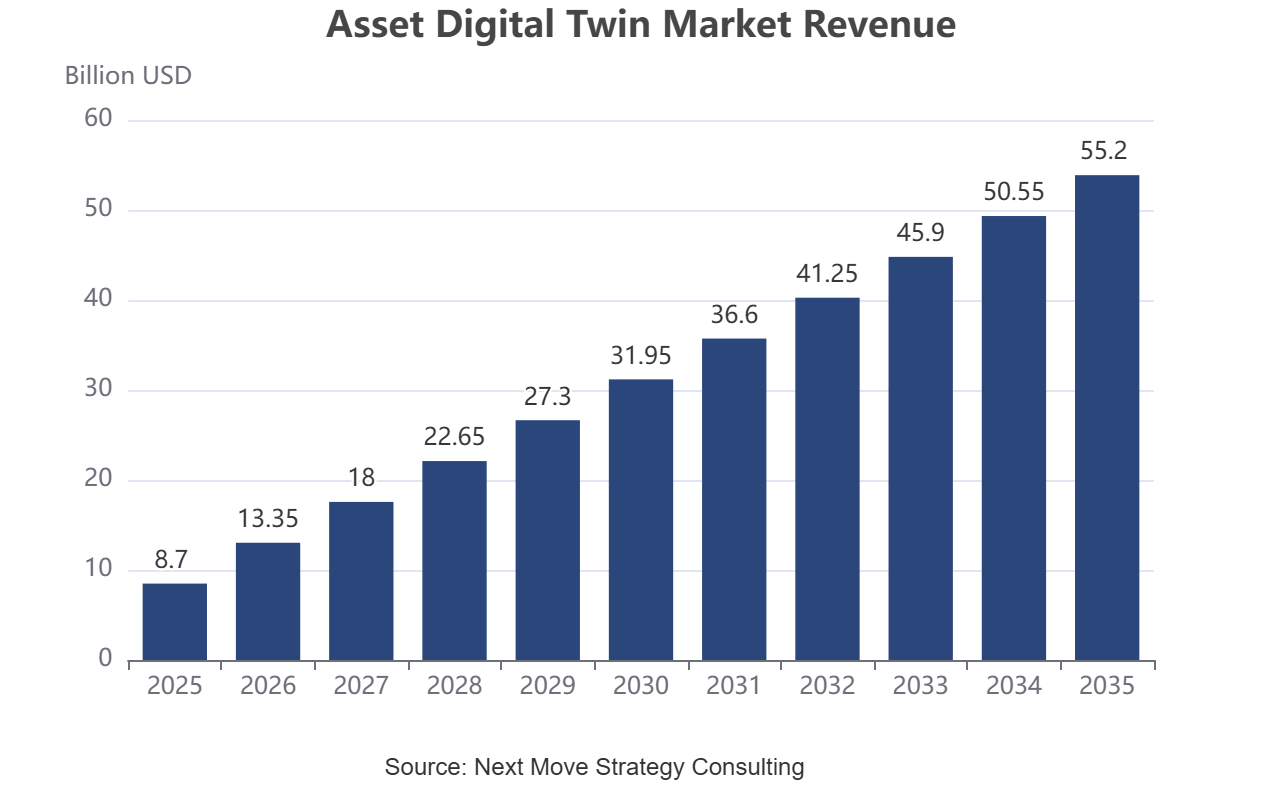
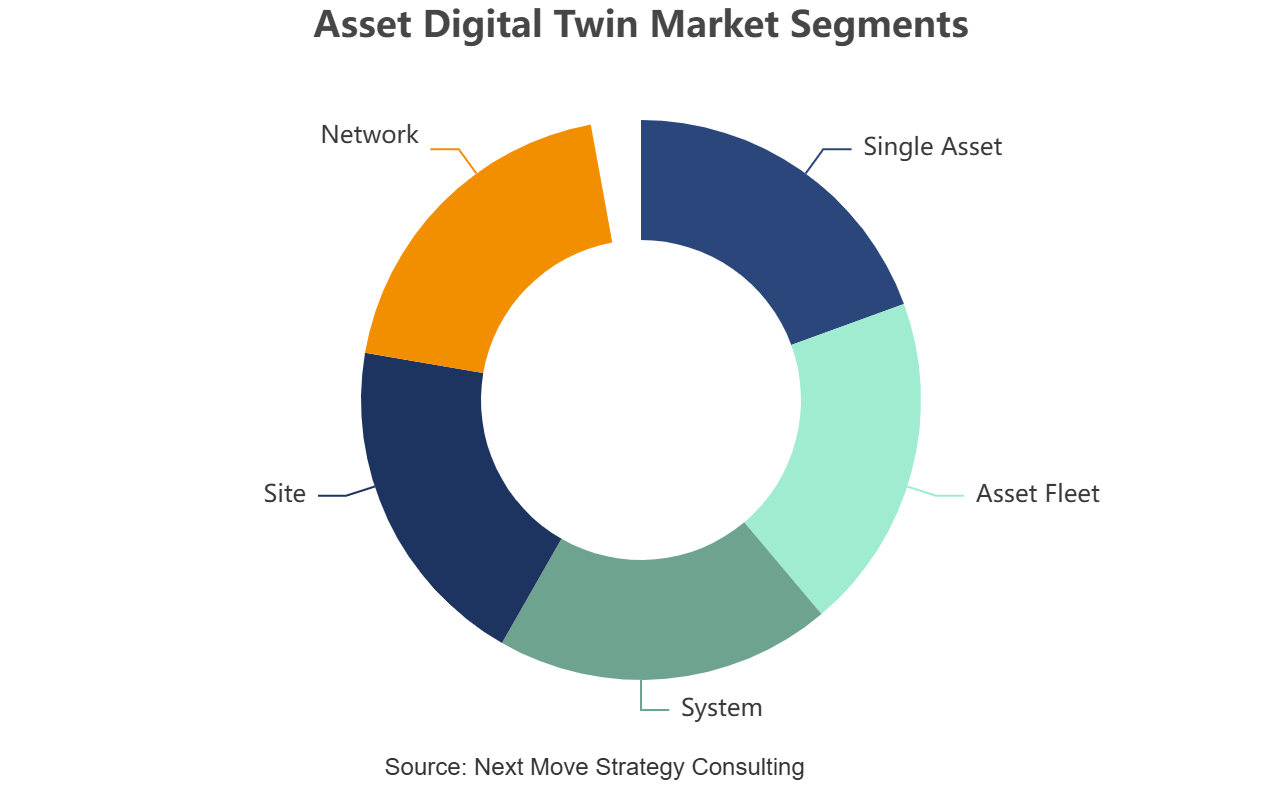
About the Author
 Saista Faiyaz
— Saista Faiyaz is Research Associate at Next Move Strategy Consulting, where she has covered consumer markets and healthcare technologies for 3 years. Her work includes primary interview review, secondary-source validation, market sizing, and structured analysis of company and industry data. She supports research by comparing evidence across sources, organizing findings into market narratives, and documenting assumptions used in analysis. Her scope includes cross-market benchmarking, and reports.
Saista Faiyaz
— Saista Faiyaz is Research Associate at Next Move Strategy Consulting, where she has covered consumer markets and healthcare technologies for 3 years. Her work includes primary interview review, secondary-source validation, market sizing, and structured analysis of company and industry data. She supports research by comparing evidence across sources, organizing findings into market narratives, and documenting assumptions used in analysis. Her scope includes cross-market benchmarking, and reports.
About the Reviewer
 Supradip Baul
— Supradip Baul is an accomplished business consultant and strategist with over a decade of rich experience in market intelligence, strategy, technology, and business transformation. His work has included rigorous qualitative and quantitative analysis across multiple industries, helping clients shape investment decisions and long-term roadmaps. Earlier in his career, he was associated with Gartner, where he contributed to industry-leading reports and market share analyses. He has worked with leading global companies and holds an MBA with a dual specialization in Marketing and Finance.
Supradip Baul
— Supradip Baul is an accomplished business consultant and strategist with over a decade of rich experience in market intelligence, strategy, technology, and business transformation. His work has included rigorous qualitative and quantitative analysis across multiple industries, helping clients shape investment decisions and long-term roadmaps. Earlier in his career, he was associated with Gartner, where he contributed to industry-leading reports and market share analyses. He has worked with leading global companies and holds an MBA with a dual specialization in Marketing and Finance.
At Next Move Strategy Consulting, we understand that insightful market research is the cornerstone of successful business decisions. That's why we employ a robust and multifaceted approach, combining various methodologies to deliver the most accurate and actionable data for our clients.

Research Landscape
We navigate the world of research with two primary approaches:
Qualitative Approach
Our qualitative research methodologies involve immersive techniques such as in-depth interviews, focus groups, and observational studies. By engaging directly with individuals and stakeholders, we uncover valuable insights that quantitative data alone may overlook.

Quantitative Research
In tandem with qualitative methodologies, NMSC leverages the power of Quantitative Research to provide a robust foundation of numerical insights. Through systematic data collection and analysis, we quantify patterns, preferences, and market trends, offering a comprehensive view of the business landscape.
Our quantitative research approach employs diverse tools, including surveys, experiments, and statistical modelling. These methodologies enable us to gather data from a large and representative sample, ensuring the statistical significance of our findings. By employing structured questionnaires and standardized data collection methods, we guarantee the reliability and validity of the information we present to our clients.
Quantitative research is particularly effective in measuring the prevalence of trends, assessing market size, and gauging the impact of various factors on consumer behavior. The numerical precision attained through this approach equips our clients with actionable insights, facilitating data-driven decision-making and strategy formulation.


Our Specialized Toolbox for Industry-Specific Market Research
We deploy a specialized arsenal of techniques tailored to meet your unique requirements. Here's a glimpse into our comprehensive toolbox:

Information Procurement
The stage entails acquiring market data or relevant information through various sources and methodologies.


Market Research Approach
We utilize both top-down and bottom-up approaches in market research analysis to achieve a comprehensive understanding of the market dynamics, leveraging the broad perspective of industry trends and macroeconomic factors alongside detailed insights from specific segments and individual companies.

Porters Five Forces Analysis
We conduct Porter's Five Forces analysis to evaluate the competitive landscape of an industry, providing us with insights into factors that affect profitability and strategic positioning.

SWOT Analysis

Forecasting
We utilize a forecasting model to predict future consumption by considering parameters like population, economics, regulations, market competition, drivers, constraints, technology, and pricing. We also employ statistical techniques such as multilinear regression, exponential smoothing, moving average, ARIMA, and Monte Carlo simulations for accurate predictions. In econometric forecasting, we analyzed short-term and long-term event impacts, attributing values based on regulatory frameworks, economic factors, and market events.





 Speak to Our Analyst