Vietnam Aluminum Market By Type (Primary, Secondary, Scrap), By Product Type (Flat-Rolled, Casting, Extrusions, Forgings, Powder & Paste, Billets, Wire Rods, Foundry Alloys, Aluminum Silicon Alloy, Others), By Alloy Series (1xxx–7xxx), By Distribution Channel (OEM Direct, Distributors, Aftermarket, E-commerce, Scrap Traders), By End User (Transportation, Consumer Goods, Machinery & Equipment, Construction, Packaging, Electrical Engineering, Others) – Analysis & Forecast, 2025–2035
Industry: Materials and Chemical | Latest Edition: September 30, 2026 | No of Pages: 245 | No. of Tables: 122 | No. of Figures: 112 | Format: PDF | Report Code: MC2896
Vietnam Aluminum Market Size & Forecast
|
Parameters |
Details |
|
Market Size in 2026 |
USD 917.24 Million |
|
Revenue Forecast in 2035 |
USD 1578.01 Million |
|
Growth Rate |
CAGR of 6.21% from 2026 to 2035 |
|
Market Volume in 2026 |
419.66 Kilotons |
|
Volume Forecast in 2035 |
656.86 Kilotons |
|
Growth Rate |
CAGR of 5.10% from 2026 to 2035 |
|
Analysis Period |
2025–2035 |
|
Base Year Considered |
2025 |
|
Forecast Period |
2026–2035 |
|
Market Size Estimation |
Million |
|
Companies Profiled |
15 |
|
Market Share |
Available for 10 companies |
Industry Outlook
The Vietnam Aluminum Market size was valued at USD 804.08 million in 2025 and is expected to reach USD 917.24 million by 2026. Looking ahead, the industry is projected to expand significantly, reaching USD 1578.01 million by 2035, registering a CAGR of 6.21% from 2026 to 2035. In terms of volume, the market recorded 370 Kilotons in 2025, with forecasts indicating growth to 419.66 Kilotons by 2026 and further to 656.86 Kilotons by 2035, reflecting a CAGR of 5.10% over the same period.
What Are the Key Market Drivers, Breakthroughs, and Investment Opportunities That Will Shape the Aluminum Industry in the Next Decade?
Growth Catalyst & Risk Assessment Matrix
|
DRIVERS / TRENDS / RESTRAINTS |
(+/–) % IMPACT ON CAGR FORECAST |
GEOGRAPHIC RELEVANCE |
IMPACT TIMELINE |
|
FDI-backed electronics and automotive manufacturing increasing demand for aluminium components |
+1.9% |
Ho Chi Minh City, Bac Ninh, Hai Phong, Binh Duong, industrial export zones |
Short to medium term (1–3 years) |
|
Urban infrastructure and housing development driving architectural aluminium consumption |
+1.7% |
Hanoi, Ho Chi Minh City, Da Nang, nationwide urban corridors |
Short to medium term (1–4 years) |
|
Packaging modernization increasing demand for aluminium foil, can-stock, and containers |
+1.6% |
Nationwide FMCG hubs, Ho Chi Minh City, Hanoi, industrial provinces |
Short to medium term (1–4 years) |
|
Limited smelting capacity and energy constraints restricting upstream production scalability |
-1.8% |
National industrial base, energy-intensive manufacturing zones |
Medium term (2–5 years) |
|
Export-oriented extrusion hubs and recycling integration strengthening value-added aluminium growth |
+1.9% |
Hai Phong ports, Binh Duong, Dong Nai, industrial export corridors |
Medium to long term (3–7 years) |
The Vietnam aluminum market is being supported by structural demand from export-led manufacturing, urban development, and packaging modernization. Our analysis indicates that foreign direct investment in electronics and automotive parts production is increasing requirements for lightweight, corrosion-resistant, and precision-engineered aluminum inputs across industrial clusters. At the same time, housing, transport infrastructure, and commercial construction activity continue to sustain demand for architectural products such as frames, façades, partitions, and roofing systems. Packaging converters are also expanding aluminum usage as recyclability, branding quality, and shelf-life performance become stronger procurement considerations.
However, upstream limitations remain visible due to restricted domestic smelting capacity and energy-related constraints, which increase reliance on imported metal feedstock and expose processors to cost volatility. Future expansion is likely to come from export-oriented extrusion and casting hubs supported by port connectivity and industrial zones. Additional momentum may emerge through remelt and recycling investments that improve circularity, reduce import dependence, and strengthen raw material flexibility. Our observation suggests that these trends indicate a market gradually shifting toward higher-value fabrication and integrated secondary aluminum ecosystems.
Growth Drivers:
How Does Rapid FDI-Backed Electronics and Automotive Parts Manufacturing Increase in Vietnam Aluminum Market Demand?
Foreign direct investment continues to strengthen Vietnam’s position as a manufacturing base for electronic assemblies, wiring systems, battery housings, heat sinks, and precision automotive parts. Aluminum is preferred because it combines lightweight properties, corrosion resistance, and process flexibility across stamping, extrusion, and die-casting applications. Based on industry observations, we found that suppliers aligned with export manufacturing clusters are gaining order visibility and longer production runs. The Vietnam aluminum market benefits as multinational sourcing programs prioritize scalable regional metal inputs.
How Do Urban Infrastructure and Housing Projects Expand Construction-Grade Aluminum Use?
Ongoing investment in urban corridors, residential towers, logistics parks, and public transport facilities is lifting consumption of architectural aluminum products such as window frames, curtain walls, roofing systems, façades, and partitions. Contractors increasingly favor aluminum due to durability, low maintenance requirements, and compatibility with modern building designs. Our strategic assessment indicates that specification-led procurement is widening in both private and public projects. The Vietnam aluminum market, therefore, gains from recurring replacement cycles and new-build construction demand.
Why Is Packaging Modernization Supporting Additional Aluminum Consumption?
Consumer goods producers are upgrading packaging formats to improve shelf life, branding quality, recyclability, and transport efficiency. This is increasing demand for can-stock, foil, closures, and lightweight container applications across beverages, food, cosmetics, and household products. Our detailed analysis reveals that aluminum packaging also aligns with circular economy priorities and premium product positioning. The Vietnamese aluminum market is supported as converters and brand owners seek material solutions that combine performance with sustainability objectives.
Growth Inhibitor:
How Are Limited Domestic Smelting Capacity and Energy Constraints Restricting Growth in The Vietnamese Aluminum Market?
Secondary aluminum refers to metal produced from recycled inputs rather than newly smelted ore-based sources. It includes industrial scrap, generated during fabrication processes such as cutting, stamping, and machining. Strategically, this segment matters because it lowers dependence on imported primary metal, improves raw material flexibility, and supports sustainability requirements from international buyers. In our expert view, processors using reliable scrap streams can strengthen cost control and shorten replenishment timelines.
Key subsegments include post-consumer scrap and remelted secondary production, each serving different purity and alloy needs. Industrial scrap typically offers more predictable chemistry, while post-consumer streams require stronger sorting and treatment capabilities. Our review highlights that procurement teams increasingly evaluate traceability, recovery yields, and furnace efficiency when selecting suppliers. Demand logic remains tied to packaging, construction, cast parts, and general engineering applications where recycled content targets are becoming commercially relevant.
Growth Opportunity:
How Can Export-Oriented Extrusion Hubs and Recycling Investments Unlock Future Potential in The Vietnam Aluminum Market?
A strategic growth pathway lies in developing export-oriented extrusion and casting hubs near ports, industrial zones, and multinational manufacturing clusters. Such hubs can serve regional demand for profiles, automotive components, electronics housings, and engineered parts while reducing logistics complexity for overseas buyers. Our review suggests that Vietnam’s manufacturing ecosystem already provides a useful base for this transition. The Vietnam aluminum market could capture higher-value trade flows through specialized fabrication rather than commodity-only positioning.
Additional momentum may come from attracting remelt and recycling investments that convert industrial scrap and post-consumer material into secondary feedstock. This would improve material circularity, reduce import dependence, and support customers seeking lower-carbon sourcing options. Our findings reveal that secondary metal systems often strengthen margin resilience when raw material markets fluctuate. The Vietnamese aluminum market can therefore expand through integrated recycling networks linked to extrusion plants, foundries, and export manufacturing supply chains.
SWOT Analysis of the Vietnam Aluminum Market
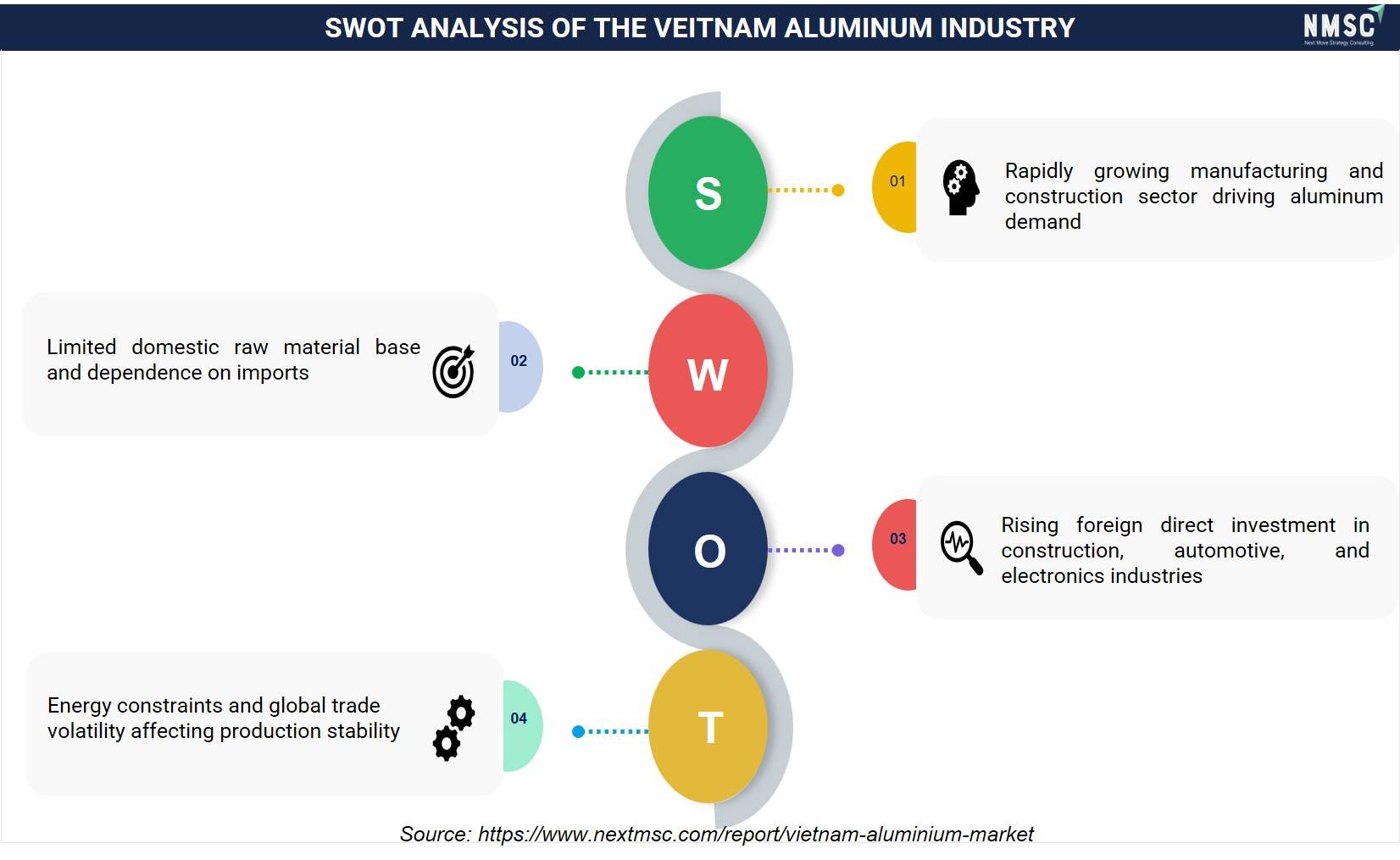
The SWOT framework presents the structural position of the Vietnamese aluminum market across internal capabilities and external market conditions. It identifies strengths through expanding manufacturing and construction activity that continue to support aluminum demand across downstream applications. Our detailed analysis reveals that weaknesses are linked to a limited domestic raw material base and continued import dependence for selected inputs. Opportunities arise from rising foreign direct investment in automotive, electronics, and infrastructure-linked industries, while energy constraints and global trade volatility remain key factors influencing production stability, procurement planning, and supply chain decisions.
How Is the Vietnam Aluminum Market Segmented in This Report, and What Are the Key Insights from the Segmentation Analysis?
By Type
How Does Type-Based Segmentation Influence Sourcing Dynamics in the Vietnam Aluminum Market?
The Vietnam aluminum market by type includes Primary Aluminum and Secondary Recycled Aluminum, with secondary material further segmented into Industrial Scrap, Post-Consumer Scrap, and Remelted Secondary Production, representing both virgin metal supply and recycling-based material recovery channels.
Primary aluminum is generally associated with stable input quality and supply consistency for manufacturing applications, while secondary aluminum supports cost-sensitive production models and circular material utilization across industrial sectors. Our assessment shows that industrial scrap provides a steady feedstock stream from fabrication and processing activities, whereas post-consumer scrap reflects recovery from packaging, transport, and consumer products. In addition, remelted secondary production enables recycled material to be converted into usable aluminum forms for downstream processors. Buyers increasingly evaluate alloy consistency, traceability standards, and supply reliability when selecting between primary and recycled inputs. Consequently, these combined factors shape sourcing strategies across Vietnam’s construction, packaging, transport, and industrial manufacturing ecosystem.
By Product Form
How Does Product Form Segmentation Determine Downstream Processing Demand in The Vietnam Aluminum Market?
The Vietnam aluminum market by product form includes Flat-Rolled products such as Sheet, Coil, Plate, Foil, and Can-Stock, along with Casting, Extrusions including Profiles and Tubes and Pipes, Forgings, Powder and Paste, Billets, Wire Rods, Foundry Alloys, Aluminium Silicon Alloy, and Other Products, representing a broad industrial processing and fabrication ecosystem.
Flat-rolled products are generally aligned with packaging, appliance, and transportation uses where formability and surface quality are required, while extrusions including profiles and tubes support construction systems and industrial assemblies. Similarly, casting materials serve machinery and component manufacturing, whereas billets and wire rods function as intermediate feedstock for further conversion processes. Forgings and foundry alloys are associated with strength-oriented mechanical applications, while powder and paste products address specialized industrial requirements. Our evaluation shows that procurement decisions are increasingly shaped by dimensional precision, conversion efficiency, alloy availability, and delivery reliability. Additionally, buyers also assess technical support and fabrication compatibility, which together influence sourcing behavior across Vietnam’s expanding manufacturing and infrastructure sectors.
Competitive Landscape
Based on NMSC’s assessment of the Vietnam aluminum industry, we observe that the competitive environment is developing steadily with strong participation from domestic producers and foreign-invested manufacturers. Companies such as Global Vietnam Aluminum Co., Ltd., Ngoc Diep Aluminium Joint Stock Company, Song Hong Aluminium Joint Stock Company, and An Lap Phat Aluminium Investment Trading Production Co., Ltd. support the market through extrusion products, construction systems, and downstream aluminum applications. In our market view, internationally linked players, including Hyundai Aluminum Vina Co., Ltd., Vietnam Yongxing Aluminium Industry Co., Ltd., Vina Washin Aluminum Co., Ltd., and Almine Vietnam Co., Ltd. contribute through advanced manufacturing processes, technical expertise, and export-oriented capabilities. Participants such as Sapa Ben Thanh Aluminium Profiles Co., Ltd., KIMSEN Industrial Corporation, East Asia Aluminum Co., Ltd., and Tiger Aluminum Vietnam Co., Ltd. further expand profile solutions, fabrication services, and industrial supply networks. From an industry intelligence perspective, Vietnam’s aluminum sector reflects a blend of domestic scale-up, overseas collaboration, and growing alignment with construction, manufacturing, and infrastructure demand trends.
Strategic Developments:
-
August 2025 – Ngoc Diep Aluminium started construction of the Dinostar high-quality aluminium plant in Hung Yen Province, Vietnam. The new facility will use advanced automated technology from Europe and Japan to expand premium aluminium production. The project supports domestic supply growth and export markets such as the US, Europe, and Japan.
-
November 2024 – Ngoc Diep Group was awarded the Vietnam National Brand, reflecting its strong investment in modern production technologies across aluminum, doors, packaging, and furniture. The recognition highlights the company’s focus on quality, innovation, and eco-friendly manufacturing practices. It also reinforces its position as a leading Vietnamese industrial manufacturer with expanding export presence.
Strategic Framework of the Vietnam Aluminum Market:
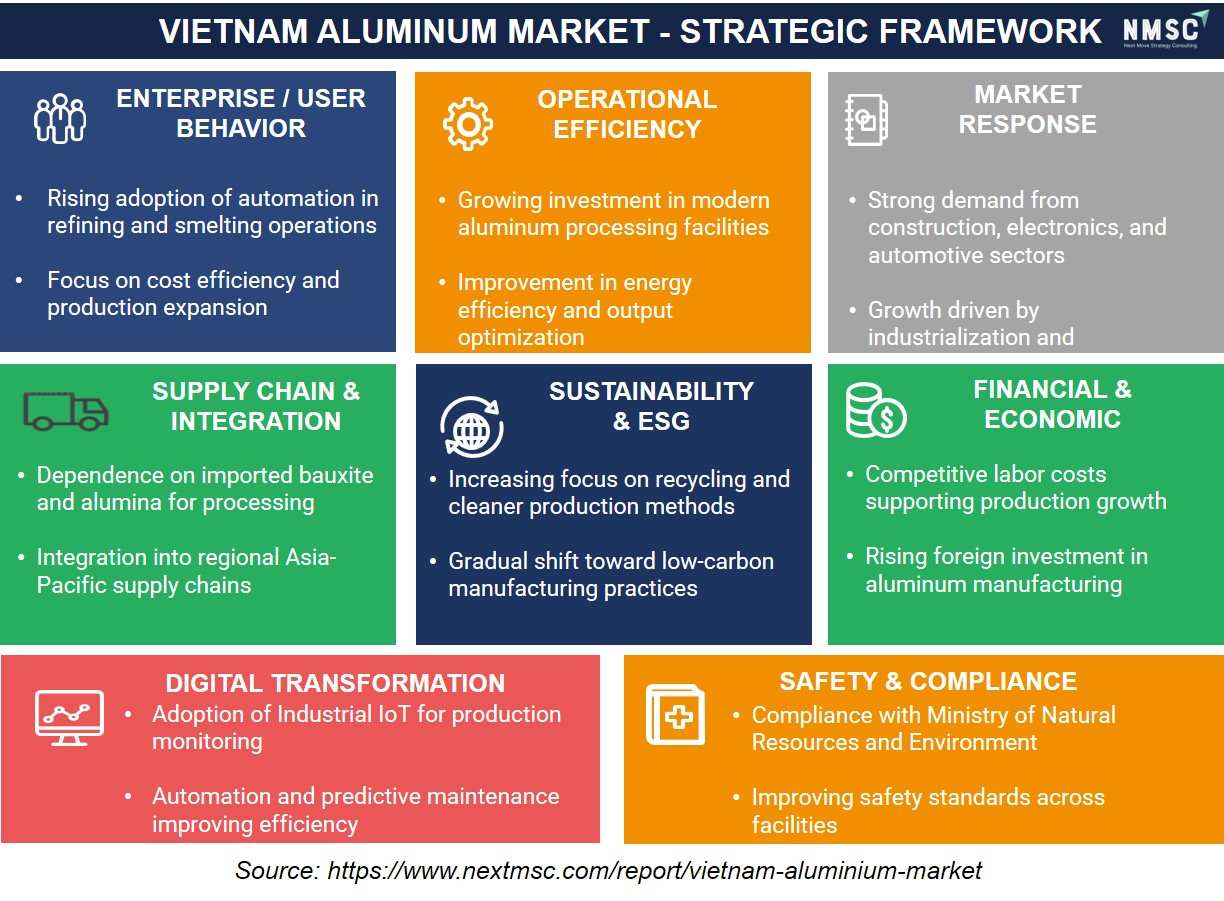
The infographic outlines the operating environment of the Vietnam aluminum market through demand, supply, efficiency, and policy perspectives. It highlights consumption support from construction, electronics, and automotive industries, alongside industrialization-led production activity and facility utilization trends. Supply chains remain linked to imported bauxite and alumina, while regional integration continues to influence sourcing and trade flows. The framework also reflects increasing adoption of automation, Industrial IoT, recycling systems, and lower-carbon production practices across facilities. Our strategic assessment indicates that labor competitiveness and foreign investment continue to shape manufacturing decisions and future capacity planning.
Key Players
-
Global Vietnam Aluminum Co., Ltd.
-
Ngoc Diep Aluminium Joint Stock Company
-
Vietnam Yongxing Aluminium Industry Co., Ltd.
-
East Asia Aluminum Co., Ltd.
-
Hyundai Aluminum Vina Co., Ltd.
-
Song Hong Aluminium Joint Stock Company
-
Sapa Ben Thanh Aluminium Profiles Co., Ltd.
-
KIMSEN Industrial Corporation
-
Tung Shin Industrial Co., Ltd.
-
Nguyet Minh 2 Daiki Aluminium Co., Ltd.
-
An Lap Phat Aluminium Investment Trading Production Co., Ltd.
-
Dong Duong Aluminium Co., Ltd.
-
Almine Vietnam Co., Ltd.
-
Vina Washin Aluminum Co., Ltd.
-
Tiger Aluminum Vietnam Co., Ltd.
Our analysis indicates that competitive dynamics in the Vietnam aluminum market are increasingly shaped by production efficiency, low-carbon manufacturing capabilities, and value-added downstream product innovation rather than primary metal capacity alone. We observe that leading suppliers are actively investing in recycling infrastructure, advanced rolling and extrusion technologies, and energy-efficient smelting processes to address rising demand for sustainable and lightweight materials across transportation, construction, packaging, and aerospace applications. The growing preference for recycled and secondary aluminum, in our view, reflects end-user focus on cost optimization, emission reduction, and circular supply chain strategies.
We also identified that market leaders are strengthening their positions through domestic capacity expansions, localized supply chains, and long-term contracts with automotive, beverage packaging, and industrial customers. These strategies enable stronger market penetration while reducing exposure to import volatility, logistics disruptions, and trade policy uncertainty. Overall, we expect sustained investment in recycling capacity, fabrication technologies, and customer-specific alloy development to remain the key determinant of competitive positioning in the Vietnam aluminum market.
Vietnam Aluminum Market Key Segments
By Type
-
Primary Aluminum
-
Secondary (Recycled) Aluminum
-
Industrial Scrap
-
Post-Consumer Scrap
-
Remelted Secondary Production
-
By Product Form
-
Flat-Rolled
-
Sheet
-
Coil
-
Plate
-
Foil
-
Can-Stock
-
-
Casting
-
Extrusions
-
Profiles
-
Tubes & Pipes
-
-
Forgings
-
Powder & Paste
-
Billets
-
Wire Rods
-
Foundry Alloys
-
Aluminium Silicon (AlSi) Alloy
-
Other Products
By Alloy Series
-
1xxx Series
-
2xxx Series
-
3xxx Series
-
4xxx Series
-
5xxx Series
-
6xxx Series
-
7xxx Series
By Distribution Channel
-
OEM Direct
-
Distributors
-
Aftermarket
-
E-commerce
-
Scrap Traders
By End User
-
Transportation
-
Aerospace
-
Automotive
-
Marine
-
Rail
-
-
Consumer Goods
-
Machinery & Equipment
-
Construction
-
Packaging
-
Food & Beverage
-
Cosmetics
-
Others
-
-
Electrical Engineering
-
Other End Users
Key Benefits for Stakeholders:
Next Move Strategy Consulting (NMSC) presents a comprehensive analysis of the Vietnam aluminum market, covering historical developments from 2020 to 2025 and providing forward-looking forecasts through 2035. The study assesses the market at regional levels, combining quantitative market sizing with qualitative insights into key growth drivers, supply-demand dynamics, pricing trends, sustainability transitions, technology evolution, and investment activity across major aluminum product categories and end-use industries.
From our analysis, the Vietnam aluminum market delivers strong value across the industrial ecosystem. Manufacturers benefit from lightweight, durable, and recyclable materials that improve product performance and production efficiency. Investors gain exposure to long-term growth supported by infrastructure development, electric vehicle expansion, packaging demand, and rising adoption of recycled aluminum. Fabricators, processors, and technology providers benefit from recurring opportunities through value-added product development, recycling capacity expansion, and long-term supply agreements. Overall, the market supports industrial competitiveness, supply chain resilience, and Vietnam’s broader manufacturing transformation, reinforcing its strategic importance in the country’s industrial landscape.
|
Parameters |
Details |
|
Customization Scope |
Free customization (equivalent to up to 80 analyst-working hours) after purchase. |
|
Pricing and Purchase Options |
Avail customised purchase options to meet your exact research needs. |
|
Approach |
In-depth primary and secondary research; proprietary databases; rigorous quality control and validation measures. |
|
Analytical Tools |
Porter's Five Forces, SWOT, value chain, and Harvey ball analysis to assess competitive intensity, stakeholder roles, and relative impact of key factors. |


About the Author
 Tushmi Dutta
— Tushmi Dutta is a focused researcher specializing in detailed analysis and insight-driven research across diverse business landscapes. She supports strategic initiatives through structured data interpretation, thorough validation, and clear communication of findings that aid informed decision-making. With a strong interest in writing, she enjoys presenting research insights in an engaging and accessible manner. Beyond work, she enjoys traveling, reading, painting, and continuously learning new skills that contribute to her creative and professional growth.
Tushmi Dutta
— Tushmi Dutta is a focused researcher specializing in detailed analysis and insight-driven research across diverse business landscapes. She supports strategic initiatives through structured data interpretation, thorough validation, and clear communication of findings that aid informed decision-making. With a strong interest in writing, she enjoys presenting research insights in an engaging and accessible manner. Beyond work, she enjoys traveling, reading, painting, and continuously learning new skills that contribute to her creative and professional growth.
About the Reviewer
 Supradip Baul
— Supradip Baul is an accomplished business consultant and strategist with over a decade of rich experience in market intelligence, strategy, technology, and business transformation. His work has included rigorous qualitative and quantitative analysis across multiple industries, helping clients shape investment decisions and long-term roadmaps. Earlier in his career, he was associated with Gartner, where he contributed to industry-leading reports and market share analyses. He has worked with leading global companies and holds an MBA with a dual specialization in Marketing and Finance.
Supradip Baul
— Supradip Baul is an accomplished business consultant and strategist with over a decade of rich experience in market intelligence, strategy, technology, and business transformation. His work has included rigorous qualitative and quantitative analysis across multiple industries, helping clients shape investment decisions and long-term roadmaps. Earlier in his career, he was associated with Gartner, where he contributed to industry-leading reports and market share analyses. He has worked with leading global companies and holds an MBA with a dual specialization in Marketing and Finance.
At Next Move Strategy Consulting, we understand that insightful market research is the cornerstone of successful business decisions. That's why we employ a robust and multifaceted approach, combining various methodologies to deliver the most accurate and actionable data for our clients.

Research Landscape
We navigate the world of research with two primary approaches:
Qualitative Approach
Our qualitative research methodologies involve immersive techniques such as in-depth interviews, focus groups, and observational studies. By engaging directly with individuals and stakeholders, we uncover valuable insights that quantitative data alone may overlook.

Quantitative Research
In tandem with qualitative methodologies, NMSC leverages the power of Quantitative Research to provide a robust foundation of numerical insights. Through systematic data collection and analysis, we quantify patterns, preferences, and market trends, offering a comprehensive view of the business landscape.
Our quantitative research approach employs diverse tools, including surveys, experiments, and statistical modelling. These methodologies enable us to gather data from a large and representative sample, ensuring the statistical significance of our findings. By employing structured questionnaires and standardized data collection methods, we guarantee the reliability and validity of the information we present to our clients.
Quantitative research is particularly effective in measuring the prevalence of trends, assessing market size, and gauging the impact of various factors on consumer behavior. The numerical precision attained through this approach equips our clients with actionable insights, facilitating data-driven decision-making and strategy formulation.


Our Specialized Toolbox for Industry-Specific Market Research
We deploy a specialized arsenal of techniques tailored to meet your unique requirements. Here's a glimpse into our comprehensive toolbox:

Information Procurement
The stage entails acquiring market data or relevant information through various sources and methodologies.


Market Research Approach
We utilize both top-down and bottom-up approaches in market research analysis to achieve a comprehensive understanding of the market dynamics, leveraging the broad perspective of industry trends and macroeconomic factors alongside detailed insights from specific segments and individual companies.

Porters Five Forces Analysis
We conduct Porter's Five Forces analysis to evaluate the competitive landscape of an industry, providing us with insights into factors that affect profitability and strategic positioning.

SWOT Analysis

Forecasting
We utilize a forecasting model to predict future consumption by considering parameters like population, economics, regulations, market competition, drivers, constraints, technology, and pricing. We also employ statistical techniques such as multilinear regression, exponential smoothing, moving average, ARIMA, and Monte Carlo simulations for accurate predictions. In econometric forecasting, we analyzed short-term and long-term event impacts, attributing values based on regulatory frameworks, economic factors, and market events.





 Speak to Our Analyst