Wind Tunnel Testing Services Market Global Industry Analysis and Forecast (2026–2035)

Wind Tunnel Testing Services Market size was USD 510.3 Million in 2025, projected to reach USD 1153.79 Million by 2035, growing at a CAGR of 8.5% from 2026 to 2035. Key drivers include aerodynamic validation demand for new aircraft programs, growth in hypersonic and high-speed defense research, and advances in optical and pressure measurement systems, with North America leading the global market.

Download Free Sample PDF
Base Year (2025)
$510.3 Million
Forecast (2035)
$1,153.8 Million
CAGR (2026-2035)
8.5%
Top Region
North America

What Is the Wind Tunnel Testing Services Market Size?

The global wind tunnel testing services Market reached USD 510.3 Million in 2025 and is estimated at USD 553.68 Million in 2026, forecast to reach USD 1153.79 Million by 2035 at a CAGR of 8.5% between 2026 and 2035. North America leads with approximately 34% revenue share in 2025, while Aerodynamic Performance testing is the dominant testing type, holding approximately 48% of total market revenue.

We observed that technological shifts are reshaping how wind tunnel testing services are delivered. Operators are adopting high-fidelity pressure-sensitive paint, advanced force balances, and particle image velocimetry to capture flow behavior with greater precision. Facility operational scale is also expanding, as larger test sections accommodate full-scale components and integrated subsystems. Composite and additively manufactured test models demand tighter tolerance control, prompting service providers to upgrade model fabrication capabilities alongside their core tunnel infrastructure.

Wind Tunnel Testing Services Market Global Industry Analysis and Forecast (2026–2035) Revenue Forecast

Values in USD Million

2025 $510.3 Million
2025
2026 $553.7 Million
2026
2027 $600.7 Million
2027
2028 $651.8 Million
2028
2029 $707.2 Million
2029
2030 $767.3 Million
2030
2031 $832.5 Million
2031
2032 $903.3 Million
2032
2033 $980.1 Million
2033
2034 $1,063.4 Million
2034
2035 $1,153.8 Million
2035

Key Takeaways

By Testing Type: Aerodynamic Performance testing held the largest share, expanding from USD 245.21 Million in 2025 to USD 446.98 Million by 2035; Propulsion & Aeroacoustic testing is the fastest-growing at 11.61% CAGR from 2026–2035.

By Application: Commercial Aviation held the largest share, expanding from USD 230.43 Million in 2025 to USD 451.02 Million by 2035; Wind Energy & Other Industrial is the fastest-growing at 11.34% CAGR from 2026–2035.

By End User: Aerospace OEMs held the largest share, expanding from USD 250.29 Million in 2025 to USD 496.52 Million by 2035; Academic & Research Institutes are the fastest-growing at 11.11% CAGR from 2026–2035.

By Distribution Channel: Direct Institutional Contracts held the largest share, expanding from USD 215.04 Million in 2025 to USD 420.52 Million by 2035; Specialized Engineering Service Partners is the fastest-growing at 10.91% CAGR from 2026–2035.

Dominant Region: North America dominated the market with approximately 34% revenue share (USD 173.5 Million) in 2025, anchored by large government and OEM tunnel infrastructure, established aerospace programs, and a high concentration of leading aerospace primes.

Fastest-Growing Region: Asia-Pacific is expected to register the highest CAGR of 11.67% during 2026–2035, driven by state-directed investment in large test facilities, expanding aerospace development programs, and growing institutional testing capacity.

Dominant Country: The U.S. led the market with an estimated USD 131.86 Million in 2025 (~76% of North America), supported by a dense network of government, university, and commercial aerodynamic test facilities.

Fastest-Growing Country: India is among the fastest-growing major countries, projected to expand from USD 27.56 Million in 2025 at a CAGR of approximately 13.47%, driven by upgrades to national and defense research tunnels serving indigenous fighter, transport, and unmanned aircraft development.

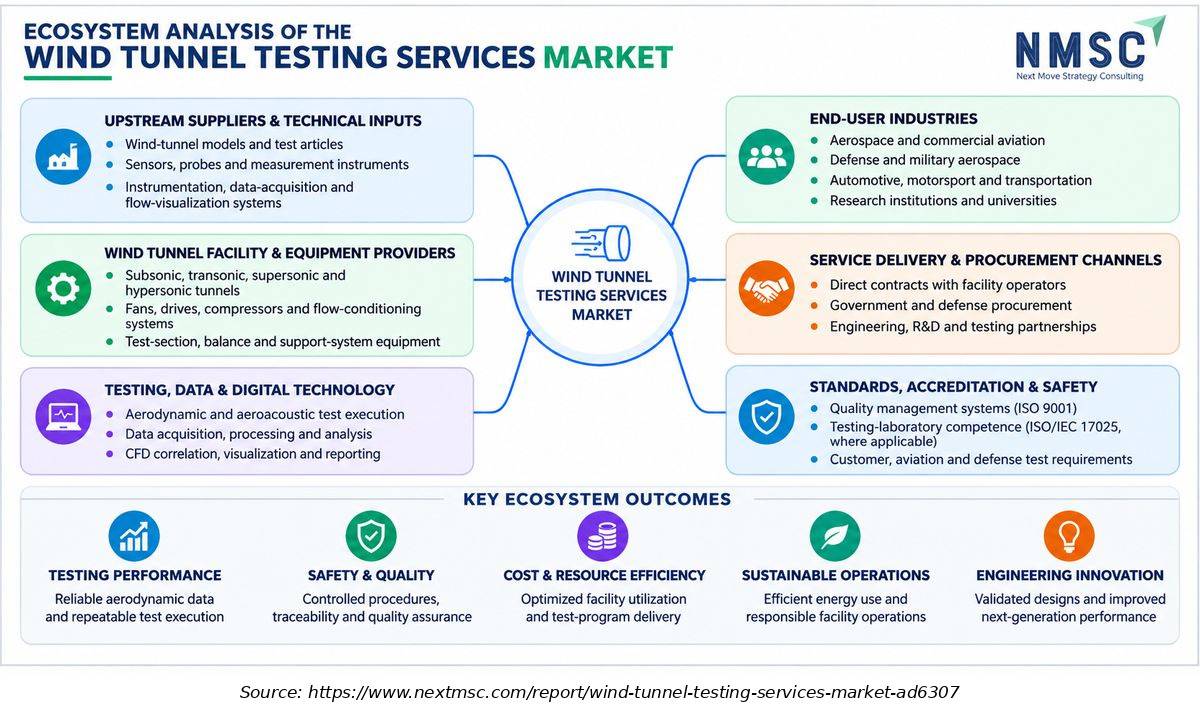
Ecosystem Analysis of the Wind Tunnel Testing Services Industry

The above infographic provides a detailed ecosystem analysis of the wind tunnel testing services market, mapping out key stakeholders from upstream suppliers and facility providers to service delivery channels and end-user industries. It illustrates how digital testing technologies and regulatory standards support the delivery of reliable aerodynamic data for aerospace, defense, and automotive sectors. Ultimately, the diagram highlights the key ecosystem outcomes, demonstrating that this interconnected network drives testing performance, safety, cost efficiency, sustainable operations, and engineering innovation.

What Does the Wind Tunnel Testing Services Market Encompass?

The wind tunnel testing services market encompasses contracted aerodynamic, aeroacoustic, and propulsion testing performed in subsonic, transonic, supersonic, and hypersonic facilities. Service offerings include model design and fabrication, test planning, data acquisition, flow visualization, and post-test analysis. Core technologies include force and moment balances, pressure measurement systems, particle image velocimetry, and infrared thermography. Testing supports fixed-wing aircraft, rotorcraft, missiles, launch vehicles, and ground vehicles, with service structures ranging from single campaigns to multi-year programs.
Design specifications for wind tunnel testing services emphasize Reynolds number scaling, model blockage limits, and precise control of flow quality, temperature, and pressure. Material innovations such as carbon fiber composite models, additively manufactured components, and high-strength alloys enable higher loads and tighter geometric fidelity. Certification and quality frameworks, including AS9100 aerospace quality management and national accreditation for calibration laboratories, govern measurement traceability. Compliance with these standards is essential for test data to support airworthiness and procurement decisions.

Market Drivers & Dynamics

Interactive Dataset
Aerodynamic validation demand for new aircraft programs driver High Development of new airframes requires extensive wind tunnel verification before flight testing Immediate
Growth in hypersonic and high-speed defense research driver High Hypersonic vehicles require specialized high-enthalpy facilities and instrumentation Immediate
Advances in optical and pressure measurement systems driver Medium Improved instrumentation expands the range of testable flow phenomena Medium-term
High capital cost of large-scale tunnel facilities restraint High Constructing and maintaining major tunnels limits new market entrants and capacity additions Immediate
Shortage of skilled aerodynamic test engineers restraint Medium Limited specialist talent constrains test campaign capacity and analysis quality Medium-term
Growing reliance on computational fluid dynamics restraint Low Simulation tools reduce the volume of physical testing needed for some configurations Long-term
Source: Next Move Strategy Consulting

Growth Drivers

What Is the Primary Growth Driver in the Wind Tunnel Testing Services Industry?

The primary catalyst for wind tunnel testing services is the sustained development of new aircraft and defense platforms. Each program requires repeated aerodynamic campaigns to validate configurations, control surfaces, and propulsion integration. Next Move Strategy Consulting's analysis indicates that these validation requirements persist even as simulation tools mature. Physical testing remains the reference standard for certification-grade data, which anchors demand for contracted tunnel capacity throughout the development lifecycle.

How Are Industry Standards and Directives Driving the Tunnel Testing Services Market?

Airworthiness authorities and procurement agencies require documented aerodynamic evidence before approving new aircraft designs. Standards such as AS9100 for quality management and accreditation under ISO/IEC 17025 for testing laboratories establish the credibility of wind tunnel testing services' data. Military procurement frameworks similarly demand traceable test records for weapon system qualification. These governing requirements create a compliance floor that sustains baseline demand, while more demanding certification expectations encourage developers to commission accredited tunnel campaigns.

Growth Inhibitors

What Is Restraining the Wind Tunnel Testing Services Market?

The principal restraint on wind tunnel testing services is the high capital and operating cost of large-scale facilities. Constructing a transonic or supersonic tunnel requires substantial investment in compressors, cooling systems, and instrumentation, while ongoing energy consumption remains significant. Limited facility availability can extend program schedules and push developers toward alternative methods. Providers must balance utilization rates against maintenance requirements, which constrains how rapidly total industry capacity can expand.

What Are the Growth Opportunities?

Can Hypersonic and High-Enthalpy Testing Capture High-Density Deployments?

Hypersonic development programs present a concentrated opportunity for wind tunnel testing services. Vehicles operating at high Mach numbers require specialized facilities capable of replicating extreme heating and pressure environments. Providers that secure high-enthalpy capabilities can serve defense and space programs with demanding test requirements. Such capacity is scarce, which supports premium pricing and long-term contracts with government and prime contractor customers.

How Is Mid-Tier and Regional Facility Adoption Unlocking New Market Volume?

Secondary facilities and regional research hubs are expanding access to wind tunnel testing services beyond major aerospace centers. Smaller tunnels suit preliminary screening, subscale model studies, and educational programs, which broadens the customer base. Shared access arrangements between universities, research institutes, and small aerospace firms increase utilization of existing infrastructure. This broader participation adds testing volume without requiring the capital outlay associated with flagship facilities.

Can Specialized Vertical Implementations Become Distinct Premium Markets?

Specialized applications such as automotive aerodynamics, wind energy turbine testing, and motorsport development are emerging as distinct premium niches for wind tunnel testing services. Recent developments, including the Council of Scientific and Industrial Research National Aerospace Laboratories (CSIR-NAL) initiative to offer testing for space launch vehicles and defense aircraft, illustrate expanding public sector demand. Similarly, OMOWAY's partial disclosure of car-grade tunnel testing for its OMO X electric motorcycle highlights growing commercial interest in vehicle aerodynamics.

Segmentation Analysis

2025 (USD Million)
2035 (USD Million)
Aerodynamic Performance Testing 2025: $245.2 Million | 2035: $266.1 Million
Aerodynamic
Structural & Loads Testing 2025: $159.4 Million | 2035: $172.9 Million
Structural &
Propulsion & Aeroacoustic Testing 2025: $105.7 Million | 2035: $114.7 Million
Propulsion &
Aerodynamic Performance Testing $245.2 Million $266.1 Million USD 446.98 Million
Structural & Loads Testing $159.4 Million $172.9 Million USD 398.45 Million
Propulsion & Aeroacoustic Testing $105.7 Million $114.7 Million USD 308.36 Million

Which Testing Type Segment Dominates the Tunnel Testing Services Market?

The installed base of large subsonic and transonic facilities anchors the operational foundation of this category, and Aerodynamic Performance testing commands the primary revenue share at USD 245.21 Million in 2025. Aircraft manufacturers and research organizations rely on force, pressure, and flow measurements to validate airframe configurations before costly flight trials. Propulsion & Aeroacoustic testing, meanwhile, advances at an 11.61% CAGR through 2035 as engine integration and noise certification requirements intensify. This pairing of mature baseline demand with a high-growth testing vector defines the category's commercial trajectory for wind tunnel testing services.

2025 (USD Million)
2035 (USD Million)
Category A
Category B
Category C
Category D
Segment Item 2025 (USD Million) 2035 (USD Million) CAGR
Category A $10.0 USD Million $40.0 USD Million 25.0%
Category B $17.1 USD Million $51.1 USD Million 11.0%
Category C $24.2 USD Million $62.2 USD Million 25.0%
Category D $31.3 USD Million $73.3 USD Million 11.0%

Segment-wise data is locked

Unlock complete segment-wise numbers for By Application.

Unlock Full Data
2025 (USD Million)
2035 (USD Million)
Category A
Category B
Category C
Category D
Segment Item 2025 (USD Million) 2035 (USD Million) CAGR
Category A $10.0 USD Million $40.0 USD Million 27.0%
Category B $17.1 USD Million $51.1 USD Million 9.0%
Category C $24.2 USD Million $62.2 USD Million 19.0%
Category D $31.3 USD Million $73.3 USD Million 17.0%

Segment-wise data is locked

Unlock complete segment-wise numbers for By End User.

Unlock Full Data
2025 (USD Million)
2035 (USD Million)
Category A
Category B
Category C
Category D
Segment Item 2025 (USD Million) 2035 (USD Million) CAGR
Category A $10.0 USD Million $40.0 USD Million 14.0%
Category B $17.1 USD Million $51.1 USD Million 24.0%
Category C $24.2 USD Million $62.2 USD Million 22.0%
Category D $31.3 USD Million $73.3 USD Million 12.0%

Segment-wise data is locked

Unlock complete segment-wise numbers for By Distribution Channel.

Unlock Full Data
2025 (USD Million)
2035 (USD Million)
Category A
Category B
Category C
Category D
Segment Item 2025 (USD Million) 2035 (USD Million) CAGR
Category A $10.0 USD Million $40.0 USD Million 24.0%
Category B $17.1 USD Million $51.1 USD Million 22.0%
Category C $24.2 USD Million $62.2 USD Million 20.0%
Category D $31.3 USD Million $73.3 USD Million 22.0%

Segment-wise data is locked

Unlock complete segment-wise numbers for By Region.

Unlock Full Data

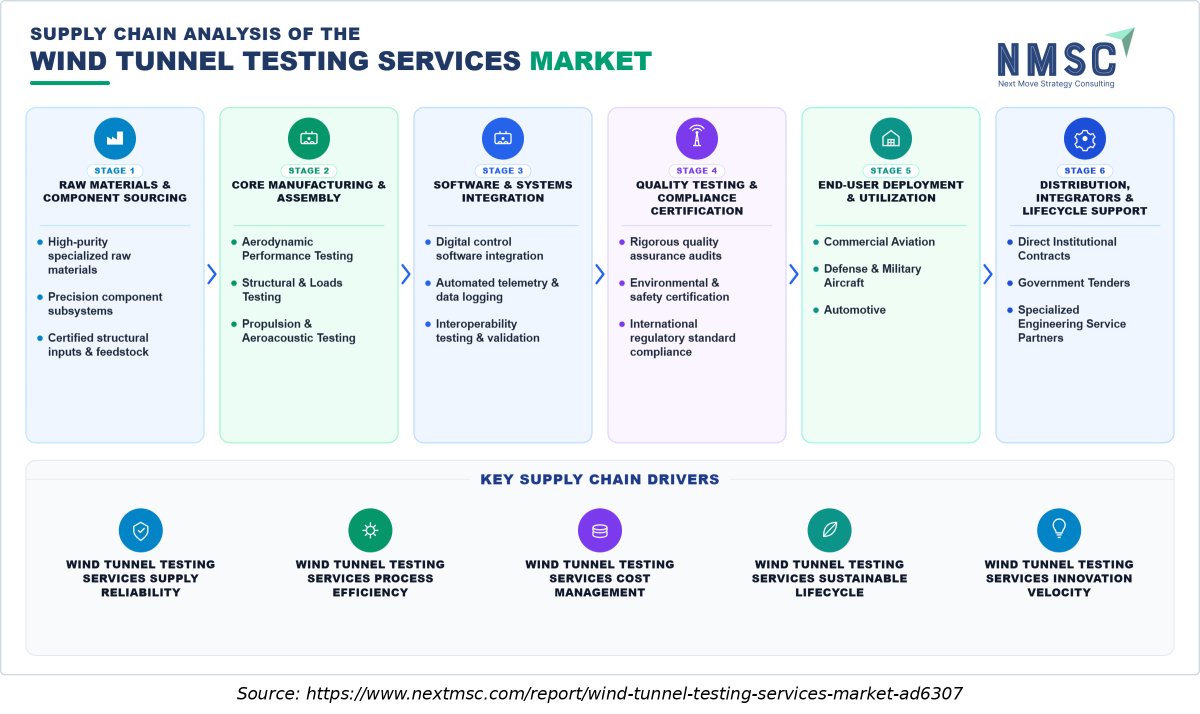
Supply Chain Analysis of the Wind Tunnel Testing Services Industry

Supply Chain Analysis of the Wind Tunnel Testing Services Industry
The above infographic outlines the supply chain of the wind tunnel testing services market, tracing a six-stage flow from raw material sourcing and manufacturing through software integration and quality testing to end-user deployment and lifecycle support. It illustrates how specialized materials and precision components are assembled and delivered to diverse sectors such as commercial aviation, defense, and automotive. Ultimately, the analysis highlights key drivers such as supply reliability, process efficiency, cost management, and innovation velocity that ensure a sustainable and effective supply chain.

Growth Opportunities

Our analysis shows that three structural whitespace opportunities are positioned to generate disproportionate commercial returns in the Wind Tunnel Testing Services Market through 2035:

Can Hypersonic and High-Enthalpy Testing Capture High-Density Deployments?

Hypersonic development programs present a concentrated opportunity for wind tunnel testing services. Vehicles operating at high Mach numbers require specialized facilities capable of replicating extreme heating and pressure environments. Providers that secure high-enthalpy capabilities can serve defense and space programs with demanding test requirements. Such capacity is scarce, which supports premium pricing and long-term contracts with government and prime contractor customers.

How Is Mid-Tier and Regional Facility Adoption Unlocking New Market Volume?

Secondary facilities and regional research hubs are expanding access to wind tunnel testing services beyond major aerospace centers. Smaller tunnels suit preliminary screening, subscale model studies, and educational programs, which broadens the customer base. Shared access arrangements between universities, research institutes, and small aerospace firms increase utilization of existing infrastructure. This broader participation adds testing volume without requiring the capital outlay associated with flagship facilities.

Can Specialized Vertical Implementations Become Distinct Premium Markets?

Specialized applications such as automotive aerodynamics, wind energy turbine testing, and motorsport development are emerging as distinct premium niches for wind tunnel testing services. Recent developments, including the Council of Scientific and Industrial Research National Aerospace Laboratories (CSIR-NAL) initiative to offer testing for space launch vehicles and defense aircraft, illustrate expanding public sector demand. Similarly, OMOWAY's partial disclosure of car-grade tunnel testing for its OMO X electric motorcycle highlights growing commercial interest in vehicle aerodynamics.

Regional Outlook

2025 (USD Million)
2035 (USD Million)
North Americ
Europe
Asia-Pacific
Latin Americ
Middle East
Region 2025 (USD Million) 2035 (USD Million) CAGR (%)
North America $10.0 USD Million $40.0 USD Million 9.0%
Europe $17.1 USD Million $51.1 USD Million 27.0%
Asia-Pacific $24.2 USD Million $62.2 USD Million 25.0%
Latin America $31.3 USD Million $73.3 USD Million 23.0%
Middle East & Africa $38.4 USD Million $84.4 USD Million 12.0%

Regional data is locked

Unlock complete regional numbers for this market.

Unlock Full Data

Competitive Landscape

The competitive structure of wind tunnel testing services market is concentrated among large aerospace primes, national research establishments, and specialized facility operators. Boeing Company, Airbus SE, Lockheed Martin Corporation, Northrop Grumman Corporation, and BAE Systems PLC maintain extensive in-house or contracted testing capacity tied to their own platform programs. Research institutions including NASA Ames Research Center, ONERA, and Aircraft Research Association Ltd provide independent facility access to the wider market. This mix of captive and public capacity shapes access conditions and pricing for external customers.

How Do Companies Compete in the Wind Tunnel Testing Services Market?

Providers differentiate primarily on measurement fidelity, facility scale, and the breadth of available test types across aerodynamic, structural, and propulsion configurations. Pricing reflects facility occupancy, instrumentation complexity, and engineering support hours rather than standardized unit rates. Distribution relies heavily on direct institutional contracts negotiated around specific development programs, while specialized engineering partners extend reach to smaller developers. Competitive success in wind tunnel testing services therefore depends on scheduling reliability and data credibility as much as on headline capacity.

Which Competitive Archetypes Dominate the Wind Tunnel Testing Services Market?

Market participants fall into three archetypes within wind tunnel testing services. Vertically integrated aerospace OEMs, including Boeing Company, Airbus SE, and Lockheed Martin Corporation, operate testing capacity that supports their own platform development while occasionally serving external programs. National and academic research organizations such as NASA Ames Research Center, ONERA, and Aircraft Research Association Ltd provide public-facing facility access and fundamental research capability. Defense and propulsion specialists including Northrop Grumman Corporation, BAE Systems PLC, and Rolls-Royce Holdings PLC contribute specialized structural, loads, and propulsion testing expertise to integrated programs.

What Innovation and Differentiation Strategies Are Companies Pursuing?

Sustainable advantage in wind tunnel testing services arises from irreplaceable facility infrastructure, accumulated test data libraries, and certified measurement processes that take years to establish. Operators with validated calibration histories and repeatable test protocols earn repeat contracts from demanding certification authorities. Integrated capabilities spanning aerodynamic, structural, and aeroacoustic testing create switching costs for customers managing multi-phase programs. Such advantages are difficult for new entrants to replicate given the capital intensity and regulatory scrutiny involved.

What M&A and Partnership Activity Is Shaping the Tunnel Testing Services Market?

Consolidation activity in wind tunnel testing services tends to focus on acquiring specialized engineering service capacity rather than large fixed facilities, which are rarely traded. Aerospace primes and defense contractors extend their testing footprint through partnerships and facility access agreements that secure capacity without full ownership. Strategic alliances with research institutes and engineering service partners allow participants to broaden technical scope and geographic coverage. Such deal patterns reflect a preference for flexible capacity access over outright infrastructure acquisition.

Key Market Players

Based on research conducted by NMSC, the following 20 companies represent the validated leadership set across Wind Tunnel Testing Services Market service providers, facility operators, and solution providers:

The Boeing Company AeroTEC ONERA Aircraft Research Association Ltd NASA Ames Research Center Airbus SE Lockheed Martin Corporation Northrop Grumman Corporation BAE Systems PLC Rolls-Royce Holdings PLC Safran SA German Aerospace Center (DLR) DNW Cranfield Aerospace Solutions Ltd QinetiQ Group PLC Calspan Corporation Dassault Aviation SA Honeywell International Inc. Kawasaki Heavy Industries Ltd Mitsubishi Heavy Industries Ltd

Latest Developments

During our market evaluation, we noticed that recent commercial activities, platform introductions, and partnerships within the industry reflect the latest market developments:

Date Event
November 2025 OMOWAY unveiled partial car-grade wind tunnel testing details for its smart electric motorcycle OMO X.
June 2025 CSIR-NAL initiated wind tunnel testing services for space launch vehicles and defence aircraft.

Investment Opportunities

Where Are Capital Inflows Concentrating in the Wind Tunnel Testing Services Market?

Capital inflows are expected to concentrate in facilities that support propulsion integration and aeroacoustic validation, areas where demand is accelerating most rapidly. Investors and institutions are expected to direct funds toward instrumentation upgrades and digital data acquisition systems that improve measurement throughput. Technology investment in wind tunnel testing services increasingly targets capacity expansion that supports both defense and commercial aviation programs.

How Is Infrastructure Investment Shaping Market Capacity?

Infrastructure investment is shaping capacity through modernization of legacy tunnels, automated model handling systems, and expanded data processing environments. Operators are upgrading drive systems and flow conditioning hardware to extend test envelopes across subsonic and transonic regimes. These capacity additions allow wind tunnel testing services providers to accommodate growing program workloads without proportional increases in facility footprint.

What ESG Considerations Are Influencing Market Investment?

Environmental and safety considerations increasingly influence investment decisions across the wind tunnel testing services ecosystem. Energy efficiency improvements in fan drives and climate control systems reduce operating intensity for long-duration test campaigns. Investors also weigh operational safety compliance and responsible handling of model materials when evaluating facility upgrades and long-term operating commitments.

Key Benefits for Stakeholders

How Does This Report Benefit Industry Leaders and Enterprise Operators?

Operational executives and procurement directors gain empirical benchmarks that clarify where testing demand is concentrated and where it is expanding. The segmentation of testing types, applications, and end users supports more precise capacity planning and contract structuring. Forecasts through 2035 help enterprise operators align facility scheduling and staffing with anticipated program workloads in wind tunnel testing services.

How Does This Report Benefit Investors and Financial Analysts?

Financial analysts can assess the market's trajectory from USD 510.3 Million in 2025 to USD 1153.79 Million by 2035, supported by an 8.5% CAGR. The absolute opportunity of USD 600.11 Million between 2026 and 2035 provides a clear basis for valuation modeling. Segment-level growth differentials help investors identify where wind tunnel testing services margins and demand momentum are strongest.

How Does This Report Benefit Technology Vendors and Solution Platform Teams?

Technology vendors can use segment growth rates to prioritize product roadmaps, particularly instrumentation and data analysis tools for propulsion and aeroacoustic testing. Identifying fast-growing end users such as academic and research institutes reveals new channels for platform adoption. Clear differentiation insights support targeted investment in capabilities that strengthen competitive positioning in wind tunnel testing services.

Key Market Segments Evaluated

By Testing Type

  • Aerodynamic Performance Testing 
    • Subsonic Testing
    • Transonic Testing
    • Supersonic Testing
  • Structural & Loads Testing 
    • Force & Moment Measurement
    • Pressure Mapping
  • Propulsion & Aeroacoustic Testing 
    • Engine Integration Testing
    • Noise Measurement

By Application

  • Commercial Aviation 
    • Airliner Design Validation
    • Retrofit & Certification
  • Defense & Military Aircraft 
    • Fighter Jet Development
    • UAV & Missile Testing
  • Automotive 
    • Vehicle Aerodynamics
    • EV Thermal Management
  • Wind Energy & Other Industrial 
    • Turbine Blade Testing
    • Building & Structural Aerodynamics

By End User

  • Aerospace OEMs 
    • Large Airframers
    • Engine Manufacturers
  • Government & Defense Agencies 
    • National Aerospace Labs
    • Defense Ministries
  • Automotive OEMs 
    • Passenger Vehicle Makers
    • Commercial Vehicle Makers
  • Academic & Research Institutes 
    • Universities
    • Independent Research Labs

By Distribution Channel

  • Direct Institutional Contracts 
    • Multi-Year Test Campaigns
    • Project-Based Testing
  • Government Tenders 
    • Public Facility Access
    • Defense Procurement
  • Specialized Engineering Service Partners 
    • Consulting Integrators
    • Simulation & Test Bundles

By Region

  • North America 
    • U.S.
    • Canada
    • Mexico.
  • Europe 
    • UK
    • Germany
    • France
    • Italy
    • Rest of Europe.
  • Asia-Pacific 
    • China
    • India
    • Japan
    • South Korea
    • Australia
    • Rest of APAC.
  • Latin America 
    • Brazil
    • Argentina
    • Colombia
    • Rest of Latin America.
  • Middle East & Africa 
    • UAE
    • Saudi Arabia
    • South Africa
    • Rest of MEA.

Conclusion & Recommendations

What Is the Long-Term Outlook for the Wind Tunnel Testing Services Market?

The long-term outlook for the wind tunnel testing services Market is strongly positive, with revenue expanding from USD 553.68 Million in 2026 to USD 1153.79 Million by 2035 at an 8.5% CAGR. Growth is underpinned by sustained new aircraft and defense program activity, rising demand for propulsion and aeroacoustic validation, and continuous advances in measurement and test automation. Sustained program activity in aerospace and defense supports consistent utilization of testing capacity over the forecast horizon.

What Strategic Positioning Recommendations Does NMSC Offer?

Market participants should prioritize capacity investments in propulsion and aeroacoustic testing to capture the fastest-growing testing vector. Securing long-term institutional contracts with aerospace OEMs provides revenue stability, while partnerships with specialized engineering service providers extend reach into mid-tier developer segments. Building validated calibration records and integrated multi-discipline test offerings will sustain competitive advantage in wind tunnel testing services.

How Attractive Is the Wind Tunnel Testing Services Market for Investment?

Investment attractiveness is high, supported by the USD 600.11 Million absolute growth opportunity between 2026 and 2035 and a consistent 8.5% CAGR. Demand is anchored by mature aerospace baseline programs while high-growth vectors in propulsion testing and academic research broaden the revenue base. Facility-based economics reward operators with high utilization and repeatable measurement credibility in wind tunnel testing services.

What Are the Key Market Shifts and Risks in the Wind Tunnel Testing Services Market?

A notable structural shift is the movement toward partner-led deployment models that offer flexible capacity for smaller programs. Operational risks include facility downtime, instrumentation calibration drift, and dependence on a limited number of large-scale tunnels. Supply chain exposure to specialized model fabrication materials and drive components can also constrain throughput for wind tunnel testing services providers.

What Are the Primary Growth Pathways Through 2035?

Primary growth pathways include expanding propulsion and aeroacoustic testing capacity, scaling wind energy and industrial flow validation, and broadening academic and research access. Serving specialized engineering service partners offers an efficient route to capture the 10.91% CAGR in that channel. Together these pathways position participants to claim a disproportionate share of the USD 600.11 Million absolute growth opportunity in wind tunnel testing services.

FAQs

About the Author

Mayurima Roy

Mayurima Roy

Mayurima Roy is Research Analyst at Next Move Strategy Consulting, where she has spent 4 years working across the firm's full industry coverage rather than a single fixed vertical. Her work centers on structured research, ongoing trend tracking, competitive assessment, and insight-led content development, translating complex market data into clear, decision-ready narratives that support informed client decision-making across diverse global industries, market sectors, and world regions every day.

About the Reviewer

Supradip Baul

Supradip Baul

Supradip Baul is an accomplished business consultant and strategist with over a decade of rich experience in market intelligence, strategy, technology, and business transformation. His work has included rigorous qualitative and quantitative analysis across multiple industries, helping clients shape investment decisions and long-term roadmaps. Earlier in his career, he was associated with Gartner, where he contributed to industry-leading reports and market share analyses. He has worked with leading global companies and holds an MBA with a dual specialization in Marketing and Finance.

Download Free Sample

Gustaf Hummel Burstrom

GUSTAF HUMMEL BURSTROM

Founder

Revline Tools AB

Joseph and the team at Next Move Strategy Consulting have been excellent to work with, in supplying us with relevant market data and forecasts for our specific category. We had some special requirements and they were able to do a custom package to suit our needs. We would definitely recommend them to any other company needing market data and forecasts

Kevin Coker

KEVIN COKER

Founder, CEO and Board Diector

Proxima Clinical Research

I have been using Next MSC reports for product positioning in a new geography for a long time. They have by far the best reports I have found and the price is reasonable too!

Diana Trejo

DIANA TREJO

Assistant Manager

Sumitomo Corporation de Mexico, S.A. de C.V.

Recently, we purchased a report on the Mexico Data Center Market from Next Move Strategy Consulting. The service has been excellent, with support that is always timely and thoroughly professional. The information provided is interesting, highly useful, and delivered with clarity. I would highly recommend NextMSC for anyone seeking insightful and dependable analysis.

Pratyush Kumar Das

PRATYUSH KUMAR DAS

Assistant Manager

Polycab India Limited

We would like to express our appreciation for the data and insights provided by nextmsc. We are very pleased with the quality and depth of the information, which has proven to be highly valuable and beneficial for our business decision-making.

Rishabh Jogani

RISHABH JOGANI

Strategy Analyst

Accenture Japan

We are incredibly impressed with the market report on the real estate market in India provided by Next Move Strategy Consulting. The report was thorough, insightful, and well-structured, offering deep analysis and actionable recommendations. It not only captured the current trends and dynamics but also provided a forward-looking perspective that has been invaluable for our strategic planning. Their team demonstrated exceptional professionalism, attention to detail, and a profound understanding of the industry. The data-driven insights and clarity of presentation exceeded our expectations, making complex market trends easy to understand. We highly recommend Next Move Strategy Consulting to anyone looking for reliable and comprehensive market research services. Their expertise has given us the confidence to navigate the complexities of the Indian real estate market with clarity and foresight.

Custom Market Research Services

We will customize the research for you if the listed report does not fully match your requirements.

Get 30% Free Customization

Select License

This website uses cookies to ensure you get the best experience on our website. Learn more

✖