Commercial Space Services Market Global Industry Analysis and Forecast (2026–2035)

Commercial Space Services Market size was USD 280.57 Billion in 2025, projected to reach USD 628.55 Billion by 2035, growing at a CAGR of 8.4% from 2026 to 2035. Key drivers include declining launch costs through reusability, rising demand for satellite connectivity, and government procurement of space as a service, with North America leading the global market.

Download Free Sample PDF
Base Year (2025)
$280.57 Billion
Forecast (2035)
$628.55 Billion
CAGR (2026-2035)
8.4%
Top Region
North America

What Is the Commercial Space Services Market Size?

The global commercial space services market reached USD 280.57 Billion in 2025 and is estimated at USD 304.14 Billion in 2026, forecast to reach USD 628.55 Billion by 2035 at a CAGR of 8.4% between 2026 and 2035. North America leads with approximately 34% revenue share in 2025, while Launch Services is the dominant service type, holding approximately 35% of total market revenue.

We observed that technological shifts in propulsion, lightweight composite structures, and in-orbit servicing are expanding the operational scale of commercial space services. Reusable first stages have reduced turnaround times between missions, enabling providers to schedule frequent rideshare deployments. Meanwhile, advanced thermal protection materials and radiation-hardened electronics allow smaller platforms to sustain longer mission lifespans, which strengthens the economic case for commercial satellite operators seeking dependable orbital access and predictable service delivery.

Commercial Space Services Market Global Industry Analysis and Forecast (2026–2035) Revenue Forecast

Values in USD Billion

2025 $280.57 Billion
2025
2026 $304.14 Billion
2026
2027 $329.69 Billion
2027
2028 $357.38 Billion
2028
2029 $387.40 Billion
2029
2030 $419.94 Billion
2030
2031 $455.22 Billion
2031
2032 $493.46 Billion
2032
2033 $534.91 Billion
2033
2034 $579.84 Billion
2034
2035 $628.55 Billion
2035

Key Takeaways

By Service Type: Launch services held the largest share, expanding from USD 97.95 Billion in 2025 to USD 188.7 Billion by 2035; Space Data & Analytics is the fastest-growing at 11.46% CAGR from 2026–2035.

By Customer Segment: Government & Defense Agencies held the largest share, expanding from USD 92.17 Billion in 2025 to USD 175.51 Billion by 2035; Scientific & Research Institutions and Consumer & Maritime Users are the fastest-growing at 11.35% CAGR from 2026–2035.

By Contract & Delivery Model: Pay-Per-Use & Launch-on-Demand held the largest share, expanding from USD 130.99 Billion in 2025 to USD 240.11 Billion by 2035; Anchor Tenant & Long-Term Capacity Contracts is the fastest-growing at 11.63% CAGR from 2026–2035.

Dominant Region: North America dominated the market with approximately 34% revenue share (USD 95.4 Billion) in 2025, anchored by mature commercial infrastructure, robust customer demand, and high concentrations of established industry participants.

Fastest-Growing Region: Asia-Pacific is expected to register the highest CAGR of 11.57% during 2026–2035, driven by expanding commercial adoption, rising private investments, and growing domestic consumer and business demand.

Dominant Country: The U.S. led the market with an estimated USD 72.5 Billion in 2025 (~76% of North America), supported by extensive commercial demand, established supplier networks, and strong domestic buyer participation.

Fastest-Growing Country: India is among the fastest-growing major countries, projected to expand from USD 15.15 Billion in 2025 at a CAGR of approximately 13.37%, driven by growing regional adoption, expanding domestic distribution networks, and increasing local market demand.

The commercial space services market presents an absolute dollar opportunity of USD 324.41 Billion between 2026 and 2035, reflecting the increase from USD 304.14 Billion in 2026 to USD 628.55 Billion by 2035. Capturing this expansion requires providers to scale launch frequency, qualify new spacecraft designs, and secure long-duration service contracts with satellite constellation operators. Companies that align manufacturing throughput with rising mission volume can convert this forecast growth into durable revenue streams while maintaining the reliability standards that enterprise and government customers expect.

Competitive consolidation in commercial space services increasingly takes the form of strategic partnerships between launch providers, satellite manufacturers, and data analytics firms. Such alliances allow participants to share development costs for next-generation medium Earth orbit networks and to integrate launch, spacecraft, and ground infrastructure within a single contractual framework. Supply chain scale matters because component suppliers for propulsion, avionics, and solar arrays must meet rising mission demand. Original equipment manufacturers that secure multi-year component commitments gain pricing stability and schedule certainty, which strengthens their position as preferred partners for large constellation programs.

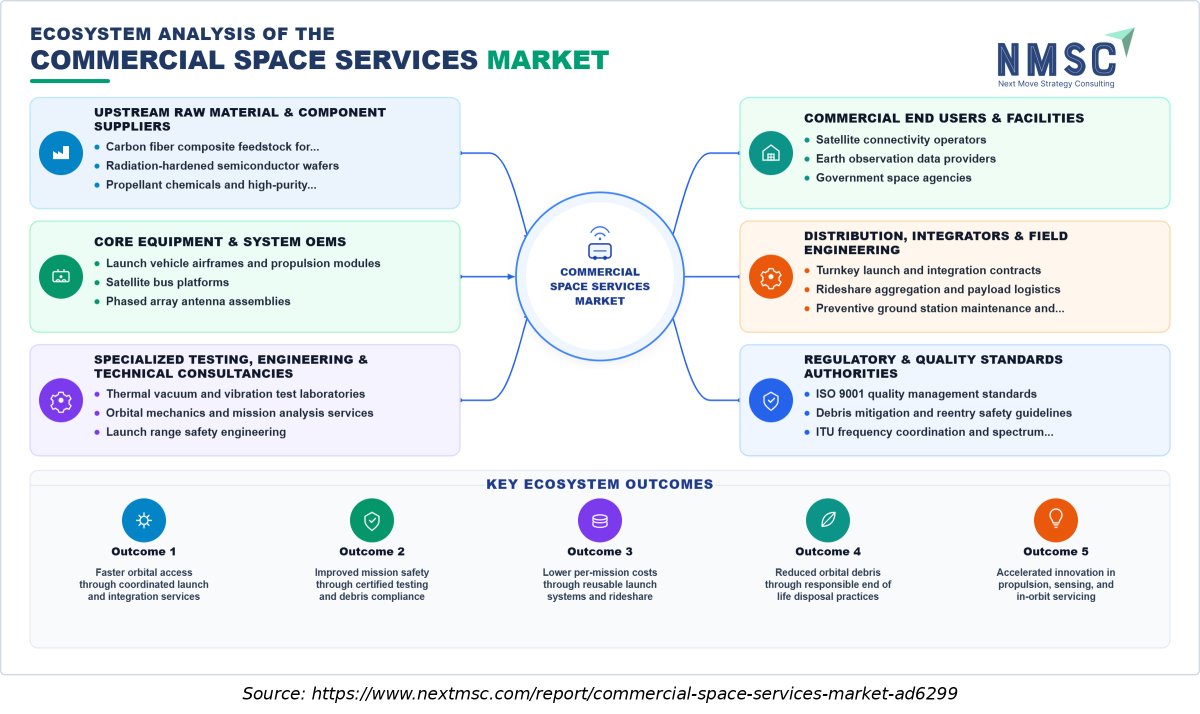
Ecosystem Analysis of the Commercial Space Services Industry

The ecosystem analysis illustrates how launch providers, spacecraft manufacturers, component suppliers, and data operators interact across the commercial space services value chain. It highlights regulators and quality authorities that shape licensing and safety compliance. The structure reveals how partnerships between these stakeholders determine mission reliability and the speed at which new constellation capacity reaches orbit.

What Does the Commercial Space Services Market Encompass?

The commercial space services market encompasses launch services, satellite communications and broadband, Earth observation and remote sensing, in-orbit servicing and logistics, and space data and analytics. Launch services include dedicated and rideshare missions using expendable and reusable rocket systems. Satellite communications cover broadband connectivity, mobile backhaul, and maritime and aviation links delivered through geostationary and low Earth orbit constellations. Core technologies include propulsion systems, phased array antennas, optical imaging sensors, and autonomous rendezvous guidance.
Design specifications in commercial space services focus on mass efficiency, radiation tolerance, and thermal stability across extreme orbital environments. Material innovations such as carbon fiber composite structures, additively manufactured propulsion components, and high-efficiency gallium arsenide solar cells reduce spacecraft mass while sustaining power output. Certifications from recognized standards bodies, along with compliance to launch safety requirements and spectrum licensing frameworks, define the qualification pathway that providers must satisfy before delivering services to commercial and governmental customers.

Market Drivers & Dynamics

Interactive Dataset
Declining Launch Costs Through Reusability driver High Immediate
Rising Demand for Satellite Connectivity driver High Immediate
Government Procurement of Space as a Service driver Medium Medium-term
Orbital Congestion and Debris Management Requirements restraint High Immediate
Specialized Component Supply Concentration restraint Medium Medium-term
Spectrum Allocation Complexity restraint Low Long-term
Source: Next Move Strategy Consulting

Growth Drivers

What Is the Primary Growth Driver in the Commercial Space Services Industry?

The primary catalyst driving commercial space services is the sustained decline in launch costs achieved through booster reusability and rideshare aggregation. Lower access costs allow satellite operators to justify constellation deployments that were previously uneconomical. Consequently, demand for launch, spacecraft integration, and ground services is rising across Earth observation, connectivity, and scientific missions. This cost structure shift changes the economics for both new entrants and established operators seeking to expand their orbital footprint.

How Are Industry Standards and Directives Driving the Market?

Regulatory frameworks shape commercial space services by setting licensing, safety, and spectrum requirements that providers must satisfy before launch. Mission authorization regimes in major jurisdictions require operators to demonstrate debris mitigation plans, reentry risk assessments, and frequency coordination agreements. Compliance with these directives creates a qualification pathway that favors experienced providers with documented heritage. As standards evolve, operators that invest early in certification gain a competitive advantage in securing government and enterprise contracts.

Growth Inhibitors

What Is Restraining the Commercial Space Services Industry?

The principal restraint on commercial space services is the concentration of qualified supply for radiation-hardened electronics, specialized propulsion components, and high-efficiency solar cells. Only a small number of manufacturers can deliver parts meeting rigorous space qualification standards within acceptable lead times. Consequently, production schedules for satellites and launch vehicles can slip when component deliveries are delayed. Providers seeking to scale mission volume must therefore invest in dual sourcing and long-term supplier agreements to protect delivery timelines.

What Are the Growth Opportunities?

Can Medium Earth Orbit Networks Capture High-Density Deployments?

Medium Earth orbit networks present a compelling avenue for commercial space services because they combine wider coverage footprints with lower latency than geostationary systems. Operators developing these constellations require reliable launch cadence, precision spacecraft manufacturing, and integrated ground infrastructure. Partnerships such as those formed between satellite operators and next-generation network developers illustrate how collaboration can accelerate deployment. Providers able to deliver repeatable satellite production will be well placed to supply these high-density programs.

How Is Mid-Tier and Regional Facility Adoption Unlocking New Market Volume?

Mid-tier satellite manufacturers and regional launch facilities are unlocking new volume in commercial space services by offering responsive, lower-cost access to orbit. Smaller spaceports and integration hubs reduce transit distances for payload delivery, which shortens schedules for research institutions and emerging operators. Regional facilities also support local workforce development and supplier ecosystems. Such distributed capacity broadens the customer base beyond large prime contractors and creates recurring demand for specialized services.

Can Specialized Vertical Implementations Become Distinct Premium Markets?

Specialized vertical implementations, including in-orbit servicing, refueling, and dedicated manufacturing platforms, may evolve into distinct premium segments within commercial space services. Operators requiring extended asset lifespans or on-orbit repair capabilities are willing to pay for services that protect high-value satellites. Developments in autonomous rendezvous and materials processing demonstrate the technical feasibility of these offerings. Providers that achieve certified performance in these niches can command higher margins than conventional launch-only contracts.

Segmentation Analysis

2025 (USD Billion)
2035 (USD Billion)
Launch Services 2025: $97.95 Billion | 2035: $106.17 Billion
Launch Servi
Satellite Communications & Broadband 2025: $72.21 Billion | 2035: $78.28 Billion
Satellite Co
Earth Observation & Remote Sensing 2025: $49.01 Billion | 2035: $53.13 Billion
Earth Observ
In-Orbit Servicing & Logistics 2025: $35.38 Billion | 2035: $38.35 Billion
In-Orbit Ser
Space Data & Analytics 2025: $26.02 Billion | 2035: $28.21 Billion
Space Data &
Launch Services $97.95 Billion $106.17 Billion USD 188.7 Billion
Satellite Communications & Broadband $72.21 Billion $78.28 Billion USD 162.67 Billion
Earth Observation & Remote Sensing $49.01 Billion $53.13 Billion USD 117.47 Billion
In-Orbit Servicing & Logistics $35.38 Billion $38.35 Billion USD 84.8 Billion
Space Data & Analytics $26.02 Billion $28.21 Billion USD 74.91 Billion

Which Service Type Segment Dominates the Market?

Launch services command the primary revenue base, holding roughly 35% share and generating USD 97.95 Billion in 2025, because access to orbit remains the foundational requirement for every other commercial space service. Operators rely on reliable, scheduled rideshare and dedicated launch capacity to deploy constellations and payloads. Space Data & Analytics, meanwhile, outpaces all peers at an 11.46% CAGR through 2035 as satellite operators and enterprises convert raw orbital imagery and telemetry into decision-ready intelligence.

2025 (USD Billion)
2035 (USD Billion)
Category A
Category B
Category C
Category D
Segment Item 2025 (USD Billion) 2035 (USD Billion) CAGR
Category A $10.0 USD Billion $40.0 USD Billion 9.0%
Category B $17.1 USD Billion $51.1 USD Billion 23.0%
Category C $24.2 USD Billion $62.2 USD Billion 9.0%
Category D $31.3 USD Billion $73.3 USD Billion 19.0%

Segment-wise data is locked

Unlock complete segment-wise numbers for By Customer Segment.

Unlock Full Data
2025 (USD Billion)
2035 (USD Billion)
Category A
Category B
Category C
Category D
Segment Item 2025 (USD Billion) 2035 (USD Billion) CAGR
Category A $10.0 USD Billion $40.0 USD Billion 19.0%
Category B $17.1 USD Billion $51.1 USD Billion 13.0%
Category C $24.2 USD Billion $62.2 USD Billion 27.0%
Category D $31.3 USD Billion $73.3 USD Billion 9.0%

Segment-wise data is locked

Unlock complete segment-wise numbers for By Contract & Delivery Model.

Unlock Full Data

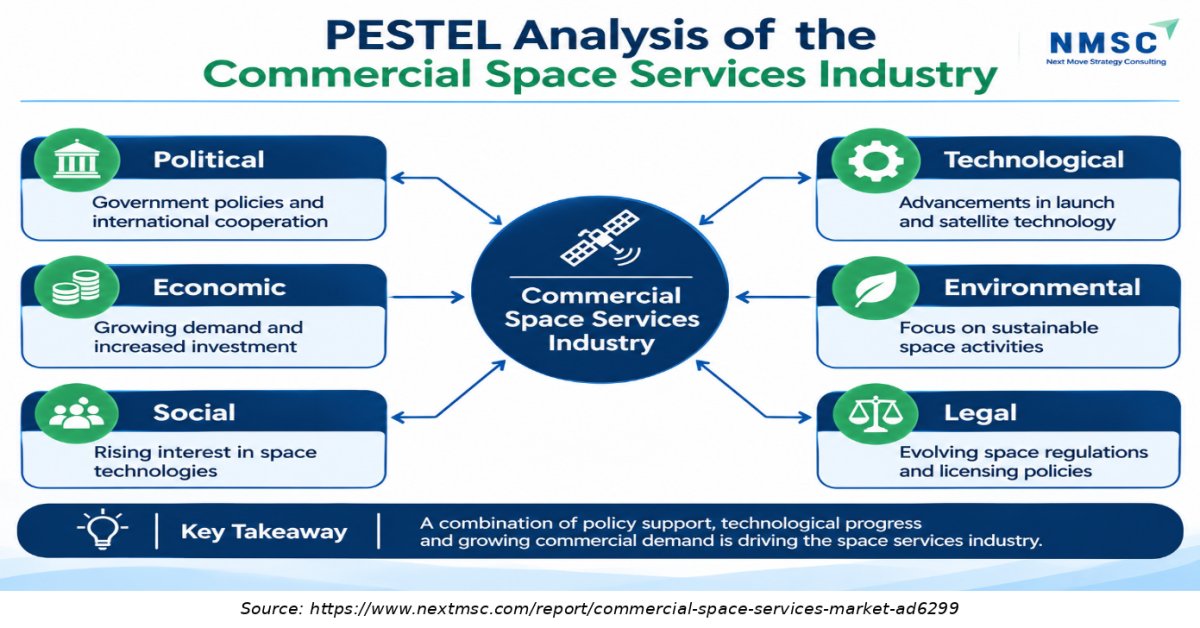
PESTEL Analysis of the Commercial Space Services Industry

PESTEL Analysis of the Commercial Space Services Industry
The PESTEL analysis examines political, economic, social, technological, environmental, and legal forces shaping commercial space services. It shows how government procurement policy, launch cost trends, and orbital debris rules interact with technological advances in reusability. The framework helps strategists weigh regulatory exposure against demand growth across major operating regions.

Growth Opportunities

Our analysis shows that three structural whitespace opportunities are positioned to generate disproportionate commercial returns in the market through 2035:

Can Medium Earth Orbit Networks Capture High-Density Deployments?

Medium Earth orbit networks present a compelling avenue for commercial space services because they combine wider coverage footprints with lower latency than geostationary systems. Operators developing these constellations require reliable launch cadence, precision spacecraft manufacturing, and integrated ground infrastructure. Partnerships such as those formed between satellite operators and next-generation network developers illustrate how collaboration can accelerate deployment. Providers able to deliver repeatable satellite production will be well placed to supply these high-density programs.

How Is Mid-Tier and Regional Facility Adoption Unlocking New Market Volume?

Mid-tier satellite manufacturers and regional launch facilities are unlocking new volume in commercial space services by offering responsive, lower-cost access to orbit. Smaller spaceports and integration hubs reduce transit distances for payload delivery, which shortens schedules for research institutions and emerging operators. Regional facilities also support local workforce development and supplier ecosystems. Such distributed capacity broadens the customer base beyond large prime contractors and creates recurring demand for specialized services.

Can Specialized Vertical Implementations Become Distinct Premium Markets?

Specialized vertical implementations, including in-orbit servicing, refueling, and dedicated manufacturing platforms, may evolve into distinct premium segments within commercial space services. Operators requiring extended asset lifespans or on-orbit repair capabilities are willing to pay for services that protect high-value satellites. Developments in autonomous rendezvous and materials processing demonstrate the technical feasibility of these offerings. Providers that achieve certified performance in these niches can command higher margins than conventional launch-only contracts.

Regional Outlook

2025 (USD Billion)
2035 (USD Billion)
North Americ
Europe
Asia-Pacific
Latin Americ
Middle East
Region 2025 (USD Billion) 2035 (USD Billion) CAGR (%)
North America $10.0 USD Billion $40.0 USD Billion 9.0%
Europe $17.1 USD Billion $51.1 USD Billion 27.0%
Asia-Pacific $24.2 USD Billion $62.2 USD Billion 25.0%
Latin America $31.3 USD Billion $73.3 USD Billion 23.0%
Middle East & Africa $38.4 USD Billion $84.4 USD Billion 12.0%

Regional data is locked

Unlock complete regional numbers for this market.

Unlock Full Data

Competitive Landscape

Competitive structure in commercial space services is concentrated among vertically integrated launch and satellite operators that control access to orbit and the downstream data products built on it. Space Exploration Technologies Corp., Rocket Lab Corporation, and Blue Origin, LLC anchor launch capacity, while Viasat, Inc., SES S.A., Eutelsat S.A., and Iridium Communications Inc. dominate connectivity. Vantor and Planet Labs PBC lead Earth observation, forming a layered ecosystem where scale in launch and orbital infrastructure strongly influences competitive position.

Product Quality & Durability

In commercial space services, durability is defined by mission reliability, radiation-hardened hardware, and consistent orbital performance over extended operational lifespans.

Distribution & Market Reach

Reach in commercial space services depends on access to government customers, telecom partners, and data platform integrations that deliver services into enterprise and institutional workflows.

Design & Customization Moat

Mission-specific payload integration, custom orbital configurations, and tailored analytics create switching costs that protect incumbent commercial space services providers.

Material Innovation & Sustainability

Advances in lightweight structural materials, in-space manufacturing of semiconductor materials, and debris mitigation practices increasingly define competitiveness in commercial space services.

Competitive Dynamics and M&A Landscape

Recent strategic moves, partnerships, and acquisitions shaping the Commercial Space Services Market Global Industry Analysis and Forecast (2026–2035).

July 2025 Neo Space Group acquisition Neo Space Group completed its acquisition of UP42 from Airbus Defence and Space in July 2025, bringing an Earth observation platform into its organization.
September 2025 SES and K2 Space partnership Strategic collaborations are also accelerating, exemplified by SES and K2 Space announcing a September 2025 partnership to co-develop next-generation MEO network infrastructure and technologies.
November 2026 Rocket Lab Corporation (Nasdaq: RKLB) launch November 2026 | Rocket Lab Corporation (Nasdaq: RKLB), a global leader in launch services and space systems, successfully launched its Electron rocket to deploy the next QPS-SAR satellite.
September 2026 Rocket Lab Corporation (Nasdaq: RKLB) launch September 2026 | Rocket Lab Corporation (Nasdaq: RKLB), a global leader in launch services and space systems, successfully launched the latest Earth-observation satellite to space.
March 2026 Spire Global launch March 2026 | Spire Global successfully launched ten satellites on SpaceX's Transporter-16 mission, serving Earth observation and IoT connectivity missions.
November 2025 Spire global launch November 2025 | Spire global successfully launches 11 Satellites on SpaceX’s Transporter-15 Mission.

Key Market Players

Based on research conducted by NMSC, the following 20 companies represent the validated leadership set across Commercial Space Services Market developers, manufacturers, and solution providers:

Space Exploration Technologies Corp. Blue Origin, LLC Rocket Lab Corporation Eutelsat S.A. Eutelsat OneWeb (Eutelsat Group) Iridium Communications Inc. Viasat, Inc. SES S.A. Vantor (formerly Maxar Intelligence) Planet Labs PBC BlackSky Technology Inc. Airbus SE Lockheed Martin Corporation Northrop Grumman Corporation Thales Alenia Space SAS The Boeing Company Arianespace S.A. Intelsat S.A. Spire Global, Inc. Astroscale Holdings Inc.

Latest Developments

During our market evaluation, we noticed that recent commercial activities, platform introductions, and partnerships within the industry reflect the latest market developments:

Date Event
November 2026 Rocket Lab Corporation (Nasdaq: RKLB), a global leader in launch services and space systems, successfully launched its Electron rocket to deploy the next QPS-SAR satellite.
September 2026 Rocket Lab Corporation (Nasdaq: RKLB), a global leader in launch services and space systems, successfully launched the latest Earth-observation satellite to space.
March 2026 Spire Global successfully launched ten satellites on SpaceX's Transporter-16 mission, serving Earth observation and IoT connectivity missions.
November 2025 Spire global successfully launches 11 Satellites on SpaceX’s Transporter-15 Mission.

Investment Opportunities

Where Are Capital Inflows Concentrating in the Commercial Space Services Market?

Capital is concentrating in launch capacity, constellation deployment, and data analytics, reflecting where commercial space services generate the most measurable returns. Rideshare missions such as Transporter-16, which carried multiple commercial and government payloads in March 2026, illustrate how operators are scaling deployment cadence. Investment is also flowing into analytics platforms that convert orbital data into recurring revenue for enterprise and government buyers.

How Is Infrastructure Investment Shaping Market Capacity?

Infrastructure investment is expanding the operational capacity of commercial space services through dedicated launch facilities, satellite manufacturing lines, and ground station networks. Operators are increasingly building automated assembly capabilities to shorten production cycles and meet rising demand for constellation replenishment. Facilities supporting in-orbit servicing and logistics are emerging as strategic assets that extend satellite lifespans and improve fleet utilization.

What ESG Considerations Are Influencing Market Investment?

Environmental and safety considerations increasingly influence investment decisions across commercial space services, particularly around orbital debris management and responsible satellite disposal. Operators that demonstrate deorbit planning and collision avoidance capabilities gain credibility with government and institutional customers. Sustainable materials research and energy-efficient spacecraft design are also becoming criteria that shape long-term capital allocation.

Key Benefits for Stakeholders

How Does This Report Benefit Industry Leaders and Enterprise Operators?

Operational executives, procurement directors, and commercial operators gain empirical benchmarks for planning launch manifests, constellation investments, and service portfolios within commercial space services. The segmentation by service type, customer, and contract model clarifies where demand concentrates and how buying behavior varies. These insights support more disciplined capacity planning and contract structuring decisions across the operating environment.

How Does This Report Benefit Investors and Financial Analysts?

Investors can assess the commercial space services market through a verified trajectory from USD 280.57 Billion in 2025 to USD 628.55 Billion by 2035. The 8.4% CAGR for 2026–2035 provides a consistent basis for valuation modeling and scenario analysis. Segment-level data on dominant and fastest-growing categories helps analysts identify where revenue durability and expansion potential align.

How Does This Report Benefit Technology Vendors and Solution Platform Teams?

Technology vendors can use the segment analysis to prioritize product roadmaps toward high-growth areas such as space data and analytics and anchor capacity offerings. Understanding how government and scientific customers differ in requirements helps teams design differentiated platforms. The competitive assessment further clarifies where interoperability, data quality, and orbital integration create defensible positions.

Key Market Segments Evaluated

By Service Type

  • Launch Services
  • Heavy-Lift Reusable Launch
  • Reusable First-Stage Booster Missions
  • Crewed & Cargo Orbital Transport
  • Small Satellite Dedicated Launch
  • Rideshare Launch Manifests
  • Dedicated Small-Launch Vehicles
  • Satellite Communications & Broadband
  • LEO Broadband Constellations
  • Consumer Broadband Terminals
  • Enterprise & Maritime Connectivity
  • GEO Mission-Critical Satcom
  • Government & Defense Transponder Leases
  • Aviation & Maritime Satcom Service
  • Earth Observation & Remote Sensing
  • Optical Imaging Constellations
  • Sub-Meter Tasking Imagery
  • Persistent Area Monitoring Feeds
  • SAR & Radar Imaging
  • All-Weather Surveillance Data
  • Interferometric Change Detection
  • In-Orbit Servicing & Logistics
  • Refueling & Life Extension
  • Robotic Docking Refueling
  • Mission Life Extension Kits
  • Debris Removal & Relocation
  • Capture & De-orbit Services
  • Orbital Relocation Tugs
  • Space Data & Analytics
  • Geospatial Intelligence Analytics
  • Defense Imagery Analytics
  • Commercial Supply-Chain Insights
  • Space Domain Awareness Services
  • Conjunction Tracking Feeds
  • Space Traffic Management Platforms

By Customer Segment

  • Government & Defense Agencies
  • Intelligence & Surveillance Users
  • Tasking Contract Buyers
  • Persistent Monitoring Subscribers
  • Civil Space Agency Programs
  • Crew & Cargo Services Contracts
  • Technology Maturation Awards
  • Commercial Enterprises
  • Agriculture & Energy Analytics
  • Crop & Asset Monitoring Feeds
  • Pipeline & Infrastructure Surveillance
  • Insurance & Financial Risk Users
  • Catastrophe Damage Assessment
  • Supply-Chain Risk Indicators
  • Telecom & Connectivity Operators
  • Mobile Backhaul Providers
  • Cellular Gap-Coverage Links
  • Direct-to-Device Roaming Services
  • Broadband Network Operators
  • Wholesale Capacity Leases
  • Rural Network Extension Links
  • Scientific & Research Institutions
  • Academic Mission Payloads
  • University CubeSat Flights
  • Instrument Hosting Services
  • Climate & Earth Science Programs
  • Atmospheric Monitoring Data
  • Ocean & Ice Observation Data
  • Consumer & Maritime Users
  • Maritime Vessel Connectivity
  • Commercial Shipping Satcom
  • Offshore Platform Connectivity
  • Residential Broadband Subscribers
  • Home Satellite Internet Plans
  • Remote Community Connectivity

By Contract & Delivery Model

  • Pay-Per-Use & Launch-on-Demand
  • Per-Mission Launch Contracts
  • Dedicated Mission Bookings
  • Rideshare Slot Purchases
  • Per-Image Data Purchases
  • Single-Scene Archive Orders
  • Tasked Acquisition Orders
  • Subscription & Managed Service
  • Recurring Connectivity Plans
  • Monthly Broadband Tiers
  • Fleet Connectivity Packages
  • Data Analytics Subscriptions
  • API-Based Data Feeds
  • Enterprise Analytics Licenses
  • Anchor Tenant & Long-Term Capacity Contracts
  • Multi-Year Capacity Reservations
  • Transponder Capacity Leases
  • Constellation Access Commitments
  • Government Anchor Tenancy Agreements
  • Other Transaction Authority Awards
  • Indefinite-Delivery Service Contracts

By Region

  • North America 
    • U.S.
    • Canada
    • Mexico.
  • Europe 
    • UK
    • Germany
    • France
    • Italy
    • Rest of Europe.
  • Asia-Pacific 
    • China
    • India
    • Japan
    • South Korea
    • Australia
    • Rest of APAC.
  • Latin America 
    • Brazil
    • Argentina
    • Colombia
    • Rest of Latin America.
  • Middle East & Africa 
    • UAE
    • Saudi Arabia
    • South Africa
    • Rest of MEA.

Conclusion & Recommendations

What Is the Long-Term Outlook for the Commercial Space Services Market?

The long-term outlook for the commercial space services Market is strongly positive, with revenue expanding from USD 304.14 Billion in 2026 to USD 628.55 Billion by 2035 at an 8.4% CAGR. Growth is underpinned by durable commercial demand expansion, the structural shift toward high-performance specialized solutions, and continuous technological innovation across core operational workflows. Participants that align capacity with these structural currents are best positioned to capture sustained value.

What Strategic Positioning Recommendations Does NMSC Offer?

Market participants should secure anchor tenant and long-term capacity agreements to stabilize revenue while the segment grows at an 11.63% CAGR. Operators should also invest in space data and analytics capabilities to capture the fastest-expanding service category. Partnerships with government agencies and scientific institutions can unlock early access to mission-driven demand, reinforcing competitive position across commercial space services.

How Attractive Is the Commercial Space Services Market for Investment?
Investment attractiveness is high, supported by the USD 324.41 Billion absolute growth opportunity between 2026 and 2035 identified in this analysis. Diversified demand across government, commercial, and scientific customers reduces dependence on any single buyer group. Margin profiles strengthen where providers combine launch access with recurring data and managed service revenue streams.

What Are the Key Market Shifts and Risks in the Commercial Space Services Market?

The market is shifting from standalone launch transactions toward integrated services that combine orbital access, connectivity, and analytics. Key risks include orbital congestion and debris compliance costs, dependence on specialized components, and spectrum allocation complexity. Providers must manage supply chain concentration and maintain reliable production throughput to protect margins and customer commitments.

What Are the Primary Growth Pathways Through 2035?

The most promising growth pathways lie in space data and analytics, anchor tenant capacity contracts, and scientific access programs that broaden the customer base. Expansion in Asia-Pacific, which is advancing at an 11.57% CAGR through 2035, offers additional geographic upside. Capturing these pathways allows participants to claim a disproportionate share of the USD 324.41 Billion absolute growth opportunity in commercial space services.

FAQs

About the Author

Mayurima Roy

Mayurima Roy

Mayurima Roy is Research Analyst at Next Move Strategy Consulting, where she has spent 4 years working across the firm's full industry coverage rather than a single fixed vertical. Her work centers on structured research, ongoing trend tracking, competitive assessment, and insight-led content development, translating complex market data into clear, decision-ready narratives that support informed client decision-making across diverse global industries, market sectors, and world regions every day.

About the Reviewer

Supradip Baul

Supradip Baul

Supradip Baul is an accomplished business consultant and strategist with over a decade of rich experience in market intelligence, strategy, technology, and business transformation. His work has included rigorous qualitative and quantitative analysis across multiple industries, helping clients shape investment decisions and long-term roadmaps. Earlier in his career, he was associated with Gartner, where he contributed to industry-leading reports and market share analyses. He has worked with leading global companies and holds an MBA with a dual specialization in Marketing and Finance.

Download Free Sample

Ross J Mckenzie

ROSS J MCKENZIE

Business Insight Manager

Staysure Group

“Next MSC have been incredibly helpful in providing detailed & robust information on our market, alongside quantifying growth by different segments. The process to procure was simple and easy, with sample reports and regular contact to ensure we had what we needed. Succinct detail on their sources & methodologies is also greatly received, allowing transparency in this respect helps build trust in the detail you pay for. Joseph in particular was fantastic, and helped ensure efficient provision of the insight pack – thank you NMSC!”.

Gaurav Jaiswal

GAURAV JAISWAL

Founder & CEO

Yano Charge Private Limited

The EV Charging market research report provided by the NextMSC was exceptionally detailed and insightful. It offered a comprehensive analysis that proved to be a game-changer for our strategic planning. Truly a testament to the NextMSC’s expertise and thoroughness in EV market landscape & analysis.

Kishu Kanda

KISHU KANDA

Strategy Analyst

Accenture

We purchased the AI Consumer Market Report from this company. Not only did they customize the report to meet our specific requirements, but they also showed great flexibility in accommodating our budget. The report we received fully met our expectations. Additionally, they provided prompt and thorough responses to both our pre-purchase and follow-up questions. We look forward to working with this company again in the future.

Melanie Samko

MELANIE SAMKO

Director of Marketing

TOSOH BIOSCIENCE, INC.

The information provided by NMSC is incredibly valuable, thank you so much for such a excellent work. I really appreciate it. I will make sure to reference all of it, in my summary document.

Kevin Coker

KEVIN COKER

Founder, CEO and Board Diector

Proxima Clinical Research

I have been using Next MSC reports for product positioning in a new geography for a long time. They have by far the best reports I have found and the price is reasonable too!

Custom Market Research Services

We will customize the research for you if the listed report does not fully match your requirements.

Get 30% Free Customization

Select License

This website uses cookies to ensure you get the best experience on our website. Learn more

✖