4 Manufacturing Scheduling Software That Handles Machine Capacity and Maintenance At a glance
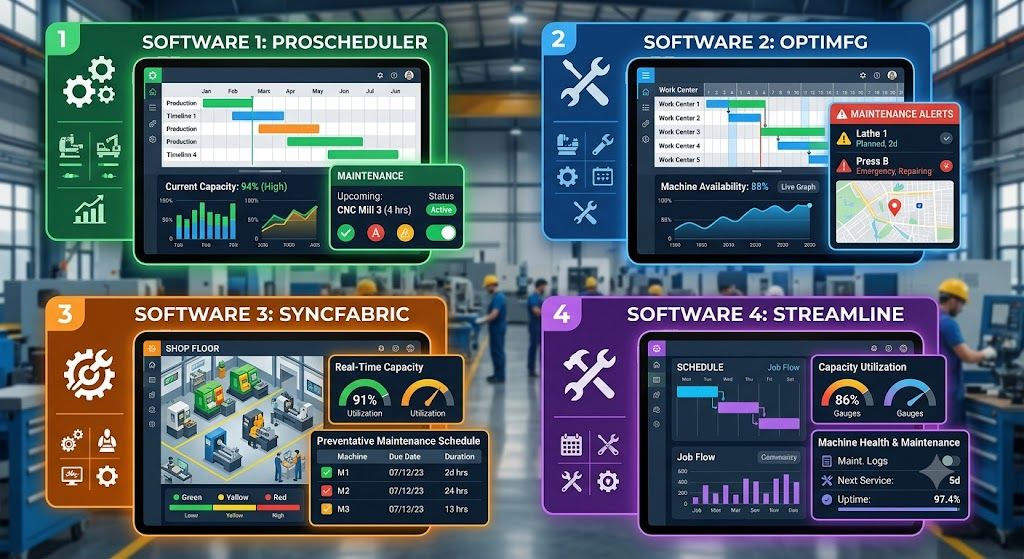
Want the summary first? Here you go: four schedulers, four different sweet spots. Three are built around capacity and downtime, and one is built around coordination.
|
Product |
Best for |
Capacity method |
Maintenance treatment |
Deployment |
Public starting price |
|
Organizely |
AI-agent coordination across materials, equipment, and labor |
Agents check materials and capacity before they draft a plan |
Does not schedule maintenance; pair it with your CMMS or an APS |
Enterprise manufacturers, set up after a demo |
Demo on request |
|
SkyPlanner APS |
Cloud-native, fast-moving mid-market plants |
Finite-capacity engine with materials, shifts, setups, tools |
Blocks planned maintenance; rapid re-solve after breakdown |
SaaS |
€199 a month for 5 workstations (public pricing page) |
|
PlanetTogether APS |
High-mix or multi-site manufacturers |
Constraint-based APS covering machines, labor, tooling, materials |
Models maintenance windows and lets planners take a machine offline and re-calculate |
Cloud-hosted or Windows |
Quote only |
|
Siemens Opcenter APS |
Enterprise, multi-constraint operations |
Detailed finite capacity with run-rate and changeover logic |
Planned and unplanned downtime; integrates with the broader Opcenter suite |
Vendor-scoped |
Quote only |
1. Organizely: best emerging AI-agent coordination
Most schedulers start with machines and squeeze people around them. Organizely starts with the whole operation: its Organizely production planning agents keep people, machines, and stock in sync. When an order arrives, the agents check materials and capacity, flag shortages, and then draft the purchase orders and production plan for your team to approve. That approval step keeps operators in control and gives auditors a clear record.
We kept Organizely on the list for the coordination layer around the schedule. A plan fails when materials, machines, and labor do not line up, and Organizely joins those three in one plan. For plants with many change orders and shared workstations, this cross-functional view cuts the daily back-and-forth between purchasing, planning, and the floor.
How it handles capacity
Organizely looks at capacity together with materials. When a new order arrives, the agents check whether the stock and the capacity are ready. If a material runs short, they draft the purchase order and schedule the production run after the expected delivery, so the plan does not promise work the plant cannot start. The team approves each plan by message before anything is sent.
Where maintenance fits
Organizely does not schedule maintenance. Its agents follow changes in demand, inventory, equipment, and work, but the maintenance calendar itself stays in your CMMS or in a dedicated scheduler such as the three APS tools below. Plants that need both use Organizely for coordination and an APS for maintenance windows.
AI and the human-in-the-loop
The agents reorder before you run short, forecast demand from your real sales and stock history, and propose purchase orders from what is selling. Each step waits for a person: the team says yes, and only then does the agent send the order or schedule the work.
Getting started
Organizely works with enterprise manufacturers, and each setup starts with a demo booked from its website. Bring one live order flow to that call, for example a product with frequent material shortages, so the team can show how the agents would plan it.
2. SkyPlanner APS: best for cloud-native AI scheduling
Why we picked it
Plants where orders change by the hour need a planner that recalculates at the same pace. SkyPlanner’s cloud engine does exactly that, and it posts its terms in plain sight: €199 a month for five workstations and a 30-day free trial. Price transparency and a self-service start are uncommon in finite-capacity scheduling.
How it handles capacity
Every workstation carries its own calendar, setup rules, and tooling limits. When an order arrives, the Arcturus engine checks machine time, shifts, and material availability. If any link is missing, it hunts for an approved alternate (no double-booked resources, no phantom inventory). Dashboards plot load versus capacity down to the hour so planners can spot overloads instantly.
How it handles maintenance
Planned maintenance is assigned to a workstation once and blocks that time on the Gantt. Arcturus pushes clashing jobs to open slots or alternate machines and flags delivery risk. For breakdowns, set the asset to offline and the solver reroutes in seconds while respecting locks and material limits. SkyPlanner does not list a CMMS connector, but its REST API and webhooks can bridge that gap.
AI, ease of use, and pricing
Drag a job, lock a run, or switch on Autopilot and let Arcturus re-solve when anything changes. Entry pricing is €199 a month for five workstations, with €20 for each additional resource; the clear tariff lowers the risk of trying before budget approval. Vendor case material credits the system with lifting Piristeel’s delivery reliability to 99.2 percent, but treat that as a single reference point, not a guarantee.
3. PlanetTogether APS: best for complex and multi-site operations
Why we picked it
When one plant in Connecticut must back up its sister line in Ohio, planners need a solver that understands machines, skills, tooling, materials and cross-plant transfers. PlanetTogether’s constraint-based engine models all of that in one view. It also treats downtime as a first-class constraint: block a spindle grind, click recalculate, and every dependent job lands in a legal slot.
According to a PlanetTogether case study, a leading medical device company cut inventory costs by 15 percent and overtime by 20 percent while keeping production flowing. CAI acquired PlanetTogether in June 2026, and in August it also bought CMMS vendor LLumin. That sequence hints at tighter scheduling-maintenance links ahead, according to the company’s news release.
How it handles capacity
Import machine calendars, labor skills, tool constraints, and material availability, then press solve. The engine builds a finite schedule that respects every primary and secondary resource, including sequence-dependent setups. If an order shifts from Milwaukee to Monterrey, PlanetTogether checks spare capacity, transit lead times, and inventory buffers before approving the move.
How it handles maintenance
Downtime is scheduled like any other resource. Preventive windows block capacity; unexpected breakdowns can be entered and the plan re-solved. If cross-site moves are allowed, the solver can route work to sister plants until the asset returns to service.
PlanetTogether connects to ERP and MES systems, and its what-if scenarios let planners test the impact of downtime before they publish a schedule.
Ease of use, implementation, and pricing
PlanetTogether runs as a Windows application with cloud-hosted options. Drag-and-drop Gantt views, what-if scenarios, and bottleneck management help new schedulers get up to speed. Implementation pace depends on data quality, and PlanetTogether offers a proof of concept before purchase so you can test it on your own data. Pricing is quote-only and varies by plant count, user count, and integration scope.
4. Siemens Opcenter APS: best for enterprise multi-constraint scheduling
Why we picked it
Regulated plants that juggle hundreds of SKUs, campaign sequencing, and board-level service penalties need rigorous scheduling. Siemens Opcenter APS models machines, materials, secondary resources, run-rate shifts, and customer-specific changeovers in one solver. Planned and unplanned downtime follow the same rules, so maintenance never fights production.
Opcenter connects with the wider Siemens manufacturing stack (MES, PLM, quality). Proof in the field: according to a Siemens case study, cookie maker Dauper cut scheduling time 300-fold after tying shop-floor data back into the engine. Another case study reports that aerospace supplier Applied Composites now ships on time 96 to 98 percent of the time while trimming schedule prep from hours to minutes.
How it handles capacity
Every machine stores run rates, preferred sequencing, cleaning rules, and changeover logic. Fixtures, gauges, and skilled technicians enter the same equation, so a schedule never releases if a required gauge is busy elsewhere. Inter-operation lags for cure, cool, or inspect are enforced automatically. When plants share resources, Capable-to-Promise checks real capacity across sites before sales quotes a date.
How it handles maintenance
Opcenter APS accounts for planned preventive maintenance and breakdowns, with production calendars down to each piece of equipment. Planned work blocks the calendar; emergency stops trigger a fresh solve that hunts for parallel assets or adjusts campaigns to protect priority orders. The system also reacts to real-time downtime and shift changes reported from the shop floor.
Ease of use, implementation, and pricing
Plan an Opcenter rollout in stages: a pilot model first, then line by line. Planners work in a desktop client, and others can view schedules in the browser-based Opcenter Anywhere Viewer. Pricing is quote-only and often bundled with broader Siemens licenses, so budget for APS seats, viewer seats, connectors, training, and data-cleanup hours up front.
How to choose the right scheduler
Most buying journeys collapse to six checkpoints. Walk through them and one, maybe two, tools usually stand out.
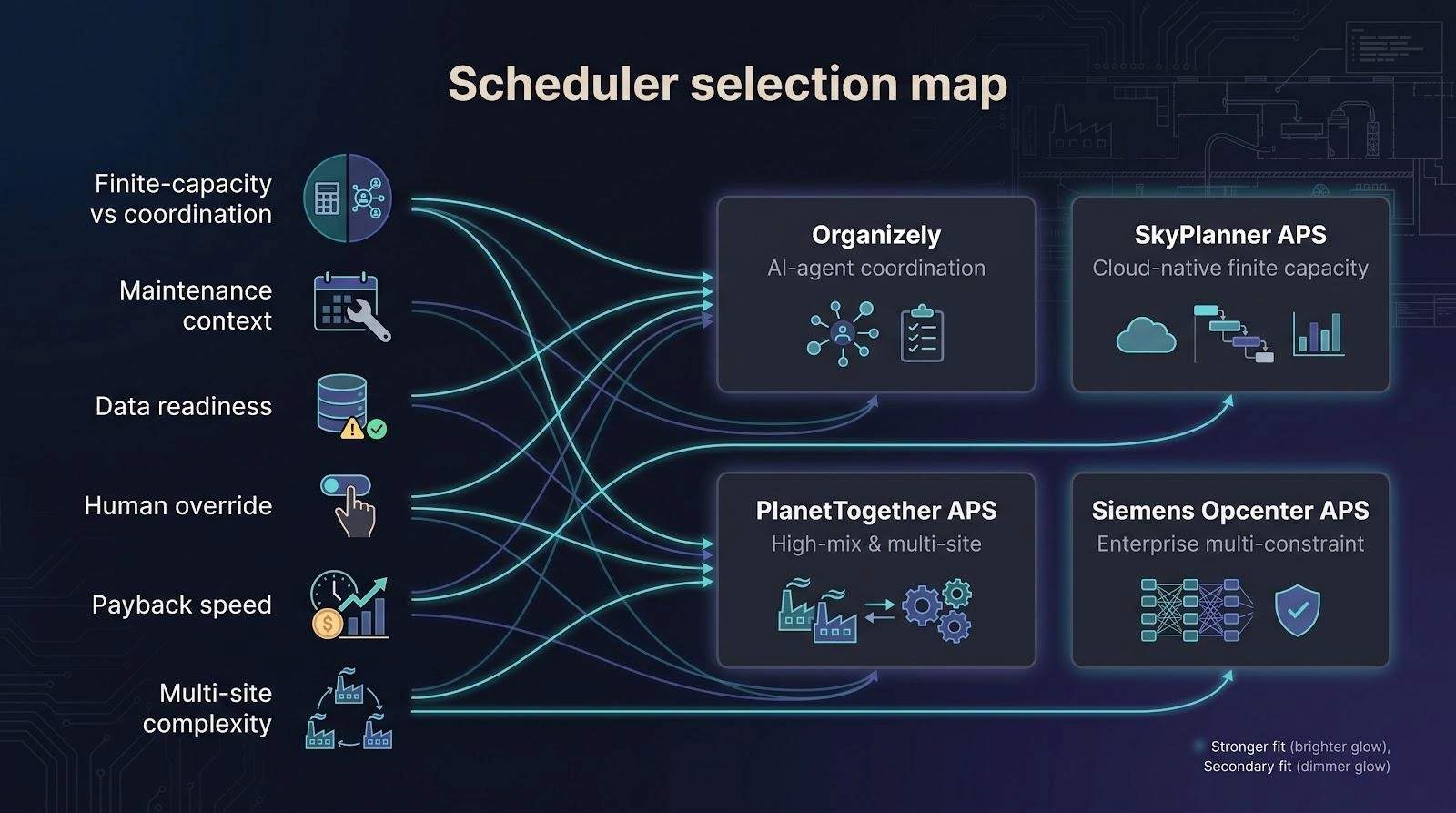
1. Do you need deep finite-capacity math or cross-functional coordination?
-
Double-booked machines and tricky changeovers → choose a pure APS engine (SkyPlanner, PlanetTogether, or Opcenter).
-
Constant tug-of-war among purchasing, labor, and production → Organizely’s agent model fits better.
2. How much maintenance context is enough?
Calendar blocks keep preventive work visible. Automatic reschedule after a breakdown protects delivery. A live CMMS or predictive feed closes the loop. Match the software tier to the data you can supply today.
3. Can your data survive finite scheduling?
Bad routings and stale run rates surface fast once the solver goes live. Audit them first. If you need extra guidance, book an Organizely demo or start SkyPlanner’s 30-day trial.
4. How much human override do you want?
SkyPlanner favors quick drag-and-drop edits, and Organizely asks the team to approve each drafted plan. Opcenter enforces governance, which suits regulated plants but feels heavy for a two-line job shop. PlanetTogether sits between the two.
5. How fast must payback arrive?
SkyPlanner’s published €199 price and free trial meet a quick-ROI mandate. PlanetTogether lands mid-pack with scoped pilots. Opcenter behaves more like a capital project with multi-year benefits.
6. Will multi-site complexity matter soon?
If sister plants already pinch-hit on capacity, shortlist PlanetTogether or Opcenter. They treat inter-plant moves as standard logic, not edge cases.
Work through these six and your shortlist should shrink to a single pilot candidate, two at most. Budget time for master-data cleanup and change-management workshops no matter which path you choose.
Conclusion
Production plans collapse the moment maintenance steals capacity.
-
Organizely joins materials, machines, and labor in AI-drafted plans that your team approves.
-
SkyPlanner APS delivers cloud speed, finite capacity, and a transparent €199 entry price.
-
PlanetTogether APS handles high-mix complexity and multi-plant transfers without losing sight of downtime.
-
Siemens Opcenter APS enforces enterprise-grade rules, quality gates, and maintenance events in one authoritative schedule.
The timing is right: analysts expect the MES market to rise from $16.27 billion in 2024 to $29.50 billion by 2030, yet unplanned downtime costs the world’s 500 largest companies about $1.4 trillion a year. Trust is another hurdle: only 37 percent of manufacturers are very or extremely confident in the data behind their AI initiatives.
The takeaway: pick a scheduler that mirrors your constraints, keeps maintenance and capacity in the same model, and leaves final say with the people on the floor. Pilot on one bottleneck line, clean the data that feeds it, and watch every downstream promise grow firmer.
About the Author
 Sanyukta Deb
— Sanyukta Deb is Digital Marketing Team Lead at Next Move Strategy Consulting, where she has led content strategy and technical SEO for the firm's B2B market research publications for over 2 years. Her editorial process translates NextMSC's primary and secondary research — spanning technology, industrial, and consumer sectors — into commercial narratives, backed by search-intent, keyword, and competitive analysis. She brings 5 years of overall experience in digital marketing and content strategy.
Sanyukta Deb
— Sanyukta Deb is Digital Marketing Team Lead at Next Move Strategy Consulting, where she has led content strategy and technical SEO for the firm's B2B market research publications for over 2 years. Her editorial process translates NextMSC's primary and secondary research — spanning technology, industrial, and consumer sectors — into commercial narratives, backed by search-intent, keyword, and competitive analysis. She brings 5 years of overall experience in digital marketing and content strategy.
About the Reviewer
 Debashree Dey
— Debashree Dey is Assistant Manager at Next Move Strategy Consulting, where she supports cross-vertical market content and communications across diverse industries for 6 years. Her professional background includes senior content writing, communications, and published manuscript authorship, with experience developing audience-focused business narratives and maintaining clear, consistent messaging. Her role supports research-led content development and editorial quality across NextMSC publications.
Debashree Dey
— Debashree Dey is Assistant Manager at Next Move Strategy Consulting, where she supports cross-vertical market content and communications across diverse industries for 6 years. Her professional background includes senior content writing, communications, and published manuscript authorship, with experience developing audience-focused business narratives and maintaining clear, consistent messaging. Her role supports research-led content development and editorial quality across NextMSC publications.


















Add Comment