5G mmWave Market: Why Verizon Is Rebuilding Around Gigabit FWA | NextMSC
Introduction
On October 26, 2026, Verizon Communications reported third-quarter results that paired a slowdown in fixed wireless sign-ups with a new job for its high-band airwaves. According to Light Reading's coverage of the earnings call, Chief Executive Officer Dan Schulman said Verizon would use its 1,700 MHz of millimeter-wave spectrum to deliver 1 Gbit/s fixed wireless access (FWA) to an incremental 10 million to 15 million premises. A spectrum asset that much of the industry had written off as a niche capacity layer is being reassigned to metropolitan broadband, and that reassignment frames the present direction of the 5G mmWave market.
According to Next Move Strategy Consulting's 5G mmWave Market report, the global market is projected to reach USD 7.59 billion by 2030, growing at a CAGR of 14.5% from 2024 to 2030. NextMSC primary research and analysis shows that this growth rests on hardware, solutions and services across the 23 GHz to 300 GHz range, with North America holding the largest regional share and Asia Pacific rising steadily.
For More Information: Download FREE Sample on 5G mmWave Market Report
This article examines the 2026 developments that are changing where mmWave capacity is bought and used, from Verizon's fixed wireless reset to spectrum awards in Japan and Canada, a manufacturing change at Ericsson and the Federal Communications Commission's pivot toward mid-band spectrum.
Verizon's October 2026 Gigabit FWA Reset and the Repositioning of High-Band Spectrum
Verizon's Q3 2026 Call: A Second Life for 1,700 MHz of mmWave
Verizon Communications reported on October 26, 2026 that it added 314,000 broadband customers in the third quarter, comprising 159,000 FWA net additions and 155,000 fiber net additions, which lifted total broadband connections to 17.4 million. FWA was the weaker half. Light Reading's Jeff Baumgartner reported on October 27, 2026 that the 159,000 additions compared with 261,000 a year earlier, a decline of 39.1%, and fell short of the 194,000 that analysts had expected.
Light Reading's Michelle Donegan reported on October 26, 2026 that Schulman described a 1 Gbit/s FWA service on millimeter-wave spectrum for metropolitan areas, aimed at 10 million to 15 million additional premises over the medium term and added to the 40 million to 50 million fiber passings Verizon already targets. RCR Wireless News reported on October 28, 2026 that Schulman called the mmWave position a differentiated and competitive advantage that also frees capacity in Verizon's C-band spectrum. Schulman said the plan marks “a more sophisticated, segmented approach to FWA,” and Verizon will not sell the service where it cannot deliver the speed a customer segment expects, according to Light Reading.
Verizon did not specify the technology. Light Reading reported that Chief Financial Officer Anthony Skiadas pointed to the multi-dwelling unit program, and that analysts linked the plan to Starry, the mmWave platform Verizon acquired. LightShed Partners analysts Walter Piecyk and Joe Galone said landlord approvals will slow multi-dwelling deployment relative to single-family homes. MoffettNathanson's Craig Moffett and Julie Zhu called the decline the largest on record and the twelfth consecutive quarter of lower net additions.
Japan's 26 GHz Competition: NTT DOCOMO Pays JPY 6.288 Billion for a Nationwide Block
Japan's Ministry of Internal Affairs and Communications (MIC) announced on June 30, 2026 the results of its price-based competition for 26 GHz spectrum. Five parties applied, and bidding ran from June 11 to June 25, 2026. NTT DOCOMO won the single nationwide block (25.8 GHz to 26.2 GHz), while JTOWER and Hi-Tech Inter won regional blocks (26.8 GHz to 27.0 GHz).
According to Annex 2 of the MIC results, the nationwide block carried a ten-year reserve price of JPY 3.93 billion and drew three bidders: NTT DOCOMO, KDDI together with Okinawa Cellular Telephone, and SoftBank. NTT DOCOMO prevailed after four rounds at JPY 6.288 billion, which is 1.6 times the reserve price. JTOWER committed JPY 468.71 million across 13 municipal areas, including the 23 wards of Tokyo, and Hi-Tech Inter committed JPY 8.184 million across smaller municipalities.
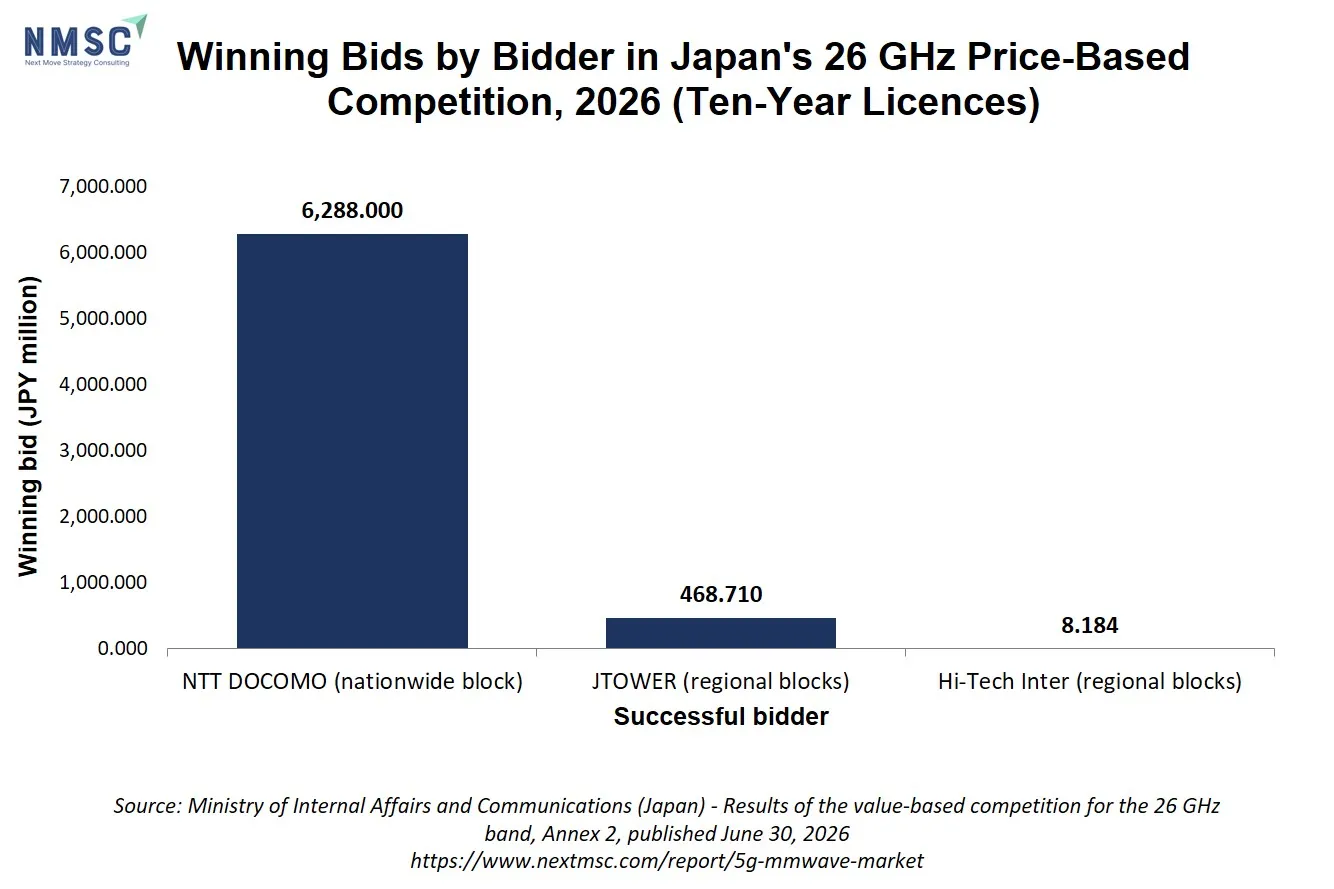
The Ministry of Internal Affairs and Communications published ten-year winning bids totalling JPY 6,288 million for NTT DOCOMO, JPY 468.71 million for JTOWER and JPY 8.184 million for Hi-Tech Inter. NTT DOCOMO's amount covers the single nationwide block (25.8 GHz to 26.2 GHz). The JTOWER and Hi-Tech Inter amounts are the sums of their regional awards in the 26.8 GHz to 27.0 GHz block.
A nationwide block priced at a 60% premium to reserve shows that a national operator will pay for contiguous high-band capacity when it is offered as a single lot. The regional blocks opened the band to an infrastructure-sharing company and a smaller entrant, which adds mmWave equipment buyers outside the national carriers.
Canada's mmWave Auction Rules: 4.8 GHz Across the 26 GHz and 38 GHz Bands
Innovation, Science and Economic Development Canada (ISED) announced on May 19, 2026 the rules for an upcoming millimetre wave auction offering 4.8 GHz in the 26 GHz and 38 GHz bands, with a further 850 MHz in the 26 GHz band to follow through non-competitive licensing. ISED named industrial automation, smart agriculture, private networks and rural fixed wireless among the target uses.
Supply Chain Signals: Ericsson's Texas Exit and Qualcomm's Fixed Access Platforms in the 5G mmWave Market
Light Reading reported on November 6, 2026 that Ericsson stopped manufacturing mmWave radios at its Lewisville, Texas factory and moved that production to Estonia. Ericsson said in a statement that this was a production-footprint decision and not a discontinuation of its mmWave portfolio. The plant opened in 2020 with a USD 150 million investment, and Verizon was the first carrier to receive a base station built there. Ericsson declined to disclose volumes, and Light Reading read the move as a sign of softer US carrier demand.
Vendors are retargeting rather than leaving. On October 12, 2026, Qualcomm Technologies unveiled Dragonwing Point-to-Multi-Point and Point-to-Point platforms for mmWave access and backhaul at Network X 2026 in Vienna, using licensed spectrum and a TDMA scheduler for low latency. Verizon Chief Technology Officer Yago Tenorio said at the Brooklyn AI-Native 6G Summit that mmWave has found a second life in FWA and will supply stadium-style hotspot capacity in 6G, as reported by Light Reading on November 6, 2026.
NMSC Strategic Perspective: Why Fixed Access Now Anchors the 5G mmWave Market
NextMSC primary research and analysis reads these developments as a change in which buyer sets the pace for the 5G mmWave market. The NMSC report segments the market by component (hardware, solution and services), bandwidth (23 GHz to 57 GHz, 57 GHz to 95 GHz and 95 GHz to 300 GHz), application and end user. Verizon's plan concentrates demand in the 23 GHz to 57 GHz segment and in hardware and services, because gigabit residential links require access radios, customer premises equipment and installation work.
Three conclusions follow. First, buyers are moving from handset coverage toward capacity-constrained fixed geometries such as apartment buildings, venues and transport hubs, where short range limits interference between cells. Second, licensing is splitting between competitive national blocks, as in Japan and Canada, and local or shared-infrastructure licences. Third, NextMSC regional analysis places North America as the largest region, a position the Verizon program reinforces, while the steady rise of Asia Pacific, linked in the report to smartphone adoption moving from 76% in 2022 to 94% in 2030 and 5G adoption from 4% to 41%, is consistent with the Japanese award. NextMSC identifies the limited range of high-frequency signals as the principal restraint, which is why Verizon confines the plan to metropolitan premises.
Section Summary:
Four 2026 developments show that the 5G mmWave market is being rebuilt around fixed access and venue capacity.
-
Verizon Communications plans 1 Gbit/s FWA on 1,700 MHz of mmWave for 10 million to 15 million additional premises.
-
Japan's MIC cleared a nationwide 26 GHz block at 1.6 times its reserve price on June 30, 2026.
-
ISED Canada set rules on May 19, 2026 for an auction of 4.8 GHz across the 26 GHz and 38 GHz bands.
-
Ericsson moved mmWave radio production to Estonia while stating that its portfolio continues.
Industry Impact Analysis
Spectrum Policy: The FCC's Upper C-Band Order Redraws mmWave's Supporting Role
On July 22, 2026, the Federal Communications Commission adopted rules to auction 160 MHz of Upper C-band spectrum (3.98 GHz to 4.14 GHz) by July 2027, and a public notice released on July 24, 2026 scheduled Auction 115 for April 27, 2027. Earlier, on June 23, 2026, the Commission closed the AWS-3 auction with more than USD 3.5 billion in proceeds and 17 qualified bidders. The direction is mid-band first. Light Reading and RCR Wireless News both reported that Verizon's use of mmWave for fixed access frees C-band capacity for mobile subscribers, so mmWave radios compete with mid-band expansion for carrier capital and must justify their budget through a specific revenue line such as gigabit broadband.
Ecosystem Readiness: The GSMA's Band-by-Band Assessment
The GSMA's Mobile Spectrum Report 2026 Edition, published in October 2026, shows that the 26 GHz band has about 27 live networks and nearly 100 compatible devices, while the 40 GHz band has about 3 live networks and 150 devices. The 50 GHz and 66 GHz bands have no live networks. The GSMA states that 26 GHz assignments are beginning for hotspots such as sports stadiums and transport hubs, and that 28 GHz functions as a specialised capacity layer and not as a wide-area coverage band.
Traffic Evidence: World Cup Loads and the Rise of Uplink
The GSMA reported on July 29, 2026 that Verizon carried nearly 500 TB across stadiums during the FIFA World Cup, including 29.2 TB during the final, with upload traffic rising almost 70% at half-time. The GSMA article does not attribute the traffic to spectrum bands, so the figures measure venue load and not mmWave usage. The Ericsson Mobility Report of June 2026 shows why direction matters: of 55 providers measured, 43 recorded faster uplink than downlink growth, and Ericsson described SoftBank using mmWave for uplink capacity during live broadcasting at the 2026 Suzuka Formula 1 Grand Prix.
Traffic Migration and Fixed Wireless Scale
Ericsson's report states that the share of mobile data traffic carried over 5G rose from 34% to 48% during 2025 and is projected to reach 85% by 2031. Global 5G subscriptions passed 3.1 billion in the first quarter of 2026, and Ericsson forecasts 6.4 billion by the end of 2031. FWA connections stood at 185 million at the end of 2025 and are forecast to reach 350 million by the end of 2031.
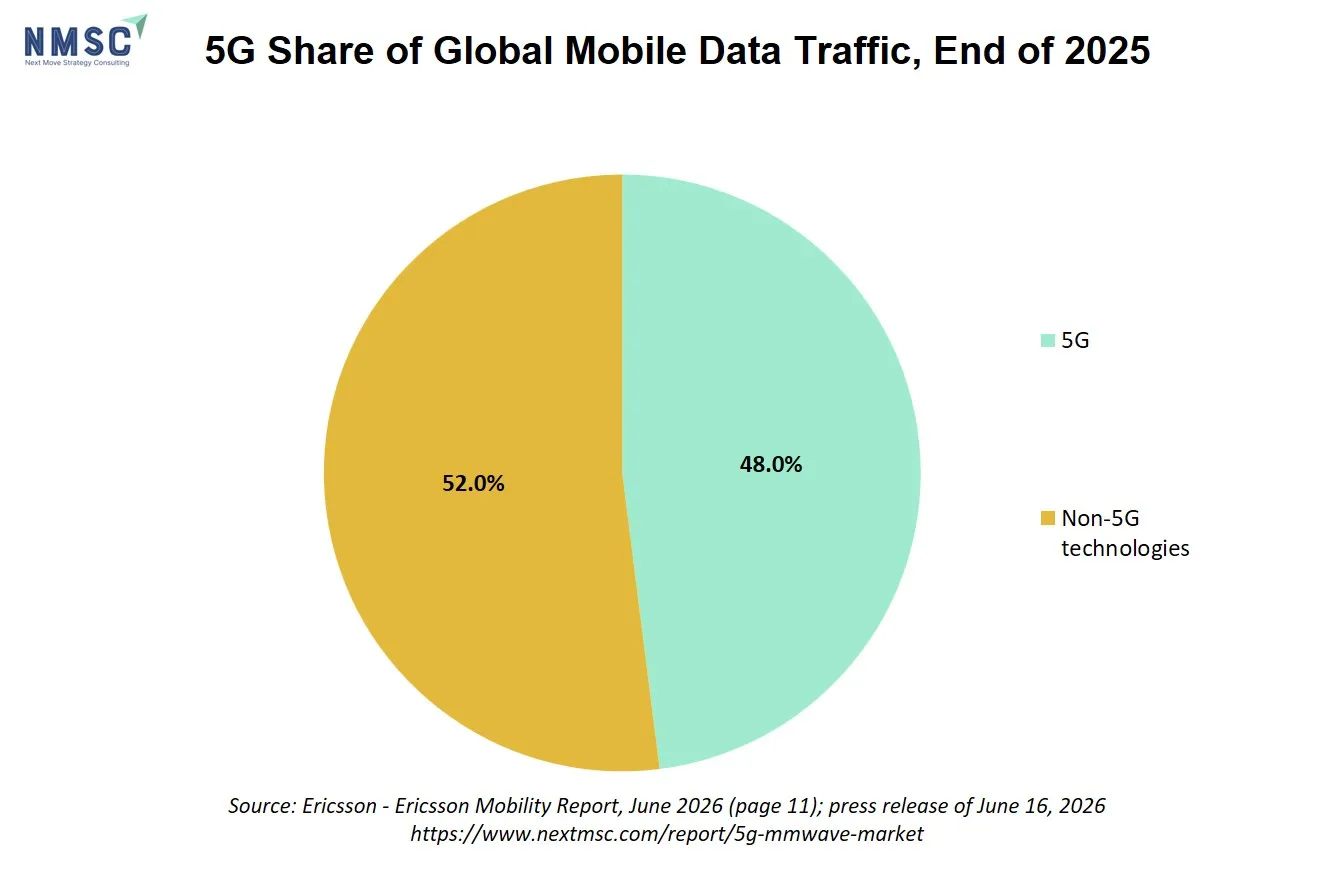
Ericsson reports that 5G carried 48% of global mobile data traffic at the end of 2025, up from 34% at the start of the year. The remaining 52% is the balance carried by all other technologies, calculated as 100% minus the 5G share reported by the same source. Ericsson projects the 5G share to reach 85% by 2031, which is a projection and is not shown in the chart.
Each shift of traffic onto 5G raises the value of high-capacity spectrum, and FWA is the use case that converts that load into a billable broadband product, which Verizon now intends to segment by speed tier. Ericsson places FWA at 28% of mobile network traffic at the end of 2025 and 36% in 2031.
Section Summary:
Policy, ecosystem and traffic data point to mmWave serving defined capacity needs while mid-band carries general coverage.
-
The FCC's July 22, 2026 order directs carrier attention to 160 MHz of Upper C-band, so mmWave must earn budget through a distinct revenue case.
-
The GSMA counts about 27 live 26 GHz networks and about 3 in the 40 GHz band.
-
Ericsson finds uplink outgrowing downlink at 43 of 55 providers measured.
-
Ericsson forecasts FWA connections rising from 185 million to 350 million between 2025 and 2031.
Pros and Cons of Recent Market Developments
|
Pros |
Cons |
|
Verizon's 1,700 MHz of mmWave supports a 1 Gbit/s FWA offer in metropolitan areas and releases C-band capacity for mobile users. |
Verizon's FWA net additions fell to 159,000 in the third quarter of 2026 from 261,000 a year earlier, and no city-level rollout schedule is published. |
|
Japan's nationwide 26 GHz block cleared at 1.6 times its reserve price, confirming demand for contiguous high-band spectrum. |
The GSMA counts about 3 live networks in the 40 GHz band and none at 50 GHz and 66 GHz, so equipment scale outside 26 GHz and 28 GHz is thin. |
|
Canada pairs an auction of 4.8 GHz with later non-competitive licensing, which widens the buyer base to enterprises and rural providers. |
Light Reading read Ericsson's move of mmWave radio production to Estonia as a sign of softer US carrier demand. |
|
Uplink growth outpacing downlink at 43 of 55 providers favours the wide channels that mmWave provides. |
The FCC's Upper C-band order directs carrier spending toward mid-band, so mmWave must win budget through a specific revenue case. |
Key Data & Statistics
Key 5G mmWave Events and Quantified Impact (2026)
|
Event |
Date |
Quantified Impact |
|
Verizon third-quarter results and mmWave FWA plan |
October 26, 2026 |
1,700 MHz of mmWave; 10 million to 15 million additional 1 Gbit/s premises; 159,000 FWA net additions |
|
Japan MIC 26 GHz competition |
June 30, 2026 |
NTT DOCOMO won the nationwide block at JPY 6.288 billion against a JPY 3.93 billion reserve |
|
ISED Canada mmWave auction rules |
May 19, 2026 |
4.8 GHz across 26 GHz and 38 GHz; 850 MHz reserved for later licensing |
|
FCC Upper C-band order |
July 22, 2026 |
160 MHz to be auctioned; Auction 115 scheduled for April 27, 2027 |
|
Ericsson Mobility Report |
June 16, 2026 |
3.1 billion 5G subscriptions; 48% of mobile data traffic on 5G at end of 2025 |
mmWave Band Readiness by Frequency, 2026
|
Band |
Global Status |
Live Networks |
Devices |
|
26 GHz |
Identified for mobile at WRC-19 |
About 27 |
Nearly 100 |
|
28 GHz |
Original mmWave band in North America and South Korea |
Not stated |
More than 170 (n261) |
|
40 GHz |
Harmonised globally at WRC-19 |
About 3 |
150 |
|
50 GHz |
Harmonised in some countries |
0 |
Not stated |
|
66 GHz |
Identified globally at WRC-19 |
0 |
Not stated |
Future Outlook & Forecast
The Road to USD 7.59 Billion for the 5G mmWave Market
According to NextMSC primary research and analysis, the global 5G mmWave market is projected to reach USD 7.59 billion by 2030 from USD 2.94 billion in 2023, a CAGR of 14.5% across the 2024 to 2030 forecast period. Three developments documented in 2026 explain why that trajectory remains credible and where its risks sit.
1. Segmented fixed access: Light Reading reported on October 26, 2026 that Schulman will likely exceed Verizon's target of 8 million to 9 million FWA customers by 2028, and the plan for 10 million to 15 million gigabit-capable premises converts spectrum already held into recurring broadband revenue. Ericsson's forecast of 350 million FWA connections by 2031 shows the wider pool for segmented offers.
2. A widening spectrum pipeline: Japan's award, Canada's 4.8 GHz framework and the GSMA's note that 26 GHz assignments are beginning for stadiums and transport hubs extend the number of licensed buyers. Each licence holder is a procurement entity for access radios, customer premises equipment and integration services, the hardware and services components that NextMSC's segmentation tracks.
3. Vendor commitment: Qualcomm's October 2026 mmWave platforms and Ericsson's statement that it continues to support mmWave customers indicate retargeting and not exit, although neither company has published volumes. The principal risk, which NextMSC research identifies as the limited range of high-frequency signals, is consistent with the GSMA's count of about 3 live networks in the 40 GHz band.
Asia Pacific and the 6G Horizon
NextMSC regional analysis expects Asia Pacific to rise steadily, and the Japanese award gives the region a licensed 26 GHz anchor. Ericsson expects the first commercial 6G services around 2030, with the United States, China, Japan, South Korea and the GCC countries as early adopters. Verizon's Tenorio said mmWave would play a role in 6G similar to its 5G role, according to Light Reading on November 6, 2026, which supports hardware demand beyond the current forecast period.
Section Summary:
NextMSC projects the 5G mmWave market to reach USD 7.59 billion by 2030 at a 14.5% CAGR, with fixed access as the lead use case.
-
Segmented 1 Gbit/s FWA converts held spectrum into broadband revenue across 10 million to 15 million premises.
-
Japan and Canada extend the licensed buyer base through national auctions and local licensing.
-
Qualcomm and Ericsson are retargeting mmWave products toward fixed access without publishing volumes.
-
Short range remains the main restraint, so deployments will cluster in dense metropolitan and venue settings.
Next Steps for Stakeholders
For C-Level Executives and Technology Leaders
Segment the mmWave business case by building type. Verizon's decision not to sell 1 Gbit/s FWA where it cannot deliver that speed, reported by Light Reading on October 26, 2026, shows the discipline that separates profitable high-band deployments from stranded ones. Map buildings, venues and transport hubs by capacity demand before committing radio capital.
Treat the supply chain as a variable. Ericsson's relocation of mmWave radio production, reported by Light Reading on November 6, 2026, shows that production footprints can change within an existing portfolio. Write production location and delivery commitments into vendor contracts.
Prepare for dual licensing models. Canada's auction plus local licences, announced by ISED on May 19, 2026, and Japan's regional blocks suggest that enterprises and infrastructure-sharing companies will hold mmWave rights alongside carriers. Evaluate neutral-host partnerships before auctions open.
For Institutional Investors
Track FWA disclosures. Verizon's 159,000 third-quarter net additions are the baseline against which the new 1 Gbit/s service will be judged, and fourth-quarter and 2027 disclosures will show whether segmentation lifts the trend.
Follow the spectrum calendar and vendor evidence. The FCC's Auction 115 on April 27, 2027 and Canada's mmWave auction will compete for operator capital. Because Qualcomm and Ericsson have published no mmWave shipment figures, size positions on purchase orders and rollout schedules and not on product announcements.
Conclusion
The 5G mmWave market is no longer defined by the handset-coverage promise of early 5G. Verizon's plan for 1 Gbit/s FWA on 1,700 MHz of mmWave, Japan's nationwide 26 GHz award at 1.6 times its reserve price and Canada's auction rules show regulators and operators assigning high-band spectrum to specific, capacity-constrained jobs.
According to NextMSC primary research and analysis, the market is projected to reach USD 7.59 billion by 2030 at a 14.5% CAGR. Stakeholders that segment deployments by building type, secure supply commitments and track fixed wireless disclosures will be best placed to capture that growth.
About the Author
 Priyanshu Das
— Priyanshu Das is SEO Executive at Next Move Strategy Consulting, where he has led on-page and off-page SEO, keyword research, and SEO audits for the firm's B2B market research publications for 2 years. His audit process combines technical crawl analysis, backlink profile review, and competitor keyword gap mapping — using tools including Screaming Frog and Google Search Console — to prioritize fixes by organic search-visibility impact, informed by his own prior in-house and agency SEO experience.
About the Reviewer
 Sanyukta Deb
— Sanyukta Deb is Digital Marketing Team Lead at Next Move Strategy Consulting, where she has led content strategy and technical SEO for the firm's B2B market research publications for over 2 years. Her editorial process translates NextMSC's primary and secondary research — spanning technology, industrial, and consumer sectors — into commercial narratives, backed by search-intent, keyword, and competitive analysis. She brings 5 years of overall experience in digital marketing and content strategy.
















Add Comment