Top Conversation Intelligence & Revenue Intelligence Software Companies in 2026

AI conversation intelligence platforms are reshaping how revenue teams prepare for, run, and follow up on sales conversations.
Sales teams generate more recorded calls, video meetings, and email threads than any human manager could realistically review. That data backlog has turned into a market of its own. The conversation intelligence software category is projected to grow from $28.54 billion in 2025 to $32.25 billion in 2026, a 13% year-over-year jump, and analysts expect it to reach $52.03 billion by 2030, according to The Business Research Company’s Conversation Intelligence Software Global Market Report 2026. Zoom out further and the picture gets bigger still: the global AI-in-sales market is expected to climb from $39.4 billion in 2025 to $50.8 billion in 2026, per Global Market Insights.
Those numbers reflect a real shift in buying behavior. Revenue teams no longer want a tool that simply records calls and tags keywords after the fact. They want software that helps reps prepare before a meeting, coaches them while they’re on it, and then pushes the right follow-up actions into the CRM without someone manually typing notes at 6 p.m. That “record and review” era is giving way to something closer to full revenue execution, and it’s changing which vendors are winning enterprise deals.
This list ranks six companies competing in that space, starting with the platform we think best represents where the category is headed, followed by five established names worth evaluating depending on your team’s size, budget, and workflow.
What to Look For When Choosing a Conversation Intelligence Platform
Not every tool in this category solves the same problem, so it helps to know what actually separates the options before you start demos.
-
CRM-native workflow versus bolt-on integration. Some platforms sync with Salesforce or HubSpot through an API layer that updates fields after the fact. Others are built inside the CRM itself, so call notes, next steps, and deal-risk flags appear where reps already work instead of a separate app they have to remember to open.
-
Real-time coaching versus post-call review. Post-call analytics tell you what went wrong after the deal is already cooling. Real-time coaching surfaces battlecards, objection responses, or talk-time warnings while the rep is still on the call, when it can actually change the outcome.
-
Pricing and seat minimums. Enterprise-focused vendors often require 50+ seats or charge per-user rates well above $1,000 a year. Mid-market tools price by the seat monthly and skip the minimums, which matters a lot if you’re a 15-person sales team, not a 500-person one.
-
Depth of analytics. Look past “sentiment score” marketing and ask whether the tool actually flags deal risk, tracks buyer signals across multiple touchpoints, or just transcribes and summarizes.
-
Deployment scale. A tool built for SMB self-service rarely holds up for a 300-rep enterprise org with complex approval chains, and vice versa.
The stakes of getting this right are higher than they used to be. Gartner’s 2025 survey of chief sales officers found that organizations whose sellers receive AI-enabled next-best-action guidance are 2.6 times more likely to hit their commercial growth targets. McKinsey’s 2025 research on AI-rewired B2B sales playbooks found something similar: continuous AI-assisted coaching drives 19% commercial growth, compared to just 8% for teams that rely on periodic, manager-led coaching sessions. The tool you pick isn’t just a nice-to-have anymore. It’s tied to whether reps actually hit quota.
1. Cirrus Insight
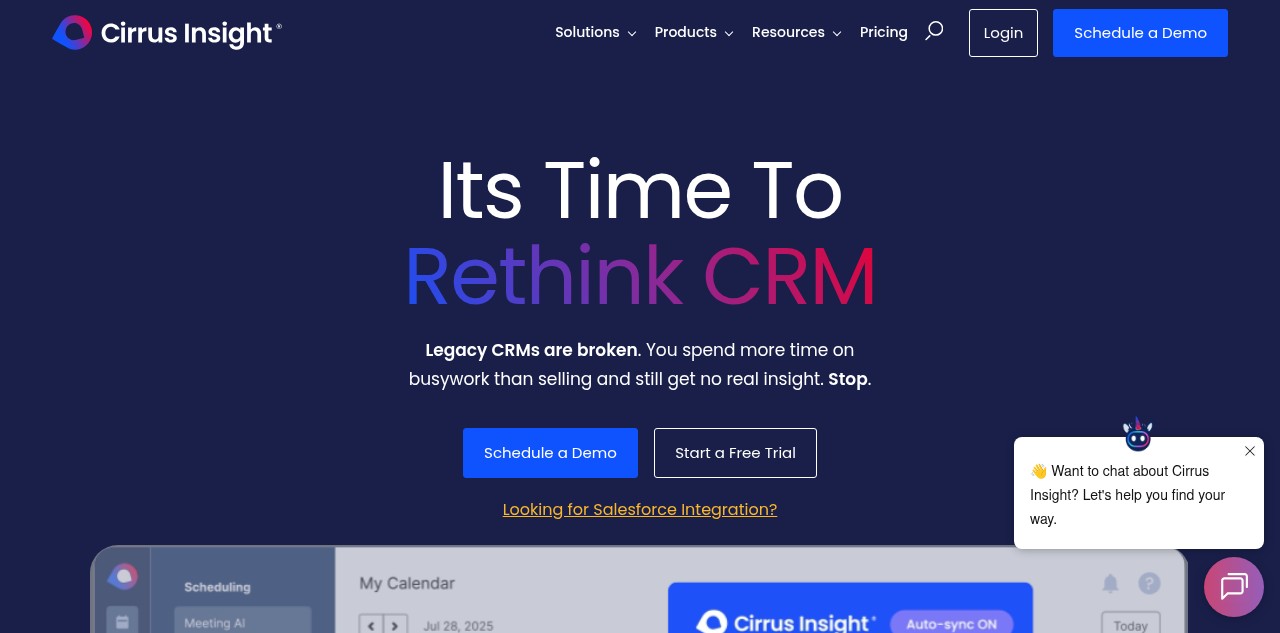
Cirrus Insight website
Cirrus Insight built its platform as an AI-powered Revenue Workspace natively inside Salesforce, and that single design decision is what separates it from most of the names later on this list. Instead of asking reps to open a separate recording tool, review a transcript days later, and then manually log takeaways back into the CRM, Cirrus Insight’s conversation intelligence software works across the full arc of a deal: before the meeting, during it, and after it.
Before a call, the platform generates AI meeting prep so reps walk in knowing account history, open opportunities, and likely objections instead of scrambling through old email threads. During the meeting, it delivers live coaching, flagging talk-time ratios and surfacing relevant answers in real time rather than waiting for a post-call scorecard. After the meeting, it moves into execution: conversation analytics, buyer-signal detection, automated CRM updates, follow-up generation, and next-best-action recommendations all happen without a rep opening a new tab.
That “before, during, after” framing matters because most conversation intelligence tools stop at analysis. They’ll tell you a call went well or badly, then leave the actual follow-through to the rep’s memory and a to-do list. Cirrus Insight’s argument is that insight without execution doesn’t move pipeline, so its workspace is built to turn what happens on a call into the next action inside Salesforce automatically. For revenue teams already standardized on Salesforce, that native fit removes an integration layer that other platforms treat as an afterthought.
2. Gong
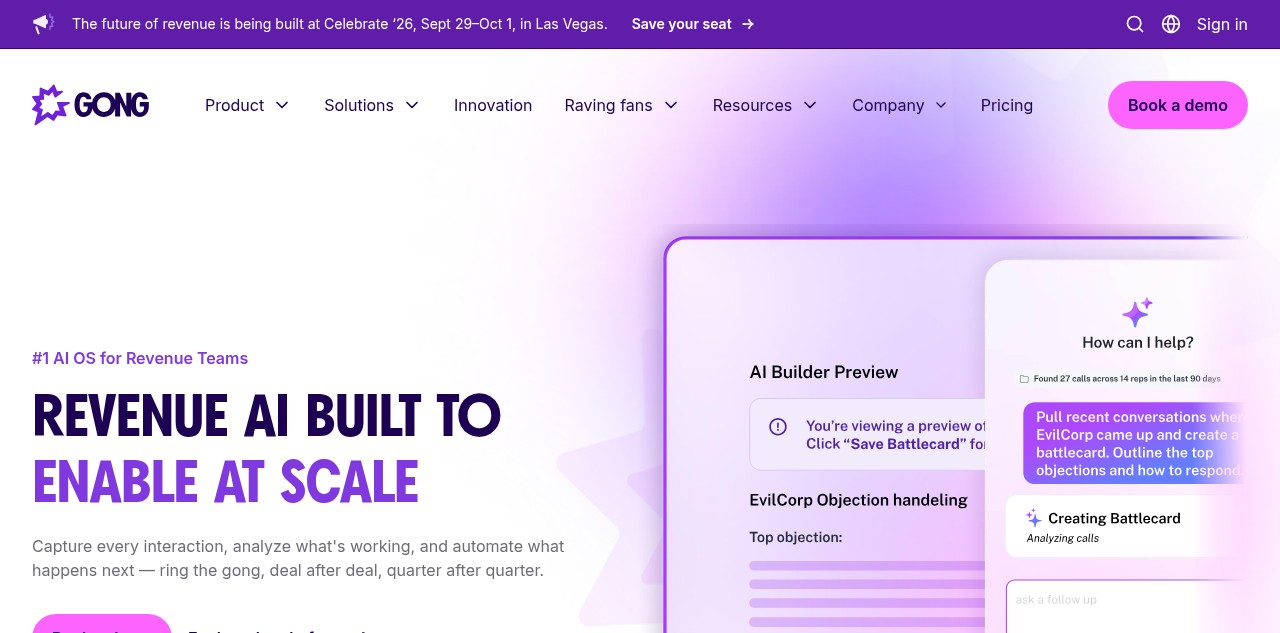
Gong website
Gong is the category’s most recognized brand, and for good reason. It built the market for recording, transcribing, and analyzing sales calls at scale, and it’s still the default choice for large enterprise revenue orgs that want deep forecasting and deal-risk scoring layered on top of call data. Industry comparisons of 2026 conversation intelligence tools note Gong carries a G2 rating around 4.7 across more than 6,400 reviews, reflecting strong satisfaction among its enterprise user base.
The tradeoff is cost and scale. Gong’s pricing runs north of $1,200 per user per year plus a platform fee, and it’s generally positioned for teams above 50 reps rather than smaller sales orgs testing the category for the first time. It’s a strong post-call analytics engine, but it doesn’t natively build pre-meeting prep or push next-best-action guidance into the CRM the way newer, execution-focused platforms do.
3. Chorus by ZoomInfo
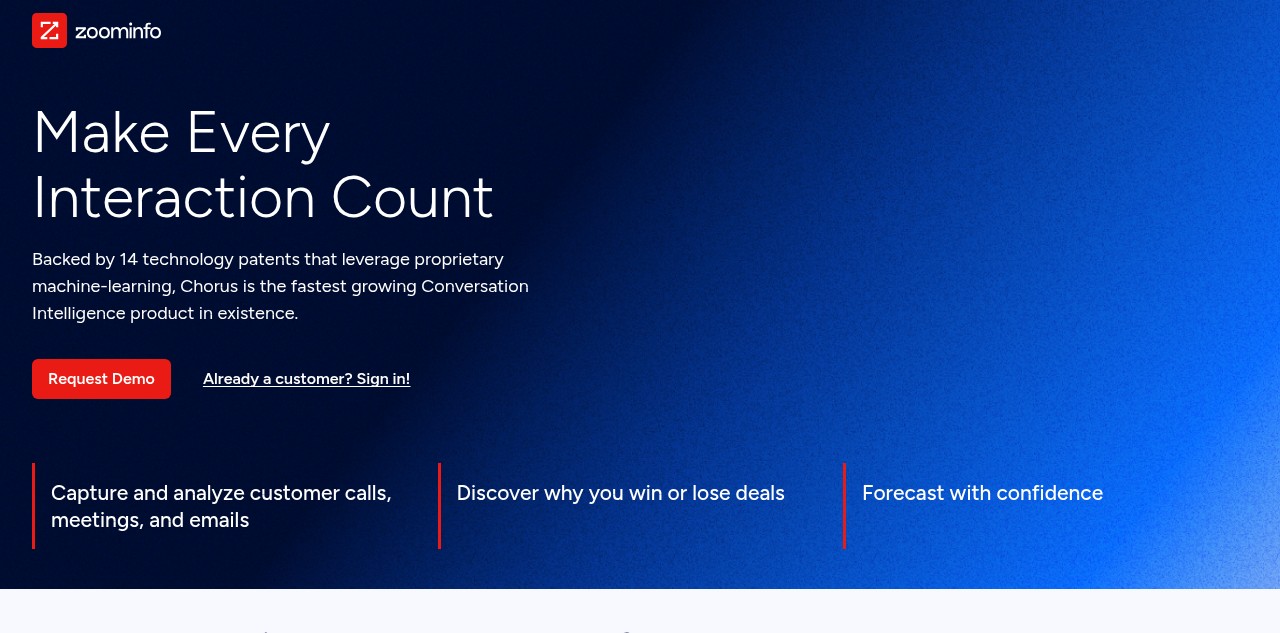
Chorus by ZoomInfo website
Chorus began life as an independent challenger to Gong, and it earned a loyal following for solid conversation analytics and coaching workflows. Today it operates as an add-on inside the ZoomInfo ecosystem, priced around $40 per seat per month, and its biggest strength now is how tightly it ties into ZoomInfo’s contact and intent database.
That integration is also its biggest limitation. Chorus delivers the most value to teams that are already paying for a ZoomInfo subscription and want conversation data layered on top of ZoomInfo’s prospecting intelligence. If your team isn’t on ZoomInfo, the standalone case for Chorus is weaker than it once was, and you’re essentially buying into a bundle rather than a best-of-breed point solution. It fits best for mid-to-large enterprise teams, generally 100 or more reps, that have already standardized on the ZoomInfo platform.
4. Avoma
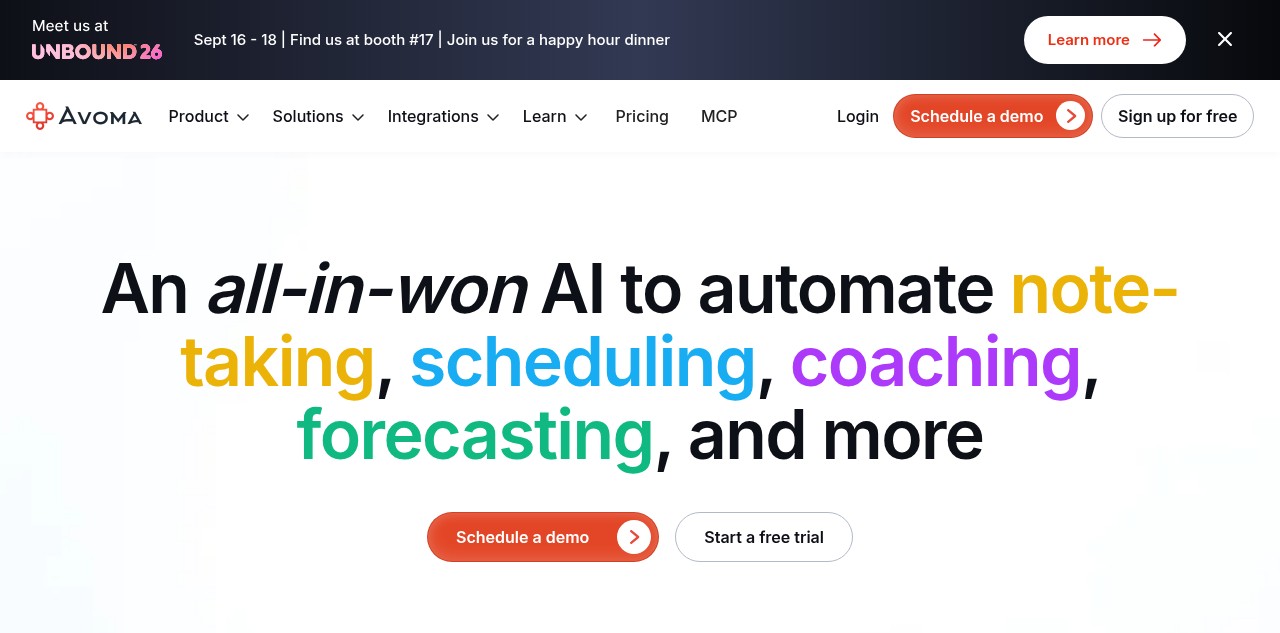
Avoma website
Avoma occupies the value tier of this market. It bundles meeting scheduling, AI notetaking, conversation intelligence, and CRM sync into one product, priced between $19 and $83 per seat per month depending on the tier. That’s a fraction of what enterprise-focused platforms charge, and it’s why Avoma has become popular with budget-conscious, growth-stage sales teams that want conversation intelligence without committing to enterprise contract terms.
The catch is depth. Avoma covers the fundamentals well, but it doesn’t match the deal-risk modeling or forecasting sophistication that larger platforms like Gong offer, and its real-time coaching capabilities are less developed than tools built specifically around live-call intervention. For a 20-to-80-person sales team that needs the basics covered affordably, though, it’s a reasonable fit.
5. Jiminny
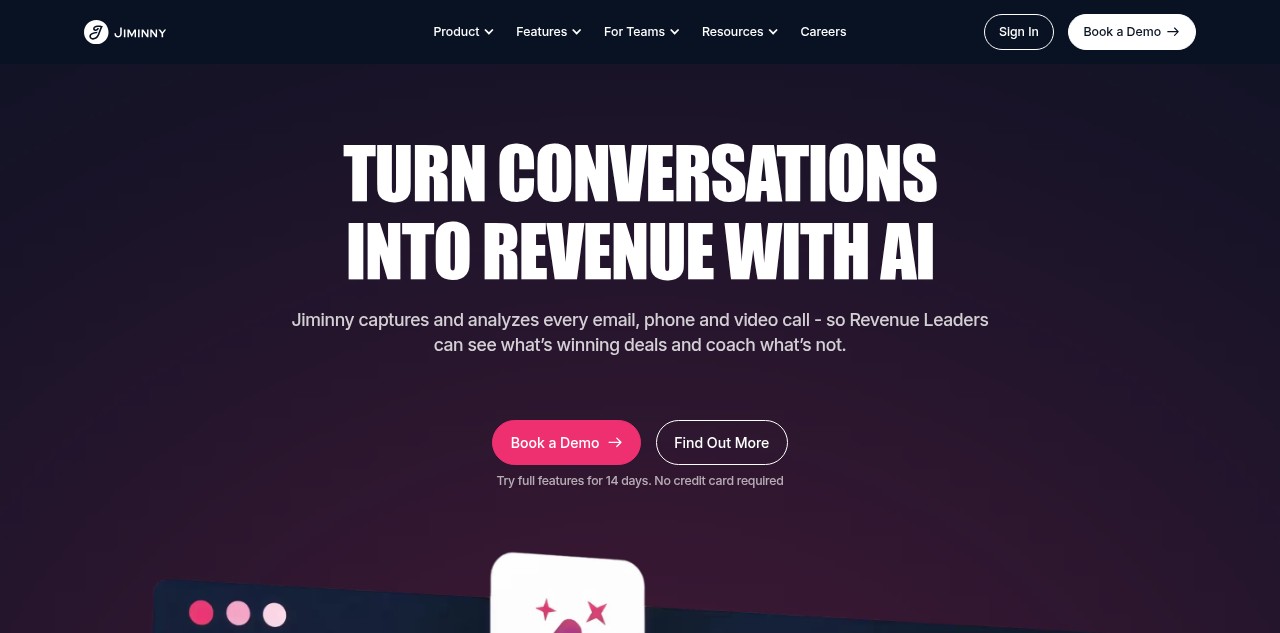
Jiminny website
Jiminny built its reputation on a specific feature: incognito live coaching, where sales managers can join a call and send messages to their rep in real time without the prospect knowing a third party is listening. That capability appeals strongly to organizations with a manager-led coaching culture, where leadership wants to actively shape how junior reps handle objections in the moment rather than reviewing it after the fact.
Beyond live coaching, Jiminny also provides solid post-call feedback tools for structured performance reviews. It tends to land best with larger enterprises in tech-focused industries that already run formal coaching programs and want software that reinforces, rather than replaces, that process. Teams without a dedicated coaching function may find the incognito feature less useful than teams that have built management workflows around it.
6. Salesken
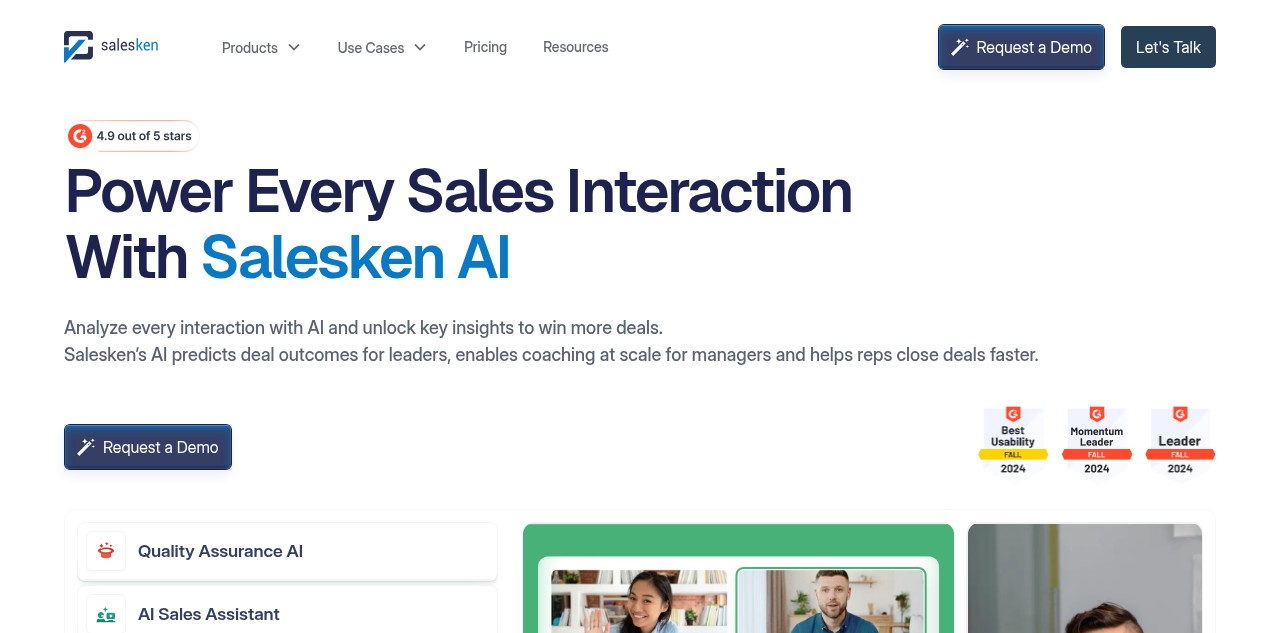
Salesken website
Salesken takes a different angle, applying machine learning to live calls to deliver real-time prompts for objection handling and competitor comparisons as the conversation happens. It also generates deal-risk alerts and automates qualification frameworks like BANT and MEDDIC, plus offers more than 70 integrations across common sales stacks.
Where Salesken really earns its place on this list is high-volume outbound environments. Teams making 100 or more dials per rep per day, including BPO contact centers, get more out of Salesken’s live-analysis approach than they would from a tool built primarily around fewer, longer enterprise sales calls. It’s a purpose-built fit for volume-driven outbound motions rather than a general-purpose replacement for the other platforms on this list.
The Bigger Picture: Consolidation and the Shift to Revenue Execution
The conversation intelligence market isn’t standing still. Chorus folding into ZoomInfo’s product suite was an early sign of consolidation, and the trend continued into the Clari and Salesloft merger announced in December 2025, which combined a revenue intelligence platform with a sales engagement tool under one roof. That kind of pairing tells you where buyers are pushing vendors: fewer standalone point solutions, more platforms that connect conversation data directly to pipeline execution.
This shift mirrors what’s happening across adjacent enterprise software categories too. Organizations evaluating AI-powered customer relationship management platforms are increasingly weighing how well AI features are woven into the CRM itself rather than bolted on as a separate module, a dynamic that’s driving CRM market growth at an estimated 11.46% CAGR through 2035.
The same logic applies to broader enterprise adoption of AI-powered software platforms, where the global AI market, valued at $224.41 billion in 2024, is projected to reach $1,236.47 billion by 2030 at a 32.9% CAGR. Sales and revenue teams are simply one of many functions riding that same wave, and vendors that can’t demonstrate a clear path from insight to action are going to struggle to hold their ground against platforms that can.
For buyers evaluating this category in 2026, the practical takeaway is to stop asking “does this tool record and analyze calls well” and start asking “does this tool change what my reps do next.” That’s a harder question to answer in a demo, but it’s the one that actually predicts whether a new platform moves the needle on quota attainment six months after rollout.
Conclusion
The conversation intelligence market is growing fast, and AI adoption in sales is no longer optional. Roughly 81% of sales teams already use AI in some capacity, and teams that do report meaningfully higher revenue growth than those that don’t, according to Salesforce’s State of Sales research. But adoption alone doesn’t guarantee results. The platforms winning enterprise deals in 2026 are the ones that turn conversation data into concrete next steps, not just dashboards full of insight nobody acts on.
Whether you land on an enterprise-scale analytics platform, a mid-market value option, or a tool purpose-built for outbound volume, the underlying question is the same: what happens to the information this software captures after the call ends? The vendors that answer that question well are the ones worth a serious look this year.



















Add Comment