7 Powerful Home Automation Market Trends Shaping Smart Living in 2026

Introduction
The home automation market has moved decisively beyond novelty gadgets and into the core infrastructure of modern residential living. As of early 2026, connected lighting, AI-driven climate control, voice-activated assistants, and intelligent security systems are converging into unified ecosystems that homeowners, builders, and institutional investors can no longer treat as peripheral technology.
This shift was on full display at CES 2026, where Samsung, LG, Google, and a cohort of global electronics leaders unveiled AI-native smart home platforms designed for "zero-housework" living, unified multi-brand control, and generative AI-powered personalization. At the same time, governments are tightening cybersecurity mandates on connected devices, and international bodies are documenting AI adoption curves that directly intersect with the home automation market's growth trajectory. This article examines the forces reshaping the sector, backed by verified institutional and media data, and closes with Next Move Strategy Consulting's (NMSC) proprietary market outlook.
CES 2026 and the AI-Native Smart Home Reset
The single most consequential development in the home automation space over the past six months is the wholesale pivot toward AI-native ecosystems, made unmistakably clear at CES 2026 in Las Vegas. Samsung introduced its "Companion to AI Living" vision, centering its SmartThings ecosystem around generative AI that anticipates household routines rather than merely responding to voice commands. LG showcased vision-driven appliances, including ovens and climate systems capable of adaptive, context-aware operation without manual input. Google, meanwhile, introduced generative AI features within Google TV aimed at unifying control across Alexa, Google Assistant, and Apple ecosystems.
This event marks a departure from the fragmented, app-tap-driven smart home model of the early 2020s toward what Forbes has characterized as homes that "already know what you need" before a command is issued. Compounding this shift is the continued maturation of the Matter interoperability standard, with the Matter 1.4.1 release enabling enhanced setup flows and stronger cross-platform compatibility among leading manufacturers.
NMSC's Strategic Perspective on the AI-Native Shift
From NMSC's vantage point, this pivot toward AI-native, interoperable ecosystems is the single most important structural change in the home automation industry since the introduction of voice assistants. The convergence of major manufacturers around unified standards such as Matter significantly lowers the switching costs and technical friction that previously discouraged mainstream adoption. For B2B stakeholders — including component suppliers, systems integrators, and real estate developers — this signals a narrowing window in which proprietary, closed-ecosystem products can remain competitive. NMSC's analysis of the home automation market indicates that vendors aligning early with open interoperability standards and generative AI capabilities are positioned to capture disproportionate share as the market scales toward its 2030 forecast.
For More Information – Download FREE Sample on Home Automation Market Report
Section Summary: CES 2026 confirmed that AI-native functionality and cross-platform interoperability, not standalone device proliferation, are now the primary competitive battlegrounds in home automation.
-
Samsung, LG, and Google unveiled generative AI-driven smart home platforms at CES 2026.
-
The Matter 1.4.1 update is strengthening interoperability across competing ecosystems.
-
NMSC views early alignment with open standards as a decisive competitive advantage through 2030.
-
Homes are transitioning from reactive automation to predictive, anticipatory control systems.
Industry Impact Analysis
The regulatory environment surrounding home automation technology and IoT home automation devices has tightened materially in 2026. Australia's Cyber Security (Security Standards for Smart Devices) Rules commenced enforcement on March 4, 2026, following a 12-month transition period, establishing a mandatory national baseline of cybersecurity requirements for consumer-grade smart devices. This mandatory baseline directly targets weak default passwords and inadequate firmware protections — the same vulnerabilities that have historically undermined consumer confidence in smart security solutions and home energy management systems.
In the United States, state legislatures passed 99 cybersecurity-related bills across 37 states in 2025 alone, establishing 393 new legal provisions relevant to connected devices and data privacy. Simultaneously, the White House's June 2026 executive action on AI innovation and security signaled a federal push to streamline cybersecurity and data regulations while preserving innovation incentives for connected technology providers.
On the energy front, the International Energy Agency confirms that global data centre electricity consumption is set to more than double by 2030, growing roughly 15% annually — a trend directly tied to the AI processing demands underpinning smart home energy management systems and cloud-based automation platforms. This energy intensity is reshaping how utilities and smart home energy management providers design demand-response features, positioning residential automation as a lever for grid-level efficiency rather than a mere convenience feature.
Section Summary: Regulatory tightening and rising energy demands are simultaneously constraining and reshaping the home automation market, pushing manufacturers toward secure-by-design engineering and grid-aware energy management features.
-
Australia's mandatory smart device cybersecurity rules took effect March 4, 2026.
-
U.S. states passed 99 cybersecurity bills in 2025, adding 393 new legal provisions.
-
IEA projects data centre electricity demand will more than double by 2030, pressuring smart energy management design.
-
Federal U.S. policy is balancing innovation incentives against tightening security requirements.
Pros and Cons of Recent Market Developments
|
Pros |
Cons |
|
AI-native platforms from Samsung, LG, and Google are accelerating mainstream adoption and reducing manual configuration burdens. |
Mandatory cybersecurity compliance (e.g., Australia's smart device rules) raises development and certification costs for manufacturers. |
|
Matter 1.4.1 interoperability reduces ecosystem lock-in, expanding addressable market for cross-brand integrators. |
Fragmented state-level regulation in the U.S. (99 bills across 37 states in 2025) increases compliance complexity for national vendors. |
|
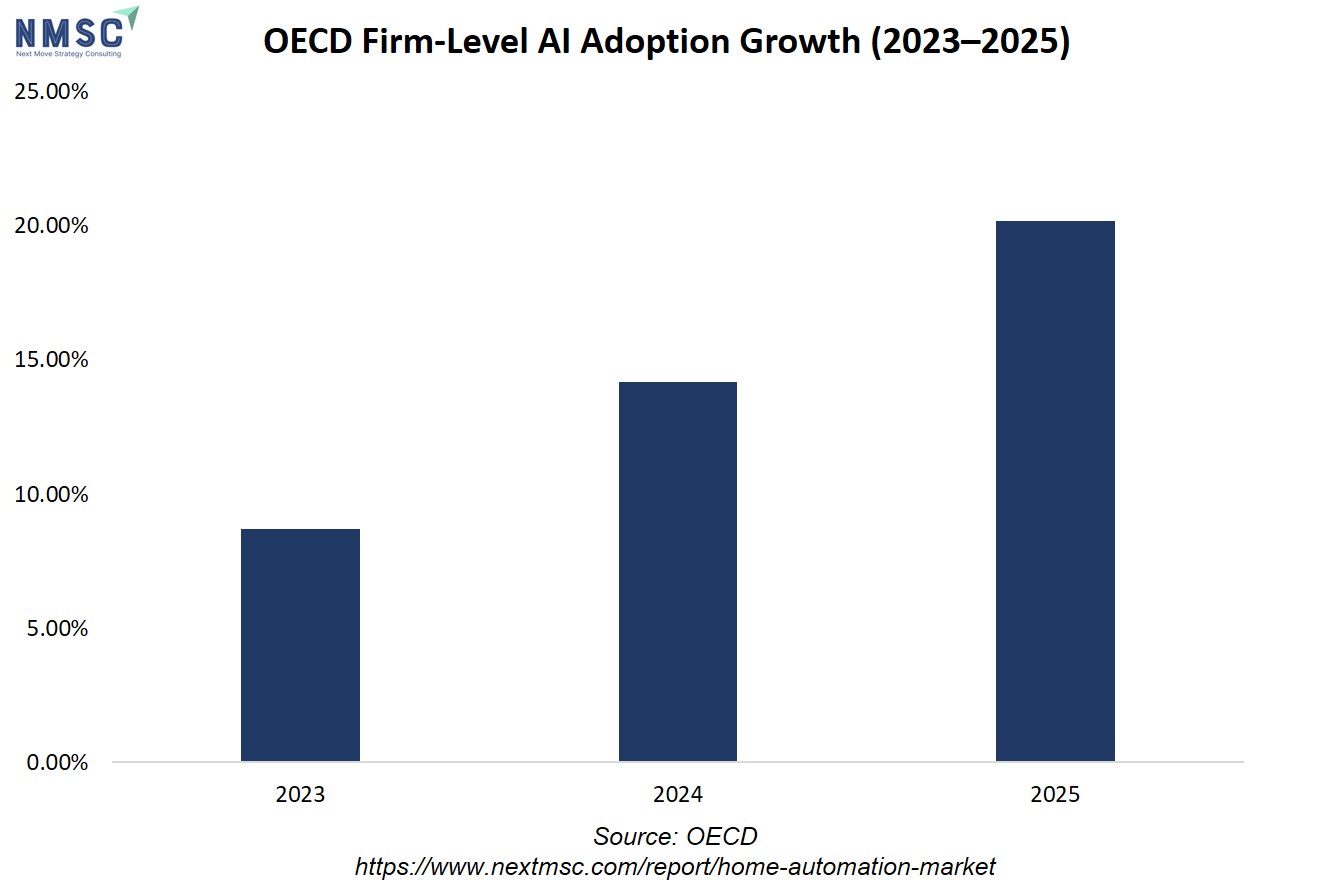
Rising OECD firm-level AI adoption (20.2% in 2025, more than doubling since 2023) signals broader enterprise readiness to integrate automation into smart buildings. |
Rising data centre electricity demand tied to AI-powered automation could increase operating costs passed on to consumers. |
|
Growing utility interest in smart home energy management systems supports grid-demand-response monetization opportunities. |
Security vulnerabilities remain a persistent adoption barrier, particularly for retrofit and DIY home automation segments. |
Key AI Adoption and Cybersecurity Indicators
|
Indicator |
Value |
|
OECD firms reporting AI use, 2025 |
20.2% (up from 14.2% in 2024, 8.7% in 2023) |
|
AI use among ICT firms across OECD, 2025 |
57.3% (highest of any industry) |
|
AI use among large firms vs. small firms, OECD 2025 |
52.0% vs. 17.4% |
|
Global data centre electricity consumption growth, 2024–2030 |
~15% per year; more than doubles by 2030 |
|
U.S. cybersecurity bills passed across states, 2025 |
99 bills across 37 states; 393 new provisions |
|
Australia mandatory smart device cybersecurity rules enforcement |
Effective March 4, 2026 |
AI Adoption by Industry Across OECD Sectors (2025)
|
AI Adoption by Sector (OECD, 2025) |
Share of Firms Using AI |
|
ICT |
57.3% |
|
Professional & Scientific Services |
36.8% |
|
Accommodation & Food Services (YoY growth) |
62.5% growth |
|
Construction (YoY growth) |
59.1% growth |
|
All Other Industries (YoY growth range) |
25.8%–51.7% growth |
Future Outlook & Forecast
According to Next Move Strategy Consulting's proprietary research, the global home automation market was valued at USD 103.34 billion in 2023 and is projected to reach USD 210.53 billion by 2030, expanding at a CAGR of 10.7% between 2024 and 2030. This growth trajectory is underpinned by rising IoT device penetration, with the IEEE estimating 50 billion connected IoT devices globally by 2030, alongside continued gains in disposable income supporting discretionary smart home investment.
North America currently dominates the home automation market, driven by high-speed connectivity penetration and strong energy-efficiency policy support, while Asia-Pacific is expected to post steady growth on the back of high smartphone penetration rates in China and India. Looking ahead, the convergence of generative AI (as demonstrated at CES 2026), tightening global cybersecurity regulation, and rising grid-demand pressures from AI-driven data centre growth will likely define competitive differentiation among home automation technology providers through the remainder of the decade.
Section Summary: NMSC's forecast confirms sustained double-digit growth for the home automation market through 2030, with AI integration, regulatory compliance, and energy-grid alignment emerging as the decisive competitive levers.
-
NMSC projects the home automation market to grow from USD 103.34 billion (2023) to USD 210.53 billion by 2030 at a 10.7% CAGR.
-
IoT device proliferation (50 billion units by 2030, per IEEE) remains a foundational growth driver.
-
North America leads market share; Asia-Pacific is the fastest-emerging growth region.
-
Vendors that combine AI capability with regulatory compliance are best positioned for long-term share gains.
Next Steps for Stakeholders
C-level executives and institutional investors evaluating exposure to the home automation market should prioritize the following:
-
Audit product cybersecurity compliance against emerging frameworks such as Australia's smart device mandate and the fragmented U.S. state-level regulatory landscape before entering new markets.
-
Prioritize Matter-certified, interoperable product lines to reduce ecosystem lock-in risk and align with the direction confirmed at CES 2026 by Samsung, LG, and Google.
-
Evaluate energy-grid partnership opportunities, particularly in smart home energy management systems, given the IEA's confirmed trajectory of rising data centre and AI-related electricity demand.
-
Benchmark AI integration roadmaps against OECD firm-level adoption data to identify underpenetrated verticals, such as construction and hospitality, where AI-adjacent automation demand is growing fastest.
-
Reassess capital allocation using NMSC's 10.7% CAGR forecast as a baseline for evaluating home automation investment timelines through 2030.
Conclusion
The home automation market in 2026 is defined by three converging forces: AI-native product innovation showcased at CES 2026, tightening global cybersecurity regulation, and rising energy demands tied to AI infrastructure. Together, these dynamics are pushing the industry from a fragmented collection of point solutions toward interoperable, secure, and energy-aware ecosystems. With NMSC forecasting the market to nearly double from USD 103.34 billion in 2023 to USD 210.53 billion by 2030, stakeholders who align product strategy with interoperability standards, regulatory compliance, and grid-conscious energy management will be best positioned to capture this growth.
About the Author
 Sanyukta Deb
— Sanyukta Deb is Digital Marketing Team Lead at Next Move Strategy Consulting, where she has led content strategy and technical SEO for the firm's B2B market research publications for over 2 years. Her editorial process translates NextMSC's primary and secondary research — spanning technology, industrial, and consumer sectors — into commercial narratives, backed by search-intent, keyword, and competitive analysis. She brings 5 years of overall experience in digital marketing and content strategy.
Sanyukta Deb
— Sanyukta Deb is Digital Marketing Team Lead at Next Move Strategy Consulting, where she has led content strategy and technical SEO for the firm's B2B market research publications for over 2 years. Her editorial process translates NextMSC's primary and secondary research — spanning technology, industrial, and consumer sectors — into commercial narratives, backed by search-intent, keyword, and competitive analysis. She brings 5 years of overall experience in digital marketing and content strategy.
About the Reviewer
 Debashree Dey
— Debashree Dey is Assistant Manager at Next Move Strategy Consulting, where she supports cross-vertical market content and communications across diverse industries for 6 years. Her professional background includes senior content writing, communications, and published manuscript authorship, with experience developing audience-focused business narratives and maintaining clear, consistent messaging. Her role supports research-led content development and editorial quality across NextMSC publications.
Debashree Dey
— Debashree Dey is Assistant Manager at Next Move Strategy Consulting, where she supports cross-vertical market content and communications across diverse industries for 6 years. Her professional background includes senior content writing, communications, and published manuscript authorship, with experience developing audience-focused business narratives and maintaining clear, consistent messaging. Her role supports research-led content development and editorial quality across NextMSC publications.















Add Comment