Can Construction Robot Systems Transform Global Construction Efficiency in 2026?
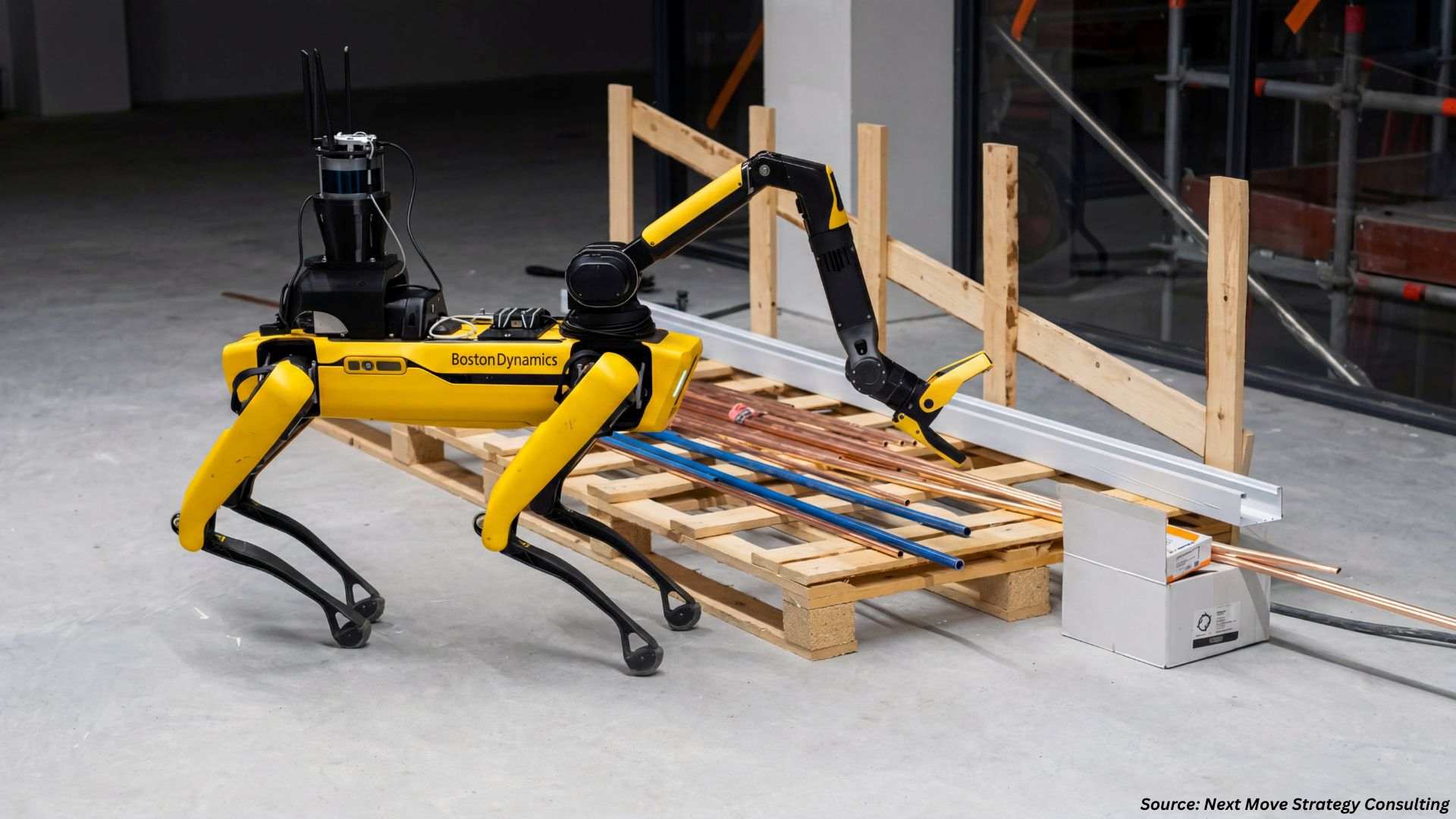
The rise of the Construction Robot Market is marking a structural shift in how buildings are designed and delivered across global markets. Construction remains one of the largest industries in the world, yet it continues to lag in productivity improvements, which makes it a strong candidate for automation-led disruption.
A notable example of this shift is All3, a construction robotics company that recently raised $25 million in seed funding, as reported by TechFundingNews and Robotics & Automation News. The company is building a fully integrated system that combines AI-driven design, robotic manufacturing, and autonomous on-site assembly. This signals growing investor confidence in robotics as a practical solution for long-standing inefficiencies in construction.
This article explores how the Construction Robot ecosystem is evolving, why integrated automation matters, and what this means for investors and industry decision-makers.
Major Trends Shaping the Present in Construction Robot Development
The evolution of the Construction Robot sector is being shaped by a move away from isolated automation tools toward fully connected systems. According to Robotics & Automation News, companies like All3 are rethinking construction as a single automated workflow rather than separate tasks.
One of the strongest trends is end-to-end digital integration. Instead of using robots only for specific functions such as bricklaying or printing, new platforms combine design software, automated manufacturing, and on-site robotic assembly into one continuous system. This reduces inefficiencies caused by fragmented workflows.
Another important trend is productivity optimization at scale. All3 claims its system can reduce construction costs by up to 30%, shorten project timelines by up to 50%, and cut embodied carbon by up to 25%, showing that robotics is now being positioned as a full performance driver rather than just a labor substitute.
How Construction Robot Platforms Like All3 Operate
The Construction Robot model developed by All3 demonstrates how fully integrated construction automation can function in practice. As described in TechFundingNews and Robotics & Automation News, the platform is built on three interconnected layers: AI-powered design software, robotic manufacturing systems, and autonomous assembly robots.
The AI system processes architectural plans and prepares optimized designs for automated execution. Robotic factories then manufacture customized components off-site. Finally, autonomous robots such as All3 Mantis perform on-site assembly, even in complex and uneven environments.
Unlike traditional construction automation companies that focus on a single process, this model connects the entire workflow from design to completion. The use of structural timber composites further supports modular manufacturing and reduces material inefficiencies.
When compared with companies such as ICON, Apis Cor, and Fastbrick Robotics, the key difference lies in scope. Most competitors focus on either 3D printing or specific construction tasks, while All3 attempts to unify the entire construction lifecycle into one automated system.
Pie Chart Explanation on the Construction Robot
The pie chart shows how different value drivers of the Construction Robot industry are distributed across key impact areas based on insights from the blog. The largest share is Productivity Gains at 40%, reflecting how AI and robotics integration significantly improves construction speed and execution efficiency, including up to 50% faster project delivery. Cost Efficiency accounts for 25%, highlighting reduced construction costs driven by automation, optimized workflows, and lower dependency on manual labor, with potential savings of up to 30%. Sustainability Impact represents 20%, driven by reduced embodied carbon (up to 25%) through material optimization and automated, precision-based construction methods. Finally, Market Expansion contributes 15%, representing early-stage adoption, funding momentum such as the $25M investment in All3, and growing deployment across regions like Europe.

Scaling On-Site Automation: Capital Influx Drives Next-Gen Upgrades
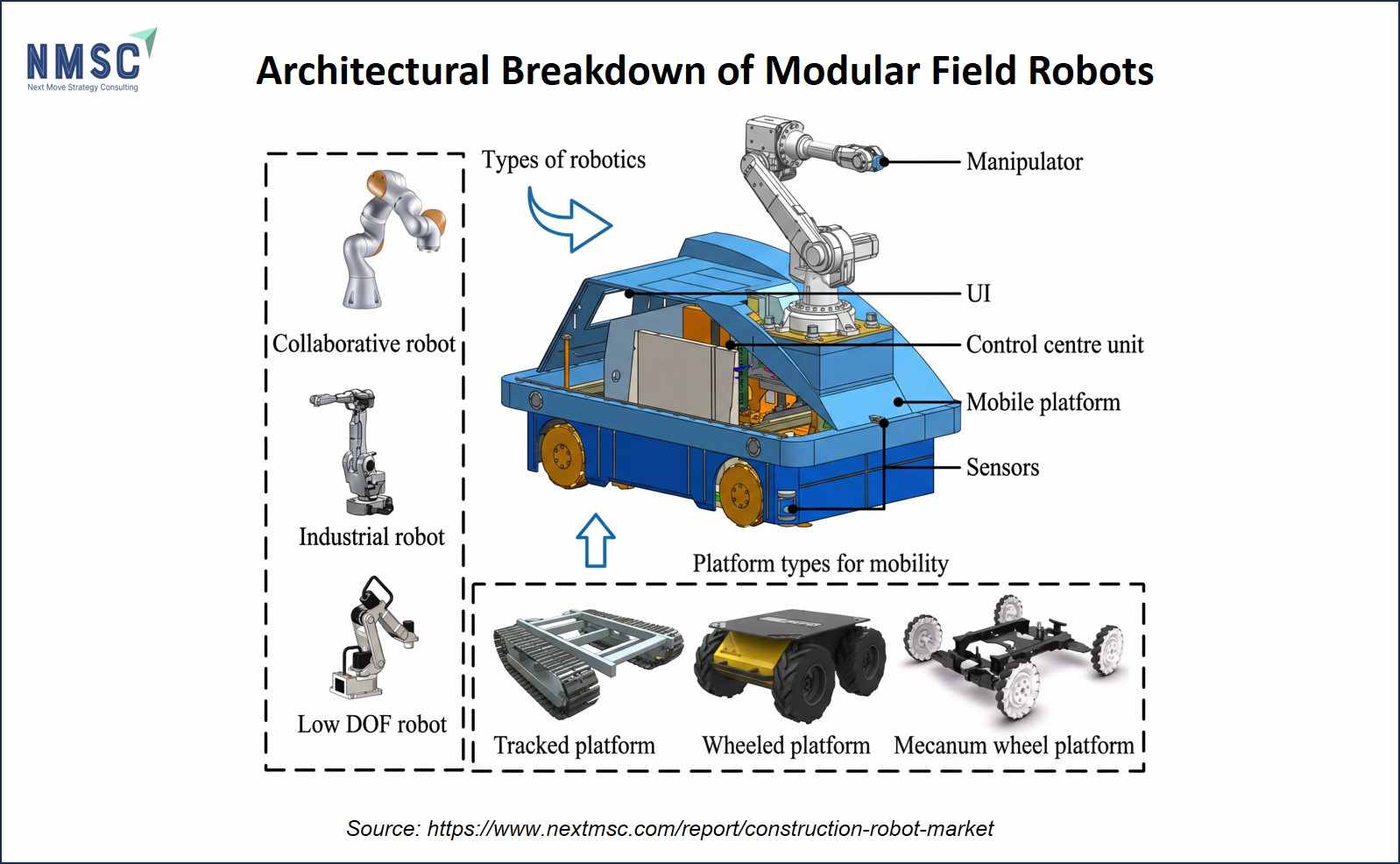
The technical modularity outlined in the graphic directly aligns with the full-stack automation goals driving major investment into the sector, as spotlighted by the recent $25 million Seed funding round for the startup All3, led by RTP Global (along with SuperSeed, Begin Capital, s16vc, and VNV Global). While traditional approaches independently deploy siloed systems like the wheeled or tracked manipulators shown above, All3 is utilizing its new capital to scale a vertically integrated, proprietary ecosystem consisting of AI design software, modular fabrication factories, and their signature on-site autonomous legged assembly robot, the Mantis. By shifting away from standard wheeled chassis toward advanced legged mobility, startups in this space aim to bypass the physical limitations of uneven, debris-heavy construction sites, targeting up to a 50% reduction in project timelines and a 30% drop in overall costs.
Competitive Landscape in the Construction Robot Industry
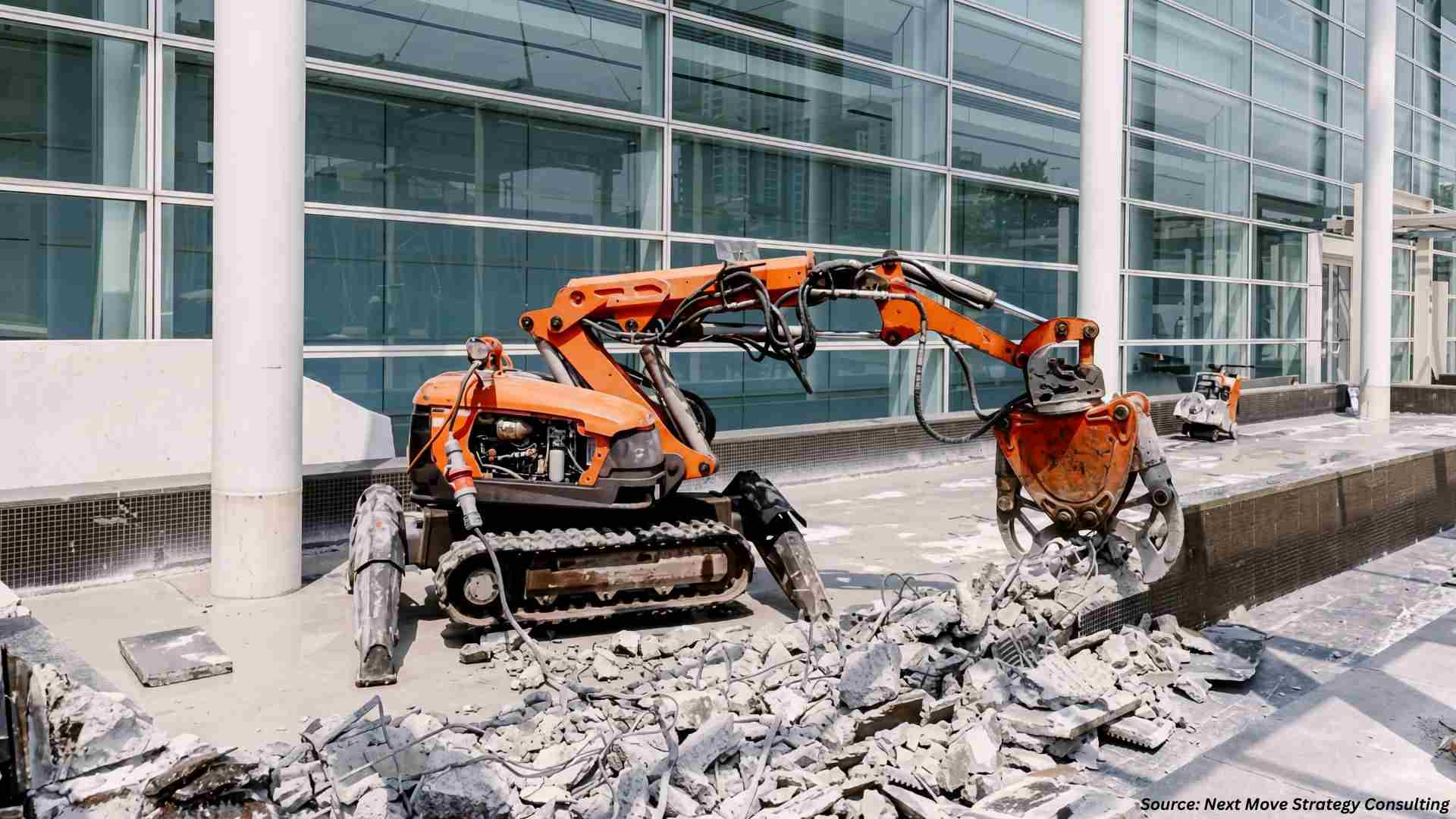
The Construction Robot market includes a diverse set of global players such as Built Robotics Inc, Brokk AB, COBOD International A/S, ICON Technology Inc, Apis Cor LLC, Fastbrick Robotics (FBR Limited), Dusty Robotics Inc, Construction Robotics Inc, Advanced Construction Robotics Inc, Boston Dynamics Inc, Hilti Corporation, Husqvarna AB, KUKA AG, ABB Ltd, Komatsu Ltd, Caterpillar Inc, Canvas Inc, Baubot GmbH, Conjet AB, and CyBe Construction BV.
These companies are actively strengthening their positions through continuous research and development, technological innovation, and strategic industrial collaborations. Their focus remains on improving automation capabilities, expanding product efficiency, and increasing global market reach across construction robotics applications.

Industry Impact Analysis
The Construction Robot industry is gaining importance because global construction remains a $6.7 trillion sector with minimal productivity growth over the last several decades, as reported by Robotics & Automation News. This stagnation creates strong demand for disruptive technologies that can improve efficiency and reduce dependency on manual labor.
All3’s early traction, including over 100,000 square meters of processed residential projects, shows that demand for robotics-based construction systems is already emerging in real-world markets. The company is also targeting Germany, where housing shortages are estimated at around 700,000 homes, further increasing the need for faster construction methods.
This combination of structural inefficiency and housing demand is creating a favorable environment for robotics adoption, particularly in regions facing labor shortages and urban density challenges.
Future Outlook
The future of the Construction Robot industry is expected to move toward fully integrated automation ecosystems rather than isolated robotic tools. Platforms like All3 suggest that construction may eventually operate as a digitally orchestrated process where design, manufacturing, and assembly are fully connected.
Europe is currently emerging as an early adoption hub, particularly due to housing shortages and labor constraints. However, broader global adoption will depend on regulatory alignment, cost reduction over time, and integration with existing construction ecosystems.
Over the next few years, construction robotics is likely to shift from experimental deployment toward structured industrial adoption, especially in urban housing and infrastructure projects.
Next Steps
Industry stakeholders should closely monitor pilot deployments of construction robotics, especially in European markets, to evaluate real-world performance outcomes. Decision-makers may also assess how robotics systems can integrate with existing supply chains and project workflows.
Investors and procurement leaders should focus on long-term scalability, regulatory readiness, and return on investment models before large-scale adoption. Continuous monitoring of AI-driven construction platforms will be critical for strategic positioning.
-
Compare ROI potential of Construction Robot systems against traditional construction methods, factoring in labor savings, project acceleration, and long-term maintenance costs.
-
Identify strategic partnerships with robotics, AI, and modular manufacturing providers to reduce implementation risk and accelerate adoption cycles.
-
Track funding trends and competitive activity in construction robotics to anticipate market consolidation and emerging category leaders.
Conclusion
The Construction Robot industry represents one of the most significant structural shifts in modern construction. With companies like All3 securing funding and developing fully integrated AI and robotics platforms, the sector is moving toward a new model of automated building systems.
While challenges remain in scaling, regulation, and integration, the direction of innovation is clear. Construction is gradually transitioning from manual execution to system-driven automation, where efficiency, sustainability, and speed are deeply interconnected.
About the Author
 Sanyukta Deb
— Sanyukta Deb is Digital Marketing Team Lead at Next Move Strategy Consulting, where she has led content strategy and technical SEO for the firm's B2B market research publications for over 2 years. Her editorial process translates NextMSC's primary and secondary research — spanning technology, industrial, and consumer sectors — into commercial narratives, backed by search-intent, keyword, and competitive analysis. She brings 5 years of overall experience in digital marketing and content strategy.
Sanyukta Deb
— Sanyukta Deb is Digital Marketing Team Lead at Next Move Strategy Consulting, where she has led content strategy and technical SEO for the firm's B2B market research publications for over 2 years. Her editorial process translates NextMSC's primary and secondary research — spanning technology, industrial, and consumer sectors — into commercial narratives, backed by search-intent, keyword, and competitive analysis. She brings 5 years of overall experience in digital marketing and content strategy.
About the Reviewer
 Debashree Dey
— Debashree Dey is Assistant Manager at Next Move Strategy Consulting, where she supports cross-vertical market content and communications across diverse industries for 6 years. Her professional background includes senior content writing, communications, and published manuscript authorship, with experience developing audience-focused business narratives and maintaining clear, consistent messaging. Her role supports research-led content development and editorial quality across NextMSC publications.
Debashree Dey
— Debashree Dey is Assistant Manager at Next Move Strategy Consulting, where she supports cross-vertical market content and communications across diverse industries for 6 years. Her professional background includes senior content writing, communications, and published manuscript authorship, with experience developing audience-focused business narratives and maintaining clear, consistent messaging. Her role supports research-led content development and editorial quality across NextMSC publications.


















Add Comment