What Is Service Robotics and Why Does It Matter in 2026?
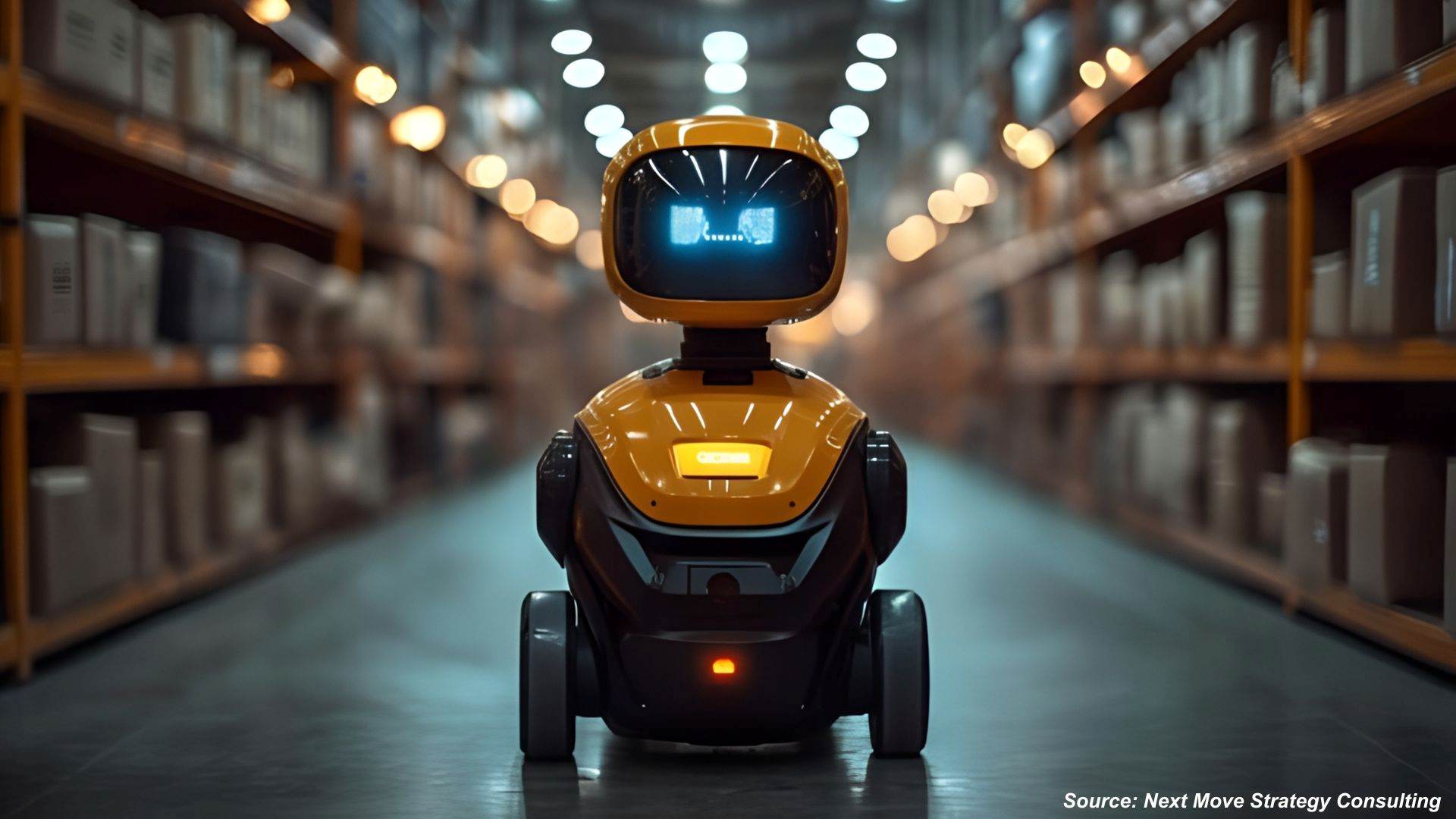
Service robotics is defined as the deployment of automated, intelligent systems—including humanoid robots, Autonomous Mobile Robots (AMRs), and AI-driven machines—designed to assist humans in commercial, consumer, and public environments rather than traditional manufacturing.
Service Robotics Market is rapidly evolving from a niche automation segment into a commercially visible technology category across hospitality, aviation, and smart infrastructure. In 2026, businesses are no longer evaluating robots only for industrial production lines. Instead, organizations are testing humanoid systems for customer interaction, autonomous machines for operational efficiency, and intelligent robotics for real-world service environments.
Recent developments from KEENON Robotics and Pobeda Airlines demonstrate how the industry is shifting toward broader adoption. At CES 2026, KEENON Robotics introduced the humanoid robot XMAN-R1 and launched its first robotic lawn mower, KEENMOW K1. Around the same period, Pobeda Airlines tested a humanoid robot flight attendant during a commercial flight between Ulyanovsk and Moscow. These developments reflect a growing commercial interest in service robotics beyond traditional automation use cases.
For investors, operations leaders, and procurement decision-makers, the topic matters because robotics is increasingly connected to labor optimization, customer engagement, and long-term digital transformation strategies. Businesses are now evaluating whether intelligent service robots can improve operational consistency while also enhancing customer experiences.
How Is Service Robotics Reshaping Hospitality and Customer Experience?
One of the most significant trends in service robotics is the rise of customer-facing humanoid systems. At CES 2026, KEENON Robotics showcased XMAN-R1, a humanoid robot designed to interact naturally with users through greetings, service assistance, and entertainment-focused engagement. According to the company, the launch represents an expansion from specialized robotics toward broader service-oriented applications.
KEENON Robotics also demonstrated how robotics ecosystems are becoming increasingly interconnected. Rather than relying on a single-purpose machine, organizations are beginning to adopt coordinated robotic systems that support multiple functions within the same environment, including:
-
Food Delivery & Room Service: Enhancing speed and accuracy in dining and hospitality.
-
Hotel & Guest Support: Providing 24/7 concierge assistance and wayfinding.
-
Facility Cleaning Operations: Automating sanitation for large-scale commercial spaces.
This multi-functional approach is particularly relevant for hospitality businesses where operational speed and customer satisfaction are closely linked.
This approach is particularly relevant for hospitality businesses where operational speed and customer satisfaction are closely linked. Hotels and restaurants are under continuous pressure to maintain service quality while managing workforce challenges and rising operational costs. Service robotics offers a potential solution by automating repetitive tasks without completely removing human interaction from the customer journey.
The aviation industry is also exploring similar opportunities. Pobeda Airlines introduced a humanoid robot named Volodya during a commercial flight, where the robot participated in passenger engagement and safety demonstrations. Although the deployment was experimental, it highlighted how airlines are beginning to explore robotics as part of the onboard experience.
How Is Service Robotics Transforming the Hospitality Workforce?
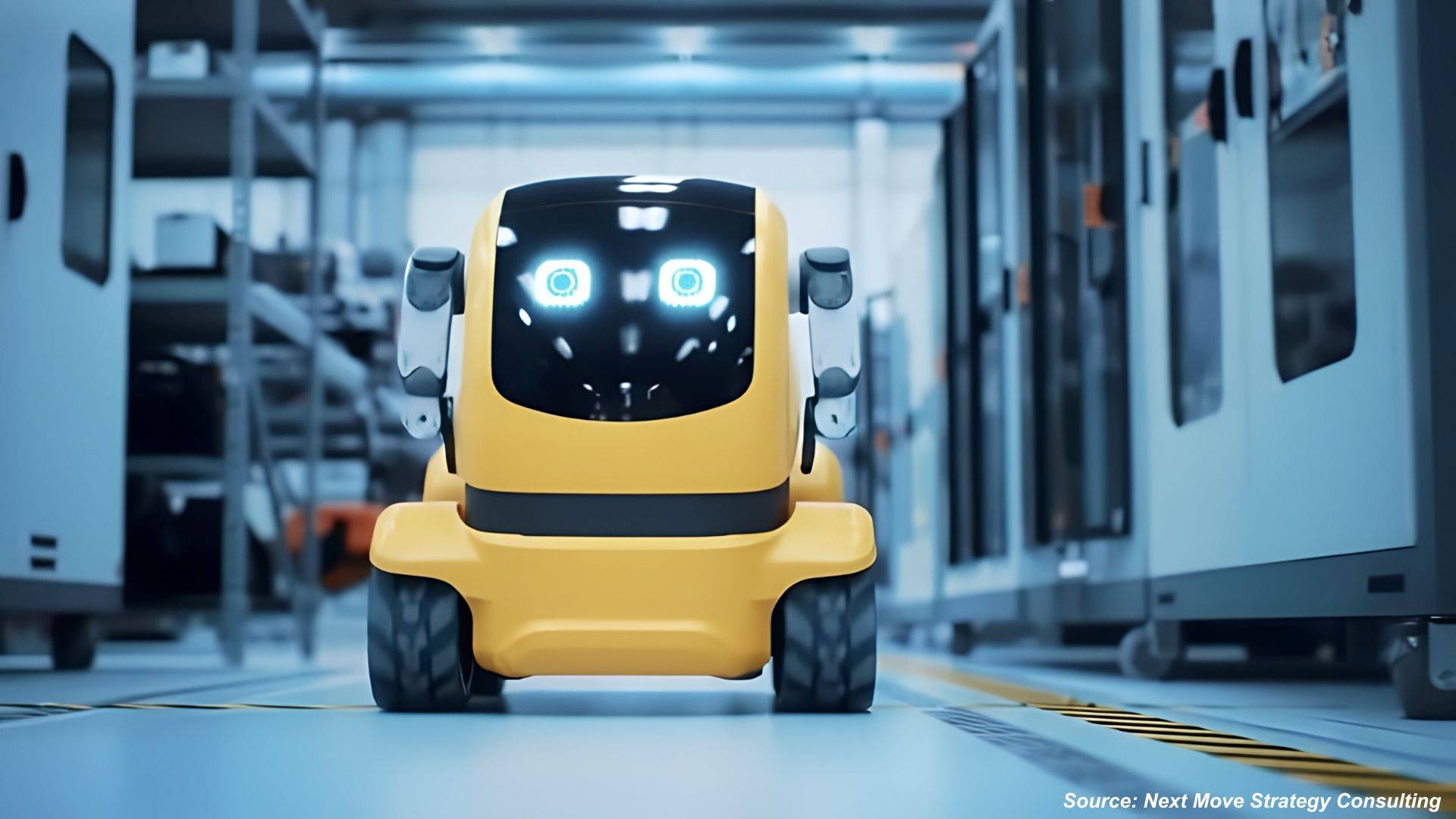
This image illustrates the evolving architecture of service robotics within the hospitality industry and highlights how intelligent robots are becoming part of the future workforce. At the center of the diagram is a puzzle-based framework representing the four core foundations of service robots: Technologies, Intelligence, Mechanics, and Roles. These interconnected components demonstrate how robotics systems combine artificial intelligence, operational functionality, and mechanical design to support hospitality operations.
The outer layer focuses on important service robot criteria such as capacity, navigation, charging, functionality, maintenance & resources, and purchase methods. These factors are critical for businesses when evaluating robotics deployment in hotels, restaurants, and customer service environments.
The image also emphasizes a human-centric approach, showing that service robotics is designed to enhance human work rather than completely replace it. The mention of “job-enhancement robots” reflects the growing industry focus on collaborative automation, where robots assist employees with repetitive tasks while improving operational efficiency and customer experiences.
Overall, the infographic highlights how service robotics is reshaping hospitality operations through intelligent automation, workforce support, and integrated robotic ecosystems.
Major Trends Shaping the Present of Service Robotics
Expansion Beyond Indoor Commercial Automation
A major development in 2026 is the expansion of service robotics into outdoor and smart-home environments. KEENON Robotics introduced the KEENMOW K1 robotic lawn mower, marking the company’s entry into autonomous outdoor robotics. The mower uses a 3D LiDAR-Vision fusion perception system that allows it to navigate environments and avoid obstacles more accurately.
This launch signals a broader industry transition where robotics companies are no longer limiting innovation to restaurants, hotels, or warehouses. Instead, organizations are developing intelligent robotic solutions for residential and outdoor applications, creating new growth opportunities across consumer and commercial segments.
Artificial Intelligence Is Becoming Central to Robotics
Another important trend is the increasing integration of artificial intelligence into service robotics systems. Reports related to humanoid robotics developments highlighted the use of imitation learning and reinforcement learning technologies. These AI methods allow robots to improve interactions and adapt to changing environments more effectively.
As AI capabilities improve, service robots are expected to become more responsive, context-aware, and operationally flexible. This is particularly important for customer-facing environments where adaptability directly affects user experience.
Major Robotic Vision Applications Driving Intelligent Robotics
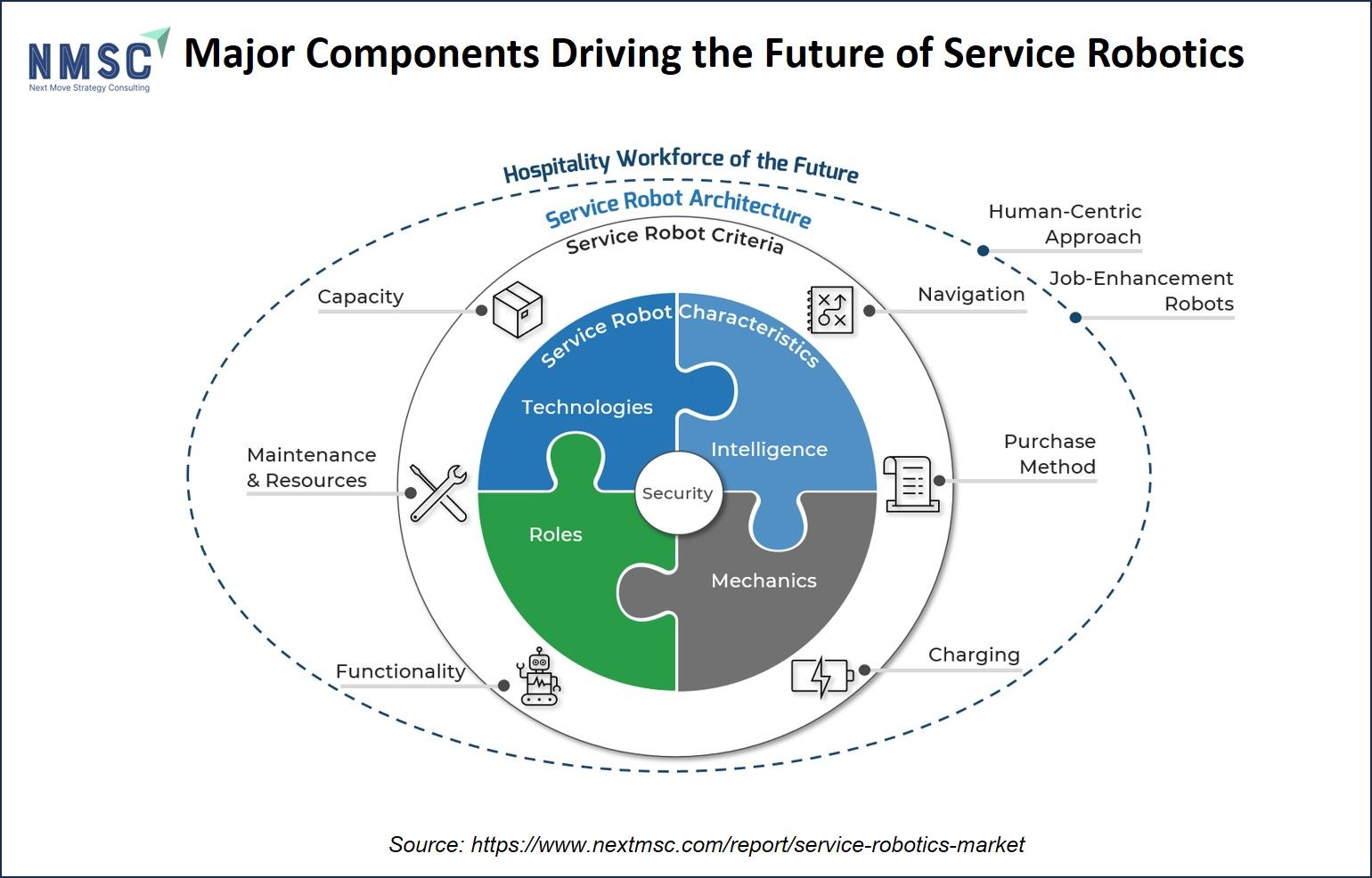
The infographic presents a strategic overview of how robotic vision is being applied across different robotics sectors. The diagram categorizes robotic vision applications into four major areas: collaborative robotics, surgical robotics, autonomous navigation, and industrial automation.
Collaborative robots rely on robotic vision to safely interact with humans and adapt to changing environments. These systems are designed for flexibility and efficiency in shared workspaces. Surgical robots, on the other hand, demand advanced vision systems capable of delivering high precision and adaptability during sensitive medical procedures.
The image also emphasizes the growing importance of autonomous navigation technologies. Navigation robots use robotic vision to understand surroundings, detect obstacles, and move independently in dynamic environments. In industrial automation, robotic vision enables precise manufacturing operations, quality inspection, and repetitive assembly tasks with high accuracy.
The visual ultimately reflects how robotic vision is becoming a foundational technology for intelligent robotics by improving machine awareness, adaptability, and precision across healthcare, manufacturing, logistics, and collaborative work environments.
Robotics Is Becoming More Visible to Consumers
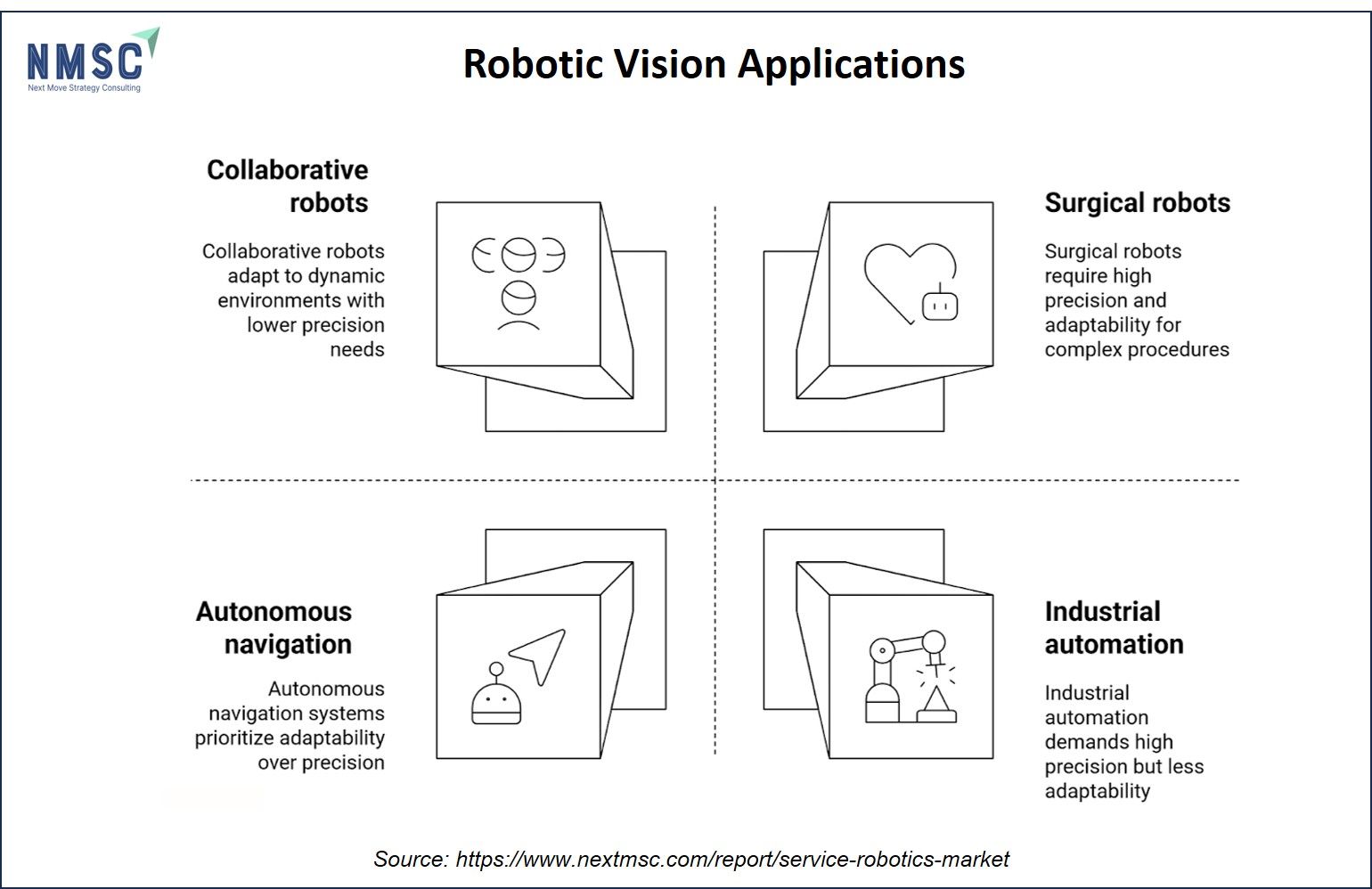
Unlike earlier generations of industrial robotics that operated behind the scenes, modern service robotics is increasingly visible in public spaces. Humanoid robots at exhibitions, hotels, and even airlines demonstrate how businesses are positioning robotics as part of the customer experience itself.
While increased visibility strengthens brand innovation strategies, it simultaneously requires organizations to proactively manage the market's reaction. Businesses must address public concerns related to safety, operational reliability, and workforce displacement to build lasting consumer trust in these highly sensitive environments.
Industry Impact Analysis
Service robotics could significantly influence industries where repetitive workflows, customer interaction, and operational consistency are critical. Hospitality businesses may benefit from improved delivery efficiency and facility management support, while aviation companies are experimenting with robotic engagement tools to enhance passenger experiences.
However, adoption is not without challenges. Public reactions to humanoid robots in aviation demonstrated that some consumers remain cautious about robotics in highly sensitive environments. Businesses must therefore balance automation benefits with customer trust and operational safety.
For institutional investors and corporate strategists, scalability remains the key issue. Experimental demonstrations attract attention, but long-term value depends on whether robotics systems can operate reliably in real-world commercial settings over extended periods.
Key Data & Statistics
|
Data Point |
Details |
|
KEENON deployment footprint |
More than 600 global locations |
|
Major launch event |
CES 2026 |
|
Aviation robotics trial |
Pobeda Airlines commercial flight |
|
Core navigation technology |
3D LiDAR-Vision fusion system |
What Could the Future of Service Robotics Look Like?
The future direction of service robotics appears increasingly focused on multi-functional humanoid systems and AI-enabled automation. Companies are moving away from isolated robotics applications and toward integrated service ecosystems capable of supporting different operational tasks simultaneously.
Another major trend is the convergence of commercial and consumer robotics. Technologies originally designed for hotels or restaurants are now influencing residential automation products such as robotic lawn mowers and intelligent home service systems.
Despite this momentum, adoption challenges remain important. Businesses will need to address regulatory requirements, workforce adaptation concerns, and customer trust issues before large-scale deployment becomes standard across industries.
For business leaders, the next few years will likely determine whether service robotics becomes a mainstream operational technology or remains concentrated within specialized pilot programs.
Leading Companies Driving Innovation in the Service Robotics Industry
The service robotics market is highly competitive and includes several prominent companies such as Intuitive Surgical, Inc., Ecovacs Robotics Co., Ltd., iRobot Corporation, Boston Dynamics, Inc., UBTECH Robotics Corp., Omron Corporation, SoftBank Robotics Group Corp., Locus Robotics Corp., Mobile Industrial Robots (MiR) A/S, Starship Technologies Ltd., Fetch Robotics, Inc., Blue Ocean Robotics A/S, PAL Robotics S.L., Anybotics AG, Clearpath Robotics Inc., Geek+ Technology Co., Ltd., Vecna Robotics Corp., Diligent Robotics, Inc., Aethon, Inc., and Agility Robotics, Inc. among others. These companies are increasingly adopting strategic partnerships, collaborations, and joint venture initiatives across different regions to strengthen their market presence and maintain a competitive edge in the global service robotics industry.

Service Robotics Applications Market Share in 2025
The pie chart illustrates the distribution of service robotics applications across major industries in 2025, highlighting how different sectors are increasingly adopting robotic automation technologies to improve efficiency, customer experience, and operational performance.
The hospitality sector holds the largest share at 32%, reflecting the growing use of service robots in hotels, restaurants, and customer support operations. Businesses in this sector are increasingly deploying robots for food delivery, room service assistance, cleaning, and guest interaction to streamline workflows and enhance service quality.
Healthcare accounts for 25% of the market share, driven by rising demand for robotic assistance in surgical procedures, patient care support, rehabilitation, and hospital automation. The increasing need for precision, efficiency, and reduced workload in healthcare environments continues to accelerate robotics adoption.
The retail industry represents 20% of the market, where robots are being used for inventory management, customer assistance, automated checkout systems, and warehouse operations. Retailers are leveraging robotics to improve operational accuracy and customer engagement.
Logistics and warehousing contribute 15% of the market share due to the expanding role of autonomous robots in material handling, package movement, and warehouse navigation. Automation in logistics is becoming increasingly important for improving supply chain efficiency and reducing operational delays.
The remaining 8% falls under other applications, including smart home robotics, security robots, and emerging autonomous service technologies across different industries.
Overall, the pie chart highlights the expanding role of service robotics across multiple sectors, with hospitality and healthcare emerging as the leading areas of adoption due to their strong demand for operational efficiency and intelligent automation.

Next Steps
Organizations evaluating service robotics strategies should begin by identifying operational areas with repetitive workflows and customer-service dependencies. Decision-makers should also monitor pilot programs in hospitality and aviation to understand how customer-facing robotics performs in live environments.
Businesses considering robotics adoption should prioritize vendors with scalable ecosystem capabilities and strong AI integration strategies. Operational reliability and customer trust should remain central considerations throughout deployment planning.
-
Identify repetitive operational tasks that can benefit from automation
-
Evaluate customer-facing areas where robotics can improve service efficiency
-
Monitor pilot deployments in hospitality and aviation sectors
-
Assess integration costs, infrastructure needs, and long-term scalability
-
Prioritize robotics vendors with strong AI and ecosystem capabilities
Conclusion
Service robotics is becoming one of the most visible areas of intelligent automation in 2026. Developments from KEENON Robotics and Pobeda Airlines demonstrate how humanoid systems, autonomous navigation technologies, and AI-driven robotics are moving into practical commercial environments.
For investors, procurement leaders, and operational strategists, service robotics represents more than a technology trend. It reflects a broader shift toward intelligent service infrastructure capable of improving efficiency while reshaping customer experiences. Although adoption challenges remain, the industry is clearly progressing toward wider commercial relevance across hospitality, aviation, and smart automation sectors
About the Author
 Sanyukta Deb
— Sanyukta Deb is Digital Marketing Team Lead at Next Move Strategy Consulting, where she has led content strategy and technical SEO for the firm's B2B market research publications for over 2 years. Her editorial process translates NextMSC's primary and secondary research — spanning technology, industrial, and consumer sectors — into commercial narratives, backed by search-intent, keyword, and competitive analysis. She brings 5 years of overall experience in digital marketing and content strategy.
Sanyukta Deb
— Sanyukta Deb is Digital Marketing Team Lead at Next Move Strategy Consulting, where she has led content strategy and technical SEO for the firm's B2B market research publications for over 2 years. Her editorial process translates NextMSC's primary and secondary research — spanning technology, industrial, and consumer sectors — into commercial narratives, backed by search-intent, keyword, and competitive analysis. She brings 5 years of overall experience in digital marketing and content strategy.
About the Reviewer
 Debashree Dey
— Debashree Dey is Assistant Manager at Next Move Strategy Consulting, where she supports cross-vertical market content and communications across diverse industries for 6 years. Her professional background includes senior content writing, communications, and published manuscript authorship, with experience developing audience-focused business narratives and maintaining clear, consistent messaging. Her role supports research-led content development and editorial quality across NextMSC publications.
Debashree Dey
— Debashree Dey is Assistant Manager at Next Move Strategy Consulting, where she supports cross-vertical market content and communications across diverse industries for 6 years. Her professional background includes senior content writing, communications, and published manuscript authorship, with experience developing audience-focused business narratives and maintaining clear, consistent messaging. Her role supports research-led content development and editorial quality across NextMSC publications.

















Add Comment