7 Powerful Military Drone Market Trends Reshaping Global Defense
Introduction
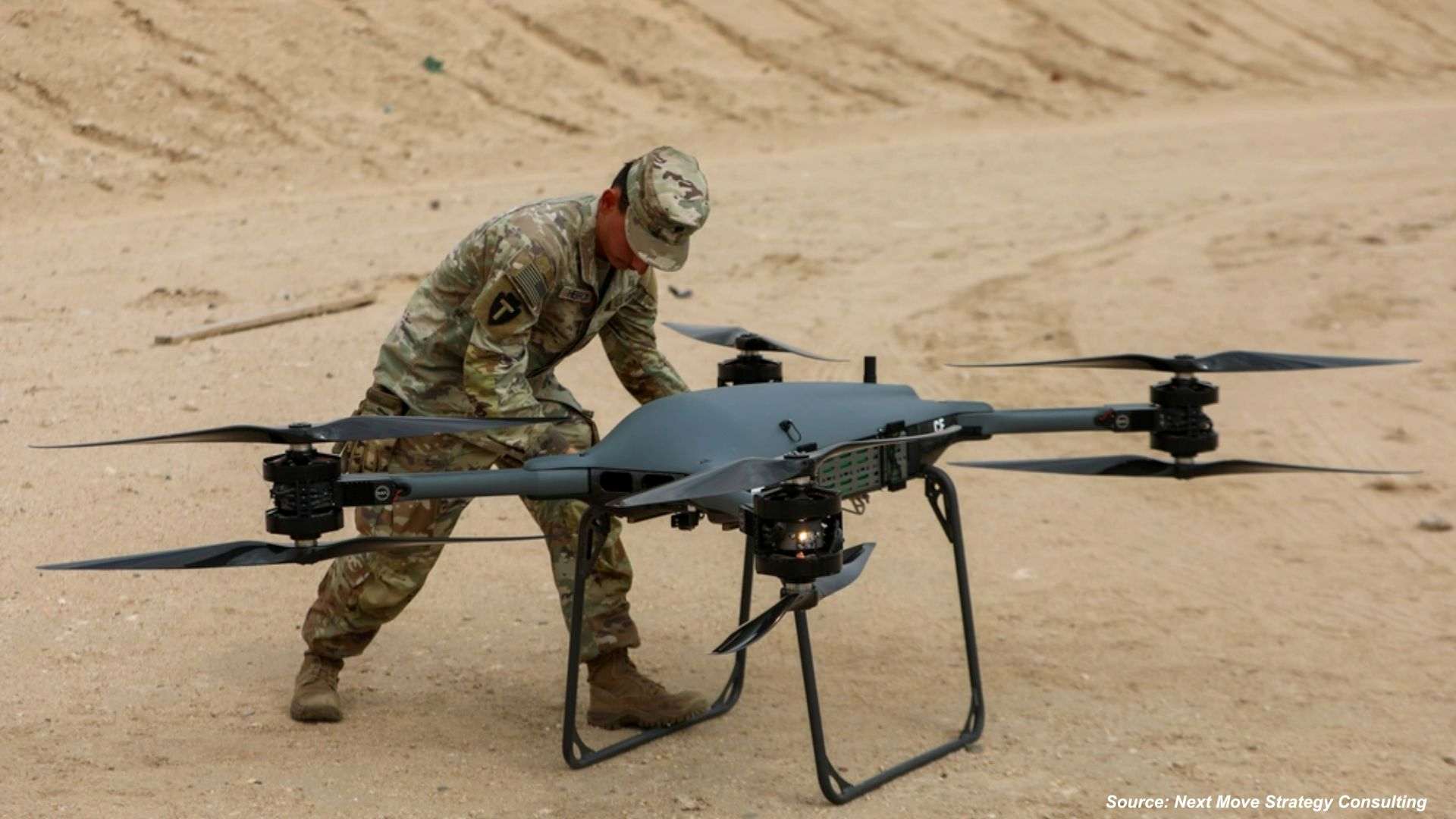
The global Military Drone Market has entered a period of irreversible strategic transformation. What was once a specialized capability reserved for a handful of technologically advanced militaries has become the defining procurement priority of defense establishments worldwide — from NATO alliance members racing to close capability gaps to Indo-Pacific powers accelerating autonomous systems integration across all warfighting domains.
In 2026, the convergence of record-breaking global defense budgets, landmark alliance-level drone investment commitments, and the rapid maturation of AI-enabled autonomous mission systems has elevated the military drone market from a supplementary procurement category to the central axis of modern force modernization. According to Next Move Strategy Consulting (NMSC), the global military drone market is projected to reach USD 14.40 billion in 2026, advancing to USD 47.51 billion by 2035 at a compound annual growth rate (CAGR) of 14.18%.
For C-level defense industry executives, institutional investors, and national security policymakers, the strategic signals are unambiguous: the autonomous aerial systems revolution is not a future scenario — it is the present operational reality. This article examines the seven most consequential trends reshaping the military drone market in 2026, the industry impact of landmark recent developments, and the strategic outlook through 2035.
For More Information: Download FREE Sample on Military Drone Market Report
Autonomous Dominance: The Forces and Events Redefining the Military Drone Market in 2026
NATO Commits USD 40 Billion to Counter-Drone Capabilities at Ankara Summit
The single most consequential institutional development in the military drone market in 2026 occurred on July 7, at the NATO Summit Defence Industry Forum in Ankara, Turkey. NATO Allies formally announced that over USD 40 billion will be invested in counter-drone capabilities over the next five years. Simultaneously, the Alliance committed to training five times as many drone operators by the end of 2027. To accelerate procurement, NATO announced the establishment of a counter-drone marketplace ensuring that systems are NATO-tested, NATO-compatible, and available for rapid purchase. NATO's Supply and Procurement Agency (NSPA) also awarded a contract in the hundreds of millions of dollars to procure surveillance drones for Allies.
NATO Secretary General Mark Rutte's remarks at the Forum underscored the doctrinal shift: "Drones have fundamentally altered the character of modern warfare and become a decisive factor on the battlefield. Effective defence relies on the ability to rapidly detect, identify, and neutralise drones."
This USD 40 billion commitment is not merely a procurement signal — it is a structural demand catalyst for the entire military drone market ecosystem, encompassing ISR platforms, loitering munitions, swarm-capable systems, counter-UAS technology, and the AI-enabled command and control infrastructure that binds them together.
The U.S. DoD Creates History's First Dedicated Autonomy Budget Line at USD 13.4 Billion
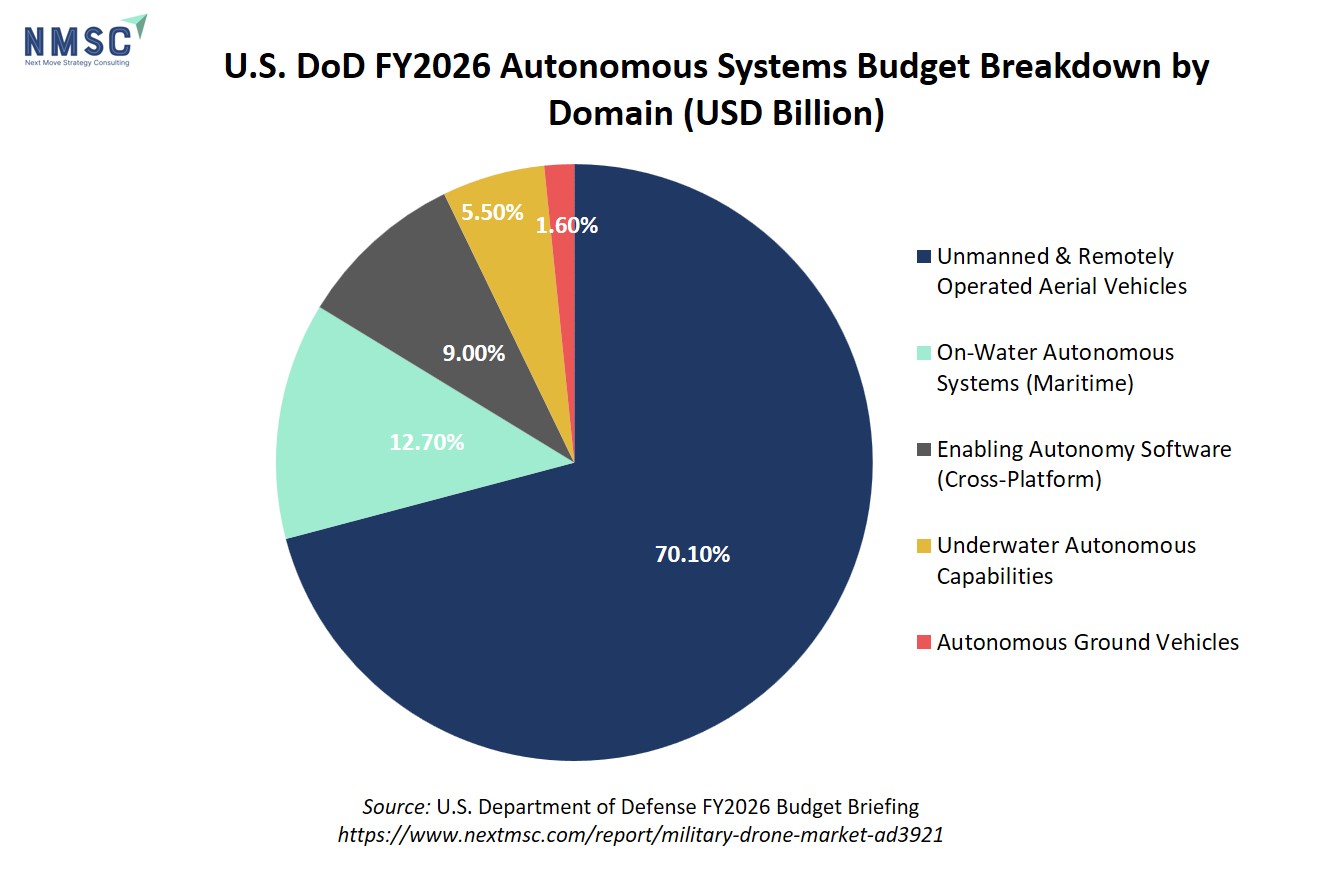
In its FY2026 budget request, the U.S. Department of Defense established, for the first time in its history, a dedicated autonomy and autonomous systems budget line — allocating USD 13.4 billion specifically to this category. A senior defense official confirmed to DefenseScoop: "This budget is the first year that we are calling out — specifically — our autonomy line in its own section."
The breakdown of the USD 13.4 billion allocation is as follows: USD 9.4 billion for unmanned and remotely operated aerial vehicles; USD 1.7 billion for on-water autonomous systems; USD 7.34 million for underwater autonomous capabilities; USD 210 million for autonomous ground vehicles; and USD 1.2 billion for enabling autonomy software — the cross-platform AI and autonomy stack that integrates all unmanned systems into a unified operational architecture. Additionally, the DoD requested USD 3.1 billion for counter-UAS capabilities across the services.
Pentagon Awards USD 500 Million Counter-Drone Contract to Perennial Autonomy
In May 2026, the Pentagon awarded a USD 500 million contract to Perennial Autonomy — a company recognized for its AI-enabled interceptor systems — to accelerate procurement of counter-drone technology. The contract, structured as a three-year ceiling agreement through Joint Interagency Task Force 401, supports enterprise-wide counter-unmanned aerial system capabilities across the U.S. defense establishment. Separately, AeroVironment was awarded a USD 117 million contract on June 3, 2026, for 82 P550 unmanned aircraft systems for the U.S. Army.
Proposed FY2027 Budget Allocates USD 54 Billion to the Defense Autonomous Warfare Group
In April 2026, the proposed U.S. federal budget for fiscal year 2027 revealed a transformational funding increase for the Defense Autonomous Warfare Group (DAWG) — the Pentagon's dedicated drone development organization. The proposed allocation of nearly USD 54 billion over five years represents an increase from the USD 225.9 million the group received in FY2026, with the option to accelerate spending to a two-year timeline. The funding is intended to expand the industrial base and maintain consistent autonomous systems production lines.
SIPRI Confirms Record Global Military Spending of USD 2,718 Billion in 2024
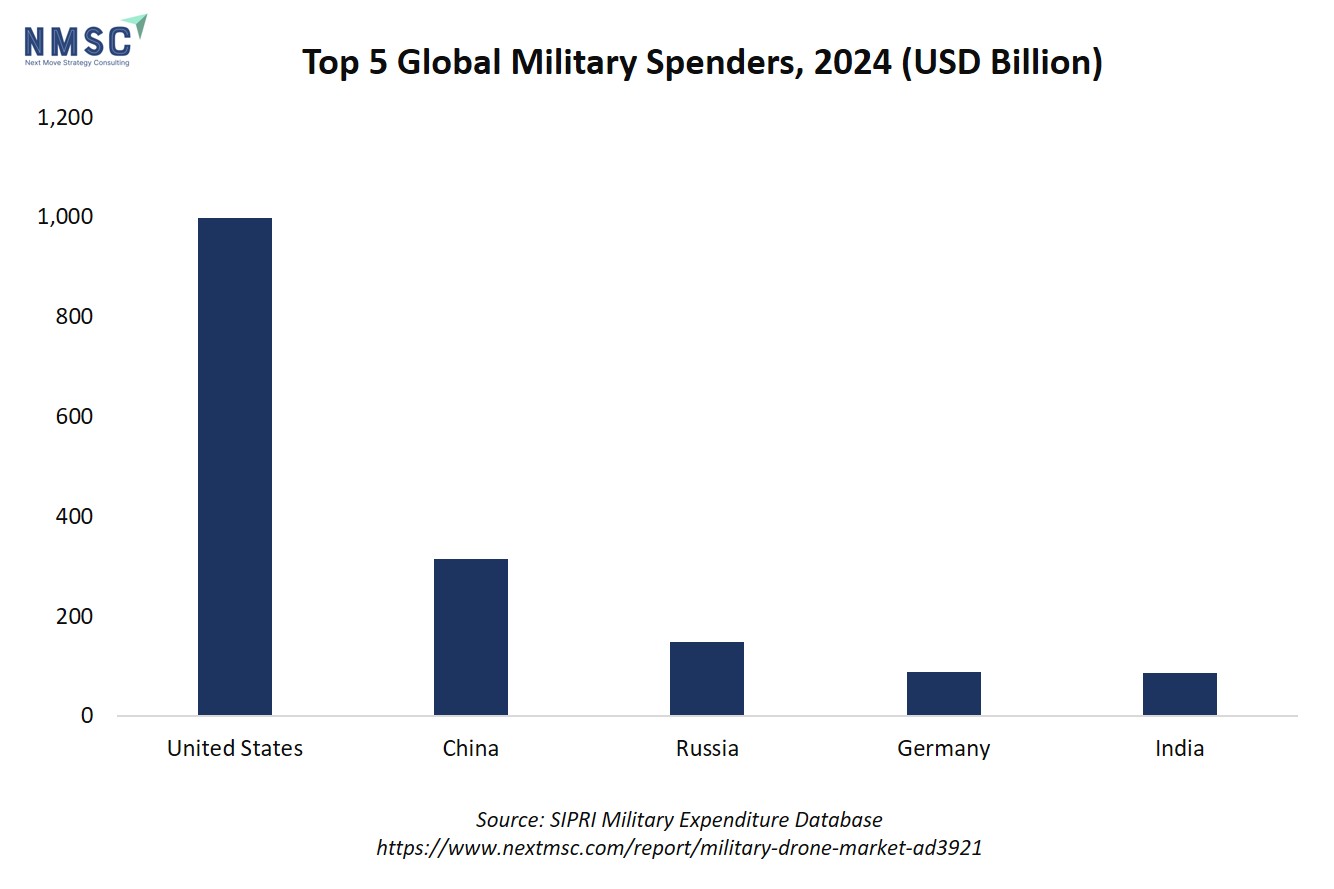
The structural demand foundation for the military drone market is anchored in a historic global defense spending surge. According to the Stockholm International Peace Research Institute (SIPRI), world military expenditure reached USD 2,718 billion in 2024 — an increase of 9.4% in real terms from 2023 and the steepest year-on-year rise since at least the end of the Cold War. Military spending increased in all world regions. The top five military spenders — the United States (USD 997 billion), China (USD 314 billion), Russia (USD 149 billion), Germany (USD 88.5 billion), and India (USD 86.1 billion) — accounted for 60% of the global total, with combined spending of USD 1,635 billion.
Europe's military spending rose by 17% to USD 693 billion in 2024, driven by the ongoing conflict in Ukraine and NATO burden-sharing commitments. Germany's military expenditure increased by 28% to USD 88.5 billion, making it the largest military spender in Central and Western Europe for the first time since reunification. Poland's military spending grew by 31% to USD 38.0 billion, representing 4.2% of GDP.
Shield AI and JSW Defence Establish India Manufacturing Partnership for V-BAT Systems
In November 2024, Shield AI signed a strategic partnership with India's JSW Defence to produce and supply Shield AI's V-BAT Group-3 VTOL unmanned systems in India under local manufacturing and technology-transfer arrangements — a landmark development reflecting the growing importance of sovereign procurement mandates and indigenous production requirements in the military drone market.
Thales and Software République Integrate Drones into Public Safety and Defence Scenarios
In June 2025, Thales and ecosystem partners participated in the Software République initiative to integrate long- and short-range drones into public safety and defense scenarios — demonstrating the expanding role of European defense technology consortia in developing interoperable, software-defined drone architectures for both military and dual-use applications.
NMSC Strategic Perspective: The Software-Defined Military Drone as the New Competitive Paradigm
NMSC's analysis of the military drone market identifies the transition from hardware-centric to software-defined platform architectures as the most consequential structural shift reshaping competitive positioning in 2026. The industrial value chain is being fundamentally restructured: autonomy software platforms, certifiable AI mission-management stacks, secure datalinks, and SATCOM relay technologies are emerging as the primary sources of differentiation and margin capture — while airframe manufacturing increasingly commoditizes.
NMSC's research further identifies AI-enabled autonomy as the defining capability dimension across all procurement cycles. Governments and prime contractors are actively testing cooperative autonomy, swarm coordination, and manned-unmanned teaming concepts. However, certification, safety assurance, and doctrinal alignment continue to lag technical progress — creating a structural opportunity for vendors that develop modular, certifiable autonomy architectures with demonstrable safety artifacts. Companies that productize standardized autonomy modules and resilient datalinks will secure higher margins and accelerated procurement within allied interoperability programs.
NMSC also identifies the Robot as a Service (RaaS) and through-life digital services model as an emerging revenue architecture in the commercial defense sector, where prime contractors are increasingly bundling hardware, software updates, remote monitoring, and performance analytics into long-term sustainment contracts — generating recurring revenue streams that command premium valuations from institutional investors.
Section Summary: The military drone market in 2026 is defined by an unprecedented convergence of institutional investment commitments, record defense budgets, and AI-native platform innovation. NATO's USD 40 billion counter-drone pledge, the U.S. DoD's historic USD 13.4 billion autonomy budget line, and SIPRI's confirmation of USD 2,718 billion in global military spending collectively establish the most favorable structural demand environment in the history of the military drone market.
Key Takeaways:
-
NATO Allies committed USD 40 billion to counter-drone capabilities over five years at the July 2026 Ankara Summit, with a target to train five times as many drone operators by end of 2027.
-
The U.S. DoD's FY2026 budget established the first-ever dedicated autonomy line at USD 13.4 billion, with USD 9.4 billion allocated specifically to aerial drones.
-
SIPRI confirmed global military expenditure reached a record USD 2,718 billion in 2024 — the steepest annual increase since the end of the Cold War.
-
NMSC identifies software-defined autonomy architecture and certifiable AI mission-management stacks as the primary competitive differentiators and margin drivers in the military drone market through 2035.
Industry Impact Analysis
Geopolitical Instability Is Structurally Accelerating Military Drone Procurement Timelines
The operational lessons of the Ukraine conflict have fundamentally altered procurement doctrine across NATO and partner nations. The demonstrated effectiveness of low-cost loitering munitions, first-person-view (FPV) attack drones, and autonomous ISR platforms in contested environments has compressed procurement timelines and elevated attritable drone systems — designed for high-volume, low-cost production and expendable deployment — to a top-tier acquisition priority. CNBC reported in July 2026 that NATO unveiled a new drone initiative, the United Kingdom earmarked billions of pounds for drones and counter-drone systems, and Germany accelerated its autonomous systems procurement programs — all within a single quarter.
Export Controls and Sovereign Procurement Mandates Are Reshaping Market Access
Geopolitical competition and tightening export control regimes are compelling defense buyers to favor domestically manufactured or allied-sourced platforms, particularly for sensitive components such as encrypted datalinks, GNSS-resilient navigation modules, and propulsion systems. Firms with established local industrial footprints, offset arrangements, or licensed production agreements are increasingly winning competitive tenders, as governments prioritize supply-chain sovereignty. This dynamic raises barriers to entry for foreign suppliers while expanding program scale for companies able to operate within host-nation ecosystems — a structural advantage that is reshaping competitive positioning across Asia-Pacific, the Middle East, and Europe.
The Counter-UAS Ecosystem Is Emerging as a Parallel High-Growth Market
The rapid proliferation of military drones has created an equally significant counter-UAS market. The U.S. DoD's FY2026 request of USD 3.1 billion for counter-UAS capabilities across the services — combined with the Pentagon's USD 500 million contract to Perennial Autonomy and NATO's counter-drone marketplace initiative — signals that the detect-identify-neutralize mission set is becoming a procurement category of comparable scale to offensive drone systems themselves. Defense operators are confronting a fundamental cost asymmetry: enemy drones often cost a fraction of the multimillion-dollar missiles previously deployed to neutralize them, driving urgent investment in AI-enabled, cost-effective counter-drone solutions.
Multi-Domain Integration Is Redefining the Military Drone's Role in Force Architecture
Modern militaries are transitioning from platform-centric doctrines to network-centric, multi-domain operations in which information superiority and real-time situational awareness are operationally decisive. Military drones are central to this transition, providing continuous ISR, electronic intelligence, targeting data, and communication relay functions that feed directly into integrated C4ISR architectures. The U.S. Navy's FY2026 autonomy investment of USD 5.3 billion — USD 2.2 billion above FY2025 — encompasses procurement of MQ-25 carrier-based unmanned tankers, unmanned surface vessels, and unmanned undersea systems, reflecting the full multi-domain scope of autonomous systems integration.
Asia-Pacific Defense Modernization Is Creating Sustained Structural Demand
Asia-Pacific is one of the fastest-growing military drone markets, driven by territorial disputes, maritime surveillance requirements, and rapid defense modernization across both established and emerging military powers. SIPRI data confirms that Japan's military spending rose by 21% to USD 55.3 billion in 2024 — the largest annual increase since 1952 — while China's military expenditure grew by 7.0% to an estimated USD 314 billion, marking three decades of consecutive growth. India's military expenditure reached USD 86.1 billion in 2024. These spending trajectories are directly translating into accelerated procurement of tactical UAVs, MALE-class platforms, loitering munitions, and maritime ISR systems across the region.
Section Summary: The military drone market's industry impact in 2026 is being driven by a powerful combination of geopolitical instability accelerating procurement timelines, sovereign manufacturing mandates reshaping market access, the emergence of counter-UAS as a parallel high-growth ecosystem, and Asia-Pacific defense modernization generating sustained structural demand across all drone platform categories.
Key Takeaways:
-
Operational lessons from the Ukraine conflict have elevated attritable, high-volume drone systems to a top-tier NATO procurement priority, compressing acquisition timelines across alliance members.
-
The U.S. DoD's USD 3.1 billion counter-UAS budget request and NATO's counter-drone marketplace signal that the detect-identify-neutralize mission set is becoming a procurement category of comparable scale to offensive drone systems.
-
Japan's 21% military spending increase and China's three decades of consecutive defense budget growth are directly fueling Asia-Pacific military drone procurement acceleration.
-
Sovereign procurement mandates and export control regimes are structurally advantaging companies with established local industrial footprints, offset arrangements, and licensed production agreements.
Pros and Cons of Recent Market Developments
|
Recent Development |
Pros |
Cons |
|
NATO USD 40 Billion Counter-Drone Commitment (July 2026) |
Creates a massive, multi-year institutional demand signal for the entire drone and counter-drone ecosystem; NATO-tested marketplace accelerates procurement cycles |
Counter-drone focus may temporarily divert procurement budgets from offensive drone platform investment; interoperability requirements add certification complexity |
|
U.S. DoD USD 13.4 Billion Dedicated Autonomy Budget Line (FY2026) |
Establishes the largest single-year government investment in autonomous systems in history; provides multi-year revenue visibility for prime contractors and autonomy software vendors |
Concentrated U.S. government dependency creates revenue risk for suppliers if budget priorities shift; certification timelines for autonomous functions may delay fielding |
|
Pentagon USD 500 Million Perennial Autonomy Contract (May 2026) |
Validates AI-enabled counter-drone technology at enterprise scale; accelerates commercial-to-military technology transition |
Three-year contract ceiling creates execution risk; counter-drone technology obsolescence cycles are rapid given adversary drone innovation pace |
|
Proposed USD 54 Billion DAWG Budget (FY2027) |
Signals a generational commitment to autonomous warfare capability; would dramatically expand the U.S. drone industrial base and production capacity |
Proposed budget subject to Congressional appropriations process; five-year spending horizon introduces execution and oversight risk |
|
SIPRI-Confirmed Record USD 2,718 Billion Global Military Spending (2024) |
Provides the broadest possible demand foundation for military drone procurement across all regions and platform categories |
Rapid spending increases may outpace industrial base capacity, creating delivery bottlenecks; economic and social trade-offs of sustained high defense spending may generate political pressure for reductions |
|
Shield AI–JSW Defence India Manufacturing Partnership |
Establishes a replicable model for sovereign production compliance in high-growth emerging markets; positions Shield AI for Indian defense procurement programs |
Technology transfer arrangements carry IP risk; local manufacturing ramp-up timelines may lag procurement demand |
|
Export Controls and Sovereign Procurement Mandates |
Incentivizes local industrial investment and technology transfer, strengthening host-nation defense industrial bases |
Significantly increases contractual complexity and acquisition cycle length; limits addressable market for foreign suppliers without local partnerships |
Key Data & Statistics
Military Drone Market — Regional Competitive Landscape & Growth Drivers (2026–2035)
|
Region |
2025 Value (USD Bn) |
2035 Forecast (USD Bn) |
CAGR (2026–2035) |
Primary Growth Driver |
Key Countries |
|
North America |
~5.5 |
~19.0 |
~13.2% |
USD 13.4B DoD autonomy budget; MALE/HALE program continuity; manned-unmanned teaming |
U.S., Canada |
|
Europe |
~2.8 |
~10.5 |
~14.2% |
NATO USD 40B counter-drone pledge; ReArm Europe; Germany +28% defense spending |
UK, Germany, France, Poland, Nordics |
|
Asia-Pacific |
~2.4 |
~11.0 |
~16.4% |
China USD 314B defense budget; Japan +21% spending; India sovereign manufacturing |
China, India, Japan, South Korea, Taiwan |
|
Middle East & Africa |
~1.0 |
~4.8 |
~17.0% |
Active conflict-driven demand; Vision 2030 modernization; border and maritime security |
Israel, Saudi Arabia, UAE, Turkey |
|
Latin America |
~0.5 |
~2.2 |
~15.9% |
Counter-narcotics; border surveillance; cost-effective tactical UAV procurement |
Brazil, Mexico, Colombia |
Future Outlook & Forecast for the Military Drone Market
NMSC Market Size and CAGR Projections
According to Next Move Strategy Consulting, the global military drone market was valued at USD 12.21 billion in 2025 and is projected to reach USD 14.40 billion in 2026, advancing to USD 47.51 billion by 2035 at a CAGR of 14.18% from 2026 to 2035. This trajectory is underpinned by three structural forces: the continuous expansion of global defense budgets driven by geopolitical instability and NATO burden-sharing commitments; the rapid maturation of AI-enabled autonomy, sensor fusion, and secure datalink technologies that are extending drone mission profiles into electronic warfare, logistics, and networked strike; and the proliferation of sovereign manufacturing mandates that are expanding the military drone industrial base across Asia-Pacific, the Middle East, and Europe.
AI-Native Autonomy Will Define the Next Decade of Platform Competition
NMSC's analysis identifies AI-enabled autonomy as the primary value driver in the military drone market through 2035. The market is transitioning from remotely piloted systems — where human operators control every mission action — to semi-autonomous and fully autonomous platforms capable of swarm coordination, dynamic rerouting, target identification, and manned-unmanned teaming. The U.S. DoD's USD 1.2 billion FY2026 investment in enabling autonomy software — described by senior defense officials as "the central brain" that integrates all unmanned systems — signals that software-defined autonomy architecture will be the decisive competitive differentiator in large-program procurement through 2035.
Two-Track Production Strategy Will Become the Industry Standard
NMSC's research identifies a structural bifurcation in military drone procurement that will define industrial strategy through 2035: the simultaneous scaling of premium long-endurance MALE/HALE platforms for strategic ISR and precision strike, alongside high-volume, low-cost production of attritable tactical systems and loitering munitions for distributed combat operations. Prime contractors that fail to develop a credible two-track production strategy — maintaining high-assurance, long-life airframes while investing in rapid, low-cost manufacturing for expendable systems — will cede significant market share to specialized competitors.
Strategic M&A Will Intensify Through 2028 as Primes Acquire Autonomy Specialists
NMSC's analysis indicates that mergers, acquisitions, and joint-venture strategies will intensify as prime contractors strengthen their autonomy, payload, and manufacturing capabilities. Market activity will increasingly reflect large primes acquiring or partnering with software, sensor, and communications specialists, as well as establishing local joint ventures to comply with sovereign procurement and offset mandates. NMSC identifies the 2025–2028 period as the most active window for consolidation opportunities among autonomy software companies, secure datalink providers, AI mission-management stack developers, and high-throughput manufacturers of tactical and loitering systems.
Europe's ReArm Initiative and NATO Commitments Will Sustain a Decade of Elevated Procurement
SIPRI's assessment that "Europe has entered a period of high and increasing military spending that is likely to continue for the foreseeable future" — anchored by Germany's €100 billion special defense fund, Poland's 4.2% of GDP defense spending, and NATO's 18-member 2%-of-GDP compliance milestone — establishes Europe as a sustained high-growth military drone market through 2035. The Guardian reported in May 2026 that Europe is scrambling to spend billions on weapons including drones, with the ReArm Europe initiative mobilizing up to €800 billion in defense investment capacity.
Section Summary: The military drone market's trajectory to USD 47.51 billion by 2035 is underpinned by record global defense budgets, AI-native autonomy maturation, a structural two-track production bifurcation between premium MALE/HALE platforms and high-volume attritable systems, and a decade of elevated European procurement driven by NATO commitments and the ReArm Europe initiative.
Key Takeaways:
-
The global military drone market is projected to grow from USD 14.40 billion in 2026 to USD 47.51 billion by 2035 at a CAGR of 14.18%, per NMSC.
-
AI-enabled autonomy software — including swarm coordination, manned-unmanned teaming, and certifiable mission-management stacks — will be the primary competitive differentiator and margin driver through 2035.
-
A two-track production strategy combining premium long-endurance platforms with high-volume attritable systems will become the industry standard for competitive prime contractors.
-
The 2025–2028 period represents the most active M&A window in the military drone market, with prime contractors acquiring autonomy software, secure datalink, and AI mission-management capabilities.
Next Steps for Stakeholders
For Defense Industry Executives and Prime Contractors:
-
Develop and execute a credible two-track production strategy — simultaneously sustaining high-assurance MALE/HALE platform programs and investing in rapid, low-cost manufacturing capacity for attritable tactical systems and loitering munitions, as NMSC identifies this bifurcation as the defining industrial strategy requirement through 2035.
-
Prioritize certifiable autonomy architecture as the primary product investment theme, ensuring that AI mission-management stacks, swarm coordination modules, and secure datalinks meet the safety assurance and certification requirements that procurement authorities are increasingly mandating as conditions of contract award.
-
Establish regional industrial partnerships and joint ventures in high-growth markets — particularly India, the Gulf Cooperation Council, and Eastern Europe — to satisfy sovereign procurement mandates, offset requirements, and technology-transfer obligations that are becoming standard conditions in competitive defense tenders.
-
Integrate through-life digital services — including software updates, remote monitoring, predictive maintenance, and performance analytics — into platform sustainment contracts to generate recurring revenue streams that command premium valuations and reduce dependency on lumpy capital equipment procurement cycles.
For Institutional Investors and Private Equity:
-
Target autonomy software platforms, certifiable AI mission-management stacks, and secure datalink providers as the highest-margin investment themes within the military drone value chain, given their defensible IP, integration depth with prime contractors, and recurring revenue profiles from software update and sustainment contracts.
-
Prioritize firms with visible contract backlogs and prime contractor partnerships as the most reliable indicators of sustained revenue growth, as NMSC identifies backlog visibility and prime integration as the primary valuation determinants in the military drone market.
-
Monitor the 2025–2028 M&A consolidation window for bolt-on acquisition opportunities among autonomy software companies, EO/IR and SAR payload integrators, and high-throughput manufacturers of tactical and loitering systems — categories where NMSC identifies the strongest strategic acquisition rationale for large defense primes.
-
Assess European defense investment exposure through the ReArm Europe initiative and NATO's USD 40 billion counter-drone commitment, which collectively establish a decade-long elevated procurement environment across 32 NATO member nations.
Conclusion
The military drone market in 2026 is operating at the intersection of the most consequential defense spending surge since the Cold War, a landmark NATO institutional commitment to autonomous systems, and a technological inflection point where AI-native autonomy is transforming unmanned platforms from remotely piloted tools into semi-autonomous mission systems capable of swarm coordination, dynamic rerouting, and manned-unmanned teaming.
The most critical strategic insight for decision-makers is this: the military drone market's next decade of growth will not be determined by airframe specifications alone. It will be won by companies that deliver certifiable autonomy architectures, resilient secure datalinks, and modular payload ecosystems — while simultaneously demonstrating the sovereign manufacturing compliance, prime contractor integration depth, and through-life sustainment capability that modern defense procurement authorities require. Organizations and investors that align their strategies with these structural imperatives — and act with urgency in the 2025–2028 consolidation window — will be best positioned to capture the full value of the autonomous defense revolution.
About the Author
 Sanyukta Deb
— Sanyukta Deb is Digital Marketing Team Lead at Next Move Strategy Consulting, where she has led content strategy and technical SEO for the firm's B2B market research publications for over 2 years. Her editorial process translates NextMSC's primary and secondary research — spanning technology, industrial, and consumer sectors — into commercial narratives, backed by search-intent, keyword, and competitive analysis. She brings 5 years of overall experience in digital marketing and content strategy.
Sanyukta Deb
— Sanyukta Deb is Digital Marketing Team Lead at Next Move Strategy Consulting, where she has led content strategy and technical SEO for the firm's B2B market research publications for over 2 years. Her editorial process translates NextMSC's primary and secondary research — spanning technology, industrial, and consumer sectors — into commercial narratives, backed by search-intent, keyword, and competitive analysis. She brings 5 years of overall experience in digital marketing and content strategy.
About the Reviewer
 Debashree Dey
— Debashree Dey is Assistant Manager at Next Move Strategy Consulting, where she supports cross-vertical market content and communications across diverse industries for 6 years. Her professional background includes senior content writing, communications, and published manuscript authorship, with experience developing audience-focused business narratives and maintaining clear, consistent messaging. Her role supports research-led content development and editorial quality across NextMSC publications.
Debashree Dey
— Debashree Dey is Assistant Manager at Next Move Strategy Consulting, where she supports cross-vertical market content and communications across diverse industries for 6 years. Her professional background includes senior content writing, communications, and published manuscript authorship, with experience developing audience-focused business narratives and maintaining clear, consistent messaging. Her role supports research-led content development and editorial quality across NextMSC publications.















Add Comment