7 Powerful Trends Driving the Intelligent Application Market

Introduction
The enterprise technology landscape is undergoing a fundamental structural shift. Intelligent applications — software systems that embed artificial intelligence, machine learning, natural language processing, and adaptive analytics directly into their core architecture — are no longer a forward-looking aspiration. They are the operational standard that C-level executives, institutional investors, and technology leaders are actively deploying, scaling, and governing today.
The Intelligent Application Market sits at the intersection of several of the most consequential technology forces of this decade: the mainstreaming of generative AI, the proliferation of agentic systems, the expansion of cloud-native infrastructure, and the growing regulatory imperative around responsible AI deployment. As organizations move from isolated AI pilots to enterprise-wide intelligent application ecosystems, the strategic and financial implications are substantial. According to Next Move Strategy Consulting, the global intelligent application market was valued at USD 39.02 billion in 2024 and is projected to reach USD 201.24 billion by 2030, expanding at a CAGR of 31.4% from 2025 to 2030.
This article examines the seven most consequential trends reshaping the intelligent application market in 2026, drawing on the latest institutional research, enterprise survey data, and strategic intelligence from globally recognized authorities.
For More Information: Download FREE Sample on Intelligent Application Market Report
The Agentic AI Inflection Point: How Enterprise Apps Are Being Fundamentally Redefined
The Gartner Prediction That Is Reordering Enterprise Software Priorities
In August 2025, Gartner released one of the most consequential forecasts in recent enterprise technology history: 40% of enterprise applications will be integrated with task-specific AI agents by the end of 2026, up from less than 5% in 2025. This is not a marginal adjustment to existing software architectures — it represents a categorical transformation in how enterprise applications are designed, deployed, and monetized.
Gartner's analysis outlines a five-stage evolution of agentic AI within enterprise applications. The first stage, already underway, involves the embedding of AI assistants across virtually all enterprise applications by the end of 2025. The second stage — task-specific agent applications — is the defining characteristic of 2026, where AI agents move beyond passive assistance to execute complex, end-to-end workflows autonomously. By 2027, Gartner predicts that one-third of agentic AI implementations will combine agents with different skill sets to manage complex tasks within application and data environments. By 2028, AI agent ecosystems will enable networks of specialized agents to collaborate dynamically across multiple applications and business functions.
In its best-case scenario, Gartner projects that agentic AI could drive approximately 30% of enterprise application software revenue by 2035, surpassing USD 450 billion — up from just 2% in 2025. For C-level executives at software organizations, Gartner has issued an explicit warning: there is a critical three-to-six-month window to define an agentic AI product strategy before competitive disadvantage becomes structural.
NMSC Strategic Perspective: What the Agentic Shift Means for the Intelligent Application Market
From Next Move Strategy Consulting's analytical standpoint, the Gartner forecast validates a broader structural thesis: the intelligent application market is transitioning from a phase of incremental AI feature integration to one of architectural reinvention. The distinction is critical. Organizations that treat intelligent applications as enhanced versions of legacy software — layering AI capabilities onto existing process flows — will capture only a fraction of the value available to those that redesign workflows, data architectures, and human-AI interaction models from the ground up.
NMSC's research indicates that the commercial applications segment is positioned to capture the largest share of intelligent application market growth through 2030, driven precisely by this agentic transformation. Sectors including BFSI, healthcare, and manufacturing — where complex, multi-step decision workflows are the norm — stand to benefit most from the shift toward autonomous, task-specific AI agents embedded directly within enterprise applications. The cloud deployment model, which provides the scalable computational infrastructure necessary to support agentic AI at enterprise scale, is expected to be the dominant deployment pathway throughout the forecast period.
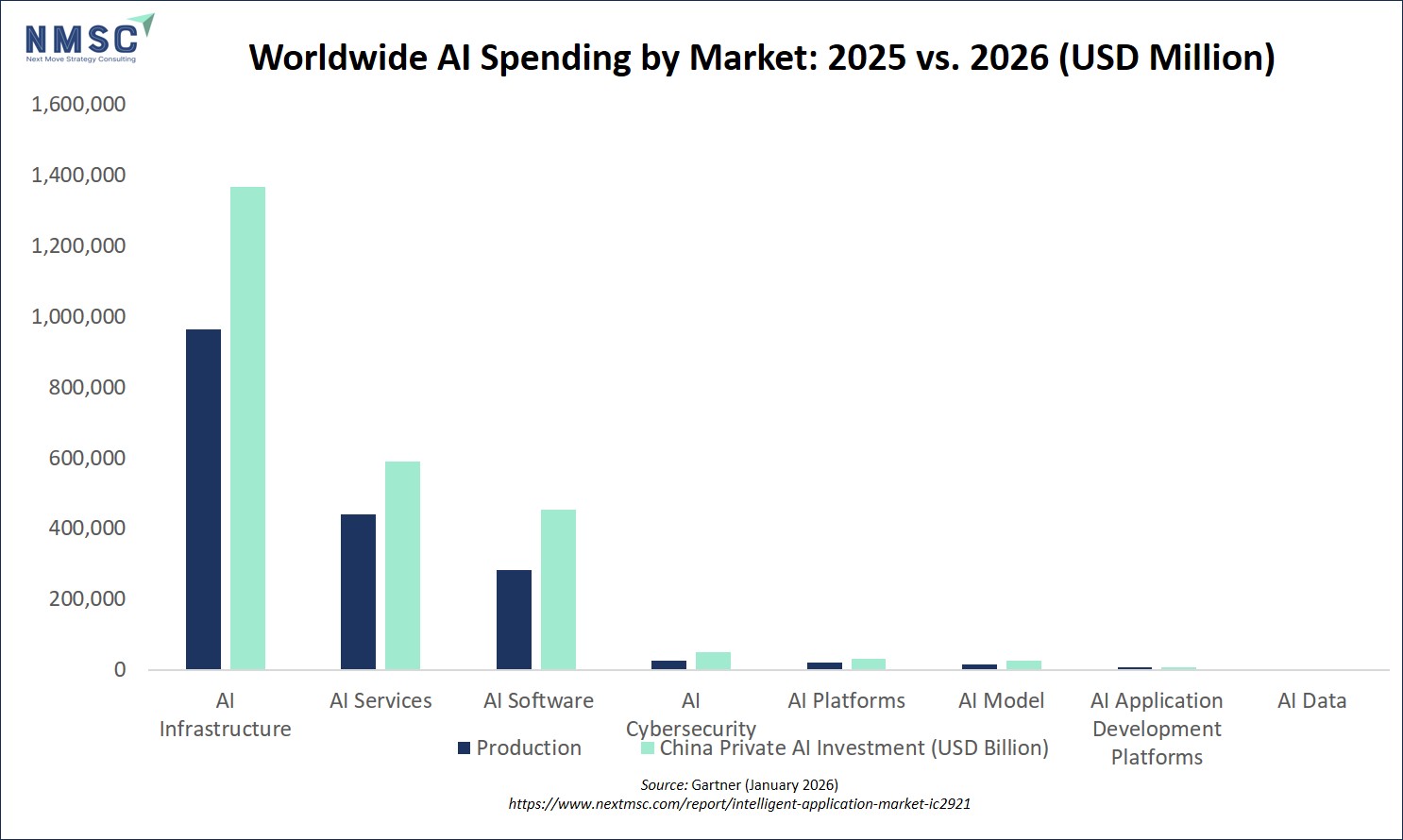
Section Summary: The agentic AI inflection point, validated by Gartner's August 2025 forecast, is the single most consequential structural force reshaping the intelligent application market in 2026. The transition from AI assistants to autonomous, task-specific agents embedded within enterprise applications is accelerating at a pace that demands immediate strategic response from software leaders.
Key Takeaways:
-
Gartner predicts 40% of enterprise apps will embed task-specific AI agents by end-2026, up from under 5% in 2025.
-
Agentic AI could account for 30% of enterprise application software revenue by 2035, exceeding USD 450 billion.
-
C-level executives have a three-to-six-month strategic window before competitive gaps become entrenched.
-
NMSC identifies commercial applications in BFSI, healthcare, and manufacturing as the highest-value segments for agentic AI adoption.
Industry Impact Analysis
Trend 1: Enterprise AI Adoption Has Crossed the Threshold of Scale
The Deloitte AI Institute's 2026 State of AI in the Enterprise report — based on a survey of 3,235 senior leaders across 24 countries conducted between August and September 2025 — confirms that enterprise AI adoption has moved decisively beyond the pilot phase. Worker access to AI rose by 50% in 2025, and the number of companies with 40% or more of their AI projects in production is set to double within six months.
Two-thirds (66%) of organizations surveyed by Deloitte report measurable gains in productivity and operational efficiency from AI deployment. An additional 53% report enhanced insights and decision-making capabilities, while 40% have achieved meaningful cost reductions. These figures represent the realized value of intelligent applications across enterprise functions — not aspirational projections.
However, Deloitte's data also reveals a critical bifurcation in the market. Only 34% of organizations are using AI to deeply transform their businesses — creating new products, services, or fundamentally reinventing core processes. The remaining 66% are either redesigning key processes (30%) or using AI at a surface level with minimal process change (37%). This bifurcation has direct implications for the intelligent application market: organizations in the transformative cohort are the primary drivers of premium intelligent application adoption, while the surface-level cohort represents a significant addressable market for vendors capable of demonstrating clear ROI pathways.
Trend 2: Multi-Model AI and Distributed Inferencing Are Redefining Application Architecture
F5's 2026 State of Application Strategy Report — drawing on responses from more than 1,100 IT decision-makers at global organizations — reveals that the architecture of intelligent applications has grown substantially more complex. Organizations now rely on an average of seven AI models, and 78% of digital leaders operate their own inference infrastructure.
With 52% of organizations chaining or orchestrating multiple AI models, distributed inferencing has emerged as a new source of operational complexity and security risk — directly paralleling the challenges of distributed application deployment that defined the previous decade. More than 93% of organizations operate in hybrid multicloud environments, and 86% operate across all three environment types: public cloud, private cloud, and colocation. This architectural reality means that intelligent application vendors must design for heterogeneous, multi-environment deployment from the outset.
Trend 3: AI Investment Concentration Is Accelerating Capability Gaps
Stanford HAI's 2026 AI Index Report provides the most comprehensive institutional view of the global AI investment landscape. U.S. private AI investment reached USD 285.9 billion in 2025 — more than 23 times the USD 12.4 billion invested in China. The United States also led in entrepreneurial activity, with 1,953 newly funded AI companies in 2025, more than 10 times the next closest country. This concentration of investment capital is directly accelerating the development and commercialization of intelligent applications, particularly in North America.
Organizational AI adoption reached 88% globally, and generative AI reached 53% population adoption within three years — faster than the PC or the internet. The estimated value of generative AI tools to U.S. consumers reached USD 172 billion annually by early 2026, with the median value per user tripling between 2025 and 2026.
Trend 4: Governance Deficits Are Creating Systemic Risk
Despite the acceleration of intelligent application deployment, governance frameworks are lagging critically behind. Stanford HAI's 2026 AI Index reports that documented AI incidents rose to 362 in 2025, up from 233 in 2024 — a 55% year-over-year increase. Deloitte's research corroborates this concern: only one in five companies has a mature governance model for autonomous AI agents, even as agentic AI usage is poised to rise sharply.
F5's report adds a security dimension: more than nine in 10 respondents confirm that agentic AI at production levels introduces a new set of security challenges, ranging from credential stuffing to the difficulty of auditing autonomous agent actions. The No. 1 security strategy currently in place — used by 55% of organizations — is managing authentication for AI services and API access.
Trend 5: The Workforce Skills Gap Is the Primary Adoption Barrier
Deloitte's 2026 survey identifies insufficient worker skills as the single largest barrier to integrating AI into existing workflows. Organizations are responding primarily through education: 53% are educating the broader workforce to raise overall AI fluency, and 48% are implementing upskilling and reskilling strategies. Gartner projects that by 2029, at least 50% of knowledge workers will develop new skills to work with, govern, or create AI agents on demand.
Trend 6: Sovereign AI Is Reshaping Regional Deployment Strategies
Stanford HAI's 2026 AI Index identifies AI sovereignty as a defining feature of national policy globally. National AI strategies are expanding, particularly among developing economies, and state-backed investments in AI supercomputing are rising in parallel. Deloitte's research confirms that sovereign AI — the deployment of AI under a country's own laws, infrastructure, and data governance frameworks — is now a material factor in enterprise vendor selection decisions. For intelligent application vendors, this trend is creating both market segmentation opportunities and compliance complexity.
Trend 7: Physical AI Is Expanding the Intelligent Application Perimeter
Deloitte's 2026 report documents a significant expansion of intelligent applications beyond software into physical environments. More than half of companies (58%) report at least limited use of physical AI today — including collaborative robotics, inspection drones, autonomous logistics systems, and digital twins — and that figure is projected to reach 80% within two years. Asia Pacific is leading in early implementation of physical AI, with manufacturing, logistics, and defense sectors at the forefront.
Section Summary: Seven structural trends are simultaneously reshaping the intelligent application market: the mainstreaming of agentic AI, the complexity of multi-model architectures, the concentration of AI investment, the governance deficit, the workforce skills gap, the rise of sovereign AI, and the expansion of physical AI. Each trend creates both market opportunity and strategic risk for enterprise stakeholders.
Key Takeaways:
-
Enterprise AI adoption has reached 88% globally, with worker access rising 50% in 2025 alone.
-
Organizations now operate an average of seven AI models, creating significant architectural and security complexity.
-
U.S. private AI investment reached USD 285.9 billion in 2025, accelerating the commercialization of intelligent applications.
-
Documented AI incidents rose 55% year-over-year in 2025, underscoring the urgency of governance investment.
Pros and Cons of Recent Market Development
|
Recent Development |
Pros |
Cons |
|
Agentic AI Integration in Enterprise Apps |
Enables autonomous, end-to-end workflow execution; reduces human intervention in repetitive complex tasks; drives new revenue models for software vendors |
Governance frameworks are immature; only 1 in 5 companies has mature oversight for autonomous agents; risk of "agentwashing" misrepresenting AI assistants as agents |
|
Multi-Model AI Architecture |
Enables specialization and best-of-breed AI capability selection; improves application performance across diverse tasks |
Adds significant infrastructure complexity; 52% of organizations report orchestration challenges; increases security attack surface |
|
Rapid Enterprise AI Adoption (88% Globally) |
Accelerates market growth and investment; validates intelligent application ROI across sectors; creates competitive pressure that drives innovation |
Creates a bifurcated market where only 34% of organizations are achieving deep transformation; surface-level adoption risks commoditization |
|
Sovereign AI Policy Expansion |
Creates new regional market opportunities; drives domestic AI infrastructure investment; strengthens data governance frameworks |
Fragments the global intelligent application market; increases compliance complexity for multinational vendors |
|
Physical AI Expansion |
Extends intelligent application value into manufacturing, logistics, and defense; opens new verticals; Asia Pacific adoption is accelerating |
Requires significant capital investment in hardware and edge infrastructure; safety and liability frameworks remain underdeveloped |
|
U.S. AI Investment Concentration (USD 285.9B in 2025) |
Accelerates frontier model development; sustains U.S. leadership in intelligent application innovation |
Creates geopolitical concentration risk; AI researcher inflows to the U.S. have dropped 89% since 2017, threatening long-term talent sustainability |
Future Outlook & Forecast
NMSC Market Forecast: A USD 201.24 Billion Opportunity by 2030
According to Next Move Strategy Consulting's proprietary research, the global intelligent application market is on a trajectory to expand from USD 39.02 billion in 2024 to USD 201.24 billion by 2030, representing a CAGR of 31.4% over the 2025–2030 forecast period. This growth trajectory is underpinned by three primary structural drivers: the widespread adoption of cloud computing infrastructure, the expansion of the global e-commerce sector, and the rising integration of IoT device ecosystems that generate the real-time data streams that intelligent applications require to function at their highest capability levels.
North America is projected to maintain its dominant position throughout the forecast period, supported by a favorable regulatory environment, substantial government investment in AI infrastructure, and the concentration of leading intelligent application vendors including IBM Corporation, Microsoft Corporation, Google LLC, Amazon Web Services Inc., SAP SE, Salesforce Inc., Oracle Corporation, NVIDIA Corporation, and ServiceNow Inc. Asia-Pacific is expected to register the most dynamic growth trajectory, driven by the rapid expansion of digital commerce — particularly in China and India — and the scale of the regional telecommunications market.
The Emerging Opportunity: Edge Computing Integration
NMSC's research identifies the integration of edge computing as a key opportunity factor for the intelligent application market in the forthcoming years. By enabling real-time data processing at the source — rather than routing all data to centralized cloud infrastructure — edge-integrated intelligent applications can deliver substantially lower latency, enhanced responsiveness, and improved performance in environments where connectivity is constrained or where data sovereignty requirements preclude cloud transmission. This capability is particularly relevant for manufacturing, healthcare, and defense applications where real-time decision-making is operationally critical.
The Governance Imperative: Responsible AI as a Market Differentiator
Stanford HAI's 2026 AI Index identifies a critical gap between AI capability advancement and responsible AI governance. Almost all leading frontier AI model developers report results on capability benchmarks, but reporting on responsible AI benchmarks remains inconsistent. For intelligent application vendors, this gap represents both a risk and a differentiation opportunity. Organizations that embed governance, auditability, and compliance frameworks directly into their intelligent application architectures will be positioned to capture the growing segment of enterprise buyers for whom regulatory compliance is a non-negotiable procurement criterion.
Deloitte's research confirms that enterprises where senior leadership actively shapes AI governance achieve significantly greater business value than those delegating governance to technical teams alone. As AI regulation matures across jurisdictions — with the EU's AI Act framework setting a global precedent — governance-ready intelligent applications will command premium positioning in enterprise procurement decisions.
Section Summary: The intelligent application market is positioned for sustained, high-velocity growth through 2030, driven by cloud adoption, e-commerce expansion, IoT proliferation, and the structural shift toward agentic AI. NMSC projects the market will reach USD 201.24 billion by 2030 at a CAGR of 31.4%. Governance capability and edge computing integration will be the defining competitive differentiators in the next phase of market development.
Key Takeaways:
-
The global intelligent application market is forecast to reach USD 201.24 billion by 2030, growing at a CAGR of 31.4%.
-
North America will maintain market leadership; Asia-Pacific will register the highest growth velocity.
-
Edge computing integration is the primary emerging opportunity driver identified by NMSC.
-
Governance-ready intelligent applications will command premium enterprise positioning as AI regulation matures globally.
Next Steps for Stakeholders
For C-Level Executives at Enterprise Organizations:
-
Define an agentic AI strategy within the next three to six months. Gartner's August 2025 forecast makes clear that the window for strategic positioning in agentic AI is narrow. Organizations that delay risk structural competitive disadvantage as 40% of enterprise applications embed task-specific agents by end-2026.
-
Audit your AI governance architecture before scaling. With only 20% of organizations having mature governance for autonomous AI agents, and documented AI incidents rising 55% year-over-year, governance investment is not optional — it is a prerequisite for sustainable intelligent application deployment.
-
Redesign workflows, not just tools. Deloitte's data shows that only 34% of organizations are achieving deep transformation through AI. The remaining 66% are capturing only a fraction of available value by layering AI onto legacy processes. Intelligent application ROI is maximized through holistic workflow redesign.
-
Invest in AI fluency at every organizational level. The skills gap is the primary adoption barrier. Organizations that invest in broad AI fluency — not just specialized technical hiring — will scale intelligent application deployment faster and more sustainably.
For Institutional Investors and Technology Vendors:
-
Prioritize vendors with multi-model orchestration and hybrid multicloud capabilities. With organizations averaging seven AI models and 93% operating in hybrid multicloud environments, intelligent application platforms that cannot manage distributed inferencing complexity will face structural adoption barriers.
-
Monitor sovereign AI policy developments as a market segmentation signal. National AI strategies are creating distinct regional market dynamics. Vendors with localized deployment capabilities and data sovereignty compliance frameworks will capture disproportionate share in regulated and emerging markets.
-
Evaluate the Asia-Pacific opportunity with urgency. NMSC's research identifies Asia-Pacific as the fastest-growing regional market for intelligent applications, driven by e-commerce scale and telecom infrastructure expansion. Early positioning in this region offers significant long-term return potential.
Conclusion
The intelligent application market is not approaching a tipping point — it has already passed one. The convergence of agentic AI proliferation, multi-model architectural complexity, record-level AI investment, and expanding physical AI deployment has created a market environment where the pace of change is outstripping the strategic planning cycles of most organizations. Gartner's landmark August 2025 forecast — that 40% of enterprise applications will embed task-specific AI agents by end-2026 — is not a distant projection; it is an immediate operational reality that is reshaping procurement decisions, vendor roadmaps, and workforce strategies today.
For the intelligent application market, the path from USD 39.02 billion in 2024 to USD 201.24 billion by 2030 is not guaranteed by technology alone. It will be determined by the organizations and vendors that move decisively on governance, architectural modernization, and workforce transformation — and by those that recognize that intelligent applications are not a product category but a fundamental redefinition of how enterprise software creates and delivers value.
About the Author
 Sanyukta Deb
— Sanyukta Deb is Digital Marketing Team Lead at Next Move Strategy Consulting, where she has led content strategy and technical SEO for the firm's B2B market research publications for over 2 years. Her editorial process translates NextMSC's primary and secondary research — spanning technology, industrial, and consumer sectors — into commercial narratives, backed by search-intent, keyword, and competitive analysis. She brings 5 years of overall experience in digital marketing and content strategy.
Sanyukta Deb
— Sanyukta Deb is Digital Marketing Team Lead at Next Move Strategy Consulting, where she has led content strategy and technical SEO for the firm's B2B market research publications for over 2 years. Her editorial process translates NextMSC's primary and secondary research — spanning technology, industrial, and consumer sectors — into commercial narratives, backed by search-intent, keyword, and competitive analysis. She brings 5 years of overall experience in digital marketing and content strategy.
About the Reviewer
 Debashree Dey
— Debashree Dey is Assistant Manager at Next Move Strategy Consulting, where she supports cross-vertical market content and communications across diverse industries for 6 years. Her professional background includes senior content writing, communications, and published manuscript authorship, with experience developing audience-focused business narratives and maintaining clear, consistent messaging. Her role supports research-led content development and editorial quality across NextMSC publications.
Debashree Dey
— Debashree Dey is Assistant Manager at Next Move Strategy Consulting, where she supports cross-vertical market content and communications across diverse industries for 6 years. Her professional background includes senior content writing, communications, and published manuscript authorship, with experience developing audience-focused business narratives and maintaining clear, consistent messaging. Her role supports research-led content development and editorial quality across NextMSC publications.
















Add Comment