Cognex–RealSense Deal Redefines the Advanced Computer Vision Market | NextMSC

Introduction
The global advanced computer vision market is undergoing a structural transformation — one driven not by incremental software upgrades, but by a convergence of edge AI hardware, Physical AI infrastructure, and landmark M&A activity that is fundamentally expanding what machine vision systems can perceive, process, and act upon. According to Next Move Strategy Consulting's Advanced Computer Vision Market report, the global advanced computer vision market is projected to reach USD 39.75 billion by 2030, growing at a CAGR of 15.7% from 2024 to 2030. This trajectory reflects a market that is no longer confined to static 2D inspection on factory floors — it now encompasses 4D dynamic scene reconstruction, depth-sensing robotics, and AI-native vision agents operating across autonomous vehicles, humanoid robots, and clinical imaging environments.
The catalyst that most sharply illustrates this shift arrived on September 22, 2026, when Cognex Corporation — the NASDAQ-listed global leader in industrial machine vision — announced a definitive agreement to acquire RealSense, the market leader in depth-sensing cameras and vision technology for robotic perception and Physical AI, for approximately USD 500 million in cash. This single transaction signals that the advanced computer vision market's next growth phase will be defined by 3D robotic perception — not 2D image classification — and that the competitive boundary between industrial machine vision and Physical AI has effectively dissolved.
For More Information: Download FREE Sample on Advanced Computer Vision Market Report
From Factory Floors to Physical AI: The Structural Shift Reshaping Advanced Computer Vision
Cognex–RealSense: A $500M Bet on 3D Robotic Perception
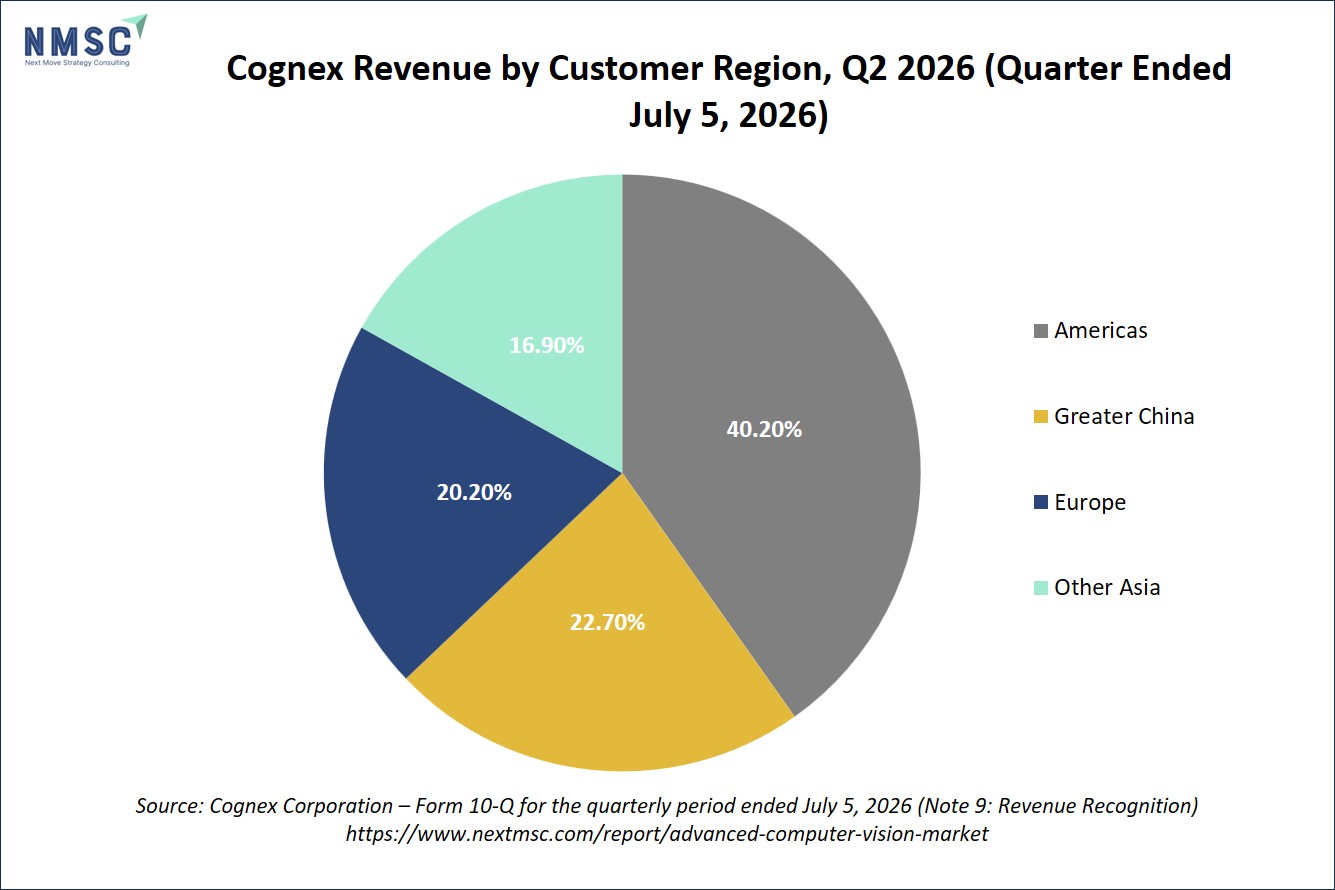
On September 22, 2026, Cognex Corporation announced its agreement to acquire RealSense — originally founded by Intel in 2014 and spun out as an independent company in 2025 — for approximately USD 500 million, financed entirely from existing cash and investments. The transaction is expected to close in Q4 2026, subject to customary closing conditions.
RealSense's technology — which it describes as the "Visual Cortex of Physical AI" — is deployed across fixed-arm perception-guided robotics, autonomous mobile robots (AMRs), quadrupeds, and humanoid robots. The robotic perception market that RealSense serves is estimated at USD 600 million today and is expected to grow at more than 25% annually to approximately USD 1.6 billion by 2030, according to Cognex's own acquisition disclosures. RealSense is expected to generate revenue of USD 80 million to USD 90 million in 2026, representing more than 50% growth over the prior year.
"RealSense represents a compelling strategic expansion for Cognex into robotic perception, one of the most attractive adjacent markets in machine vision," said Matt Moschner, President and Chief Executive Officer of Cognex, in the company's official press release dated September 22, 2026.
Notably, prior to closing, RealSense will spin out its Facial Authentication product line into an independent company — a structural decision that directly reflects the compliance requirements of the EU AI Act, which became fully applicable on August 2, 2026, and imposes strict prohibitions on real-time biometric identification systems in public spaces.
NVIDIA Declares the "Big Bang of Physical AI" at GTC 2026
In March 2026, at NVIDIA's GTC conference in San Jose, NVIDIA announced the Physical AI Data Factory Blueprint — an open reference architecture that unifies and automates how training data is generated, augmented, and evaluated for physical AI systems, including vision AI agents, robotics, and autonomous vehicles. The blueprint leverages NVIDIA Cosmos open world foundation models to transform limited real-world training data into large, diverse datasets — including rare edge cases that are impractical to capture physically.
"Physical AI is the next frontier of the AI revolution, where success depends on the ability to generate massive amounts of data," said Rev Lebaredian, Vice President of Omniverse and Simulation Technologies at NVIDIA, in the company's official announcement on March 16, 2026. "In this new era, compute is data."
Leading physical AI developers including FieldAI, Hexagon Robotics, Milestone Systems, Teradyne Robotics, and Uber are already using the blueprint to accelerate robotics, vision AI agents, and autonomous vehicle development. Microsoft Azure and Nebius are integrating the blueprint into their cloud infrastructure, enabling developers to convert accelerated compute into high-volume training data at scale.
Cognex In-Sight 6900: Edge AI Processing at 157 TOPS Without External PCs
On April 28, 2026, Cognex launched the In-Sight® 6900 Vision Controller, powered by NVIDIA Jetson technology, delivering up to 157 TOPS of AI performance at the edge. The system enables multiple high-resolution AI models to run simultaneously on the production line without external PCs or distributed architectures — a capability that directly reduces the total cost of deploying advanced computer vision in high-throughput manufacturing environments. The controller uses transformer-based classification models requiring as few as 10–20 training images, compressing deployment timelines that previously required thousands of labeled samples.
"The In-Sight Vision Controller delivers exactly that, combining NVIDIA's edge AI processing with Cognex's modular hardware and proven vision tools," said Matt Moschner, President and CEO of Cognex, in the company's official press release dated April 28, 2026.
On May 5, 2026, Cognex followed this with the launch of its highest-performance embedded AI vision system powered by Qualcomm, further extending its edge AI portfolio across different silicon architectures.
CVPR 2026: Research Breakthroughs That Will Define the Next Generation of Vision Systems
The Conference on Computer Vision and Pattern Recognition (CVPR) 2026, held June 3–7 in Denver, Colorado, received 16,092 paper submissions — a record for the conference — with 4,089 papers accepted. The best paper award went to D4RT ("Efficiently Reconstructing Dynamic Scenes One D4RT at a Time"), developed by a team from Google DeepMind, University College London, and the University of Oxford. D4RT uses a unified transformer-based architecture to estimate depth, spatio-temporal correspondence, and full camera parameters simultaneously — enabling efficient reconstruction of the geometry and motion of dynamic 4D scenes from video.
The Best Student Paper was awarded to the O-Voxel method for 3D generative modeling, developed by teams from Tsinghua University, Microsoft Research, and the University of Science and Technology of China, which significantly improves the quality and realism of AI-generated 3D assets. Meta Superintelligence Labs presented SAM 3D, a generative model for visually grounded 3D object reconstruction from a single image, achieving at least a 5:1 win rate in human preference tests over prior methods.
"The selected papers introduce concepts and practices that undoubtedly will help shape the next generation of computer vision systems and applications," said Chen Change Loy, Tan Lip-Bu Professor in AI at Nanyang Technological University and CVPR 2026 Program Co-Chair, in the official CVPR 2026 announcement dated June 9, 2026.
NMSC Strategic Perspective: Why 3D Perception Is the Market's Defining Inflection Point
NextMSC primary research and analysis identifies the convergence of three simultaneous developments — Cognex's USD 500M acquisition of RealSense, NVIDIA's Physical AI Data Factory Blueprint, and CVPR 2026's D4RT breakthrough — as the clearest evidence that the advanced computer vision market is transitioning from a 2D inspection paradigm to a full-stack 3D spatial intelligence paradigm. This transition has direct implications for market segmentation: the hardware segment, which encompasses cameras, image sensors, and processors, is positioned to capture disproportionate revenue share as depth-sensing cameras and edge AI accelerators become standard components in robotic perception stacks. The automotive and transportation end-user segment, already the largest revenue contributor per NMSC's analysis, will see accelerated investment as autonomous vehicle developers integrate vision AI agents trained on synthetic data generated through platforms such as NVIDIA's Physical AI Data Factory Blueprint.
Section Summary:
-
Cognex's USD 500M acquisition of RealSense (September 22, 2026) consolidates 2D machine vision and 3D robotic perception under a single industrial platform, targeting a robotic perception market projected to reach USD 1.6 billion by 2030.
-
NVIDIA's Physical AI Data Factory Blueprint (March 2026) reduces the cost and complexity of generating training data for vision AI agents, directly lowering the barrier to deploying advanced computer vision in autonomous systems.
-
Cognex's In-Sight 6900 Vision Controller (April 2026), delivering 157 TOPS at the edge, eliminates the need for external PCs in demanding manufacturing inspection applications.
-
CVPR 2026's D4RT and SAM 3D breakthroughs signal that dynamic 4D scene reconstruction and single-image 3D reconstruction are transitioning from research milestones to deployable capabilities.
Industry Impact Analysis
The EU AI Act's August 2026 Enforcement: Redrawing the Boundaries of Facial Recognition and Biometric Vision
On August 2, 2026, the EU AI Act's transparency obligations under Article 50 became fully enforceable across all EU member states. The Act prohibits nine specific AI practices, including the compilation of facial recognition databases through untargeted scraping of CCTV footage or internet images, emotion recognition in workplaces and educational institutions, and real-time biometric identification of individuals in publicly accessible spaces by law enforcement. Non-compliance carries fines of up to €15 million or 3% of worldwide annual turnover, whichever is higher.
The practical consequence for the advanced computer vision market is a bifurcation of the facial recognition application segment: vendors serving EU markets must now architect their systems to exclude real-time biometric identification in public spaces, while vendors serving industrial, healthcare, and controlled-access environments — where facial recognition is used for authenticated access rather than mass surveillance — operate under a separate, high-risk AI system compliance framework. Cognex's decision to spin out RealSense's Facial Authentication product line into an independent company prior to closing the acquisition is a direct structural response to this regulatory environment.
The U.S. AI Action Plan: Federal Policy as a Demand Accelerator for Vision AI in Autonomous Systems
The White House's "America's AI Action Plan," released in July 2025, identifies over 90 federal policy actions across three pillars — accelerating AI innovation, building domestic AI infrastructure, and leading in international AI diplomacy. The plan explicitly encourages investment in "next-generation" manufacturing applications including autonomous drones and self-driving cars — two application categories that are primary consumers of advanced computer vision hardware and software. This policy posture, combined with the June 2026 White House executive order promoting advanced AI innovation and security, creates a federal procurement and investment environment that directly expands the addressable market for military and defense computer vision applications — the segment in which North America already holds the dominant global share, per NMSC's regional analysis.
Automotive and Transportation: EV Proliferation Drives Embedded Vision Demand
The International Energy Agency (IEA) has documented the rapid scaling of the global electric vehicle fleet, which reached 10 million units in 2020 and is projected to reach 145 million by 2030. Each new-generation electric and hybrid vehicle integrates advanced computer vision hardware — including cameras, image sensors, and processors — for energy management, ADAS functions, and autonomous navigation. As EV penetration accelerates toward the IEA's 2030 target, the automotive and transportation end-user segment of the advanced computer vision market receives a structural demand tailwind that is independent of broader macroeconomic cycles.
Healthcare: Vision-Guided Diagnostics and Surgical Assistance
In the healthcare segment, advanced computer vision systems are deployed for medical image analysis, disease diagnosis, surgical assistance, and patient monitoring. The integration of deep learning-based image segmentation and object detection into clinical workflows enables radiologists and surgeons to process higher volumes of imaging data with greater consistency. NMSC's primary research and analysis identifies healthcare as one of the fastest-growing end-user segments within the advanced computer vision market, driven by the increasing digitization of hospital infrastructure and the adoption of AI-assisted diagnostic platforms across North America, Europe, and Asia-Pacific.
Section Summary:
-
The EU AI Act's full enforcement from August 2, 2026 prohibits real-time biometric identification in public spaces and facial recognition database scraping, directly restructuring the facial recognition application segment and compelling vendors to separate biometric products from industrial vision platforms.
-
The U.S. AI Action Plan's explicit support for autonomous drones and self-driving cars creates a federal policy environment that expands defense and automotive computer vision procurement.
-
IEA's projection of 145 million EVs on the road by 2030 provides a durable, policy-backed demand driver for embedded vision hardware in the automotive and transportation segment.
-
Healthcare's adoption of AI-assisted diagnostics and surgical vision systems positions it as a high-growth end-user segment alongside automotive and defense.
Key Industry Events and Quantified Market Impact (2026)
|
Event |
Date |
Quantified Impact |
|
Cognex acquires RealSense |
September 22, 2026 |
USD 500M acquisition; RealSense revenue USD 80–90M in 2026 (>50% YoY growth); robotic perception market projected at USD 1.6B by 2030 |
|
Cognex In-Sight 6900 Vision Controller (NVIDIA Jetson) |
April 28, 2026 |
157 TOPS edge AI performance; transformer models deployable with 10–20 training images |
|
Cognex Embedded AI Vision System (Qualcomm) |
May 5, 2026 |
Highest-performance embedded AI vision system in Cognex's portfolio |
|
NVIDIA Physical AI Data Factory Blueprint |
March 16, 2026 |
Adopted by Uber, Teradyne Robotics, FieldAI, Hexagon Robotics, Milestone Systems; integrated with Microsoft Azure and Nebius cloud |
|
CVPR 2026 (Denver, CO) |
June 3–7, 2026 |
16,092 submissions; 4,089 accepted papers; Best Paper: D4RT (Google DeepMind/UCL/Oxford) |
|
EU AI Act — Full Enforcement |
August 2, 2026 |
Fines up to €15M or 3% of global annual turnover; prohibits real-time biometric ID in public spaces |
|
Event |
Date |
Quantified Impact |
|
Cognex acquires RealSense |
September 22, 2026 |
USD 500M acquisition; RealSense revenue USD 80–90M in 2026 (>50% YoY growth); robotic perception market projected at USD 1.6B by 2030 |
|
Cognex In-Sight 6900 Vision Controller (NVIDIA Jetson) |
April 28, 2026 |
157 TOPS edge AI performance; transformer models deployable with 10–20 training images |
|
Cognex Embedded AI Vision System (Qualcomm) |
May 5, 2026 |
Highest-performance embedded AI vision system in Cognex's portfolio |
|
NVIDIA Physical AI Data Factory Blueprint |
March 16, 2026 |
Adopted by Uber, Teradyne Robotics, FieldAI, Hexagon Robotics, Milestone Systems; integrated with Microsoft Azure and Nebius cloud |
|
CVPR 2026 (Denver, CO) |
June 3–7, 2026 |
16,092 submissions; 4,089 accepted papers; Best Paper: D4RT (Google DeepMind/UCL/Oxford) |
|
EU AI Act — Full Enforcement |
August 2, 2026 |
Fines up to €15M or 3% of global annual turnover; prohibits real-time biometric ID in public spaces |
Future Outlook & Forecast
The Road to USD 39.75 Billion: Three Structural Forces Sustaining 15.7% CAGR
According to NextMSC primary research and analysis, the global advanced computer vision market is projected to reach USD 39.75 billion by 2030, growing at a CAGR of 15.7% from 2024 to 2030. Three structural forces underpin this trajectory:
1. The Physical AI Hardware Cycle: NVIDIA's Physical AI Data Factory Blueprint and Cognex's In-Sight 6900 Vision Controller represent the leading edge of a hardware refresh cycle in which edge AI accelerators — not cloud-connected servers — become the primary compute substrate for advanced computer vision. As manufacturers, logistics operators, and autonomous vehicle developers deploy edge AI vision systems at scale, the hardware component segment (cameras, image sensors, processors) will capture an increasing share of total market revenue. NVIDIA's collaboration with Microsoft Azure and Nebius to deliver the Physical AI Data Factory Blueprint as a cloud-native service further accelerates the synthetic data generation pipelines that make large-scale vision AI deployment economically viable.
2. The Robotic Perception Adjacency: Cognex's acquisition of RealSense positions the combined entity to serve the full spectrum of Physical AI — from 2D barcode reading and surface inspection to 3D depth perception and robotic navigation. The robotic perception market, currently estimated at USD 600 million, is projected to grow at more than 25% annually to approximately USD 1.6 billion by 2030, per Cognex's own acquisition disclosures. This adjacency is additive to the broader advanced computer vision market and will draw new categories of buyers — humanoid robot developers, AMR manufacturers, and autonomous vehicle integrators — into the industrial vision ecosystem.
3. Regulatory-Driven Compliance Investment: The EU AI Act's full enforcement from August 2, 2026 creates a mandatory compliance investment cycle for any enterprise deploying high-risk AI systems — including advanced computer vision systems used in critical infrastructure, healthcare, and employment contexts. Vendors that can demonstrate auditable, explainable, and compliant vision AI systems will command premium pricing and longer contract cycles, particularly in European markets. This regulatory dynamic is expected to accelerate consolidation among smaller vision AI vendors who lack the compliance infrastructure to compete in regulated markets.
Asia-Pacific: The Next Growth Engine
NMSC's regional analysis identifies Asia-Pacific as the fastest-growing region in the advanced computer vision market, driven by the rapid expansion of manufacturing, healthcare, and automotive industries in China, Japan, South Korea, and India. The region's high adoption of computer vision technology for visual inspection in industrial workplaces — exemplified by deployments in electronics manufacturing and automotive assembly — provides a large and growing installed base upon which software and services revenue can be layered. Industry 4.0 initiatives across Asia-Pacific, which integrate computer vision systems with robotics and high-speed industrial networks, are expanding the total addressable market for advanced computer vision beyond traditional quality control applications into predictive maintenance, autonomous logistics, and real-time production optimization.
Section Summary:
-
NMSC projects the global advanced computer vision market to reach USD 39.75 billion by 2030 at a 15.7% CAGR, driven by edge AI hardware proliferation, robotic perception adoption, and regulatory compliance investment.
-
The robotic perception sub-market — the strategic rationale behind Cognex's USD 500M RealSense acquisition — is projected to grow at more than 25% annually to USD 1.6 billion by 2030, representing a high-growth adjacency within the broader market.
-
The EU AI Act's enforcement creates a compliance-driven investment cycle that will accelerate consolidation and reward vendors with auditable, explainable vision AI architectures.
-
Asia-Pacific's manufacturing and automotive expansion positions it as the fastest-growing regional market, with Industry 4.0 integration extending computer vision applications beyond inspection into autonomous logistics and predictive maintenance.
Next Steps for Stakeholders
For C-Level Executives and Technology Leaders:
-
Audit your vision AI architecture for EU AI Act compliance immediately. The August 2, 2026 enforcement date means that any advanced computer vision system deployed in EU markets that involves biometric identification, emotion recognition, or CCTV-based data scraping is now subject to fines of up to €15 million or 3% of global annual turnover. Engage legal and technical teams to classify your systems under the Act's risk tiers before the next product cycle.
-
Evaluate edge AI vision hardware as a strategic infrastructure investment, not a line-item cost. Cognex's In-Sight 6900 Vision Controller — delivering 157 TOPS at the edge without external PCs — represents a new cost-performance benchmark for industrial vision. Manufacturers that deploy edge AI vision systems now will build proprietary inspection datasets and model libraries that become durable competitive assets.
-
Incorporate synthetic data generation into your vision AI development pipeline. NVIDIA's Physical AI Data Factory Blueprint, now available on Microsoft Azure and Nebius, enables developers to generate large, diverse training datasets — including rare edge cases — at a fraction of the cost of real-world data collection. Organizations that adopt synthetic data pipelines now will compress model development timelines and reduce dependency on costly manual labeling.
For Institutional Investors:
-
The Cognex–RealSense transaction establishes a valuation benchmark for 3D robotic perception assets. At USD 500 million for a business generating USD 80–90 million in 2026 revenue (>50% YoY growth), the implied revenue multiple signals that institutional capital is pricing robotic perception at a significant premium to traditional 2D machine vision. Investors should evaluate the robotic perception supply chain — depth camera manufacturers, edge AI silicon vendors, and vision software platforms — through this lens.
-
Monitor the CVPR 2026 research pipeline for near-term commercialization opportunities. D4RT's dynamic 4D scene reconstruction and SAM 3D's single-image 3D reconstruction are Google DeepMind and Meta Superintelligence Labs outputs, respectively — organizations with the engineering resources to move from research publication to production deployment within 12–24 months. These capabilities will expand the addressable market for advanced computer vision in autonomous vehicles, augmented reality, and surgical robotics.
Conclusion
The advanced computer vision market is not simply growing — it is being architecturally redefined. The convergence of Cognex's USD 500 million acquisition of RealSense, NVIDIA's Physical AI Data Factory Blueprint, the EU AI Act's full enforcement, and CVPR 2026's breakthroughs in dynamic 4D scene reconstruction collectively mark the transition from a market defined by 2D factory inspection to one defined by full-stack spatial intelligence for Physical AI. According to NextMSC primary research and analysis, the global advanced computer vision market is projected to reach USD 39.75 billion by 2030 at a 15.7% CAGR — a forecast that reflects not only the maturation of existing applications in automotive, healthcare, and defense, but the emergence of robotic perception, vision AI agents, and synthetic data infrastructure as the market's next structural growth layer. Stakeholders who align their technology investments, compliance architectures, and M&A strategies with these forces now will be best positioned to capture value as the market scales toward its 2030 horizon.
About the Author
 Sanyukta Deb
— Sanyukta Deb is Digital Marketing Team Lead at Next Move Strategy Consulting, where she has led content strategy and technical SEO for the firm's B2B market research publications for over 2 years. Her editorial process translates NextMSC's primary and secondary research — spanning technology, industrial, and consumer sectors — into commercial narratives, backed by search-intent, keyword, and competitive analysis. She brings 5 years of overall experience in digital marketing and content strategy.
Sanyukta Deb
— Sanyukta Deb is Digital Marketing Team Lead at Next Move Strategy Consulting, where she has led content strategy and technical SEO for the firm's B2B market research publications for over 2 years. Her editorial process translates NextMSC's primary and secondary research — spanning technology, industrial, and consumer sectors — into commercial narratives, backed by search-intent, keyword, and competitive analysis. She brings 5 years of overall experience in digital marketing and content strategy.
About the Reviewer
 Debashree Dey
— Debashree Dey is Assistant Manager at Next Move Strategy Consulting, where she supports cross-vertical market content and communications across diverse industries for 6 years. Her professional background includes senior content writing, communications, and published manuscript authorship, with experience developing audience-focused business narratives and maintaining clear, consistent messaging. Her role supports research-led content development and editorial quality across NextMSC publications.
Debashree Dey
— Debashree Dey is Assistant Manager at Next Move Strategy Consulting, where she supports cross-vertical market content and communications across diverse industries for 6 years. Her professional background includes senior content writing, communications, and published manuscript authorship, with experience developing audience-focused business narratives and maintaining clear, consistent messaging. Her role supports research-led content development and editorial quality across NextMSC publications.

















Add Comment