Hyper Automation Market: How Agentic AI Is Transforming Business | NextMSC
Introduction
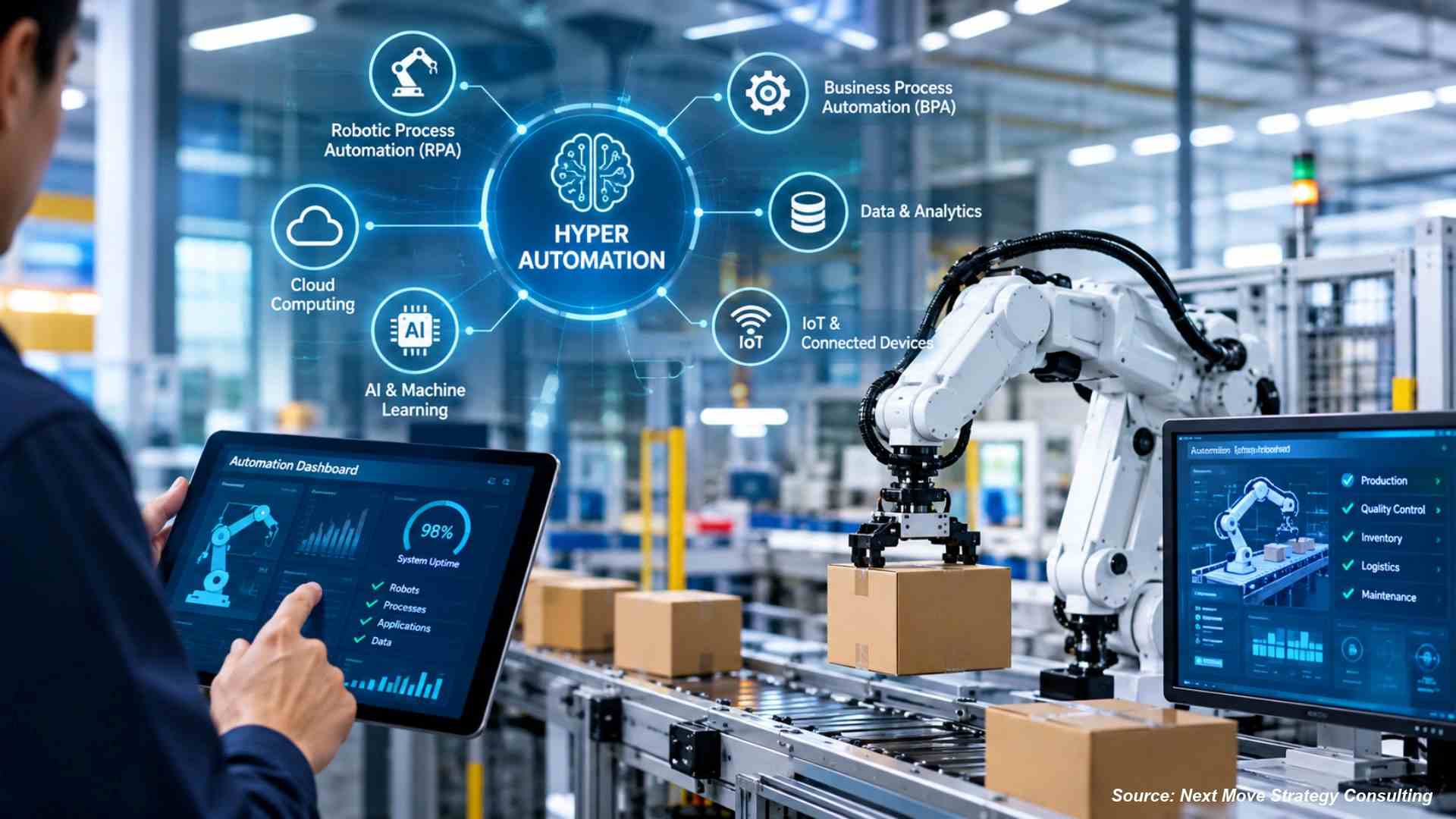
Enterprise automation has crossed a structural threshold. The question for C-suite leaders is no longer whether to automate, but how rapidly they can orchestrate AI agents, robotic process automation (RPA), process mining, and low-code platforms into a unified, self-governing operational fabric — what the industry now calls hyper automation. The convergence of these technologies is compressing decision cycles, eliminating manual handoffs across complex workflows, and fundamentally altering how organizations allocate human capital.
According to Next Move Strategy Consulting's Hyper Automation Market report, the global hyper automation market is projected to reach USD 60.62 billion by 2030, growing at a CAGR of 19.6% from 2023 to 2030. This trajectory reflects not incremental adoption but a wholesale re-architecture of enterprise operating models — one being accelerated by a wave of platform-level announcements from the market's most consequential players.
For More Information: Download FREE Sample on Hyper Automation Market Report
From RPA to Agentic Orchestration: The Structural Shift Redefining Enterprise Automation
UiPath FUSION 2026: The Moment Automation Became Self-Directing
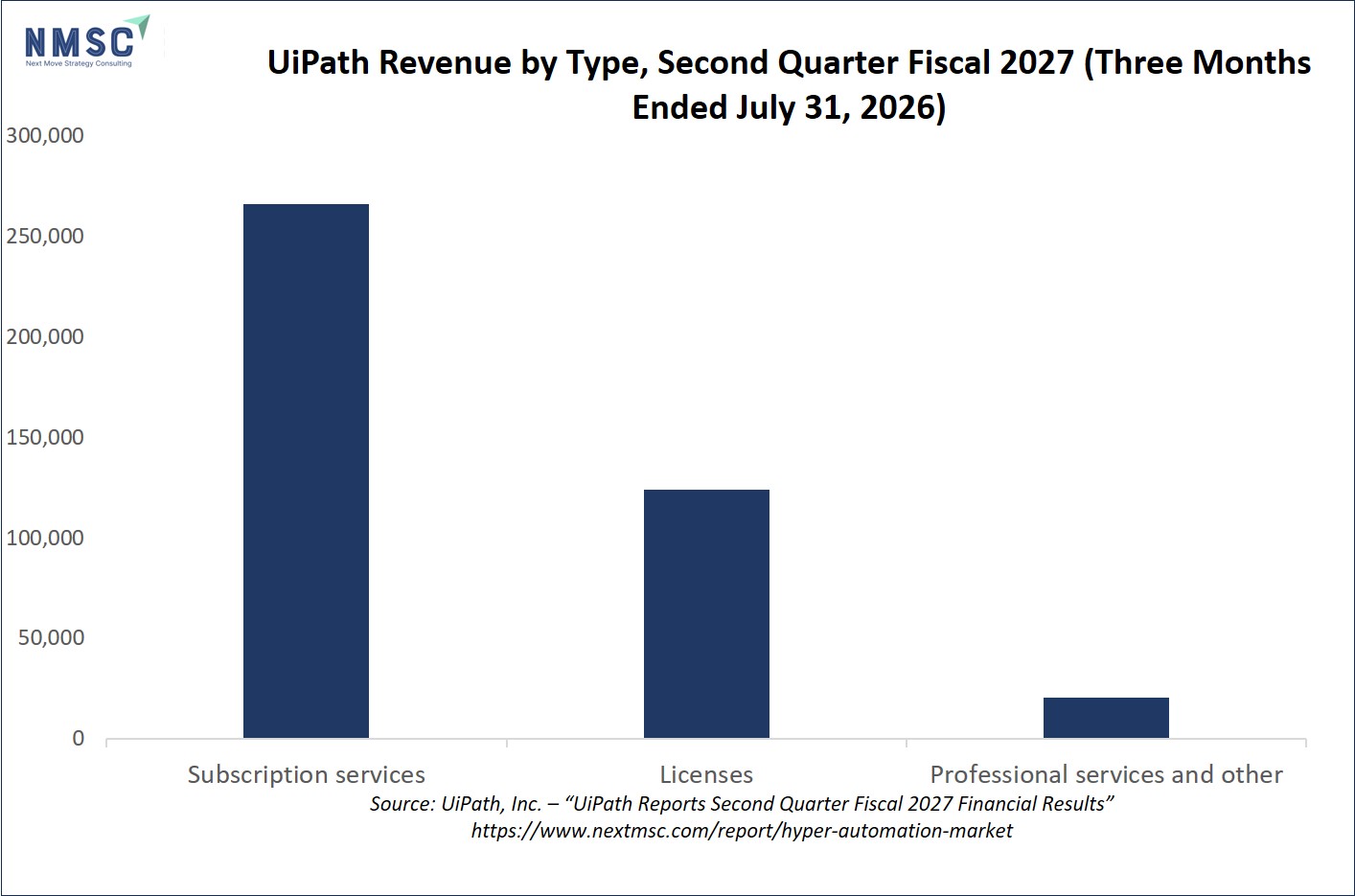
At its FUSION conference from September 22–25, 2026, UiPath unveiled new products—including Cartographer and Process Atlas—that position rule-based automation as a vital governance layer rather than a replaced paradigm. The company introduced Cartographer, an AI-powered process discovery tool that autonomously maps enterprise workflows without requiring manual documentation; Delegate, a capability enabling AI agents to hand off tasks to human workers and back again within a single orchestrated workflow; and Maestro updates that extend multi-agent coordination across heterogeneous enterprise systems.
These are not incremental feature releases. Cartographer directly addresses the single largest barrier to hyper automation deployment at scale: the cost and time required to document processes before they can be automated. By eliminating that prerequisite, UiPath has materially shortened the time-to-value curve for enterprise customers deploying automation across hundreds of processes simultaneously. UiPath's Platform for Agentic Automation and Orchestration was also named one of TIME's Best Inventions of 2025, a recognition that underscores the platform's transition from an RPA tool to a full-stack agentic orchestration environment.
ServiceNow and Microsoft Unify Agent Governance Across the Enterprise Stack
On May 5, 2026, at Knowledge 2026 in Las Vegas, ServiceNow (NYSE: NOW) announced a deepened strategic integration with Microsoft that extends ServiceNow AI Control Tower governance across the Microsoft Agent 365 ecosystem. Under the partnership, ServiceNow AI specialists are made available in the Microsoft Agent 365 Marketplace, enabling the ServiceNow Autonomous Workforce to operate directly within Microsoft 365 applications — including Word, Outlook, and PowerPoint — subject to Microsoft's identity and policy controls.
Jon Sigler, Executive Vice President and General Manager, AI Platform at ServiceNow, stated: "With this expanded integration, customers can securely apply governance across ServiceNow and Microsoft environments with integrated visibility and controls, while putting ServiceNow Autonomous Workforce to work across the Microsoft 365 environment. This is an example of what it means to put AI to work at enterprise scale, with the trust and interoperability that business transformation requires."
Charles Lamanna, Executive Vice President, Copilot, Agents, and Platform at Microsoft, added: "That's why we're excited to collaborate with ServiceNow, bringing their AI expertise into Microsoft 365 to add workflow intelligence on top of that secure foundation. Together, we're helping customers act on insights more quickly and drive meaningful outcomes across their business processes."
The significance of this partnership extends beyond product integration. ServiceNow's platform currently runs more than 100 billion workflows annually, and the extension of AI Control Tower governance into Microsoft's ecosystem means that enterprises can now enforce consistent agent identity, permission, and audit policies across two of the largest enterprise software environments simultaneously — resolving what had been a critical governance gap in multi-vendor agentic deployments.
NMSC Strategic Perspective: Why Agentic Governance Is the New Competitive Differentiator
NextMSC primary research and analysis identifies a decisive inflection point in the hyper automation market: the competitive advantage is shifting from the ability to deploy automation to the ability to govern it. Early hyper automation adopters built competitive moats by automating high-volume, rule-based processes faster than peers. The next competitive layer — now being established by the ServiceNow-Microsoft integration and UiPath's Maestro orchestration framework — is the capacity to deploy AI agents across heterogeneous enterprise environments with unified visibility, consistent policy enforcement, and measurable ROI attribution.
Organizations that cannot govern their agent ecosystems will face compounding risks: regulatory exposure as AI governance frameworks mature across the EU, UK, and U.S. federal agencies; operational fragility from ungoverned agent interactions; and an inability to scale automation beyond isolated departmental deployments. The market's trajectory toward USD 60.62 billion by 2030, as projected by NextMSC proprietary research and estimates, is predicated on enterprises solving this governance challenge — not merely expanding the volume of automated tasks.
Section Summary
The hyper automation market is undergoing a structural transition from task-level RPA to enterprise-wide agentic orchestration. UiPath's FUSION 2026 announcements eliminate the process-documentation bottleneck that previously constrained deployment velocity, while the ServiceNow-Microsoft governance integration resolves the multi-vendor oversight gap that has limited enterprise-scale agentic deployments.
Key Takeaways:
-
UiPath's Cartographer tool automates process discovery, removing the most time-intensive prerequisite for large-scale hyper automation rollouts.
-
ServiceNow AI Control Tower now governs agents across both ServiceNow and Microsoft Agent 365 ecosystems from a single administrative interface.
-
Governance capability — not automation volume — is emerging as the primary differentiator for enterprise hyper automation platforms.
-
NextMSC proprietary research and analysis identifies multi-platform agent governance as the critical enabler of the market's projected 19.6% CAGR through 2030.
Industry Impact Analysis
The Agentic AI Investment Signal and What It Means for Hyper Automation Buyers
McKinsey's Technology Trends Outlook 2026, published September 15, 2026, recorded USD 9.9 billion in equity investment in agentic AI in 2025 — a figure accompanied by a 952% increase in agentic AI job postings between 2024 and 2025. AI infrastructure investment, which underpins the compute layer on which hyper automation platforms run, reached USD 145 billion in 2025, doubling in a single year.
These figures are not abstract market signals. For enterprise procurement teams evaluating hyper automation vendors, the 952% surge in agentic AI talent demand means that the platforms investing most heavily in agentic capabilities today — UiPath, ServiceNow, Microsoft, IBM — are building the deepest engineering benches and will sustain the fastest product iteration cycles. Vendor selection decisions made in 2026 will lock organizations into platform ecosystems for three to five years; the investment and talent data from McKinsey indicate which vendors have the organizational capacity to deliver on their agentic roadmaps.
Workforce Transformation: The Demand Signal Driving Hyper Automation Adoption
The World Economic Forum's Future of Jobs Report 2025 found that AI and information-processing technologies are expected to transform the operations of 86% of surveyed employers by 2030, with robotics and automation cited by 58% of employers as a primary transformation driver. The same report projects that AI and automation will create 170 million new roles globally while displacing 92 million — a net positive of 78 million jobs, but one that requires significant workforce reskilling and process redesign.
This workforce dynamic directly expands the addressable market for hyper automation platforms. As organizations restructure roles around human-agent collaboration — the model explicitly embedded in UiPath's Delegate capability and ServiceNow's Autonomous Workforce framework — demand for orchestration platforms that can manage task handoffs between AI agents and human workers becomes a board-level procurement priority rather than an IT department initiative.
BFSI: Where Hyper Automation Delivers the Most Measurable ROI
The Banking, Financial Services, and Insurance (BFSI) sector represents the most mature and highest-ROI deployment environment for hyper automation, driven by the combination of high transaction volumes, strict regulatory documentation requirements, and the availability of structured data that AI models can act upon with high accuracy. Intelligent document processing — a core hyper automation component — is being deployed across loan origination, claims adjudication, and regulatory reporting workflows, where manual processing costs are both quantifiable and substantial.
ServiceNow's AI products were on pace to exceed USD 500 million in annual contract value in 2025, with BFSI and enterprise IT operations representing the largest consumption segments.
Section Summary
The hyper automation market's growth is being driven by three converging forces: record equity investment in agentic AI infrastructure, a workforce transformation imperative affecting 86% of global employers, and sector-specific ROI realization in BFSI and enterprise IT that is validating the business case for broader deployment.
Key Takeaways:
-
Agentic AI attracted USD 9.9 billion in equity investment in 2025, with job postings rising 952% year-over-year, per McKinsey's Technology Trends Outlook 2026.
-
The WEF projects AI and automation will affect 86% of businesses by 2030, creating sustained demand for orchestration and governance platforms.
-
BFSI remains the highest-ROI deployment vertical, with structured data environments enabling measurable automation outcomes in loan processing, claims, and compliance reporting.
-
Human-agent task handoff capabilities — now embedded in leading platforms — are expanding hyper automation's addressable market beyond back-office functions into customer-facing and knowledge-worker workflows.
Pros and Cons of Recent Market Developments
|
Development |
Pros |
Cons |
|
UiPath FUSION 2026 — Cartographer & Delegate |
Eliminates manual process documentation, reducing deployment timelines from months to weeks; Delegate enables seamless human-agent task handoffs, extending automation into judgment-intensive workflows |
Cartographer's AI-generated process maps require validation by domain experts before deployment, adding a review layer that may slow initial rollouts in regulated industries |
|
ServiceNow–Microsoft AI Control Tower Integration (May 2026) |
Unified governance across two of the largest enterprise software ecosystems; reduces agent sprawl risk; enables consistent identity and permission management across multi-vendor environments |
Integration is in preview; full availability of ServiceNow AI specialists in Microsoft Agent 365 Marketplace is scheduled for later in 2026, creating a deployment gap for organizations seeking immediate cross-platform governance |
|
Agentic AI Investment Surge ($9.9B in 2025, per McKinsey) |
Signals sustained vendor R&D investment, ensuring rapid platform capability expansion; deepens the engineering talent pool available to enterprise customers |
Rapid capability expansion increases platform complexity and the risk of organizations deploying agentic features before adequate governance frameworks are in place |
|
WEF: 86% of Employers Expect AI-Driven Transformation by 2030 |
Creates a broad, sustained demand signal that justifies long-term hyper automation investment; accelerates C-suite prioritization of automation budgets |
The projected displacement of 92 million roles generates regulatory and reputational risk for organizations that automate without parallel workforce transition programs |
|
Microsoft Agent Framework (Public Preview, October 2025) |
Provides a unified SDK for building and orchestrating multi-agent systems within Azure AI Foundry, lowering the technical barrier for enterprise custom agent development |
Public preview status means enterprise-grade SLAs and support structures are not yet fully established, limiting deployment in mission-critical environments |
Key Data & Statistics
Selected AI and Automation Technology Equity Investment, 2025
|
Technology Trend |
2025 Equity Investment (USD Billion) |
Year-over-Year Job Posting Change (2024–2025) |
Enterprise Adoption Score (1–5) |
|
AI Infrastructure & Model Architectures |
145.0 |
+47% |
4 — Scaling in Progress |
|
Cybersecurity & Trustworthy Systems |
77.5 |
+6% |
4 — Scaling in Progress |
|
Future of Life Sciences & Bioengineering |
101.0 |
-10% |
4 — Scaling in Progress |
|
Future of Mobility |
63.5 |
-11% |
3 — Piloting |
|
Advanced Connectivity |
60.5 |
+10% |
4 — Scaling in Progress |
|
Application-Specific Semiconductors |
41.6 |
+22% |
4 — Scaling in Progress |
|
Future of Robotics |
19.5 |
+12% |
2 — Experimentation |
|
Future of Space Technologies |
15.7 |
-16% |
2 — Experimentation |
|
Quantum Technologies |
13.3 |
-46% |
1 — Frontier Innovation |
|
Agentic AI |
9.9 |
+952% |
3 — Piloting |
|
Agentic Software Development |
4.9 |
+221% |
3 — Piloting |
Key Hyper Automation Platform Milestones — Selected Competitive Events, 2025–2026
|
Company |
Event |
Date |
Strategic Significance |
|
UiPath |
FUSION 2026: Launched Cartographer (autonomous process discovery), Delegate (human-agent handoff), Maestro updates, and Coding Agents |
September 29, 2026 |
Eliminates process documentation bottleneck; extends agentic automation into judgment-intensive workflows |
|
ServiceNow + Microsoft |
AI Control Tower governance extended to Microsoft Agent 365 ecosystem; ServiceNow AI specialists listed on Microsoft Agent 365 Marketplace |
May 5, 2026 |
First cross-platform unified agent governance framework spanning two major enterprise software ecosystems |
|
UiPath |
Platform for Agentic Automation and Orchestration named one of TIME's Best Inventions of 2025 |
October 10, 2025 |
Validates agentic orchestration as a commercially mature, enterprise-grade capability |
|
Microsoft |
Launched Microsoft Agent Framework (public preview) — unified SDK and runtime for multi-agent system orchestration within Azure AI Foundry |
October 2025 |
Lowers the technical barrier for enterprise custom agent development; expands the Azure-native hyper automation ecosystem |
|
ServiceNow |
AI products on pace to exceed USD 500 million in annual contract value |
2025 |
Demonstrates commercial validation of AI-driven workflow automation at enterprise scale |
|
UiPath |
Released agentic AI capabilities on UiPath Automation Suite for government agencies and regulated industries |
2026 |
Extends hyper automation into the public sector, a previously underserved vertical with high process-volume and compliance requirements |
Future Outlook & Forecast
The Path to USD 60.62 Billion: What the Next Four Years Require
NextMSC proprietary research and estimates project the global hyper automation market will reach USD 60.62 billion by 2030, compounding at 19.6% annually from a 2022 base of USD 14.53 billion. Sustaining this trajectory requires three conditions to hold simultaneously: continued enterprise willingness to expand automation budgets beyond RPA into full-stack agentic platforms; the maturation of governance frameworks that allow regulated industries — BFSI, healthcare, government — to deploy AI agents at scale without regulatory exposure; and the resolution of the AI infrastructure energy constraint that McKinsey's Technology Trends Outlook 2026 identifies as the most significant systemic risk to AI scaling timelines.
On the first condition, the evidence is strongly affirmative. McKinsey's State of AI 2026 survey found that 44% of organizations are scaling AI across the enterprise, and 37% attribute measurable EBIT impact to AI deployments. These are not pilot-stage metrics; they reflect organizations that have moved from experimentation to production deployment — the precise transition that drives hyper automation platform revenue from one-time implementation fees to recurring managed-service and consumption-based contracts.
On the second condition, the ServiceNow-Microsoft AI Control Tower integration represents the most significant governance infrastructure development of 2026. By establishing a cross-platform agent registry with unified identity, permission, and audit capabilities, the integration creates the compliance architecture that BFSI and healthcare CIOs have cited as the primary prerequisite for expanding agentic automation beyond sandboxed environments.
On the third condition — energy infrastructure — McKinsey notes that U.S. data centers running AI workloads are projected to consume as much electricity by 2030 as California does today, with more than 2,500 gigawatts of energy projects stalled in grid queues worldwide. This constraint does not threaten the hyper automation market's growth trajectory directly, but it does create a cost-of-compute variable that will influence the economics of cloud-based hyper automation deployments and may accelerate demand for on-premises and hybrid deployment models — a segment explicitly covered in NMSC's market segmentation.
Regional Dynamics: North America Leads, Asia-Pacific Accelerates
North America maintains its position as the dominant hyper automation market, anchored by the concentration of platform vendors — Microsoft, UiPath, ServiceNow, IBM, Automation Anywhere — and by the depth of enterprise IT budgets available for automation investment. The region's regulatory environment, while evolving, has been more permissive of rapid agentic AI deployment than the EU's AI Act framework, giving North American enterprises a deployment velocity advantage.
Asia-Pacific represents the market's highest-growth regional opportunity, driven by the rapid conversion of traditional industrial operations to automated environments across manufacturing hubs in China, India, South Korea, and Japan. The WEF's Future of Jobs Report 2025 identifies robotics and automation as a transformation driver for 58% of global employers, with Asia-Pacific manufacturing sectors disproportionately represented in that cohort.
Section Summary
The hyper automation market's path to USD 60.62 billion by 2030 is supported by three converging forces: enterprise AI scaling that has moved from experimentation to measurable EBIT impact, cross-platform governance infrastructure that is unlocking regulated-industry deployments, and a regional growth dynamic in which Asia-Pacific's manufacturing transformation is expanding the market's geographic base.
Key Takeaways:
-
NextMSC proprietary research and estimates project a 19.6% CAGR through 2030, driven by the transition from task-level RPA to enterprise-wide agentic orchestration.
-
McKinsey's State of AI 2026 confirms 44% of organizations are scaling AI enterprise-wide, validating the demand signal underpinning NMSC's forecast.
-
The ServiceNow-Microsoft governance integration is the critical infrastructure development enabling regulated-industry hyper automation deployments at scale.
-
AI infrastructure energy constraints may accelerate demand for on-premises and hybrid hyper automation deployment models, expanding the addressable market for non-cloud segments.
Next Steps for Stakeholders
For C-Level Executives and Board Members:
-
Reframe the automation investment thesis around governance, not volume. The competitive advantage in hyper automation has shifted from the number of processes automated to the quality of governance over AI agents operating across enterprise systems. Boards should require CIOs to present agent governance frameworks — covering identity, permissions, audit trails, and cross-platform visibility — as a prerequisite for approving expanded agentic automation budgets.
-
Evaluate vendor ecosystems, not individual platforms. The ServiceNow-Microsoft integration demonstrates that the hyper automation market is consolidating around interoperable platform ecosystems. Procurement decisions should assess not only a vendor's current capabilities but the depth and governance maturity of its partner ecosystem — specifically, whether agents built on one platform can be governed and audited from another.
-
Prioritize BFSI and healthcare deployments where ROI is most measurable. These verticals offer the clearest path from automation investment to quantifiable cost reduction and compliance improvement. Organizations in these sectors should accelerate deployment of intelligent document processing and IT process automation, where structured data environments enable high-accuracy AI agent performance.
For Institutional Investors:
Monitor the agentic AI talent demand signal as a leading indicator. McKinsey's 952% year-over-year increase in agentic AI job postings in 2025 is the most reliable forward indicator of which vendors are building the engineering capacity to sustain product leadership. Equity positions in hyper automation platform vendors should be evaluated against their agentic AI hiring velocity, not only their current revenue metrics.
Track the on-premises and hybrid deployment segment. As AI infrastructure energy constraints tighten, enterprises in energy-constrained markets may shift hyper automation workloads from cloud to on-premises or hybrid architectures. Vendors with strong on-premises deployment capabilities — a segment explicitly covered in NMSC's market segmentation — may capture disproportionate share in these environments.
Assess public sector as an emerging growth vertical. UiPath's release of agentic AI capabilities on Automation Suite for government agencies signals that the public sector — historically a laggard in enterprise software adoption — is entering the hyper automation market. Government procurement cycles are long but contract values are large and recurring; early vendor positioning in this vertical will compound over the forecast period.
Conclusion
The hyper automation market is not growing because enterprises are automating more of the same tasks. It is growing because the nature of what can be automated has fundamentally changed. The transition from rule-based RPA to agentic orchestration — embodied in UiPath's FUSION 2026 announcements and the ServiceNow-Microsoft AI Control Tower integration — means that organizations can now automate judgment-intensive, multi-system, multi-step workflows that were previously beyond the reach of automation technology.
NextMSC proprietary research and estimates project this market will reach USD 60.62 billion by 2030 at a 19.6% CAGR, a forecast grounded in the observable acceleration of enterprise AI scaling, the maturation of cross-platform governance infrastructure, and the expansion of hyper automation into regulated industries and the public sector. For executives and investors, the strategic imperative is clear: the organizations that build governance-first agentic automation architectures today will hold the operational and competitive advantages that define enterprise performance through the end of the decade.
About the Author
 Sanyukta Deb
— Sanyukta Deb is Digital Marketing Team Lead at Next Move Strategy Consulting, where she has led content strategy and technical SEO for the firm's B2B market research publications for over 2 years. Her editorial process translates NextMSC's primary and secondary research — spanning technology, industrial, and consumer sectors — into commercial narratives, backed by search-intent, keyword, and competitive analysis. She brings 5 years of overall experience in digital marketing and content strategy.
Sanyukta Deb
— Sanyukta Deb is Digital Marketing Team Lead at Next Move Strategy Consulting, where she has led content strategy and technical SEO for the firm's B2B market research publications for over 2 years. Her editorial process translates NextMSC's primary and secondary research — spanning technology, industrial, and consumer sectors — into commercial narratives, backed by search-intent, keyword, and competitive analysis. She brings 5 years of overall experience in digital marketing and content strategy.
About the Reviewer
 Debashree Dey
— Debashree Dey is Assistant Manager at Next Move Strategy Consulting, where she supports cross-vertical market content and communications across diverse industries for 6 years. Her professional background includes senior content writing, communications, and published manuscript authorship, with experience developing audience-focused business narratives and maintaining clear, consistent messaging. Her role supports research-led content development and editorial quality across NextMSC publications.
Debashree Dey
— Debashree Dey is Assistant Manager at Next Move Strategy Consulting, where she supports cross-vertical market content and communications across diverse industries for 6 years. Her professional background includes senior content writing, communications, and published manuscript authorship, with experience developing audience-focused business narratives and maintaining clear, consistent messaging. Her role supports research-led content development and editorial quality across NextMSC publications.

















Add Comment