A Data Center Infrastructure Market Moving from Conventional Capacity to AI-Ready Architecture
The Data Center Infrastructure Market is entering a new infrastructure cycle as enterprises, cloud providers, hyperscalers, and AI developers redesign facilities around increasingly compute-intensive workloads. The market was valued at USD 269.86 billion in 2025 and is projected to reach USD 795.17 billion by 2035, reflecting a 10.3% CAGR from 2026 to 2035. The expansion is being shaped by increasing demand for accelerated computing, high-speed networking, dense rack configurations, advanced cooling, scalable storage, and infrastructure services required to support AI and other high-performance workloads.
The market's offering structure also reflects the breadth of this transformation. Hardware accounted for USD 171.99 billion in 2025 and is projected to reach USD 471.02 billion by 2035, while software is projected to increase from USD 41.16 billion to USD 152.52 billion. Services are forecast to expand from USD 56.71 billion to USD 171.62 billion during the same period. Software records the highest projected CAGR at 12.9%, underscoring the increasing importance of infrastructure management, orchestration, optimization, and operational intelligence alongside physical data center assets.
NMSC’s analysis indicates that the Data Center Infrastructure Market is shifting from component-based procurement toward integrated infrastructure architectures. AI workloads are increasing requirements for rack-scale compute, liquid cooling, high-bandwidth networking, power optimization, and infrastructure management, while providers are increasingly positioning complete systems, validated architectures, and deployment services rather than isolated products. Recent developments from NVIDIA, Supermicro, Lenovo, Cisco, and IBM reflect this transition across compute, networking, cooling, software, and managed infrastructure.
Want Insights on the Data Center Infrastructure Market? Access a FREE Sample Instantly.
Key Takeaway
The competitive landscape is increasingly centered on AI-ready infrastructure. NVIDIA is extending from accelerated compute into rack-scale AI factories and full-stack data center architecture; Supermicro is integrating servers, racks, liquid cooling, software, and deployment services; Lenovo is expanding liquid-cooled infrastructure and gigawatt-scale AI factory solutions; Cisco is strengthening the networking layer through high-capacity switching and secure AI-factory architectures; and IBM is combining enterprise cloud infrastructure with accelerated computing to support production AI workloads. These strategies are broadening the addressable scope of the Data Center Infrastructure Market beyond conventional servers and facility equipment.
Data Center Infrastructure Market by Offering, 2025–2035 (USD Billion)
|
Offering |
2025 |
2035 |
CAGR |
|
Hardware |
171.99 |
471.02 |
9.53% |
|
Software |
41.16 |
152.52 |
12.90% |
|
Services |
56.71 |
171.62 |
10.60% |
|
Total |
269.86 |
795.17 |
10.30% |
NVIDIA Corporation
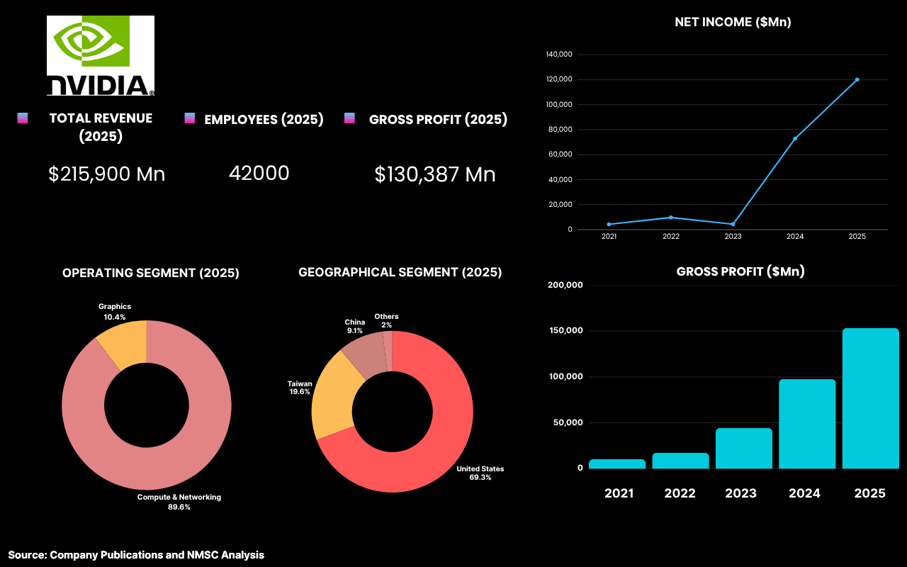
NVIDIA Corporation, headquartered in Santa Clara, California, is a technology company whose platforms span accelerated computing, GPUs, networking, data-center systems, and software. Its data-center portfolio now extends across GPU and CPU compute, networking, DPUs, rack-scale platforms, and full-stack infrastructure designed for AI and high-performance workloads. NVIDIA identifies its accelerated computing platform as an end-to-end foundation for modern data centers.
A major 2026 development came in May, 2026, when NVIDIA announced that its Vera Rubin platform was ramping into full production for next-generation AI factories. The platform combines Rubin GPUs, Vera CPUs, ConnectX-9 SuperNICs, BlueField-4 DPUs, and networking technologies into rack-scale systems. NVIDIA stated that the platform was being manufactured through a supply chain spanning more than 350 factories across 30 countries, with the objective of supporting large-scale AI infrastructure deployments by cloud providers and hyperscalers.
NVIDIA is consequently broadening its role within the Data Center Infrastructure Market from accelerator supplier toward a wider infrastructure architecture provider. The company’s Vera Rubin NVL72 platform integrates compute, networking, and rack-scale design, while NVIDIA's 2026 infrastructure materials emphasize coordinated planning across power, cooling, networking, and compute. This model is reinforcing the shift toward integrated AI data center architectures where compute density and facility-level infrastructure are designed together.
NMSC’s market assessment finds that NVIDIA’s influence is particularly significant in the hardware segment because higher-density AI systems create corresponding requirements for networking, power, cooling, rack design, and infrastructure management. Its expanding ecosystem therefore increases demand across multiple layers of the Data Center Infrastructure Market rather than only within accelerated computing.
Super Micro Computer, Inc.
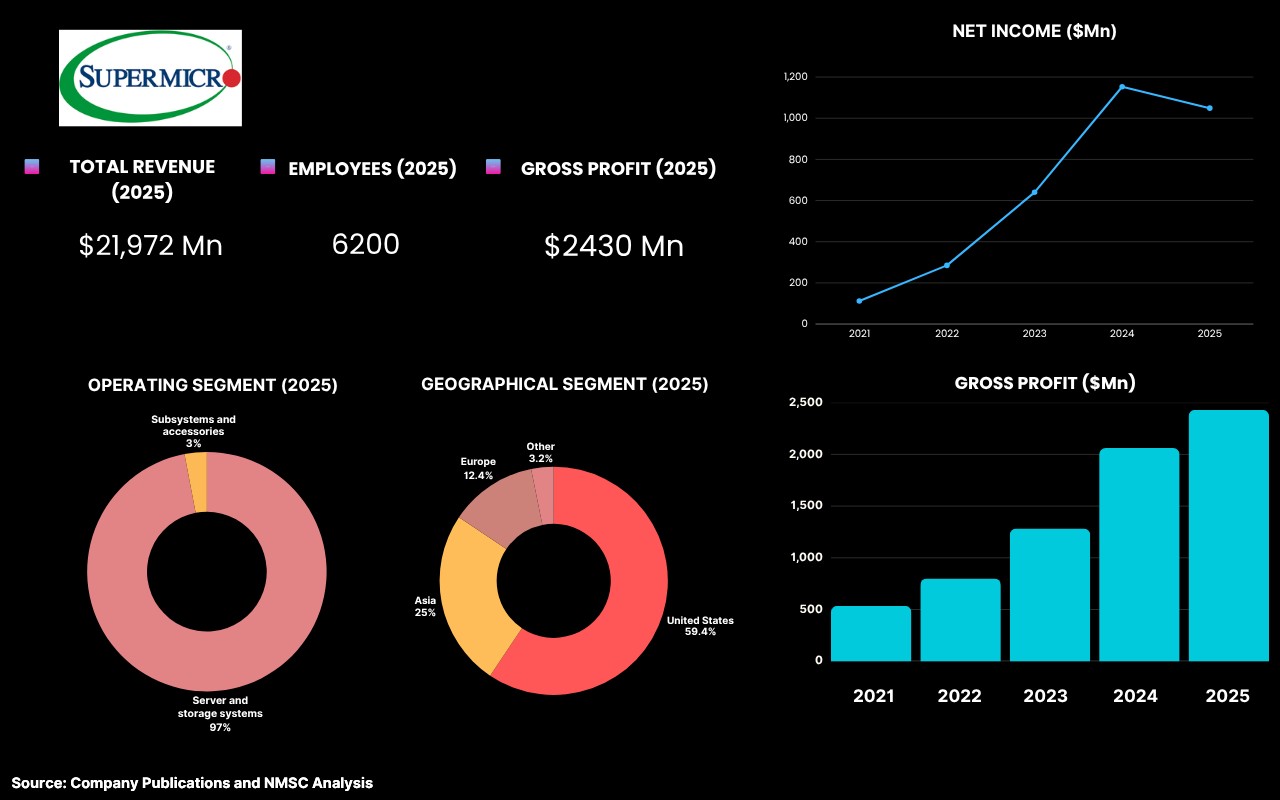
Super Micro Computer, Inc. (Supermicro), headquartered in San Jose, California, designs and manufactures server, storage, networking, and data center systems. The company has expanded its portfolio toward rack-scale and data-center-level solutions, including infrastructure for AI, cloud, storage, high-performance computing, and 5G/edge workloads. Supermicro states that its product and manufacturing operations support global customers across more than 100 countries.
Supermicro accelerated this strategy in July 2026 with an expansion of its Data Center Building Block Solutions (DCBBS) portfolio. In July, 2026, the company announced a range of precision-engineered AI racks designed for high-density deployments, with factory pre-assembly, modular construction, and support for integrated liquid-cooling components. The company introduced ten rack models across multiple configurations and highlighted load capacities exceeding 5,500 pounds for higher-density computing deployments.
The move builds on Supermicro’s expansion of its liquid-cooling portfolio. In July 2026, the company introduced additional rear-door heat exchanger options supporting cooling capacities from 10 kW to 120 kW, providing a deployment path for high-density AI and HPC infrastructure in both new and existing facilities. Earlier, in May 2025, Supermicro launched DCBBS as a broader business line covering servers, storage, networking, racks, liquid cooling, software, services, and support.
Supermicro’s strategy is closely aligned with the increasing demand for integrated infrastructure. Rather than positioning servers as standalone products, the company is combining compute, racks, cooling, management software, and deployment services into modular building blocks. This approach directly addresses the complexity associated with deploying dense AI infrastructure at scale.
Lenovo Group Limited
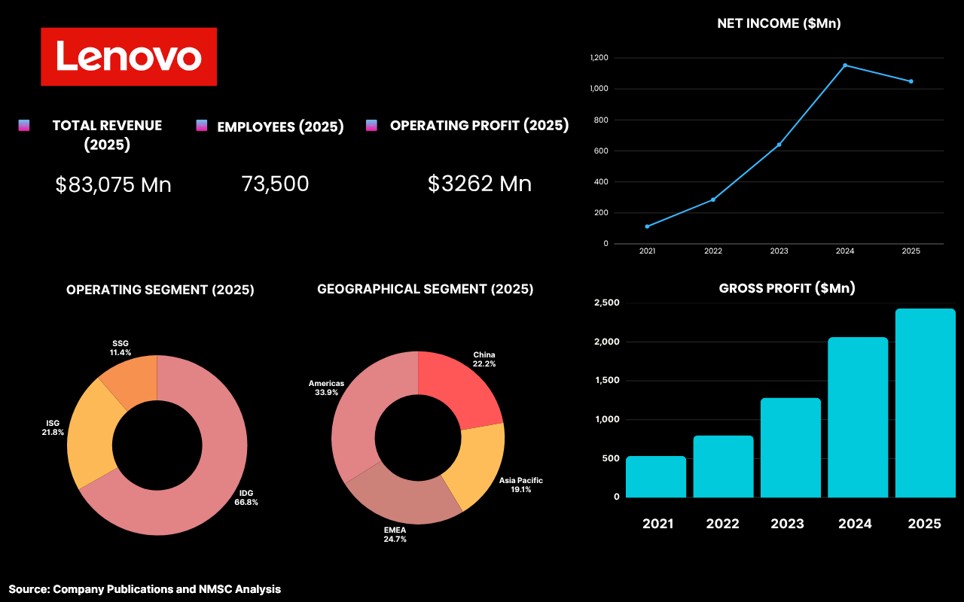
Lenovo Group Limited is a global technology company incorporated and listed in Hong Kong, with headquarters in Beijing, China, and North Carolina, USA. Its Infrastructure Solutions Group provides server, storage, high-performance computing, edge, and data center infrastructure, while the company has developed liquid-cooling technologies under its Neptune platform.
Lenovo strengthened its data center infrastructure proposition in January 2026 by expanding deployment of its Neptune Liquid Cooling technology. In a January 2026 announcement with Formula 1, Lenovo stated that Neptune was being deployed in Formula 1’s high-performance computing environment to support AI and data workloads. The solution uses warm-water cooling at the processor level and is designed to improve performance and energy efficiency for high-density computing.
Lenovo also expanded its AI data center strategy through its Lenovo AI Cloud Gigafactory with NVIDIA program, announced in January 2026. The initiative supports rack-scale AI infrastructure based on NVIDIA Blackwell Ultra and Vera Rubin architectures, including fully liquid-cooled GB300 NVL72 systems that integrate 72 Blackwell Ultra GPUs and 36 Grace CPUs into a rack-scale platform. The program targets rapid deployment of large AI infrastructure environments while integrating computing, storage, networking, cooling, and manufacturing capabilities.
Lenovo’s developments highlight the growing importance of thermal management as a core infrastructure layer. The company's liquid-cooling capabilities and rack-scale AI systems connect compute growth directly with facility-level requirements for heat removal, density, power efficiency, and deployment speed. As AI infrastructure moves toward higher rack densities, these capabilities strengthen Lenovo's position across hardware and infrastructure services.
Based on NMSC’s analysis, we noticed that Lenovo’s combination of server manufacturing, liquid cooling, rack-scale architecture, and infrastructure services positions the company across several segments of the Data Center Infrastructure Market simultaneously. This integrated model aligns with the increasing requirement for standardized, validated infrastructure that supports rapid expansion of AI capacity.
Cisco Systems, Inc.
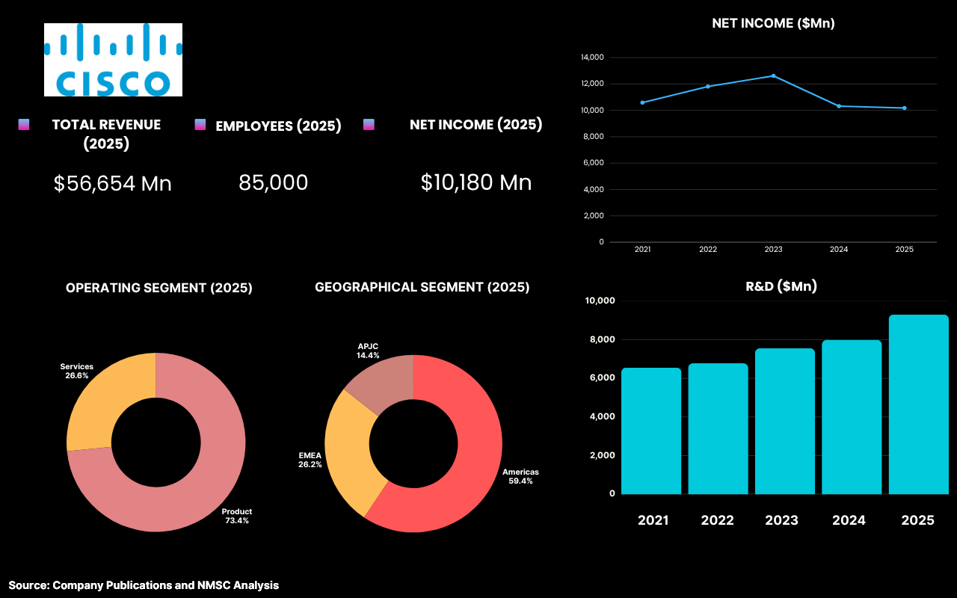
Cisco Systems, Inc., headquartered in San Jose, California, provides networking, security, observability, cloud management, and related infrastructure technologies. Within the Data Center Infrastructure Market, Cisco's primary role is concentrated in high-performance networking, switching, security, and management technologies that connect compute systems and enable data movement across modern facilities.
In February 2026, Cisco introduced its Silicon One G300 switching silicon together with new Cisco N9000 and Cisco 8000 systems and advanced optics designed for large-scale AI data center deployments. The G300 provides 102.4 Tbps switching capability, while the new systems support liquid-cooled configurations for high-density environments. Cisco positioned the portfolio for hyperscalers, neoclouds, sovereign clouds, service providers, and enterprises building AI infrastructure.
Cisco expanded this infrastructure strategy again in August 2026, announcing an extension of its Secure AI Factory with NVIDIA through a partnership with Supermicro. The architecture combines Cisco AI networking with high-density server infrastructure and liquid- or air-cooled compute, providing an integrated reference architecture for enterprises, neoclouds, and sovereign cloud providers. Cisco specifically highlighted the interaction between computing power, power availability, cooling, networking, security, and deployment speed in next-generation AI environments.
Cisco's recent product development demonstrates how networking is becoming an increasingly central component of data center infrastructure planning. AI clusters require high-bandwidth, low-latency connections between compute systems, while higher-density deployments increase requirements for network efficiency and infrastructure management. Cisco's move toward integrated AI-factory architectures therefore extends its role from traditional switching toward coordinated infrastructure for large-scale AI deployments.
International Business Machines Corporation
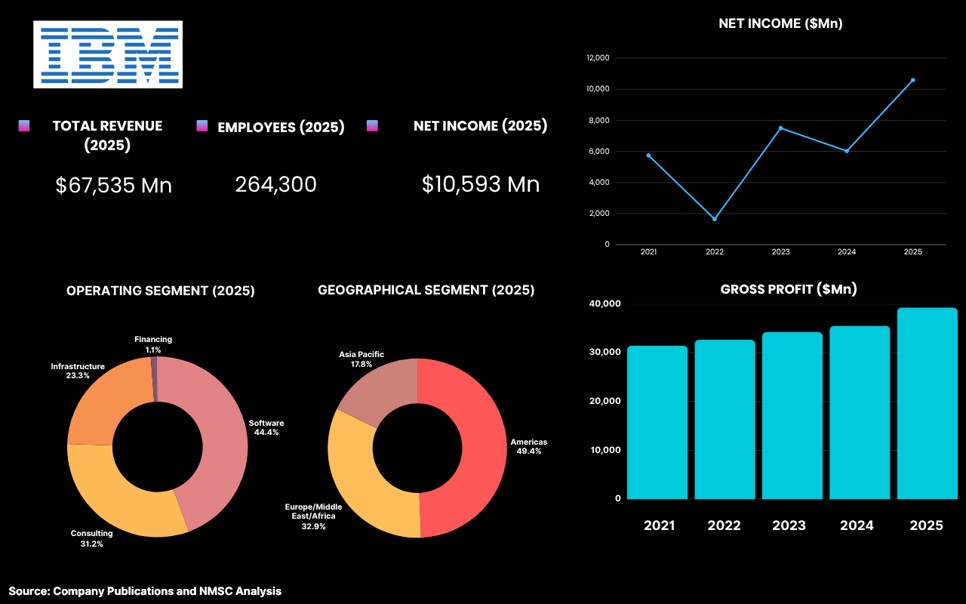
International Business Machines Corporation (IBM), headquartered in Armonk, New York, operates across hybrid cloud, enterprise infrastructure, AI, consulting, and computing technologies. Its infrastructure portfolio spans servers, storage, networking, hybrid cloud environments, and services designed to modernize enterprise data center environments. IBM identifies data center infrastructure modernization as increasingly focused on compute, storage, networking, power, and cooling requirements for modern workloads.
A significant 2026 development came in August 2026, when IBM announced a multi-year agreement with Together AI to deploy a large cluster of NVIDIA HGX B300 systems on IBM Cloud, with expected availability in the first quarter of 2027. The infrastructure is designed for large-scale AI inference and combines NVIDIA accelerated computing with Spectrum-X Ethernet networking on IBM Cloud. IBM stated that the agreement is valued at USD 240 million.
IBM has also expanded the infrastructure-management layer through IBM Apptio Data Center Total Cost of Ownership, announced in June 2026. The capability provides visibility into data center cost, capacity, rack space, cooling, and power constraints, enabling organizations to evaluate infrastructure investment and available capacity as AI workloads increase.
IBM's approach therefore spans both infrastructure consumption and infrastructure management. Its combination of enterprise cloud, accelerated computing, hybrid infrastructure, and data center financial and capacity management addresses organizations that are expanding AI capacity while maintaining existing enterprise environments.
Band Title: Understand the Competitive Structure of the Data Center Infrastructure Market
Band Subline: Access market sizing, offering-level forecasts, regional analysis, competitive positioning, market shares, and strategic insights across the global Data Center Infrastructure Market.
Band Button: Download Free Sample
Market Outlook: AI Infrastructure Is Redefining the Data Center Infrastructure Market
The Data Center Infrastructure Market is moving toward architectures designed around high-density AI workloads rather than conventional enterprise computing alone. GPU-accelerated systems, rack-scale architectures, high-speed networking, liquid cooling, advanced storage, infrastructure management software, and deployment services are becoming increasingly interconnected. IBM's 2026 explanation of data center modernization highlights the increasing requirements of AI and distributed workloads, while NVIDIA's Vera Rubin architecture demonstrates the industry movement toward coordinated compute, networking, and facility infrastructure.
The competitive landscape is consequently expanding across multiple infrastructure layers. NVIDIA is extending accelerated computing into rack-scale AI factories; Supermicro is integrating servers, racks, cooling, software, and services; Lenovo is scaling liquid-cooled AI infrastructure and gigawatt-oriented architectures; Cisco is expanding high-speed networking and secure AI-factory reference architectures; and IBM is combining enterprise cloud infrastructure with accelerated computing and infrastructure management capabilities. These developments reflect a market in which hardware, software, and services increasingly converge around common AI infrastructure requirements.
Our assessment indicates that the next phase of market expansion will be defined by infrastructure density, thermal management, energy efficiency, interoperability, deployment speed, and lifecycle optimization. With the market projected to increase from USD 328.11 billion in 2026 to USD 795.17 billion by 2035, providers with capabilities spanning multiple infrastructure layers will participate in a broader portion of the value chain as organizations modernize facilities for AI, cloud, HPC, and data-intensive enterprise workloads.
About the Author
 Sanyukta Deb
— Sanyukta Deb is Digital Marketing Team Lead at Next Move Strategy Consulting, where she has led content strategy and technical SEO for the firm's B2B market research publications for over 2 years. Her editorial process translates NextMSC's primary and secondary research — spanning technology, industrial, and consumer sectors — into commercial narratives, backed by search-intent, keyword, and competitive analysis. She brings 5 years of overall experience in digital marketing and content strategy.
Sanyukta Deb
— Sanyukta Deb is Digital Marketing Team Lead at Next Move Strategy Consulting, where she has led content strategy and technical SEO for the firm's B2B market research publications for over 2 years. Her editorial process translates NextMSC's primary and secondary research — spanning technology, industrial, and consumer sectors — into commercial narratives, backed by search-intent, keyword, and competitive analysis. She brings 5 years of overall experience in digital marketing and content strategy.
About the Reviewer
 Debashree Dey
— Debashree Dey is Assistant Manager at Next Move Strategy Consulting, where she supports cross-vertical market content and communications across diverse industries for 6 years. Her professional background includes senior content writing, communications, and published manuscript authorship, with experience developing audience-focused business narratives and maintaining clear, consistent messaging. Her role supports research-led content development and editorial quality across NextMSC publications.
Debashree Dey
— Debashree Dey is Assistant Manager at Next Move Strategy Consulting, where she supports cross-vertical market content and communications across diverse industries for 6 years. Her professional background includes senior content writing, communications, and published manuscript authorship, with experience developing audience-focused business narratives and maintaining clear, consistent messaging. Her role supports research-led content development and editorial quality across NextMSC publications.

















Add Comment