Best Tactical Gear for Security Businesses

Security firms, hospitals, and factories all buy from the same underlying supply chain, and that supply chain is consolidating faster than most buyers realize. Two of the ten companies most commonly named as leaders in the Personal Protection Equipment (PPE) Market which NMSC values at USD 67.99 billion in 2023, growing to a projected USD 102.27 billion by 2030 at a 7.0% CAGR have exited the business entirely over the past 18 months, selling their PPE brands to other players. A third is navigating a near-total restructuring of the federal agency that certifies its products. None of that shows up in a typical buying guide, but all of it changes what gloves, respirators, and protective clothing will cost and who will be selling them next year.
Why Is U.S. PPE Certification and Regulation in Flux?
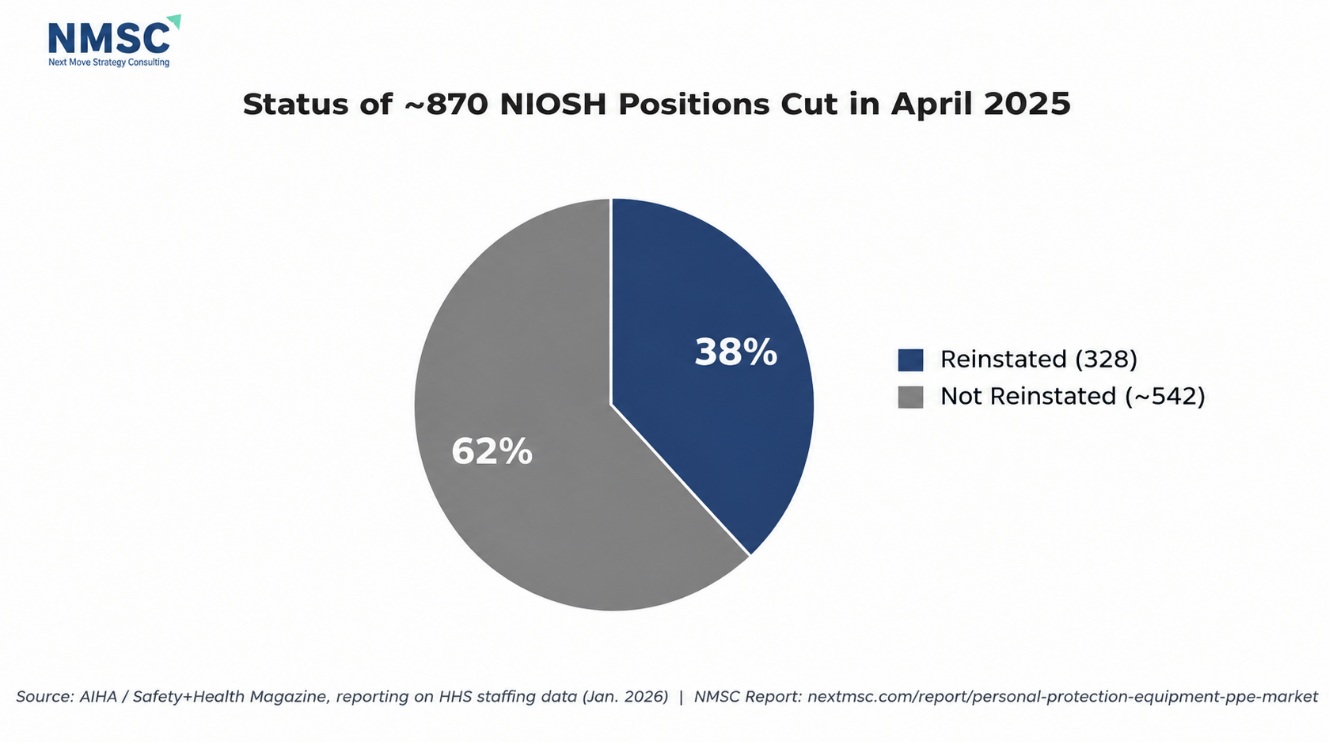
The clearest sign of instability sits inside NIOSH, the federal institute that certifies every N95 mask and workplace respirator sold in the United States. In April 2025, HHS issued reduction-in-force notices covering roughly 870 of NIOSH's approximately 1,000 positions, including the entire Respirator Approval Program effectively halting new respirator certifications nationwide. Industry pressure from groups including the International Safety Equipment Association (ISEA) and AIHA led HHS to reverse course: the Respirator Approval Program was restored by May 15, 2025, with 328 positions reinstated, and HHS confirmed the broader reversal on January 13, 2026. Congress fully funded NIOSH for FY2026, adding $4 million and recommending $23 million specifically for the Personal Protective Technology account.
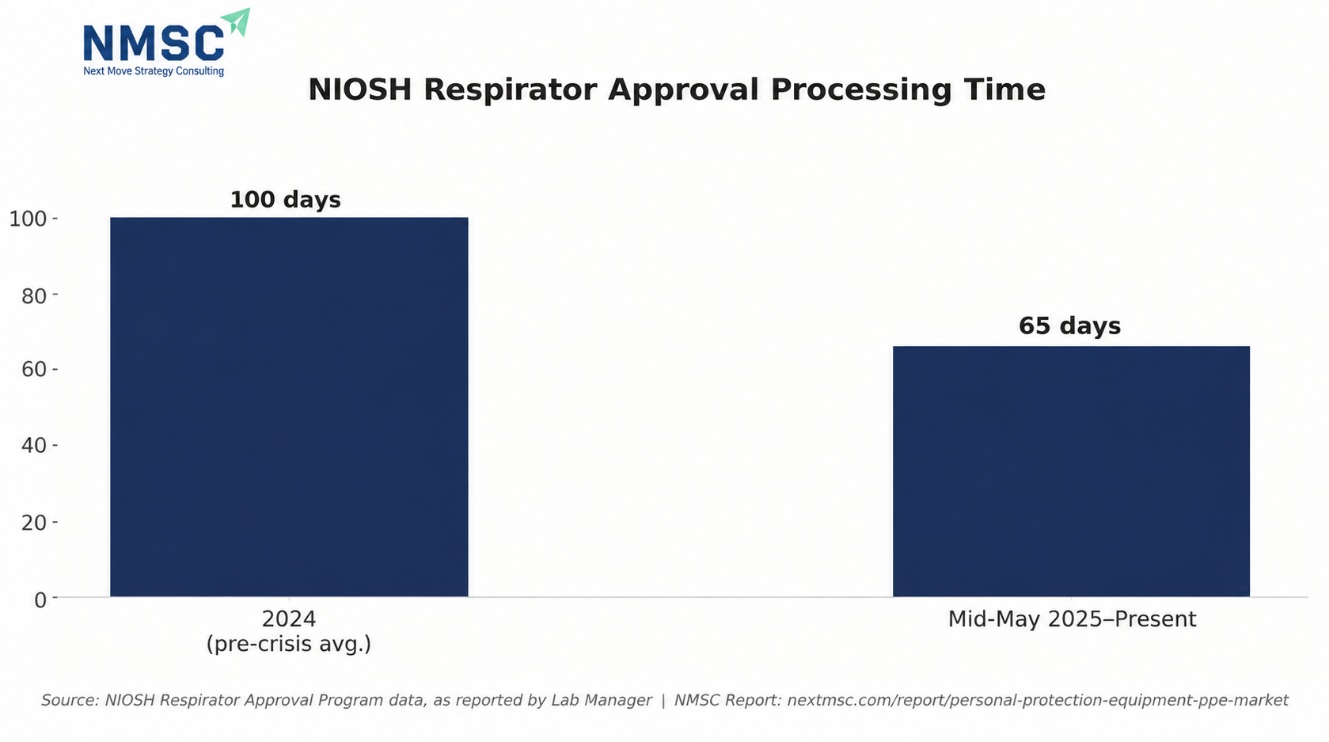
The program has since improved: NIOSH reported that average respirator-approval processing time fell from 100 days in 2024 to 65 days from mid-May 2025 onward, a 35% reduction, alongside expanded enforcement against counterfeit respirators. But the underlying instability has not fully resolved HHS’s FY2027 budget-in-brief, published April 3, 2026, proposes folding NIOSH into a new National Center for Chemicals and Toxins inside the CDC and again targets its $120.5 million research budget (NORA) for elimination. Separately, OSHA has pulled in two directions at once: a long-delayed rule requiring construction PPE to properly fit each employee took effect January 13, 2025, while OSHA's heat-illness National Emphasis Program lapsed on April 8, 2026 with no replacement announced, and the underlying federal heat standard remains stalled.
The certification and enforcement infrastructure behind the PPE Market went through a genuine near-crisis in 2025 and has only partly stabilized buyers should not assume respirator certification continuity is guaranteed going forward.
-
NIOSH's Respirator Approval Program was effectively halted in April 2025 before being restored a month later
-
On January 13, 2026, HHS reversed the NIOSH RIF notices, initiating broad reinstatement of affected employees.
-
Processing times have improved 35% since the crisis, but a new FY2027 restructuring proposal threatens NIOSH's research budget again
-
OSHA is simultaneously tightening PPE fit requirements and letting its heat-illness enforcement program lapse
How Is Industry Consolidation Reshaping the PPE Market's Competitive Landscape?
Honeywell has exited this market entirely. It sold its full Personal Protective Equipment portfolio the Fendall, Fibre-Metal, Howard Leight, and KCL brands, roughly 5,000 employees, and 20 manufacturing facilities to Protective Industrial Products (PIP), a portfolio company of Odyssey Investment Partners, for $1.325 billion in a deal that closed May 21, 2025. Honeywell has since broken itself into three separate public companies (Solstice Advanced Materials, spun off October 2025; Honeywell Aerospace, spun off June 29, 2026), confirming PPE was never coming back into its portfolio. Kimberly-Clark made a similar portfolio move: it agreed in April 2024 to sell its Personal Protective Equipment business, including the Kimtech™ and KleenGuard™ brands, to Ansell for US$640 million. Ansell completed the acquisition on July 1, 2024, with integration and systems cutovers continuing thereafter.
3M completed its exit from PFAS manufacturing at the end of 2025 and divested its remaining PFAS-producing subsidiary, Dyneon GmbH, in the second quarter of 2026 for a $324 million pre-tax loss a shift with direct implications for protective-clothing materials, since PFAS chemistry historically supplied water and chemical repellency in firefighting and chemical-protective gear. The company's Safety and Industrial segment still delivered 3.8% organic growth in the fourth quarter of 2025, even as a Connecticut federal judge allowed a new firefighter lawsuit alleging PFAS exposure to proceed against 3M and more than 20 other companies in September 2026. MSA Safety moved in the opposite direction, expanding rather than exiting: it acquired Norway's Autronica Fire and Security for approximately $555 million in a deal that closed in July 2026, pushing into a $3 billion fire- and gas-detection market adjacent to its core business, while posting 24% adjusted EPS growth in the second quarter of 2026.
DuPont addressed the industry's comfort-versus-protection tension directly, launching Tyvek® APX™ at Thailand's Safe@Work 2026 conference on June 24, 2026 a new protective-coverall material independently verified by Switzerland's Empa laboratories for improved breathability without sacrificing chemical and particulate protection, a response to the same heat-stress pressures driving OSHA's stalled rulemaking. Avon Rubber's Avon Protection division reported first-half 2026 revenue up 23% to $92.9 million, driven substantially by Ukraine-related demand, plus a $13 million Middle East filter order and a $14 million sole-source U.S. Department of War contract; it is also developing the MITR-M1 respiratory system explicitly for “modern combat and policing” applications, a direct line back to the security-sector buyers this article originally targeted. Alpha Pro Tech posted 46.8% net income growth in the second quarter of 2026, helped in part by a $219,000 refund tied to Trump-era IEEPA tariffs a small but concrete illustration of how tariff policy is now a direct line item for PPE manufacturers.
Johnson Safety Products (JSP), a UK-based independent head-protection manufacturer that distributes through PIP in North America, is navigating EN 397:2025, the first substantive overhaul of Europe's industrial helmet standard in roughly 30 years. Cardinal Health's PPE lines (gloves, gowns, masks) remain folded into its much larger Global Medical Products and Distribution segment; no PPE-specific strategic initiative from the past six months was found in the company's public disclosures separate from that broader distribution business.
The pattern across all ten companies is consolidation, not expansion: two former leaders exited entirely into other companies' hands, a third is absorbing PFAS-exit costs and new litigation, and only the mid-sized specialists MSA Safety, Avon Protection, Alpha Pro Tech are actively growing their core PPE and detection businesses.
The PPE Market's ten most-cited leaders no longer look like ten independent competitors brand consolidation, PFAS-related exits, and defense-driven demand are reshaping who actually competes in this space.
-
Honeywell and Kimberly-Clark have both exited the PPE business entirely, selling their brands to PIP and Ansell respectively
-
3M's PFAS exit is reshaping protective-clothing materials while new litigation continues into 2026
-
MSA Safety, Avon Protection, and Alpha Pro Tech are the clearest examples of active growth rather than portfolio retreat
-
Defense- and security-sector demand (Avon Protection's Ukraine-driven growth, MITR-M1) is an increasingly distinct growth lane within the broader market
What Should Security and Industrial Buyers Take from This?
For the security companies and facility operators this topic was originally written for, the practical implication is straightforward: procurement decisions once made on brand loyalty now need to account for who actually owns that brand. A guard company that standardized on Honeywell eyewear or Kimberly-Clark gloves years ago is, whether it realizes it or not, now buying from PIP or Ansell. Buyers sourcing tactical and PPE gear from established suppliers including broad-catalog retailers such as LA Police Gear should confirm which manufacturer and certification currently stands behind a given product line rather than assuming continuity with past purchases.
The closely related Workplace Safety Market NMSC's broader category covering the hardware, software, and services (not just equipment) that organizations use to manage safety offers useful context here. NMSC values that market at USD 15.03 billion in 2023, growing to a projected USD 35.72 billion by 2030 at a 13.2% CAGR, a faster pace than PPE alone, reflecting how much of new safety spending is going toward monitoring and detection systems rather than wearable equipment.
NMSC Market Size & Growth Comparison
|
Market |
2023 value |
2030 projected value |
CAGR (2024–2030) |
|
Personal Protection Equipment (PPE) Market |
USD 67.99 billion |
USD 102.27 billion |
7.0% |
|
Workplace Safety Market |
USD 15.03 billion |
USD 35.72 billion |
13.2% |
Recent PPE Regulatory & Institutional Timeline
|
Date |
Development |
|
Jan. 13, 2025 |
OSHA's construction PPE fit rule (29 CFR 1926.95(c)) takes effect |
|
Apr. 1, 2025 |
HHS issues RIF notices to ~870 of NIOSH's ~1,000 positions, including the Respirator Approval Program |
|
May 15, 2025 |
NIOSH Respirator Approval Program restored; 328 positions reinstated |
|
May 21, 2025 |
Honeywell completes $1.325B sale of its PPE business to Protective Industrial Products |
|
Jan. 13, 2026 |
HHS confirms full reversal of NIOSH staffing cuts |
|
Apr. 3, 2026 |
HHS's FY2027 budget proposes folding NIOSH into a new National Center for Chemicals and Toxins |
|
Apr. 10, 2026 |
OSHA updates its National Emphasis Program on outdoor and indoor heat-related hazards, effective immediately. |
A Test for Next Year's Procurement Planning
Given how much of the PPE Market's ownership structure has shifted in the past 18 months, buyers should treat brand continuity as something to verify, not assume. Before renewing a standing equipment contract, confirm three things: which company currently owns the brand, whether the relevant NIOSH or ANSI certification is current under that ownership, and whether recent tariff or litigation exposure at the manufacturer level is likely to affect price or supply. Companies that can answer all three quickly are sourcing from a stable position; those that cannot are exposed to exactly the kind of consolidation risk this year has demonstrated.
Procurement and strategy teams evaluating suppliers against this backdrop can go deeper into segment-level and regional data Download Free Sample
Conclusion
The Personal Protection Equipment (PPE) Market is not the stable, brand-loyal category a decade of buying guides implied. Two of its most commonly cited leaders have exited entirely, its primary U.S. certification body spent much of 2025 in genuine crisis, and tariff and litigation exposure now show up directly in quarterly earnings at companies from Alpha Pro Tech to 3M. None of that changes the underlying demand driving NMSC's projected growth to USD 102.27 billion by 2030 but it does mean the list of companies actually supplying that demand in 2030 will look different from the list that supplies it today.
About the Author
 Sanyukta Deb
— Sanyukta Deb is Digital Marketing Team Lead at Next Move Strategy Consulting, where she has led content strategy and technical SEO for the firm's B2B market research publications for over 2 years. Her editorial process translates NextMSC's primary and secondary research — spanning technology, industrial, and consumer sectors — into commercial narratives, backed by search-intent, keyword, and competitive analysis. She brings 5 years of overall experience in digital marketing and content strategy.
Sanyukta Deb
— Sanyukta Deb is Digital Marketing Team Lead at Next Move Strategy Consulting, where she has led content strategy and technical SEO for the firm's B2B market research publications for over 2 years. Her editorial process translates NextMSC's primary and secondary research — spanning technology, industrial, and consumer sectors — into commercial narratives, backed by search-intent, keyword, and competitive analysis. She brings 5 years of overall experience in digital marketing and content strategy.
About the Reviewer
 Debashree Dey
— Debashree Dey is Assistant Manager at Next Move Strategy Consulting, where she supports cross-vertical market content and communications across diverse industries for 6 years. Her professional background includes senior content writing, communications, and published manuscript authorship, with experience developing audience-focused business narratives and maintaining clear, consistent messaging. Her role supports research-led content development and editorial quality across NextMSC publications.
Debashree Dey
— Debashree Dey is Assistant Manager at Next Move Strategy Consulting, where she supports cross-vertical market content and communications across diverse industries for 6 years. Her professional background includes senior content writing, communications, and published manuscript authorship, with experience developing audience-focused business narratives and maintaining clear, consistent messaging. Her role supports research-led content development and editorial quality across NextMSC publications.


















Add Comment