Account Layers Benefits for Wallet Platforms and Developers at Scale
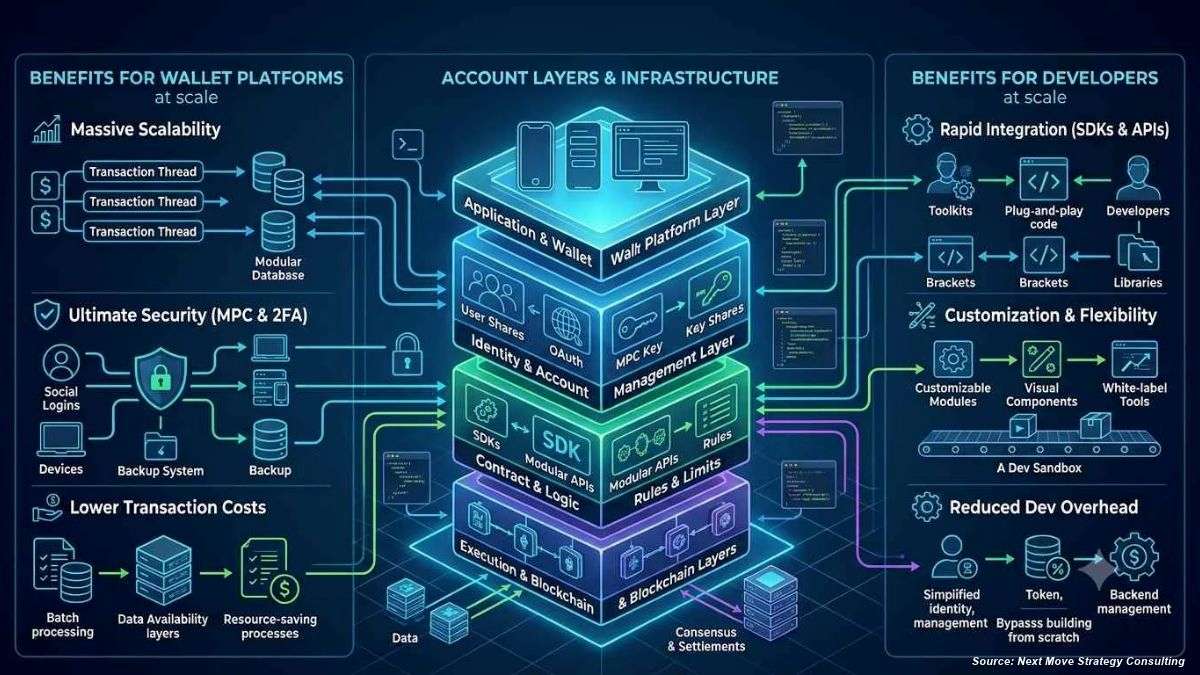
As digital wallet platforms attract more users, their infrastructure must handle increasing transaction volumes, diverse financial services, and growing operational demands. Systems that work efficiently during early development may struggle when businesses introduce additional currencies, payment networks, blockchain integrations, and compliance requirements. Scaling therefore involves more than increasing server capacity. It requires an architecture that supports expansion without creating unnecessary technical complexity.
Understanding the account layers benefits for wallet platforms and developers helps explain how financial applications can prepare for sustained growth. An account layer connects essential capabilities, including identity verification, account management, payment processing, and digital asset operations, through reusable infrastructure. When developers combine this architecture with well-designed APIs, they can expand services, automate workflows, and manage increasing activity more efficiently.
Understanding Account Layers in Scalable Financial Infrastructure
An account layer provides the underlying infrastructure that allows applications to manage financial accounts and related operations. It connects services that might otherwise require separate systems, such as customer onboarding, balance management, fiat payments, and cryptocurrency transactions.
For wallet platforms, this architecture creates a foundation for expanding beyond basic digital asset storage.
A growing wallet application may eventually need to support thousands of additional accounts, multiple blockchain networks, international transfers, and more complex verification procedures. Without a coordinated infrastructure, each new capability can introduce additional integrations and maintenance requirements.
An account layer helps organize these functions through standardized interfaces. Developers can access supported financial services without independently recreating every underlying component.
Why Scalability Matters for Wallet Platforms
Scalability determines whether an application can maintain reliable performance as its user base and transaction activity increase.
Managing Growing Transaction Volumes
A wallet platform must process account requests, balance updates, deposits, withdrawals, and transaction notifications accurately.
As activity increases, inefficient database queries, poorly designed APIs, and inadequate infrastructure can create delays.
Account layers can help separate financial operations into manageable components. Developers can optimize individual services, monitor transaction workloads, and improve processing capacity without redesigning the entire application.
Supporting Expanding Financial Services
Wallet platforms often introduce new features as customer requirements evolve. These may include stablecoin transfers, multicurrency accounts, fiat payment access, and card-related services.
A modular account architecture allows developers to add supported capabilities progressively.
This reduces the need to rebuild existing systems whenever the business introduces another financial product.
How API-Based Account Layers Support Development at Scale
APIs provide the communication framework between wallet applications and financial infrastructure. Their effectiveness directly influences how easily developers can expand and maintain their products.
Standardizing Financial Operations
Standardized APIs give developers consistent methods for interacting with account services.
For example, an application can use defined endpoints to retrieve balances, create accounts, initiate transfers, or access transaction records.
Consistent request and response structures reduce integration complexity and make application behavior easier to maintain.
Automating Repetitive Processes
Manual financial operations become increasingly difficult to manage as transaction volumes grow.
API automation can support account creation, identity verification workflows, payment initiation, and transaction status updates.
Webhooks provide another important mechanism. They notify applications when financial events occur, allowing systems to update records without continuously requesting information from external providers.
Supporting Independent Service Improvements
A modular architecture allows engineering teams to improve individual components without changing unrelated application functions.
For instance, developers may optimize payment processing separately from identity verification or account reporting.
This separation can simplify testing, reduce deployment risks, and support more organized software maintenance.
Operational Benefits of Account Layers at Scale
The advantages of account infrastructure become more apparent as financial platforms expand their operations.
Simplified Account Management
Managing large numbers of customer accounts requires consistent processes for account creation, permissions, balances, and transaction histories.
A coordinated account layer can provide shared interfaces for these operations, reducing fragmentation across application components.
More Efficient Financial Reconciliation
Reconciliation compares internal account records with transaction information from banks, payment providers, and blockchain networks.
As transaction volumes increase, manual reconciliation becomes time-consuming and difficult to maintain.
Integrated account data and automated reporting can help teams identify discrepancies, track payment statuses, and investigate incomplete transactions.
Better Monitoring and Operational Visibility
Large-scale financial applications need continuous visibility into system performance.
Developers should monitor API response times, transaction failures, webhook delivery, processing delays, and account inconsistencies.
Account layers can provide structured access to financial activity, helping operational teams identify problems and respond before they affect a larger number of users.
Managing Security and Compliance During Expansion
Growth increases the importance of financial security. A platform that handles more customers and transactions must maintain reliable controls across account access, data protection, and regulatory processes.
Centralized Identity Verification
Know Your Customer (KYC) procedures help financial service providers establish customer identities. Account layers can connect identity verification with account creation, reducing fragmented onboarding workflows.
When providers support reusable identity credentials, participating applications may also reduce repeated verification steps, subject to applicable regulatory requirements.
Consistent Transaction Monitoring
Anti-Money Laundering (AML) controls help identify unusual transaction patterns and potential financial crime.
An integrated account architecture can coordinate sanctions screening, transaction monitoring, and customer risk assessments across supported services.
However, businesses must understand their individual regulatory obligations and ensure that monitoring systems can accommodate increasing transaction volumes.
Protecting Infrastructure Availability
Scalable financial applications need safeguards against service interruptions and unauthorized access.
Developers should implement rate limiting, secure authentication, encrypted communications, backup procedures, and appropriate disaster recovery plans. They should also test how integrations behave when external services become unavailable.
Choosing an Account Architecture for Long-Term Growth
Not every wallet platform requires the same infrastructure. A startup may prioritize rapid integration, while an established exchange may need advanced transaction controls and compatibility with existing systems.
Developers should evaluate several factors before selecting an account layer:
-
API documentation, versioning, and integration support.
-
Supported currencies, payment networks, and blockchain ecosystems.
-
Account ownership, custody arrangements, and authorization controls.
-
Compliance coverage and regulatory responsibilities.
-
Transaction capacity, service availability, and recovery procedures.
-
Pricing structures and the flexibility to add services independently.
These considerations help businesses avoid infrastructure decisions that limit future development or introduce unnecessary operational dependencies.
UR and the Development of Scalable Account Infrastructure
UR provides an example of composable account infrastructure designed for wallets, exchanges, and financial technology developers. Its platform combines identity, multicurrency accounts, fiat payment rails, digital asset services, and compliance capabilities through API-based integration.
Its published architecture allows partners to select individual modules instead of adopting every available service. For example, a wallet could integrate identity and digital asset conversion first, then introduce additional account or payment capabilities as its requirements change.
UR also supports Delegated Mode and External Wallet Access, giving developers different approaches to transaction execution and asset control.
This illustrates how modular infrastructure can support different stages of business growth. However, developers should independently assess provider licensing, custody arrangements, technical capacity, service availability, and contractual responsibilities before integration.
Preparing Wallet Platforms for Sustainable Growth
Account layers provide an architectural foundation for wallet platforms that need to expand beyond basic cryptocurrency functionality. By connecting financial accounts, payment services, identity verification, and digital asset operations, they help developers organize complex systems through reusable infrastructure.
The greatest advantage comes from combining modular development with reliable APIs, effective monitoring, and strong security controls. These elements allow platforms to introduce additional services while maintaining operational consistency.
Ultimately, scaling successfully requires more than accommodating additional users. It means building financial infrastructure that can adapt to changing requirements, support reliable transactions, and maintain user confidence as the platform grows.
About the Author
 Sanyukta Deb
— Sanyukta Deb is Digital Marketing Team Lead at Next Move Strategy Consulting, where she has led content strategy and technical SEO for the firm's B2B market research publications for over 2 years. Her editorial process translates NextMSC's primary and secondary research — spanning technology, industrial, and consumer sectors — into commercial narratives, backed by search-intent, keyword, and competitive analysis. She brings 5 years of overall experience in digital marketing and content strategy.
About the Reviewer
 Debashree Dey
— Debashree Dey is Assistant Manager at Next Move Strategy Consulting, where she supports cross-vertical market content and communications across diverse industries for 6 years. Her professional background includes senior content writing, communications, and published manuscript authorship, with experience developing audience-focused business narratives and maintaining clear, consistent messaging. Her role supports research-led content development and editorial quality across NextMSC publications.

















Add Comment