AI-Based Security Operations: Why SOCs Must Match Machine Speed | NextMSC

Introduction
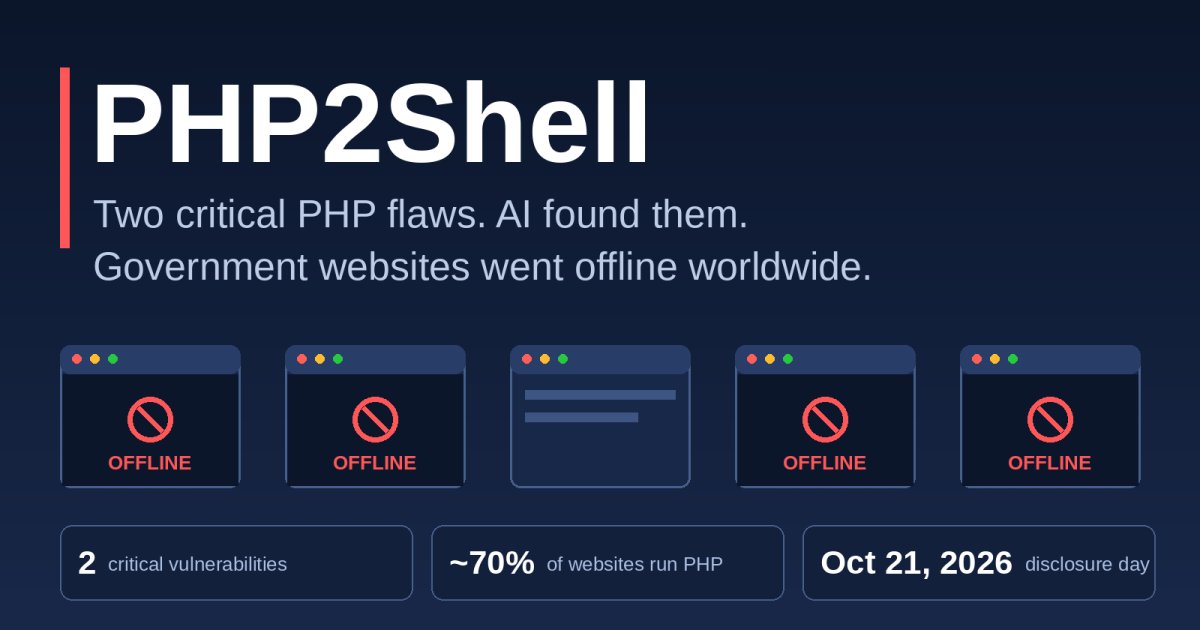
On October 21, 2026, the National Security Agency advised U.S. government departments to patch two critical PHP flaws immediately, and within hours government and corporate websites across Europe and Asia went offline as a precaution. CNN reported on October 22, 2026 that researchers at OpenAI, Wiz and a second cybersecurity company had found the flaws, collectively named PHP2Shell, with the help of frontier AI models, in code where they had stayed hidden for more than a decade. PHP powers 70% of all websites, so a coding defect became a worldwide security operations workload overnight: inventory every exposed server, rank the exposure, hunt through logs and contain whatever cannot be patched.
According to Next Move Strategy Consulting's AI-Based Security Operations Market report, the global AI-based security operations market was valued at USD 28.24 billion in 2024 and is projected to reach USD 82.45 billion by 2030, growing at a CAGR of 19.2% from 2025 to 2030. NextMSC primary research and analysis identifies rising cyberattack volumes, growing corporate investment in AI and wider digitalization as the structural demand factors behind that forecast.
For More Information: Download FREE Sample on AI-Based Security Operations Market Report
This analysis tests that forecast against the last six months of evidence: PHP2Shell, quarterly results from Palo Alto Networks and CrowdStrike, IBM's breach-cost research, new government directives and the Microsoft Digital Defense Report 2026. Each event is judged by what it changes in buying behavior, not only by what it says about threats.
From PHP2Shell to Agentic SOCs: What Machine-Speed Exploits Mean for the AI-Based Security Operations Market
PHP2Shell: A Decade-Old Flaw Becomes a Security Operations Emergency
The National Security Agency's October 21, 2026 advisory set out the response in operational terms. It told organizations to inventory hardware and software services that rely on vulnerable PHP versions, add enhanced logging, replace end-of-life PHP services that cannot take the patch and take systems offline if an immediate update was not feasible. PHP released its open-source fix the same day. CNN reported that government websites in France, Denmark, Finland and the Netherlands, including the Dutch cyber security agency, went offline temporarily, while Japan's ANA, JR West and MUFG suspended some pages and services.
The Record reported on October 27, 2026 that the Cybersecurity and Infrastructure Security Agency added CVE-2026-109618 and CVE-2026-109619 to its Known Exploited Vulnerabilities catalog on October 26 and ordered civilian agencies to patch by October 29. The same report cited Censys data showing that, of 42 million internet-facing PHP services, more than 10 million had been patched since October 21. CNN relayed Wiz's finding that a single researcher completed in a week what previously needed a world-class team for months, because frontier AI models made it practical to turn a long-present flaw into a working exploit.
For a security operations center, that compression is the operational lesson. Asset discovery, exposure ranking, log hunting and containment decisions must run in parallel within hours, and each is a task that AI triage, automated playbooks and agentic workflows are built to absorb. A team that handles those steps manually must choose between speed and coverage, the trade-off that AI-based security tooling is designed to remove.
Palo Alto Networks and CrowdStrike: Platform Vendors Rebuild Around Agents
Palo Alto Networks reported on September 1, 2026 that fiscal fourth-quarter revenue grew 34% to USD 3.41 billion and Next-Generation Security annual recurring revenue (ARR) grew 63% to USD 9.10 billion, with Cortex, its security operations platform, named among the sources of strength. Chairman and CEO Nikesh Arora said the latest AI advances are "elevating cybersecurity to the top of the CIO priority list." The company announced the same day that it had acquired Console, an AI-native platform for agentic workflows, to deepen the agentic capabilities of Cortex, which investigates signals, prioritizes work and takes action across customer environments.
CrowdStrike's August 26, 2026 results point the same way. The company reported record net new ARR of USD 333 million, total ARR of USD 5.84 billion (up 25%) and ARR from accounts that have adopted its Falcon Flex subscription model above USD 2.29 billion, growing 101%. It raised its fiscal 2027 net new ARR growth outlook by 630 basis points to 34% at the midpoint and agreed to acquire the technology assets of XM Cyber, an attack-path visualization and offensive simulation provider, from Schwarz Digits.
Module adoption shows how buyers are acting. CrowdStrike reported that 51% of its subscription customers use six or more modules, 35% use seven or more and 26% use eight or more as of July 31, 2026. NextMSC primary research and analysis reads this pattern, together with Palo Alto Networks' platform emphasis, as consolidation: when attackers move in hours, each handoff between separate consoles costs analyst minutes, so buyers favor suites that share data and automation across detection, response and exposure management.
IBM's 2026 Breach Study: The Cost Case for the AI-Based Security Operations Market
IBM's Cost of a Data Breach Report 2026, released on July 29, 2026 with the Ponemon Institute and based on breaches at 602 organizations between March 2025 and February 2026, puts a price on the shift. The global average cost of a breach rose 12% to a record USD 4.99 million. One in four malicious breaches was AI-enabled, a 56% increase over the prior year, and those breaches cost an average of USD 6 million. Organizations that used AI and automation extensively in security operations saved USD 1.93 million per breach compared with those that used none, yet one in four organizations had not adopted these tools in their security operations.
The adoption gap is specific. According to IBM's July 29, 2026 release, more than 50% of organizations use AI agents for threat detection and containment, but only 18% apply agents to vulnerability management, leaving known exposures open while AI shortens exploit windows. IBM's follow-on research with the Ponemon Institute, conducted in May 2026, found that 85% of organizations plan to raise security spending after learning about advanced frontier AI cyber capabilities, against 64% that planned to do so after experiencing a breach. Anticipated capability now moves budgets faster than realized loss.
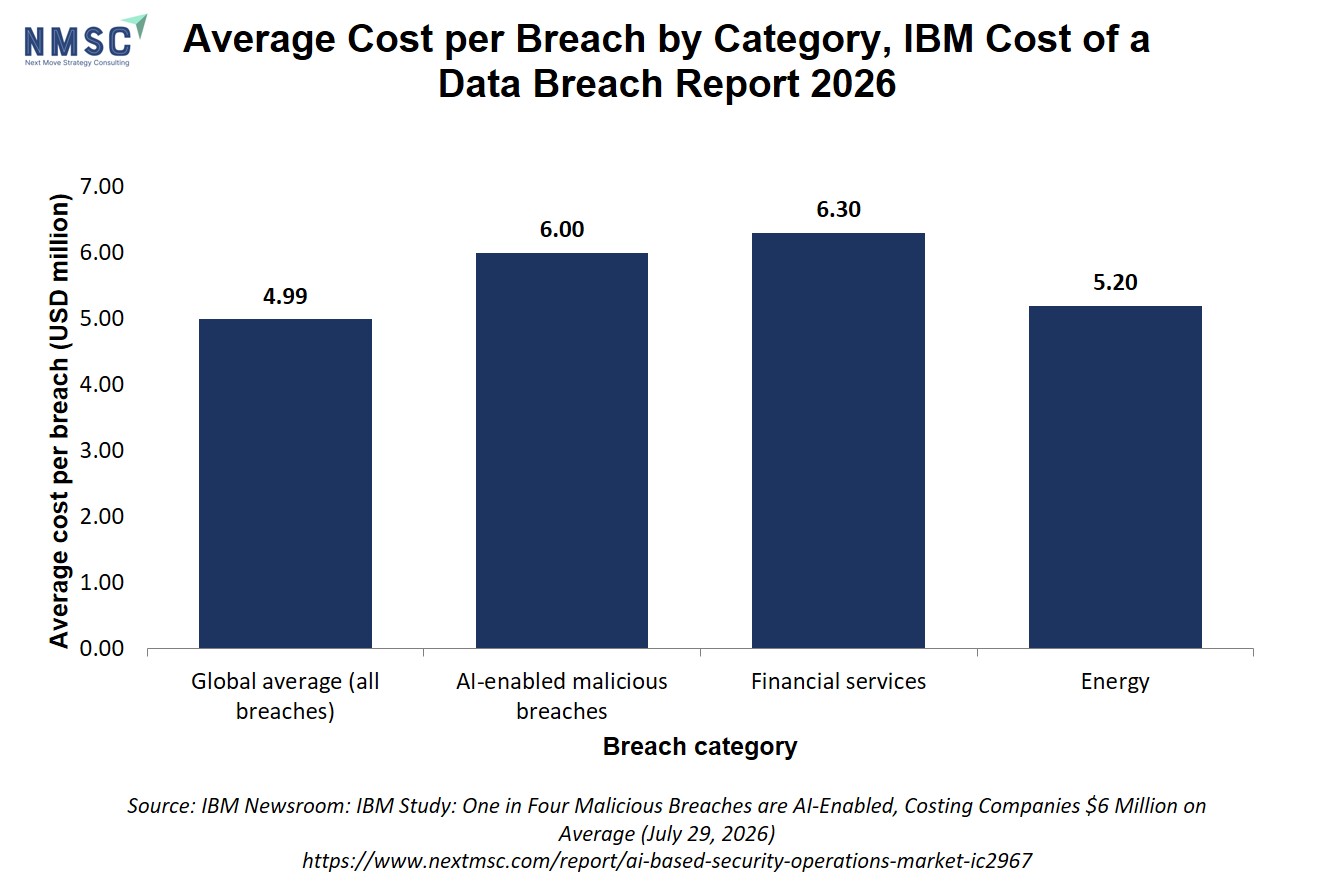
IBM's Cost of a Data Breach Report 2026, released on July 29, 2026, reports a global average breach cost of USD 4.99 million. AI-enabled malicious breaches averaged USD 6 million, financial services breaches USD 6.3 million and energy breaches USD 5.2 million. The figures describe breaches experienced by 602 organizations between March 2025 and February 2026.
NMSC Strategic Perspective: Remediation, Not Detection, Is the Next Segment Contest
NextMSC primary research and analysis draws one conclusion from the evidence above. IBM's finding that more than 50% of organizations apply agents to detection and containment while 18% apply them to vulnerability management shows where AI-based security operations spending has already landed and where it has not. In NextMSC's segmentation, detection and alerting sit under the Threat Operations application, while vulnerability and risk management sits under Risk & Compliance and threat hunting under Proactive Defense. NextMSC's reading is that PHP2Shell, the CISA directive and the NCSC warnings discussed below all raise the value of those second and third application groups, because each shortens the time allowed between discovery and fix, not only the time allowed to spot an alert.
Three further observations follow from NextMSC's research. First, NextMSC's report identifies high implementation cost, driven by the specialized servers, cloud storage and compute needed to analyze security data in real time, as a restraint for small and medium-sized enterprises; managed AI-SOC services are the structural answer because they convert that fixed cost into a subscription. Second, data security and privacy concerns remain a significant restraint in NextMSC's analysis, which favors hybrid and on-premise deployment for regulated buyers even as cloud-native software leads vendor roadmaps. Third, NextMSC's report identifies North America as the leading region and attributes Europe's steady growth to digitalization and rising defense budgets.
NextMSC's forecasting model combines top-down and bottom-up analysis with statistical techniques such as ARIMA and Monte Carlo simulation, and its USD 82.45 billion projection for 2030 does not depend on any single vendor's results. The vendor and government evidence in this blog tests the direction of demand; it does not restate the market size.
Section Summary:
Four 2026 developments show where AI-based security operations spending is heading: toward platforms that automate triage, remediation and exposure management at machine speed.
-
PHP2Shell (October 21, 2026) turned an AI-assisted discovery into a global inventory, patching and containment task.
-
Palo Alto Networks and CrowdStrike reported record platform demand in August and September 2026 and bought agentic and attack-path technology.
-
IBM found USD 1.93 million in savings from extensive AI and automation, yet only 18% of organizations apply agents to vulnerability management.
Industry Impact Analysis: Directives, Warnings and Threat Data Reset Buying Criteria
CISA Directive 26-04 and the Five Eyes Statement: The Patch Clock Shortens
On June 10, 2026, the Cybersecurity and Infrastructure Security Agency issued Binding Operational Directive 26-04, Prioritizing Security Updates Based on Risk, which supersedes directives 19-02 and 22-01. It ranks each flaw on four variables: whether the asset is publicly exposed, whether the flaw is in the Known Exploited Vulnerabilities catalog, whether exploitation can be automated and whether it gives partial or total control. Remediation windows run from three days to 14 or 60 days, or deferral to the next major upgrade. Twelve days later, on June 22, 2026, the Five Eyes cyber security agencies stated that AI is shortening the time between vulnerability discovery and exploitation, urged faster patching and advised that organizations integrating AI tools into security operations can detect vulnerabilities earlier and respond faster.
The operating consequence is concrete. A three-day deadline is workable only if the four variables are evaluated per asset automatically, because a manual review of each flaw would consume the window; PHP2Shell, listed on October 26, carried an October 29 federal deadline. That requirement favors exposure management and automated enrichment capabilities, which sit inside the AI-based security operations market, not beside it.
NCSC State of the Cyber Nation: Familiar Weaknesses, Faster Exploitation
The UK National Cyber Security Centre's State of the Cyber Nation report, published on November 3, 2026, assessed that AI-powered malware is highly likely to feature in a ransomware attack on UK critical national infrastructure by 2028. Its annual review, covering September 1, 2025 to August 31, 2026, records 1,831 reports of cyber attacks, 337 incidents that needed NCSC support, 80 classed as nationally significant and early-warning notifications to 8,500 organizations. NCSC Chief Executive Dr Richard Horne said in the November 3, 2026 launch announcement that the era of "tech on the cheap" is over.
The review adds that most successful compromises still rely on familiar methods, and that many state-linked incidents exploited vulnerabilities for which patches existed but had not been deployed in time. Government money follows that diagnosis: in the week before the report, the Chancellor announced £60 million for the first phase of a national Cyber Shield, £70 million for a National Exposure and Real-Time Vulnerability Centre and an AI Cyber Security Centre of Excellence in Manchester run by the NCSC. Each program funds AI-enabled detection or exposure discovery, which are core functions of the AI-based security operations market.
Attack Composition: How AI-Enabled Intrusions Begin
Microsoft's Digital Defense Report 2026, covering July 2025 to June 2026 and summarized by Microsoft on October 8, 2026, shows that identity remains the entry point. Phishing accounted for 23% of observed intrusions, up from 7% in 2025, and 52.2% of intrusions involving valid accounts led to further credential theft. Governments faced 27% of observed threat activity, up from 17%, making them the most affected sector. Microsoft also reported that the time from a vulnerability's discovery in the wild to weaponization can be well below 24 hours, that publicly disclosed vulnerabilities are projected to reach a record 72,000 in 2026 and that attacker dwell time rose across multiple sectors. Yannis Stathopoulos, Regional Technology Officer, Europe South at Microsoft, said in that release that "AI is changing the physics of cybersecurity."
IBM's U.K. newsroom release of July 28, 2026 reports that deepfake impersonation was the most common AI-enabled attack type at 45%, followed by AI-enabled malware at 19% and phishing campaigns at 17%. Combined with Microsoft's phishing and valid-account data, the pattern is that AI scales social engineering and credential abuse first. That points to identity-centric analytics, such as user and entity behavior analytics and identity threat detection, which NextMSC's segmentation lists within its AI-XDR, UEBA/NDR and Proactive Defense categories.
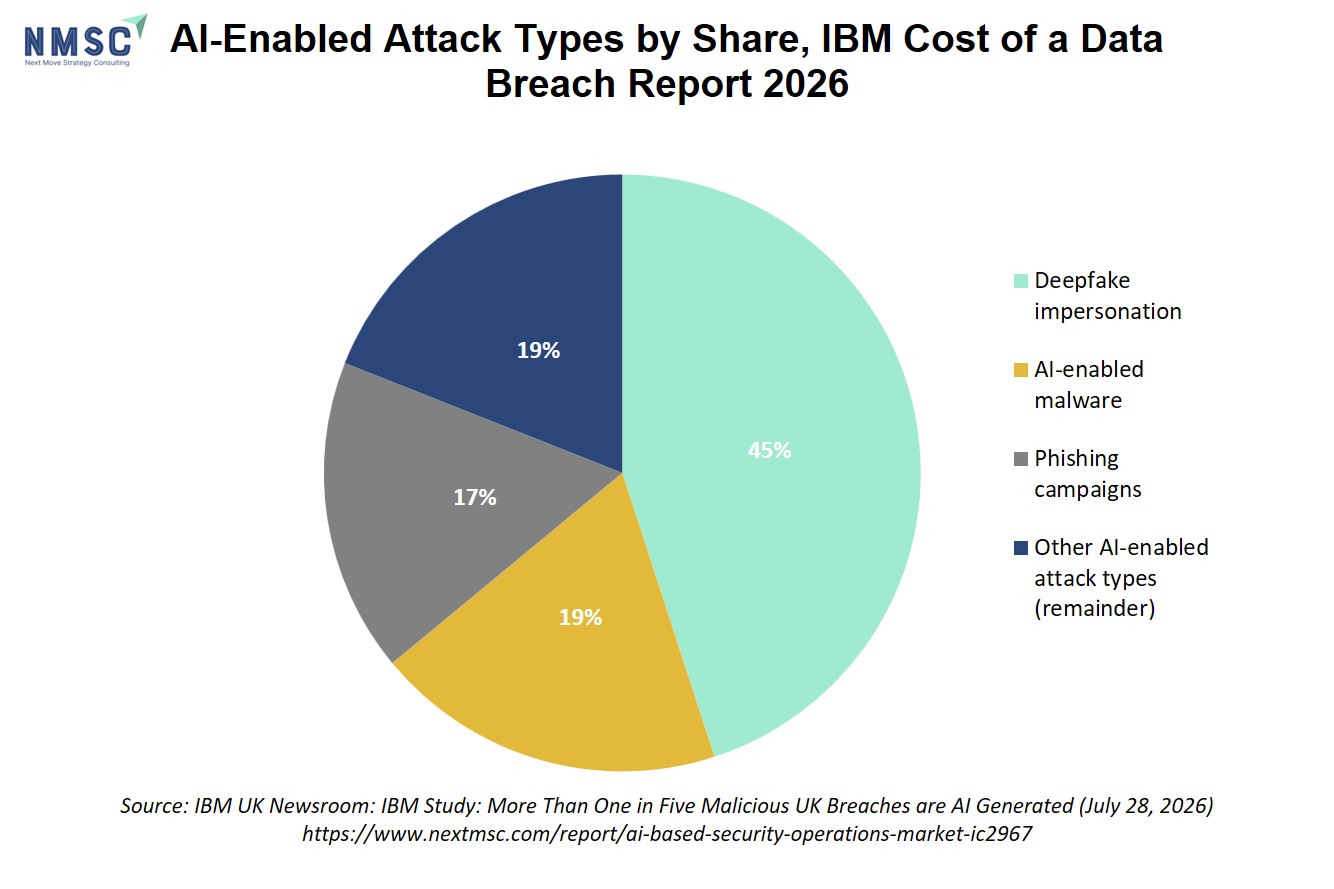
IBM's U.K. newsroom release of July 28, 2026 reports deepfake impersonation at 45%, AI-enabled malware at 19% and phishing campaigns at 17% of AI-enabled attack types. The remaining 19% is the balance of other attack types, calculated as 100% minus the three reported categories.
Section Summary:
Regulators and threat data point in one direction: shorter response clocks, identity-led intrusions and public money for AI-enabled defense.
-
CISA Binding Operational Directive 26-04 (June 10, 2026) sets remediation windows as short as three days for the highest-risk flaws.
-
The NCSC's November 3, 2026 report rates AI-powered ransomware against UK critical infrastructure by 2028 as highly likely.
-
Microsoft recorded phishing at 23% of observed intrusions in its 2026 report, up from 7% in 2025.
Pros and Cons of Recent Market Developments
The table weighs the developments above for buyers and investors.
|
Pros |
Cons |
|
CrowdStrike reported record net new ARR of USD 333 million in the quarter ended July 31, 2026. |
NextMSC's report identifies high implementation cost as a barrier for small and medium-sized enterprises. |
|
IBM found that extensive AI and automation saved USD 1.93 million per breach. |
IBM found that only 18% of organizations apply AI agents to vulnerability management. |
|
The UK committed £60 million to the first phase of a national Cyber Shield. |
IBM reports AI-enabled breaches averaging USD 6 million, about USD 1 million above the global average. |
Key Data & Statistics
The tables below consolidate the vendor and threat indicators cited in this analysis.
Vendor Demand Indicators, Latest Reported Quarter
|
Company |
Period |
Indicator |
Reported value |
|
Palo Alto Networks |
Q4 FY2026, ended July 31, 2026 |
Next-Generation Security ARR |
USD 9.10 billion, up 63% |
|
CrowdStrike |
Q2 FY2027, ended July 31, 2026 |
Total ARR |
USD 5.84 billion, up 25% |
|
CrowdStrike |
Q2 FY2027, ended July 31, 2026 |
Falcon Flex ending ARR |
Above USD 2.29 billion, up 101% |
Threat and Response Indicators, 2026
Publisher Indicator Reported value
|
Publisher |
Indicator |
Reported value |
|
IBM |
Global average cost of a data breach |
USD 4.99 million, up 12% |
|
IBM |
Savings from extensive AI and automation |
USD 1.93 million per breach |
|
Microsoft |
Phishing share of observed intrusions |
23%, up from 7% in 2025 |
|
National Cyber Security Centre |
Nationally significant incidents |
80, among 1,831 reports |
Future Outlook & Forecast: The AI-Based Security Operations Market to 2030
NextMSC primary research and analysis projects the AI-based security operations market to expand from USD 28.24 billion in 2024 to USD 82.45 billion by 2030, a CAGR of 19.2% from 2025 to 2030. The 2026 evidence supports the direction of that curve. Palo Alto Networks guided to fiscal 2027 revenue of USD 14.10 billion to USD 14.20 billion, growth of 23% to 24%, and CrowdStrike raised its fiscal 2027 net new ARR growth outlook to 34% at the midpoint. Both are company guidance, not market forecasts, and they cover two vendors rather than the whole market, but both providers are named in NextMSC's report and both are planning for sustained demand.
Three conditions will shape delivery against the forecast. First, the NCSC's 2028 horizon for AI-powered ransomware against critical infrastructure gives operators a dated reason to fund automation before then. Second, NextMSC's report names data security and privacy concerns and high implementation cost as restraints, so vendors that offer hybrid deployment and managed services are better placed to reach buyers that cannot run cloud-native platforms. Third, NextMSC's report identifies the integration of blockchain with cyber threat detection as a future opportunity, aimed at data integrity and decentralized threat-intelligence sharing; it remains a research direction, not a purchasing criterion today.
Investors should read the forecast alongside the uncertainty the evidence documents: IBM reports that only 18% of organizations apply agents to vulnerability management, and the NCSC's review states that none of the AI uses it observed enabled a novel class of attack. Spending is therefore likely to move toward closing known gaps before it moves toward novel capabilities.
Section Summary:
The forecast rests on operating pressure that is already measurable, and the near-term contest is over remediation and exposure management.
-
NextMSC projects USD 82.45 billion by 2030 at a 19.2% CAGR from 2025 to 2030.
-
Vendor guidance from Palo Alto Networks and CrowdStrike for fiscal 2027 points to continued platform demand.
-
Cost and privacy restraints favor hybrid deployment and managed services for smaller and regulated buyers.
Next Steps for Stakeholders
The evidence points to a sequencing problem rather than a funding problem. Buyers already know that AI-enabled attacks cost more; the open question is which workflow to automate first. The actions below follow the order in which the 2026 events exposed delay: inventory, ranking, containment and then governance.
-
Chief information security officers: time how long your team takes to inventory, rank and contain exposure for a flaw such as PHP2Shell, then automate the slowest step first; the three-day tier of CISA Directive 26-04 is a usable benchmark.
-
Chief financial officers: treat IBM's USD 1.93 million savings figure as a hypothesis to test against internal incident costs before approving platform consolidation.
-
Investors: track net new ARR, module adoption and agentic acquisitions at Palo Alto Networks and CrowdStrike, since 51% of CrowdStrike's subscription customers already use six or more modules.
-
Public-sector and critical infrastructure operators: align procurement with the NCSC's Cyber Shield and exposure-centre programs and require vendors to document how automated actions are governed and audited.
Conclusion
The AI-based security operations market is being shaped by operating pressure, not by technology enthusiasm. PHP2Shell, CISA's three-day patching tier, the NCSC's 2028 warning and IBM's breach-cost data all shorten the time security teams have, while Palo Alto Networks and CrowdStrike are building agentic platforms to match. NextMSC's projection of USD 82.45 billion by 2030 rests on that pressure continuing, and the next contest within the AI-based security operations market will be remediation, not detection. For executives, the practical test is time: how many hours separate a public disclosure from a contained exposure in your own environment. For investors, the test is whether vendor results keep reflecting measurable operating pressure, as they did in the quarters reported on August 26 and September 1, 2026.
About the Author
 Sanyukta Deb
— Sanyukta Deb is Digital Marketing Team Lead at Next Move Strategy Consulting, where she has led content strategy and technical SEO for the firm's B2B market research publications for over 2 years. Her editorial process translates NextMSC's primary and secondary research — spanning technology, industrial, and consumer sectors — into commercial narratives, backed by search-intent, keyword, and competitive analysis. She brings 5 years of overall experience in digital marketing and content strategy.
About the Reviewer
 Debashree Dey
— Debashree Dey is Assistant Manager at Next Move Strategy Consulting, where she supports cross-vertical market content and communications across diverse industries for 6 years. Her professional background includes senior content writing, communications, and published manuscript authorship, with experience developing audience-focused business narratives and maintaining clear, consistent messaging. Her role supports research-led content development and editorial quality across NextMSC publications.
















Add Comment