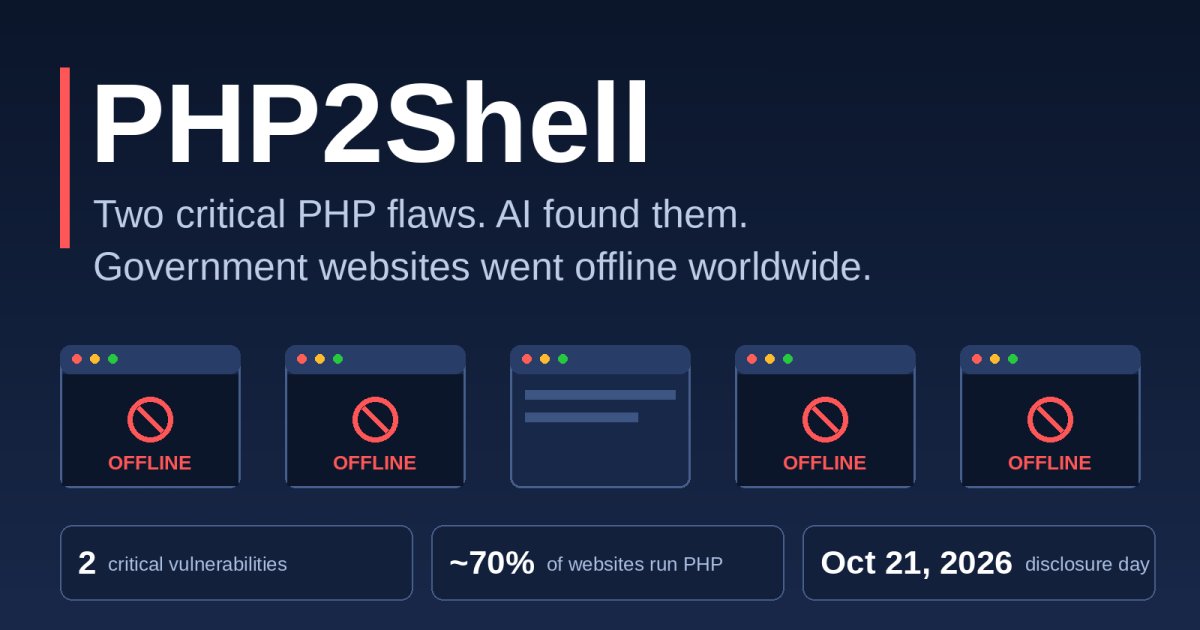
On October 21, 2026, government websites across several continents went dark on purpose. The trigger was a PHP vulnerability pair nicknamed PHP2Shell, which security researchers uncovered with the help of artificial intelligence. Agencies in Europe, Australia, Japan, Britain and the United States urged anyone running PHP to update immediately or switch their sites off until a patch could be applied, according to CNBC.
This post explains what happened, why one programming language can cause a worldwide scramble, what the AI angle means for the cybersecurity market, and what you should do if your own site runs on PHP. For ongoing coverage of the security sector, see our Cyber Security market research.
Reviewed by Supradip Baul. This is a fast-moving story; details may change as PHP and national agencies publish more information.
What happened with the PHP vulnerabilities?
The PHP developers said on Tuesday, October 20, that they had found two critical vulnerabilities and urged users to update as soon as a fix was released. Because there were reports of hackers already exploiting the flaws, agencies in the Netherlands and Finland took sites offline before the patch arrived, as Reuters reported and CNBC summarized.
The US National Security Agency also issued a rare public warning, advising that websites which could not be updated immediately should be taken offline, according to Al Jazeera. One secondary report, citing Censys, lists the two flaws as CVE-2026-109618 and CVE-2026-109619, both described as unauthenticated remote code execution bugs with a CVSS v4.0 score of 9.2 (Global Banking & Finance Review). Confirm these identifiers against the official PHP advisory at php.net before relying on them.
Need this modeled for a different segment or region?
Why does a PHP flaw put so much of the web at risk?
PHP is a server-side scripting language that sits behind about 70% of the world's websites, including WordPress and Drupal, according to CNN. When a flaw sits in the language itself rather than in one application, every site built on top of it inherits the exposure.
Scale is only part of the problem. Officials said all versions from PHP 5 onward could be affected, though PHP had not yet named the specific vulnerable versions when the first reports came out (CNBC). Old, unmaintained installations are therefore the most likely to be left behind.
Which government websites and organizations went offline?
the national cyber security agency, the Port of Rotterdam, the Overheid.nl portal, the national football association, the websites of the five largest political parties and several hospital sites, per Reuters.
government sites were temporarily taken offline while fixes were applied (CNN).
the federal digital ministry took some websites offline as a preventative step (Al Jazeera).
some federal websites were taken offline temporarily, and Wikipedia, Cloudflare and Maple Health also addressed the vulnerabilities (CBC News).
one report lists Australia alongside the Netherlands, Finland and France among countries that took services offline (The National).
How did AI find vulnerabilities that humans missed for years?
Two cybersecurity companies said in independent reports that the flaws were found using AI, per Reuters via Global Banking & Finance Review. Reports differ on the specifics: The National credits an OpenAI model, while other coverage attributes the discovery to AI-assisted work without naming one system.
What is consistent across coverage is the age of the bugs. They stayed hidden in the PHP codebase for more than a decade and would have been extremely complicated for a human attacker to use, according to RTE. Security firm Wiz called the episode an "AI inflection point" in its comment to CNN.
The warning had been building. In May 2026, Dutch cybersecurity officials said AI is compressing the time needed to find and exploit software flaws from days to hours, and possibly minutes (NL Times). PHP2Shell is a concrete example of that shift, and the PHP Foundation itself cautioned that AI will make weaknesses like these easier to find (Al Jazeera).
What does PHP2Shell mean for businesses and the cybersecurity market?
Our analysis: three implications stand out. First, dependency concentration is now a board-level risk: when one language underpins most of the web, a single disclosure can trigger simultaneous outages across public and private sectors. Second, patch speed becomes a competitive advantage, because AI shortens the gap between discovery and exploitation. Third, buyers are likely to scrutinize vulnerability management, application security and continuous monitoring more closely.
If you are sizing these opportunities, explore Next Move Strategy Consulting's ICT & Media industry reports, browse related analysis on our insights blog, or read an Industry Deep Dive for a broader view. Teams that need tailored forecasts or competitive benchmarking can review our research services.
How to protect your PHP website right now
List every site, CMS, plugin and internal tool that runs PHP, including forgotten staging and legacy servers.
Follow the PHP project's release notes and your hosting or CMS vendor's advisories.
This is the guidance agencies gave while the fix was pending.
Reports said some attackers were already exploiting the flaws, so review access logs, new user accounts and unexpected file changes.
Use a web application firewall, restrict admin interfaces, keep backups offline and rehearse an incident response plan.
Frequently asked questions about PHP2Shell
What is PHP2Shell?
PHP2Shell is the nickname given to a pair of critical vulnerabilities in the PHP programming language that were disclosed on October 21, 2026. Security researchers found them with the help of artificial intelligence.
Is my website affected?
If your site runs on PHP, including platforms such as WordPress or Drupal, assume it is in scope until you confirm otherwise. Officials said every version from PHP 5 onward could be affected, and the exact vulnerable versions had not been published at the time of the first reports. Check the official PHP release notes and your hosting provider.
Why did governments take websites offline instead of waiting for the patch?
The flaws were disclosed before a fix was available, and there were reports that attackers were already exploiting them. Agencies including the US NSA advised that sites which could not be updated immediately should be taken offline.
What should I do right now?
Identify every PHP-based asset you run, apply the official patch the moment it is available, review logs for unusual activity, and take exposed systems offline if you cannot patch them promptly.
Conclusion
PHP2Shell is less about one language and more about a new reality: AI can surface deeply buried flaws faster than organizations are used to patching them. The sensible response is to know what you run, patch quickly and plan for outages. To follow how this reshapes demand across the security landscape, visit our Cyber Security reports or contact the Next Move Strategy Consulting team to discuss a custom study.
Disclaimer: This article is for informational purposes and reflects reporting available on October 22, 2026. It is not security, legal or investment advice. Verify technical details with the official PHP advisory and your national cybersecurity agency.
Sources
- Reuters (via U.S. News), Oct 21, 2026: Cyber agency warns websites may go dark as PHP prepares critical fix
- CNBC, Oct 21, 2026: Government websites go dark as software flaw sparks security scramble
- CNN, Oct 21, 2026: Websites shut down globally after AI finds a critical flaw
- Al Jazeera, Oct 22, 2026: World leaders warn of security flaws found in PHP
- CBC News, Oct 2026: Canadian government sites among those offline
- RTE, Oct 22, 2026: Websites go dark after AI-discovered flaw
- The National, Oct 22, 2026: PHP security flaw: websites taken down
- Global Banking & Finance Review, Oct 21, 2026: Government websites go dark after AI-discovered flaw
- NL Times, May 25, 2026: AI can be used to quickly access sensitive government data, Dutch experts warn
About the Author
 Debashree Dey
— Debashree Dey is Assistant Manager at Next Move Strategy Consulting, where she supports cross-vertical market content and communications across diverse industries for 6 years. Her professional background includes senior content writing, communications, and published manuscript authorship, with experience developing audience-focused business narratives and maintaining clear, consistent messaging. Her role supports research-led content development and editorial quality across NextMSC publications.
About the Reviewer
 Supradip Baul
— Supradip Baul is an accomplished business consultant and strategist with over a decade of rich experience in market intelligence, strategy, technology, and business transformation. His work has included rigorous qualitative and quantitative analysis across multiple industries, helping clients shape investment decisions and long-term roadmaps. Earlier in his career, he was associated with Gartner, where he contributed to industry-leading reports and market share analyses. He has worked with leading global companies and holds an MBA with a dual specialization in Marketing and Finance.
Related Blogs
A single unpatched vendor connection, one lapsed Business Associate Agreement, or one over-privileged login can undo years of careful governance work...
Read more
Cyber threats have become a critical concern for defense organizations as military systems, communications networks, and operational platforms increas...
Read more
The 5G Security Market is entering a decisive stage as telecom operators and enterprises expand standalone and private 5G deployments. Unlike previous...
Read more







Add Comment