Acrylic Acid Market: Innovation and Sustainability Driving the Next Phase

The acrylic acid market is undergoing a meaningful transformation as manufacturers balance performance requirements with rising sustainability expectations. Acrylic acid continues to play a vital role in coatings, adhesives, super absorbent polymers, and specialty materials, but recent developments show that how acrylic acid is produced is becoming just as important as where it is used. This blog explores the most recent and credible developments shaping the market, based strictly on verified industry sources from 2024–2025.
Understanding Acrylic Acid and Its Industrial Importance
Acrylic acid is a core chemical intermediate used to manufacture a wide range of functional materials. Its chemical properties make it suitable for products that require durability, flexibility, adhesion, and absorbency. Because of this versatility, acrylic acid remains a critical input across construction, hygiene products, coatings, and advanced materials. As demand grows for environmentally responsible products, producers are increasingly challenged to maintain performance standards while reducing environmental impact. Acrylic acid remains indispensable to modern industry, but sustainability considerations are now influencing production strategies.
Synthomer and Lummus Collaboration
In 2025, Synthomer and Lummus Technology announced a strategic partnership focused on licensing acrylic acid esters technology. This collaboration allows Lummus to offer Synthomer’s proven technology to a wider global customer base, expanding access to advanced production methods. The licensed technology supports the production of acrylic acid esters used in coatings, adhesives, and sealants. Importantly, the process can accommodate both conventional and bio-based feedstocks, offering manufacturers flexibility as sustainability regulations and customer expectations evolve.
From a market perspective, this partnership strengthens technology availability while reducing barriers for new or expanding producers seeking high-performance acrylic solutions. Technology licensing partnerships are enabling broader market participation while supporting future-ready feedstock flexibility.
Key Industry Players in the Acrylic Acid Market
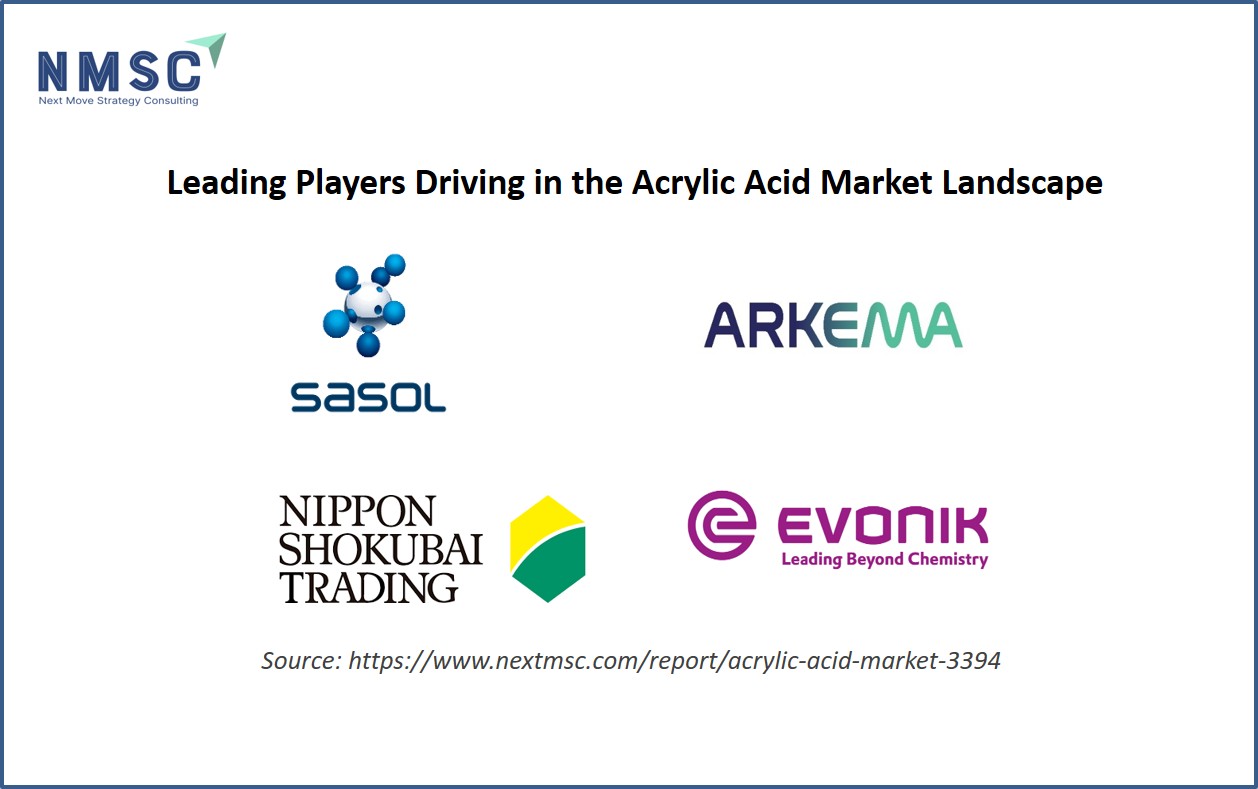
Across the global acrylic acid landscape, major chemicals and materials companies have historically played significant roles in producing acrylic acid and related derivatives. Names often associated with leadership in this space include integrated chemical manufacturers with broad product portfolios and deep technological capabilities, such as BASF SE, Arkema S.A., Nippon Shokubai, LG Chem, Dow Chemical, Evonik, and Mitsubishi Chemical. These corporations are recognized for supplying foundational chemicals to diverse downstream markets, including coatings, adhesives, super absorbent polymers, and performance materials. Their scale, research and development efforts, and established production infrastructure contribute to the overall dynamics of the acrylic acid market.
Sustainability Shift: Plant-Based Acrylic Acid Production
LG Chem’s Bio-Acrylic Acid Milestone
LG Chem has accelerated the commercial production of 100% plant-based acrylic acid, marking a significant step toward sustainable chemical manufacturing. The company uses plant-derived raw materials and microbial fermentation to produce acrylic acid with identical properties to petroleum-based versions.
The product has received USDA Certified Biobased Product labeling, confirming that it is entirely bio-based. Initial production capacity is set at 100 metric tons per year for prototype applications, allowing customers to test and validate performance before large-scale commercialization.
LG Chem has indicated that this bio-acrylic acid is suitable for applications such as super absorbent polymers, cosmetics, coatings, adhesives, and electronic materials, particularly in markets where sustainability credentials influence purchasing decisions. Commercial bio-acrylic acid production demonstrates that sustainability and performance can coexist in the acrylic acid market.
Key Market Developments at a Glance
|
Market Focus |
Key Insight |
|
Technology expansion |
Licensing of acrylic acid esters technology enables wider industrial adoption |
|
Sustainable production |
LG Chem launches 100% plant-based acrylic acid with verified certification |
|
Feedstock flexibility |
Industry is moving toward adaptable fossil and bio-based raw material strategies |
Market momentum is driven by a combination of licensing innovation and verified sustainable production methods.
Implications for the Acrylic Acid Market
These developments highlight a broader shift in the acrylic acid market. Technology partnerships are lowering entry barriers and accelerating innovation, while bio-based acrylic acid is responding directly to sustainability demands without compromising material performance. Manufacturers that adapt early to these changes are likely to gain competitive advantages in markets where regulatory pressure and customer expectations are intensifying.
Next Steps: Strategic Actions for Industry Stakeholders
-
Evaluate licensed acrylic acid ester technologies to expand or modernize production capabilities.
-
Engage customers seeking certified bio-based materials, especially in hygiene, coatings, and cosmetics sectors.
-
Monitor scaling plans for plant-based acrylic acid to anticipate future supply shifts.
-
Develop flexible sourcing strategies that support both traditional and bio-based feedstocks.
Conclusion
The acrylic acid market is entering a new phase defined by technology collaboration and sustainable innovation. Recent developments from Synthomer, Lummus, and LG Chem show that the industry is actively responding to performance, scalability, and environmental priorities. As these trends continue, acrylic acid producers and downstream users who align with these shifts will be better positioned for long-term growth and regulatory resilience. Together, these developments signal a market that is not only responding to regulatory and environmental pressures but also proactively redefining its production pathways. Companies that align with these technological and sustainability shifts are likely to strengthen their competitive positioning as the acrylic acid market continues to adapt to changing industry and consumer expectations.
About the Author
 Sanyukta Deb
— Sanyukta Deb is Digital Marketing Team Lead at Next Move Strategy Consulting, where she has led content strategy and technical SEO for the firm's B2B market research publications for over 2 years. Her editorial process translates NextMSC's primary and secondary research — spanning technology, industrial, and consumer sectors — into commercial narratives, backed by search-intent, keyword, and competitive analysis. She brings 5 years of overall experience in digital marketing and content strategy.
Sanyukta Deb
— Sanyukta Deb is Digital Marketing Team Lead at Next Move Strategy Consulting, where she has led content strategy and technical SEO for the firm's B2B market research publications for over 2 years. Her editorial process translates NextMSC's primary and secondary research — spanning technology, industrial, and consumer sectors — into commercial narratives, backed by search-intent, keyword, and competitive analysis. She brings 5 years of overall experience in digital marketing and content strategy.
About the Reviewer
 Debashree Dey
— Debashree Dey is Assistant Manager at Next Move Strategy Consulting, where she supports cross-vertical market content and communications across diverse industries for 6 years. Her professional background includes senior content writing, communications, and published manuscript authorship, with experience developing audience-focused business narratives and maintaining clear, consistent messaging. Her role supports research-led content development and editorial quality across NextMSC publications.
Debashree Dey
— Debashree Dey is Assistant Manager at Next Move Strategy Consulting, where she supports cross-vertical market content and communications across diverse industries for 6 years. Her professional background includes senior content writing, communications, and published manuscript authorship, with experience developing audience-focused business narratives and maintaining clear, consistent messaging. Her role supports research-led content development and editorial quality across NextMSC publications.
















Add Comment