Carbon Storage and Capture Market: Why the Race Is Accelerating | NextMSC
Introduction
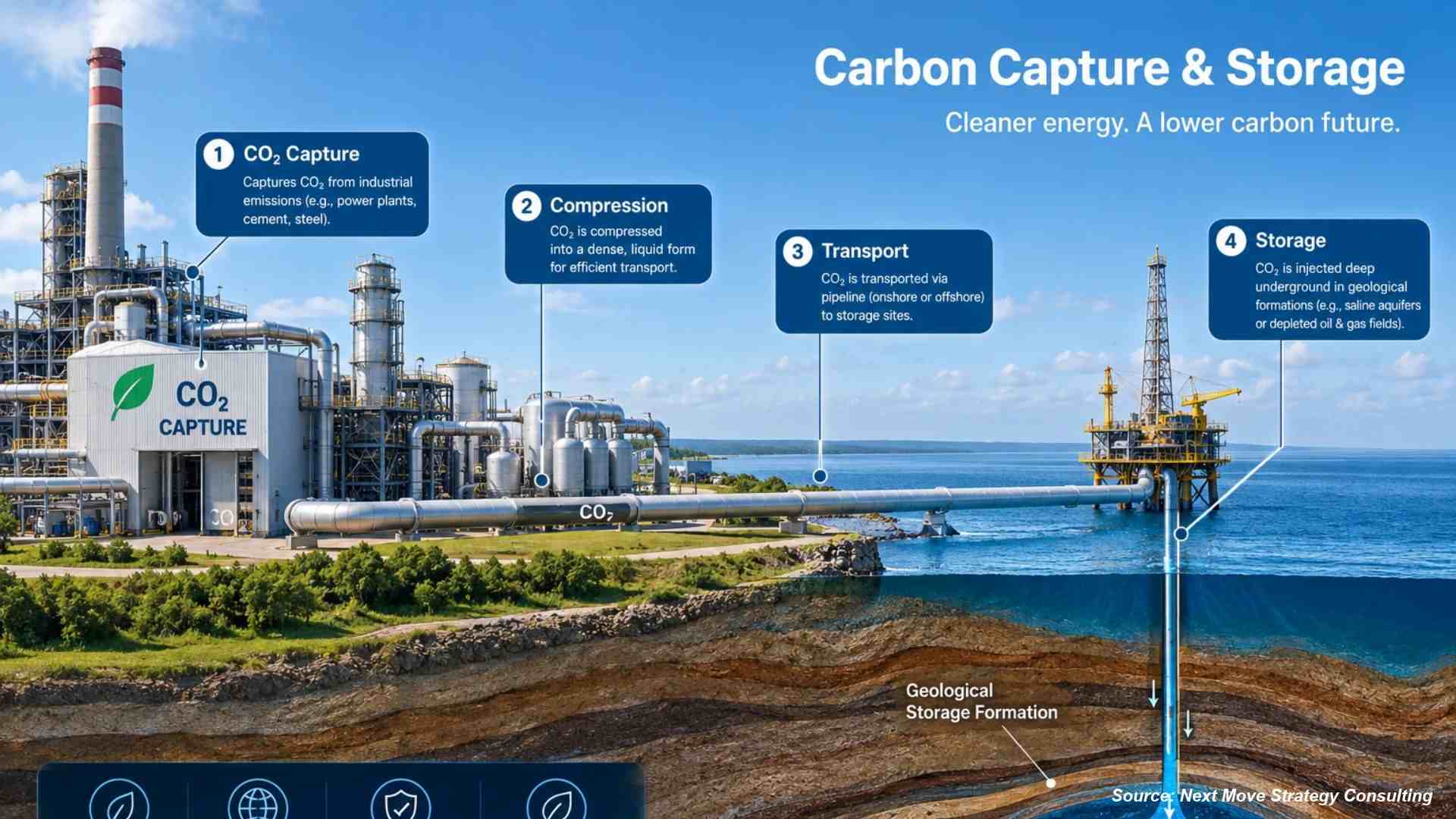
The global carbon capture and storage (CCS) industry has crossed a threshold that analysts have anticipated for over a decade: commercial-scale infrastructure is now operational, binding regulatory mandates are compelling investment at the corporate level, and cumulative capital commitments are approaching figures that signal structural market formation rather than pilot-phase experimentation. According to Next Move Strategy Consulting's Carbon Storage and Capture Market report, the global carbon storage and capture market is projected to reach USD 13.76 billion by 2030, growing at a CAGR of 22.1% from 2024 to 2030. This trajectory reflects a convergence of hard regulatory deadlines, sovereign-level investment mandates, and a growing recognition among heavy-industry operators that CCS is not an optional decarbonization pathway — it is, for sectors such as cement, steel, and chemicals, the only technically viable one at scale.
The market's acceleration is not driven by a single policy or technology event. It is the product of simultaneous pressure from three directions: the United States' expanded Section 45Q tax credit regime, the European Union's legally binding 50-million-tonne CO₂ injection capacity target under the Net-Zero Industry Act (NZIA), and a wave of final investment decisions (FIDs) by major energy companies that have converted years of project development into committed capital. Understanding where this market stands today — and where it is heading — requires examining each of these forces in detail.
For More Information: Download FREE Sample on Carbon Storage and Capture Market Report
From Ambition to Infrastructure: The Structural Shifts Redefining the CCS Market
The Northern Lights Expansion: A Commercial Proof Point for the Entire Industry
In March 2025, Shell plc, Equinor ASA, and TotalEnergies SE announced a joint investment of 7.5 billion Norwegian crowns (USD 713.66 million) to expand the Northern Lights carbon storage facility in western Norway — the world's first open-access CO₂ transport and storage infrastructure. The investment decision was triggered by a 15-year commercial agreement with Stockholm Exergi to transport and store 900,000 tonnes of CO₂ per year — a bioenergy CCS (BECCS) offtake arrangement that demonstrates the market's capacity to generate long-duration revenue contracts.
The expansion, which includes additional onshore storage tanks, pumps, a new jetty, injection wells, and additional CO₂ transport vessels, aims to more than triple the site's annual CO₂ injection capacity to at least 5 million tonnes per year — equivalent to roughly 10% of Norway's annual emissions. Phase 2 is expected to be completed in the second half of 2028. The European Commission co-funded the expansion with a grant of 131 million euros, underscoring the degree to which public capital is being deployed to de-risk private CCS infrastructure at scale.
The Northern Lights expansion is significant not merely as a capital event, but as a commercial template. It demonstrates that a CCS hub can attract long-term offtake agreements from industrial emitters — in this case, a district heating operator using bioenergy — and that the resulting revenue certainty is sufficient to unlock hundreds of millions in private investment. This model, where a shared transport and storage backbone serves multiple industrial capture sources, is precisely the architecture that regulators in both the EU and the U.S. are attempting to replicate at national scale.
The EU's NZIA Storage Mandate: A Legal Obligation Reshaping Corporate Strategy
The European Union's Net-Zero Industry Act (NZIA), which entered into force in June 2024, establishes a legally binding obligation for EU oil and gas producers to collectively deliver at least 50 million tonnes of annual CO₂ injection capacity by 2030. This is not a voluntary target or an aspirational policy goal — it is a regulatory obligation with individual company-level contributions assigned by the European Commission under a Delegated Regulation, and with annual progress reporting requirements beginning in June 2026.
The European Commission's first monitoring report, published in May 2026, found that based on plans submitted by obligated entities, the current trajectory would deliver approximately 29 million tonnes of CO₂ injection capacity — less than two-thirds of the 50 Mtpa target. The Commission's report identified rapid growth in CO₂ injection capacity around the North Sea, with three storage sites already permitted and seven more in the permitting process, but concluded that obligated entities must increase their efforts and develop additional sites to close the gap.
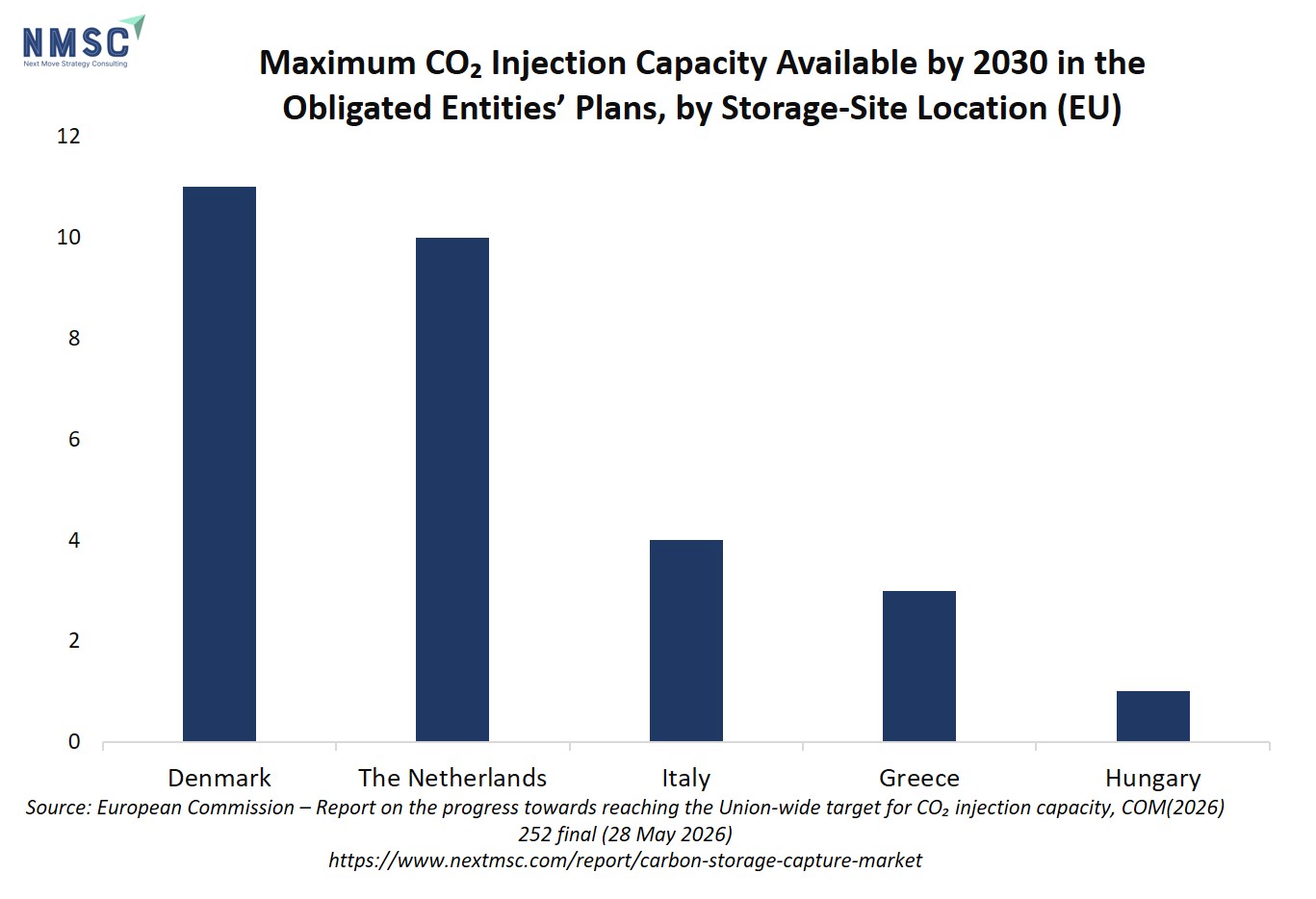
The NZIA's enforcement mechanism is creating a qualitatively different investment dynamic from prior voluntary CCS commitments. Twelve companies have taken legal action against the regulation and its implementing acts, primarily arguing that the 2030 timeline is not feasible. However, analysis by the Clean Air Task Force published in June 2026 found that the current pipeline of proposed projects could yield up to 43 million tonnes per year of operational capacity by 2030, and that the principal cause of historical project delays has been funding policy uncertainty rather than technical or permitting constraints. The NZIA obligation has already spurred new projects: the Kompas project by ONE Dyas and the Abeona project by Petrogas, both launched in 2026, are using depleted oil and gas reservoirs in the Dutch North Sea and targeting operation by 2030.
The U.S. 45Q Tax Credit: Tripling Claims and a New Parity Provision
In the United States, the Section 45Q Carbon Oxide Sequestration Credit has become the primary financial instrument driving CCS deployment. The Inflation Reduction Act of 2022 expanded the credit to USD 85 per tonne for industrial and power sector capture, and USD 180 per tonne for direct air capture (DAC). More recently, the One Big Beautiful Bill Act introduced parity in credit values across different uses of captured carbon, addressing a structural inequity that had disadvantaged carbon utilization pathways relative to geological storage.
A U.S. Government Accountability Office (GAO) report published in August 2026 found that as of March 2026, there were 33 carbon capture facilities operating in the United States, with additional facilities planned, and that the number of 45Q credit claims more than tripled from 2019 to 2023. The GAO identified administrative bottlenecks in the credit's utilization pathway — specifically, long delays and high rejection rates for life-cycle assessment (LCA) pre-approvals — and made six recommendations to the IRS and the Department of Energy to streamline the process. Resolving these administrative frictions is material to the market's near-term growth trajectory, as they directly affect the economics of carbon utilization projects — a segment that converts captured CO₂ into products such as concrete, synthetic fuels, and industrial gases.
Technology Frontiers: From Sorbent Chemistry to Biological CO₂ Conversion
The technology layer of the CCS market is advancing on multiple fronts simultaneously. Research published in Nature Chemical Engineering in February 2026 highlighted two distinct technical developments: a synthetic metabolic pathway developed by Michael Jewett and co-workers that converts CO₂ to acetyl-CoA by combining electrochemical CO₂ reduction with biosynthetic formate conversion, and a method presented by Youhong Guo and Alan Hatton to reduce the regeneration energy of aqueous carbonate carbon capture sorbents using a thermally responsive pH regulator. Reducing regeneration energy is particularly significant because the thermal energy required to release captured CO₂ from sorbents represents the largest single operating cost in post-combustion capture systems.
The Global CCS Institute's State of the Art: CCS Technologies 2026 report, published in July 2026, provides a comprehensive assessment of where capture, transport, and storage technologies stand commercially and what performance thresholds must be achieved for emerging approaches to become economically viable. The 2026 APAC CCS Forum, held in Adelaide in August 2026, brought together more than 120 participants from over 50 organizations to address the transition from project ambition to operational deployment across the Asia-Pacific region.
NMSC Strategic Perspective: Why the 22.1% CAGR Reflects a Structural, Not Cyclical, Shift
NextMSC primary research and analysis identifies the carbon storage and capture market's 22.1% CAGR as a function of three compounding structural forces that distinguish this growth cycle from prior CCS expansion phases that stalled.
First, the regulatory architecture has shifted from voluntary to mandatory. The EU NZIA's injection capacity obligation and the U.S. 45Q credit's expanded rate structure both create durable, policy-anchored revenue floors for CCS projects — a prerequisite for the long-duration capital commitments that large-scale infrastructure requires. Second, the hub-and-spoke storage model pioneered by Northern Lights has demonstrated that shared infrastructure can aggregate demand from multiple industrial emitters, solving the chicken-and-egg problem that prevented individual point-source projects from achieving viable scale. Third, the hard-to-abate sector imperative — cement, steel, chemicals, and fertilizer production — creates a captive addressable market for CCS that cannot be served by electrification or renewable energy substitution alone. These sectors collectively account for a disproportionate share of industrial CO₂ emissions and face the most acute regulatory pressure to decarbonize, making CCS adoption a compliance-driven necessity rather than a discretionary investment.
Section Summary & Key Takeaways:
-
Shell, Equinor, and TotalEnergies committed USD 713.66 million to expand Northern Lights to 5 Mtpa capacity, backed by a 15-year BECCS offtake agreement with Stockholm Exergi — establishing a replicable commercial template for CCS hub financing.
-
The EU NZIA mandates 50 Mtpa of CO₂ injection capacity by 2030; the European Commission's May 2026 monitoring report found current plans would deliver only 29 Mtpa, creating a compliance gap that is accelerating new project development.
-
The U.S. GAO confirmed 33 operational carbon capture facilities as of March 2026, with 45Q credit claims tripling from 2019 to 2023 — a direct measure of the credit's market-formation effect.
-
NextMSC analysis identifies the convergence of mandatory regulatory frameworks, proven hub-and-spoke infrastructure models, and hard-to-abate sector demand as the structural basis for the market's 22.1% CAGR through 2030.
Industry Impact Analysis
Hard-to-Abate Sectors: Where CCS Transitions from Option to Obligation
The World Economic Forum, citing DNV's Energy Transition Outlook: CCS to 2050 report, notes that CCS is often the most feasible decarbonization technology for process industries such as cement, steel, and chemical production — sectors where the CO₂ emissions are inherent to the chemical reactions involved, not merely the energy inputs. DNV projects that CCS will grow fourfold to 2030, with cumulative investments in the coming five years expected to reach approximately USD 80 billion. Approximately two-thirds of projected capacity additions will occur in North America and Europe.
After 2030, DNV projects that manufacturing will account for 41% of annual CO₂ captured by mid-century, with cement and chemicals dominating in Europe, hydrogen and ammonia in North America and the Middle East, and coal power in China. This sectoral distribution has direct implications for the carbon storage and capture market's segment composition: industrial point-source capture — which targets high-concentration CO₂ streams from cement kilns, steel blast furnaces, and chemical plants — will remain the dominant capture source through the forecast period, while direct air capture (DAC) scales from a niche technology to a material contributor post-2030.
Major Corporate Commitments: Capital Deployment at Scale
The competitive landscape of the carbon storage and capture market is being reshaped by a series of large-scale acquisitions and investment commitments that signal long-term strategic positioning rather than opportunistic participation. ExxonMobil's acquisition of Denbury Resources for USD 4.9 billion in 2023 gave the company access to one of the largest CO₂ pipeline networks in the United States — a piece of infrastructure that is not replicable on short timelines and that positions ExxonMobil as a dominant transport and storage intermediary for industrial emitters along the U.S. Gulf Coast. ExxonMobil has stated its intent to pursue approximately USD 20 billion in lower-emission capital investments from 2025 through 2030, with CCS representing a significant component of that allocation.
Occidental Petroleum's acquisition of Carbon Engineering for USD 1.1 billion, followed by its acquisition of a second DAC company, Holocene, reflects a strategic bet that DAC will transition from a high-cost novelty to a scalable carbon removal mechanism as the 45Q credit's USD 180/tonne DAC rate makes projects economically viable. Occidental's 1PointFive subsidiary operates the STRATOS facility in Texas, which is among the world's largest operational DAC installations.
The EU's Compliance Gap: A Market-Creation Mechanism
The European Commission's finding that current obligated entity plans would deliver only 29 Mtpa against the 50 Mtpa NZIA target is, paradoxically, a market-positive signal. The compliance gap creates a structural demand for new storage capacity that must be filled by 2030 — a hard deadline that is generating project FIDs that would not otherwise have occurred on this timeline. The NZIA's requirement that storage permits for Net-Zero Strategic Projects be processed within 18 months is designed to remove permitting delays as a rate-limiting factor, addressing the primary cause of historical project slippage identified in the CATF's June 2026 analysis.
The EU's longer-term ambition is even more substantial: the European Commission estimates that the EU will need to capture and permanently store approximately 250 million tonnes of CO₂ per year starting in 2040 to achieve climate neutrality by 2050. The 50 Mtpa target by 2030 is explicitly framed as a first step toward building the infrastructure and institutional capacity required to reach that 2040 scale.
Section Summary & Key Takeaways:
-
DNV projects USD 80 billion in cumulative CCS investment over the next five years, with approximately two-thirds of capacity additions concentrated in North America and Europe.
-
ExxonMobil's USD 4.9 billion acquisition of Denbury and its USD 20 billion lower-emission investment commitment through 2030 position the company as a structural intermediary in the U.S. CCS transport and storage market.
-
The EU's 21 Mtpa compliance gap against the NZIA's 50 Mtpa target is generating new project FIDs, with the NZIA's 18-month permitting deadline for strategic projects designed to eliminate the policy uncertainty that caused historical delays.
-
The European Commission's 2040 target of 250 Mtpa of permanent CO₂ storage establishes a multi-decade demand signal that extends well beyond the current forecast period.
Global Carbon Storage and Capture Market — Key Metrics
|
Metric |
Detail |
|
Market Value (2023) |
USD 4.03 billion |
|
Projected Market Value (2030) |
USD 13.76 billion |
|
CAGR (2024–2030) |
22.1% |
|
U.S. Operational CCS Facilities (March 2026) |
33 facilities |
|
U.S. 45Q Credit Claims Growth (2019–2023) |
More than tripled |
|
EU NZIA CO₂ Injection Capacity Target (2030) |
50 million tonnes per year |
|
EU Current Pipeline Capacity (2030 estimate) |
Up to 43 million tonnes per year |
|
EU Obligated Entity Plans (as of May 2026) |
29 million tonnes per year |
|
Cumulative Global CCS Investment (next 5 years) |
~USD 80 billion |
|
CCS Share of Global CO₂ Emissions Captured (2030) |
~0.5% |
|
CCS Share of Global CO₂ Emissions Captured (2050) |
~6% |
|
EU Long-Term CO₂ Storage Need (from 2040) |
~250 million tonnes per year |
Major CCS Project and Investment EventsFuture Outlook & Forecast
|
Project / Event |
Parties Involved |
Scale / Value |
Status |
|
Northern Lights Phase 2 Expansion |
Shell, Equinor, TotalEnergies |
USD 713.66 million; 5 Mtpa capacity |
FID taken March 2025; completion H2 2028 |
|
Stockholm Exergi BECCS Offtake Agreement |
Northern Lights / Stockholm Exergi |
900,000 tCO₂/year; 15-year term |
Signed; underpins Phase 2 FID |
|
ExxonMobil Acquisition of Denbury Resources |
ExxonMobil |
USD 4.9 billion |
Completed 2023 |
|
Occidental Acquisition of Carbon Engineering |
Occidental / 1PointFive |
USD 1.1 billion |
Completed |
|
Occidental Acquisition of Holocene (DAC) |
Occidental |
Undisclosed |
Completed |
|
EU NZIA Injection Capacity Obligation |
44 obligated EU oil & gas producers |
50 Mtpa by 2030 |
Annual reporting from June 2026 |
|
Greensand CO₂ Storage Project (Denmark) |
Greensand consortium |
0.4 Mtpa initial; storage permit Dec 2025 |
FID taken 2024; injection from 2027 |
|
Kompas & Abeona Projects (Netherlands) |
ONE Dyas; Petrogas |
Depleted North Sea reservoirs |
Launched 2026; targeting 2030 operation |
Future Outlook & Forecast
The Path to USD 13.76 Billion: Segment and Regional Drivers
NextMSC primary research and analysis projects the global carbon storage and capture market to reach USD 13.76 billion by 2030, growing at a CAGR of 22.1%. This growth will be distributed unevenly across segments and geographies, with the industrial point-source capture segment maintaining dominance through the forecast period due to the cost advantage of capturing CO₂ from high-concentration industrial streams relative to atmospheric DAC. The storage segment — encompassing deep saline aquifer injection, depleted reservoir utilization, and mineralization — will see the most significant infrastructure investment as the EU NZIA mandate and U.S. Gulf Coast hub development drive geological storage capacity expansion.
North America will retain the largest regional market share through 2030, supported by the 45Q credit's financial architecture, ExxonMobil's Denbury pipeline network, and the concentration of industrial emitters along the Gulf Coast corridor. Europe will be the fastest-growing region in absolute infrastructure terms, driven by the NZIA's binding obligations and the Northern Lights hub model's replication across the North Sea basin. Asia-Pacific will emerge as a significant growth market post-2030, with China's coal power sector and India's expanding industrial base creating large addressable markets for post-combustion capture technology.
DNV's analysis, as reported by the World Economic Forum, projects that policy-driven growth in CCS capacity will lower costs by approximately 14% by 2030, primarily through reductions in capital costs for capture technologies and in transport and storage costs. This cost reduction dynamic is self-reinforcing: lower costs expand the addressable market to emitters with lower CO₂ concentrations and smaller capture volumes, which in turn increases the utilization of shared transport and storage infrastructure, further reducing per-tonne costs.
The Nature Chemical Engineering editorial published in February 2026 frames the technology development challenge with precision: the critical questions for emerging capture technologies are what selectivity and permeability a membrane must achieve to be viable, and what energy penalty renders a capture process economically unfeasible. These are engineering benchmarks, not aspirational targets, and the research community's focus on sorbent regeneration energy reduction and biological CO₂ conversion pathways suggests that the next generation of capture technologies will be defined by operating cost reduction rather than capture rate improvement.
Section Summary & Key Takeaways:
-
NextMSC projects the carbon storage and capture market to reach USD 13.76 billion by 2030 at a 22.1% CAGR, with industrial point-source capture and geological storage as the dominant segments.
-
DNV projects a 14% reduction in CCS costs by 2030 driven by capital cost reductions in capture technology and economies of scale in transport and storage infrastructure.
-
North America leads in current market share; Europe leads in near-term infrastructure investment growth driven by NZIA compliance obligations; Asia-Pacific represents the largest post-2030 expansion opportunity.
-
The technology frontier is shifting from capture rate optimization to operating cost reduction, with sorbent regeneration energy and biological CO₂ conversion pathways as the primary areas of active research investment.
Next Steps for Stakeholders
For C-Level Executives in Hard-to-Abate Industries (Cement, Steel, Chemicals):
The EU NZIA's 2030 compliance deadline and the U.S. 45Q credit's expanded rate structure have created a narrow window in which early movers can secure access to shared transport and storage infrastructure at preferential terms. Companies that delay capture project development risk facing higher per-tonne storage costs as hub capacity fills and offtake agreements are locked in by first movers. Executives should initiate feasibility assessments for point-source capture at their highest-concentration emission sources immediately, with a focus on identifying proximity to existing or planned CO₂ pipeline infrastructure.
For Institutional Investors and Infrastructure Funds:
The Northern Lights Phase 2 investment structure — combining private equity from three major energy companies with a European Commission grant and a 15-year commercial offtake agreement — provides a replicable financing template for CCS infrastructure. The 22.1% CAGR projected by NextMSC through 2030, combined with the regulatory certainty provided by the NZIA and 45Q frameworks, positions CCS infrastructure as a long-duration asset class with policy-anchored revenue floors. Investors should evaluate exposure to CO₂ transport and storage infrastructure specifically, as this segment captures value from multiple capture sources and is the least replicable component of the CCS value chain.
For Technology Developers and Engineering Firms:
The GAO's August 2026 identification of LCA approval bottlenecks in the U.S. 45Q utilization pathway represents a near-term commercial opportunity for firms that can develop standardized, pre-approved life-cycle assessment methodologies for common carbon utilization pathways. The Global CCS Institute's State of the Art: CCS Technologies 2026 report provides the performance benchmarks against which emerging capture technologies will be evaluated — developers should align their R&D roadmaps to these thresholds.
For Policymakers and Regulatory Bodies:
The European Commission's finding that current obligated entity plans would deliver only 29 Mtpa against the 50 Mtpa NZIA target requires immediate attention to enforcement mechanisms and additional project incentives. The NZIA's 18-month permitting deadline for strategic projects must be operationalized consistently across Member States to prevent permitting timelines from becoming the new rate-limiting factor. In the U.S., the GAO's six recommendations to the IRS and DOE for streamlining the 45Q utilization approval process should be implemented as a priority to unlock the full market-formation potential of the credit.
Conclusion
The global carbon storage and capture market is no longer in a development phase — it is in a deployment phase. The combination of the EU NZIA's legally binding 50 Mtpa injection capacity mandate, the U.S. 45Q credit's expanded financial architecture, and the commercial validation provided by the Northern Lights Phase 2 FID has created the conditions for sustained, policy-anchored market growth. NextMSC primary research and analysis projects this market to grow from USD 4.03 billion in 2023 to USD 13.76 billion by 2030 at a CAGR of 22.1% — a trajectory that reflects structural demand from hard-to-abate industries, not cyclical investment enthusiasm.
The critical variables that will determine whether the market reaches or exceeds this forecast are the pace of EU NZIA compliance, the resolution of U.S. 45Q administrative bottlenecks, and the rate at which shared transport and storage infrastructure is built to serve industrial emitters who cannot economically develop point-to-point CCS solutions independently. For executives, investors, and policymakers operating in or adjacent to the carbon storage and capture market, the strategic imperative is clear: the infrastructure decisions made between now and 2028 will define the market's architecture for the following two decades.
About the Author
 Sanyukta Deb
— Sanyukta Deb is Digital Marketing Team Lead at Next Move Strategy Consulting, where she has led content strategy and technical SEO for the firm's B2B market research publications for over 2 years. Her editorial process translates NextMSC's primary and secondary research — spanning technology, industrial, and consumer sectors — into commercial narratives, backed by search-intent, keyword, and competitive analysis. She brings 5 years of overall experience in digital marketing and content strategy.
Sanyukta Deb
— Sanyukta Deb is Digital Marketing Team Lead at Next Move Strategy Consulting, where she has led content strategy and technical SEO for the firm's B2B market research publications for over 2 years. Her editorial process translates NextMSC's primary and secondary research — spanning technology, industrial, and consumer sectors — into commercial narratives, backed by search-intent, keyword, and competitive analysis. She brings 5 years of overall experience in digital marketing and content strategy.
About the Reviewer
 Debashree Dey
— Debashree Dey is Assistant Manager at Next Move Strategy Consulting, where she supports cross-vertical market content and communications across diverse industries for 6 years. Her professional background includes senior content writing, communications, and published manuscript authorship, with experience developing audience-focused business narratives and maintaining clear, consistent messaging. Her role supports research-led content development and editorial quality across NextMSC publications.
Debashree Dey
— Debashree Dey is Assistant Manager at Next Move Strategy Consulting, where she supports cross-vertical market content and communications across diverse industries for 6 years. Her professional background includes senior content writing, communications, and published manuscript authorship, with experience developing audience-focused business narratives and maintaining clear, consistent messaging. Her role supports research-led content development and editorial quality across NextMSC publications.


















Add Comment