Advanced Nuclear Reactors Market: Why Permits Are the Easy Part | NextMSC
Introduction
On November 9, 2026, the U.S. Nuclear Regulatory Commission issued a construction permit for four Xe-100 reactors at Dow's Seadrift site in Texas, the first for a high-temperature gas-cooled reactor in the United States in nearly 60 years, according to World Nuclear News (November 10, 2026). The decision moved the advanced nuclear reactors market from design-certification debate to a licensed construction pathway. It came within six weeks of a second NRC permit at Clinch River, and two days later Ontario Power Generation warned that its first small modular reactor will miss its cost and schedule targets.
Next Move Strategy Consulting's Advanced Nuclear Reactors Market report segments the industry by reactor technology (sodium-cooled, lead-cooled and gas-cooled fast reactors, molten salt, supercritical water and high-temperature gas reactors), by size and capacity, by fuel type and by application, across a 2025 to 2030 forecast window. NextMSC primary research and analysis identifies North America as the largest regional market and high upfront capital cost as the principal restraint. This article tests that framework against licensing, fuel, cost and demand evidence published between July and November 2026.
For More Information: Download FREE Sample on Advanced Nuclear Reactors Market Report
Advanced Nuclear Reactors Market Moves From Design to Permits After the Texas Approval
The Long Mott Permit: What It Authorises and What It Does Not
Long Mott Energy, a wholly owned Dow subsidiary, is developing the Long Mott Generating Station with X-energy under the U.S. Department of Energy's Advanced Reactor Demonstration Program, according to World Nuclear News (November 10, 2026). Four Xe-100 units, each rated at 80 MWe and 200 MWt, would supply electricity and high-temperature steam to Dow's Seadrift complex. NRC Chairman Ho K. Nieh said the agency met its 18-month schedule, and X-energy Chief Executive Clay Sell called the review "thorough and efficient".
The permit set several NRC firsts: a multimodule advanced reactor facility, a pebble-bed core, online refuelling, and a high-temperature gas-cooled design reviewed under the Licensing Modernization Project framework, according to World Nuclear News. Each precedent shortens the path for the next applicant, because the review basis no longer has to be built from first principles.
The siting economics are the commercial point. World Nuclear News reported that the Xe-100's passive safety profile is expected to support a 400-metre emergency planning zone, against 10 miles (16 kilometres) for conventional light-water reactors. A zone measured in hundreds of metres lets generation sit beside the industrial load it serves, turning nuclear from a grid asset into a captive source of process steam and power.
The permit does not authorise operation or commit Dow to build. Dow said its Board must still review the project once design is finalised, and that a preliminary investment decision is expected in 2027, with startup early next decade, according to World Nuclear News. Edward Stones, Dow's business vice president for Energy & Climate, said the company will weigh competitiveness, execution readiness and capital affordability. A permit removes the licensing variable; the investment variable remains open.
Clinch River and Darlington: The Cost Reality Check
At the end of September 2026, the NRC issued the Tennessee Valley Authority a construction permit for a GE Vernova Hitachi BWRX-300 at Clinch River, Tennessee, after a 14-month review that finished four months early, according to World Nuclear News (September 30, 2026). TVA announced no construction date and said it is negotiating cost sharing with industry partners. TVA Interim President and CEO Mike Skaggs said the Tennessee Valley should not carry the cost of first-of-a-kind technology.
That caution matches what Ontario Power Generation disclosed with its third-quarter results on November 11, 2026. OPG said Darlington New Nuclear Project Unit 1, the first of four planned BWRX-300 units, will miss its October 2030 commercial operation target and its CAD 7.7 billion (USD 5.4 billion) estimate, citing ongoing first-of-a-kind engineering by GE Vernova Hitachi Nuclear Energy, as reported by World Nuclear News. A full reassessment is due by mid-2027.
For capital allocators this is the most important recent data point. Ontario approved a CAD 20.9 billion (USD 15 billion) budget for the four-unit programme in May 2025, so a revised first-unit cost is a signal for every project that benchmarks against it, including the six-unit Pątnów plant that SGE and ZE PAK plan in Poland.
Pilot Reactors, Fuel Contracts and Public Procurement
On July 6, 2026, the U.S. Department of Energy announced that Aalo Atomics' Aalo-X at Idaho National Laboratory had become the fourth advanced test reactor to complete a zero-power criticality demonstration, after Antares Nuclear's Mark-0, Valar Atomics' Ward 250 and Deployable Energy's Unity in June. Energy Secretary Chris Wright said the Reactor Pilot Program had surpassed its goal of three by July 4. Zero-power criticality proves a chain reaction, not commercial output, but it narrows the evidence gap that investors previously bridged with simulations.
Fuel is the second gate. On November 12, 2026, Blykalla and Urenco signed what World Nuclear News described as the first HALEU enrichment contract for a commercial lead-cooled reactor, with enrichment at Urenco's Capenhurst facility in the United Kingdom for Blykalla's first US SEALER unit and deliveries from the early 2030s. Urenco Chief Commercial Officer Laurent Odeh said reliable HALEU supply is becoming increasingly important. Fuel for an unbuilt reactor is being secured years ahead of delivery.
Public buyers are entering too. On November 12, 2026, the New York Power Authority qualified ten developer-integrators in its search for partners to develop at least 1 GWe of advanced nuclear capacity in Upstate New York, after a request for qualifications drew 21 responses. Avangrid, Elementl Power, NextEra Energy, Oppenheimer Energy, The Nuclear Company and Turquoise Power qualified for both large and small reactor pathways, while Blue Energy, Holtec International, TerraPower and X-energy qualified for the small reactor pathway only, according to World Nuclear News.
In China, construction began in early November 2026 on Xuwei unit 3, a 660 MWe Chilong One high-temperature gas-cooled reactor developed by China National Nuclear Corporation and Tsinghua University, with a 60-year design life, according to World Nuclear News (November 6, 2026). Within days of the Long Mott permit, two countries had advanced the same technology family.
NMSC Strategic Perspective: Permits Are Becoming the Cheapest Milestone
NextMSC primary research and analysis reads the recent record as a split between regulatory risk and capital risk. The NRC cleared Clinch River in 14 months and Long Mott on an 18-month schedule, so licensing time is becoming predictable for mature safety cases. Capital risk has not followed: Darlington's revision, Dow's 2027 investment decision and TVA's cost-sharing talks show that first-of-a-kind construction cost now sets the pace of deployment.
That reading fits the restraint NextMSC identifies in its report, high upfront cost, and suggests three screening tests for investors: an anchor customer with a defined process-heat or power need, as Dow has at Seadrift; a repeatable licensing basis, which TVA said Clinch River establishes for future BWRX-300 applicants; and contracted fuel, as in Blykalla's HALEU agreement. In NextMSC's judgement, projects passing all three are better placed to convert permits into capital commitments than projects passing one.
Section Summary:
Licensing is becoming predictable, while construction cost and fuel supply remain the binding constraints on the advanced nuclear reactors market.
-
The NRC cleared Clinch River in 14 months and Long Mott on an 18-month schedule.
-
Darlington Unit 1 will miss its October 2030 target, and Dow's investment decision is expected in 2027.
-
Urenco's HALEU contract and the New York Power Authority's ten qualified developers show fuel and procurement advancing.
Industry Impact Analysis: How Permits, Power Demand and Fuel Reshape the Advanced Nuclear Reactors Market
Regulation and Federal Policy
Regulatory speed is now measurable: 14 months at Clinch River and 18 months at Long Mott. Clay Sell credited Congressionally mandated reforms of the past six years, as reported by World Nuclear News. A predictable review window turns licensing from an open-ended cost into a scheduled one, lowering the carrying cost of development capital and letting developers align equity raises with permit dates.
The federal pilot pathway adds a second route. NextMSC's reading is that Department of Energy authorisation demonstrates hardware, while commercial plants like Long Mott and Clinch River still depend on NRC construction permits. Developers benefit from running both tracks: pilot data supports the safety case, and the NRC permit unlocks project finance.
Electricity Demand and the Gap Nuclear Has to Fill
The International Energy Agency's Electricity Mid-Year Update 2026, published in July 2026, forecasts global electricity demand growth of 3.6% in 2026 and 3.8% in 2027, up from 3% in 2025, and nuclear generation growth of less than 1% in 2026. Demand is growing at least three times faster than nuclear output, and other sources are covering the difference.
The agency notes that services-sector electricity demand rose by more than 3% in the first half of 2026 on rising data centre consumption, and that US spending on fossil-fired generation is set to exceed China's in 2026 for the first time in decades as data centres drive gas turbine orders. Buyers needing firm capacity now are signing turbine orders, so advanced nuclear must compete on delivery date as well as on emissions.
Fuel, Supply Chain and Geography
The International Atomic Energy Agency's September 2026 outlook lifts the SMR share of projected new capacity to 28% of 1,017 GWe in the high case and 23% of 521 GWe in the low case, up from 24% and 5% a year earlier, as reported by World Nuclear News on September 14, 2026. The IAEA projects that about 60% of new capacity in North America could come from SMRs.
Those shares imply demand for enrichment, fuel fabrication and modular components outside the large-reactor supply chain. With Urenco's HALEU deliveries not due until the early 2030s, fuel availability, not approval, limits near-term deployment of several designs. Suppliers committing capacity ahead of orders gain long-dated revenue visibility, while vendors without contracted fuel carry schedule exposure.
Geographic competition is visible too. On October 15, 2026, SGE and ZE PAK agreed a joint venture to convert the Pątnów coal site in Poland to up to six BWRX-300 units totalling 1,800 MWe, according to World Nuclear News, while Xuwei puts a 660 MWe high-temperature gas-cooled unit on a state-backed timetable and Long Mott awaits a private investment decision.
Section Summary:
Regulation, power demand and fuel supply are moving at different speeds, and the slowest of the three sets the pace for each design.
-
Global electricity demand is forecast to grow 3.6% in 2026 while nuclear generation grows by less than 1%, according to the International Energy Agency.
-
The IAEA lifted the SMR share of new capacity to 28% in the high case and 23% in the low case.
-
HALEU deliveries in the early 2030s make fuel the near-term bottleneck for several designs.
Pros and Cons of Recent Market Developments
The table sets favourable and unfavourable evidence from July to November 2026 side by side.
Pros and Cons of Recent Advanced Nuclear Reactor Developments
|
Pros |
Cons |
|
The NRC delivered Long Mott in 18 months and Clinch River in 14 months. |
Dow has no final investment decision; a preliminary one is expected in 2027. |
|
Four Department of Energy pilot reactors reached zero-power criticality by July 4, 2026. |
Zero-power criticality does not demonstrate commercial output or fuel cycle economics. |
|
The IAEA raised the SMR share of new capacity to 28% in the high case. |
OPG says Darlington Unit 1 will miss its October 2030 date and CAD 7.7 billion estimate. |
|
Urenco and Blykalla signed the first HALEU contract for a commercial lead-cooled reactor. |
HALEU deliveries are not expected until the early 2030s. |
|
The New York Power Authority qualified ten developers for at least 1 GWe. |
Host community, technology and partner selection remain pending. |
Key Data & Statistics
The tables consolidate dated milestones and project parameters announced between July and November 2026.
Advanced Reactor Milestones, July to November 2026
|
Date |
Project or programme |
Milestone |
|
July 4, 2026 |
DOE Reactor Pilot Program |
Aalo-X completes zero-power criticality, the fourth pilot reactor to do so |
|
September 30, 2026 |
Clinch River, Tennessee |
NRC construction permit for the first US BWRX-300 after a 14-month review |
|
October 15, 2026 |
Pątnów, Poland |
SGE and ZE PAK form a joint venture for up to six BWRX-300 units |
|
November 6, 2026 |
Xuwei unit 3, China |
Construction starts on a 660 MWe Chilong One reactor |
|
November 9, 2026 |
Long Mott, Texas |
NRC construction permit for four Xe-100 units |
|
November 11, 2026 |
Darlington, Ontario |
OPG says Unit 1 will miss its October 2030 target and CAD 7.7 billion estimate |
|
November 12, 2026 |
New York Power Authority |
Ten developer-integrators qualified for at least 1 GWe |
Design and Status of Lead Advanced Reactor Projects
|
Project |
Reactor and capacity |
Status |
|
Long Mott, Texas |
Xe-100 gas-cooled, four units of 80 MWe |
Permit issued; investment decision expected in 2027 |
|
Clinch River, Tennessee |
BWRX-300 water-cooled, 300 MWe |
Permit issued; no construction date |
|
Darlington, Ontario |
BWRX-300, four units of 300 MWe planned |
Under construction; reassessment due by mid-2027 |
|
Xuwei unit 3, China |
Chilong One gas-cooled, 660 MWe |
Under construction |
Future Outlook & Forecast: Advanced Nuclear Reactors Market Through 2030 and Beyond
The IAEA's 46th edition of Energy, Electricity and Nuclear Power Estimates for the Period up to 2060, presented on September 14, 2026, raised the nuclear outlook for the sixth consecutive year. Capacity stood at 377.1 GWe across 413 operable reactors at the end of 2025. The high case reaches 1,045 GWe by 2050, up from 992 GWe, and 1,284 GWe by 2060, which is 3.4 times the 2025 level. The low case reaches 641 GWe by 2050, up from 561 GWe, and 696 GWe by 2060.
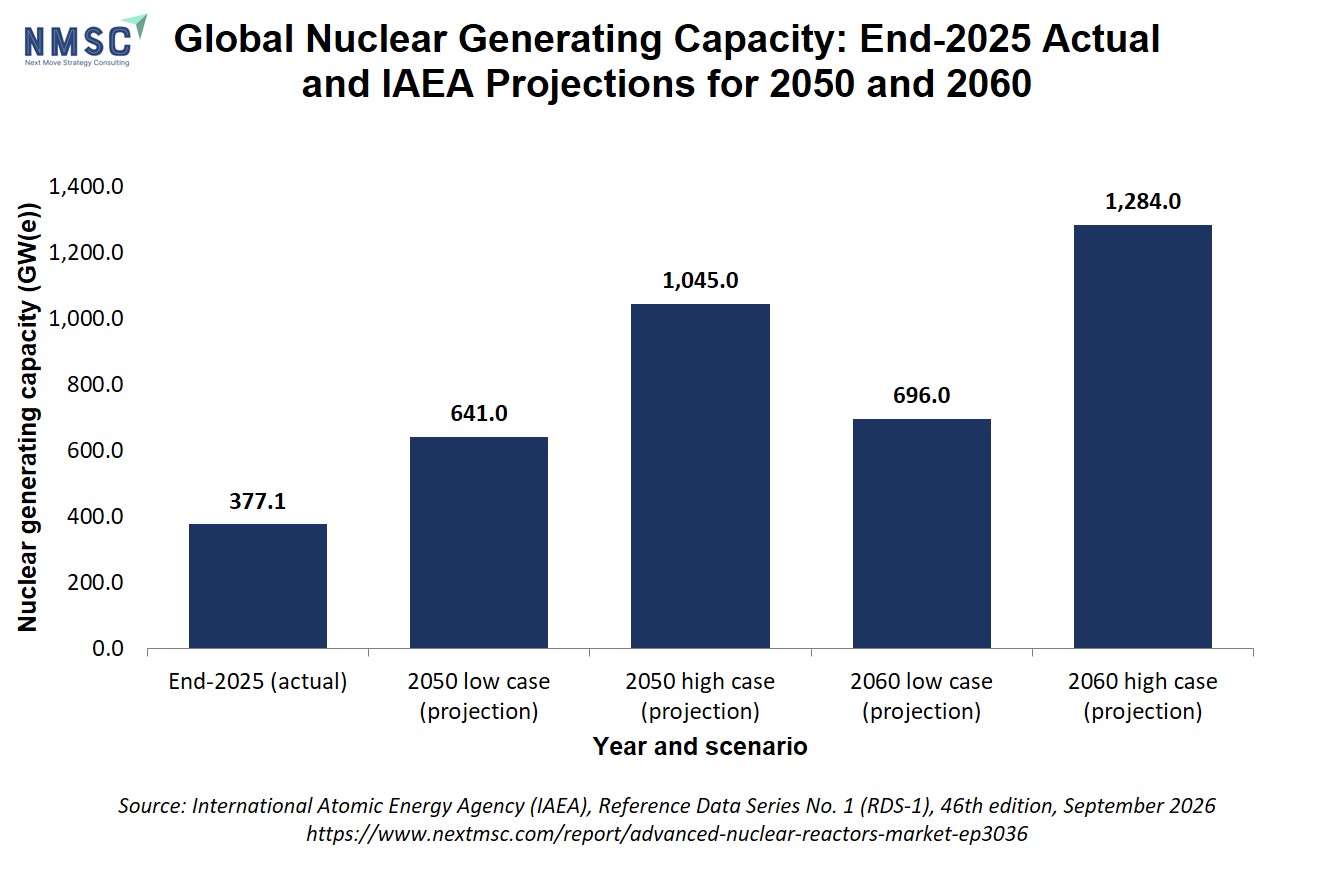
The IAEA reports 377.1 GW(e) of operating nuclear capacity at the end of 2025, which is actual data. It projects 641 GW(e) in 2050 and 696 GW(e) in 2060 in the low case, and 1,045 GW(e) in 2050 and 1,284 GW(e) in 2060 in the high case. The 2050 and 2060 values are projections, not observed data.
The World Nuclear Association's World Nuclear Outlook Report, published in early September 2026, found that global capacity could reach 1,457 GWe by 2050 if all national targets and goals were achieved and the existing fleet keeps operating, as reported by World Nuclear News. The gap between that figure and the IAEA high case shows how much of the outlook depends on policy delivery rather than on technology readiness.
Nuclear generation rose by 1% in 2025 against 2.7% growth in total generation, which cut nuclear's share from 8.7% to 8.4%, the IAEA reported. Holding share requires new capacity to be added faster than demand grows, which is why the agency stresses lifetime extensions: in the high case 70% of today's operating capacity still runs in 2060, while in the low case almost two-thirds retire.
SMRs carry much of the difference between the scenarios. The IAEA, which defines an SMR as a reactor of up to 300 MWe, projects that they supply 28% of the 1,017 GWe of high-case new capacity added by 2060, equal to 284 GWe, according to World Nuclear News.
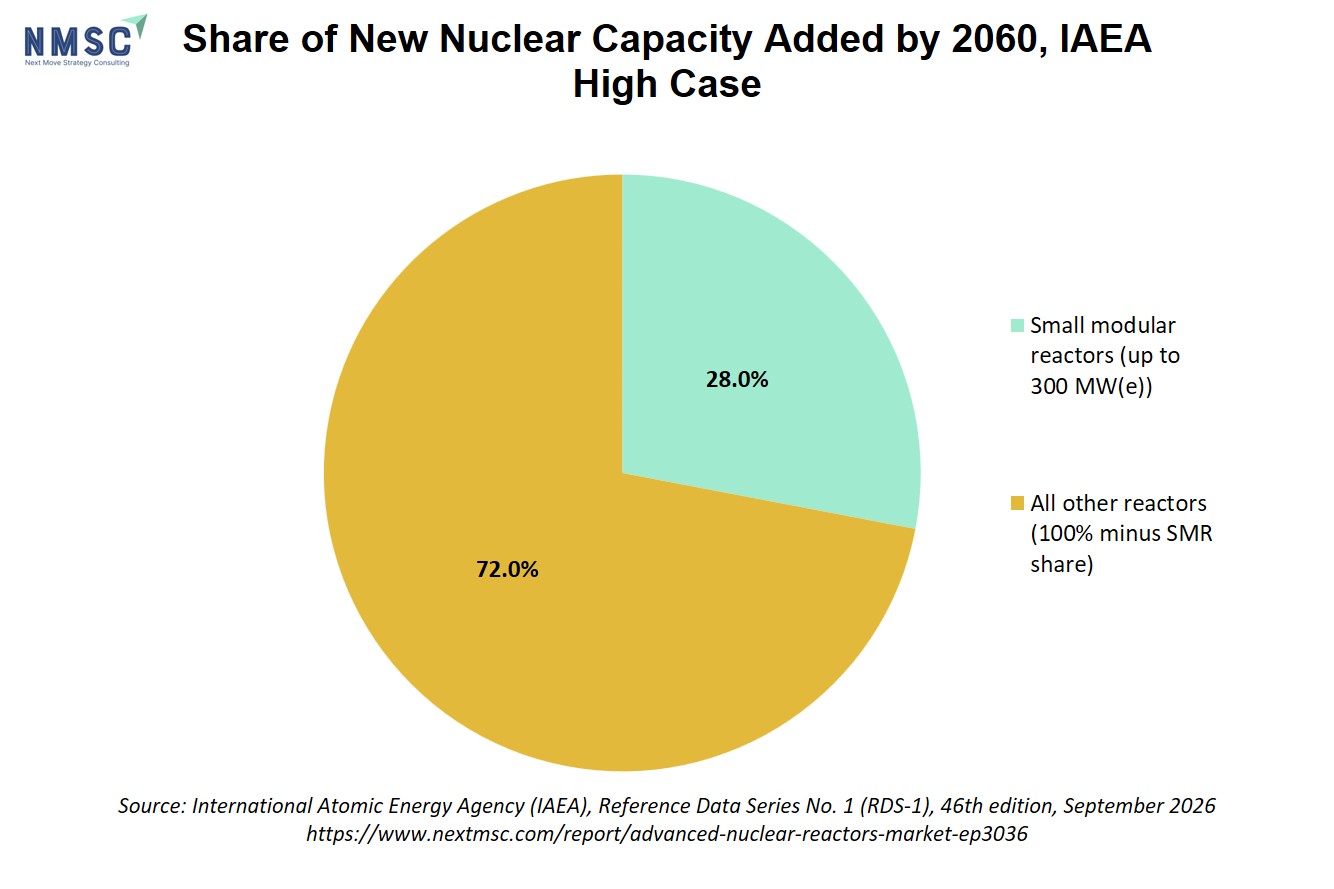
In its high case, the IAEA projects that small modular reactors supply 28% of the 1,017 GW(e) of new capacity added by 2060. The remaining 72% is the balance of new capacity, calculated as 100% minus the SMR share. The IAEA defines a small modular reactor as a reactor of up to 300 MW(e).
NextMSC's research window runs from 2025 to 2030, with 2024 as the base year, which places the first licensed construction starts and fuel deliveries inside the period it analyses. NextMSC's analysis indicates that segments with licensed projects or construction starts, namely high-temperature gas-cooled and small modular light-water designs, are positioned to attract the earliest capital, while sodium-cooled, lead-cooled and molten salt designs depend on fuel contracts and demonstration results. North America, the largest regional market in NextMSC's research, hosts both licensed US projects discussed here. Integration with renewable energy, an opportunity highlighted in NextMSC's report, will test whether firm nuclear output can complement variable wind and solar supply.
Three dated decisions will determine whether the permits of 2026 become plants: OPG's Darlington reassessment, due by mid-2027, which sets the BWRX-300 cost benchmark; Dow's 2027 preliminary investment decision, which tests industrial appetite for a four-unit gas-cooled plant; and the New York Power Authority's partner selection, expected in the coming months.
Section Summary:
Long-range projections keep rising, but near-term conversion of permits into plants depends on three dated decisions and on fuel availability.
-
The IAEA high case reaches 1,045 GWe by 2050 and 1,284 GWe by 2060, while the low case reaches 641 GWe and 696 GWe.
-
SMRs supply 28% of high-case new capacity by 2060, equal to 284 GWe.
-
The Darlington reassessment and Dow's investment decision will set the cost benchmark.
Next Steps for Stakeholders
The evidence of 2026 supports a sequenced response for each stakeholder group.
-
Investors: screen projects on anchor customer, repeatable licensing basis and contracted fuel, and treat OPG's mid-2027 reassessment and Dow's 2027 decision as the next cost benchmarks.
-
Utilities and public power authorities: settle cost sharing and fuel arrangements before construction authorisations, as TVA is doing at Clinch River.
-
Industrial energy buyers: map process-steam and power loads against a 400-metre emergency planning zone, the commercial case that Long Mott is testing.
-
Suppliers: secure enrichment, fuel fabrication and modular component capacity ahead of orders, since HALEU deliveries are not expected until the early 2030s.
-
Policymakers: preserve the 14-month to 18-month review window as applications grow, and align Department of Energy pilot data with NRC licensing needs.
Conclusion
The advanced nuclear reactors market is entering the final weeks of 2026 with a clearer regulatory path and an unresolved capital question. The Long Mott and Clinch River permits, four pilot criticalities, the Urenco and Blykalla fuel contract and the New York Power Authority's ten qualified developers show licensing, fuel and procurement advancing, while Darlington's revision shows that first-of-a-kind construction remains expensive.
For decision-makers, permits are now necessary but no longer sufficient. Capital, fuel and customer commitments separate projects that will be built from approvals that remain on paper. Readers who want segment-level analysis of reactor technologies, fuel types and regions can request the sample of NextMSC's full report, and NextMSC will keep tracking licensing, fuel and procurement milestones as the first projects move from permit to construction.
About the Author
 Sanyukta Deb
— Sanyukta Deb is Digital Marketing Team Lead at Next Move Strategy Consulting, where she has led content strategy and technical SEO for the firm's B2B market research publications for over 2 years. Her editorial process translates NextMSC's primary and secondary research — spanning technology, industrial, and consumer sectors — into commercial narratives, backed by search-intent, keyword, and competitive analysis. She brings 5 years of overall experience in digital marketing and content strategy.
About the Reviewer
 Debashree Dey
— Debashree Dey is Assistant Manager at Next Move Strategy Consulting, where she supports cross-vertical market content and communications across diverse industries for 6 years. Her professional background includes senior content writing, communications, and published manuscript authorship, with experience developing audience-focused business narratives and maintaining clear, consistent messaging. Her role supports research-led content development and editorial quality across NextMSC publications.














Add Comment