Generator Sets Market: Why Data Centers Now Drive Backup Power | NextMSC
Introduction
On November 5, 2026, Cummins Inc. reported record third-quarter EBITDA of USD 1.8 billion, equal to 18.9% of sales, led by its Power Systems business. One week earlier, Caterpillar Inc. had reported what Construction Dive described on October 30, 2026 as its highest sales quarter ever, and a day before that Generac Holdings Inc. posted record net sales of USD 1.29 billion. Each company pointed to the same cause: data center operators are ordering backup and prime power equipment faster than factories can ship it, which is turning the generator sets market from a storm-season business into a long-lead capital equipment cycle.
According to Next Move Strategy Consulting's Generator Sets Market report, the global generator sets market was valued at USD 27.50 billion in 2021 and is projected to reach USD 38.10 billion by 2030, growing at a CAGR of 7.1% from 2022 to 2030. NextMSC primary research and analysis defines the generator sets market across portable, inverter and standby units, six power ratings from below 50 kVA to above 750 kVA, and diesel, gas and hybrid fuels, which is why growth in large data center units cannot be read directly as growth for the whole category.
For More Information: Download FREE Sample on Generator Sets Market Report
Data Centers Redraw the Generator Sets Market: Three Record Quarters in Nine Days
Cummins: Record Power Systems Profitability, With Supply Setting the Pace
In its November 5, 2026 news release, filed with the U.S. Securities and Exchange Commission, Cummins Inc. reported third-quarter revenues of USD 9.4 billion, up 13%. Power Systems sales reached USD 2.3 billion, up 15%, with segment EBITDA of USD 582 million, a margin of 25.4% compared with 22.9% a year earlier. Cummins attributed the growth primarily to power generation demand, particularly from data center projects in the United States, China and Asia Pacific.
The segment sales tables in the same filing show where the growth sits. Sales of the power generation product line inside Power Systems reached USD 1,557 million in the third quarter of 2026, compared with USD 1,280 million a year earlier, an increase of 21.6%. Over the first nine months of 2026, the line recorded USD 4,376 million, which already equals 92.5% of the USD 4,731 million it recorded in all of 2025. A data center generator set is a multi-megawatt engine, alternator and controls package, so its unit economics differ sharply from the sub-50 kVA units that dominate residential demand.
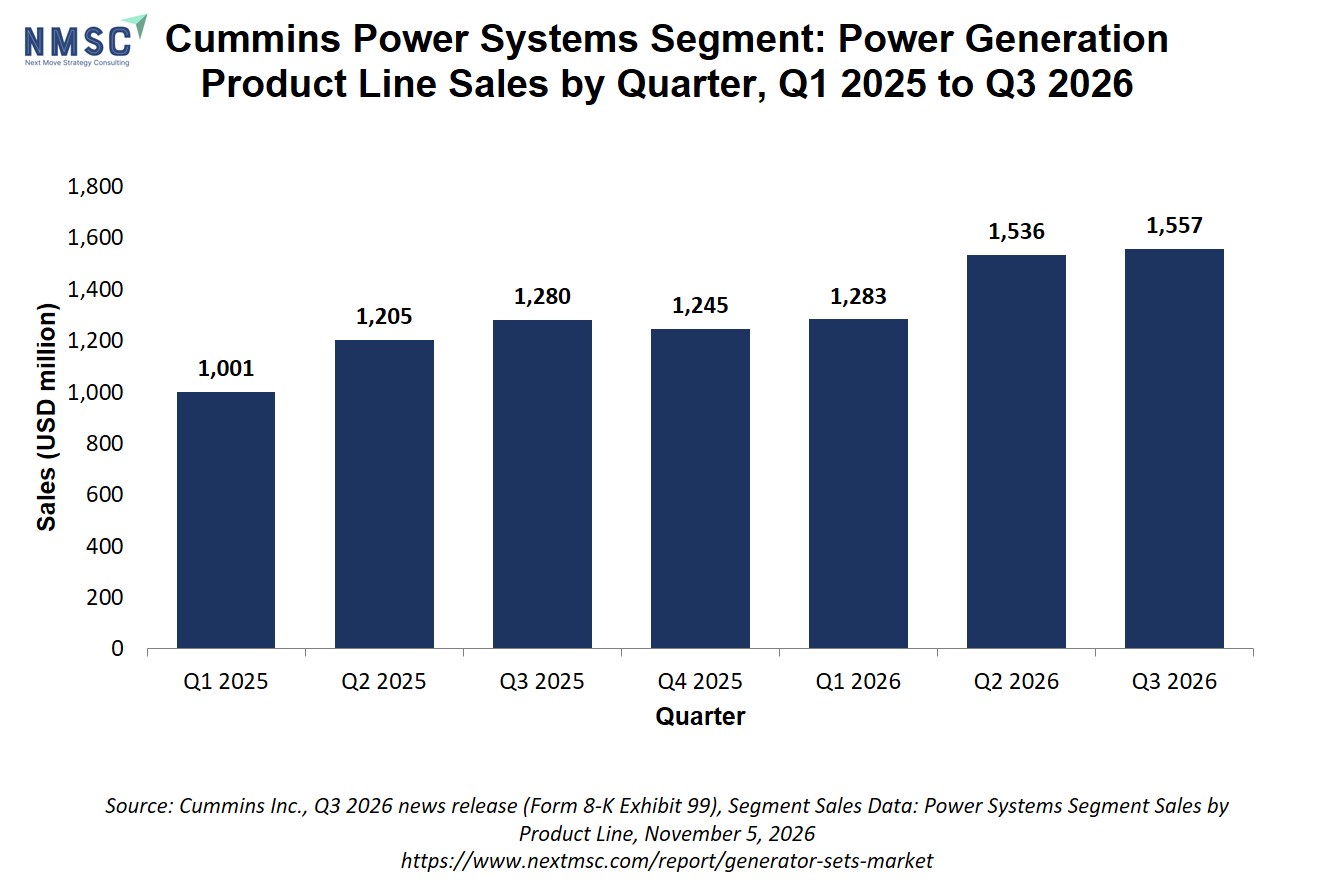
Cummins Inc.'s November 5, 2026 release reports quarterly sales for the power generation product line of its Power Systems segment. Sales were USD 1,001 million in the first quarter of 2025 and USD 1,557 million in the third quarter of 2026, and the largest sequential increase in the series came between the first and second quarters of 2026, from USD 1,283 million to USD 1,536 million. All figures are unaudited historical results, and the product line is one of three within the segment, alongside industrial and generator technologies.
On its earnings call the same day, Cummins management said North American power generation revenues rose 22% and China power generation sales rose 42% on accelerating data center demand, while supply chain constraints held back shipments, which management expects to largely catch up in the fourth quarter. The release states that Cummins expects fourth-quarter revenues to set a new record. Cummins narrowed its full-year revenue growth outlook to approximately 10%, attributing the change primarily to weaker North American pickup truck demand, and maintained a 15% to 25% growth forecast for 2026 power generation revenue.
Caterpillar and Generac: Turbines, Large Engines and a USD 4.5 Billion Backlog
Caterpillar Inc. reported on October 29, 2026 that third-quarter sales and revenues rose 17% to USD 20.7 billion. In Power & Energy, Power Generation external sales rose 30% to USD 3,421 million from USD 2,634 million, mainly from turbines, turbine-related services and large reciprocating engines, primarily in data center applications. Segment profit grew 31% to USD 2.143 billion, and profit as a share of segment sales widened to 24.4% from 21.9%.
Construction Dive reported on October 30, 2026 that Caterpillar's order backlog reached USD 78 billion, almost double the level of a year earlier. Operating profit also included USD 128 million of tariff recoveries under the International Emergency Economic Powers Act, a reminder that reported margins in this cycle carry one-off items alongside volume. The Power Generation line includes turbines, so it cannot be read as genset-only revenue, but the large reciprocating engines inside it anchor data center backup and prime power.
Generac Holdings Inc. reported on October 28, 2026 that net sales rose 16% to a record USD 1.29 billion. External net sales in its Commercial & Industrial segment rose about 28% to USD 552 million from USD 432 million, while Residential rose about 9% to USD 743 million from USD 682 million. Generac said its backlog for data center products has grown to approximately USD 4.5 billion following a long-term supply agreement with Amazon, under which initial deliveries are expected to total USD 2.4 billion across 2027 and 2028.
On Generac's earnings call that day, management said third-quarter data center revenue exceeded USD 100 million, that full-year 2026 data center revenue should approach USD 500 million, and that the company is working to triple global production capacity for large-megawatt generators. A new Sussex, Wisconsin, facility started initial production at the end of the quarter.
Rolls-Royce and Kirloskar: Europe and Asia Follow the Same Curve
Rolls-Royce Holdings plc reported its 2026 half-year results on July 30, 2026. Its Power Systems division, which includes the mtu brand, grew organic revenue 28% to GBP 2,604 million and underlying operating profit 72% to GBP 528 million, lifting operating margin to 20.3% from 15.3%. The company stated that power generation profit growth was driven by data centers, and it reported Power Systems order intake of GBP 4.6 billion, a book-to-bill ratio of 1.8 times and an order backlog of GBP 8.0 billion.
Asia shows the same demand pattern with thinner margins. Kirloskar Oil Engines Limited, an Indian engine and generator set manufacturer, reported on November 4, 2026 record standalone net sales of INR 1,722.5 crore for the quarter ended September 30, 2026, up 19%. Standalone EBITDA fell 6% to INR 191.1 crore, narrowing the margin to 11.0% from 14.0%, and consolidated net profit declined 18.1% to INR 130.31 crore as input and operating costs grew faster than revenue.
NMSC Strategic Perspective: Reading Company Results Against the Generator Sets Market
NextMSC primary research and analysis draws three conclusions from these disclosures. First, the reported growth rates describe product lines, not the whole category: Caterpillar's 30% covers turbines and large engines, Cummins' 22% covers North American power generation shipments, and Generac's 28% covers a commercial and industrial segment. The NMSC report spans portable, inverter and standby units across every power rating, so its 7.1% CAGR blends megawatt-class data center demand with smaller units that follow outage frequency and local construction activity.
Second, the value pool is moving up the power-rating ladder. The NMSC report segments the category from below 50 kVA to above 750 kVA, and Generac's large-megawatt facility, Caterpillar's large reciprocating engines and Rolls-Royce's data center power orders all sit at the top of that ladder. Company disclosures therefore point toward a rising share of revenue from the highest power ratings, and toward longer order-to-delivery cycles as backlogs stretch into 2027 and 2028.
Third, geography matters as much as scale. The NMSC report identifies Asia-Pacific as the largest regional generator sets market, supported by demand from IT and telecom, healthcare and utilities, and describes North America as a region with steady growth. Cummins' 42% rise in China power generation sales and Kirloskar's record Indian sales are consistent with the Asia-Pacific position, while Cummins' 22% North American growth shows where large-unit orders currently run fastest.
Section Summary:
Third-quarter 2026 disclosures show data center demand lifting the large generator and engine lines at Cummins, Caterpillar, Generac and Rolls-Royce, with backlogs extending into 2027 and 2028. Those growth rates apply to specific product lines and not to the whole generator sets market, which spans every power rating and fuel type.
-
Cummins Power Systems sales rose 15% to USD 2.3 billion at a 25.4% EBITDA margin.
-
Caterpillar Power Generation sales rose 30%, and Generac's data center backlog reached approximately USD 4.5 billion.
-
Rolls-Royce Power Systems holds a GBP 8.0 billion backlog, while Kirloskar's record sales came with a narrower margin.
Industry Impact Analysis: Grid Rules, Emission Permits and Cost Pressure
Grid Reliability Standards Raise the Value of On-Site Firm Power
On July 16, 2026, the Federal Energy Regulatory Commission directed the North American Electric Reliability Corporation to file mandatory reliability standards for computational loads, which include AI data centers and cryptocurrency mining, by December 31, 2026, with a work plan for further standards due March 1, 2027. POWER magazine reported the order, issued in Docket No. RD26-7-000. FERC Chairman Laura Swett said at the commission's open meeting that such loads can change their demand almost instantly, creating voltage stability problems for the grid.
The mechanism matters for equipment demand. A data center that must demonstrate ride-through behavior under enforceable standards has more reason to hold firm capacity that it controls, such as generator sets and battery storage. NextMSC analysis is that the order requires no equipment purchase, so its effect is indirect: it raises the cost of depending on the grid alone. Cummins' August 2026 selection to supply battery energy storage for a large U.S. data center project, which its November 5, 2026 release links to managing AI-driven load fluctuations, shows generation and storage being bought together.
Illinois Tightens Emission Rules for New Data Center Generators
Illinois Senate Bill 25, the Clean and Reliable Grid Affordability Act, was signed on January 8, 2026 and took effect on June 1, 2026. According to a June 11, 2026 briefing by the environmental consultancy ALL4, air permit applications filed from December 1, 2026 for new emergency diesel generators at most Illinois data centers must meet U.S. Environmental Protection Agency Tier 4 standards, and new emergency natural gas units must meet Tier 2 standards. ALL4 notes that existing generators are unaffected and that Tier 4 equivalence on a diesel unit typically requires selective catalytic reduction and a diesel particulate filter.
For manufacturers, this turns an emissions rule into a bill-of-materials decision. Aftertreatment adds components, cabinet space and consumables to each diesel set, which raises installed cost and gives gas-fired and storage-hybrid designs a price advantage on new Illinois permits. It is the restraint the NMSC report identifies, increased carbon emissions, becoming a permit condition with a start date.
Supply Chains, Tariffs and Input Costs Decide Who Captures the Margin
Cummins said supply chain constraints limited third-quarter shipments, and management said on its November 5, 2026 call that a supplier issue within Power Systems shifted approximately USD 200 million of expected revenue from the third quarter into the fourth. Generac aims to triple its large-megawatt capacity, and Rolls-Royce reported capacity expansion in Power Systems. NextMSC analysis is that capacity, not demand, is the binding constraint at the top of the power-rating range.
Costs sit on the other side of that constraint. Caterpillar's operating profit included USD 128 million of tariff recoveries, and Kirloskar's margin compression shows input costs outrunning pricing. Generac guided fourth-quarter gross margin to 37% to 38%, below the 39.9% it reported for the third quarter, citing sales mix and inflationary pressures.
A Residential Base Tempers Reliance on Hyperscale Customers
Generac's Residential segment rose about 9% to USD 743 million on higher home standby and portable generator shipments, and the NMSC report records weather-related grid damage as a driver of backup power demand. This base lowers dependence on a small group of hyperscale buyers, but it follows outage frequency, which no manufacturer controls.
Section Summary:
Regulation shapes the generator sets market from two directions. Federal reliability standards strengthen the case for on-site firm power, while state emission rules raise the cost of new diesel units, and supply limits decide who ships first.
-
FERC's July 16, 2026 order requires NERC to file computational-load standards by December 31, 2026.
-
Illinois applies Tier 4 standards to new data center diesel emergency generator permit applications from December 1, 2026.
-
Cummins shifted approximately USD 200 million of expected revenue from the third to the fourth quarter, and Generac guided fourth-quarter gross margin to 37% to 38%.
Pros and Cons of Recent Market Developments
The table below sets favorable and unfavorable signals from the last six months side by side.
Pros and Cons of Recent Generator Sets Developments
|
Pros |
Cons |
|
Backlogs give revenue visibility: Generac's data center backlog is approximately USD 4.5 billion and Rolls-Royce Power Systems holds GBP 8.0 billion. |
Supply limits delay revenue: Cummins shifted approximately USD 200 million of expected revenue from the third to the fourth quarter. |
|
A richer mix lifts margins: Cummins Power Systems reached a 25.4% EBITDA margin. |
Margin gains are uneven: Kirloskar's standalone EBITDA margin fell to 11.0% from 14.0%. |
|
Capacity is expanding: Generac is working to triple large-megawatt capacity. |
New capacity arrives mainly in 2027, so near-term shipments stay constrained. |
|
Grid standards favor on-site firm power: NERC must file computational-load standards by December 31, 2026. |
Emission rules raise unit cost: Illinois requires Tier 4 for new data center diesel permit applications from December 1, 2026. |
Key Data & Statistics
The first table compares the latest reported sales for the generator and engine lines discussed above. The lines differ in scope, currency and reporting period, so the table shows direction and scale and not a like-for-like ranking.
Reported Generator and Engine Line Sales, 2026
|
Company |
Period |
Reported line |
Reported value |
Change |
|
Caterpillar Inc. |
Q3 2026 |
Power Generation external sales |
USD 3,421 million |
+30% |
|
Cummins Inc. |
Q3 2026 |
Power Systems segment sales |
USD 2.3 billion |
+15% |
|
Generac Holdings Inc. |
Q3 2026 |
Commercial & Industrial external net sales |
USD 552 million |
+28% |
|
Rolls-Royce Holdings plc |
H1 2026 |
Power Systems underlying revenue |
GBP 2,604 million |
+28% (organic) |
|
Kirloskar Oil Engines Limited |
Q2 FY27 |
Standalone net sales |
INR 1,722.5 crore |
+19% |
The second table collects the order visibility and margin indicators that decide how much current demand converts into earnings over the next two years.
Order Visibility and Margin Indicators, 2026
|
Company |
Indicator |
Reported figure |
|
Generac Holdings Inc. |
Data center product backlog |
Approximately USD 4.5 billion |
|
Caterpillar Inc. |
Order backlog, Q3 2026 |
USD 78 billion |
|
Rolls-Royce Holdings plc |
Power Systems order intake, H1 2026 |
GBP 4.6 billion (book-to-bill 1.8 times) |
|
Rolls-Royce Holdings plc |
Power Systems order backlog |
GBP 8.0 billion |
Future Outlook & Forecast: What the 2027 Delivery Schedule Implies
NextMSC primary research and analysis projects the global generator sets market to reach USD 38.10 billion by 2030, growing at a CAGR of 7.1% from 2022 to 2030. The report names Asia-Pacific as the largest region and lists Kohler Co., Atlas Copco, Caterpillar, Cummins, Generac Power Systems, Aggreko, Siemens AG, Trane Technologies, Mitsubishi Heavy Industries and ABB among its key players. Its two stated restraints, the capital cost of installation and maintenance and carbon emissions, match the pressures visible in the Illinois rule and in Kirloskar's margin.
Dated company commitments mark the near-term calendar. Cummins expects fourth-quarter revenues to set a new record and has kept its 2026 power generation growth forecast at 15% to 25%. Generac said on October 28, 2026 that more than half of its data center backlog is scheduled for delivery in 2027, and that it expects 2027 data center revenue to well exceed USD 2 billion. Rolls-Royce raised its full-year group guidance on July 30, 2026. Illinois permit rules apply from December 1, 2026, and NERC must file computational-load standards by December 31, 2026.
The NMSC report also identifies hybrid generator sets, which pair diesel with natural gas, solar, tidal or wind, as a route to lower emissions and lower fuel cost. Cummins' August 2026 battery storage award is a data point in that direction.
NextMSC analysis of the risks is straightforward. A slowdown in hyperscale capital spending would reach the highest power ratings first, because backlogs are concentrated there, while the residential and commercial standby base would be less exposed but would remain tied to outage frequency. Capacity additions timed for 2027 could also compress pricing if demand softens as they come online.
Section Summary:
The NMSC projection of USD 38.10 billion by 2030 sits alongside company disclosures that show demand running ahead of capacity in the highest power ratings through 2027. The key variables for the next two years are capacity timing, margin retention and the cost of meeting new emission and reliability rules.
-
NextMSC projects a 7.1% CAGR from 2022 to 2030, with Asia-Pacific the largest regional generator sets market.
-
Generac expects 2027 data center revenue to well exceed USD 2 billion, and Cummins keeps a 15% to 25% power generation growth forecast for 2026.
-
Hybrid generation-plus-storage packages are emerging as a second competitive front.
Next Steps for Stakeholders
Five actions follow for executives and investors who track or buy into the generator sets market.
-
Equipment buyers and data center developers should secure delivery slots early. Cummins, Generac and Rolls-Royce all report backlogs that extend into 2027 or 2028, so lead time is now a project risk.
-
Manufacturers should map product portfolios against Tier 4 and Tier 2 permit conditions. Illinois applies them to applications filed from December 1, 2026, and a compliant line shortens the path to award.
-
Investors should separate line-level growth from category growth. Caterpillar, Cummins and Generac report turbines, power generation shipments and a commercial segment, none of which equals the NMSC definition of the market.
-
Operators of large computational loads should review ride-through and on-site firm power plans ahead of NERC's December 31, 2026 filing, and evaluate generation-plus-storage packages.
-
Strategy teams should stress-test plans for a hyperscale spending slowdown in 2027, when large capacity additions come online, using the residential and standby base as the downside reference.
Conclusion
The generator sets market is being pulled in two directions at once. At the top of the power-rating range, data center orders have produced record results at Cummins, Caterpillar and Generac, backlogs that reach into 2028 and margin gains at Rolls-Royce. At the base, residential and standby demand is recovering while input costs and emission rules press on returns. NextMSC primary research and analysis projects the category to reach USD 38.10 billion by 2030. Stakeholders who separate line-level momentum from category growth, and who plan around capacity timing, will be better placed than those who read company growth rates as market growth.
About the Author
 Sanyukta Deb
— Sanyukta Deb is Digital Marketing Team Lead at Next Move Strategy Consulting, where she has led content strategy and technical SEO for the firm's B2B market research publications for over 2 years. Her editorial process translates NextMSC's primary and secondary research — spanning technology, industrial, and consumer sectors — into commercial narratives, backed by search-intent, keyword, and competitive analysis. She brings 5 years of overall experience in digital marketing and content strategy.
About the Reviewer
 Debashree Dey
— Debashree Dey is Assistant Manager at Next Move Strategy Consulting, where she supports cross-vertical market content and communications across diverse industries for 6 years. Her professional background includes senior content writing, communications, and published manuscript authorship, with experience developing audience-focused business narratives and maintaining clear, consistent messaging. Her role supports research-led content development and editorial quality across NextMSC publications.














Add Comment