Advanced Packaging for Automotive Market: How Chiplets Reach Cars | NextMSC
Introduction
On 12 November 2026, imec and Japan's Advanced SoC Research for Automotive (ASRA) released the Automotive Chiplet Interoperability Requirement, known as ACIR, at the Autonomous Edge Chiplet Forum in Japan. The two organisations stated that the joint document complements existing standards by setting common architectural requirements for interoperable automotive chiplets, with the aim of supporting cross-vendor integration in an open ecosystem and helping to accelerate and de-risk adoption. The release matters well beyond standards committees. Every chiplet-based vehicle processor still has to be assembled, cooled, tested and qualified inside a package, which places advanced packaging at the center of the automotive semiconductor supply chain.
According to Next Move Strategy Consulting's Advanced Packaging for Automotive Market report, the global advanced packaging for automotive market is projected to grow at a CAGR of 12.32% between 2025 and 2030, with system-in-package, wafer-level packaging and 3D packaging forming the core technology segments. This article concentrates on the growth drivers, supply chain moves and technology decisions behind that trajectory rather than on a headline valuation.
For More Information: Download FREE Sample on Advanced Packaging for Automotive Market Report
The analysis draws on publications from the last six months, including the International Energy Agency's Global EV Outlook 2026, the Taiwan Semiconductor Manufacturing Company and Amkor Technology agreement, the Porsche Consulting strategy paper on packaging, the Semiconductor Industry Association's third-quarter release and the fiscal 2026 results of Infineon Technologies. Together they show a back-end manufacturing step becoming a design-level decision for vehicle makers and their suppliers.
Advanced Packaging for Automotive Market: Chiplet Standards and U.S. Capacity Redraw the Supply Chain
Packaging Moves From Back-End Step to Vehicle-Level Constraint
Porsche Consulting's strategy paper Advanced Semiconductor Packaging in Automotive Electronics, published on 29 September 2026, argues that advanced packaging is no longer merely a back-end manufacturing step. As driver-assistance and autonomous driving functions become more demanding, the paper identifies bandwidth, thermal management and system integration as critical performance drivers, and it positions packaging as a key enabler of compute performance, energy efficiency and software-defined vehicle architectures. It addresses vehicle manufacturers, Tier 1 suppliers and semiconductor companies, and it focuses on rising compute requirements and emerging chiplet architectures.
The imec and ASRA announcement gives that argument a concrete engineering path. In the release dated 12 November 2026, the two organisations tied ACIR to the rapid growth of in-vehicle high-performance computing, driven by driver-assistance systems, semi-autonomous and autonomous driving, intelligent cockpit solutions and the AI workloads that support them. The forum where ACIR was unveiled took place on 12 and 13 November 2026 in Tokyo, hosted by imec with support from ASRA and RISE-A. According to imec, its Autonomous Edge Chiplet Program connects 24 partners across the automotive and semiconductor value chain.
Capacity is moving in parallel. On 16 June 2026, Taiwan Semiconductor Manufacturing Company and Amkor Technology announced a 10-year agreement under which TSMC will procure advanced packaging and testing services from Amkor in Arizona, where Amkor is developing a packaging and test campus and TSMC is building fabrication facilities. Amkor chief executive Kevin Engel said the agreement is intended to give customers a full U.S. supply chain from advanced silicon manufacturing to tested packaged devices. The announcement was framed around artificial intelligence and high-performance computing demand, yet Amkor's own description of its portfolio lists automobiles alongside smartphones, data centers and wearables, so the added capacity sits inside the ecosystem that automotive programs also use.
The clearest demand signal comes from Amkor Technology's third-quarter 2026 results, released on 26 October 2026. Net sales were $1.99 billion, and the automotive, industrial and other end market, which Amkor defines to include ADAS, electrification, infotainment and safety, reached 22% of net sales, compared with 16% in the third quarter of 2025. Amkor's Form 10-Q states that automotive and industrial revenue grew 37% year on year in the quarter, matching computing, with data center and ADAS applications named as the drivers. Over the first nine months of 2026 the automotive and industrial end market grew 33%, and chief executive Kevin Engel described automotive and industrial revenue as a record.
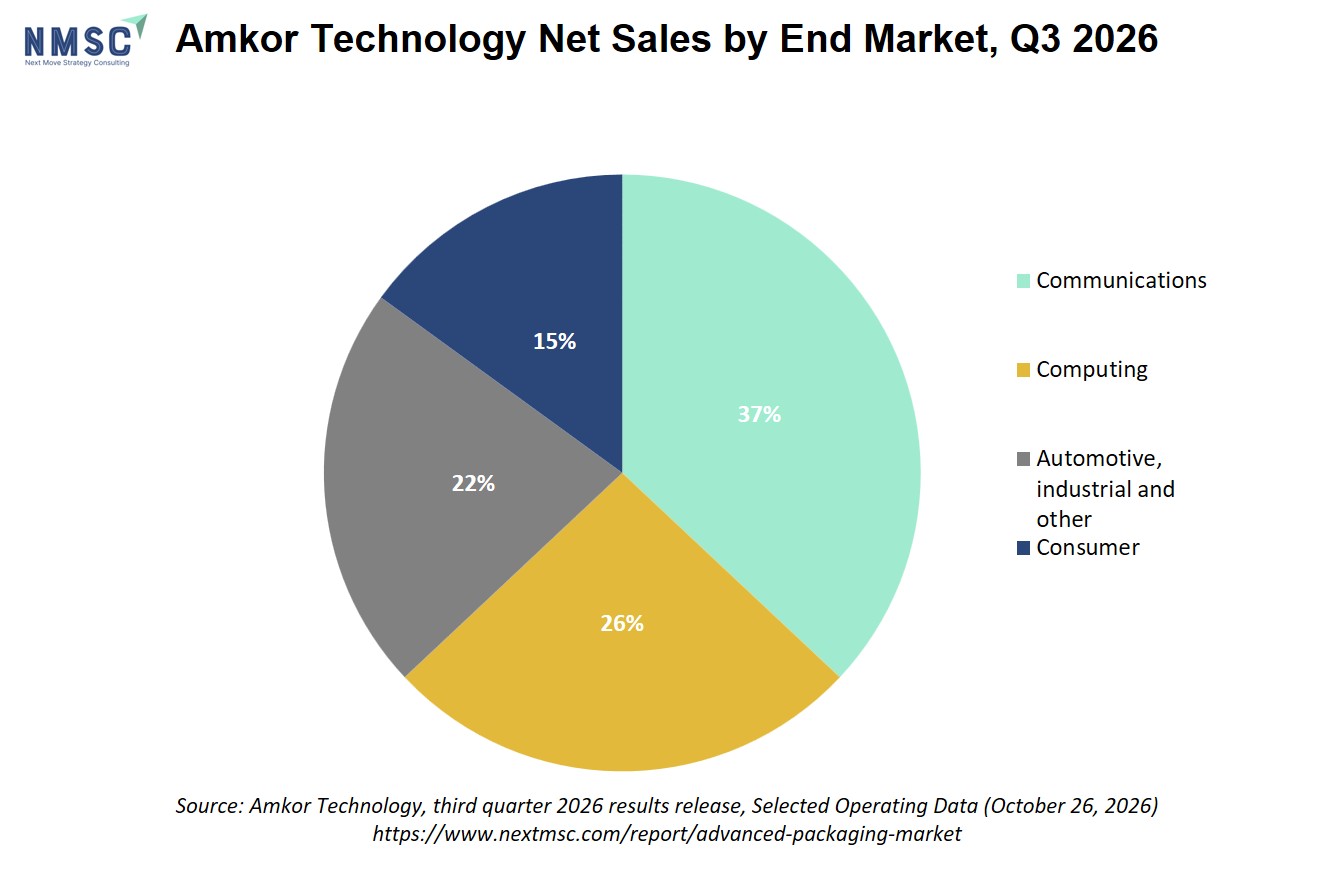
Amkor Technology's results release for the third quarter of 2026 reports net sales by end market as follows: communications 37%, computing 26%, automotive, industrial and other 22% and consumer 15%. Automotive, industrial and other is defined by the company to include ADAS, electrification, infotainment and safety applications. The four categories total 100% of net sales for the quarter.
NMSC Strategic Perspective: Packaging Is Now a Design Decision, Not a Procurement Line
NextMSC primary research and analysis indicates that the November 2026 interoperability work changes who owns the packaging decision. Under a monolithic system-on-chip model, a semiconductor supplier absorbed packaging choices and delivered a qualified part. Under a chiplet model, a vehicle manufacturer or Tier 1 supplier may combine compute, memory, interface and safety dies from several vendors, which makes the package the place where thermal limits, die-to-die bandwidth and functional safety evidence meet. For that reason NextMSC reads the 12.32% CAGR forecast for 2025 to 2030 as a statement about architecture as much as about volume: each additional compute die or high-speed interconnect raises the packaging content and the qualification effort attached to a vehicle platform.
Three consequences follow from NextMSC's analysis. First, qualification evidence becomes a commercial asset, because a package assembled from several vendors' dies must be validated as a system before a vehicle program can adopt it. Second, location matters: the TSMC and Amkor agreement and the growth in Amkor's automotive and industrial revenue show high-compute packaging capacity being built near fabrication in the United States, which shortens logistics for North American vehicle programs and is consistent with the regional growth profile in the NextMSC report, where North America is anticipated to record the fastest growth. Third, mixed technology portfolios will persist. Amkor reported that its mainstream products, defined as wirebond packaging and related test, rose from $303 million to $359 million year on year, so conventional formats continue to coexist with flip-chip and wafer-level formats rather than being displaced by them.
Section Summary:
The 2026 evidence points to packaging becoming a shared design variable across vehicle makers, Tier 1 suppliers and packaging houses.
-
Porsche Consulting (29 September 2026) classifies packaging as a performance factor for automotive compute rather than a back-end step.
-
imec and ASRA released ACIR on 12 November 2026 to support multi-vendor chiplet integration in vehicles.
-
Amkor Technology's automotive, industrial and other end market rose to 22% of net sales in the third quarter of 2026, from 16% a year earlier.
-
NextMSC expects conventional and advanced formats to coexist, with qualification evidence becoming a commercial asset.
Industry Impact Analysis: What Changes for Vehicle Makers, Tier 1 Suppliers and Packaging Houses
Electrification Widens the Volume Base
The International Energy Agency's Global EV Outlook 2026, released on 20 May 2026, reports that global electric car sales exceeded 20 million in 2025, a 20% increase on 2024, equal to one in four new cars sold worldwide. The agency expects electric car sales to reach about 23 million in 2026, close to 30% of all new cars, even though first-quarter 2026 sales fell 8% year on year after policy changes in China and the United States. NextMSC links electrification to packaging demand through content per vehicle: an electric vehicle adds battery management, power conversion and charging electronics to the driver-assistance and cockpit compute found in any modern vehicle, and each of those functions needs compact packages that tolerate heat and vibration.
Supplier Economics: Infineon's Automotive Segment
Infineon Technologies reported on 10 November 2026 that fourth-quarter fiscal 2026 revenue in its Automotive segment rose 8% from the previous quarter on the reported basis, with software-defined vehicle and electromobility products leading the increase. On the segment structure that took effect on 1 July 2026, with prior periods restated, automotive revenue reached €2,131 million, up 9% from the third quarter and 10% from the fourth quarter of fiscal 2025, while the segment result margin rose to 22.0% from 18.1% in the third quarter. Infineon expects automotive revenue to increase by a mid-teens percentage in fiscal 2027, and it plans to expand its backend sites in Bangkok and Melaka alongside group investments of €3.0 billion to €3.5 billion planned for fiscal 2027.
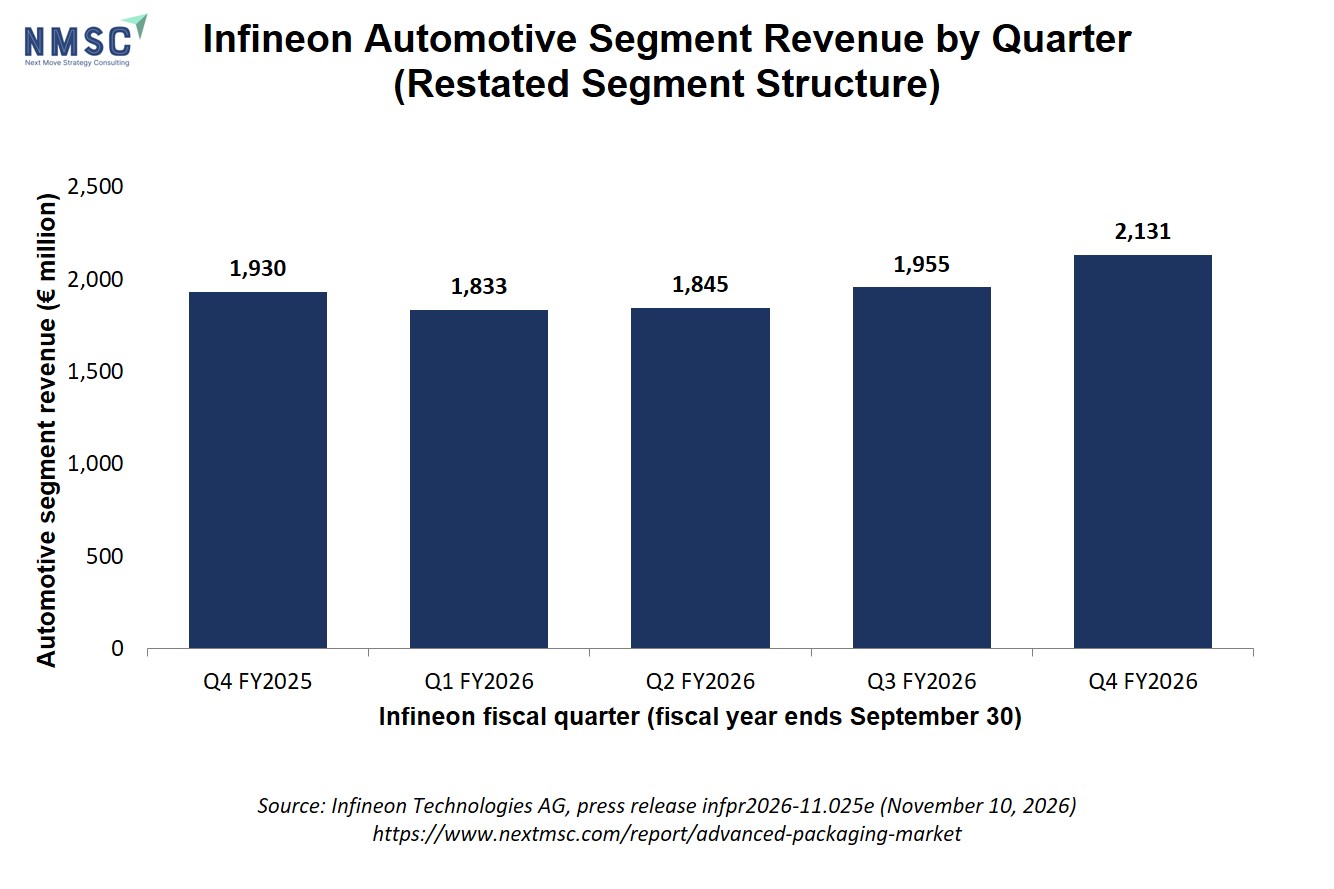
Infineon Technologies' press release of November 10, 2026 gives restated automotive segment revenue of €1,930 million in the fourth quarter of fiscal 2025, €1,833 million in the first quarter of fiscal 2026, €1,845 million in the second, €1,955 million in the third and €2,131 million in the fourth. The figures reflect the segment structure effective July 1, 2026 and are preliminary and unaudited.
The Infineon figures matter for packaging because they show where automotive semiconductor revenue is rising: microcontrollers, smart power components and MOSFETs, as described in the company's fourth-quarter analyst-call introduction. Each of these device families has to be packaged and tested before it reaches a vehicle, so revenue growth in them carries packaging and test volume with it.
Capacity Competition With Data Center Demand
The Semiconductor Industry Association reported on 3 November 2026 that global semiconductor sales reached $517.7 billion in the third quarter of 2026, up 24.1% from the second quarter. September sales were $172.6 billion, 146.8% above September 2025, based on three-month moving averages compiled by the World Semiconductor Trade Statistics organization. Automotive programs therefore compete for advanced packaging lines, substrates and test capacity at a time when overall chip demand is expanding at an exceptional rate. Amkor's results show the allocation effect: its computing end market grew 37% year on year in the third quarter, the same rate as automotive and industrial, and the company updated its 2026 capital expenditure plan to approximately $2.5 billion.
NextMSC primary research and analysis indicates that vehicle programs with long qualification cycles are exposed to this competition because a supplier cannot easily change packaging partners once a part has been qualified. Multi-year capacity agreements, of which the 10-year TSMC and Amkor arrangement is a recent example, are one contractual response available to suppliers. Amkor itself lists a downturn or lower sales to customers in the automotive industry among its stated risk factors, a reminder that packaging houses carry cyclical exposure as well.
Section Summary:
Electrification, rising compute content and tight capacity are reshaping supplier economics and contracting behavior.
-
The International Energy Agency reports more than 20 million electric car sales in 2025 and expects about 23 million in 2026.
-
Infineon Technologies expects automotive revenue to grow by a mid-teens percentage in fiscal 2027 and is expanding backend sites in Thailand and Malaysia.
-
The Semiconductor Industry Association reports third-quarter 2026 chip sales of $517.7 billion, intensifying competition for packaging capacity.
-
Long qualification cycles make multi-year capacity agreements a practical tool for automotive suppliers.
Pros and Cons of Recent Market Developments
The table below sets each documented advantage of recent developments against a documented limitation, using only statements from the named sources.
|
Pros |
Cons |
|
imec and ASRA's ACIR document gives vehicle makers and suppliers a common architectural reference for multi-vendor chiplet integration. |
ACIR complements existing standards rather than replacing them, so qualification and safety evidence still has to be built for each package. |
|
The 10-year TSMC and Amkor Technology agreement adds long-term packaging and test capacity in Arizona. |
The agreement was framed around AI and high-performance computing demand, so automotive programs share capacity with data center customers. |
|
Amkor Technology's automotive, industrial and other end market rose to 22% of net sales in the third quarter of 2026, from 16% a year earlier. |
Amkor lists a downturn or lower sales to automotive customers among its stated risk factors. |
|
Infineon Technologies expects automotive revenue to rise by a mid-teens percentage in fiscal 2027. |
Infineon expects automotive revenue to remain stable in the first quarter of fiscal 2027, so growth is not guided to be linear. |
|
Electric car sales exceeded 20 million in 2025, according to the International Energy Agency. |
The International Energy Agency reports an 8% fall in global electric car sales in the first quarter of 2026 after policy changes in China and the United States. |
Key Data & Statistics
The tables below consolidate the verified figures cited in this article, all from releases, filings and reports published within the last six months.
Verified Developments Relevant to Automotive Advanced Packaging (2026)
|
Date |
Organisation |
Verified development |
Packaging relevance |
|
20 May 2026 |
International Energy Agency |
Global EV Outlook 2026: electric car sales above 20 million in 2025, up 20% |
Sets the electrified vehicle volume base |
|
16 June 2026 |
TSMC and Amkor Technology |
10-year agreement for advanced packaging and test in Arizona |
Adds U.S. packaging capacity |
|
29 September 2026 |
Porsche Consulting |
Strategy paper on advanced semiconductor packaging in automotive electronics |
Frames packaging as a compute and thermal factor |
|
26 October 2026 |
Amkor Technology |
Automotive, industrial and other at 22% of third-quarter net sales |
Shows demand inside a packaging house |
|
10 November 2026 |
Infineon Technologies |
Automotive segment revenue of €2,131 million in the fourth quarter (restated basis) |
Shows rising automotive semiconductor output |
|
12 November 2026 |
imec and ASRA |
ACIR released for interoperable automotive chiplets |
Standardizes multi-vendor integration |
Amkor Technology Net Sales by End Market (% of Net Sales)
|
End market |
Q3 2025 |
Q2 2026 |
Q3 2026 |
|
Communications |
51% |
42% |
37% |
|
Computing |
19% |
22% |
26% |
|
Automotive, industrial and other |
16% |
22% |
22% |
|
Consumer |
14% |
14% |
15% |
|
Total |
100% |
100% |
100% |
Infineon Automotive Segment, Restated Quarterly Figures
|
Metric |
Q4 FY2025 |
Q3 FY2026 |
Q4 FY2026 |
|
Segment revenue (€ million) |
1,930 |
1,955 |
2,131 |
|
Segment result (€ million) |
427 |
353 |
469 |
|
Segment result margin |
22.1% |
18.1% |
22.0% |
Two readings stand out. Amkor's automotive, industrial and other share rose by six percentage points between the third quarters of 2025 and 2026, while communications fell by 14 points, so computing and automotive, industrial and other together now account for 48% of its net sales. Infineon's restated automotive margin recovered to 22.0% in the fourth quarter after 18.1% in the third, alongside 9% quarter-on-quarter revenue growth.
Future Outlook & Forecast for the Advanced Packaging for Automotive Market
NextMSC's forecast of a 12.32% CAGR between 2025 and 2030 rests on three structural drivers that the 2026 events reinforce: electrification, rising in-vehicle compute and thermal management. NextMSC primary research and analysis indicates that Asia Pacific retains the largest share through the forecast period on the strength of electric vehicle manufacturing and government-backed programs, while North America is anticipated to record the fastest growth, supported by electric and plug-in hybrid vehicle adoption, policy support for domestic semiconductor production and the localization of packaging capacity visible in the TSMC and Amkor agreement.
The NextMSC report segments the market by packaging type (system-in-package, wafer-level packaging, 3D packaging and others), by vehicle type (passenger cars, commercial vehicles, electric vehicles and autonomous vehicles), by material (organic substrate, lead frame, ceramic substrate and bonding wire) and by application (ADAS, infotainment systems and powertrain systems). NextMSC identifies high manufacturing and integration costs as the main restraint, particularly for smaller suppliers, and flip-chip ball grid array innovation as an opportunity because it supports higher pin density, high-speed performance and better thermal conductivity.
Company guidance supplies near-term checkpoints rather than long-range forecasts. Infineon Technologies guides automotive revenue to remain stable in the first quarter of fiscal 2027 and to rise by a mid-teens percentage across the full fiscal year. Amkor Technology guided fourth-quarter 2026 net sales to a range of $1.9 billion to $2.0 billion. The International Energy Agency's expectation of about 23 million electric car sales in 2026 depends on a recovery from the first-quarter dip. NextMSC suggests tracking five indicators against the forecast:
-
Adoption of ACIR among the 24 partners in imec's Autonomous Edge Chiplet Program, measured by announced multi-vendor reference designs.
-
Amkor Technology's automotive, industrial and other share of net sales, which stood at 22% in the third quarter of 2026.
-
Infineon Technologies' automotive revenue against its mid-teens fiscal 2027 growth guidance.
-
The pace of electric car sales recovery in China and the United States after the first-quarter 2026 decline reported by the International Energy Agency.
-
Monthly semiconductor sales from the Semiconductor Industry Association as a gauge of competition for packaging capacity.
Section Summary:
NextMSC's outlook combines a 12.32% CAGR with regional divergence and company-level checkpoints that can confirm or challenge the trajectory.
-
Asia Pacific is expected to hold the largest share, with North America growing fastest.
-
High integration costs remain the principal restraint, and flip-chip ball grid array advances the main opportunity.
-
Infineon Technologies and Amkor Technology guidance provides measurable checkpoints through fiscal 2027.
-
ACIR adoption will indicate whether multi-vendor chiplet programs move from research to production.
Next Steps for Stakeholders
The evidence supports different priorities for each group in the automotive semiconductor chain.
Vehicle Makers and Tier 1 Suppliers
-
Map the packaging implications of each central compute program, including thermal limits and die-to-die bandwidth, before choosing between monolithic and chiplet architectures.
-
Evaluate ACIR, released by imec and ASRA on 12 November 2026, as a reference when writing multi-vendor chiplet specifications.
-
Secure multi-year packaging and test capacity commitments early, given the competition for lines described by the Semiconductor Industry Association's third-quarter data.
Semiconductor Companies and Packaging Houses
-
Build qualification evidence for multi-die packages as a product, since vehicle programs must validate each combination as a system.
-
Align capacity location with vehicle production regions, following the Arizona model set by TSMC and Amkor Technology.
-
Maintain both conventional and advanced formats, as Amkor's mainstream growth from $303 million to $359 million shows continuing demand for wirebond packaging.
Investors
-
Track Amkor Technology's automotive, industrial and other share and Infineon Technologies' automotive revenue against guidance as practical indicators of the NextMSC trajectory.
-
Weigh cyclical exposure: Amkor lists automotive downturn risk among its disclosures, and Infineon guides to a stable first quarter in fiscal 2027.
-
Prioritize companies that can show automotive-grade qualification, regional capacity and participation in interoperability programs such as imec's.
Conclusion
The advanced packaging for automotive market is being reshaped by events that arrived within a single half-year: the 10-year TSMC and Amkor agreement in June, the Porsche Consulting paper in September, record automotive and industrial revenue at Amkor Technology in October, Infineon's automotive recovery in November and the imec and ASRA interoperability requirement in the same month. NextMSC's 12.32% CAGR forecast for 2025 to 2030 reflects a market in which packaging is moving from a supplier's internal choice to a shared design decision. Vehicle makers, Tier 1 suppliers and packaging houses that treat packaging as part of the vehicle architecture, secure capacity early and build qualification evidence will be best placed as chiplet-based compute enters production vehicles.
About the Author
 Priyanshu Das
— Priyanshu Das is SEO Executive at Next Move Strategy Consulting, where he has led on-page and off-page SEO, keyword research, and SEO audits for the firm's B2B market research publications for 2 years. His audit process combines technical crawl analysis, backlink profile review, and competitor keyword gap mapping — using tools including Screaming Frog and Google Search Console — to prioritize fixes by organic search-visibility impact, informed by his own prior in-house and agency SEO experience.
About the Reviewer
 Sanyukta Deb
— Sanyukta Deb is Digital Marketing Team Lead at Next Move Strategy Consulting, where she has led content strategy and technical SEO for the firm's B2B market research publications for over 2 years. Her editorial process translates NextMSC's primary and secondary research — spanning technology, industrial, and consumer sectors — into commercial narratives, backed by search-intent, keyword, and competitive analysis. She brings 5 years of overall experience in digital marketing and content strategy.













Add Comment