Refrigerator Market Statistics, Trends & Forecasts
Introduction
The global refrigerator market is navigating one of its most consequential periods of structural change in decades. What was once a mature, commoditized category is now at the center of three simultaneous disruptions: the reshoring of manufacturing capacity driven by trade policy pressures, the commercial integration of artificial intelligence into core product functionality, and the relentless expansion of urban populations across emerging economies. These forces are not operating in sequence—they are converging simultaneously, compressing the strategic decision window for manufacturers, investors, and policymakers alike.
According to Next Move Strategy Consulting (NMSC), the global Refrigerator Market is projected to reach USD 154.77 billion by 2030, expanding at a compound annual growth rate (CAGR) of 6.27% during the 2025–2030 forecast period. For C-level executives and institutional decision-makers, the imperative is clear: the refrigerator market's next growth chapter will be defined not by volume alone, but by the intersection of supply chain resilience, regulatory compliance, and technology-driven premiumization.
For More Information: Download FREE Sample on Refrigerator Market Report
Reshaping the Refrigerator Market: Three Forces Driving Structural Transformation in 2025
GE Appliances' Historic $3 Billion U.S. Manufacturing Commitment
On August 13, 2025, GE Appliances, a Haier company, announced a landmark plan to invest more than $3 billion over the next five years in its U.S. manufacturing operations. The investment—with $490 million committed in the first phase—is designed to shift refrigerator, gas range, and water heater production out of China and Mexico and into American facilities across Kentucky, South Carolina, and Tennessee, creating more than 1,000 new jobs. This announcement represents one of the most significant domestic manufacturing commitments in the U.S. appliance industry in recent history, and it signals a broader strategic recalibration among global appliance manufacturers in response to evolving trade policy and tariff pressures.
The AP News confirmed that GE Appliances is specifically shifting refrigerator production to reduce exposure to tariffs on goods manufactured in China and Mexico, underscoring that geopolitical and trade considerations are now as central to refrigerator market strategy as product innovation.
AI Integration: Godrej's Intelligent Cooling Systems
In the Asia-Pacific region, Godrej Appliances has commercially launched a new line of AI-powered refrigerators under its Eon Velvet and Eon Inspire product families. The flagship 600-litre side-by-side model uses artificial intelligence to automatically optimize cooling and energy consumption by sensing food load, ambient temperature, and usage patterns in real time, adjusting compressor speed and cooling zones accordingly. The system promises up to 30 days of food freshness and measurable energy savings. Godrej has stated its ambition to maintain 40% growth during the festive period, with AI-powered refrigerators positioned as the primary growth driver.
This development is emblematic of a broader industry shift: AI-enabled refrigerators are transitioning from premium novelties to competitive baseline requirements in high-growth markets.
Regulatory Momentum: DOE Energy Conservation Standards
In the United States, the Department of Energy (DOE) issued a final rule on December 20, 2024, establishing new and amended energy conservation standards for commercial refrigerators, freezers, and refrigerator-freezers, with an effective date of March 24, 2025. Separately, the DOE has finalized energy efficiency standards for residential refrigerators that will take effect in January 2029 or 2030, depending on product configuration.
These regulatory actions are consistent with the International Energy Agency's (IEA) finding that over 80% of global energy use for air conditioners and refrigerators is currently covered by minimum energy performance standards (MEPS). The IEA further confirms that countries with the longest history of applying MEPS have achieved electricity savings of approximately 15% of total national electricity consumption per year.
NMSC's Strategic Perspective on This Market Shift
From Next Move Strategy Consulting's analytical standpoint, these concurrent developments—reshoring of manufacturing, AI-driven product innovation, and regulatory tightening—represent a structural realignment of the refrigerator market rather than cyclical fluctuations. The convergence of supply chain nationalism, consumer demand for intelligent appliances, and government-mandated energy efficiency is creating a new competitive landscape in which manufacturers must simultaneously invest in domestic production capacity, R&D for smart features, and compliance infrastructure. Companies that treat these as separate strategic priorities risk falling behind those that integrate them into a unified market positioning strategy. The refrigerator market's next competitive moat will be built at the intersection of all three.
Section Summary: The refrigerator market in 2025 is being reshaped by three simultaneous structural forces: GE Appliances' $3 billion U.S. manufacturing reshoring initiative, the commercial launch of AI-powered refrigerators by Godrej in India, and sweeping new energy conservation standards from the U.S. DOE. These developments signal a market in fundamental transition, not merely cyclical growth.
Key Takeaways:
-
GE Appliances committed $3 billion to U.S. manufacturing on August 13, 2025, shifting refrigerator production from China and Mexico to domestic facilities.
-
Godrej's AI-powered Eon Velvet refrigerators use machine learning to optimize cooling and energy use in real time, targeting 40% festive-season growth.
-
The U.S. DOE's new commercial refrigerator energy standards took effect March 24, 2025, with residential standards to follow by 2029–2030.
-
The IEA confirms that MEPS programs covering refrigerators have delivered electricity savings of up to 15% of total national consumption in leading markets.
Industry Impact Analysis
Urbanization as a Structural Demand Driver
The United Nations' World Urbanization Prospects 2025 (WUP 2025) provides critical context for understanding the refrigerator market's long-term demand trajectory. According to the report, 57.8% of the world's population lived in urban areas in 2025 based on national definitions. Using the harmonized Degree of Urbanization methodology, 45% of the world's 8.2 billion people lived in cities, with an additional 36% in towns, and only 19% in rural areas.
Urban households are significantly more likely to own and use refrigerators than rural households, given access to electricity grids, higher disposable incomes, and modern retail infrastructure. The WUP 2025 projects that two thirds of global population growth between now and 2050 will occur in cities. Seven countries—India, Nigeria, Pakistan, the Democratic Republic of the Congo, Egypt, Bangladesh, and Ethiopia—are expected to add more than 500 million city residents by 2050, accounting for over half of the projected 986 million increase in global city dwellers. These markets represent the most significant untapped demand pools for refrigerator manufacturers over the next two decades.
Energy Efficiency Regulations: Compliance Costs and Competitive Differentiation
The DOE's new commercial refrigerator standards and the forthcoming residential standards are creating a dual impact on the refrigerator market. On one hand, they impose compliance costs on manufacturers, particularly smaller players with limited R&D capacity. On the other hand, they create a competitive differentiation opportunity for manufacturers that have already invested in energy-efficient compressor technology, inverter systems, and smart energy management.
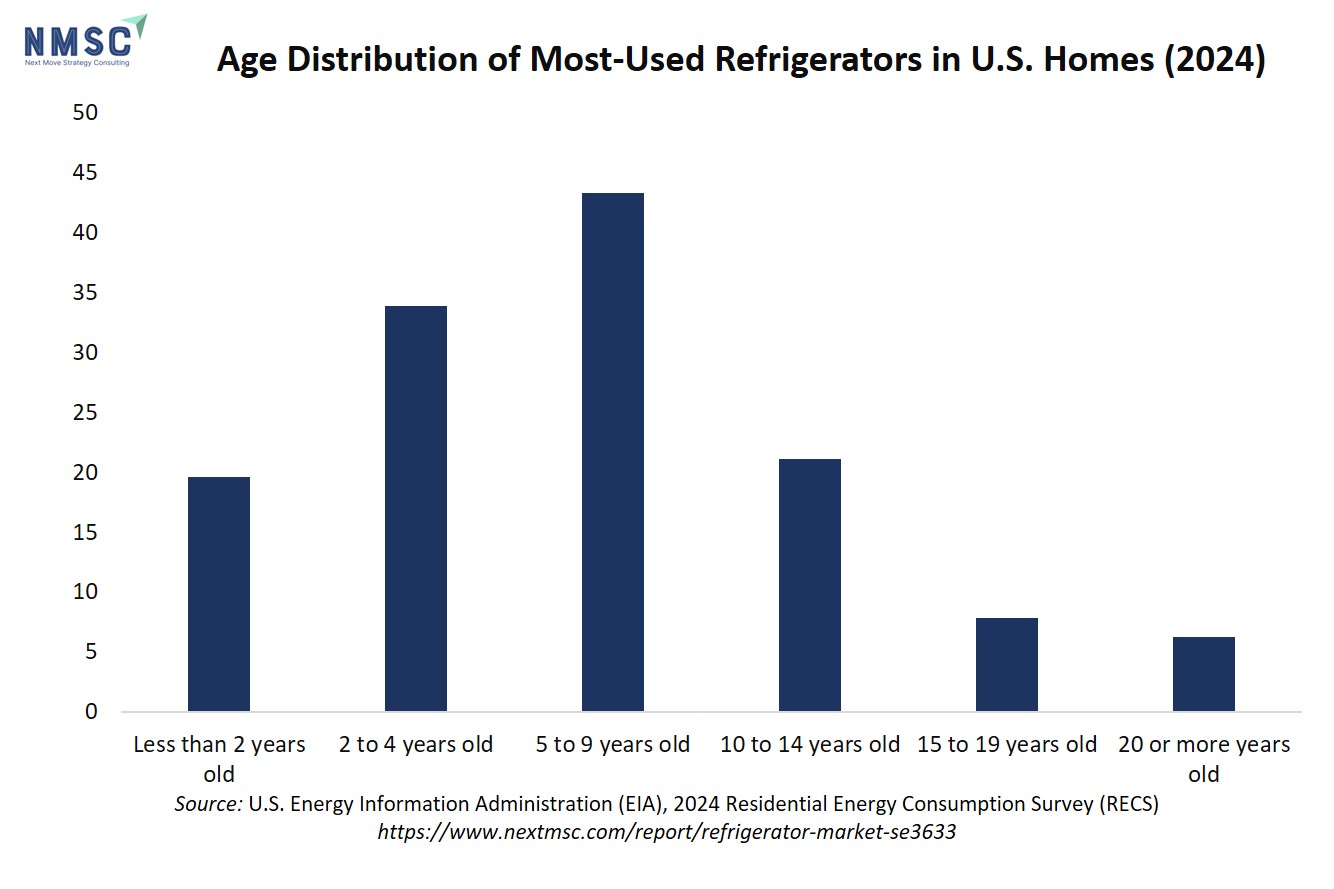
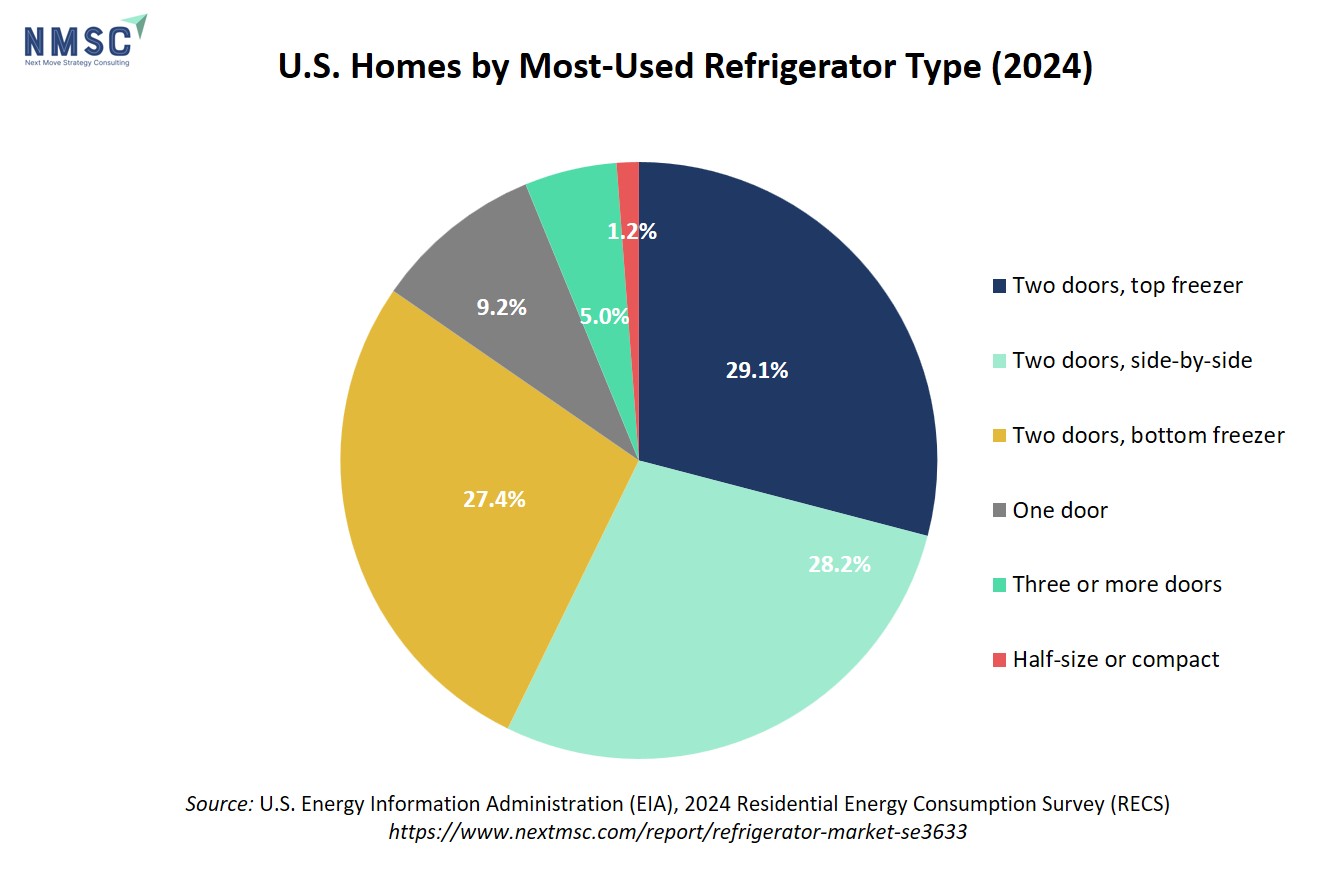
The U.S. Energy Information Administration's 2024 Residential Energy Consumption Survey (RECS) found that there are approximately 132.5 million occupied homes in the United States. Refrigerators account for approximately 7% of total household electricity consumption, making them one of the most energy-intensive always-on appliances in the home. The ENERGY STAR program certifies refrigerators that are approximately 9% more energy efficient than models meeting the federal minimum standard, with certified models saving consumers approximately $150 over a 12-year lifespan.
Supply Chain Restructuring and Tariff Implications
The GE Appliances reshoring initiative reflects a systemic reconfiguration of global appliance supply chains. For the refrigerator market, supply chain restructuring has direct implications for component sourcing, manufacturing lead times, and retail pricing. Manufacturers that successfully localize production in key markets—whether in the United States, India, or the European Union—will be better positioned to absorb tariff shocks and respond more rapidly to regional demand shifts. GE Appliances has already committed over $6.5 billion to U.S. manufacturing since 2016, with the latest $3 billion commitment representing a significant acceleration of that strategy.
Section Summary: The refrigerator market's industry impact is being shaped by three structural forces: urbanization-driven demand growth in emerging markets, regulatory-driven efficiency upgrades in developed markets, and supply chain restructuring in response to trade policy pressures. Together, these forces are redefining competitive advantage in the sector.
Key Takeaways:
-
UN WUP 2025 confirms 57.8% of the world's population lives in urban areas in 2025, with two thirds of future growth concentrated in cities.
-
Seven high-growth countries are projected to add 500+ million city residents by 2050, representing the refrigerator market's most significant long-term demand opportunity.
-
U.S. refrigerators account for approximately 7% of household electricity consumption across 132.5 million homes, making energy efficiency standards commercially significant.
-
Supply chain reshoring, exemplified by GE Appliances' $3 billion commitment, is becoming a strategic imperative for manufacturers exposed to tariff risk.
Key Data & Statistics
Key Refrigerator Market Indicators by Region and Institution (2025)
|
Indicator |
Value |
Source |
Market Relevance |
|
Global urban population share (national definitions) |
57.8% |
UN WUP 2025 |
Urbanization drives appliance demand |
|
Global city population share (Degree of Urbanization) |
45% of 8.2 billion |
UN WUP 2025 |
Core refrigerator demand base |
|
City population share – Northern Africa & Western Asia |
59.1% |
UN WUP 2025 |
High-growth regional market |
|
City population share – Latin America & Caribbean |
54.0% |
UN WUP 2025 |
Mature urban market |
|
City population share – Eastern & South-Eastern Asia |
47.3% |
UN WUP 2025 |
Largest volume market globally |
|
City population share – Central & Southern Asia |
42.5% |
UN WUP 2025 |
Rapidly urbanizing demand region |
|
City population share – Sub-Saharan Africa |
37.7% |
UN WUP 2025 |
Fastest-growing long-term demand region |
|
U.S. occupied homes (2024) |
132.5 million |
U.S. EIA RECS 2024 |
Scale of U.S. residential market |
|
Refrigerators' share of U.S. household electricity use |
~7% |
U.S. EIA RECS |
Energy efficiency imperative |
|
ENERGY STAR refrigerator efficiency premium |
~9% more efficient |
U.S. DOE / ENERGY STAR |
Regulatory compliance benchmark |
|
Global refrigerator energy use covered by MEPS |
80%+ |
IEA |
Regulatory coverage depth |
|
Electricity savings from MEPS (leading markets) |
~15% of national consumption |
IEA |
Policy effectiveness benchmark |
|
GE Appliances U.S. manufacturing investment |
USD 3 billion (5 years) |
GE Appliances (Aug 2025) |
Supply chain reshoring signal |
Future Outlook & Forecast
Market Size and CAGR Projections
According to Next Move Strategy Consulting (NMSC), the global refrigerator market is projected to grow from USD 114.21 billion in 2025 to USD 154.77 billion by 2030, representing a CAGR of 6.27% over the forecast period. This growth is underpinned by a combination of volume expansion in emerging markets and value expansion through premiumization and smart technology adoption in developed markets.
Urbanization as a Long-Term Demand Catalyst
The UN WUP 2025 projects that cities will account for two thirds of global population growth between 2025 and 2050. The seven countries expected to contribute the most to this growth—India, Nigeria, Pakistan, the Democratic Republic of the Congo, Egypt, Bangladesh, and Ethiopia—are also among the most underserved in terms of modern refrigeration penetration. As urban incomes rise and electricity infrastructure improves in these markets, refrigerator adoption rates are expected to accelerate significantly, providing a durable volume growth engine for the global refrigerator market through 2030 and beyond.
Energy Efficiency as a Competitive Moat
The IEA's analysis indicates that appliance efficiency policies have helped halve the energy consumption of major appliances, including refrigerators, over the past several decades. The IEA further notes that home and building energy management system retrofits, when combined with efficient new appliances, can enable energy savings of 20% to 30%. For refrigerator manufacturers, this creates a clear strategic imperative: energy efficiency is no longer merely a compliance requirement but a primary driver of consumer purchasing decisions and a source of durable competitive advantage. The IEA's Product Efficiency Call to Action, co-led with the UK government, specifically targets doubling the efficiency of residential refrigerator-freezers sold globally by 2030—a target that will reshape product development roadmaps across the industry.
AI and Smart Connectivity: The Next Frontier
The commercial launch of AI-powered refrigerators by Godrej in 2025, combined with similar smart refrigerator initiatives by Samsung (Bespoke AI Family Hub) and LG (SIGNATURE series), signals that artificial intelligence is transitioning from a differentiating feature to a market expectation in the premium segment. As AI inference costs decline and connectivity infrastructure improves globally, smart refrigerator features are expected to cascade into mid-range product tiers over the 2025–2030 forecast period, expanding the addressable market for intelligent refrigeration solutions.
Section Summary: The refrigerator market's future is defined by three converging growth vectors: urbanization-driven volume growth in emerging markets, energy efficiency-driven value growth in regulated markets, and AI-driven premiumization across all segments. NMSC projects the market to reach USD 154.77 billion by 2030 at a 6.27% CAGR.
Key Takeaways:
-
NMSC projects the global refrigerator market to grow from USD 114.21 billion (2025) to USD 154.77 billion (2030) at a 6.27% CAGR.
-
Seven high-growth countries will add 500+ million city residents by 2050, creating the largest untapped refrigerator demand pool globally.
-
IEA data confirms that energy efficiency policies have halved refrigerator energy consumption over recent decades, with a further doubling of efficiency targeted by 2030.
-
AI-powered refrigerators are transitioning from premium differentiators to mainstream market expectations, with commercial launches already underway in India and other major markets.
Next Steps for Stakeholders
For Manufacturers:
-
Accelerate investment in AI-enabled cooling systems and smart energy management features to capture the premium segment and build brand equity ahead of regulatory mandates.
-
Develop a dual-track supply chain strategy that balances domestic manufacturing capacity—for tariff resilience—with cost-competitive sourcing for volume markets in emerging economies.
-
Engage proactively with the DOE and equivalent regulatory bodies in key markets to shape the trajectory of energy efficiency standards and avoid compliance surprises ahead of the 2029–2030 residential standard effective dates.
For Investors:
-
Prioritize exposure to manufacturers with demonstrated AI integration capabilities and strong positions in high-urbanization markets, particularly India, Sub-Saharan Africa, and Southeast Asia.
-
Monitor the GE Appliances reshoring model as a potential template for supply chain restructuring across the broader appliance sector, and assess its implications for domestic manufacturing valuations.
-
Evaluate the regulatory risk profile of portfolio companies relative to the DOE's 2029–2030 residential refrigerator standards timeline and the IEA's 2030 efficiency doubling target.
For Retailers and Distributors:
-
Expand ENERGY STAR-certified product assortments to align with consumer demand for energy-efficient appliances and anticipated regulatory requirements.
-
Develop consumer education programs around AI-powered refrigerator features to support premium product adoption and reduce return rates.
-
Strengthen relationships with manufacturers investing in domestic production to ensure supply chain continuity in a reshoring environment.
For Policymakers:
-
Align national energy efficiency standards with IEA MEPS frameworks to maximize the electricity savings potential of refrigerator efficiency programs.
-
Develop targeted incentive programs for low-income urban households to accelerate the replacement of inefficient refrigerators, particularly in rapidly urbanizing cities across Sub-Saharan Africa and Central and Southern Asia.
Conclusion
The global refrigerator market in 2025 is at the intersection of three powerful structural forces: the reshoring of manufacturing capacity driven by trade policy pressures, the integration of artificial intelligence into core product functionality, and the relentless expansion of urban populations in emerging economies. GE Appliances' $3 billion U.S. manufacturing commitment, Godrej's AI-powered Eon Velvet launch, and the DOE's new energy conservation standards are not isolated events—they are early indicators of a refrigerator market undergoing fundamental transformation.
According to NMSC, the global refrigerator market is projected to grow from USD 114.21 billion in 2025 to USD 154.77 billion by 2030, at a CAGR of 6.27%. This growth will be driven by urbanization-fueled demand in emerging markets, energy efficiency mandates in developed markets, and the premiumization of smart appliance categories globally. For executives and investors seeking to navigate this landscape, the imperative is clear: strategic positioning in the refrigerator market requires simultaneous attention to supply chain resilience, regulatory compliance, and technology-driven product differentiation. Those who act on all three dimensions will be best positioned to capture the market's next growth chapter.
About the Author
 Sanyukta Deb
— Sanyukta Deb is Digital Marketing Team Lead at Next Move Strategy Consulting, where she has led content strategy and technical SEO for the firm's B2B market research publications for over 2 years. Her editorial process translates NextMSC's primary and secondary research — spanning technology, industrial, and consumer sectors — into commercial narratives, backed by search-intent, keyword, and competitive analysis. She brings 5 years of overall experience in digital marketing and content strategy.
Sanyukta Deb
— Sanyukta Deb is Digital Marketing Team Lead at Next Move Strategy Consulting, where she has led content strategy and technical SEO for the firm's B2B market research publications for over 2 years. Her editorial process translates NextMSC's primary and secondary research — spanning technology, industrial, and consumer sectors — into commercial narratives, backed by search-intent, keyword, and competitive analysis. She brings 5 years of overall experience in digital marketing and content strategy.
About the Reviewer
 Debashree Dey
— Debashree Dey is Assistant Manager at Next Move Strategy Consulting, where she supports cross-vertical market content and communications across diverse industries for 6 years. Her professional background includes senior content writing, communications, and published manuscript authorship, with experience developing audience-focused business narratives and maintaining clear, consistent messaging. Her role supports research-led content development and editorial quality across NextMSC publications.
Debashree Dey
— Debashree Dey is Assistant Manager at Next Move Strategy Consulting, where she supports cross-vertical market content and communications across diverse industries for 6 years. Her professional background includes senior content writing, communications, and published manuscript authorship, with experience developing audience-focused business narratives and maintaining clear, consistent messaging. Her role supports research-led content development and editorial quality across NextMSC publications.


















Add Comment