Nanotechnology Market Statistics, Trends & Forecasts for 2026

Introduction
At a scale one billionth of a meter, nanotechnology is rewriting the rules of modern industry. From solid-state batteries that power the next generation of electric vehicles to nanoscale sensors embedded in medical diagnostics, the nanotechnology market has evolved from a niche scientific discipline into a foundational pillar of the global economy. As of 2026, the convergence of accelerating government investment, landmark institutional reviews, and breakthrough laboratory discoveries is reshaping the competitive landscape for investors, manufacturers, and policymakers alike.
The Nanotechnology Market is no longer a future-facing concept — it is a present-day commercial reality with measurable economic impact. According to Next Move Strategy Consulting (NMSC), the global nanotechnology market is projected to reach USD 3.31 billion by 2030, expanding at a compound annual growth rate (CAGR) of 10.1% from 2020 to 2030. This trajectory is being driven by a powerful combination of miniaturization demands, rising healthcare adoption, and surging public-sector commitment to nanotechnology infrastructure — all of which are examined in depth throughout this report.
For More Information: Download FREE Sample on Nanotechnology Market Report
A Pivotal Inflection Point: Landmark Institutional Actions Reshaping the Nanotechnology Market
The National Academies' 2025 Quadrennial Review: A Call to Action
In May 2025, the National Academies of Sciences, Engineering, and Medicine released one of the most consequential institutional assessments of nanotechnology in recent history: the Quadrennial Review of the National Nanotechnology Initiative (2025): Securing U.S. Global Leadership Through Renewed and Expanded Infrastructure. The report delivered an unambiguous message — the United States must act decisively to shore up its nanotechnology investment or risk ceding global leadership in a field with trillion-dollar commercial implications.
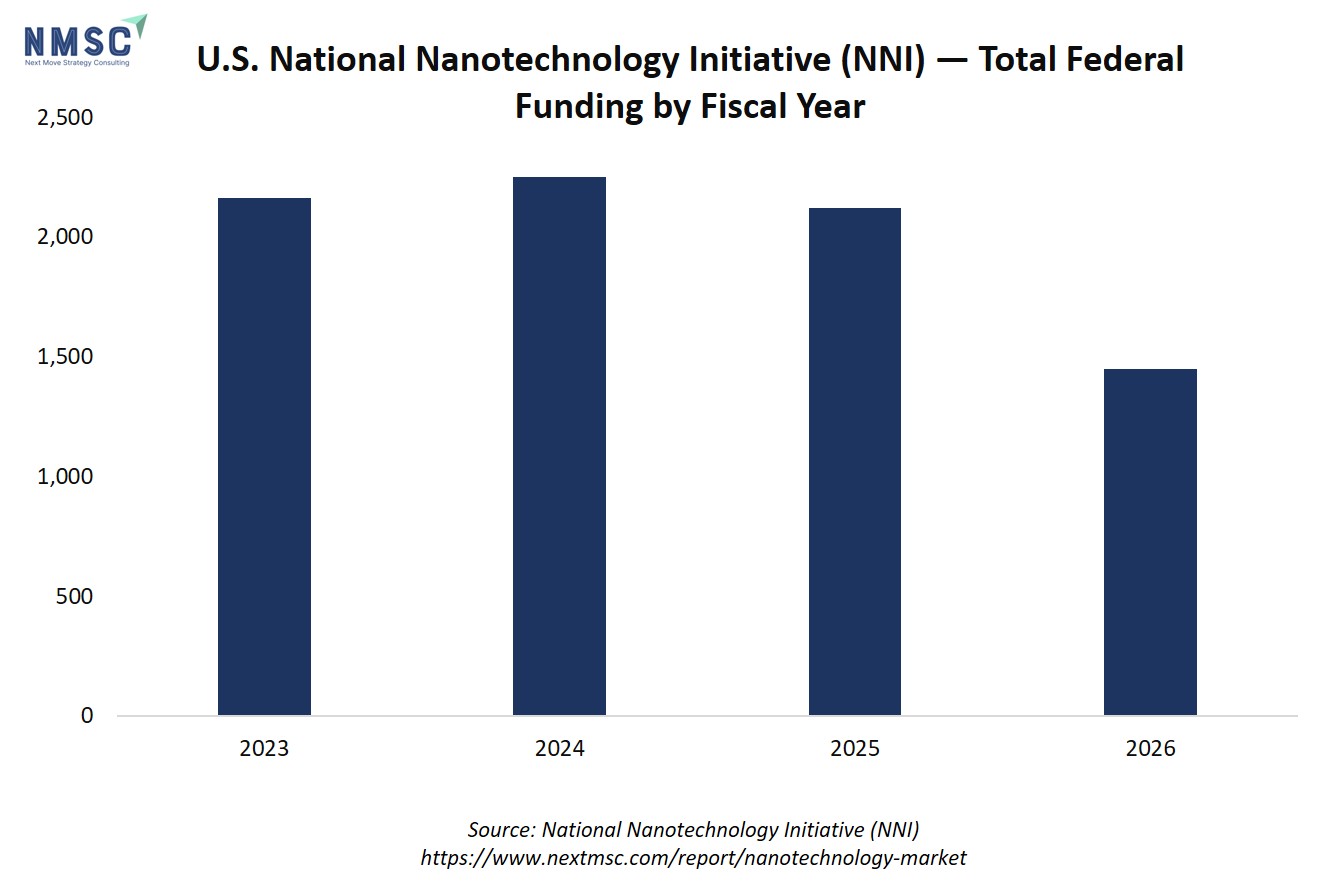
The report documented that the National Nanotechnology Initiative's (NNI) investments from 2002 to 2022 totaled approximately USD 40 billion, while the aggregated revenue of private nanotechnology companies reached nearly USD 1 trillion during that same period — a return profile that underscores the extraordinary leverage of public investment in this sector. As of 2024, total cumulative federal investment in nanotechnology through the NNI exceeded USD 43 billion.
The National Academies recommended that Congress reauthorize the NNI and reorient it as a National Nanotechnology Infrastructure — a structural shift that would expand shared facilities, instruments, and expert networks available to academic, government, and industry researchers. The report specifically identified nanotechnology's critical role in enabling advances in artificial intelligence, quantum computing, crop resilience, and advanced therapeutics.
Breakthrough Discoveries Validating the Investment Case
The institutional momentum has been matched by a series of high-impact laboratory breakthroughs in 2026. In May 2026, researchers at Argonne National Laboratory, funded by the U.S. Department of Energy, demonstrated a method to significantly boost solid-state battery energy density and longevity by forming nanoscale lithium halides through a process called "halide segregation," which enhances lithium-ion movement at the nanoscale. This discovery has direct implications for the electric vehicle and grid-scale energy storage industries, both of which are among the most capital-intensive sectors globally.
In April 2026, researchers at Brookhaven National Laboratory, also funded by the U.S. Department of Energy, built superconducting quantum interference devices (SQUIDs) using silicon-compatible transition metal silicides — a development that opens a silicon-compatible path toward scalable quantum computing systems. These breakthroughs illustrate how nanotechnology is functioning as the enabling layer beneath multiple high-growth technology sectors simultaneously.
EU Regulatory Advancement: New OECD Safety Guidance for Nanomaterials
On the regulatory front, December 2025 marked a significant milestone when the European Commission's Joint Research Centre (JRC), in collaboration with the OECD, published updated guidance on sample preparation and dosimetry for the safety testing of manufactured nanomaterials. This guidance — the first comprehensive update since 2012 — reflects over a decade of new scientific knowledge and is designed to ensure that nanomaterial production and application is safe for both humans and the environment.
The JRC guidance is positioned within the broader EU policy context, including the Chemicals Strategy for Sustainability, the EU Competitiveness Compass, the European Green Deal, and the EU's new life sciences strategy — all of which identify nanotechnology as a strategic enabler. The publication of this guidance is expected to accelerate the commercialization of nanomaterials by providing industry with clearer, internationally harmonized testing protocols.
NMSC Strategic Perspective: Interpreting the Institutional Shift
From Next Move Strategy Consulting's analytical standpoint, the convergence of the National Academies' infrastructure mandate, the DOE-funded laboratory breakthroughs, and the EU-OECD regulatory harmonization represents a structural inflection point for the nanotechnology market. These are not isolated events — they reflect a coordinated, multi-jurisdictional recognition that nanotechnology has transitioned from a research-stage technology to a commercially critical infrastructure layer.
NMSC analysts observe that the NNI's reorientation toward infrastructure — if enacted by Congress — would materially reduce the cost and time-to-market for nanotechnology-enabled products, particularly in the healthcare, energy, and semiconductor sectors. Simultaneously, the EU's updated safety guidance reduces regulatory uncertainty for manufacturers seeking to commercialize nanomaterials across European markets. For institutional investors and C-suite decision-makers, these developments collectively signal that the risk-adjusted return profile of nanotechnology investments is improving, and that the window for strategic positioning is narrowing.
Key Takeaways:
-
The NNI's 2002–2022 investments of ~USD 40 billion generated nearly USD 1 trillion in private nanotechnology company revenues, demonstrating exceptional public investment leverage.
-
Argonne National Laboratory's May 2026 nanoscale battery breakthrough directly advances the commercial viability of solid-state energy storage.
-
The EU JRC/OECD's December 2025 safety guidance update is expected to accelerate nanomaterial commercialization by harmonizing global testing standards.
-
NMSC views the convergence of these institutional actions as a structural inflection point that materially improves the investment case for nanotechnology.
Industry Impact Analysis
Healthcare: Nanotechnology as a Therapeutic Frontier
The healthcare sector represents one of the most consequential application domains for the nanotechnology market. Nanotechnology enables targeted drug delivery, advanced medical imaging, and the development of RNA nanotherapeutics — capabilities that are fundamentally altering the economics of pharmaceutical development. The National Cancer Institute's ongoing Translational Nanotechnology Cancer Initiative (TTNCI) continues to fund advanced pre-clinical research into nanotechnology-based cancer therapeutics, reflecting the U.S. government's sustained commitment to nano-enabled medicine.
The increasing adoption of nanotechnology in medical imaging, wearable diagnostics, and nano-sensor-equipped devices is a primary growth driver identified in NMSC's market analysis. North America's dominance in the global nanotechnology market is substantially attributable to the region's advanced healthcare infrastructure and the high penetration of nanotechnology in medical applications.
Electronics and Semiconductors: The Miniaturization Imperative
The electronics sector is the largest application segment within the nanotechnology market, driven by the relentless demand for miniaturization in consumer electronics, telecommunications, and semiconductor manufacturing. Nanochips, nanoscale sensors, and nano-electronics are enabling the development of devices that are simultaneously more powerful, lighter, and more energy-efficient than their predecessors. The NNI's investments have been particularly impactful in the microelectronics domain, where nanotechnology has enabled the fabrication of semiconductors at scales that were previously considered physically impossible.
Energy: Nanotechnology Enabling the Clean Energy Transition
The energy sector is emerging as one of the highest-growth application areas for nanotechnology. The Argonne National Laboratory's May 2026 discovery of nanoscale lithium halide formation to enhance solid-state battery performance is a direct example of how nanotechnology is enabling the clean energy transition. Carbon nanotubes are already being used to enhance the performance of lithium-ion batteries for electric vehicles, and the regulatory and commercial ecosystem around nano-enabled energy storage is rapidly maturing.
Regulatory Complexity: A Double-Edged Dynamic
The evolving regulatory landscape for nanomaterials presents both opportunities and challenges for market participants. A comprehensive 2025 review published in Frontiers in Toxicology by researchers from the EU JRC and the OECD documented that while significant progress has been made in developing regulatory test guidelines for nanomaterials over the past 25 years, important gaps remain — particularly in the areas of alternative test methods, FAIR (Findable, Accessible, Interoperable, and Reusable) data availability, and analytical tools for quantifying nanomaterials in complex environmental matrices.
The OECD's Working Party on Manufactured Nanomaterials (WPMN) has developed multiple nano-specific test guidelines and guidance documents, and the ongoing update of the OECD guidance on grouping of nanomaterials — which now includes specific guidance for nanomaterial grouping — is expected to significantly reduce the regulatory burden for manufacturers seeking to commercialize new nanomaterial variants.
Asia-Pacific: The Fastest-Growing Regional Market
Asia-Pacific is positioned as the fastest-growing regional market for nanotechnology, driven by surging clinical research activity, increasing product launches by regional market players, and rising investments from both public and private sectors in cutting-edge nanotechnology development. Countries including China, India, Japan, and South Korea are making substantial commitments to nanotechnology R&D, creating a competitive dynamic that is accelerating global innovation cycles.
Key Takeaways:
-
Healthcare and electronics remain the two dominant application segments, with energy emerging as the highest-growth area driven by nano-enabled battery technology.
-
The OECD's expanding library of nano-specific test guidelines is progressively reducing regulatory uncertainty for manufacturers.
-
Asia-Pacific's accelerating investment in nanotechnology R&D is creating new competitive pressures for established North American and European market leaders.
-
Regulatory gaps in alternative test methods and FAIR data availability remain material risks for companies seeking rapid commercialization.
Key Institutional Milestones and Policy Developments — Nanotechnology Market (2025–2026)
|
Event |
Institution |
Date |
Market Significance |
|
Quadrennial Review of the NNI: Securing U.S. Global Leadership |
National Academies of Sciences, Engineering, and Medicine |
May 2025 |
Recommends NNI reauthorization and infrastructure expansion; validates long-term investment case |
|
Updated OECD Guidance on Nanomaterial Safety Testing |
EU JRC / OECD |
December 2025 |
Harmonizes global testing standards; accelerates commercialization pathways |
|
Argonne National Laboratory Solid-State Battery Breakthrough |
U.S. Department of Energy |
May 2026 |
Demonstrates nano-enabled energy density improvements; advances EV battery supply chain |
|
Brookhaven National Laboratory Quantum Systems Breakthrough |
U.S. Department of Energy |
April 2026 |
Opens silicon-compatible path to scalable quantum computing via nanotechnology |
|
NNI Supplement to the President's 2026 Budget |
National Nanotechnology Coordination Office (NNCO) |
2026 |
Outlines federal nanotechnology investment priorities and cross-agency coordination |
|
NSF 2026 Graduate Research Fellowship Program |
U.S. National Science Foundation |
April 2026 |
2,500 fellowships awarded, supporting next-generation nanotechnology research talent pipeline |
Future Outlook & Forecast
NMSC Market Forecast: Sustained Growth Through 2030
According to Next Move Strategy Consulting, the global nanotechnology market is projected to reach USD 3.31 billion by 2030, growing at a CAGR of 10.1% from 2020 to 2030. This growth trajectory is underpinned by several structural drivers: the augmentation of miniaturization across consumer electronics and industrial applications, the growing demand for lightweight portable devices, the increasing adoption of smart wearable devices equipped with nanosensors, and the expanding role of nanotechnology in the medical sector.
The nano devices segment — encompassing nanomanipulators, nanomechanical test instruments, and nanoscale infrared spectrometers — and the nanosensors segment — including optical, biological, chemical, and physical nanosensors — are both expected to contribute meaningfully to this growth. The healthcare application segment is anticipated to be a particularly significant growth driver, given the accelerating adoption of nanotechnology in drug delivery, diagnostics, and medical imaging.
The AI-Nanotechnology Convergence
One of the most consequential long-term trends shaping the nanotechnology market is the convergence of nanotechnology with artificial intelligence. The National Academies' 2025 report explicitly identified AI as a domain where expanded nanotechnology infrastructure is essential — noting that the U.S. will need to fully leverage its existing nanotechnology capabilities to capitalize on advances in AI and quantum computing. AI-driven materials discovery is already accelerating the identification of novel nanomaterials with targeted properties, compressing R&D timelines and reducing development costs.
Safe and Sustainable by Design: The Governance Imperative
The future of the nanotechnology market will be shaped not only by technological capability but by governance frameworks. The EU's Safe and Sustainable by Design (SSbD) concept — embedded within the Chemicals Strategy for Sustainability and the European Green Deal — is establishing a new standard for how nanomaterials are developed and commercialized. The OECD's complementary Safe(r) and Sustainable Innovation Approach (SSIA) for nanotechnology is promoting early dialogue between innovators and regulators, reducing the risk of costly late-stage regulatory interventions.
These governance frameworks are not merely compliance requirements — they represent a competitive differentiator. Companies that embed SSbD principles into their nanotechnology development processes will be better positioned to access EU markets, attract ESG-aligned institutional capital, and build durable brand equity with regulators and end-users.
High-Deployment Sectors: Energy Storage and Quantum Computing
The energy storage and quantum computing sectors are expected to be among the highest-growth deployment areas for nanotechnology through 2030 and beyond. The Argonne solid-state battery breakthrough and the Brookhaven quantum systems development both point to a near-term commercialization horizon for nano-enabled applications in these sectors. The electric vehicle market's continued expansion will sustain demand for nano-enabled battery materials, while quantum computing's progression toward commercial viability will create entirely new demand categories for precision nanofabrication.
Section Summary: The nanotechnology market is on a sustained growth trajectory through 2030, driven by healthcare adoption, electronics miniaturization, energy storage innovation, and the convergence with AI and quantum computing. Governance frameworks are evolving to support responsible commercialization at scale.
Key Takeaways:
-
NMSC projects the global nanotechnology market to reach USD 3.31 billion by 2030 at a CAGR of 10.1%, with healthcare and energy as the highest-growth application segments.
-
The convergence of nanotechnology with AI and quantum computing is creating new, high-value application categories that extend well beyond the current forecast horizon.
-
The EU's SSbD framework and the OECD's SSIA are establishing governance standards that will increasingly function as market access requirements for global nanotechnology companies.
-
Energy storage — particularly nano-enabled solid-state batteries — is emerging as a near-term commercial deployment priority with direct linkage to the global EV market.
Next Steps for Stakeholders
For C-Level Executives and Corporate Strategy Teams:
1. Conduct a nanotechnology infrastructure audit. Assess your organization's current exposure to nanotechnology-enabled supply chains, particularly in electronics, healthcare, and energy storage. Identify where nanotechnology represents either a competitive advantage or a supply chain vulnerability.
2. Engage proactively with the evolving regulatory landscape. The EU JRC/OECD's updated safety guidance and the SSbD framework are establishing new baseline requirements for nanomaterial commercialization. Organizations that engage with regulators early — rather than reactively — will reduce time-to-market and compliance costs.
3. Evaluate strategic positioning in the energy storage value chain. The Argonne National Laboratory's solid-state battery breakthrough signals that nano-enabled energy storage is approaching commercial viability. Companies in the EV, grid storage, and consumer electronics sectors should assess their exposure to this transition and consider strategic partnerships or acquisitions in the nano-materials space.
4. Monitor the NNI reauthorization process. If Congress acts on the National Academies' recommendation to reauthorize and expand the NNI as a National Nanotechnology Infrastructure, the resulting expansion of shared research facilities will materially reduce R&D costs for companies with access to these resources. Early engagement with the NNCO and relevant federal agencies can position organizations to benefit from this infrastructure expansion.
For Institutional Investors:
5. Reassess nanotechnology sector allocations in light of the institutional validation cycle. The National Academies' report, the DOE-funded breakthroughs, and the EU regulatory harmonization collectively represent a significant de-risking of the nanotechnology investment thesis. Portfolio managers should review sector weightings accordingly.
6. Prioritize companies with demonstrated SSbD and regulatory compliance capabilities. As governance frameworks tighten globally, companies with embedded safe-by-design processes will command premium valuations and face lower regulatory risk. ESG-aligned investors should treat SSbD compliance as a material investment criterion.
7. Focus on Asia-Pacific nanotechnology exposure. The region's accelerating public and private investment in nanotechnology R&D, combined with its manufacturing scale advantages, positions it as a high-growth opportunity for investors with appropriate risk tolerance and geographic diversification mandates.
Conclusion
The nanotechnology market in 2026 is defined by a rare alignment of institutional validation, breakthrough scientific discovery, and regulatory maturation. The National Academies' landmark infrastructure report, the DOE-funded advances in solid-state batteries and quantum systems, and the EU-OECD's updated safety guidance collectively signal that nanotechnology has crossed a critical threshold — from a promising research domain to a commercially indispensable technology layer.
According to Next Move Strategy Consulting, the global nanotechnology market is projected to reach USD 3.31 billion by 2030, growing at a CAGR of 10.1% from 2020 to 2030, with North America maintaining market leadership and Asia-Pacific emerging as the fastest-growing region. The market's growth is being driven by expanding applications across healthcare, electronics, energy, and aerospace — sectors that collectively represent the backbone of the global economy.
For executives and investors, the strategic imperative is clear: nanotechnology is not a peripheral technology trend to be monitored from a distance. It is a foundational capability that will determine competitive positioning across multiple industries over the next decade. Organizations that invest in understanding, adopting, and governing nanotechnology today will be materially better positioned to capture the value this market will generate through 2030 and beyond.
About the Author
 Sanyukta Deb
— Sanyukta Deb is Digital Marketing Team Lead at Next Move Strategy Consulting, where she has led content strategy and technical SEO for the firm's B2B market research publications for over 2 years. Her editorial process translates NextMSC's primary and secondary research — spanning technology, industrial, and consumer sectors — into commercial narratives, backed by search-intent, keyword, and competitive analysis. She brings 5 years of overall experience in digital marketing and content strategy.
Sanyukta Deb
— Sanyukta Deb is Digital Marketing Team Lead at Next Move Strategy Consulting, where she has led content strategy and technical SEO for the firm's B2B market research publications for over 2 years. Her editorial process translates NextMSC's primary and secondary research — spanning technology, industrial, and consumer sectors — into commercial narratives, backed by search-intent, keyword, and competitive analysis. She brings 5 years of overall experience in digital marketing and content strategy.
About the Reviewer
 Debashree Dey
— Debashree Dey is Assistant Manager at Next Move Strategy Consulting, where she supports cross-vertical market content and communications across diverse industries for 6 years. Her professional background includes senior content writing, communications, and published manuscript authorship, with experience developing audience-focused business narratives and maintaining clear, consistent messaging. Her role supports research-led content development and editorial quality across NextMSC publications.
Debashree Dey
— Debashree Dey is Assistant Manager at Next Move Strategy Consulting, where she supports cross-vertical market content and communications across diverse industries for 6 years. Her professional background includes senior content writing, communications, and published manuscript authorship, with experience developing audience-focused business narratives and maintaining clear, consistent messaging. Her role supports research-led content development and editorial quality across NextMSC publications.


















Add Comment