Airport Baggage Handling System Market: Why New Hubs Go Automated | NextMSC
Introduction
On October 25, 2026, Western Sydney International (Nancy-Bird Walton) Airport opened to passengers, and Jetstar flight JQ362 to the Gold Coast became its first commercial departure, according to ABC News (October 25, 2026). The airport operates around the clock. Its chief executive, Simon Hickey, told ABC News that the terminal is about the size of Adelaide Airport, sized for roughly 10 million passengers a year, with capacity to grow toward 82 million in the 2060s. Many of those travellers will check a bag, so the baggage system had to be installed, trialled and ready on opening day.
According to Next Move Strategy Consulting's Airport Baggage Handling System Market report, the global airport baggage handling system market was valued at USD 8.4 billion in 2025 and is projected to reach USD 24.51 billion by 2035, growing at a CAGR of 11.3% from 2026 to 2035. NextMSC primary research and analysis places the 2026 value at USD 9.35 billion and attributes the strongest growth to greenfield airport construction, security screening upgrades and a shift from hardware-only contracts toward software and services.
For More Information: Download FREE Sample on Airport Baggage Handling System Market Report
This analysis connects three kinds of evidence from the past six months. Launch milestones at Western Sydney, Noida and Long Thanh show where capital is being committed. The SITA 2026 Baggage IT Insights report and the June 2026 outlook from the International Air Transport Association (IATA) show what airlines can afford to pay for. NextMSC segment research then shows how those signals convert into revenue for vendors across the airport baggage handling system market.
Western Sydney, Noida and Long Thanh: How 2026's Airport Launches Are Rewriting Baggage System Demand
Western Sydney International: A Greenfield Terminal Built to Grow Into Its Capacity
Reuters reported on June 10, 2026 that Qantas and its low-cost arm Jetstar would launch passenger services when the airport opened on October 25, which fixed the date by which the baggage system had to be proven. ABC News (October 25, 2026) added that cargo operations began in July, that about 10,000 workers helped build the airport and that Hickey does not expect it to start at 10 million passengers a year but to grow into that level by the early to mid 2030s. NextMSC's assessment is that a terminal growing into its capacity needs a baggage system that performs at low volume from day one and scales without rebuilding. NextMSC primary research and analysis shows greenfield contracts growing faster by value than any other project type in the airport baggage handling system market, at a CAGR of 13.6%, from USD 2.77 billion in 2025 to USD 8.74 billion in 2035.
Noida International Airport: India's Greenfield Pipeline Moves From Plans to Passengers
Business Standard reported on June 13, 2026 that commercial flights at Noida International Airport in Jewar would begin on June 15, with IndiGo operating the first services. Outlook Traveller (June 2026) described an initial phase of one runway and one terminal designed for up to 12 million travellers a year, and noted that weeks of uncertainty over regulatory approvals had preceded the launch. For vendors, India matters because NextMSC primary research and analysis identifies it as the fastest-growing individual country market, supported by Airports Authority of India modernisation, new greenfield commissions and mandatory screening upgrades. Asia-Pacific as a whole is forecast by NextMSC to grow from USD 1.93 billion in 2025 to USD 7.88 billion in 2035, a CAGR of 16.9%, the fastest of any region.
Long Thanh International Airport: Baggage Systems Installed Ahead of the December Opening
Vietnam News Agency (VNA) reported on August 2, 2026 that, according to the Airports Corporation of Vietnam, installation of the baggage handling system, steel floor structures and individual carrier system conveyor at Long Thanh International Airport was complete. Ten explosive detection system scanners had been connected to the conveyor, all 19 customs baggage scanners for arriving passengers were installed, and contractors were running inspections and functional tests before the system went into operation. Vietnam Plus (October 2026) reported that commercial operations are scheduled to begin on December 24. The sequence shows how baggage infrastructure is delivered on a greenfield project: conveyors, screening and tracking are installed and tested as one integrated system months before the first revenue flight, which is why NextMSC primary research and analysis treats end-to-end turnkey contracts as the largest single-contract opportunity for vendors.
SITA 2026 Baggage IT Insights: What Bag Loss Costs the Airport Baggage Handling System Market
SITA released its 2026 Baggage IT Insights report on June 29, 2026 and supplied the demand-side evidence. The global mishandled baggage rate fell 23% in 2025 and the number of mishandled bags fell 19% to 24 million, while passenger numbers reached 5 billion. Mishandling still cost the industry USD 6.3 billion, or an average of USD 260 per bag, which SITA set against average airline net profit of USD 8 per passenger. Nicole Hogg, Portfolio Director Baggage at SITA, said in the June 29, 2026 release that "Baggage is shifting from a logistical problem to a digital service." SITA also reported that a lost bag costs USD 635, against USD 245 for a delayed bag, which explains why airlines now treat prevention as a budget line rather than a service goal.
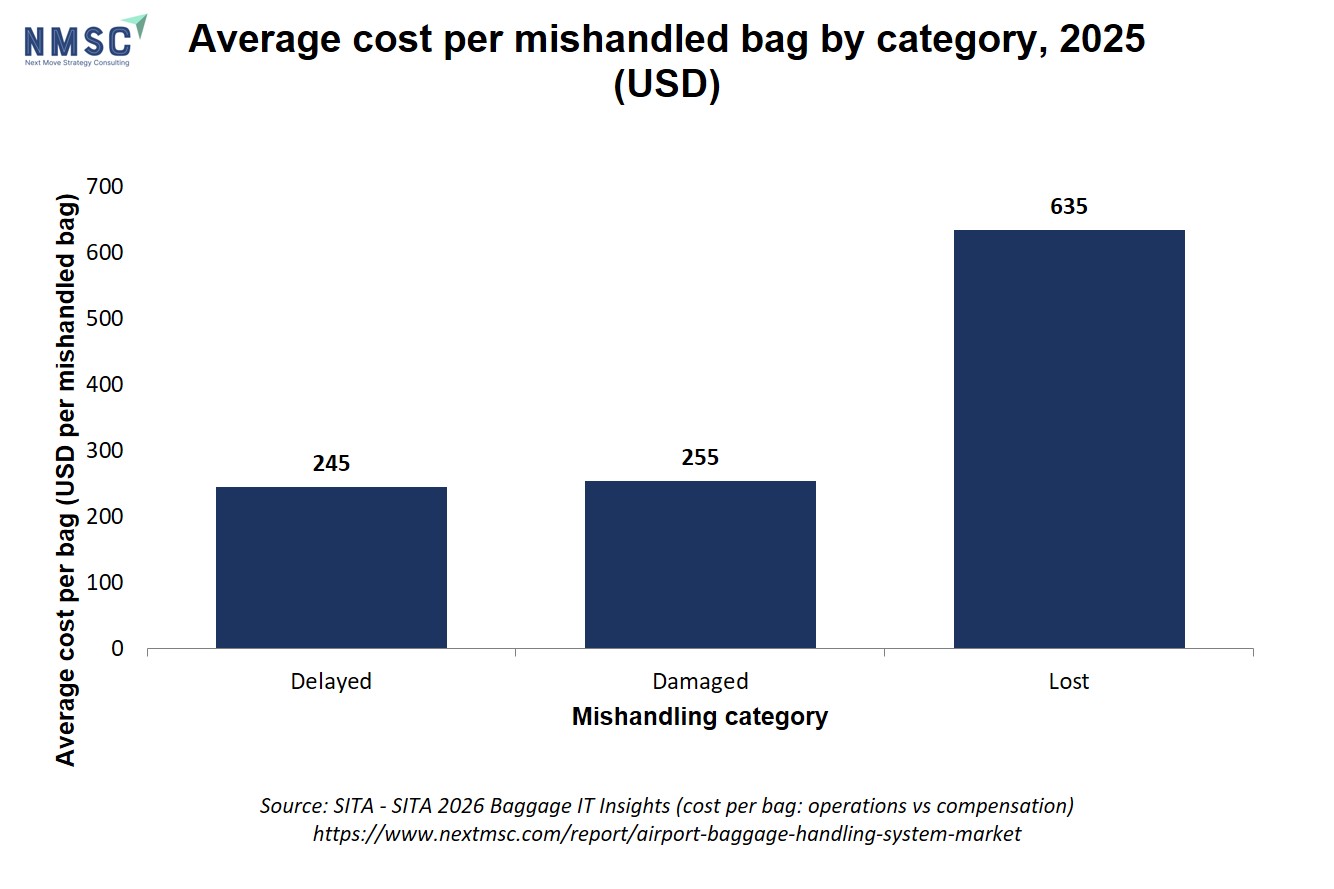
SITA's 2026 Baggage IT Insights reports the average cost of a mishandled bag by category: USD 245 for a delayed bag, USD 255 for a damaged bag and USD 635 for a lost bag. A delayed bag costs USD 170 in operations and USD 75 in compensation, a damaged bag USD 85 and USD 170, and a lost bag USD 215 and USD 420. SITA sets the global average at USD 260 per mishandled bag.
NMSC Strategic Perspective: Why Greenfield Deadlines and Tracking Mandates Now Set the Pace
NextMSC primary research and analysis reads these four developments as a single demand signal rather than four separate stories. Greenfield airports in Australia, India and Vietnam fix delivery dates by the opening of the terminal, which makes the baggage system a critical-path item and favours vendors with proven reference sites. NMSC's model shows greenfield contracts rising from USD 2.77 billion in 2025 to USD 8.74 billion in 2035, while retrofit work, which covers computed tomography scanner integration and RFID overlays at existing airports, grows at 11.3%.
The second signal is the shift from machinery to data. SITA's finding that transfers still cause 39% of mishandled bags points to where tracking is thinnest, and NextMSC primary research and analysis shows software growing at a CAGR of 15.2%, from USD 1.51 billion in 2025 to USD 5.40 billion in 2035, against 10.9% for hardware. Our assessment is that vendors able to sell tracking, reconciliation and analytics on top of installed conveyors and sorters will capture a rising share of each project's lifetime value, because airlines can now price a failed transfer at USD 260 per bag.
The third signal is regulatory. NextMSC primary research and analysis indicates that computed tomography screening is the fastest-growing screening technology in the market and that every deployment brings conveyor integration, software interfaces and operator training with it. Screening mandates therefore feed baggage system revenue directly rather than sitting in a separate budget.
Section Summary:
-
Three airport launches and one benchmark report show that delivery dates and measurable bag-loss costs now drive procurement.
-
Western Sydney International opened to passengers on October 25, 2026, with a terminal sized for about 10 million passengers a year.
-
Noida International Airport began commercial flights on June 15, 2026, and Long Thanh's baggage system was installed ahead of its December 24 target.
-
SITA put the cost of mishandled baggage at USD 6.3 billion in 2025, or USD 260 per bag, which strengthens the case for tracking and automation.
Industry Impact Analysis
IATA's June 2026 Outlook: Thinner Airline Margins Meet Rising Baggage Expectations
At its 82nd Annual General Meeting in Rio de Janeiro, the International Air Transport Association (IATA) halved its 2026 airline net profit forecast to USD 23 billion from USD 45 billion in 2025, cutting the net margin to 2.0% from 4.2%, as Reuters reported on June 7, 2026. IATA expects net profit per passenger to fall to USD 4.50 from USD 9.10 even as airlines carry a record 5.1 billion passengers, 2.4% more than in 2025. Jet fuel is forecast to average USD 152 per barrel, almost 70% above 2025, and Middle East carriers are forecast to post a net loss of USD 4.3 billion. SITA's own comparison puts the USD 6.3 billion cost of mishandled bags at the equivalent of 15% of airline industry profit in 2025. NextMSC's assessment is that thinner margins push airlines toward co-funding tracking and self-service bag drop, which cut mishandling directly, rather than toward funding conveyor capacity that airports own.
ACI World Traffic Data: Record Volumes in Asia-Pacific, Disruption in the Middle East
Airports Council International (ACI) World reported in September 2026 that global airports handled a record 9.8 billion passengers in 2025. Asia-Pacific traffic grew 5.1% and North America fell 0.7%, while Middle East traffic fell 21% in 2026 to date as conflict and airspace disruption took hold. NextMSC primary research and analysis shows how those regional paths translate into baggage system spending. North America held USD 2.86 billion, or 34.0% of 2025 revenue, driven by screening upgrades and hub capacity work, while Asia-Pacific and Europe each recorded USD 1.93 billion in 2025 but are forecast to reach USD 7.88 billion and USD 5.37 billion respectively by 2035. The Middle East adds timing risk, because NextMSC treats Gulf megaprojects as the largest concentrated greenfield opportunity through 2035, and traffic disruption can delay the capital programmes behind them.
IATA Resolution 753: How Tracking Mandates Reshape the Airport Baggage Handling System Market
SITA reported on June 29, 2026 that industry-wide baggage tracking under IATA Resolution 753 has passed 50%, with full compliance targeted for 2027. The resolution requires tracking at check-in, loading, transfer and arrival, and transfers remain the largest single cause of mishandling at 39% of cases. NextMSC primary research and analysis identifies RFID as the leading identification technology in the airport baggage handling system market and values the software segment, which includes control, tracking, reconciliation and analytics platforms, at USD 1.51 billion in 2025. A compliance target one year after the halfway mark compresses purchasing: airports and airlines that have not equipped transfer points must buy read points, middleware and reconciliation software inside that window rather than across the full forecast period. SITA also credited AI routing, biometric bag drop and connected passenger devices for the 2025 improvement, which keeps analytics and integration software at the centre of vendor roadmaps.
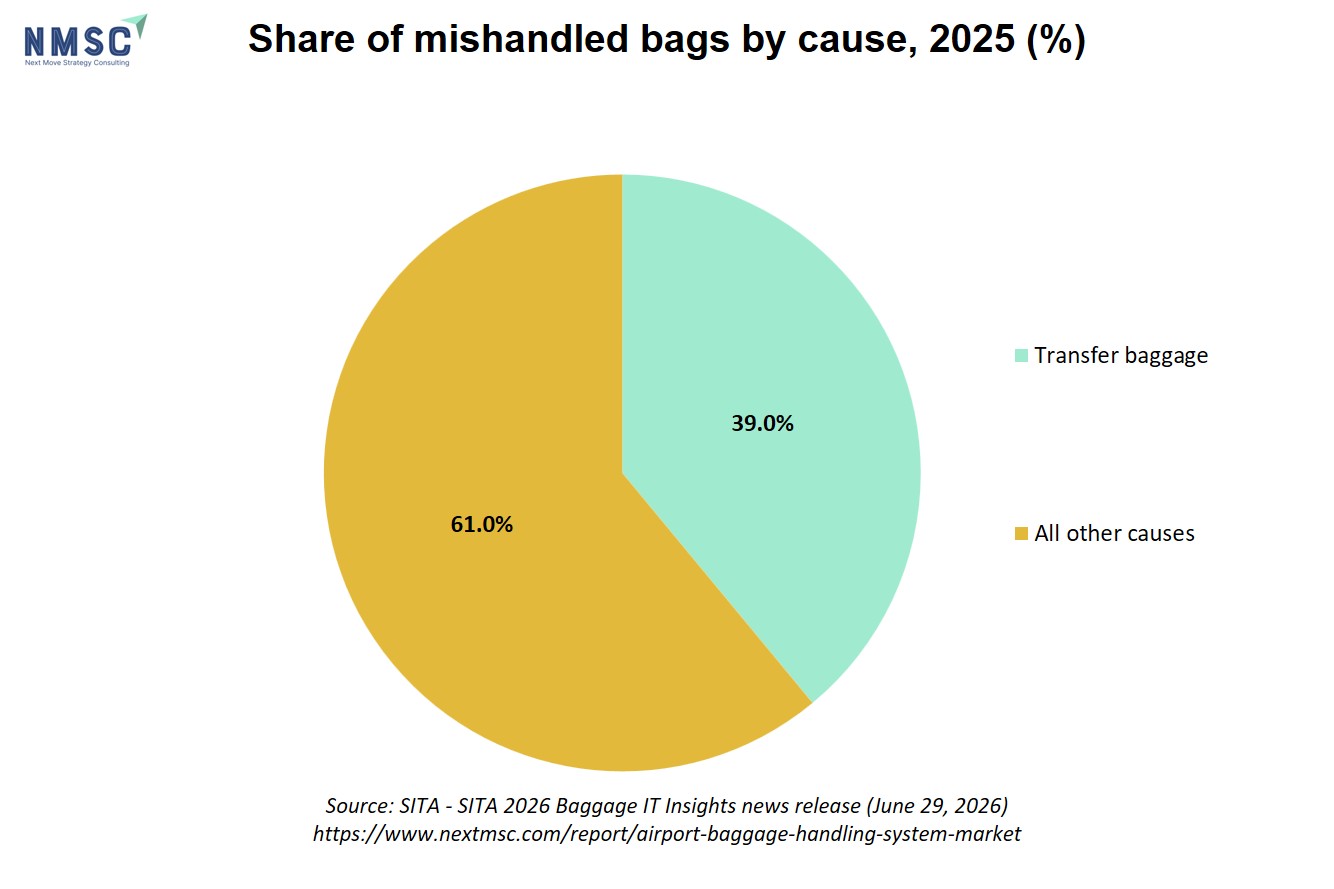
SITA's June 29, 2026 news release states that transfers caused 39% of mishandled bags in 2025, down from 41% the year before. The remaining 61% is the balance of all other causes, calculated as 100% minus the reported transfer share.
Retrofit and Brownfield Work: Where Existing Airports Place Their Budgets
Not every airport buys a new terminal. NextMSC primary research and analysis shows brownfield projects, which expand operating airports, rising from USD 2.44 billion in 2025 to USD 7.11 billion in 2035 at a CAGR of 11.9%, retrofit work rising from USD 2.10 billion to USD 5.88 billion at 11.3%, and replacement contracts rising from USD 1.09 billion to USD 2.78 billion at 11.0%. These project types carry integration risk that greenfield builds avoid. NextMSC primary research and analysis reports cost overruns of 20% to 30% on brownfield integrations, caused by undocumented legacy interfaces, and observes that the lack of open standards across departure control, baggage control and reconciliation platforms forces vendors to write proprietary adaptors, which extends timelines. The 2026 launches therefore describe only part of the demand picture: greenfield contracts set the headline growth rate, while retrofit and replacement work at pre-2010 airports supplies the services revenue that NextMSC expects to anchor vendor earnings.
Section Summary:
Airline margins, traffic geography and tracking deadlines now shape who pays for baggage systems and when.
-
IATA forecasts USD 23 billion of airline net profit in 2026, down from USD 45 billion in 2025.
-
Brownfield, retrofit and replacement work grows at 11.0% to 11.9% a year, with integration risk that greenfield builds avoid.
-
ACI World recorded 9.8 billion airport passengers in 2025, with Asia-Pacific up 5.1% and the Middle East down 21% in 2026 to date.
-
Resolution 753 tracking has passed 50% of the industry, with full compliance targeted for 2027.
Pros and Cons of Recent Market Developments
|
Pros |
Cons |
|
Greenfield launches in Australia, India and Vietnam give vendors fixed delivery dates and large first-time installations. |
IATA's forecast of USD 23 billion in 2026 net profit limits the capacity of airlines to co-fund baggage projects. |
|
SITA reported a 23% fall in the mishandling rate in 2025, which gives airlines evidence that digital baggage investment works. |
Mishandling still cost USD 6.3 billion in 2025, so the investment case is proven but the gap is not closed. |
|
Resolution 753 tracking above 50% creates a clear compliance runway to 2027 for RFID and reconciliation software. |
ACI World reported Middle East traffic down 21% in 2026 to date, which adds timing risk to Gulf programmes. |
|
A record 9.8 billion airport passengers in 2025 keeps capacity expansion on airport plans. |
Noida's launch followed weeks of regulatory uncertainty, which shows how opening dates can slip. |
Key Data & Statistics
The tables below collect the most recent verified figures from SITA and IATA. The two charts earlier in this article draw on separate SITA datasets covering the cost and the cause of mishandling.
SITA 2026 Baggage IT Insights: headline baggage metrics for 2025
|
Metric |
2025 value |
|
Global passengers |
5 billion |
|
Mishandled bags |
24 million (down 19%) |
|
Change in mishandling rate |
Down 23% |
|
Total cost of mishandled bags |
USD 6.3 billion |
|
Average cost per mishandled bag |
USD 260 |
|
Share of mishandled bags caused by transfers |
39% (41% in 2024) |
|
Average airline net profit per passenger |
USD 8 |
IATA airline industry outlook: 2025 estimate versus 2026 forecast
|
Metric |
2025 |
2026 forecast |
|
Industry net profit |
USD 45 billion |
USD 23 billion |
|
Net profit margin |
4.2% |
2.0% |
|
Net profit per passenger |
USD 9.10 |
USD 4.50 |
|
Passengers carried |
4.98 billion |
5.1 billion |
|
Passenger load factor |
83.5% |
84.0% |
Future Outlook & Forecast
NextMSC primary research and analysis values the airport baggage handling system market at USD 9.35 billion in 2026 and projects USD 24.51 billion by 2035, a CAGR of 11.3% from 2026 to 2035. Hardware, valued at USD 4.91 billion in 2025 and 58.5% of revenue, remains the largest component. Software at a CAGR of 15.2% and services at 14.4% are the segments gaining relative share, because ageing installed bases at older airports shift buying toward maintenance, modernisation and tracking.
By region, NextMSC forecasts North America at USD 7.49 billion by 2035 at a CAGR of 11.3%, Europe at USD 5.37 billion at 12.0% and Asia-Pacific at USD 7.88 billion at 16.9%, which would make Asia-Pacific the largest region by the end of the forecast. The Middle East and Africa are forecast at USD 2.26 billion at 10.6%, and Latin America at USD 1.51 billion at 7.9%.
Within system types, NextMSC primary research and analysis shows self-service solutions growing at a CAGR of 14.5%, from USD 1.09 billion in 2025 to USD 3.68 billion in 2035, and automated vehicle systems at 14.3%, from USD 1.18 billion to USD 3.92 billion, against 11.2% for conveyor and sortation, which still held the largest share at USD 2.35 billion in 2025. By airport class, medium hubs are forecast to grow at 13.0% and small airports at 15.1%, and among customers, systems integrators are the fastest-growing buyer group at 15.2% as airports appoint prime integrators to deliver whole systems. Those growth rates indicate that the next decade of vendor competition will be decided by software, automation and integration capability rather than by conveyor volume alone.
The forecast rests on three conditions that the 2026 evidence tests. First, greenfield projects must open on schedule, as Western Sydney did on October 25, 2026 and as Long Thanh is working toward for December 24. Second, Resolution 753 compliance must reach the targeted 2027 level so that tracking spend lands inside the forecast window. Third, airline finances must hold up under IATA's 2026 profit forecast. NextMSC primary research and analysis flags a sustained fall in passenger growth, delays to Gulf projects and cybersecurity incidents affecting safety-critical control systems as the main risks to the 11.3% CAGR.
Section Summary:
-
The market is forecast to grow from USD 9.35 billion in 2026 to USD 24.51 billion by 2035, with software, services and Asia-Pacific growing fastest.
-
NextMSC projects an 11.3% CAGR for 2026 to 2035.
-
Software at 15.2% CAGR and Asia-Pacific at 16.9% CAGR lead the segment and regional growth rates.
-
Greenfield delivery, Resolution 753 compliance and airline finances are the three conditions to monitor.
Next Steps for Stakeholders
The evidence above points to different priorities for each group of decision-makers in the airport baggage handling system market.
-
Airport operators: treat the baggage system as a critical-path item in greenfield schedules, as Long Thanh's early installation and testing illustrates, and specify tracking and open data interfaces in tenders so that Resolution 753 compliance is built in rather than retrofitted.
-
Airlines: target transfer points first, because SITA attributes 39% of mishandled bags to transfers, and weigh co-investment in read points against the USD 260 average cost per mishandled bag.
-
Vendors and integrators: pair turnkey bid capability for greenfield projects in India, Vietnam, the Gulf and Australia with software and managed-service offers that convert one-time installations into recurring revenue.
-
Investors: track opening milestones such as the December 24 Long Thanh target, and favour vendors with recurring software and services income, the segments NextMSC forecasts to grow at 15.2% and 14.4%.
Conclusion
The 2026 launches at Western Sydney, Noida and Long Thanh show that the airport baggage handling system market is being shaped by fixed opening dates, measurable loss costs and tracking deadlines at the same time. SITA's USD 6.3 billion mishandling figure and IATA's halved profit forecast give airlines a financial reason to demand better bag tracking, while greenfield terminals give vendors the projects to deliver it. NextMSC primary research and analysis projects growth from USD 8.4 billion in 2025 to USD 24.51 billion by 2035 at a CAGR of 11.3%, with software, services and Asia-Pacific growing fastest. Stakeholders who plan for delivery dates, tracking compliance and recurring revenue are best placed to benefit.
About the Author
 Priyanshu Das
— Priyanshu Das is SEO Executive at Next Move Strategy Consulting, where he has led on-page and off-page SEO, keyword research, and SEO audits for the firm's B2B market research publications for 2 years. His audit process combines technical crawl analysis, backlink profile review, and competitor keyword gap mapping — using tools including Screaming Frog and Google Search Console — to prioritize fixes by organic search-visibility impact, informed by his own prior in-house and agency SEO experience.
About the Reviewer
 Sanyukta Deb
— Sanyukta Deb is Digital Marketing Team Lead at Next Move Strategy Consulting, where she has led content strategy and technical SEO for the firm's B2B market research publications for over 2 years. Her editorial process translates NextMSC's primary and secondary research — spanning technology, industrial, and consumer sectors — into commercial narratives, backed by search-intent, keyword, and competitive analysis. She brings 5 years of overall experience in digital marketing and content strategy.
















Add Comment