Advanced Phase Change Materials: Why Grids Want to Store Heat | NextMSC

Introduction
On July 23, 2026, the International Energy Agency published its Electricity Mid-Year Update and put a price on volatility. The agency forecasts global electricity demand growth of 3.6% in 2026 and 3.8% in 2027, up from 3% in 2025, and reports that average spot electricity prices in the European Union and Japan rose by more than 30% year-on-year in the second quarter of 2026. The same release observes that negative wholesale prices are becoming more common in some markets as renewable generation expands, and that wider price swings through the day raise the importance of flexibility. Stored heat is one practical way for buildings and factories to shift when they draw power, which explains why materials that absorb and release thermal energy during a phase transition are attracting attention well beyond the laboratory.
According to Next Move Strategy Consulting's Advanced Phase Change Materials Market report, the global advanced phase change materials market was valued at USD 2.50 billion in 2025 and is projected to reach USD 7.73 billion by 2035, growing at a CAGR of 10.82% from 2026 to 2035. NextMSC primary research and analysis places the 2026 value at USD 3.07 billion. This article tests that trajectory against six months of external evidence and identifies where demand is actually being decided.
For More Information: Download FREE Sample on Advanced Phase Change Materials Market Report
From Gas Price Shock to Stored Heat: What 2026 Is Teaching the Advanced Phase Change Materials Market
IEA Electricity Mid-Year Update (July 23, 2026): Volatility Becomes a Design Input
The International Energy Agency attributes the 2026 price spike to disruptions in liquefied natural gas flows through the Strait of Hormuz, which pushed natural gas prices in Asia and Europe to their highest levels since the 2022-23 energy crisis. In markets where LNG plays a central role, wholesale electricity followed: spot prices rose by more than 30% year-on-year in the European Union and Japan during the second quarter of 2026, while prices in the United States stayed broadly stable and those in India rose by less than 10%. Global consumption is projected to climb from 28,600 TWh in 2025 to 30,700 TWh in 2027. Growth in China is forecast at 5.5% in 2026, in India at 7%, and close to 2% in both the United States and the European Union. Reuters, reporting the release on July 23, 2026, listed air conditioning and heat pumps among the drivers, and the agency itself cautioned that a stronger El Niño could raise cooling needs further.
The mechanism that matters for thermal materials sits in a different paragraph of the same release. The agency states that negative wholesale prices signal insufficient system flexibility, and that wider intraday price swings increase the value of flexibility, including battery storage and demand response. A building or process line that charges a phase change store when power is cheap and discharges it when power is expensive converts that spread into avoided cost, without a chemical battery. NextMSC primary research and analysis sizes thermal energy storage at USD 758.38 million in 2025 and projects 12.64% CAGR to USD 2.76 billion by 2035.
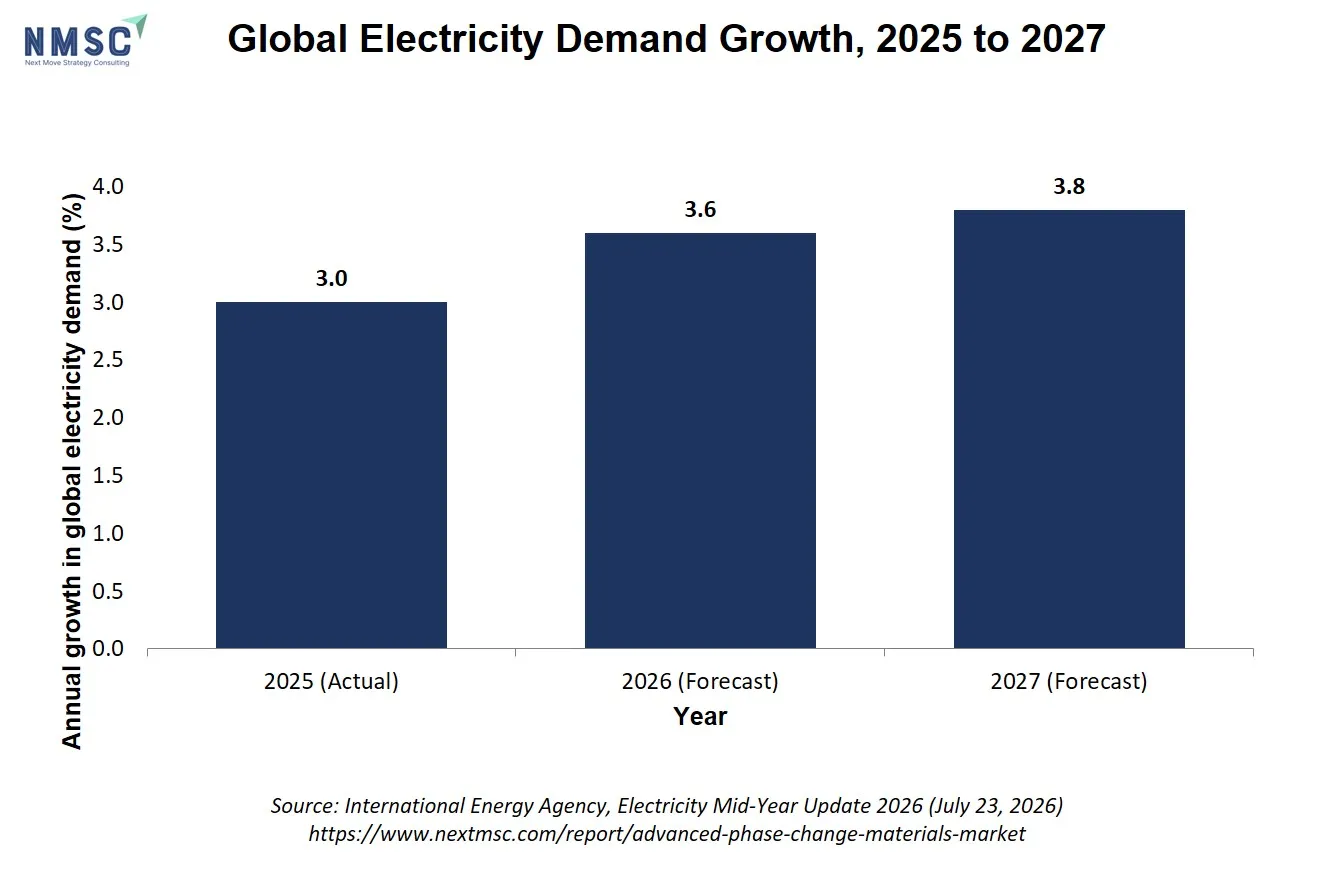
The International Energy Agency's Electricity Mid-Year Update 2026 reports global electricity demand growth of 3% in 2025 and forecasts 3.6% in 2026 and 3.8% in 2027. The 2025 value is reported as actual and the 2026 and 2027 values are IEA forecasts.
Sunamp and Urel (June 18, 2026): Phase Change Storage Targets Turkish Process Heat
On June 18, 2026, Sunamp, the Edinburgh-based thermal storage company, announced a partnership with Urel Engineering to introduce its Central Bank range of phase change material thermal stores for industrial heat to the Turkish market. Urel surveys between 30,000 and 40,000 steam traps a year for major industrial companies and has built its own steam-trap fault monitoring system, which gives it plant-level data on heat loss. Urel's founder, Berkin Izdar, named six target sectors: textiles, food and beverage, paper, feed, chemicals and petrochemicals, and tied the opportunity to rising natural gas costs in Turkey.
A storage product needs a buyer who can already see where heat is wasted, and Urel's survey base supplies exactly that. Sunamp's own news page adds one further data point: on August 13, 2026 it reported a Canadian patent, number 3,107,495, for its phase change heat battery technology, which the company describes as completing North American protection for its core technology. NextMSC primary research and analysis reads the sequence of channel partner and patent as a specialist moving into industrial process heat through local engineering partners.
IEA Global EV Outlook 2026 (May 20, 2026): Battery Packs Raise the Thermal Stakes
The International Energy Agency reported in its Global EV Outlook 2026 that electric car sales grew by 20% to exceed 20 million in 2025, equal to one in four new cars. China accounted for more than 13 million of those sales, Europe for 4.2 million, a 28% share of its market, and the United States for around 1.5 million, just under 10% of sales. The agency expects 23 million sales in 2026, a 28% share, even though first-quarter sales of about 3.9 million were 8% lower year-on-year after policy changes in China and the United States. Without new policies, the global fleet could grow more than sixfold by 2035 to as many as 510 million vehicles, excluding electric two- and three-wheelers.
Charging power is the variable that links those volumes to thermal materials. The International Energy Agency notes that the first 1,000-volt models arrived in 2025 and that charging times under 10 minutes have been announced into 2026, with megawatt-level systems enabling a full recharge in under 10 minutes at greater stress on the grid. NextMSC primary research and analysis notes that delivering a full charge in that window raises the heat a pack must shed, and identifies Automotive & Transport as the fastest-growing end-user industry. Composite phase change materials are the fastest-growing chemistry, expanding at 14.54% CAGR from USD 243.87 million in 2025 to USD 1.05 billion by 2035, because passive buffering layers can absorb short heat spikes that would otherwise load the active cooling loop.
Research Signals: Nature Reviews Materials and the Wearable Frontier
Academic publishing shows the same widening of scope. On September 21, 2026, Nature Reviews Materials published a review titled Phase-change materials for thermal management, which frames these materials as a route to thermal management in next-generation electronic devices, renewable energy systems and sustainable buildings because they store latent heat within nearly isothermal phase transitions. A separate review in Smart Materials and Devices, announced through a news release dated August 21, 2026 and titled Photothermal phase change materials for wearable thermal management and intelligent healthcare, concludes that photothermal variants have moved beyond passive thermal energy storage and may combine with data-driven design.
NMSC Strategic Perspective: Three Clocks, One Material Class
NextMSC primary research and analysis reads these signals as three demand clocks that run at different speeds. A policy clock sets when building rules become enforceable. A price clock moves with gas and electricity markets. A product clock follows charging power in vehicles and heat density in electronics. Each clock selects a different product form. Encapsulated phase change materials, which avoid leakage during phase transitions and suit construction and cold chain, are the largest form in NextMSC's analysis at USD 823.75 million in 2025, a 32.9% share. Formulated phase change materials, which include shape-stabilized, composite and slurry systems built for EV and industrial storage, are the fastest-growing form at a CAGR of 14.01%, rising from USD 545.27 million in 2025 to USD 2.25 billion by 2035.
NextMSC primary research and analysis quantifies the clocks in its CAGR model: mandatory green building energy codes carry a +2.3% impact on the forecast CAGR and EV battery thermal management carries +2.1%, against restraints of -1.0% for specialty raw material costs and -0.8% for the low thermal conductivity of organic phase change materials. Asia-Pacific holds the largest regional share at USD 940.54 million in 2025, or 37.6%, and is forecast to grow at 13.06% CAGR. The practical implication is portfolio breadth. When one clock slows, as European transposition and Chinese and American EV incentives have in 2026, the other two continue, so suppliers that serve several product forms carry less timing risk than those tied to a single end use.
Section Summary:
Three independent 2026 signals, an electricity price shock, an industrial storage channel and faster EV charging, point to demand that is broader than building insulation alone.
-
The International Energy Agency's July 23, 2026 update links price volatility to the rising value of flexibility.
-
Sunamp's June 18, 2026 partnership with Urel Engineering opens six Turkish industrial sectors to phase change heat storage.
-
The IEA's Global EV Outlook 2026 forecasts 23 million electric car sales in 2026 as charging power and pack density rise.
Industry Impact Analysis
EU Buildings Rules: A Missed Deadline That Delays but Does Not Cancel Demand
On July 15, 2026, the European Commission sent letters of formal notice to all 27 member states for not fully notifying national transposition of Directive (EU) 2024/1275, the recast Energy Performance of Buildings Directive, which was due by May 29, 2026. According to the EU Construction Platform news item of August 4, 2026, member states have two months to respond and the Commission may then issue reasoned opinions. Euronews reported on July 23, 2026 that eight member states had already submitted draft National Building Renovation Plans, and the European Commission's directive page lists December 31, 2026 as the date for final plans. On October 20, 2026, Eunews reported that Energy Commissioner Dan Jørgensen rejected claims of a collective failure, noting that over half of member states had self-declared partial transposition.
Transposition is the step at which minimum energy performance standards become enforceable national rules, so a universal miss delays the point at which specifiers must act. It does not remove the dated pipeline of renovation plans. NextMSC primary research and analysis ranks Building & Construction as the largest end-user segment of the advanced phase change materials market and values Europe at USD 646.24 million in 2025, rising to USD 1.78 billion by 2035 at a CAGR of 9.55%. Europe therefore grows more slowly than Asia-Pacific in the NextMSC model, which is consistent with a regulatory pull that is real but staggered by country.
Data Centres and Cooling Load: Where Thermal Buffering Is Being Evaluated
The International Energy Agency's Energy and AI report, released in April 2025, found that data centres used 415 TWh in 2024, about 1.5% of world electricity, and that consumption is set to more than double to roughly 945 TWh by 2030. The same report puts the United States at 45% of 2024 data centre electricity use, China at 25% and Europe at 15%, which concentrates thermal management decisions in three regions.
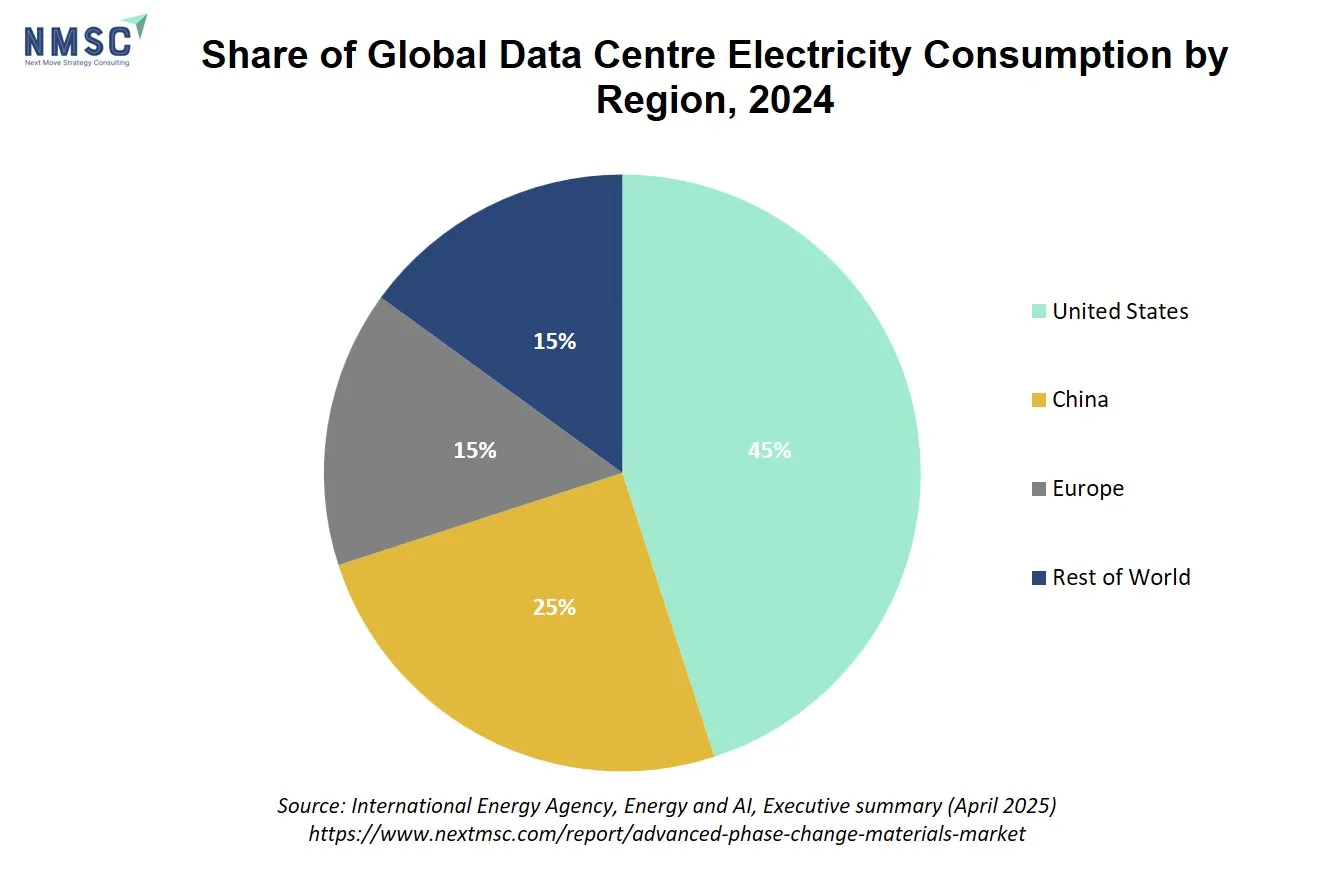
The International Energy Agency's Energy and AI report states that the United States accounted for 45% of global data centre electricity consumption in 2024, China for 25% and Europe for 15%. The remaining 15% is the balance of the 100% total across all other regions.
NextMSC primary research and analysis identifies data center peak cooling as a +0.9% driver of its forecast CAGR and values Active Cooling Support, the application function that covers it together with EV battery regulation and electronics cooling, at USD 429.51 million in 2025, growing at 8.63% CAGR. The mechanism is load shifting: slurry and composite phase change materials in cooling panels can store cold during low-tariff hours and release it when server utilisation peaks, which reduces peak demand on chillers.
Cost and Performance Restraints Investors Should Price In
Two constraints temper the picture. First, the International Energy Agency reports that global electric car sales fell 8% in the first quarter of 2026 and that United States sales are expected to reach 1.2 million in 2026, a decline of over 20%, so EV-linked volume will be uneven by region. Second, NextMSC primary research and analysis notes that organic paraffin and fatty acid phase change materials typically deliver thermal conductivity of 0.2 to 0.4 W/(m·K), while data center cooling and fast-charge EV packs need more than 1.0 W/(m·K), which pushes buyers toward nano-enhanced and composite grades that cost more.
Section Summary:
Regulation, grid economics and electronics are widening demand, but timing and cost constraints will decide which suppliers benefit first.
-
All 27 EU member states received formal notice on July 15, 2026, so building-code demand is delayed rather than cancelled.
-
Data centres used 415 TWh in 2024 according to the International Energy Agency, with 85% concentrated in three regions.
-
Low organic conductivity and uneven EV policy remain the main restraints on premium product adoption.
Pros and Cons of Recent Market Developments
|
Pros |
Cons |
|
Sunamp's June 18, 2026 agreement with Urel Engineering gives industrial phase change storage a local engineering channel in a gas-sensitive economy. |
All 27 EU member states missed the May 29, 2026 transposition deadline, which delays enforceable building performance standards. |
|
The International Energy Agency's July 23, 2026 update highlights negative prices and intraday swings that raise the value of flexibility. |
Global electric car sales fell 8% in the first quarter of 2026, and United States sales are forecast to fall by over 20% in 2026. |
|
The International Energy Agency forecasts 23 million electric car sales in 2026, widening the base of battery packs needing temperature control. |
NextMSC primary research and analysis counts specialty raw material costs (-1.0%) and low organic conductivity (-0.8%) as CAGR restraints. |
|
Nature Reviews Materials (September 21, 2026) positions phase change materials across electronics, renewables and buildings. |
Spot electricity prices in the EU and Japan rose by more than 30% in the second quarter of 2026, which pressures project budgets. |
Key Data & Statistics
Key 2026 Developments and Quantified Signals
|
Development |
Date |
Quantified Signal |
|
IEA Global EV Outlook 2026 |
May 20, 2026 |
More than 20 million electric cars sold in 2025; 23 million forecast for 2026 |
|
Sunamp and Urel Engineering partnership |
June 18, 2026 |
Urel surveys 30,000 to 40,000 steam traps a year; six target industrial sectors |
|
European Commission formal notices on EPBD |
July 15, 2026 |
27 of 27 member states notified; two months to respond |
|
IEA Electricity Mid-Year Update |
July 23, 2026 |
Demand growth of 3.6% in 2026; EU and Japan spot prices up more than 30% year-on-year |
|
Sunamp Canadian patent grant |
August 13, 2026 |
Canadian patent number 3,107,495 for phase change heat battery technology |
Electrification Reference Points from the International Energy Agency
|
Indicator |
Value |
Period |
|
Global electric car sales |
More than 20 million (25% of new cars) |
2025 |
|
China electric car sales |
More than 13 million |
2025 |
|
Europe electric car sales |
4.2 million (28% share) |
2025 |
|
United States electric car sales |
Around 1.5 million (just under 10% share) |
2025 |
|
Forecast global electric car sales |
23 million (28% share) |
2026 |
|
Global electricity consumption |
28,600 TWh rising to 30,700 TWh |
2025 to 2027 |
|
Data centre electricity use |
415 TWh (about 1.5% of world electricity) |
2024 |
Future Outlook & Forecast: The Advanced Phase Change Materials Market to 2035
The Road to USD 7.73 Billion: Where NextMSC Sees the Growth Concentrating
According to NextMSC primary research and analysis, the global advanced phase change materials market is projected to rise from USD 2.50 billion in 2025 to USD 3.07 billion in 2026 and USD 7.73 billion by 2035, a CAGR of 10.82% from 2026 to 2035. Growth is concentrated in the segments that the external signals above favour. By application function, Thermal Buffering is forecast to grow at 12.71% CAGR to USD 1.30 billion and Thermal Energy Storage at 12.64% CAGR to USD 2.76 billion, against 9.77% for Isothermal Control, the current leader at USD 792.82 million in 2025.
NextMSC regional analysis shows Asia-Pacific reaching USD 3.56 billion by 2035, Europe USD 1.78 billion and North America USD 1.47 billion at 8.34% CAGR. The Middle East & Africa region, at 11.35% CAGR from USD 204.89 million, is the second-fastest-growing region, which aligns with the Turkish industrial-heat entry that Sunamp announced in June 2026. Latin America grows at 7.38% from USD 116.73 million.
NextMSC primary research and analysis frames the strategic sequence in three horizons. Through 2027, the priorities are EV battery thermal management qualification and composite production scale-up. From 2027 to 2031, bio-based chemistry and Asia-Pacific distribution take priority, supported by European sustainability procurement. Through 2035, high-temperature phase change materials for concentrated solar power and data centre integration become the larger prizes.
Section Summary:
NextMSC projects USD 7.73 billion by 2035, with composite chemistry, formulated products and Asia-Pacific growing fastest.
-
Thermal Buffering and Thermal Energy Storage lead application growth at 12.71% and 12.64% CAGR.
-
Asia-Pacific grows at 13.06% CAGR and reaches USD 3.56 billion, the largest regional pool by 2035.
-
Middle East & Africa, at 11.35% CAGR, is the second-fastest region, led by cold chain and industrial heat.
Next Steps for Stakeholders
For C-Level Executives and Product Leaders
-
Map each product line to its demand clock. Classify revenue by whether it depends on policy timing, energy prices or product cycles. The 2026 evidence shows the policy clock slowing in the EU while the price clock accelerates, so concentration in a single clock is the main avoidable risk.
-
Pursue channel partnerships before capacity. Sunamp's agreement with Urel Engineering shows that a partner with plant-level heat-loss data can shorten the sales cycle for industrial storage.
-
Close the conductivity gap with qualified data. Automotive and data centre buyers need conductivity above 1.0 W/(m·K), so invest in composite and shape-stabilized grades and in thermal cycling validation data.
For Institutional Investors
-
Weight exposure by segment growth, not headline growth. A 10.82% market CAGR conceals a range from 6.00% for other product forms to 14.54% for composite chemistry in NextMSC's model, so segment-level exposure explains most of the return dispersion.
-
Track dated regulatory checkpoints. The EU's final national building renovation plans are due on December 31, 2026. Reasoned opinions or completed national transposition would be the next verifiable signals for building-linked demand.
Conclusion
The advanced phase change materials market is being repriced by events outside the materials industry. Gas disruptions in 2026 pushed spot electricity prices up by more than 30% in the European Union and Japan, EV charging has moved toward sub-10-minute sessions, and a missed EU deadline has delayed but not cancelled building-code demand. Each event changes which product form a buyer needs and when.
According to Next Move Strategy Consulting, the global advanced phase change materials market will grow from USD 2.50 billion in 2025 to USD 7.73 billion by 2035 at a CAGR of 10.82%. Suppliers, investors and specifiers who track the policy, price and product clocks separately will be better placed to read each signal as it arrives.
About the Author
 Sanyukta Deb
— Sanyukta Deb is Digital Marketing Team Lead at Next Move Strategy Consulting, where she has led content strategy and technical SEO for the firm's B2B market research publications for over 2 years. Her editorial process translates NextMSC's primary and secondary research — spanning technology, industrial, and consumer sectors — into commercial narratives, backed by search-intent, keyword, and competitive analysis. She brings 5 years of overall experience in digital marketing and content strategy.
About the Reviewer
 Debashree Dey
— Debashree Dey is Assistant Manager at Next Move Strategy Consulting, where she supports cross-vertical market content and communications across diverse industries for 6 years. Her professional background includes senior content writing, communications, and published manuscript authorship, with experience developing audience-focused business narratives and maintaining clear, consistent messaging. Her role supports research-led content development and editorial quality across NextMSC publications.















Add Comment