Aluminum Powders, Pastes, and Flakes: How Gulf Outages Hit Costs | NextMSC
Introduction
On May 20, 2026, the International Aluminium Institute reported that Gulf primary aluminium output had fallen to 10,989 tonnes per day in April, a 26.7% drop from March and less than two-thirds of the pre-conflict baseline of about 17,800 tonnes per day. Almost every tonne of aluminum powder, paste and flake begins as ingot, so a shock of that scale travels directly into the cost base of atomizers, flake mills and pigment makers. By October 2026, the U.S. Bureau of Labor Statistics producer price index for metal powders, paste and flake stood at 389.030, against 289.147 in October 2025, a gap that shows how the Gulf outage moved from the smelter gate to the powder plant.
According to Next Move Strategy Consulting's Aluminum Powders, Pastes, and Flakes Market report, the global aluminum powders, pastes, and flakes market was valued at USD 6.21 billion in 2025 and is projected to reach USD 11.87 billion by 2035, growing at a CAGR of 6.20% from 2026 to 2035. NextMSC primary research and analysis places the 2026 value at USD 6.60 billion, which means the forecast period opens in the middle of a primary aluminium supply disruption.
For More Information: Download FREE Sample on Aluminum Powders, Pastes, and Flakes Market Report
This analysis examines how the Gulf outage, U.S. trade policy and a global smelter restart cycle are reshaping the economics of aluminum powders, pastes and flakes. It separates NextMSC proprietary estimates from external facts throughout.
Gulf Smelters Go Dark: How the Hormuz Shock Rewired the Aluminum Powders, Pastes, and Flakes Market
IAI Data: A Slow-Motion Supply Shock Reaches the Powder Chain
The International Aluminium Institute (IAI) press release of May 20, 2026, Gulf aluminium output collapses by 40% of pre-war levels as global supply crisis deepens, put numbers on the disruption. Gulf smelters produced 10,989 tonnes per day in April 2026, a 26.7% decline from March. The region represents about 8% of global primary output, yet it supplies about 19% of EU primary aluminium imports, 28% of Japan's and 21% of the United States'. In 2025 alone, Gulf producers shipped 860,500 metric tons of primary aluminium to the United States. IAI Secretary General Jonathan Grant described the episode in the release as a "slow-motion supply chain shock."
For powder producers the transmission mechanism is direct. According to NextMSC primary research and analysis, aluminum powders, pastes and flakes are produced through atomization, grinding or milling of aluminum metal, so the price a producer pays for ingot, rather than the headline exchange quote, sets the cost floor. A supply shock concentrated in those three import markets therefore reaches coatings, ink and additive manufacturing customers within a few quarters.
Reuters: A Calm LME Screen Hides a Strained Physical Market
Reuters columnist Andy Home wrote on October 14, 2026, that Iranian missile attacks on Gulf smelters and the disruption to shipping through the Strait of Hormuz had removed almost 3 million metric tons of aluminium production capacity. The disruption is also reflected in primary production data published by the International Aluminium Institute (IAI). According to the IAI's May 20, 2026 release, Gulf aluminium production declined to 10,989 tonnes per day in April 2026, compared with 15,000 tonnes per day in March. The institute also reported that the region accounted for approximately 8% of global primary aluminium output, highlighting its importance to international metal supply chains.
For aluminum powder, paste and flake manufacturers, the disruption creates exposure to feedstock availability, delivered metal costs and regional sourcing conditions. NextMSC analysis indicates that producers dependent on imported primary aluminium may face greater procurement uncertainty when shipping routes and smelter operations are disrupted. Although movements in exchange-traded aluminium prices provide an important market reference, actual procurement conditions also depend on regional availability, product specifications and delivery arrangements.
Physical buyers continue to face uncertainty as Gulf production disruptions affect the availability and movement of primary aluminium. The International Aluminium Institute reported that the region produced approximately 330,000 metric tons of primary aluminium in April 2026, with daily output falling to 10,989 tonnes. Its production updates also indicate that restrictions on raw material movement and damage to production facilities have affected regional smelter operations. For aluminum powder, paste and flake manufacturers, these developments reinforce the importance of monitoring physical metal availability alongside benchmark prices. NextMSC analysis suggests that producers with diversified sourcing arrangements and established supplier relationships may be better positioned to manage procurement disruptions than manufacturers dependent on a limited number of feedstock suppliers.
Powder Prices Follow Metal: U.S. Producer Price Data
The U.S. Bureau of Labor Statistics tracks a producer price index for metal powders, paste and flake, published through the Federal Reserve Bank of St. Louis. The series rose from 298.935 in December 2025 to 347.899 in May 2026 and then stepped up to 389.905 in June, a 12.1% one-month increase calculated from the published values. It held between 386.101 and 391.142 from June to September and registered 389.030 in October. The index covers the broader metal powders, paste and flake category.
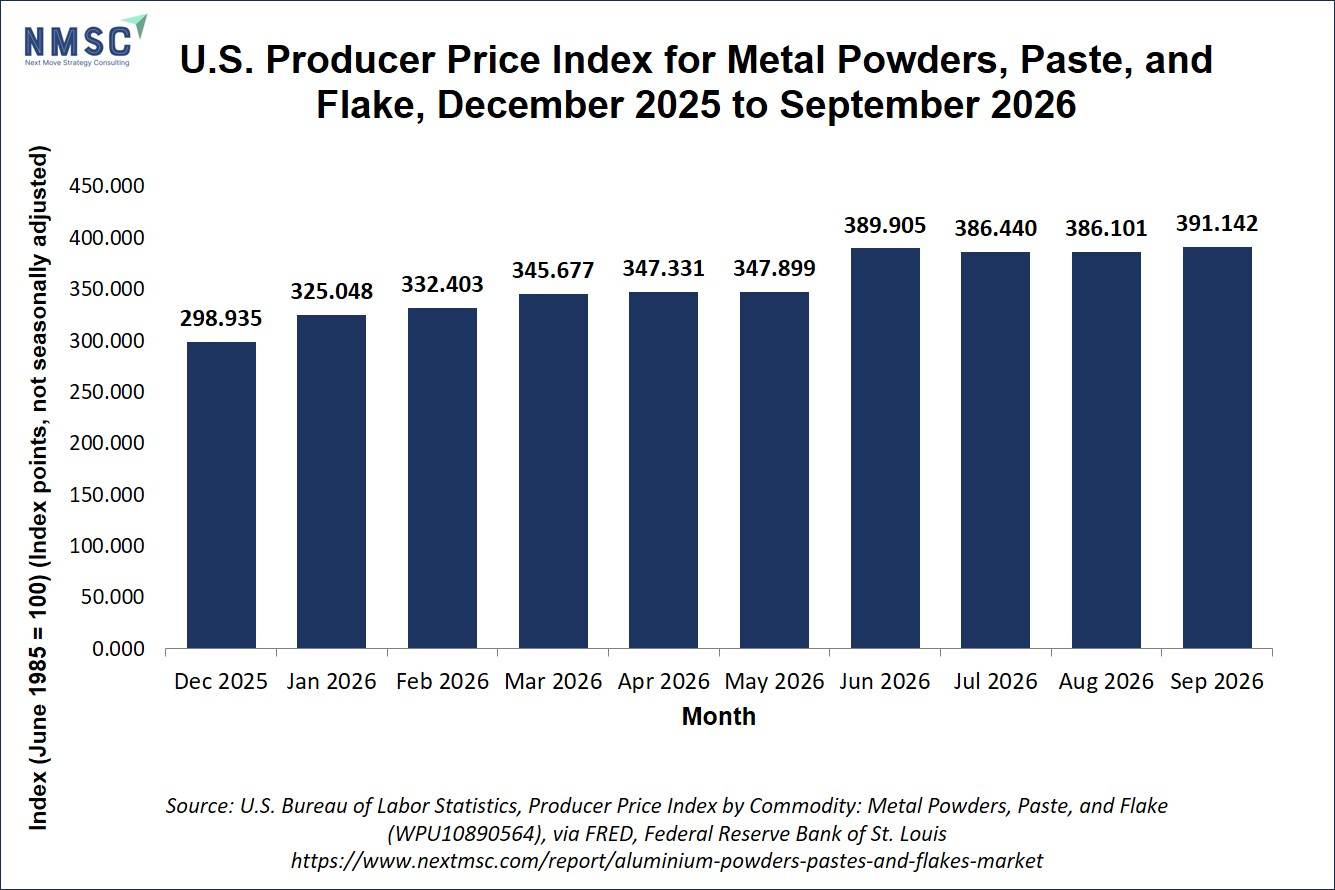
The U.S. Bureau of Labor Statistics producer price index for metal powders, paste and flake rose from 298.935 in December 2025 to 391.142 in September 2026 (index, June 1985 = 100, not seasonally adjusted). The index moved from 347.899 in May 2026 to 389.905 in June 2026, then held between 386.101 and 391.142 from June to September. The series covers the broader metal powders, paste and flake commodity category rather than aluminum products alone.
Downstream Repricing: Flint Group and the Coatings Chain
The cost pressure is now visible in finished-goods pricing. According to Packaging Insights on November 16, 2026, Flint Group Packaging Solutions will raise packaging ink and coating prices in the United States and Canada from December 14 and in Europe from January 1, 2027. Heiner Klokkers, Flint Group's president for Europe, India, Africa and the Middle East and its chief technology officer, told Packaging Insights that prices are "unlikely to ease" until input costs return to pre-conflict levels. Flint attributes the increases to pigment, solvent, resin and carbon black costs, China's safety rules and energy prices, not to aluminum specifically.
From Laboratory to Production Line: Aluminum Powder for Additive Manufacturing
Innovation continues in parallel with the cost shock. Metal Additive Manufacturing magazine reported on September 16, 2026 on research into an aluminium powder for foamable wire used in wire arc additive manufacturing. The AlMg2Si1.2 powder was produced through a custom atomization process at an atomization pressure of 20.3 bar, and the study found no statistically significant difference in porosity or median pore size between the 45 to 63 micrometer and 63 to 90 micrometer fractions.
NextMSC analysis suggests that two fractions performing alike matters commercially, because a wider usable size range can raise the share of each atomization run that qualifies as saleable powder. The Congressional Research Service (CRS) report U.S. Aluminum Manufacturing: Industry Trends and Policy Options, dated October 30, 2026, notes that secondary aluminum often carries more impurities than primary metal and that defense manufacturers often favor primary aluminum for predictable alloy chemistry.
NMSC Strategic Perspective: Feedstock Cost, Purity Tier and Regional Sourcing
NextMSC primary research and analysis identifies three channels through which the Gulf outage is reshaping the aluminum powders, pastes, and flakes market. The first is feedstock cost. The Bureau of Labor Statistics index gain of 30.8% between December 2025 and September 2026, calculated from published values, shows producers repricing quickly. The second is purity tier. NextMSC's report segments the market into high purity (above 98.1%), standard purity (95.1% to 98%) and technical grade (up to 95%) products, and the CRS observation that secondary metal contains more impurities implies that high purity grades have the least room to substitute scrap.
The third channel is regional sourcing. NextMSC regional analysis finds that Asia-Pacific holds the dominant share of the market, anchored by aluminum paste use in solar cell production, while North America is supported by additive manufacturing and automotive lightweighting. A U.S. smelter restart cycle could shorten ingot supply lines for North American atomizers.
Section Summary:
The Gulf outage has moved from smelter output tables to powder price indices within two quarters.
-
IAI data show Gulf output 26.7% below March in April 2026, and Reuters reported almost 3 million metric tons of capacity knocked out.
-
The Bureau of Labor Statistics metal powders, paste and flake index rose from 298.935 in December 2025 to 391.142 in September 2026.
-
NextMSC analysis ties exposure to feedstock cost, purity tier and regional sourcing.
Industry Impact Analysis
U.S. Policy: 50% Tariffs and a Smelter Restart Cycle
The CRS report of October 30, 2026 details how trade policy and the Gulf outage now interact. The Section 232 tariff on aluminum imports has stood at 50% for nearly all countries since June 4, 2025, and the CRS reports that the Midwest Premium reached nearly 70% of the LME price in December 2025. The United States produced 660,000 metric tons of primary aluminum in 2025, the lowest level since 1950 and under 1% of global output, and relied on imports for 60% of its consumption, according to the U.S. Geological Survey estimate cited in the report.
Tariffs and disruption are now drawing capital into domestic metal. As of October 2026, four smelters operated by Alcoa and Century Aluminum are active, with combined capacity of about 795,000 metric tons per year. Century Aluminum and Emirates Global Aluminium plan a 750,000 metric ton smelter at Inola, Oklahoma, which the CRS says would raise active U.S. capacity by about 94%. Magnitude 7 Metals announced in July 2026 a restart of its New Madrid, Missouri smelter at 75,000 metric tons per year, about 9% more capacity. Oklahoma Attorney General Gentner Drummond filed a petition on June 2, 2026 to block the Inola project, a reminder that permitting risk accompanies the policy tailwind.
For powder and paste producers, domestic restarts matter less for tonnage than for terms. NextMSC analysis indicates that North American atomizers, which buy at a delivered price anchored on the Midwest Premium, stand to gain from shorter and more predictable supply lines once restarts reach commissioning. The CRS cautions, however, that policies raising domestic aluminum prices may negatively affect industries that use aluminum.
Europe, Asia and Scrap: Restarts Reshape Supply Lines
Outside the United States, regional production conditions and government policies remain important factors influencing aluminium supply. The International Aluminium Institute's April 2026 production data recorded primary aluminium output of 604,000 metric tons in Europe, including Russia, 408,000 metric tons in Asia excluding China, and 322,000 metric tons in North America. These figures provide a primary-source reference for assessing regional production distribution during the Gulf supply disruption. For powder and paste manufacturers, differences in regional production capacity, supplier availability and transportation infrastructure influence sourcing decisions and production continuity.
Scrap availability is another important consideration for aluminium processors. The European Commission's revised Waste Shipments Regulation (EU) 2024/1157 introduces stricter requirements for non-hazardous waste exports to non-OECD countries from May 21, 2027. Under the regulation, such exports will generally be prohibited unless the destination country meets the specified environmental management requirements and is authorized to receive the relevant waste streams. NextMSC analysis indicates that changes in cross-border scrap movements could influence feedstock sourcing strategies for aluminium processors. Manufacturers should assess recycled-metal availability alongside purity specifications and the suitability of secondary aluminium for their intended powder, paste and flake applications.
Where Demand Pull Meets Cost Push: Coatings, Mobility and Defense
Cost pressure lands on the demand centers that NextMSC identifies as the core of the market. NextMSC primary research and analysis names automotive paints and coatings and construction applications as leading demand drivers. The U.S. Geological Survey's Mineral Commodity Summaries 2026, published in February 2026, reports that transportation accounted for 36% of U.S. aluminum consumption in 2025, packaging for 24% and building for 13%. Together these three markets make up 73%, matching the CRS statement that they consumed 73% of the total.
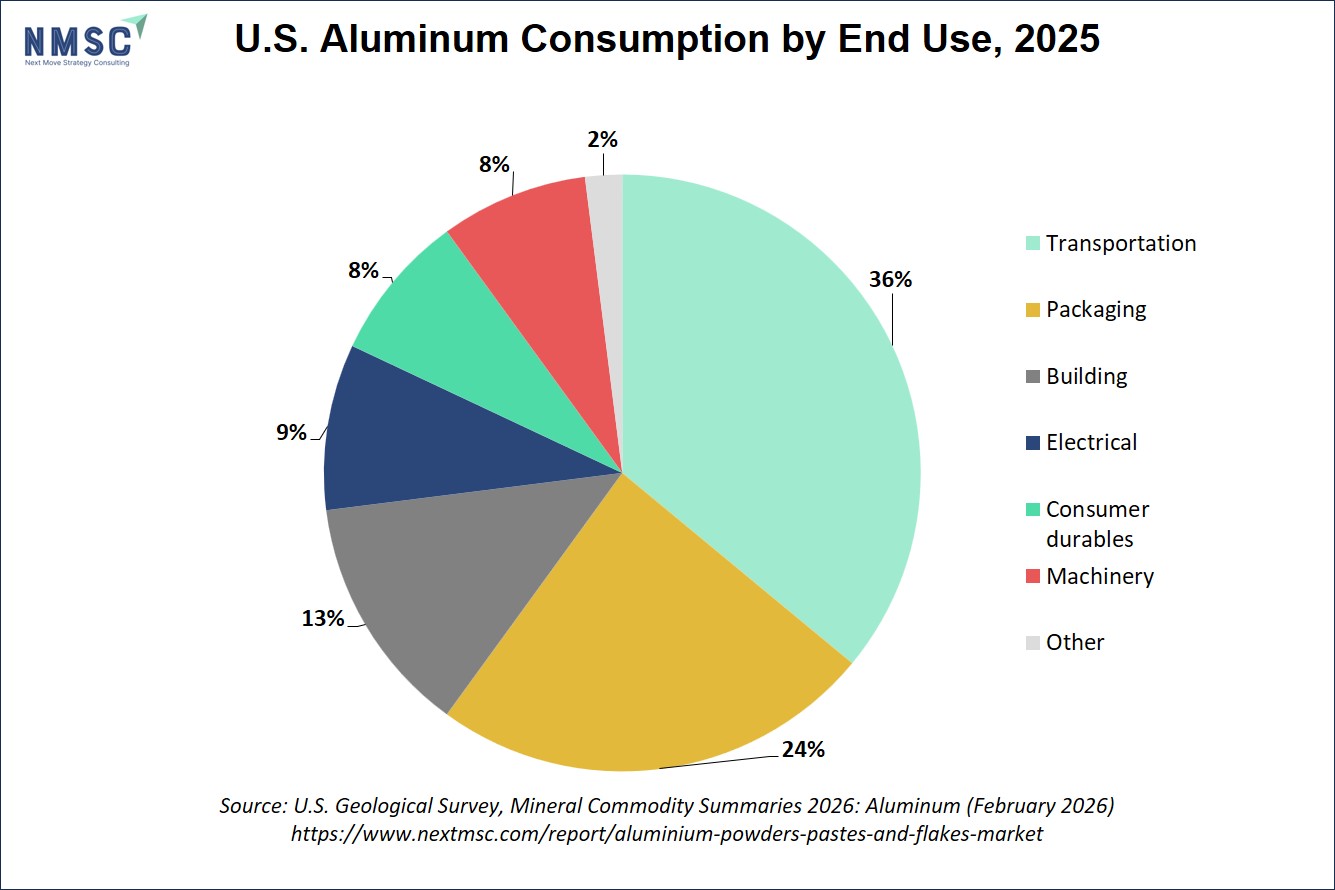
The U.S. Geological Survey's Mineral Commodity Summaries 2026 reports that transportation accounted for 36% of U.S. aluminum consumption in 2025, followed by packaging at 24%, building at 13%, electrical at 9%, consumer durables and machinery at 8% each, and other uses at 2%. The shares total 100%.
Defense adds a second pull. The CRS lists aircraft frames, shell casings and explosive chemical compounds among military products that use aluminum. It also notes that the U.S. Department of Defense supported Arconic's high purity expansion at Davenport, Iowa, with a USD 45.5 million Defense Production Act Title III agreement, lifting capacity to 43,000 metric tons per year of high purity metal.
Section Summary:
Tariffs, supply disruption and scrap policy are changing where powder producers source metal and what they pay for it.
-
The 50% Section 232 tariff in force since June 4, 2025 and the Gulf outage have lifted U.S. metal costs and prompted restart plans of 750,000 and 75,000 metric tons per year.
-
An EU scrap export ban due in May 2027 may make recycled feedstock harder to secure and favor primary-based grades.
Pros and Cons of Recent Market Developments
|
Pros |
Cons |
|
The International Aluminium Institute's April 2026 production data provides greater visibility into regional primary aluminium output and supports more informed sourcing decisions. |
Gulf production disruptions have increased uncertainty around primary aluminium availability and the reliability of established supply routes. |
|
The European Commission's revised Waste Shipments Regulation establishes a framework for improving waste traceability and environmentally sound recycling practices. |
Stricter cross-border waste shipment requirements may create additional compliance and sourcing considerations for manufacturers dependent on recycled aluminium. |
|
NextMSC projects the aluminum powders, pastes, and flakes market to expand through 2035, supported by automotive coatings and construction applications. |
NextMSC identifies the high initial cost of setting up and operating powder, paste and flake manufacturing facilities as a restraint on new entrants. |
Key Data & Statistics
Aluminum Supply Shock Indicators, 2026
|
Indicator |
Value |
Context |
|
Gulf primary aluminium production |
10,989 tonnes per day |
April 2026, according to IAI |
|
Gulf production decline |
26.7% |
Compared with March 2026 |
|
Gulf share of global primary output |
Approximately 8% |
Regional contribution to global production |
|
Global primary aluminium production |
5.922 million metric tons |
April 2026 |
|
North American primary aluminium production |
322,000 metric tons |
April 2026 |
|
European primary aluminium production |
604,000 metric tons |
April 2026, including Russia |
|
Asia excluding China primary aluminium production |
408,000 metric tons |
April 2026 |
U.S. Aluminum Policy and Capacity Reference Points
|
Indicator |
Value |
Date and basis |
|
U.S. primary aluminum production |
660,000 metric tons |
2025; lowest since 1950 and under 1% of global output |
|
Active primary smelters |
Four, about 795,000 metric tons per year |
As of October 2026 |
|
Section 232 tariff |
50% for nearly all countries |
Effective June 4, 2025 |
|
Planned Inola, Oklahoma smelter |
750,000 metric tons per year |
Century Aluminum and Emirates Global Aluminium joint project |
|
Arconic Davenport high purity capacity |
43,000 metric tons per year |
2025 |
Future Outlook & Forecast
From USD 6.60 Billion to USD 11.87 Billion: The Aluminum Powders, Pastes, and Flakes Market Outlook
According to NextMSC primary research and analysis, the global aluminum powders, pastes, and flakes market is projected to expand from USD 6.21 billion in 2025 and USD 6.60 billion in 2026 to USD 11.87 billion by 2035, a CAGR of 6.20% over 2026 to 2035. NextMSC's model applies top-down and bottom-up approaches across 28 countries and 15 profiled companies.
External primary-source production data provides important context for the market's cost outlook. The International Aluminium Institute's April 2026 figures show that Gulf primary aluminium production declined substantially compared with March, demonstrating the exposure of international supply chains to regional production and transportation disruptions. Separately, the European Commission's revised Waste Shipments Regulation establishes stricter conditions for non-hazardous waste exports to non-OECD countries from May 2027. These developments create two important considerations for powder manufacturers: the reliability of primary aluminium supply and the future availability of suitable recycled feedstock. NextMSC analysis indicates that regional sourcing strategies, metal purity requirements and supplier diversification will remain important factors influencing procurement costs and production continuity.
NextMSC identifies two demand drivers behind its forecast. The first is growing use of aluminum powders, pastes and flakes in automotive paints and coatings, where they enhance metallic effect, gloss and durability. The second is rising use in construction, including concrete reinforcement and thermal insulation. The principal restraint is the high initial cost of setting up facilities, and NextMSC sees hydrogen fuel cell materials as an emerging opportunity.
Scenarios to Watch Through 2027
-
Gulf production recovery: International Aluminium Institute monthly production releases will help manufacturers assess whether Gulf smelter output is recovering and whether regional supply conditions are stabilizing.
-
EU waste shipment regulation: The May 21, 2027 implementation of stricter non-hazardous waste export requirements for non-OECD destinations will be important for monitoring changes in recycled aluminium sourcing and cross-border material flows.
-
U.S. smelter development: Domestic smelter projects and restart activities documented by the Congressional Research Service will remain important indicators of potential changes in North American primary aluminium availability.
Section Summary:
NextMSC projects the market to reach USD 11.87 billion by 2035 at a 6.20% CAGR, while external forecasts point to an easing metal balance in 2027.
-
NextMSC's projection runs from USD 6.60 billion in 2026 to USD 11.87 billion by 2035.
-
Purity tier, regional sourcing and contracted metal supply separate resilient producers from exposed ones.
Next Steps for Stakeholders
For C-Level Executives and Procurement Leaders
-
Index powder and paste procurement contracts against clearly defined delivered-metal cost components rather than relying exclusively on exchange-traded aluminium benchmarks. The International Aluminium Institute's April 2026 production data highlights the potential for regional supply disruptions to affect feedstock availability. Procurement teams should evaluate supplier delivery commitments, transportation exposure, regional sourcing conditions and pricing adjustment mechanisms when negotiating supply agreements..
-
Qualify a second metal source by purity tier. The Congressional Research Service notes that secondary aluminum often has more impurities than primary metal. Buyers of high purity grades should secure primary-based supply, while buyers of technical grade powder can evaluate recycled-content alternatives.
-
Pre-negotiate pass-through clauses with coatings and ink customers. Flint Group's increases from December 14 and January 1, 2027 show the sequence by which formulators pass costs to converters. Producers that document metal cost components in contracts can follow that sequence with less friction.
For Institutional Investors
-
Separate integrated metal supply operations from non-integrated powder, paste and flake conversion capacity. NextMSC's report profiles 15 companies, including Alcoa Corporation, ALTANA AG through its ECKART division, TOYAL Group and Kymera International. Investors should assess each company's feedstock sourcing arrangements, product specialization, production capabilities and exposure to regional supply disruptions. Particular attention should be given to the ability to secure consistent aluminium quality and maintain operating margins during periods of raw material price volatility.
-
Track premium and stock data monthly. IAI monthly releases, LME stocks and regional premiums show whether the physical market is normalizing.
Conclusion
The aluminum powders, pastes, and flakes market enters its forecast period with feedstock pricing set by supply disruption, not by weak demand. The International Aluminium Institute, Reuters and S&P Global Energy document a Gulf outage that cut almost 3 million metric tons of capacity, while the Bureau of Labor Statistics shows powder, paste and flake prices up from 298.935 to 391.142.
According to NextMSC primary research and analysis, the market is projected to reach USD 11.87 billion by 2035 at a CAGR of 6.20%. Producers with contracted metal supply, qualified high purity grades and delivered-cost contract terms are best placed to convert that growth into margin, while exposed conversion capacity carries the greatest risk as Gulf restarts, U.S. smelter projects and the EU scrap ban reshape supply lines through 2027.
About the Author
 Priyanshu Das
— Priyanshu Das is SEO Executive at Next Move Strategy Consulting, where he has led on-page and off-page SEO, keyword research, and SEO audits for the firm's B2B market research publications for 2 years. His audit process combines technical crawl analysis, backlink profile review, and competitor keyword gap mapping — using tools including Screaming Frog and Google Search Console — to prioritize fixes by organic search-visibility impact, informed by his own prior in-house and agency SEO experience.
About the Reviewer
 Sanyukta Deb
— Sanyukta Deb is Digital Marketing Team Lead at Next Move Strategy Consulting, where she has led content strategy and technical SEO for the firm's B2B market research publications for over 2 years. Her editorial process translates NextMSC's primary and secondary research — spanning technology, industrial, and consumer sectors — into commercial narratives, backed by search-intent, keyword, and competitive analysis. She brings 5 years of overall experience in digital marketing and content strategy.















Add Comment