Aluminum Rolled Products Market: Why U.S. Sheet Supply Is Tight | NextMSC
Introduction
On November 5, 2026, Novelis Inc. reported that second-quarter fiscal 2027 net sales rose 25% to USD 5.9 billion even as its rolled product shipments fell 2% to 919 kilotonnes. Steve Fisher, president and chief executive officer of Novelis Inc., said in the company's earnings release of that date that the Bay Minette plant in Alabama will strengthen its ability to serve the "undersupplied North American market." Revenue climbing while tonnage slips is the clearest recent signal that, in North American flat-rolled aluminum, supply rather than demand has become the binding constraint.
According to Next Move Strategy Consulting's Aluminum Rolled Products Market report, the global aluminum rolled products market was valued at USD 61.66 billion in 2025, is expected to reach USD 65.48 billion in 2026 and is projected to reach USD 112.5 billion by 2035, growing at a CAGR of 6.2% from 2026 to 2035. NextMSC primary research and analysis also shows Asia-Pacific holding the largest regional share and retaining it through the forecast period, which makes the tightness in North America a regional dislocation inside a market that is expanding globally.
For More Information: Download FREE Sample on Aluminum Rolled Products Market Report
This analysis follows that squeeze through the October and November 2026 reporting season, the tariff and carbon rules that decide where rolled tonnes can be sold, and the cost pressures reaching smelters. It closes with actions for executives and investors in the aluminum rolled products market.
A Flat-Rolled Supply Squeeze Is Reshaping the Aluminum Rolled Products Market
Novelis: Higher Revenue on Lower Tonnage
Novelis Inc. reported net sales of USD 5,942 million for the quarter ended September 30, 2026, against USD 4,744 million a year earlier, and attributed the increase primarily to higher average aluminum prices. Shipments fell to 919 kilotonnes from 941 kilotonnes because higher beverage packaging and aerospace volumes were outweighed by lower automotive and specialty shipments. Adjusted EBITDA per tonne shipped rose 23% to USD 553, helped by USD 39 million of insurance recoveries tied to the 2025 fires at the Oswego, New York plant and by a favorable metal benefit from higher scrap consumption.
The capital side is as revealing as the earnings. Novelis Inc. spent USD 1.54 billion on capital expenditure in the first six months of fiscal 2027, up from USD 913 million a year earlier, largely on its greenfield rolling and recycling plant at Bay Minette. The cold mill there produced its first coil in September 2026, and commercial shipments are targeted for the first quarter of fiscal 2028. Adjusted free cash flow was an outflow of USD 1.8 billion for the half year and net leverage stood at 4.7 times.
Novelis's segment tables show where its tonnes are concentrated. North America accounted for 371 kilotonnes of third-party rolled product shipments in the quarter, ahead of Europe at 238 kilotonnes, Asia at 160 kilotonnes and South America at 150 kilotonnes, which is why a plant fire or a new mill in North America moves supply for the whole industry.
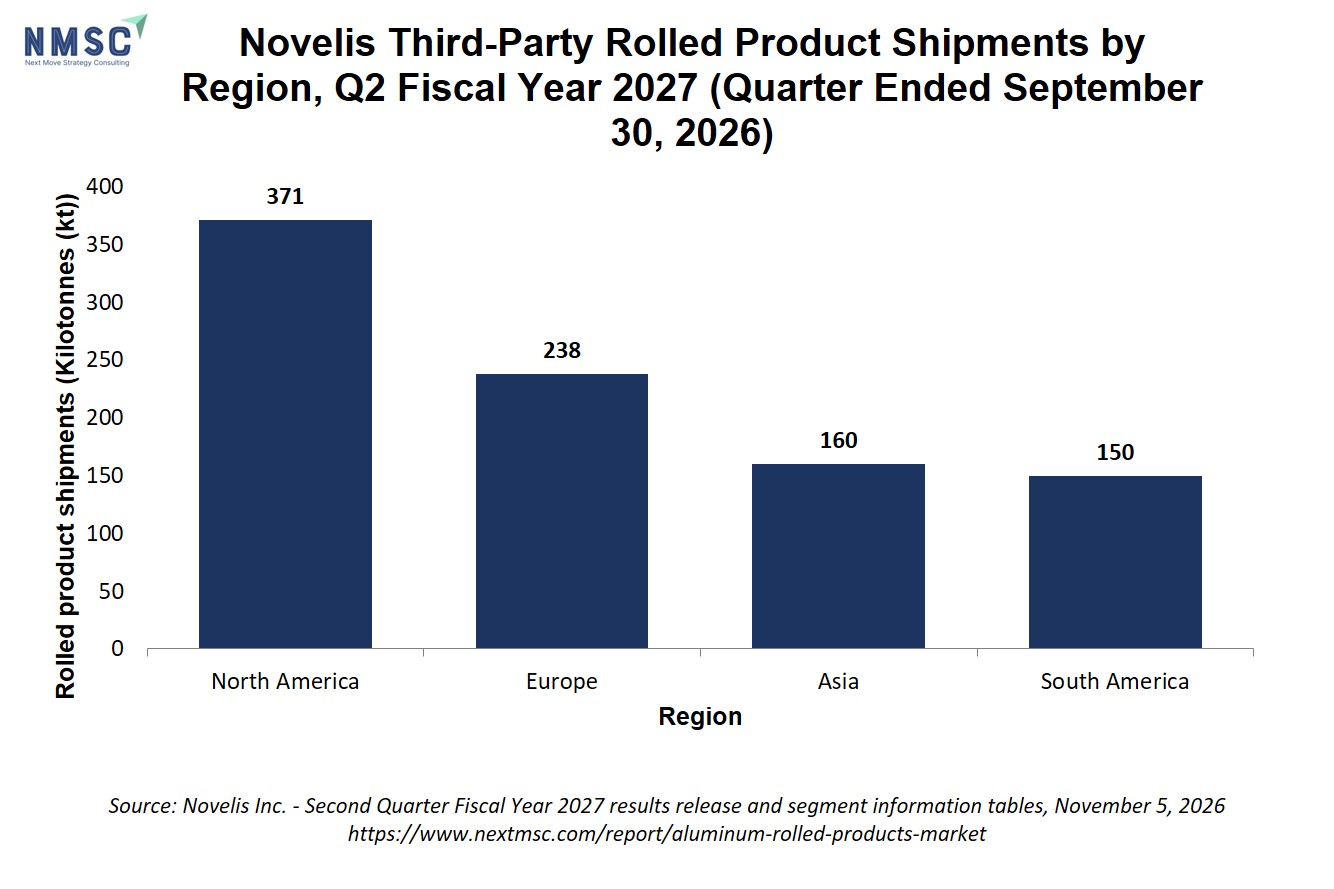
Novelis Inc. reported third-party rolled product shipments of 371 kilotonnes in North America, 238 kilotonnes in Europe, 160 kilotonnes in Asia and 150 kilotonnes in South America in the quarter ended September 30, 2026, a total of 919 kilotonnes. North America is the largest of the four regions in the company's segment disclosure.
Constellium and Kaiser: Shortage Pricing Meets Uneven Volumes
Constellium SE reported third-quarter 2026 results on October 28, 2026, with revenue of USD 2.64 billion, up 22%, and adjusted EBITDA of USD 276 million. Its Packaging & Automotive Rolled Products segment shipped 266 thousand metric tons, down 3%, yet segment adjusted EBITDA rose 98% to USD 162 million on favorable price, mix and metal costs. Ingrid Joerg, chief executive officer of Constellium SE, listed "supply shortages of automotive rolled products in North America" among the favorable conditions in the company's October 28, 2026 results release.
Lower packaging rolled shipments offset higher automotive volumes inside that segment, while Constellium's Aerospace & Transportation segment shipped 59 thousand metric tons, up 18%. Profit per tonne rose because of price and mix, not additional volume.
Kaiser Aluminum Corporation reported on October 21, 2026 that third-quarter shipments rose 11% to 300 million pounds and conversion revenue rose 25% to USD 439 million. Packaging shipments reached 153.0 million pounds against 144.1 million pounds a year earlier as the company moved toward coated products. Adjusted EBITDA margin nevertheless fell to 19.1% from 23.2% because of outages, lower scrap use and packaging start-up costs, a reminder that adding rolled capacity carries execution risk.
China's Flat-Rolled Exports Fill Part of the Gap
AL Circle reported on October 26, 2026 that China exported 208,000 tonnes of aluminum flat-rolled products to the United States in the first half of 2026, compared with 55,000 tonnes in the same period of 2025, an increase of 278%. Plates, sheets and strip drove the rise, while foil moved only from 22,000 tonnes to 24,000 tonnes. Imports are therefore acting as a relief valve for sheet and plate shortages, although the flow depends on trade rules that remain in flux.
NMSC Strategic Perspective: Why Plant Location Now Outweighs Plant Size in the Aluminum Rolled Products Market
NextMSC primary research and analysis reads the Novelis result as a decoupling of price from volume. NextMSC's calculation from Novelis Inc.'s reported net sales and shipments puts net sales per tonne shipped at USD 6,466 in the second quarter of fiscal 2027, against USD 5,041 a year earlier, an increase of 28%, while tonnage fell 2%. Metal prices explain much of that gap, but not all of it. Excluding the USD 39 million insurance recovery, NextMSC calculates adjusted EBITDA per tonne at USD 510, still above the USD 448 recorded in the prior-year quarter, although a favorable scrap benefit also contributed. Conversion economics, in other words, improved alongside metal prices.
The second implication concerns geography. The shortage that Novelis Inc. and Constellium SE both describe is specific to North America and to automotive and sheet products, so the margin gain accrues to producers with mills inside the region. The 278% rise in Chinese shipments shows that importers fill a gap when it is wide enough, which makes the speed of Bay Minette's start-up and the tariff treatment of imported rolled product the two variables that most determine how long the premium lasts.
Third, Asia-Pacific, the largest regional contributor to the global aluminum rolled products market, houses many producers named in NextMSC's competitive analysis, so pricing power in North America and Europe depends on local capacity, recycling access and policy rather than global demand alone.
Section Summary:
Four data points from the 2026 reporting season describe a market in which tonnage is constrained and price is not: Novelis's sales rose 25% on 2% lower shipments, Constellium's packaging and automotive earnings nearly doubled on 3% lower shipments, Kaiser's shipments rose 11% on new capacity, and Chinese flat-rolled shipments to the United States rose 278%.
-
Revenue per tonne at Novelis Inc. rose 28% while shipments fell 2%, according to NextMSC's calculation.
-
North American automotive sheet shortages are named by both Novelis Inc. and Constellium SE.
-
Plant location and time to commercial shipments now matter more than nameplate capacity.
Industry Impact Analysis
Section 232 Tariffs: The July 2026 Onshoring Incentive Reaches Primary Metal
The U.S. Geological Survey's Mineral Commodity Summaries 2026, published in February 2026, records that the United States imposed a 25% tariff on aluminum and aluminum derivative products in March 2025 and raised it to 50% for most countries by June 2025. On July 20, 2026, a presidential proclamation created an incentive program for primary aluminum production, as summarized by the law firm Greenberg Traurig in July 2026. Companies with approved onshoring plans may import primary aluminum, in an amount tied to the expected output of the new or refurbished U.S. facility, at half the Section 232 rate, which stood at 50% for primary aluminum products and 25% for derivative products as of April 2, 2026.
Greenberg Traurig notes that the proclamation does not extend the reduced duty to derivative articles, so the incentive targets smelting rather than rolling. For NextMSC, the effect on rolled producers is mixed: cheaper primary input could ease metal cost for mills that secure approved plans, while recycling-led mills, which draw more of their metal from scrap, benefit less.
Input Costs: Hindalco's Coal Shortage and Hydro's Price Tailwind
Hindalco Industries, the parent of Novelis Inc., reported record consolidated net profit of INR 7,533 crore for the second quarter of fiscal 2027, up 59%, on revenue of INR 91,708 crore, up 39%, according to Business Standard on November 8, 2026. The report quotes managing director Satish Pai saying coal supply at two northern Indian smelters had fallen to nearly half of normal levels, with inventories of 10 to 11 days against a normal 20 to 25 days. Aluminum production costs rose 5% sequentially in the second quarter and are expected to rise another 5% in the third, with coal e-auction premiums as high as 200%.
Hindalco's aluminum downstream segment, which converts metal into rolled and value-added products, reported EBITDA of INR 329 crore, up 26%, and Mr. Pai expects it to generate more than INR 2,000 crore of EBITDA over the next two years.
Norsk Hydro reported on October 23, 2026 that third-quarter adjusted EBITDA rose to NOK 9,089 million from NOK 5,996 million a year earlier on higher all-in metal prices, and that the three-month aluminum price climbed from USD 3,076 per tonne to USD 3,170 per tonne during the quarter as Middle East tensions affected the market. A rising metal price lifts net sales per tonne for rolled producers, as in the Novelis and Constellium results, while energy costs squeeze smelters and, through them, every downstream mill.
EU CBAM Extension: Carbon Cost Moves Downstream
On September 15, 2026, the European Parliament adopted its negotiating mandate on extending the Carbon Border Adjustment Mechanism to downstream goods, according to a Mayer Brown legal update dated October 23, 2026. The European Commission proposed about 180 downstream product types in December 2025 and the Council's June 12, 2026 mandate raised that to about 200, while Parliament's mandate covers more than 450 and lowers the aluminum mass threshold from 50 tonnes to 5 tonnes.
The first political trilogue was scheduled for October 20, 2026 and a second and final trilogue is provisionally set for November 30, 2026, according to the same update. For exporters into Europe, the outcome decides whether carbon cost attaches only to metal or also to a far wider set of semi-finished and finished goods.
End-Use Demand: Packaging, Aerospace and Transportation Pull in Different Directions
The end-use mix explains why volumes diverge. According to the U.S. Geological Survey's Mineral Commodity Summaries 2026, transportation applications accounted for 36% of U.S. aluminum consumption in 2025, followed by packaging at 24%, building at 13% and electrical applications at 9%, with consumer durables and machinery at 8% each and other uses at 2%. Transportation and packaging together therefore account for 60% of consumption, which is why automotive sheet shortages and can sheet shifts register so quickly in rolled product earnings.
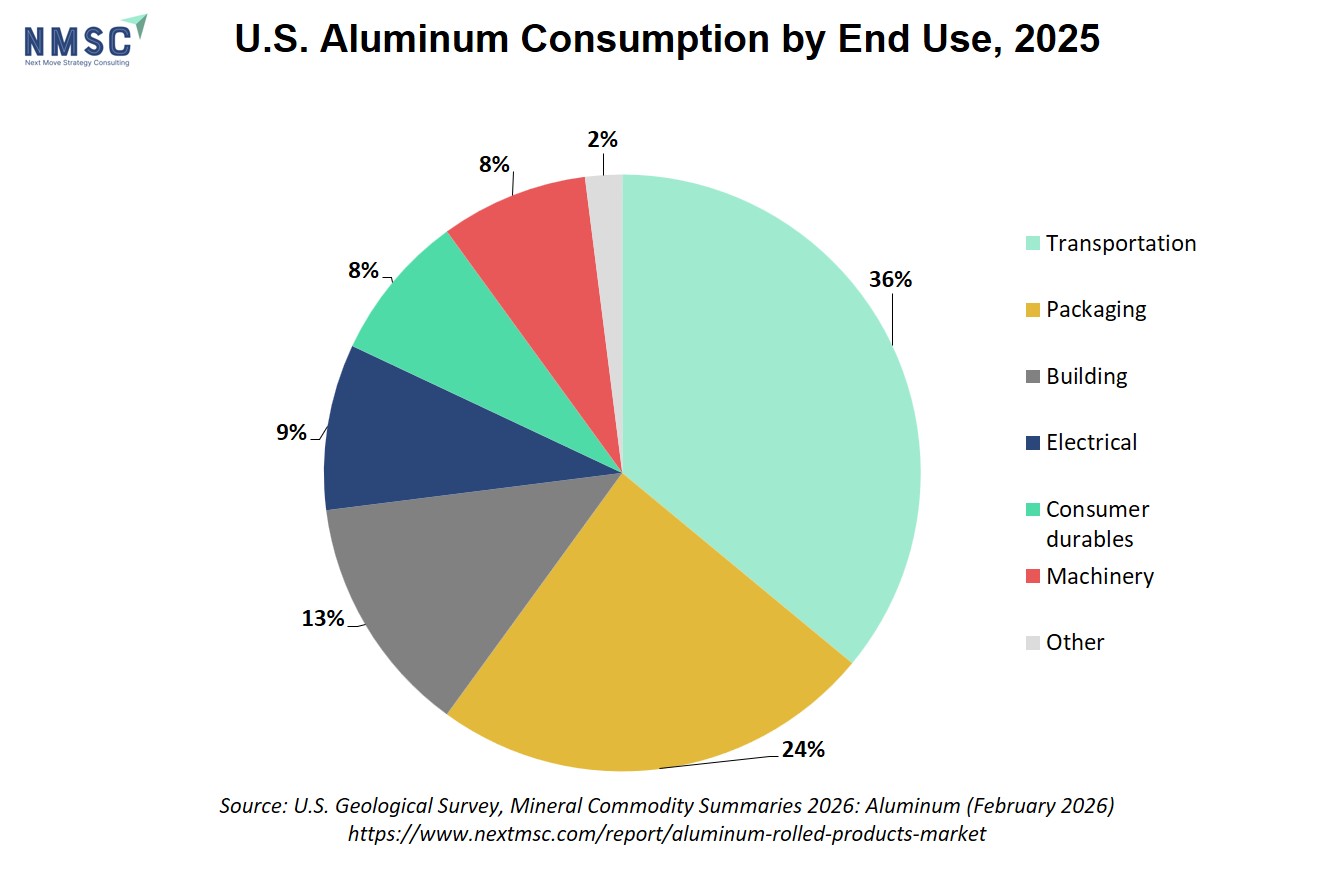
The U.S. Geological Survey reports that transportation applications accounted for 36% of U.S. aluminum consumption in 2025, followed by packaging at 24%, building at 13%, electrical at 9%, consumer durables at 8%, machinery at 8% and other uses at 2%. The shares cover all aluminum consumption and are not limited to rolled products.
Within those end uses the signals diverge. Novelis Inc. and Kaiser Aluminum Corporation reported higher packaging shipments while Constellium SE reported lower ones, and Constellium's higher North American automotive volumes mirror Novelis's lower automotive shipments as its Oswego plant restored output. Aerospace is the consistent strength across all three producers.
Section Summary:
Policy, carbon and energy costs now shape the aluminum rolled products market as much as end-use demand does, and each acts through a different channel: tariffs through import competition, CBAM through export access and scrap treatment, and coal and power through smelter cost.
-
The July 20, 2026 Section 232 incentive reduces duty on primary metal for approved plans, not on derivative articles.
-
Hindalco expects aluminum production costs to rise another 5% sequentially in its December quarter.
-
The EU Parliament's CBAM mandate covers more than 450 downstream product types, with a second and final trilogue provisionally set for November 30, 2026.
Pros and Cons of Recent Market Developments
|
Pros |
Cons |
|
New North American capacity, such as the Bay Minette plant that produced its first coil in September 2026, adds rolled supply near the shortage. |
Novelis Inc. reported net leverage of 4.7 times and a USD 1.8 billion half-year adjusted free cash flow outflow. |
|
Conversion economics are improving: Constellium's packaging and automotive EBITDA rose 98%. |
Kaiser's adjusted EBITDA margin fell to 19.1% from 23.2% on outages and start-up costs. |
|
Imports relieve shortages: Chinese flat-rolled shipments to the United States reached 208,000 tonnes in the first half of 2026. |
Import reliance exposes buyers to Section 232 and CBAM rule changes. |
|
Higher metal prices lift net sales per tonne, as Novelis's 25% sales rise shows. |
Hindalco expects another 5% sequential rise in production costs in its December quarter. |
Key Data & Statistics
Rolled Aluminum Producer Results, October to November 2026
|
Company |
Rolled Product Data Point |
Reported Change |
|
Novelis Inc. |
Rolled product shipments of 919 kilotonnes in Q2 fiscal 2027 |
Down 2% year on year |
|
Constellium SE |
Packaging & Automotive Rolled Products shipments of 266 thousand metric tons |
Down 3% year on year |
|
Kaiser Aluminum Corporation |
Shipments of 300 million pounds |
Up 11% year on year |
|
Hindalco Industries |
Aluminum downstream EBITDA of INR 329 crore |
Up 26% year on year |
Trade, Policy and Cost Reference Points
|
Indicator |
Value |
Basis |
|
Chinese flat-rolled exports to the United States, H1 2026 |
208,000 tonnes, against 55,000 tonnes a year earlier |
AL Circle |
|
Section 232 duty on most aluminum imports |
50% by June 2025 |
U.S. Geological Survey |
|
Primary aluminum onshoring incentive |
Half the Section 232 rate for approved plans |
Greenberg Traurig |
|
EU CBAM downstream scope, Parliament mandate |
More than 450 product types |
Mayer Brown |
|
Coal inventory at two Hindalco smelters |
10 to 11 days, against 20 to 25 normally |
Business Standard |
Future Outlook & Forecast
The Road to USD 112.5 Billion: What Must Hold for a 6.2% CAGR in the Aluminum Rolled Products Market
According to NextMSC primary research and analysis, the global aluminum rolled products market is expected to grow from USD 61.66 billion in 2025 to USD 65.48 billion in 2026 and to USD 112.5 billion by 2035, a CAGR of 6.2% across 2026 to 2035. That path adds USD 50.84 billion of annual value between the 2025 base year and 2035. NextMSC research links demand to lightweight material use in automotive, construction and packaging applications, and identifies fluctuation in raw material prices and high capital investment as the principal restraints.
The 2026 reporting season shows how each of those restraints now appears in company results. Raw material volatility is visible in Hindalco's coal-driven 5% sequential cost increase and in the rise in the three-month aluminum price reported by Norsk Hydro from USD 3,076 to USD 3,170 per tonne. High capital intensity is visible in the USD 1.54 billion of half-year capital expenditure and 4.7 times net leverage at Novelis Inc.
Near-Term Catalysts to Monitor
-
Bay Minette commercial shipments: Novelis Inc. targets the first quarter of fiscal 2028.
-
Free cash flow: Novelis Inc. expects a return to positive free cash flow and the start of deleveraging toward the end of fiscal 2027.
-
CBAM negotiations: a second and final trilogue is provisionally scheduled for November 30, 2026, according to Mayer Brown.
-
Indian coal supply: Hindalco expects tightness to ease in its fourth quarter, with its own coal mines supplying around the middle of 2027.
-
Section 232 implementation: Commerce is authorized to approve primary aluminum onshoring plans under the July 20, 2026 proclamation.
Section Summary:
NextMSC projects the aluminum rolled products market to reach USD 112.5 billion by 2035 at a CAGR of 6.2%, and the near-term test of that path is whether North American capacity, led by Bay Minette, arrives before the current supply gap closes through imports.
-
NextMSC base-year value of USD 61.66 billion in 2025 rises to USD 65.48 billion in 2026.
-
Raw material cost and capital intensity, the two restraints NextMSC identifies, are both visible in 2026 company results.
-
Policy milestones on Section 232 and CBAM will shape the regional distribution of growth.
Next Steps for Stakeholders
For C-Level Executives and Procurement Leaders
Secure North American sheet supply early. Novelis Inc. and Constellium SE both describe shortages of automotive rolled product in the region, so buyers that rely on spot or import volumes face the greatest exposure. Talks with mills inside North America should start before Bay Minette ships commercially.
Model tariff and carbon scenarios on landed cost. Section 232 duty on primary metal can be halved for approved plans, derivative articles receive no equivalent relief, and CBAM could cover more than 450 product types. Run landed-cost scenarios for each outcome.
Track conversion cost, not only metal price. Hindalco expects another 5% sequential rise in production costs, so supplier agreements that pass through metal but fix conversion terms deserve review.
For Institutional Investors
Underwrite capacity by location and balance sheet. Novelis Inc.'s 4.7 times net leverage during a USD 1.54 billion half-year capital program shows that the upside of regional scarcity is paired with financing risk until free cash flow turns positive.
Compare margin per tonne rather than volume. Constellium's segment EBITDA rose 98% on 3% lower shipments, and Kaiser's margin fell despite 11% higher shipments, so tonnage alone is a poor guide to profitability.
Follow the policy calendar. The CBAM trilogue date of November 30, 2026 and Commerce's approval of onshoring plans are the next events likely to change regional pricing assumptions.
Conclusion
The aluminum rolled products market is expanding globally, yet the clearest commercial signals of late 2026 come from a regional shortage: higher net sales on lower tonnage at Novelis Inc., nearly doubled packaging and automotive earnings at Constellium SE, and a 278% rise in Chinese flat-rolled shipments to the United States. Tariff design, carbon border rules and energy costs will decide how long that scarcity pricing persists.
According to NextMSC primary research and analysis, the market is projected to grow from USD 61.66 billion in 2025 to USD 112.5 billion by 2035 at a CAGR of 6.2%. Participants that align capacity, recycling access and contract structure with where the shortages sit are best placed to capture that growth.
About the Author
 Priyanshu Das
— Priyanshu Das is SEO Executive at Next Move Strategy Consulting, where he has led on-page and off-page SEO, keyword research, and SEO audits for the firm's B2B market research publications for 2 years. His audit process combines technical crawl analysis, backlink profile review, and competitor keyword gap mapping — using tools including Screaming Frog and Google Search Console — to prioritize fixes by organic search-visibility impact, informed by his own prior in-house and agency SEO experience.
About the Reviewer
 Sanyukta Deb
— Sanyukta Deb is Digital Marketing Team Lead at Next Move Strategy Consulting, where she has led content strategy and technical SEO for the firm's B2B market research publications for over 2 years. Her editorial process translates NextMSC's primary and secondary research — spanning technology, industrial, and consumer sectors — into commercial narratives, backed by search-intent, keyword, and competitive analysis. She brings 5 years of overall experience in digital marketing and content strategy.














Add Comment