How AI Is Pushing Data Centers Toward Immersion Cooling Solutions | NextMSC
Introduction
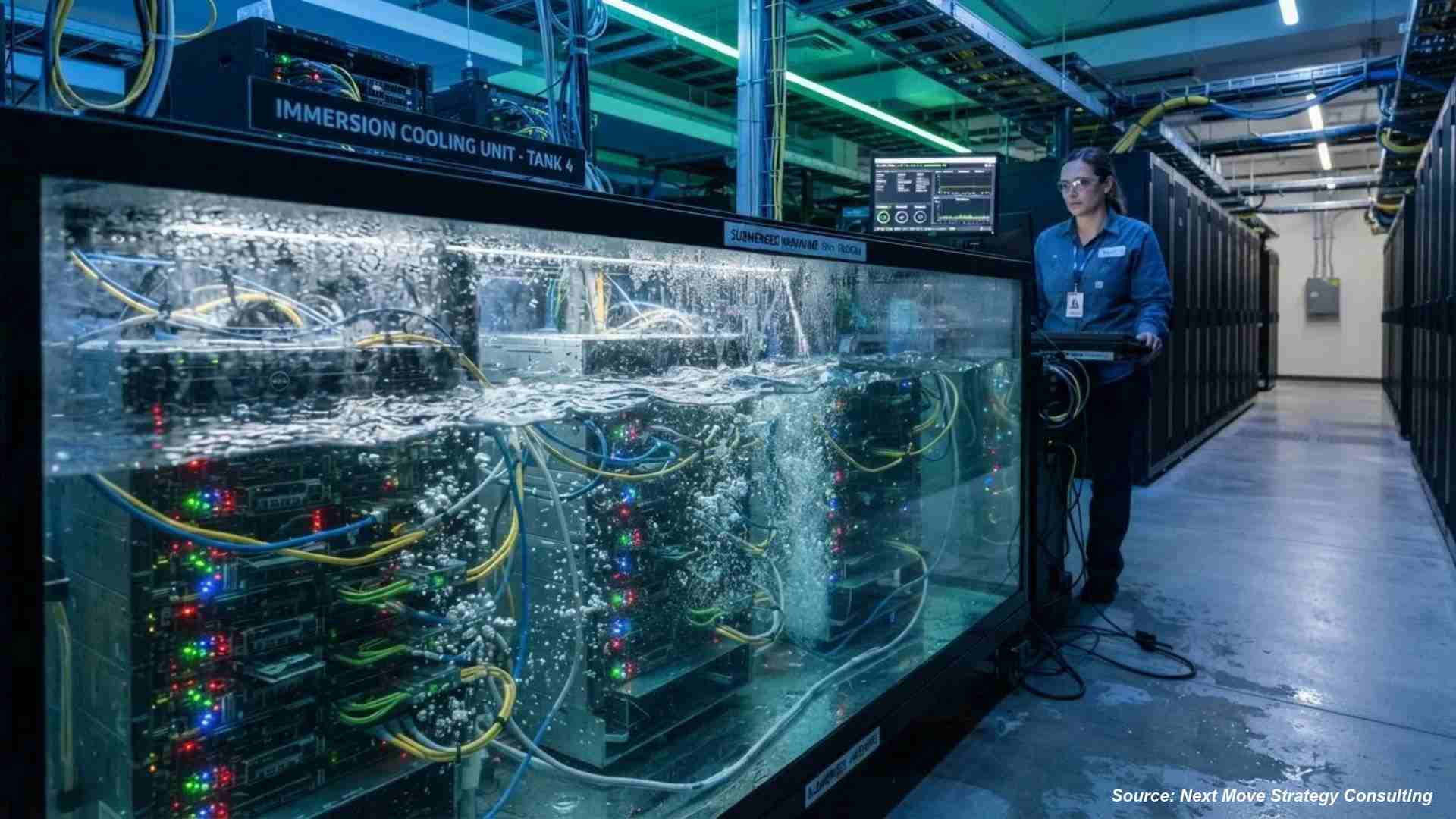
The global data center industry is confronting a thermal inflection point. As AI training clusters and high-performance computing (HPC) racks routinely exceed 30–100 kW per rack — densities that conventional air-cooling infrastructure was never engineered to handle — operators are accelerating their transition to liquid-based thermal management. Immersion cooling, which submerges servers and IT hardware directly in dielectric fluid to extract heat at the component level, has moved from a niche HPC solution to a strategic infrastructure imperative.
According to Next Move Strategy Consulting's Immersion Cooling Market report, the global immersion cooling market is projected to reach USD 1.37 billion by 2030, growing at a CAGR of 23.2% from 2023 to 2030. This trajectory is not driven by incremental efficiency preferences — it is being forced by the physics of AI compute, the regulatory pressure on energy and water consumption, and the accelerating obsolescence of air-cooled data center design.
The International Energy Agency (IEA), in its "Energy and AI" report, projects that global data center electricity consumption will nearly double from approximately 415 TWh in 2024 to 945 TWh by 2030, with AI inference workloads alone accounting for almost half of that net increase. When a single AI chip consumes 2–4 times more watts than its conventional counterpart, the cooling system is no longer a facility utility — it is a competitive differentiator.
For More Information: Download FREE Sample on Immersion Cooling Market Report
When Physics Overrules Convention: The AI Rack Density Crisis Reshaping Cooling Strategy
The Moment Air Cooling Reached Its Limit
The structural break in data center cooling strategy became undeniable in 2026. According to the AFCOM State of the Data Center Report, AI workloads currently account for 15% of data center compute but are projected to reach 40% by 2030. Average rack density has grown from 6.1 kW nine years ago to 16 kW today, yet AI deployments routinely demand 30–100 kW per rack — a threshold at which air cooling becomes physically incapable of maintaining safe operating temperatures without prohibitive floor space and energy overhead. Only 20% of data center operators are currently prepared to support the 50–70 kW per rack required for AI workloads.
This density gap is the primary commercial engine behind immersion cooling adoption. Liquid immersion cooling achieves a Power Usage Effectiveness (PUE) of 1.03–1.08, compared to 1.50–1.80 for conventional air-cooled facilities — a 40–50% energy efficiency gain at high-density deployments. At a 64-rack deployment scale, immersion cooling delivers a 10-year total cost of ownership (TCO) of USD 28 million versus USD 42 million for air cooling — a USD 14 million delta driven by reduced power infrastructure, eliminated CRAC units, and lower cooling energy spend.
The UNICOM–GRC Deployment: Industrial-Scale Immersion Goes Turnkey
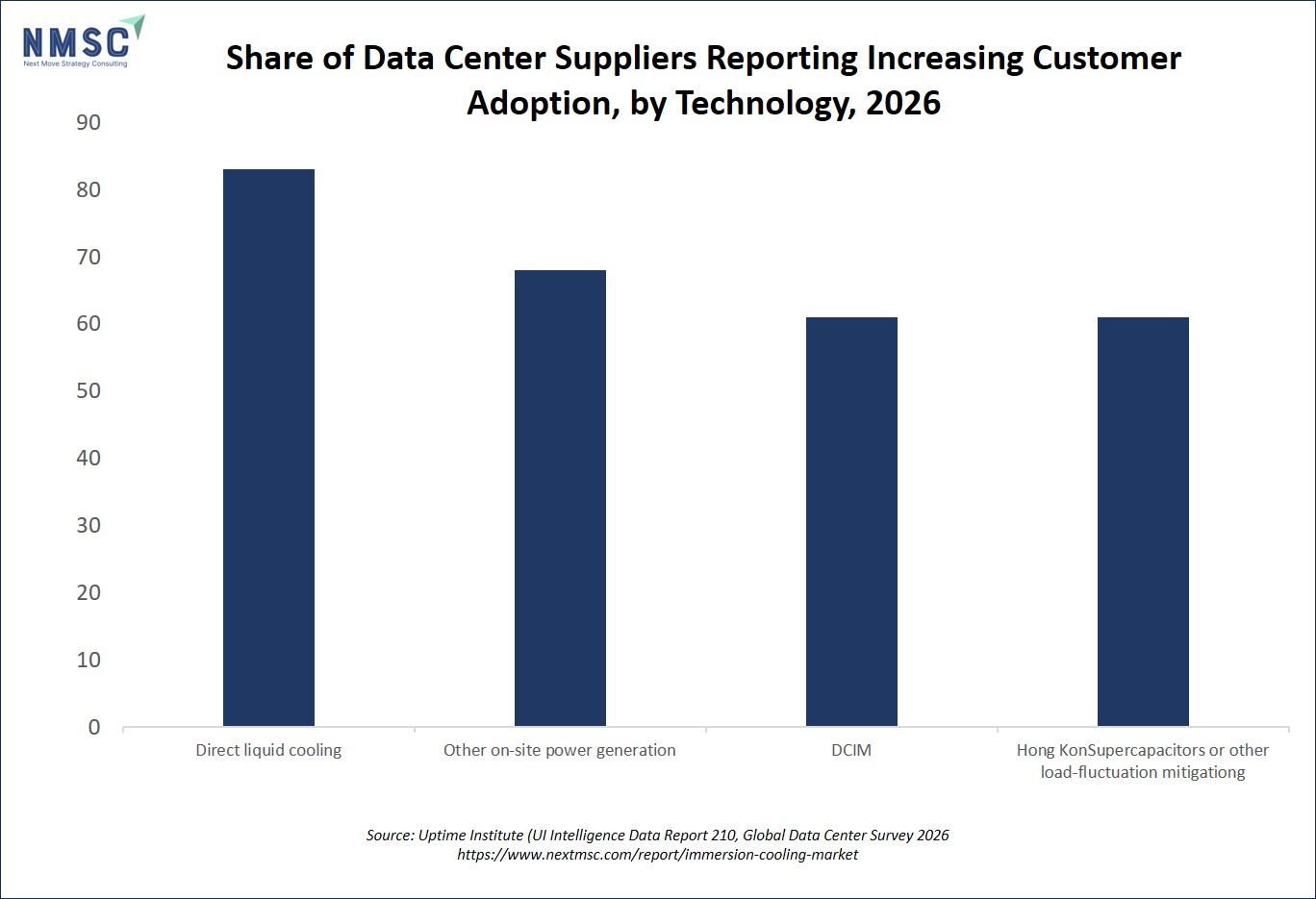
One of the most consequential commercial developments in the immersion cooling sector in 2026 was the March 10 announcement by UNICOM Engineering and Green Revolution Cooling (GRC) of a fully integrated, turnkey immersion-cooled AI solution targeting GPU-as-a-Service, HPC, and industrial data center deployments on factory production lines, remote depots, and distributed warehouse environments. This partnership directly addresses the adoption barrier that has historically constrained immersion cooling to specialist operators: the complexity of integrating dielectric fluid systems with standard server hardware at scale. By delivering pre-validated, factory-configured immersion tanks with GRC's ElectroSafe® fluid and UNICOM's compute platforms, the collaboration compresses deployment timelines and removes the need for on-site fluid engineering expertise.
This was followed in July 2026 by Mindstream Jordan LLC's expansion of its sovereign AI platform through strategic collaboration with GRC, extending immersion-cooled AI infrastructure into the Middle East — a region where ambient temperatures make air cooling economically unsustainable for high-density AI workloads.
NMSC Strategic Perspective: The Convergence of AI Density and Regulatory Pressure
NextMSC primary research and analysis identifies two simultaneous forces compressing the adoption timeline for immersion cooling beyond what market forecasts based solely on compute density trends would suggest.
First, the regulatory environment is no longer neutral. The U.S. Environmental Protection Agency's designation of per- and polyfluoroalkyl substances (PFAS) as "forever chemicals" under the Comprehensive Environmental Response, Compensation, and Liability Act (CERCLA) has effectively halted the commercial expansion of two-phase immersion cooling systems that rely on fluorocarbon-based dielectric fluids. The Toxic Substances Control Act (TSCA) reporting deadline for PFAS use has been extended to January 31, 2027, but the trajectory toward phase-out is unambiguous. 3M's discontinuation of Novec production — the dominant fluorocarbon fluid in two-phase systems — has already redirected procurement decisions toward single-phase mineral oil and synthetic fluid alternatives, which carry no PFAS exposure. This regulatory pressure is not slowing immersion cooling adoption; it is redirecting it toward single-phase configurations and PFAS-free synthetic fluids, which NextMSC analysis identifies as the fastest-growing segment within the immersion cooling fluid category.
Second, the European Commission's September 21, 2026 proposal for a common energy and water rating scheme for EU data centers, combined with its simultaneous launch of a public consultation on minimum performance standards, creates a compliance-driven procurement cycle that will structurally advantage immersion-cooled facilities. Operators building or retrofitting EU data centers between now and the final publication of minimum performance standards (planned for Q2 2027) face a binary choice: invest in immersion or liquid cooling infrastructure now, or risk stranded assets when compliance thresholds are set.
Section Summary: The immersion cooling market's growth is being driven by a specific, measurable failure of air cooling at AI rack densities above 30 kW, compounded by PFAS regulatory pressure on fluorocarbon-based fluids and EU minimum performance standards that will mandate energy and water efficiency reporting for large data centers.
Key Takeaways:
-
AI rack densities of 30–100 kW have rendered air cooling physically inadequate for next-generation HPC and AI inference deployments.
-
Immersion cooling achieves PUE of 1.03–1.08 versus 1.50–1.80 for air cooling, translating to a USD 14 million TCO advantage at 64-rack scale over 10 years.
-
The EPA's PFAS designation and 3M's Novec phase-out are redirecting two-phase immersion demand toward single-phase, PFAS-free configurations.
-
The European Commission's September 2026 data center rating scheme and minimum performance standards consultation will create compliance-driven procurement cycles favoring liquid-cooled infrastructure.
Industry Impact Analysis
The U.S. Legislative Signal: Liquid Cooling for AI Act of 2025
On November 20, 2025, U.S. Senator David McCormick (R-PA), joined by Senators Coons, Budd, and Schiff, introduced S.3269 — the Liquid Cooling for AI Act of 2025 — directing the U.S. Comptroller General to conduct a comprehensive technology assessment of liquid cooling systems for AI compute clusters and HPC facilities. The Senate Energy and Natural Resources Subcommittee on Energy held hearings on the bill on April 15, 2026. The bill's findings explicitly state that data centers accounted for 4.4% of total U.S. electricity consumption in 2023 — up from 1.9% in 2018 — and are projected to represent between 6.7% and 12.8% of total U.S. electricity consumption by 2028, per the 2024 Lawrence Berkeley National Laboratory (LBNL) Data Center Energy Usage Report.
The legislative significance extends beyond the assessment itself. The bill mandates the establishment of a Liquid Cooling Advisory Organization under the Secretary of Energy, signals federal procurement interest in liquid-cooled AI infrastructure, and positions immersion cooling as a national energy security and AI competitiveness issue — not merely a data center engineering preference. For immersion cooling vendors, this creates a credible pathway to federal government contracts and Department of Energy facility deployments.
Water Stewardship: Microsoft's Zero-Water AI Cooling Milestone
The water consumption implications of AI data center expansion have become a material ESG and operational risk. U.S. data centers consumed approximately 17 billion gallons of water in 2023, with 84% used by hyperscale and colocation facilities, according to the Lawrence Berkeley National Laboratory. Direct water consumption in hyperscale data centers alone is projected to reach 16–33 billion gallons annually by 2028.
Microsoft's June 2026 disclosure provides the most detailed public benchmark for what advanced cooling technology can achieve at hyperscale. The company reduced its average Water Use Effectiveness (WUE) from 2.3 liters per kilowatt-hour (L/kWh) in its early data center fleet to 0.27 L/kWh in 2025 — a nearly 90% reduction — through continuous cooling technology innovation. In 2024, Microsoft introduced a new AI-optimized data center design that consumes zero water for cooling during operations, using a closed-loop, direct-to-chip cooling system that recirculates water without evaporation.
Immersion cooling using dry cooler heat rejection eliminates 95–98% of water consumption compared to traditional evaporative cooling towers. For operators in water-stressed regions — including the U.S. Southwest, the Middle East, and parts of Southeast Asia — this water elimination capability is not a sustainability preference; it is a site viability requirement.
The EU's Data Center Rating Scheme: A Compliance Catalyst
The European Commission's September 21, 2026 proposal for a common EU-wide rating scheme for data centers, combined with the simultaneous launch of a public consultation on minimum performance standards (open until December 14, 2026), represents the most consequential regulatory development for the European immersion cooling market since the Energy Efficiency Directive. The Commission's own projections indicate that global data center electricity consumption is set to more than double toward 945 TWh by 2030, driven primarily by AI workloads, and the EU aims to triple its data center capacity by 2035. The rating scheme will make PUE, water usage effectiveness, and renewable energy consumption publicly comparable across EU facilities — creating direct commercial pressure on operators running air-cooled infrastructure with PUE above 1.5 to accelerate liquid cooling transitions.
Cooling Trends Reshaping Data Center Design in 2026
Data center cooling is changing faster than at any point in the last decade, with liquid cooling moving from niche high-end deployments to mainstream adoption. Improvements in dielectric fluids — focusing on environmental safety and better thermal performance — are addressing current adoption barriers, while two-phase cooling is seeing more use as engineers refine ways to manage its complexity for ultra-high-density systems.
Section Summary: The immersion cooling market is being shaped by converging legislative, regulatory, and operational forces — from the U.S. Liquid Cooling for AI Act to the EU's data center rating scheme — that are transforming cooling technology selection from an engineering decision into a compliance and ESG imperative.
Key Takeaways:
-
The U.S. Liquid Cooling for AI Act of 2025 (S.3269) positions immersion cooling as a national AI competitiveness and energy security priority, with Senate committee hearings held in April 2026.
-
U.S. data centers consumed ~17 billion gallons of water in 2023; immersion cooling with dry cooler heat rejection eliminates 95–98% of that water consumption.
-
Microsoft's 2024 AI data center design achieves zero on-site water consumption through closed-loop, direct-to-chip cooling — establishing the benchmark for next-generation facility design.
-
The EU's September 2026 data center rating scheme and minimum performance standards consultation will make PUE and WUE publicly comparable, creating direct commercial pressure on air-cooled operators.
Pros and Cons of Recent Market Developments
|
Recent Development |
Pros |
Cons |
|
PFAS Regulation & Novec Phase-Out |
Accelerates adoption of PFAS-free single-phase immersion cooling; aligns with ESG mandates; reduces long-term regulatory liability for operators |
Disrupts two-phase immersion cooling supply chains; increases R&D costs for alternative fluid development; creates short-term fluid availability uncertainty |
|
EU Data Center Rating Scheme (Sept 2026) |
Creates compliance-driven demand for immersion cooling across EU; enables transparent PUE/WUE benchmarking; incentivizes energy-efficient facility design |
Compliance timelines (final standards Q2 2027) create investment uncertainty; smaller operators may face disproportionate reporting burdens |
|
U.S. Liquid Cooling for AI Act of 2025 |
Signals federal procurement interest; potential for DOE facility deployments; establishes advisory body to standardize best practices |
Bill remains in committee stage; no binding mandates yet; assessment timeline may lag commercial deployment cycles |
|
Turnkey Immersion Solutions (UNICOM–GRC, March 2026) |
Reduces deployment complexity; expands addressable market to non-specialist operators; accelerates industrial and edge deployments |
Pre-configured systems may limit customization for unique thermal profiles; vendor lock-in risk for fluid and hardware ecosystems |
|
Hyperscaler Zero-Water Cooling Designs |
Eliminates water consumption risk in water-stressed regions; reduces WUE to near-zero; strengthens ESG reporting |
High upfront capital expenditure; requires full facility redesign for retrofits; limited applicability to legacy colocation environments |
Key Data & Statistics
Immersion Cooling vs. Air Cooling — Operational Performance Benchmarks
|
Performance Metric |
Immersion Cooling |
Air Cooling |
Source |
|
Power Usage Effectiveness (PUE) |
1.03–1.08 |
1.50–1.80 |
Energy Solutions, 2026 |
|
Water Consumption Reduction |
95–98% less than evaporative cooling |
Baseline (evaporative towers) |
Energy Solutions, 2026 |
|
10-Year TCO (64-rack scale) |
USD 28 Million |
USD 42 Million |
Adam Silva Consulting, 2026 |
|
Maximum Rack Density Supported |
100+ kW per rack |
~15–20 kW per rack (practical limit) |
CoolIT Systems, Feb 2026 |
|
U.S. Data Center Electricity Share (2023) |
— |
4.4% of total U.S. electricity |
LBNL, 2024 (via S.3269) |
|
Projected U.S. Data Center Electricity Share (2028) |
— |
6.7%–12.8% of total U.S. electricity |
LBNL, 2024 (via S.3269) |
|
Global Data Center Electricity (2024) |
— |
~415 TWh (1.5% of global total) |
IEA, "Energy and AI," 2025 |
|
Global Data Center Electricity Projection (2030) |
— |
~945 TWh |
IEA, "Energy and AI," 2025 |
Future Outlook & Forecast
NMSC Market Forecast: USD 1.37 Billion by 2030
NextMSC primary research and analysis projects the global immersion cooling market to grow from USD 0.25 billion in 2022 to USD 1.37 billion by 2030, at a CAGR of 23.2%. This growth trajectory reflects the compounding effect of three structural forces: the irreversible shift toward AI-optimized data center architecture, the regulatory elimination of PFAS-based cooling fluids, and the emergence of energy and water efficiency mandates that make immersion cooling a compliance requirement rather than a performance preference.
North America: Regulatory and Hyperscaler-Led Demand
North America dominates the global immersion cooling market, driven by the concentration of hyperscale data center operators, the legislative momentum of the Liquid Cooling for AI Act, and the density of AI compute infrastructure in markets such as Northern Virginia, Phoenix, and the Pacific Northwest. The U.S. Department of Energy's identification of 16 federal sites for data center and AI infrastructure deployment creates an additional procurement channel for immersion cooling vendors with federal contracting capabilities.
Asia-Pacific: The Fastest-Growing Regional Market
Asia-Pacific represents the highest-growth regional opportunity within the immersion cooling market, driven by the rapid expansion of AI data center capacity in India, China, Japan, and Southeast Asia. Amazon Web Services has announced a USD 6 billion investment in Malaysia by 2037, and a USD 5 billion investment in Thailand, while Google has committed to a USD 1 billion facility in Thailand. In markets where ambient temperatures routinely exceed 35°C, the energy cost of air cooling is prohibitive at AI rack densities, making immersion cooling the economically rational default for new hyperscale builds.
Competitive Landscape: Manufacturing Scale and Modular Deployment
The competitive landscape is consolidating around operators with manufacturing scale and modular deployment capabilities. LiquidStack opened its second manufacturing facility in Carrollton, Texas in March 2025 and unveiled its MicroModular™ and MegaModular™ turnkey product lines, directly targeting operators who require rapid, standardized deployment without custom engineering. Schneider Electric's October 2024 agreement to acquire a 75% stake in Motivair — a U.S. liquid-cooling specialist — positions it to deliver end-to-end liquid cooling portfolios for AI and HPC workloads through its global data center channel. Vertiv's CoolLoop product family and Vertiv™ OneCore prefabricated infrastructure target the same AI/HPC rack density segment with hybrid liquid-air approaches.
The GRC ICEraQ™ Nano, launched in November 2025, extends immersion cooling to edge deployments in small data rooms and communications closets — delivering up to 13 kW of cooling in a 10U form factor without chilled water infrastructure — opening a segment of the market that was previously inaccessible to immersion technology.
Section Summary: The immersion cooling market's path to USD 1.37 billion by 2030 is supported by hyperscaler capital deployment in Asia-Pacific, federal procurement signals in the U.S., EU compliance mandates in Europe, and a competitive landscape that is rapidly commoditizing turnkey deployment through modular product architectures.
Key Takeaways:
-
NextMSC projects the global immersion cooling market to reach USD 1.37 billion by 2030 at a 23.2% CAGR, driven by AI compute density, PFAS regulation, and energy efficiency mandates.
-
Asia-Pacific is the fastest-growing regional market, with hyperscaler investments exceeding USD 11 billion committed across Malaysia, Thailand, and Indonesia.
-
The competitive landscape is consolidating around modular, turnkey deployment models — GRC's ICEraQ™ Nano, LiquidStack's MicroModular™/MegaModular™, and Schneider Electric's Motivair-backed portfolio.
-
The EU's planned minimum performance standards (final publication Q2 2027) will create a compliance-driven procurement cycle that structurally advantages immersion-cooled EU data center operators.
Next Steps for Stakeholders
For Data Center Operators and Hyperscalers:
Conduct a rack-level thermal audit to identify deployments already operating above 20 kW per rack. For any planned AI or HPC expansion above 30 kW per rack, model the 10-year TCO of immersion cooling against air cooling before committing to facility design. Given the EU's September 2026 rating scheme proposal and the PFAS reporting deadline of January 31, 2027, operators with EU facilities or fluorocarbon-based cooling systems should initiate fluid transition assessments immediately.
For Institutional Investors and Infrastructure Funds:
The immersion cooling market's 23.2% CAGR through 2030, per NextMSC primary research and analysis, is underpinned by non-discretionary demand from AI infrastructure build-out and regulatory compliance — not cyclical IT spending. Evaluate exposure to immersion cooling vendors with manufacturing scale, PFAS-free fluid portfolios, and modular deployment capabilities, as these characteristics will determine which players capture the compliance-driven procurement cycles emerging from EU minimum performance standards.
For Immersion Cooling Vendors:
The PFAS phase-out creates a product differentiation window for vendors with validated PFAS-free single-phase fluid ecosystems. Prioritize fluid certification programs, interoperability with major GPU and CPU OEM cold plate designs, and federal contracting capabilities to capture the U.S. government procurement channel signaled by the Liquid Cooling for AI Act. Edge deployment — as demonstrated by GRC's ICEraQ™ Nano — represents an underpenetrated segment with lower competitive intensity than hyperscale.
For Policymakers and Regulatory Bodies:
The EU's minimum performance standards consultation (open until December 14, 2026) and the U.S. Liquid Cooling for AI Act's advisory committee process both represent active windows for industry input. Immersion cooling vendors and data center operators should engage these processes to ensure that performance standards are calibrated to technology capabilities rather than legacy air-cooling baselines.
Conclusion
The immersion cooling market is not growing because operators prefer it — it is growing because the physics of AI compute, the regulatory trajectory on PFAS and energy efficiency, and the water stewardship imperatives of hyperscale data center operation have collectively made air cooling an inadequate solution for the infrastructure demands of the next decade. According to NextMSC primary research and analysis, the market will reach USD 1.37 billion by 2030 at a 23.2% CAGR, with North America leading and Asia-Pacific growing fastest. The convergence of the U.S. Liquid Cooling for AI Act, the EU's September 2026 data center rating scheme, and the PFAS reporting deadline of January 2027 means that the strategic decisions operators and investors make in the next 12–18 months will determine their competitive and compliance positioning for the remainder of the decade. For C-level executives and institutional decision-makers, the question is no longer whether to transition to immersion cooling — it is how quickly the transition can be executed without stranding existing air-cooled assets.
About the Author
 Sanyukta Deb
— Sanyukta Deb is Digital Marketing Team Lead at Next Move Strategy Consulting, where she has led content strategy and technical SEO for the firm's B2B market research publications for over 2 years. Her editorial process translates NextMSC's primary and secondary research — spanning technology, industrial, and consumer sectors — into commercial narratives, backed by search-intent, keyword, and competitive analysis. She brings 5 years of overall experience in digital marketing and content strategy.
Sanyukta Deb
— Sanyukta Deb is Digital Marketing Team Lead at Next Move Strategy Consulting, where she has led content strategy and technical SEO for the firm's B2B market research publications for over 2 years. Her editorial process translates NextMSC's primary and secondary research — spanning technology, industrial, and consumer sectors — into commercial narratives, backed by search-intent, keyword, and competitive analysis. She brings 5 years of overall experience in digital marketing and content strategy.
About the Reviewer
 Debashree Dey
— Debashree Dey is Assistant Manager at Next Move Strategy Consulting, where she supports cross-vertical market content and communications across diverse industries for 6 years. Her professional background includes senior content writing, communications, and published manuscript authorship, with experience developing audience-focused business narratives and maintaining clear, consistent messaging. Her role supports research-led content development and editorial quality across NextMSC publications.
Debashree Dey
— Debashree Dey is Assistant Manager at Next Move Strategy Consulting, where she supports cross-vertical market content and communications across diverse industries for 6 years. Her professional background includes senior content writing, communications, and published manuscript authorship, with experience developing audience-focused business narratives and maintaining clear, consistent messaging. Her role supports research-led content development and editorial quality across NextMSC publications.
















Add Comment