AI-Driven Intelligence, Compliance-Centric Architectures, and Cloud-Led Transformation Reshaping the Europe ERP Software Market

Based on our ongoing engagement with enterprise IT leaders and digital transformation stakeholders, we observed that the Europe ERP software market is being redefined by a decisive shift toward AI-driven intelligence, compliance-centric system architectures, and cloud-first operational models. Unlike earlier phases that focused primarily on process automation and system consolidation, the current landscape is driven by enterprise demand for real-time business insights, regulatory-aligned data management, and scalable digital infrastructure. As operational complexity increases across multi-country environments, ERP platforms are evolving from transactional systems into intelligent, integrated decision-support ecosystems. Organizations increasingly prioritize solutions that enable continuous data visibility, audit-ready financial reporting, and seamless cross-functional coordination. Consequently, ERP vendors are positioning their platforms as strategic enablers of enterprise agility, governance, and data-driven decision-making across the European business environment.
According to Next Move Strategy Consulting, the Europe ERP Software Market size was valued at USD 36.40 billion in 2025, and is expected to be valued at USD 43.94 billion by the end of 2026. The industry is projected to grow, hitting USD 123.16 billion by 2035, with a CAGR of 12.13% between 2026 and 2035.
Want Insights on the Europe ERP Software Market? Access a FREE Sample Instantly
Are Next-Generation ERP Solutions Transforming Enterprise Oversight Across Europe?
Based on our structured analysis of enterprise system deployments across Europe, we observed that ERP software plays a central role in managing core business functions, including finance, supply chain, human resources, and operations across multi-country organizations. However, the role of ERP systems is evolving beyond traditional process integration. Enterprises increasingly prioritize centralized financial control, real-time data visibility, and standardized reporting frameworks to manage growing operational complexity. As a result, organizations are shifting toward ERP platforms that offer integrated analytics, cross-functional data synchronization, and strong governance capabilities. This transition enables enterprises to move from fragmented system environments towards unified, integrated digital ecosystems. Consequently, ERP solutions are strengthening their position as strategic platforms that support financial discipline, operational transparency, and enterprise-wide decision-making across the ERP software market in Europe.

Structural Factors Strengthening Competitive Differentiation Among ERP Vendors
Multiple converging factors are intensifying competitive differentiation across the Europe ERP software market. Based on our engagements with enterprise IT leaders and finance decision-makers, we noticed that increasing operational complexity across multi-country environments is driving demand for ERP systems capable of handling diverse regulatory, financial, and reporting requirements. In addition, organizations are prioritizing vendors that offer flexible, cloud-based platforms with embedded analytics and industry-specific functionalities. At the same time, the growing need for seamless integration across legacy systems, third-party applications, and digital tools is reshaping vendor selection criteria. As a result, ERP providers are strengthening their capabilities in API-driven integration, modular system design, and real-time data processing. Consequently, advanced analytics, scalability, and interoperability are emerging as critical differentiators, enabling vendors to address evolving enterprise requirements and maintain competitive positioning in the European market.
Are Compliance and Data Governance Now the Foundation of Enterprise ERP Platforms?
Based on our evaluation of enterprise IT strategies and regulatory environments across Europe, we assessed that compliance integration and data governance are becoming central priorities within ERP system adoption. Organizations operating across multiple jurisdictions must ensure adherence to regional data protection regulations, financial reporting standards, and audit requirements, which increases the importance of robust governance frameworks within ERP platforms. As a result, enterprises increasingly adopt systems with built-in compliance controls, standardized reporting structures, and secure data management capabilities. Furthermore, ERP vendors are embedding governance features directly into system architecture, enabling real-time monitoring, audit readiness, and transparent data handling. Consequently, organizations strengthen regulatory alignment, reduce compliance risks, and improve operational accountability. This shift positions ERP systems as critical enablers of governance, trust, and long-term operational resilience across the Europe ERP software market.

Company Developments and Strategic Positioning in 2025–2026
Between 2025 and 2026, competitive positioning in the Europe ERP software market is increasingly shaped by AI-led innovation, platform expansion, and intelligent automation capabilities across core enterprise functions. Based on our review of verified corporate announcements and strategic product developments, we evaluated that leading ERP vendors are reinforcing differentiation through embedded AI, financial intelligence, and autonomous workflow capabilities.
In November 2025, Sage Group PLC introduced AI-first innovations, including the Sage Intacct Finance Intelligence Agent and AI Trust Label, enhancing automation, transparency, and auditability in financial management processes. Also, in October 2025, Oracle launched AI agents integrated within its Fusion Cloud Applications, enabling end-to-end automation across ERP, HCM, and supply chain modules while supporting regulatory alignment in European environments. From our analytical observations, these developments indicate a clear shift toward AI-native ERP ecosystems, where intelligent automation, real-time decision support, and compliance-ready architectures are becoming central to competitive advantage across the Europe ERP software market.
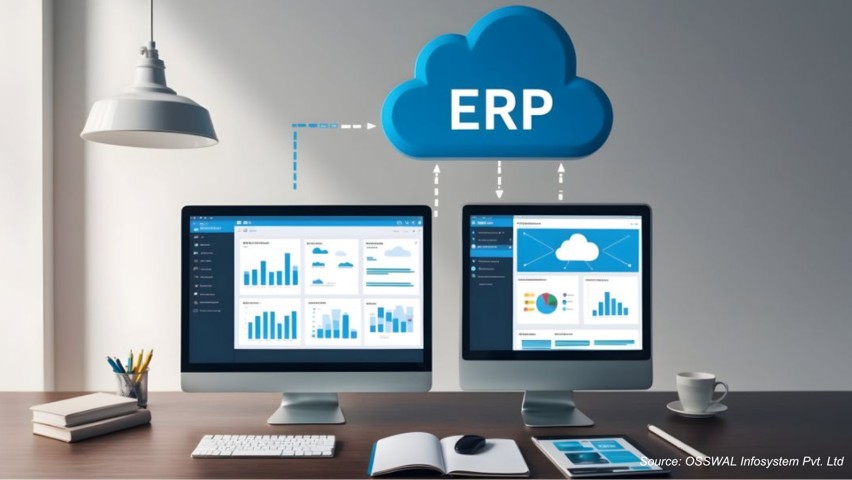
What Lies Ahead for AI-Enabled ERP Systems in Driving Enterprise Reinvention?
In conclusion, the Europe ERP software market is progressing toward a model anchored in intelligent automation, real-time decision support, and compliance-driven system architectures. Based on our industry assessment, we assessed that ERP vendors that combine AI-driven analytics, modular cloud platforms, interoperable data ecosystems, and governance-centric capabilities will be best positioned to support evolving enterprise requirements.
As operational complexity increases across multi-country environments and regulatory expectations continue to tighten, organizations are prioritizing ERP systems that deliver continuous visibility, standardized control, and scalable performance. This shift moves ERP beyond transactional system management toward becoming a strategic foundation for enterprise-wide coordination and data-driven decision-making. Consequently, vendors that enable measurable business outcomes, operational agility, and long-term system adaptability defines the next phase of growth and innovation across the Europe ERP software market.
About the Author
 Saista Faiyaz
— Saista Faiyaz is Research Associate at Next Move Strategy Consulting, where she has covered consumer markets and healthcare technologies for 3 years. Her work includes primary interview review, secondary-source validation, market sizing, and structured analysis of company and industry data. She supports research by comparing evidence across sources, organizing findings into market narratives, and documenting assumptions used in analysis. Her scope includes cross-market benchmarking, and reports.
Saista Faiyaz
— Saista Faiyaz is Research Associate at Next Move Strategy Consulting, where she has covered consumer markets and healthcare technologies for 3 years. Her work includes primary interview review, secondary-source validation, market sizing, and structured analysis of company and industry data. She supports research by comparing evidence across sources, organizing findings into market narratives, and documenting assumptions used in analysis. Her scope includes cross-market benchmarking, and reports.
About the Reviewer
 Sikha Haritwal
— Sikha Haritwal is an assistant manager with strong expertise in market research, data analysis, and cross-functional coordination. She plays a key role in leading complex research initiatives, strengthening analytical rigor, and enabling data-driven decision-making across teams. Known for her leadership mindset and structured problem-solving approach, she supports process improvement, enhances operational efficiency, and contributes to building scalable frameworks that drive long-term strategic outcomes and organizational effectiveness.
Sikha Haritwal
— Sikha Haritwal is an assistant manager with strong expertise in market research, data analysis, and cross-functional coordination. She plays a key role in leading complex research initiatives, strengthening analytical rigor, and enabling data-driven decision-making across teams. Known for her leadership mindset and structured problem-solving approach, she supports process improvement, enhances operational efficiency, and contributes to building scalable frameworks that drive long-term strategic outcomes and organizational effectiveness.
















Add Comment