AI, E-Commerce and ESG Transform Italy’s Electric Shaver Market | NextMSC
Introduction
Italy's grooming appliance sector is undergoing a structural shift — one driven not by incremental product updates, but by the convergence of artificial intelligence, changing household demographics, and a rapidly maturing digital retail infrastructure. According to Next Move Strategy Consulting's Italy Electric Shaver Market report, the Italy electric shaver market was valued at USD 563.2 million in 2025 and reached USD 607.2 million by 2026, with the industry projected to expand to USD 856.6 million by 2035, registering a CAGR of 3.90% over the forecast period. In volume terms, the market is expected to grow from 5 million units in 2025 to 9 million units by 2035, reflecting a volume CAGR of 5.61%, according to NextMSC primary research and analysis.
This divergence between value and volume growth rates is itself a market signal: Italian consumers are trading up. The average transaction value per unit is rising as AI-integrated, cordless, and multifunctional grooming devices displace entry-level shavers in both online and organized retail channels. For investors and brand strategists, the Italy electric shaver market presents a well-defined opportunity — one shaped by an ageing, appearance-conscious population, a digital commerce base of 35.2 million active online shoppers, and a competitive landscape where premium technology differentiation is becoming the primary battleground.
For More Information: Download FREE Sample on Italy Electric Shaver Market Report
When AI Meets the Razor: How Intelligent Grooming Technology Is Redefining Italy's Shaver Market
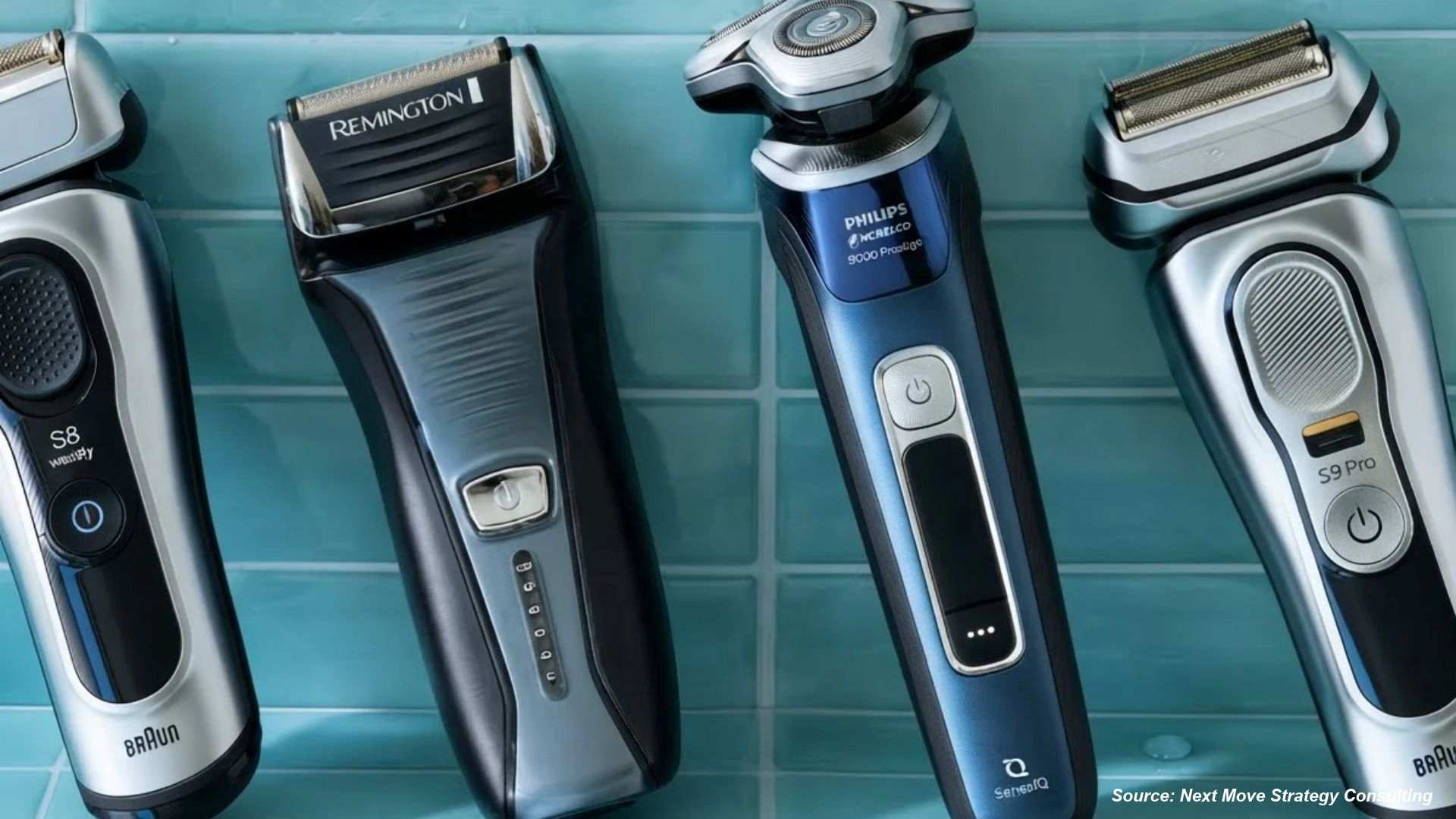
The Philips i9000 Launch: A Benchmark Moment for Premium Electric Shavers in Europe
On April 16, 2025, Royal Philips announced the global launch of its i9000 Shaver Series — comprising the i9000, i9000 Prestige, and i9000 Prestige Ultra — marking the most significant product architecture shift in the premium rotary shaver segment in over a decade.
The i9000 Prestige Ultra — Philips' flagship model — introduces SkinIQ PRO, an AI system that reads beard density 500 times per second and automatically adjusts cutting power to match individual hair thickness in real time. The device also features Active Pressure & Motion Guidance, which delivers real-time feedback on shaving technique via a companion app, and an AI Skin Analyzer that tracks 10 skin condition metrics. The i9000 Prestige Ultra's UV power charging pouch — the world's first of its kind — kills 99.9% of bacteria on the shaver surface while simultaneously providing six weeks of charge. The series earned a 2025 iF Design Award, one of the world's most prestigious product design recognitions.
For the Italy electric shaver market, the i9000 rollout carries specific commercial weight. Philips S.p.A. is among the most prominent players in Italy's grooming appliance sector, and the i9000 Series' European deployment — including Italy — directly targets the premium urban consumer segment in Lombardy, Lazio, and Veneto, where grooming appliance ownership rates are already high and replacement-cycle purchasing is the primary demand driver, per NextMSC primary research and analysis. The i9000's multi-tier pricing architecture (standard, Prestige, and Prestige Ultra) is designed to capture consumers at different willingness-to-pay thresholds, extending Philips' addressable market within Italy's existing electric shaver owner base rather than relying solely on first-time buyers.
Xiaomi's Mijia Ecosystem Enters Europe: A New Competitive Variable for Italy
In September 2026, Xiaomi made its most assertive European market statement to date at IFA 2026 in Berlin, officially announcing the large-scale expansion of its Mijia smart home brand across Europe. Xiaomi's IFA presence spanned over 3,300 square meters — the company's largest standalone overseas exhibition — featuring more than 380 products across 130+ categories under the "Art of Smart Living" positioning.
Xiaomi Technology Italy S.r.l. is already an active participant in Italy's grooming appliance market. The Mijia European expansion — which encompasses grooming products within its 2,000+ product portfolio — introduces a new competitive dynamic: affordable, app-connected grooming devices embedded within a broader smart home ecosystem. For Italian consumers who already use Xiaomi smartphones and smart home devices, the Mijia grooming range offers ecosystem lock-in that traditional grooming-only brands cannot replicate. This positions Xiaomi's Italian grooming business for accelerated growth in the online channel, where cross-category brand familiarity translates directly into conversion.
NMSC Strategic Perspective: What These Competitive Moves Mean for Italy's Market Structure
NextMSC primary research and analysis identifies a bifurcating competitive structure in the Italy electric shaver market. At the premium end, established players such as Philips S.p.A. and Panasonic Italia S.p.A. are investing in AI-driven personalization and skin-health integration to justify higher price points and extend replacement cycles. At the accessible-premium tier, Xiaomi Technology Italy S.r.l. is leveraging ecosystem connectivity and competitive pricing to capture digitally native consumers who prioritize value-for-technology over brand heritage.
This bifurcation is consequential for market volume growth. NMSC's analysis indicates that the volume CAGR of 5.61% — materially higher than the revenue CAGR of 3.90% — reflects unit growth being driven disproportionately by the accessible-premium and mid-market segments, where Xiaomi and value-oriented brands are gaining traction. Meanwhile, revenue growth is being anchored by premium and ultra-premium devices, where average selling prices are rising as AI features become standard rather than exceptional. The net effect is a market that is simultaneously expanding in units and premiumizing in value — a combination that supports sustained investment across the competitive spectrum.
Section Summary
The Italy electric shaver market's competitive landscape is being reshaped by two simultaneous forces: AI-driven premiumization at the top of the market and ecosystem-led accessible-premium expansion at the mid-tier. Philips' i9000 Series and Xiaomi's Mijia European push are not competing for the same consumer — they are collectively expanding the total addressable market.
Key Takeaways:
-
Philips' i9000 Prestige Ultra, launched April 2025, introduces SkinIQ PRO — an AI system reading beard density 500 times per second — setting a new technical benchmark for premium rotary shavers in Italy's replacement-cycle market.
-
Xiaomi's Mijia brand expansion at IFA 2026, covering 130+ product categories across a 3,300 sq. meter exhibition, introduces ecosystem-embedded grooming devices that leverage cross-category brand loyalty in Italy's online channel.
-
NMSC analysis identifies a volume CAGR (5.61%) materially exceeding the revenue CAGR (3.90%), signaling that unit growth is being driven by accessible-premium segments while revenue growth is anchored by AI-integrated premium devices.
-
The competitive bifurcation between premium-AI and accessible-ecosystem players is expanding Italy's total addressable market rather than redistributing a fixed pool of demand.
Industry Impact Analysis
Italy's Demographic Profile: Why an Ageing, Urbanizing Population Sustains Grooming Appliance Demand
Italy's demographic structure is a structural tailwind for the electric shaver market that is frequently underestimated in standard market analyses. According to Italy's National Institute of Statistics (ISTAT), as of January 1, 2026, Italy's resident population stands at 58 million 943 thousand individuals, with a mean age of 47.1 years — the highest median age in the EU27. People aged 65 and over account for 25.1% of the total population, the highest proportion in the European Union.
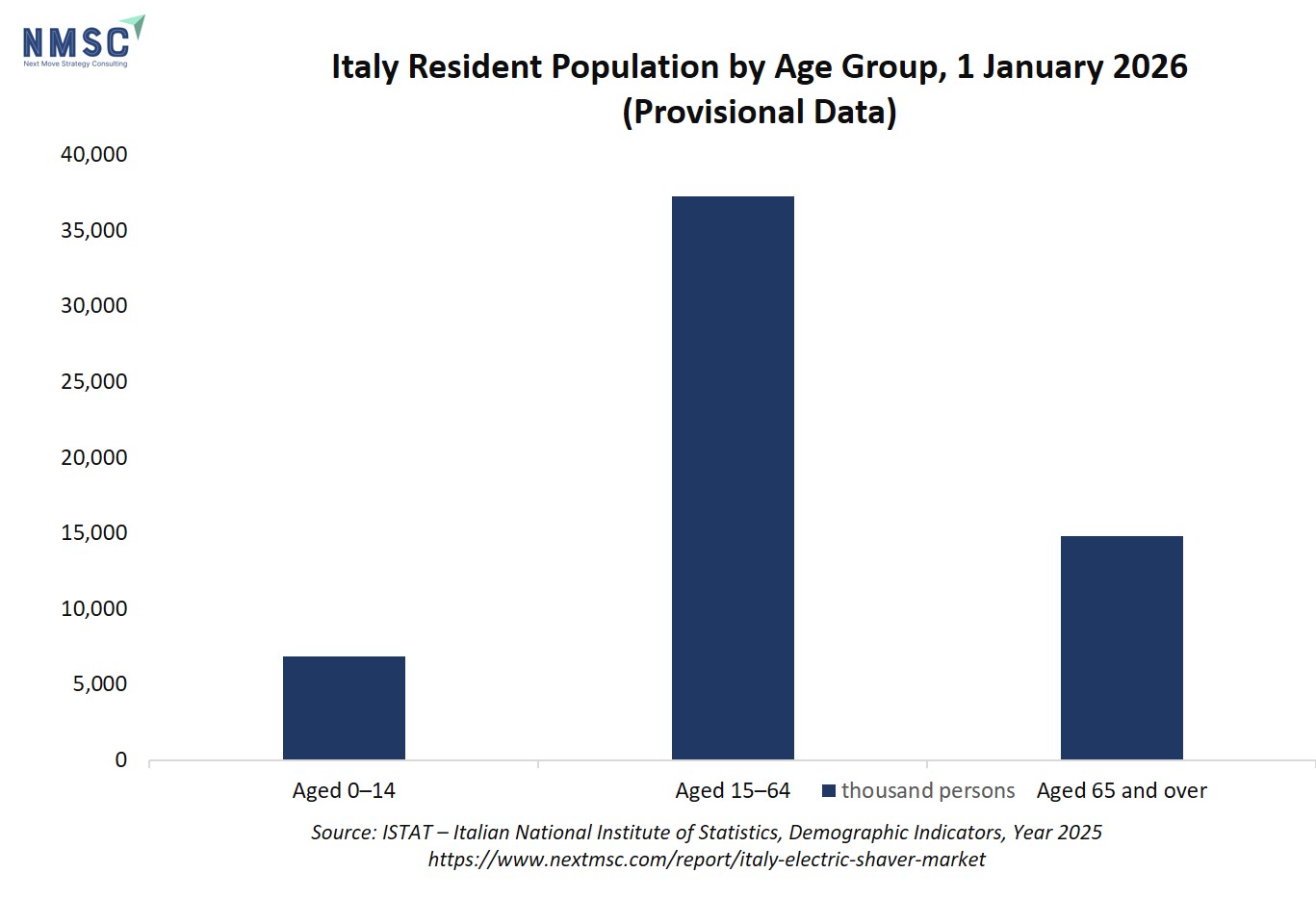
This demographic profile has a direct and measurable impact on grooming appliance demand. Older consumers — particularly men aged 55 and above — exhibit higher rates of electric shaver ownership than younger cohorts, driven by skin sensitivity concerns, reduced manual dexterity, and established grooming routines. Italy's life expectancy of 81.7 years for men and 85.7 years for women (ISTAT, 2025) means that the country's large older population represents a sustained, multi-decade demand base for electric shavers, not a temporary cohort effect.
Equally significant is the household structure shift documented by ISTAT: single-person households now account for 37.1% of all Italian households — the most common household type — up from 25.9% two decades ago. Single-person households purchase grooming appliances independently rather than sharing devices, directly increasing the number of individual grooming appliance units required per capita. In Lombardy, Emilia-Romagna, and Veneto — the regions with the highest population growth rates of +3.2‰, +3.4‰, and positive net migration respectively — single-person household formation is concentrated among working-age urban professionals, a demographic with above-average grooming appliance spending.
Italy's E-Commerce Infrastructure: The Distribution Channel Reshaping Grooming Appliance Access
Italy's B2C e-commerce market reached over €62 billion in 2025, growing approximately 6% year-over-year, according to the Osservatorio eCommerce B2c Netcomm – Politecnico di Milano. Beauty and personal care was the strongest-growth product category in 2025, expanding at 7% — outpacing the broader market — with 35.2 million Italians having made at least one online purchase during the year.
For the Italy electric shaver market, this e-commerce expansion has a specific structural effect: it is broadening consumer access to premium grooming appliances in regions where organized retail coverage is thinner. Consumers in Campania, Puglia, and Sicily — where health and beauty store density is lower than in northern Italy — can now access the full Philips, Panasonic, and Xiaomi grooming ranges through Amazon.it, MediaWorld's online platform, and brand direct-to-consumer channels. This geographic democratization of premium product access is a meaningful driver of volume growth in the market's mid-tier segments, per NextMSC primary research and analysis.
Mobile commerce is the dominant interface for this shift: 84% of Italians aged 18–74 browse via mobile daily, per Casaleggio Associati's 2025 data cited by the Politecnico di Milano / Netcomm research. Grooming appliance brands that have optimized mobile product pages, integrated digital wallet checkout (PayPal commands approximately 39% of Italian online payment preference), and deployed BNPL options through platforms such as Scalapay are capturing conversion that desktop-only or in-store-only strategies cannot reach.
The EU Ecodesign for Sustainable Products Regulation: A Compliance Imperative Reshaping Product Design
The EU's Ecodesign for Sustainable Products Regulation (ESPR), Regulation 2024/1781, entered into force in July 2024 and is establishing a new compliance framework for consumer electronics and personal care appliances sold across EU member states, including Italy. The regulation mandates product lifecycle transparency, resource efficiency, and environmental impact reduction, with the Digital Product Passport (DPP) — a QR-code-linked electronic system tracking product composition, repair requirements, and end-of-life handling — required to be registered in an EU-wide registry by July 2026.
For electric shaver manufacturers operating in Italy, the ESPR introduces both a compliance cost and a product differentiation opportunity. Brands that proactively design for repairability, use recycled materials in shaver housings, and provide transparent end-of-life instructions will be positioned to meet DPP requirements ahead of enforcement deadlines — and to communicate these credentials to Italy's growing segment of sustainability-conscious consumers. Philips' i9000 Series already incorporates paper-based packaging and a battery and motor engineered to last at least seven years, directly aligning with ESPR's durability and repairability objectives.
Section Summary
Three structural forces — Italy's ageing demographic profile, its maturing e-commerce infrastructure, and the EU's ESPR compliance framework — are reshaping demand patterns, distribution economics, and product design requirements in the Italy electric shaver market simultaneously.
Key Takeaways:
-
Italy's mean population age of 47.1 years and 25.1% share of residents aged 65+ (ISTAT, 2026) create a sustained, multi-decade demand base for electric shavers among older consumers with established grooming routines and skin-sensitivity requirements.
-
Single-person households — now 37.1% of all Italian households (ISTAT) — increase per-capita grooming appliance unit demand, with the highest concentration of single-person household formation in Lombardy, Emilia-Romagna, and Veneto.
-
Italy's B2C e-commerce market exceeded €62 billion in 2025 (Politecnico di Milano / Netcomm), with beauty and personal care growing at 7% — the fastest of any product category — broadening premium grooming appliance access in regions with lower organized retail density.
-
The EU ESPR (Regulation 2024/1781), with DPP registry requirements effective July 2026, is compelling electric shaver manufacturers to redesign for durability, repairability, and material transparency — creating a compliance-driven product innovation cycle.
Key Data & Statistics
Italy E-Commerce Market — Key Statistics Relevant to Grooming Appliance Distribution
|
Indicator |
Value |
Relevance to Electric Shaver Market |
|
Italian B2C E-Commerce Market Size (2025) |
€62 billion+ |
Primary distribution channel for premium grooming appliances |
|
B2C E-Commerce YoY Growth (2025) |
~6% |
Sustained channel expansion broadening grooming appliance reach |
|
Beauty & Personal Care Online Growth (2025) |
+7% |
Fastest-growing category; directly encompasses grooming appliances |
|
Active Online Shoppers in Italy (2025) |
35.2 million |
Total addressable online consumer base for electric shavers |
|
Daily Mobile Internet Usage (18–74 yrs) |
84% |
Mobile-first optimization imperative for grooming appliance brands |
|
Italy Resident Population (Jan 1, 2026) |
58.94 million |
Total consumer base; mean age 47.1 years |
|
Population Aged 65+ (Jan 1, 2026) |
25.1% of total |
Core demographic for electric shaver demand |
|
Single-Person Households (2024–2025) |
37.1% of all households |
Structural driver of per-capita grooming appliance unit demand |
Future Outlook & Forecast
The Decade Ahead: From Replacement-Cycle Dependence to Smart Grooming Ecosystem Growth
NextMSC primary research and analysis projects the Italy electric shaver market to reach USD 856.6 million by 2035, growing at a revenue CAGR of 3.90% from 2026. The volume trajectory — from 6 million units in 2026 to 9 million units in 2035 at a CAGR of 5.61% — indicates that unit growth will outpace revenue growth throughout the forecast period, reflecting the continued expansion of accessible-premium and mid-market segments alongside a premiumizing top tier.
Three specific mechanisms will shape this trajectory:
1. Smart Grooming Device Penetration Beyond Early Adopters
The Philips i9000 Series' AI personalization features — real-time beard density sensing, skin condition tracking, and motion guidance — represent the current frontier of smart grooming technology. As these features migrate from ultra-premium to mid-market price points over the forecast period (a pattern consistent with prior consumer electronics technology diffusion cycles), the addressable market for connected grooming devices in Italy will expand beyond the early-adopter segment concentrated in Milan, Rome, and Turin. NMSC's analysis identifies Lazio, Veneto, and Tuscany as the regions with the highest medium-to-long-term growth potential for smart grooming device penetration, driven by above-average digital engagement and organized retail infrastructure.
2. Women's Grooming Segment: An Underpenetrated Growth Opportunity
The Italy electric shaver market is segmented by end-user into men and women, per NextMSC primary research and analysis. The women's segment — encompassing electric shavers and body trimmers designed for female grooming routines — remains underpenetrated relative to the men's segment, representing a structural growth opportunity for brands that invest in product design, marketing, and retail placement tailored to female consumers. Italy's growing focus on personal care routines across both genders, combined with the expansion of health and beauty store distribution, positions the women's segment for above-market growth through the forecast period.
3. EU ESPR Compliance as a Product Innovation Catalyst
The Digital Product Passport registry requirement, effective July 2026 under EU Regulation 2024/1781, will compel electric shaver manufacturers to document material composition, repairability, and end-of-life handling for all products sold in Italy and across the EU. Brands that treat ESPR compliance as a product design discipline — rather than a documentation exercise — will be positioned to differentiate on sustainability credentials in a market where Italian consumers are demonstrating increasing environmental awareness. This regulatory pressure is expected to accelerate the transition toward longer-lasting, repairable grooming appliances, which in turn supports higher average selling prices and improved brand loyalty metrics.
Section Summary
The Italy electric shaver market's growth through 2035 will be driven by smart device technology diffusion, women's segment expansion, and ESPR-driven product innovation — not by population growth or first-time buyer acquisition in a market where urban ownership rates are already high.
Key Takeaways:
-
NextMSC projects the Italy electric shaver market to reach USD 856.6 million by 2035 at a 3.90% revenue CAGR, with volume growing from 6 million to 9 million units at a 5.61% CAGR — indicating accessible-premium segment expansion driving unit growth while AI-integrated premium devices anchor revenue.
-
Smart grooming device features (AI skin analysis, real-time motion guidance, UV hygiene systems) will migrate from ultra-premium to mid-market price points over the forecast period, expanding the connected grooming addressable market beyond early adopters in Italy's major metropolitan areas.
-
The women's electric shaver and body trimmer segment represents a structurally underpenetrated growth opportunity, with health and beauty store expansion and targeted product development required to capture it.
-
EU ESPR's Digital Product Passport requirements (effective July 2026) will function as a product innovation catalyst, rewarding brands that design for durability and repairability with both regulatory compliance and consumer differentiation advantages.
Next Steps for Stakeholders
For Brand Manufacturers and Product Strategists:
The Italy electric shaver market's bifurcating competitive structure demands a deliberate portfolio architecture decision. Brands competing at the premium tier must invest in AI personalization features, skin-health integration, and ESPR-compliant product design to justify replacement-cycle purchasing among Italy's high-ownership urban consumer base. Brands targeting the accessible-premium and mid-market segments must prioritize mobile-optimized e-commerce presence, digital wallet payment integration (PayPal, Scalapay), and ecosystem compatibility — particularly as Xiaomi's Mijia expansion raises the bar for connected device value propositions in Italy's online channel.
For Retail and Distribution Partners:
The e-commerce channel's 7% growth in beauty and personal care (Politecnico di Milano / Netcomm, 2025) is not a temporary trend — it is a structural redistribution of grooming appliance purchasing from physical to digital touchpoints. Health and beauty stores and electronic stores retain their role in product demonstration and expert guidance, but omnichannel strategies that integrate in-store experience with online conversion are now the minimum competitive standard. Retailers in Campania, Puglia, and Sicily should prioritize online channel investment to capture demand that physical store density cannot serve.
For Investors and Private Equity:
The Italy electric shaver market's combination of a 3.90% revenue CAGR, a 5.61% volume CAGR, and a structurally ageing consumer base with high grooming appliance ownership rates presents a predictable, replacement-cycle-anchored revenue profile with upside from smart device premiumization. Investment theses should focus on brands with defensible AI technology differentiation, ESPR-compliant product portfolios, and established omnichannel distribution in Italy's northern regions — where population growth, single-person household formation, and digital commerce engagement are highest.
For Technology and Component Suppliers:
The Philips i9000 Series' AI sensor architecture — reading beard density 500 times per second and integrating UV hygiene technology — signals the direction of premium electric shaver hardware requirements through the forecast period. Suppliers of precision sensors, AI-capable microprocessors, UV LED components, and sustainable packaging materials should position Italy's grooming appliance OEM base as a priority customer segment, particularly as ESPR compliance requirements increase demand for traceable, recycled-content materials.
Conclusion
The Italy electric shaver market is not a mature, low-growth category in secular decline — it is a market in active technological transition, where AI-driven personalization, ecosystem connectivity, and regulatory-driven product redesign are collectively raising the value of each unit sold and expanding the addressable consumer base beyond traditional demographic boundaries. NextMSC primary research and analysis projects the market to grow from USD 607.2 million in 2026 to USD 856.6 million by 2035 at a 3.90% CAGR, with volume growth of 5.61% annually reflecting the accessible-premium segment's expanding contribution.
The competitive events of 2025 and 2026 — Philips' i9000 AI shaver launch, Xiaomi's Mijia European expansion at IFA 2026, and the EU ESPR's Digital Product Passport requirements — are not isolated developments. They are converging signals of a market where technology differentiation, distribution reach, and sustainability compliance are becoming simultaneous prerequisites for sustained competitive positioning. Stakeholders who treat the Italy electric shaver market as a replacement-cycle commodity business will underperform those who recognize it as a technology-driven consumer electronics category with a structurally supportive demographic base and a decade of compounding growth ahead.
About the Author
 Sanyukta Deb
— Sanyukta Deb is Digital Marketing Team Lead at Next Move Strategy Consulting, where she has led content strategy and technical SEO for the firm's B2B market research publications for over 2 years. Her editorial process translates NextMSC's primary and secondary research — spanning technology, industrial, and consumer sectors — into commercial narratives, backed by search-intent, keyword, and competitive analysis. She brings 5 years of overall experience in digital marketing and content strategy.
About the Reviewer
 Debashree Dey
— Debashree Dey is Assistant Manager at Next Move Strategy Consulting, where she supports cross-vertical market content and communications across diverse industries for 6 years. Her professional background includes senior content writing, communications, and published manuscript authorship, with experience developing audience-focused business narratives and maintaining clear, consistent messaging. Her role supports research-led content development and editorial quality across NextMSC publications.
















Add Comment