Air Coolers Market: How Pricier ACs and Clean Stock Shift Demand | NextMSC
Introduction
On October 29, 2026, Symphony Limited, the Ahmedabad-based evaporative air cooler maker, reported consolidated revenue of INR 275 crore for the September quarter, up 31% from INR 210 crore a year earlier, with consolidated EBITDA rising from INR 13 crore to INR 36 crore. The figures matter less than what management said about dealer stock. Chairman and Managing Director Achal Bakeri told investors on the Q2 FY27 earnings call that both company and channel inventory had been worked down by the end of the June quarter, so stock now being built ahead of the next summer is fresh production rather than leftover units from earlier seasons.
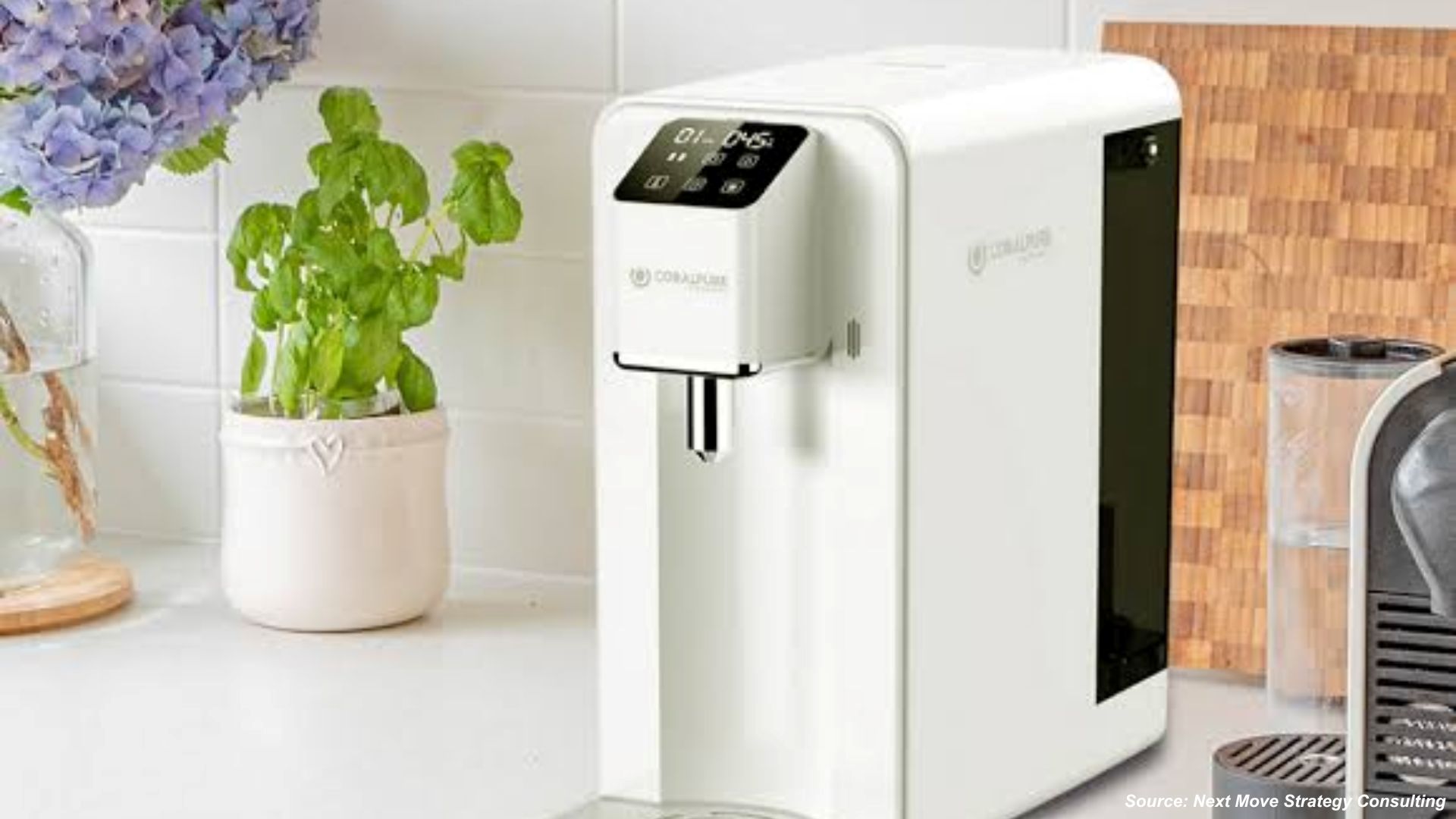
According to Next Move Strategy Consulting's Air Coolers Market report, the global air coolers market was valued at USD 1.93 billion in 2023 and is projected to reach USD 3.31 billion by 2030, growing at a CAGR of 7.5% from 2024 to 2030. That path adds USD 1.38 billion of annual value across seven years. The practical question for executives is no longer whether hot weather lifts sales. It is which structural forces decide who captures the increase when weather, prices and dealer stock all move at once.
For More Information: Download FREE Sample on Air Coolers Market Report
This analysis draws on company filings, India's official inflation release and NOAA's latest El Niño assessment to show how a cleaner channel, costlier air conditioners and a strengthening El Niño are changing the commercial logic of the air coolers market.
Clean Channels, Costlier Air Conditioners and a Building El Niño: The 2026 Signals Behind Air Cooler Demand
Symphony's October 29 Call: A Dealer Network Cleared for the Next Season
The Symphony Limited call of October 29, 2026, transcribed and filed with the National Stock Exchange of India and BSE Limited on November 3, 2026, is the most detailed recent disclosure from a listed air cooler specialist. Management reported consolidated profit after tax of INR 24 crore against INR 17 crore a year earlier. It also reported a consolidated EBITDA margin of 13% against 6.4% in the prior-year quarter, which management attributed to operating leverage, cost discipline and product mix.
The more instructive passage concerned inventory. Mr. Bakeri explained that during the June quarter the company deliberately let its own stock and its dealers' stock run down, even at the cost of near-term company sales, and moved units between channel partners to normalise holdings. Because the channel is now clean, he said, even a normal summer without exceptional temperatures should produce good sales across cooling categories. Dealers who carry no unsold stock from the previous season have no reason to discount at the start of the next one, which protects price realisation.
Symphony reported consolidated revenue of INR 378 crore for the June quarter ended June 30, 2026, up from INR 350 crore a year earlier, and a profit of INR 40 crore, according to Indian Television's report on the results announced on August 4, 2026. The report noted that the profit came despite softer cooling demand and higher advertising spend.
Down-Trading From Air Conditioners: What Appliance Executives Reported in 2026
The demand side was described most clearly by Kamal Nandi, Business Head and Executive Vice President of the Appliances Business at Godrej Enterprises Group, in remarks to the Press Trust of India published by Outlook Business on June 28, 2026. Mr. Nandi said air conditioner sales declined across the country in June, including north India, because unseasonal thunderstorms and cooler evenings reduced the need for cooling and because consumers were postponing discretionary purchases amid inflationary pressure.
He added that consumers were down-trading to air coolers and fans because air conditioners had become expensive, with prices up 18% to 20% over the last few years after several rounds of increases. This is a price-ladder effect. When the entry cost of a compressor-based product rises, a share of first-time cooling buyers can move one rung down to evaporative products, which NextMSC research notes need no installation and offer lower energy consumption.
Havells India Limited, whose electrical consumer durables portfolio includes air coolers, gave a consistent picture in its Q1 FY27 information update dated July 17, 2026. The company said the quarter had a decent summer but that a delayed onset restricted the full benefit for cooling products, and that it had taken calibrated and staggered price increases across categories to offset raw material inflation.
El Niño Strengthens: NOAA's November 12 Assessment
Weather remains the swing variable for every seasonal cooling category, and the November 12, 2026 ENSO Diagnostic Discussion from the NOAA Climate Prediction Center is the most authoritative current reading. NOAA reported that El Niño continues to strengthen, with the Niño-3.4 index at +2.5°C, the Niño-3 index at +3.6°C and the Niño-1+2 index at +4.4°C. It assigned a greater than 79% chance that a strong-to-very strong El Niño persists through January to March 2027, and roughly 60% odds of a historic event exceeding every El Niño since 1950 for the October-December and November-January periods.
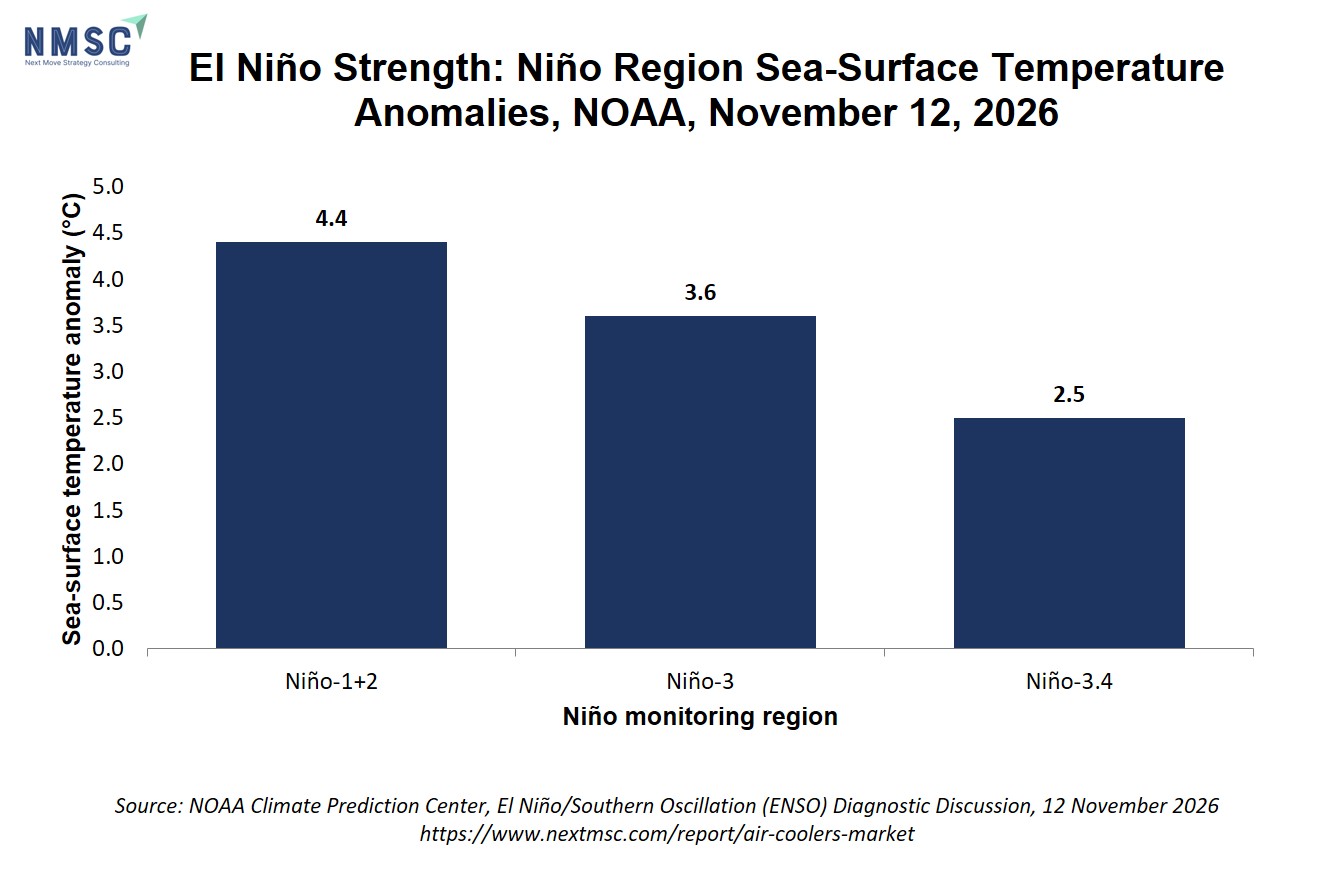
The NOAA Climate Prediction Center's ENSO Diagnostic Discussion of November 12, 2026 reports sea-surface temperature anomalies of +4.4°C in the Niño-1+2 region, +3.6°C in Niño-3 and +2.5°C in Niño-3.4. NOAA states that El Niño continues to strengthen and remains under an El Niño Advisory.
NOAA also cautioned that impacts consistent with El Niño are more likely under a very strong event but not guaranteed, and that the event is expected to begin weakening in early 2027. Mr. Bakeri echoed that caution on the Symphony call, describing El Niño as unpredictable and saying the company would not count on it lifting all categories. For planners, the disciplined reading is that El Niño raises the probability of heat, not the certainty of it.
NMSC Strategic Perspective: What the Air Coolers Market Is Pricing In
NextMSC primary research and analysis reads these disclosures as evidence that the growth thesis for air coolers is shifting from weather alone toward a combination of price position, inventory discipline and channel breadth. NextMSC primary research and analysis places Asia-Pacific at 43% of the global air coolers market with the highest growth rate to 2030, and finds China leading the regional pool with a 53% share. Asia-Pacific's weight means that Indian channel behaviour and Chinese manufacturing capacity both transmit quickly into global pricing.
The mechanism has three links. First, air conditioner price inflation widens the pool of buyers for whom an evaporative cooler is the rational first appliance. Second, clean dealer stock turns that wider pool into full-price sales instead of clearance sales, because retailers are not forced to liquidate. Third, manufacturers use the cooler network to carry additional categories, which Symphony's planned entry into room air conditioners, BLDC ceiling fans and air purifiers illustrates. The measurable test is whether the next season converts the larger pool at stable margins.
Section Summary:
Company filings and official data from June to November 2026 show a category whose demand is being shaped as much by price and inventory as by temperature.
-
Symphony Limited reported consolidated revenue of INR 275 crore for the September 2026 quarter against INR 210 crore a year earlier, and described a cleared dealer channel.
-
Godrej Enterprises Group's Kamal Nandi reported down-trading from air conditioners to air coolers and fans, with air conditioner prices up 18% to 20% in recent years.
-
NOAA's November 12, 2026 assessment gives a greater than 79% chance of a strong-to-very strong El Niño through January to March 2027, raising heat risk without guaranteeing it.
Industry Impact Analysis: How Costs, Inflation and Diversification Reach the Air Coolers Market
Input Costs and Price Increases
Cost pressure is visible at every listed manufacturer. Symphony Limited said consolidated gross margin fell by about 4% because of input cost pressure, yet protected its EBITDA margin through operating leverage. Havells India Limited stated in its July 17, 2026 update that it had raised prices in a calibrated, staggered manner to offset raw material inflation. Business Standard reported on October 20, 2026 that Nomura Research raised its FY27 revenue growth estimate for Crompton Greaves Consumer Electricals' electrical consumer durables and lighting business to 13% from 10% to 12%, explicitly factoring in price increases.
Crompton's electrical consumer durables segment, about 80% of its revenue, grew 19.2% in the September 2026 quarter, with Business Standard attributing the growth in BLDC fans to portfolio changes, wider distribution and consumer preference for energy-efficient products. The common thread is that manufacturers are passing costs through selectively rather than absorbing them, and that energy efficiency is becoming a purchase criterion in adjacent cooling categories.
Household Budgets: India's October 2026 Inflation Reading
The Ministry of Statistics and Programme Implementation reported on November 12, 2026 that India's retail inflation rose to 6.09% in October from 5.54% in September, crossing the Reserve Bank of India's upper tolerance limit of 6%. Rural inflation stood at 6.63% against 5.41% in urban areas, and food inflation reached 8.94%.
The rural gap deserves attention. Households facing the sharpest price increases are those for whom a low-cost appliance is most relevant, which strengthens the case for evaporative cooling. Stretched budgets can also defer purchases, as Mr. Nandi observed for air conditioners in June. Price points and financing terms, rather than features, are therefore likely to decide conversion.
Diversification: From Air Coolers to the Full Cooling Pyramid
Symphony's disclosures show the clearest strategic response to seasonality. Management said products and geographies that do not depend on the Indian summer, which it calls Beyond India Summer Products, contributed INR 625 crore and now make up 51% of consolidated top line. That group includes geysers, tabletop fans, exports from India and sales by overseas subsidiaries. Management said these businesses are EBITDA positive and use minimal capital.
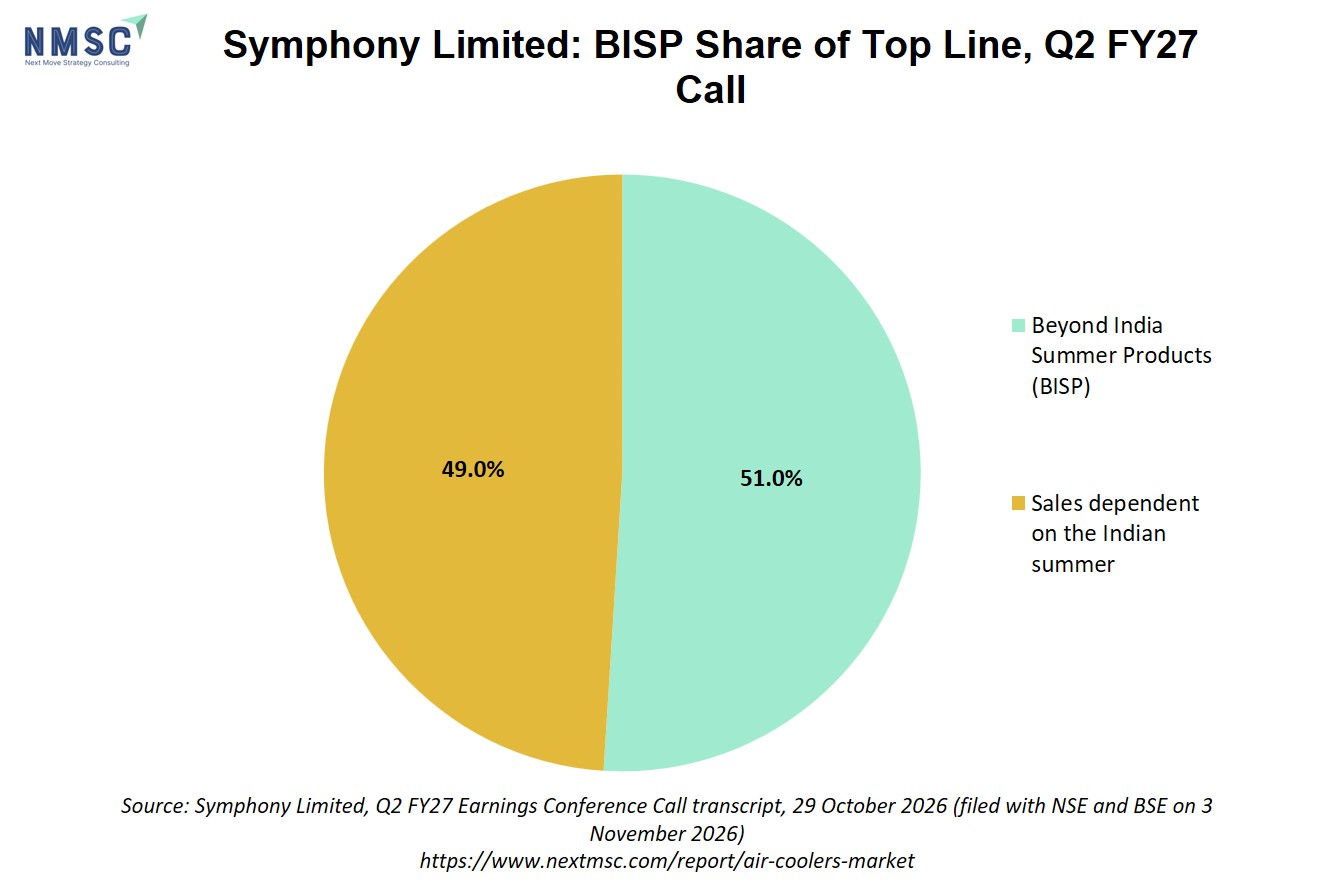
Symphony Limited's management reported that Beyond India Summer Products, defined as all products and geographies whose sales do not depend on the Indian summer, make up 51% of consolidated top line. The remaining 49% is the portion that does depend on the Indian summer, calculated as 100% minus the reported 51%.
In the December quarter of 2026 the company plans to launch room air conditioners, BLDC ceiling fans and air purifiers under an outsourced, asset-light model with zero capital expenditure for the air conditioners and fans. Management's stated rationale is that its dealers sell to consumers for only about two months each summer, so year-round categories would keep the trade engaged and benefit evaporative cooler sales.
Beyond India: Europe's Heatwave and Export Frictions
Cooling demand is also surfacing in markets that have historically under-invested in it. BusinessToday reported on July 4, 2026 that China's air conditioner exports to the European Union reached USD 3.76 billion in the first half of 2026, up 43.2% year on year, with portable units rising by more than 70%. Bloomberg, in a report carried by Business Standard on July 6, 2026, said Citigroup estimates that Midea Group's consumer air conditioning sales in Europe could grow by more than 20% year on year in the second quarter.
These figures concern air conditioners rather than evaporative coolers, but they show that installation-free, low-complexity cooling formats are winning new buyers. Symphony's overseas subsidiary in Mexico, IMPCO, reported September-quarter revenue of INR 40 crore against INR 17 crore a year earlier. Chief Growth Officer Rajesh Mishra added that the Middle East situation held back international growth, with customers who had paid in advance unable to receive shipments and freight costs rising.
Section Summary:
Costs, household inflation and diversification are now as important to the air coolers market as seasonal temperature.
-
Manufacturers are passing through raw material costs selectively, and Nomura Research lifted Crompton's FY27 segment growth estimate to 13% on price increases.
-
India's October 2026 retail inflation of 6.09%, with rural inflation at 6.63%, pressures the households most likely to buy air coolers.
-
Symphony Limited reports that Beyond India Summer Products now supply 51% of consolidated top line, reducing exposure to a single season.
Pros and Cons of Recent Market Developments
|
Pros |
Cons |
|
Air conditioner prices up 18% to 20% in recent years push price-sensitive buyers toward air coolers and fans, according to Godrej Enterprises Group. |
Rural inflation of 6.63% in October 2026 pressures the same households and can postpone discretionary purchases. |
|
Cleared dealer stock lets the next season start without clearance discounting, as Symphony Limited described. |
Seasonal demand is exposed to unseasonal rain and delayed summers, which restricted cooling sales in the June 2026 quarter. |
|
NOAA's November 12, 2026 outlook gives a greater than 79% chance of a strong-to-very strong El Niño through early 2027. |
NOAA states El Niño impacts are likely but not guaranteed, so heat-driven demand cannot be assumed. |
|
Diversification into fans, air conditioners and purifiers keeps dealers engaged year-round, which may spill over to cooler sales. |
Input cost pressure cut Symphony Limited's consolidated gross margin by about 4%, and price increases may test demand. |
|
Export markets such as Mexico show growth, with IMPCO revenue at INR 40 crore against INR 17 crore. |
Middle East disruption and higher freight costs delayed shipments, according to Symphony Limited management. |
Key Data & Statistics
The tables below consolidate the primary figures cited in this analysis, so readers can check each reading against its publisher and date. Company figures are in Indian rupees (INR) crore, where one crore equals ten million rupees, as reported by the companies.
Table 1: Symphony Limited consolidated performance, September quarter (INR crore)
|
Metric |
Q2 FY26 |
Q2 FY27 |
Change |
|
Consolidated revenue from operations |
210 |
275 |
+31% |
|
Consolidated EBITDA |
13 |
36 |
+23 crore |
|
Consolidated profit after tax |
17 |
24 |
+7 crore |
|
Standalone revenue |
155 |
170 |
+15 crore |
Table 2: Selected 2026 indicators affecting air cooler demand
|
Indicator |
Latest reading |
Publisher and date |
|
Niño-3.4 sea-surface temperature anomaly |
+2.5°C |
NOAA Climate Prediction Center, November 12, 2026 |
|
Chance of strong-to-very strong El Niño, January to March 2027 |
Greater than 79% |
NOAA Climate Prediction Center, November 12, 2026 |
|
India retail inflation, October 2026 |
6.09% (rural 6.63%, urban 5.41%) |
Ministry of Statistics and Programme Implementation, November 12, 2026 |
|
Air conditioner price increase over recent years |
18% to 20% |
Godrej Enterprises Group via Press Trust of India, June 28, 2026 |
|
Chinese air conditioner exports to the EU, first half of 2026 |
USD 3.76 billion, up 43.2% |
BusinessToday, July 4, 2026 |
|
Beyond India Summer Products share of Symphony consolidated top line |
51% |
Symphony Limited, October 29, 2026 |
Table 3: Timeline of developments shaping the air coolers market
|
Date |
Development |
Why it matters |
|
June 28, 2026 |
Godrej Enterprises Group reports down-trading from air conditioners to air coolers and fans |
Confirms a price-ladder effect in demand |
|
July 4, 2026 |
BusinessToday reports Chinese air conditioner exports to the EU at USD 3.76 billion |
Shows demand for installation-free cooling formats |
|
July 17, 2026 |
Havells India Limited reports a delayed summer onset and staggered price increases |
Links weather timing and cost recovery |
|
October 29, 2026 |
Symphony Limited reports a cleared channel and September-quarter revenue growth of 31% |
Signals disciplined starting stock for the next season |
|
November 12, 2026 |
NOAA reports a strengthening El Niño; MoSPI reports 6.09% retail inflation |
Raises heat odds while testing household budgets |
Future Outlook & Forecast: Reading the Air Coolers Market Into the Next Season
NextMSC's research model projects the global air coolers market to reach USD 3.31 billion by 2030 from USD 1.93 billion in 2023, a CAGR of 7.5% from 2024 to 2030, with Asia-Pacific holding the largest share and the highest growth rate. The recent disclosures do not change that trajectory. They clarify the conditions under which it is achieved: stable price realisation, clean dealer stock and a heat-supportive weather pattern that is probable but unconfirmed.
Three observable signals will indicate whether the next season converts those conditions into growth. The first is dealer sell-through in the opening weeks of the season, which will show whether down-trading is a durable behaviour or a one-season reaction to air conditioner prices. The second is manufacturer gross margin, which will show whether price increases are holding against raw material costs. The third is the NOAA Climate Prediction Center's December 10, 2026 discussion, which will update the odds on El Niño's strength before dealers finalise orders.
Strategically, Symphony Limited's entry into room air conditioners places an evaporative specialist across the cooling price ladder, and Chief Growth Officer Rajesh Mishra said the company does not foresee the new categories cannibalising air coolers. Whether that holds will depend on trade-channel execution, since management intends to use its existing dealer network and service franchise for all three launches.
Section Summary:
The forecast depends on conditions that company filings and NOAA data now make observable.
-
NextMSC projects USD 3.31 billion by 2030 at a 7.5% CAGR, with Asia-Pacific leading on both share and growth.
-
Dealer sell-through, gross margin and NOAA's December 10, 2026 update are the three signals to watch before the next season.
-
Multi-category expansion by cooler specialists will test whether year-round products reinforce or dilute the core business.
Next Steps for Stakeholders
-
Manufacturers: set production plans against dealer sell-through rather than last season's shipments, and hold price increases to the level that raw material costs justify, since Symphony Limited's September-quarter results followed a deliberate clean-up of channel stock.
-
Distributors and retailers: place orders in tranches linked to NOAA's December 10, 2026 update and early-season temperatures, and avoid carrying unsold units into a second season.
-
Investors: track gross margin and channel inventory commentary in company filings, because both Symphony Limited and Havells India Limited tie results to the timing of the summer and to raw material costs.
-
C-level executives in adjacent categories: evaluate whether cooler dealer networks can carry fans, air conditioners and purifiers, and test the economics under an asset-light, outsourced model before committing capital.
-
Export planners: build freight and payment-security contingencies for Middle East routes, where Symphony Limited reported that shipments were delayed after advance payments were received.
Conclusion
The air coolers market enters its next season with a configuration that differs from earlier years. Dealer stock is cleaner, air conditioner prices have pushed some buyers toward evaporative cooling, household budgets in rural India are under strain, and NOAA assigns high odds to a strong El Niño that may or may not translate into heat. NextMSC's projection of USD 3.31 billion by 2030 at a 7.5% CAGR remains the reference path, and these recent signals describe how fast the market can move along it.
Companies that manage inventory discipline, price position and channel breadth together are best placed to convert the next season, while those that depend on temperature alone carry the most exposure.
About the Author
 Sanyukta Deb
— Sanyukta Deb is Digital Marketing Team Lead at Next Move Strategy Consulting, where she has led content strategy and technical SEO for the firm's B2B market research publications for over 2 years. Her editorial process translates NextMSC's primary and secondary research — spanning technology, industrial, and consumer sectors — into commercial narratives, backed by search-intent, keyword, and competitive analysis. She brings 5 years of overall experience in digital marketing and content strategy.
About the Reviewer
 Debashree Dey
— Debashree Dey is Assistant Manager at Next Move Strategy Consulting, where she supports cross-vertical market content and communications across diverse industries for 6 years. Her professional background includes senior content writing, communications, and published manuscript authorship, with experience developing audience-focused business narratives and maintaining clear, consistent messaging. Her role supports research-led content development and editorial quality across NextMSC publications.












Add Comment