Top 5 Signs a Supplier Is All-in-One for Multi-SKU Brands

Adding a couple of new SKUs can quietly balloon a brand's dieline library, tooling budget, and warehouse footprint, and that complexity has real margin consequences for any team managing a growing product line. It is also, increasingly, a story about scale: the suppliers best equipped to absorb that complexity are consolidating fast, and 2026 has brought a wave of mergers, buyouts, and regulatory deadlines that is reshaping who those suppliers are. The packaging market is no longer just about material costs and lead times it is being redrawn by private equity, debt restructuring, and a hard compliance deadline in Europe.
This piece looks at what has actually changed: the size and trajectory of the market itself, the consolidation and product moves from twenty of its largest manufacturers over the past several months, and the verified data behind where all that packaging material ends up.
Packaging Market Snapshot: Size, Forecast, and Growth Drivers
The global packaging market was valued at USD 1.18 trillion in 2025, is estimated at USD 1.23 trillion in 2026, and is forecast to reach USD 1.95 trillion by 2035, expanding at a CAGR of 5.25% between 2026 and 2035. Growth is concentrated around rising e-commerce fulfillment and parcel shipment volumes, expanding food and beverage consumption in emerging economies, and continued growth in fiber-based and mono-material recyclable substitution. Extended producer responsibility and single-use plastics compliance costs remain the clearest restraint, disproportionately affecting smaller regional converters that lack the reformulation budget of diversified multinationals.
Packaging Market Snapshot, 2025–2035
|
Parameter |
Detail |
|
Market Size, 2026 |
USD 1.23 trillion |
|
Revenue Forecast, 2035 |
USD 1.95 trillion |
|
Growth Rate |
CAGR of 5.25% from 2026 to 2035 |
|
Base Year |
2025 (USD 1.18 trillion) |
|
Forecast Period |
2026–2035 |
|
Companies Profiled |
20 |
|
Countries Covered |
33 |
Section summary: the market's growth case rests on structural demand from e-commerce and emerging-market consumption, offset by a real and rising regulatory compliance bill.
-
USD 1.23T (2026) → USD 1.95T (2035) at a 5.25% CAGR
-
E-commerce fulfillment and emerging-market food and beverage demand are the primary growth drivers
-
Extended producer responsibility and plastics compliance costs are the clearest restraint, especially for smaller converters
Current Trends Reshaping the Packaging Market
The clearest driver behind this year's product announcements is a hard regulatory deadline: the EU's Packaging and Packaging Waste Regulation (Regulation (EU) 2025/40) applies from August 12, 2026 and requires traceable material data and recyclability metrics at the SKU level. Manufacturers are racing to get ahead of it. Tetra Pak committed €60 million to a pilot plant in Lund, Sweden, to scale a paper-based barrier that replaces the aluminum foil layer in aseptic cartons, part of a broader €100 million annual sustainable-packaging R&D commitment. ALPLA posted a record €5.2 billion in 2025 turnover and reaffirmed its €15 million annual recycling investment as it prepares for the EU's 2030 recycled-content mandates. Amcor's mono-material film portfolio and Smurfit Westrock's expanded molded-fiber capacity, both cited in the primary market report, reflect the same shift away from multi-layer laminates and rigid plastic toward simpler, more recyclable structures a shift Smurfit Westrock demonstrated at scale in July, when it partnered with Coca-Cola China on paper-based packaging formats for the brand's 2026 World Cup campaign.
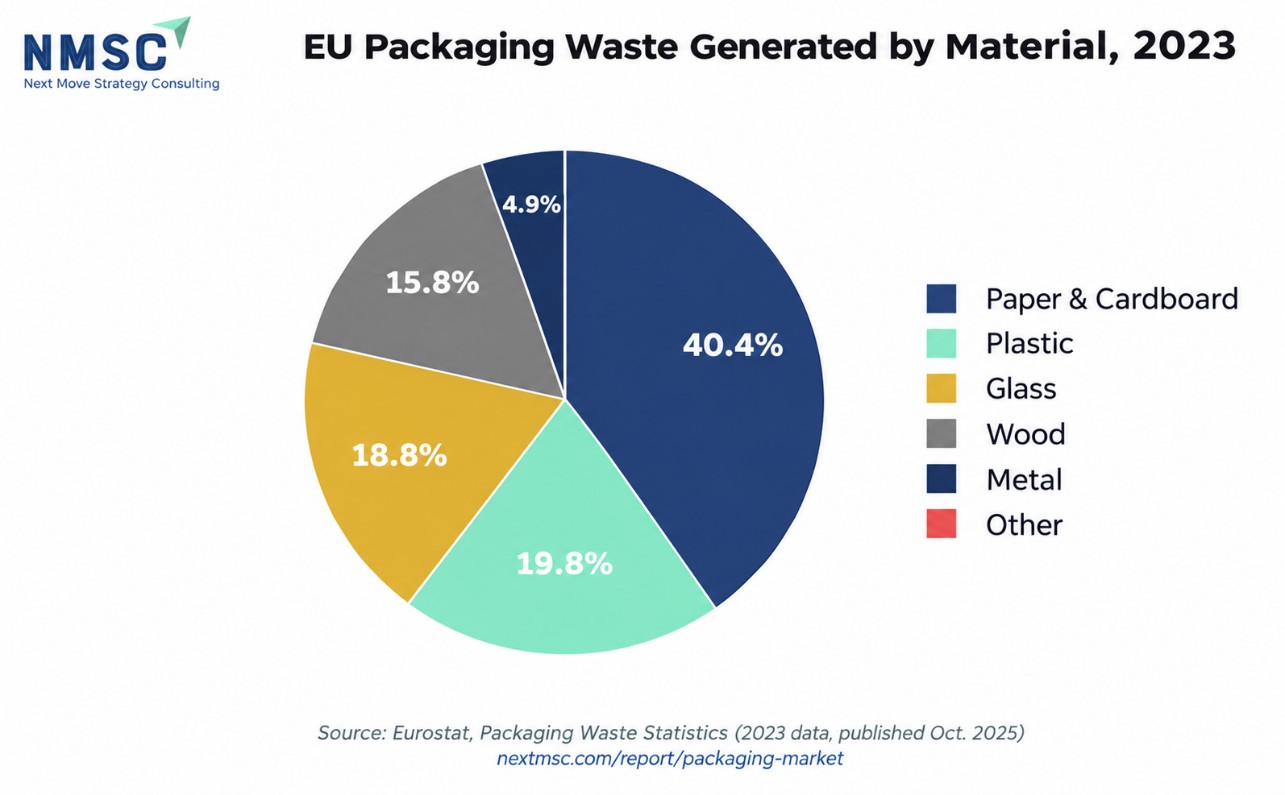
Paper and cardboard already make up the largest share of packaging waste generated in the EU, which is exactly why so much of the current R&D spending is aimed at fiber substitution rather than plastic redesign alone. For multi-SKU brands managing that transition across dozens of pack formats, the operational burden increasingly falls on one-stop packaging systems that keep dieline, material, and compliance data unified across a portfolio rather than scattered across individual supplier relationships.
Section summary: regulatory deadlines, not just cost, are now the primary force behind material innovation across the industry.
-
EU PPWR (Regulation (EU) 2025/40) takes effect August 12, 2026, requiring SKU-level recyclability data
-
Tetra Pak, ALPLA, Amcor, and Smurfit Westrock are all investing directly in fiber and mono-material substitution
-
Paper and cardboard already account for over 40% of EU packaging waste generated, the largest single category
Industry Impact: Consolidation and Capital Discipline
2026 has also been a year of significant ownership change. Sealed Air, the maker of Bubble Wrap and Cryovac, completed its acquisition by private equity firm Clayton, Dubilier & Rice at a $10.3 billion enterprise value in April, ending its run as a publicly traded company. Ardagh Group underwent a multibillion-dollar debt restructuring that a Luxembourg court confirmed in June after a group of dissenting bondholders lost their legal challenge, transferring the bulk of ownership to former unsecured creditors. Novolex continued rationalizing its footprint following the 2025 Pactiv Evergreen acquisition, closing plants in South Carolina and Virginia through the summer. And Packaging Corporation of America's acquired Greif containerboard business is now integrated enough to be reported as a distinct earnings contributor, adding $0.14 per share in the second quarter with synergies running ahead of target.
Not every deal has gone as planned. O-I Glass cut its full-year earnings guidance after furnace disruptions in France and the UK compounded an already difficult restructuring under its “Fit to Win” program, and Graphic Packaging saw quarterly net income fall sharply amid input-cost inflation even as it divested a Croatia facility and announced a Tennessee plant closure. As consolidation reshapes who supplies packaging, it is also reshaping demand for adjacent categories: the same e-commerce fulfillment volumes driving the primary market are fueling a distinct e-commerce packaging market built specifically around damage-resistant, right-sized parcel formats.
Packaging Industry Leader Moves, 2026
|
Company |
Most Recent Material Move |
Date |
Source |
|
Smurfit Westrock |
Partnered with Coca-Cola China on paper-based World Cup packaging formats spanning retail and e-commerce channels. |
July 2026 |
smurfitwestrock.com; Business Wire |
|
Amcor |
Reported FY26 net sales up 57% to $23.5B as Berry Global integration delivered $285M of year-one synergies, 9.6% ahead of target. |
Aug. 2026 |
Amcor 8-K; PlasticsToday |
|
International Paper |
Completed the $360M NORPAC mill acquisition and advanced plans to split into separate North America and EMEA public companies. |
June 2026 |
SEC 10-Q; PR Newswire |
|
Ball Corporation |
Announced a new can-manufacturing facility investment in Uttar Pradesh, India, its sixth consecutive quarter of global volume growth. |
Sept. 2026 |
investors.ball.com |
|
Crown Holdings |
Raised full-year adjusted EPS guidance to $8.30–$8.50 on 5% global beverage can volume growth; expanding capacity in Brazil, Greece, Spain and India. |
July 2026 |
Crown Holdings press release |
|
Tetra Pak |
Invested €60M in a Lund, Sweden pilot plant for paper-based aseptic carton barriers, replacing aluminum foil layers. |
Jan. 2026 |
Tetra Pak; Packaging Strategies |
|
Ardagh Group |
Completed a multibillion-dollar debt restructuring after a Luxembourg court rejected a dissenting bondholder challenge; ownership shifted to former creditors. |
June 2026 |
Irish Times; Bloomberg Law |
|
Novolex |
Continued post-merger footprint rationalization with plant closures in South Carolina and Virginia following the 2025 Pactiv Evergreen acquisition. |
May–Aug. 2026 |
Plastics News |
|
Packaging Corp. of America |
Reported Q2 net sales of $2.5B as its acquired Greif containerboard business added $0.14/share, with synergies ahead of the $30M annual target. |
July 2026 |
PCA press release; SEC 10-Q |
|
Graphic Packaging |
Q2 net income fell to $24M amid inflation headwinds; divested a Croatia facility and announced closure of its Lebanon, TN plant. |
Aug. 2026 |
PR Newswire; Simply Wall St |
|
Silgan Holdings |
Agreed to a roughly €838M acquisition expanding its dispensing and closures leadership, targeting €20M of synergies. |
Oct 2024 |
Silgan investor disclosures |
|
O-I Glass |
Cut FY26 adjusted EBITDA guidance to $1.0–$1.1B after furnace disruptions in France and the UK added to ongoing restructuring costs. |
July 2026 |
O-I Glass Q2 earnings release |
|
Mondi |
H1 results showed improving momentum on higher packaging paper prices after a 2025 net loss; capex guidance trimmed to €500M. |
July 2026 |
Mondi H1 2026 results |
|
Sonoco Products |
Q2 adjusted net income rose 10.6% as its portfolio simplification into two core segments concluded following the ThermoSafe divestiture. |
July 2026 |
Sonoco/BriefGlance |
|
ALPLA |
Reported record €5.2B 2025 turnover and reaffirmed €15M/year recycling investment ahead of EU PPWR recycled-content mandates. |
Jan. 2026 |
Plastics News |
|
Rengo |
Took an ¥18.9B impairment on its European Tri-Wall subsidiary amid an automotive-sector slowdown, cutting its FY guidance. |
April 2026 |
BigGo Finance (TDnet filing) |
|
Sealed Air |
Taken private by Clayton, Dubilier & Rice in a completed $10.3B enterprise-value deal, ending its NYSE listing. |
April 2026 |
Sealed Air; Seeking Alpha |
|
Toyo Seikan |
Its chemically recycled polypropylene material was adopted for a limited-run dressing line under a multi-company cap-recycling initiative. |
April 2026 |
PR Times |
|
Huhtamäki |
H1 net sales fell 3% on currency effects, but adjusted EBIT margin held at 10.1% and certified/recycled fiber use reached 99.1%. |
July 2026 |
Huhtamäki half-year report |
|
Oji Holdings |
Returned to quarterly profit as corrugated price revisions and the AustroCel Hallein biorefinery consolidation lifted results. |
Aug. 2026 |
Pulp and Paper Chronicle |
Section summary: capital structure, not just product innovation, is now a competitive differentiator across the packaging industry.
-
Sealed Air's $10.3B take-private by CD&R ended its public-company status in April 2026
-
Ardagh completed a multibillion-dollar debt restructuring after a Luxembourg court rejected dissenting bondholders
-
PCA's Greif integration and Novolex's post-Pactiv footprint work show consolidation gains take years to fully realize
Competitive Landscape: Regional and Segment-Specific Moves
Beyond the headline deals, most of the twenty largest packaging manufacturers posted a mixed but generally positive quarter. Ball Corporation announced a new can-manufacturing investment in Uttar Pradesh, India, its sixth straight quarter of global volume growth, while Crown Holdings raised its full-year guidance on 5% global beverage can volume growth and is expanding capacity across Brazil, Greece, Spain, and India both companies leaning further into aluminum packaging as a lower-carbon, highly recyclable substrate. International Paper completed its $360 million NORPAC mill acquisition and is advancing plans to split into separate North America and EMEA public companies. In Europe, Mondi's first-half results showed improving momentum on higher packaging paper prices after a difficult 2025, while Rengo took a ¥18.9 billion impairment on its European heavy-duty packaging subsidiary amid an automotive-sector slowdown. In Japan, Oji Holdings returned to quarterly profit on corrugated price revisions, and Toyo Seikan's chemically recycled polypropylene material was adopted for a limited-run retail product as part of a multi-company cap-recycling initiative.

That earnings spread Amcor's acquisition-driven 26% net sales growth at one end, Huhtamäki's currency-driven 3% decline at the other captures the two forces defining the sector right now: M&A is the fastest way to add scale, but organic demand remains uneven across regions and substrates. Vendors investing in packaging machinery and automated converting lines are best positioned to hold margin through that unevenness, and flexible packaging converters in particular are under pressure to prove mono-material formats can match legacy laminate performance.
Section summary: growth is bifurcated between companies scaling through acquisition and those managing organic headwinds from currency, input costs, or regional demand softness.
-
Amcor, Ball, and PCA posted the strongest net sales growth, each boosted by a recent acquisition
-
Graphic Packaging, Sonoco, and Huhtamäki posted slight declines tied to divestitures, inflation, or currency
-
Regional divergence is sharp: Ball and Crown are investing in Asia and Latin America while Rengo absorbed a European impairment
Future Outlook: Compliance Costs Meet Consolidation
With the market forecast to grow from USD 1.23 trillion in 2026 to USD 1.95 trillion by 2035, the next phase looks less like uniform expansion and more like a sorting process. Suppliers that can demonstrate unified governance, SKU-level recyclability data, and multi-region converting capacity the same criteria multi-SKU brands are already using to evaluate an all-in-one packaging partner are positioned to keep consolidating share. The EU's PPWR deadline this August is only the first of several regulatory milestones through 2030, and companies still relying on fragmented, single-material production are the most exposed to both compliance costs and further buyout activity.
Section summary: expect the sorting between diversified, compliance-ready manufacturers and narrower material specialists to continue through the rest of the decade.
-
Market forecast to reach USD 1.95T by 2035 at a 5.25% CAGR
-
EU PPWR compliance deadlines through 2030 will keep pressuring single-material and regional specialists
-
Further consolidation is likely among mid-sized converters lacking capital for mono-material R&D
Conclusion
The packaging market's next phase will be defined as much by who owns the suppliers as by what they manufacture. For a full breakdown of market sizing, segmentation, and vendor share, Download Free Sample of the complete Next Move Strategy Consulting report.
About the Author
 Sanyukta Deb
— Sanyukta Deb is Digital Marketing Team Lead at Next Move Strategy Consulting, where she has led content strategy and technical SEO for the firm's B2B market research publications for over 2 years. Her editorial process translates NextMSC's primary and secondary research — spanning technology, industrial, and consumer sectors — into commercial narratives, backed by search-intent, keyword, and competitive analysis. She brings 5 years of overall experience in digital marketing and content strategy.
Sanyukta Deb
— Sanyukta Deb is Digital Marketing Team Lead at Next Move Strategy Consulting, where she has led content strategy and technical SEO for the firm's B2B market research publications for over 2 years. Her editorial process translates NextMSC's primary and secondary research — spanning technology, industrial, and consumer sectors — into commercial narratives, backed by search-intent, keyword, and competitive analysis. She brings 5 years of overall experience in digital marketing and content strategy.
About the Reviewer
 Debashree Dey
— Debashree Dey is Assistant Manager at Next Move Strategy Consulting, where she supports cross-vertical market content and communications across diverse industries for 6 years. Her professional background includes senior content writing, communications, and published manuscript authorship, with experience developing audience-focused business narratives and maintaining clear, consistent messaging. Her role supports research-led content development and editorial quality across NextMSC publications.
Debashree Dey
— Debashree Dey is Assistant Manager at Next Move Strategy Consulting, where she supports cross-vertical market content and communications across diverse industries for 6 years. Her professional background includes senior content writing, communications, and published manuscript authorship, with experience developing audience-focused business narratives and maintaining clear, consistent messaging. Her role supports research-led content development and editorial quality across NextMSC publications.

















Add Comment