USB Guard Market Statistics, Trends & Forecasts for 2026

Introduction
The physical perimeter of enterprise security has never been more contested. While organizations worldwide continue to invest heavily in cloud security, AI-driven threat detection, and zero-trust network architectures, one deceptively simple attack vector continues to evade the spotlight: the USB port. The USB Guard Market has emerged as a critical pillar of modern endpoint security strategy, addressing a threat that is simultaneously low-tech in delivery and catastrophic in consequence.
As of 2026, USB-borne threats are no longer the domain of opportunistic attackers. Nation-state adversaries, organized cybercriminal groups, and malicious insiders are all actively weaponizing removable media to bypass perimeter defenses, exfiltrate sensitive data, and deploy multi-stage malware payloads into air-gapped operational technology (OT) environments. The urgency for robust USB device authorization and control frameworks has never been greater — and the market is responding accordingly.
According to Next Move Strategy Consulting (NMSC), the global USB Guard Market is projected to reach USD 10.11 billion by 2030, expanding at a CAGR of 10.4% from 2024 to 2030. This trajectory reflects a fundamental shift in how enterprises, governments, and critical infrastructure operators perceive and manage the risk posed by removable media.
For More Information: Download FREE Sample on USB Guard Market Report
The Threat That Refuses to Retire: USB Attacks Escalate in 2025–2026
Nation-State Actors and the Industrialization of USB-Borne Malware
The most consequential development driving demand for USB Guard solutions in recent months is the documented escalation of state-sponsored USB attack campaigns. In January 2026, CrowdStrike published a detailed threat intelligence report revealing that China-nexus adversary MUSTANG PANDA conducted a series of evolving USB-borne campaigns between 2023 and 2025 using a custom USB worm designated USBFect.
USBFect was engineered to silently propagate across removable drives and launch adversary payloads — including Claimloader and ColorDrama — to execute LingerRAT shellcode. The worm relied on social engineering, presenting victims with what appeared to be a single benign file. Upon clicking, the worm executed, concealed its components, established persistence via registry manipulation, and automatically spread to any newly connected USB drive. Early operations primarily targeted entities in the Philippines, while a more sophisticated December 2024 campaign broadened targeting to Taiwan. By 2025, CrowdStrike's Falcon Adversary OverWatch and Falcon Complete Next-Gen MDR teams confirmed USBFect affecting organizations in North America, demonstrating that USB-borne threats are no longer geographically contained.
Separately, late 2025 campaigns documented by CrowdStrike showed threat actors deploying infected USB drives that automatically executed hidden files and dropped CoinMiner malware upon connection, subsequently deploying additional tools including Hworm, Brute Ratel components, and AsyncRAT to establish persistence and remote control. These multi-stage intrusions demonstrate how a single unmanaged removable drive can deliver a sophisticated attack chain that bypasses traditional perimeter defenses entirely.
The insider threat dimension is equally alarming. In a high-profile case reported in 2025, a Silicon Valley-area defense engineer admitted to transferring more than 3,600 proprietary files related to missile detection and advanced sensor technologies to personal storage devices while employed at a U.S. defense contractor — underscoring how removable media remains a fast, offline, and difficult-to-monitor exfiltration path for malicious insiders.
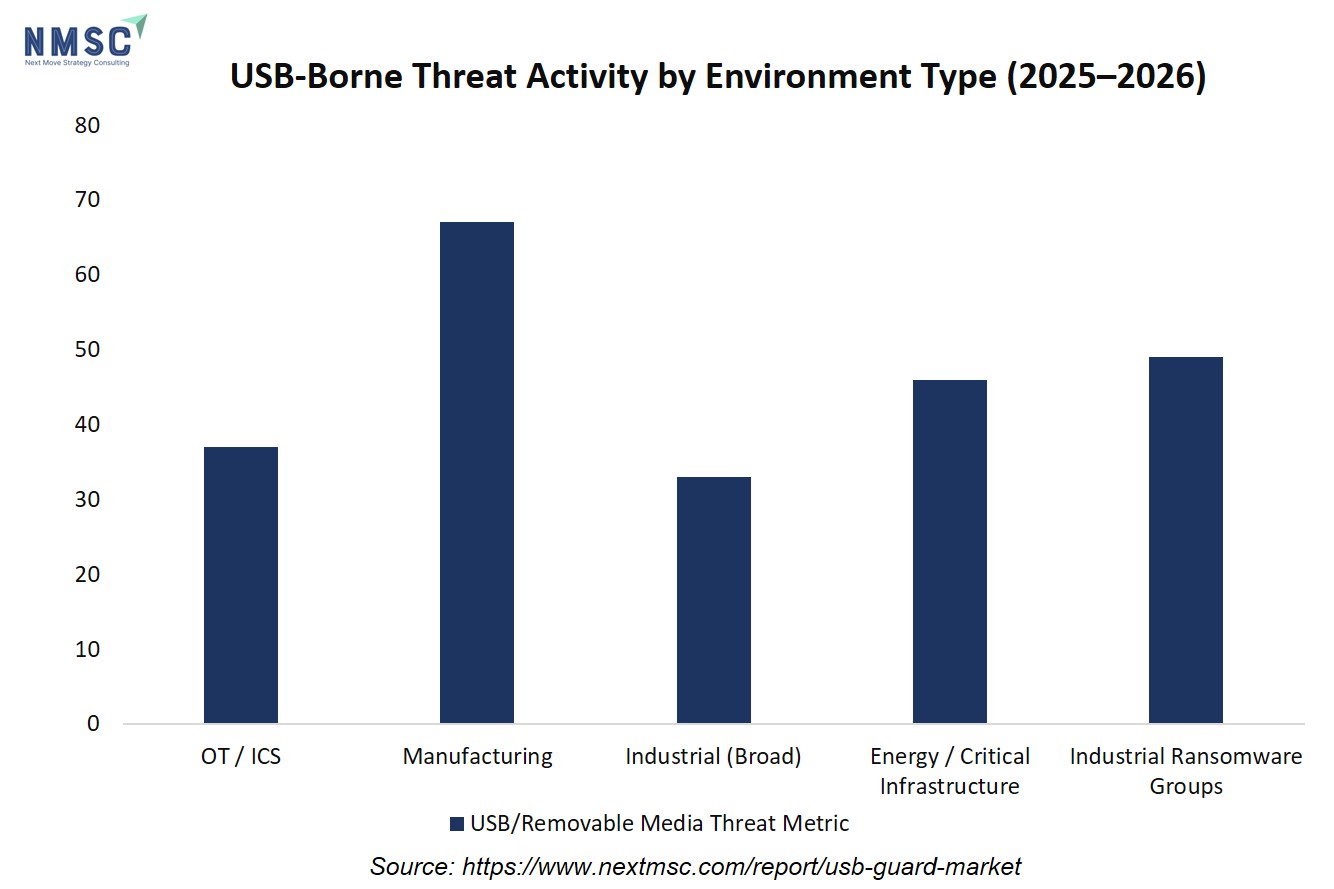
The OT/ICS Dimension: Air Gaps Are No Longer a Defense
A June 2026 analysis published by Shieldworkz confirmed that USB drives remain one of the most underestimated and persistently dangerous vectors in OT and ICS environments in 2026. The analysis highlighted a critical paradox: air-gapped or semi-isolated OT networks — intentionally disconnected from the internet — paradoxically increase USB reliance, as removable media becomes the primary data transfer method for software updates, historian exports, and configuration changes.
Legacy endpoints — including PLCs, DCS controllers, RTUs, and HMIs — frequently run Windows XP or Windows 7 with no USB port management or endpoint detection capability. Industrial equipment designed to run for 10–25 years cannot be rapidly patched, and autorun features disabled years ago in IT environments may still be active on plant floor workstations. These conditions make USB-borne threats uniquely dangerous in cyber-physical systems environments, exploiting operational realities rather than purely technical vulnerabilities.
NMSC Strategic Perspective: What This Market Shift Means for USB Guard Vendors
The escalation of USB-based threats across both IT and OT environments represents a structural demand catalyst for the USB Guard market — not a cyclical uptick. From NMSC's analytical standpoint, the convergence of three forces is reshaping the competitive landscape:
First, the professionalization of USB-based attacks by nation-state actors elevates USB Guard from a compliance checkbox to a board-level security imperative. Enterprises that previously deprioritized removable media controls are now revisiting their endpoint security architectures in light of documented campaigns targeting North American organizations.
Second, the expansion of regulatory mandates — including the EU's NIS2 Directive (Article 21), NERC CIP-010-4, NIST SP 800-82 Rev. 3, and ISA/IEC 62443-3-3 — is creating non-discretionary procurement cycles for USB device control solutions, particularly in critical infrastructure sectors.
Third, the proliferation of IoT devices and connected technologies is expanding the USB attack surface beyond traditional endpoints, creating new addressable market segments for USB Guard vendors offering hardware-agnostic, policy-driven authorization frameworks.
NMSC assesses that vendors capable of delivering unified solutions — combining device authorization policy enforcement, real-time behavioral monitoring, and OT-compatible deployment architectures — are best positioned to capture disproportionate market share through 2030.
Section Summary: USB-based threats have evolved from opportunistic attacks to sophisticated, multi-stage intrusions conducted by nation-state actors and organized criminal groups. The USB Guard market is responding to a structurally elevated threat environment.
Key Takeaways:
-
China-nexus adversary MUSTANG PANDA's USBFect campaigns confirmed active in North America as of 2025, demonstrating the global reach of USB-borne malware.
-
Air-gapped OT environments paradoxically face higher USB risk due to their reliance on removable media for data transfer and firmware updates.
-
Regulatory frameworks including NIS2, NERC CIP, and IEC 62443 are creating mandatory procurement cycles for USB Guard solutions in critical infrastructure.
-
NMSC identifies unified USB Guard platforms — combining policy enforcement, behavioral monitoring, and OT compatibility — as the highest-growth product category through 2030.
Industry Impact Analysis
The Financial Cost of Inadequate USB Security
The financial consequences of USB-related security failures are substantial and escalating. IBM's Cost of a Data Breach Report 2026 — the most authoritative annual benchmark for breach economics — recorded the global average cost of a data breach at a record high, representing a 12% increase over the prior year, driven by higher detection, escalation, and lost business costs. The report also documented a significant rise in AI-driven attacks, including AI-enabled malware, which increasingly leverages USB delivery mechanisms to bypass network-based detection.
The 2025 edition of the same report had already established a global average breach cost of USD 4.44 million, with the United States recording significantly higher figures. These figures do not capture the full economic impact of USB-specific incidents, which frequently involve intellectual property theft, operational disruption in industrial environments, and regulatory penalties — costs that extend well beyond the breach itself.
Sector-Specific Vulnerabilities Driving USB Guard Adoption
Healthcare: The healthcare sector remains among the most exposed to USB-related data breaches, given the widespread use of USB-connected medical devices, portable diagnostic equipment, and legacy clinical workstations. Regulatory frameworks including HIPAA impose stringent requirements on organizations to implement adequate safeguards for data accessed via USB devices, creating a compliance-driven demand floor for USB Guard solutions.
Manufacturing and Industrial: USB-borne malware targeting industrial control systems increased significantly in recent periods, with threat actors specifically engineering payloads to propagate through the removable media workflows inherent to OT environments. The attack surface is compounded by the prevalence of legacy endpoints that cannot support modern endpoint detection and response (EDR) agents.
Government and Defense: The documented theft of 3,600+ classified defense files via personal storage devices in 2025 illustrates the acute insider threat risk in government and defense environments. USB Guard solutions offering granular device authorization policies, audit logging, and behavioral anomaly detection are increasingly mandated by defense procurement standards.
Financial Services: Compliance mandates including PCI DSS impose specific requirements on organizations to control and monitor USB device usage in environments where payment card data is processed or stored. The financial services sector's high data sensitivity and regulatory scrutiny make it a consistent adopter of enterprise-grade USB Guard solutions.
The BYOD and Remote Work Amplification Effect
The sustained adoption of remote work and Bring Your Own Device (BYOD) policies has materially expanded the USB threat surface in North America and Europe. Employees using personal USB devices to access corporate networks and transfer data from remote locations create endpoint security gaps that traditional network-based controls cannot address. USB Guard solutions offering seamless integration with remote work environments — providing enhanced visibility and control over USB usage across distributed endpoints — are experiencing accelerated demand in these geographies.
Section Summary: Inadequate USB security carries measurable financial, operational, and reputational consequences across all major industry verticals. The IBM 2026 breach cost report confirms that breach economics continue to worsen, reinforcing the business case for proactive USB Guard investment.
Key Takeaways:
-
IBM's 2026 Cost of a Data Breach Report recorded a record-high global average breach cost — a 12% increase year-over-year — with AI-enabled malware increasingly delivered via USB vectors.
-
Healthcare, manufacturing, government, and financial services face the highest sector-specific USB threat exposure, driven by legacy infrastructure, regulatory mandates, and high data sensitivity.
-
BYOD and remote work policies have expanded the USB attack surface in North America and Europe, creating new demand for distributed endpoint USB control solutions.
-
Insider threats via removable media represent a distinct and growing risk category, requiring behavioral monitoring capabilities beyond traditional device blocking.
Key Data & Statistics: USB Security and Cybersecurity Risk Indicators
|
Metric |
Data Point |
|
Global average cost of a data breach (2026) |
Record high; 12% increase over 2025 |
|
Global average cost of a data breach (2025) |
USD 4.44 Million |
|
Defense files exfiltrated via USB (2025 insider case) |
3,600+ proprietary files |
|
MUSTANG PANDA USBFect campaigns confirmed active |
North America, 2025 |
|
CISA malicious connections blocked (federal networks, 2025) |
2.62 Billion |
|
OT asset lifecycle (industrial equipment) |
10–25 years |
|
Key regulatory frameworks mandating USB controls |
NIS2, NERC CIP-010-4, NIST SP 800-82 Rev. 3, IEC 62443 |
Future Outlook & Forecast for the USB Guard Market
Market Trajectory: From USD 5.06 Billion to USD 10.11 Billion
According to NMSC's proprietary research, the global USB Guard market is on a sustained growth trajectory, projected to nearly double in value from USD 5.06 billion in 2023 to USD 10.11 billion by 2030, at a CAGR of 10.4%. This growth is underpinned by the convergence of escalating cyber threats, expanding regulatory mandates, and the structural expansion of USB-connected device ecosystems across enterprise and industrial environments.
Regional Outlook
Asia-Pacific currently dominates the USB Guard market and is expected to maintain its leadership position through 2030. The region's dominance is driven by the rising frequency and sophistication of cyber threats targeting organizations across healthcare, manufacturing, and government sectors. Regulatory initiatives including the Personal Data Protection Act (PDPA) in Indonesia, Thailand, and Singapore are compelling organizations to implement adequate USB device safeguards. Government-led cybersecurity infrastructure programs — such as Indonesia's National Cyber and Encryption Agency (BSSN) initiative to expand the National Cyber Security Operations Centre (NSOC) — are further reinforcing market demand.
North America is expected to demonstrate a steady and accelerating rise in USB Guard adoption, driven by BYOD proliferation, remote work normalization, and stringent compliance mandates including HIPAA and PCI DSS. The region's high concentration of defense contractors, financial institutions, and healthcare organizations — all sectors with acute USB threat exposure — positions it as a high-value growth market through the forecast period.
Technology and Product Evolution
The USB Guard market is evolving beyond basic port-blocking functionality toward intelligent, policy-driven authorization frameworks. Key technology trends shaping the market through 2030 include:
-
AI and machine learning integration: Behavioral anomaly detection models that identify unusual USB usage patterns — including large file movements, first-time access to sensitive data types, and off-hours activity — are becoming standard features in enterprise-grade USB Guard platforms.
-
Zero-trust architecture alignment: USB Guard solutions are increasingly designed to integrate with zero-trust security frameworks, enforcing identity-based device authorization policies that treat every USB connection as an untrusted event requiring explicit verification.
-
OT-compatible deployment: The industrial cybersecurity market's demand for USB Guard solutions compatible with legacy OT endpoints — including those running Windows XP and embedded operating systems — represents a significant and underserved product opportunity.
-
IoT security convergence: As IoT device proliferation expands the USB attack surface, USB Guard vendors are developing solutions capable of managing authorization policies across heterogeneous connected device ecosystems.
Competitive Landscape
Key players operating in the USB Guard market include Adata Technology Co. Ltd., Kingston Technology Corporation, Toshiba Corporation, Samsung Electronics Co. Ltd., Verbatim Americas LLC, Transcend Information Inc., Intel Corporation, Koninklijke Philips N.V., Netac Technology Co. Ltd., and Teclast Electronics Co. Ltd. These organizations are actively pursuing product innovation and market development strategies to maintain competitive positioning.
A notable example is Samsung Electronics' October 2023 launch of the Auto Blocker security feature for Samsung Galaxy devices, which identifies potential malware threats and prevents the execution of harmful commands and unauthorized software installations via USB cable connections — signaling OEM-level commitment to USB security as a product differentiator.
Section Summary: The USB Guard market is positioned for sustained, double-digit growth through 2030, driven by escalating threat sophistication, expanding regulatory requirements, and the structural growth of USB-connected device ecosystems across enterprise and industrial environments.
Key Takeaways:
-
Asia-Pacific leads the market, supported by government-driven cybersecurity infrastructure investment and regional data protection regulations.
-
North America represents a high-growth opportunity, driven by HIPAA, PCI DSS compliance requirements, and the BYOD/remote work expansion of the USB threat surface.
-
AI-powered behavioral detection, zero-trust integration, and OT-compatible deployment architectures are the defining product differentiation vectors through 2030.
Next Steps for Stakeholders
For C-Level Executives and CISOs:
-
Conduct a USB risk posture assessment. Map all endpoints — including OT assets, legacy workstations, and remote employee devices — with active USB ports. Quantify the gap between current controls and the requirements of applicable regulatory frameworks (NIS2, NERC CIP, HIPAA, PCI DSS, IEC 62443).
-
Prioritize OT/ICS USB security. Air-gapped industrial environments face a paradoxical USB risk amplification. Invest in OT-compatible USB Guard solutions that support whitelist-only device authorization, read-only enforcement, and audit logging compatible with OT historian and SIEM integration.
-
Integrate USB Guard with zero-trust architecture. Treat every USB connection as an untrusted event. Implement identity-based device authorization policies that require explicit verification before any removable media interaction is permitted on corporate endpoints.
-
Address the insider threat dimension. Deploy behavioral monitoring capabilities that surface anomalous USB usage patterns — including large file movements and off-hours activity — as part of a comprehensive insider risk management program.
-
Align procurement with regulatory timelines. Organizations subject to NIS2, NERC CIP-010-4, or IEC 62443 mandates should treat USB Guard procurement as a compliance-critical investment with defined implementation deadlines, not a discretionary security enhancement.
For Investors and Market Participants:
-
Monitor the OT/ICS USB security segment. The industrial cybersecurity market's demand for OT-compatible USB Guard solutions represents a significant and currently underserved opportunity. Vendors with proven OT deployment capabilities and regulatory alignment (IEC 62443, NERC CIP) are well-positioned for above-market growth.
-
Evaluate AI integration as a competitive differentiator. USB Guard platforms incorporating machine learning-based behavioral anomaly detection and similarity detection for disguised data exfiltration are commanding premium positioning in enterprise procurement cycles.
-
Track Asia-Pacific regulatory developments. Government-led cybersecurity infrastructure programs in Indonesia, Singapore, and Thailand are creating structured demand for USB Guard solutions in a region that already leads global market share.
Conclusion
The USB Guard market stands at a pivotal inflection point. What was once considered a peripheral security concern has been elevated — by documented nation-state campaigns, record-breaking breach costs, and expanding regulatory mandates — to a strategic enterprise security priority. The MUSTANG PANDA USBFect campaigns confirmed active in North America, the escalating financial consequences captured in IBM's 2026 breach cost research, and the structural vulnerability of air-gapped OT environments to USB-borne threats collectively make the case for urgent, comprehensive USB device security investment.
NMSC's market data confirms that the industry is responding: the global USB Guard market is on track to reach USD 10.11 billion by 2030, reflecting a sustained CAGR of 10.4% as enterprises, governments, and critical infrastructure operators recognize that effective endpoint security cannot afford to leave the USB port unguarded. Organizations that act decisively — deploying intelligent, policy-driven USB Guard solutions aligned with zero-trust principles and applicable regulatory frameworks — will be best positioned to protect their data, operations, and stakeholder trust in an increasingly hostile threat environment.
About the Author
 Sanyukta Deb
— Sanyukta Deb is Digital Marketing Team Lead at Next Move Strategy Consulting, where she has led content strategy and technical SEO for the firm's B2B market research publications for over 2 years. Her editorial process translates NextMSC's primary and secondary research — spanning technology, industrial, and consumer sectors — into commercial narratives, backed by search-intent, keyword, and competitive analysis. She brings 5 years of overall experience in digital marketing and content strategy.
Sanyukta Deb
— Sanyukta Deb is Digital Marketing Team Lead at Next Move Strategy Consulting, where she has led content strategy and technical SEO for the firm's B2B market research publications for over 2 years. Her editorial process translates NextMSC's primary and secondary research — spanning technology, industrial, and consumer sectors — into commercial narratives, backed by search-intent, keyword, and competitive analysis. She brings 5 years of overall experience in digital marketing and content strategy.
About the Reviewer
 Debashree Dey
— Debashree Dey is Assistant Manager at Next Move Strategy Consulting, where she supports cross-vertical market content and communications across diverse industries for 6 years. Her professional background includes senior content writing, communications, and published manuscript authorship, with experience developing audience-focused business narratives and maintaining clear, consistent messaging. Her role supports research-led content development and editorial quality across NextMSC publications.
Debashree Dey
— Debashree Dey is Assistant Manager at Next Move Strategy Consulting, where she supports cross-vertical market content and communications across diverse industries for 6 years. Her professional background includes senior content writing, communications, and published manuscript authorship, with experience developing audience-focused business narratives and maintaining clear, consistent messaging. Her role supports research-led content development and editorial quality across NextMSC publications.
















Add Comment