AI, Stablecoins and Agents Reshape the Payment Gateway Market | NextMSC

Introduction
The global payment gateway market is undergoing a structural transformation — one driven not by incremental product updates, but by the simultaneous convergence of artificial intelligence-powered fraud defense, stablecoin regulation, real-time payment rail expansion, and the emergence of agentic commerce. These forces are compressing the technology adoption cycle and raising the competitive bar for every gateway provider operating at scale.
According to Next Move Strategy Consulting's Payment Gateway Market report, the global payment gateway market is reached an estimated USD 52.40 billion in 2025, and is projected to reach USD 146.28 billion by 2030, growing at a CAGR of 22.79% from 2025 to 2030. This trajectory reflects a market where the underlying infrastructure of digital commerce — the gateway layer that authenticates, routes, and settles every online transaction — is being rebuilt from the ground up to handle a fundamentally different payments landscape.
For More Information: Download FREE Sample on Payment Gateway Market Report
AI, Stablecoins, and Agentic Commerce: The Three Forces Rewriting Gateway Architecture
Stripe's AI Foundation Model Sets a New Fraud-Detection Benchmark
In July 2025, Stripe announced the deployment of an AI-driven foundation model for fraud prevention that increased detection rates for card-testing attacks on large businesses by 64% overnight, according to Stripe's official newsroom announcement. The model is trained on data from Stripe's global network — which processed USD 1.9 trillion in payment volume in 2025 — and operates by ingesting fraud signals, chargeback patterns, and authorization data simultaneously to optimize approval rates without human intervention. Stripe also launched stablecoin account capabilities at the same event, enabling merchants to hold and manage digital currencies alongside traditional payment flows.
This development is significant for the gateway market for a specific reason: it demonstrates that the fraud-detection function — historically a rules-based, manually updated layer — is being replaced by continuously learning models that operate at network scale. The Federal Trade Commission reported in March 2025 that U.S. consumers lost USD 12.5 billion to fraud in 2024, a figure that has intensified merchant demand for gateway-embedded AI defenses rather than bolt-on third-party tools.
Compounding the urgency, a November 2025 report by Entrust, cited by J.P. Morgan's Payments Outlook, found that deepfake-enabled fraud attacks now occur every five minutes globally — a frequency that makes static rule-based gateway defenses structurally inadequate.
In May 2025, Adyen and JCB announced the rollout of JCB's Card-on-File Tokenization service, making Adyen the first global payment platform to implement JCB's advanced network tokenization for eCommerce merchants. According to the official JCB press release published on May 13, 2025, the service replaces sensitive card data with secure network tokens, targeting a reduction in credit card fraud and an improvement in authorization rates. Network tokenization has been shown to deliver approximately 3% higher authorization rates compared to traditional card-on-file credentials, directly expanding the revenue case for gateway providers that embed tokenization at the network level.
The GENIUS Act: Stablecoins Enter the Gateway Stack
On July 18, 2025, President Trump signed the Guiding and Establishing National Innovation for U.S. Stablecoins (GENIUS) Act into law, establishing the first federal regulatory framework for payment stablecoins in the United States. The Act restricts stablecoin issuance to licensed entities — subsidiaries of insured depository institutions, federally qualified issuers, or state-qualified issuers — and mandates reserve segregation, monthly certifications, and independent audits. The regime is expected to take effect on January 18, 2027, or 120 days after implementing rules are finalized, whichever is earlier.
For payment gateway providers, the GENIUS Act's practical consequence is that stablecoin settlement is transitioning from an experimental feature to a regulated, mainstream payment rail. Stripe's stablecoin account launch in July 2025 — timed to coincide with the Act's passage — signals that leading gateway operators are positioning stablecoin acceptance as a core product capability rather than a niche offering. A Federal Reserve Bank of Kansas City research working paper published in November 2025 noted that the stablecoin market grew from a negligible size in 2020 to exceed USD 200 billion in assets by 2025, with independent forecasters projecting growth into the trillions over the next several years.
Agentic Commerce: When the Buyer Is an AI Agent
J.P. Morgan's April 2026 Payments Outlook report, citing Bain & Company research, projects that agentic AI will be responsible for up to 25% of the U.S. e-commerce market by 2030 — a shift in which AI agents autonomously research, select, and purchase products on behalf of consumers. This creates a structurally new challenge for payment gateways: the counterparty initiating a transaction is no longer a human cardholder but a software agent, requiring gateways to implement cryptographic agent identity verification rather than behavioral biometrics.
Mastercard's Merchant Cloud organization has identified this shift as the defining gateway architecture challenge of 2026, with its experts noting that gateways must evolve into "unified payment experience platforms that combine cards, bank rails, wallets and biometrics into one seamless flow," with tokenization and global interoperability as non-negotiable capabilities.
In May 2025, Global Payments launched its Genius™ for Retail solution — a comprehensive point-of-sale and payment gateway system designed specifically for small and medium-sized retail businesses — integrating transaction processing, fraud prevention, and digital payment capabilities into a single platform. This product launch reflects a broader industry pattern: gateway providers are moving from transaction-processing utilities to full-stack commerce infrastructure providers.
Section Summary
The payment gateway market's growth trajectory is being shaped by three simultaneous structural shifts: AI-native fraud models that operate at network scale, the regulatory mainstreaming of stablecoin payment rails under the GENIUS Act, and the emergence of agentic commerce that requires gateways to authenticate software agents rather than human cardholders.
-
Stripe's AI foundation model cut card-testing attack success rates by 64% overnight, establishing a new performance benchmark for gateway-embedded fraud defense.
-
The GENIUS Act (signed July 18, 2025) creates a licensed stablecoin issuance framework that will make stablecoin settlement a regulated gateway capability by January 2027.
-
Adyen's JCB Card-on-File Tokenization rollout (May 2025) demonstrates that network tokenization — delivering ~3% higher authorization rates — is becoming a standard gateway feature rather than a premium add-on.
-
Agentic AI is projected to account for up to 25% of U.S. e-commerce by 2030, requiring gateways to implement cryptographic agent identity protocols that existing authentication frameworks were not designed to handle.
Industry Impact Analysis
Real-Time Payment Rails Are Redefining Gateway Settlement Economics
The U.S. real-time payment infrastructure has reached a scale that is materially altering gateway settlement economics. According to a Federal Reserve Bank of Richmond Economic Brief published in 2026, The Clearing House's RTP network processed 128 million transactions totaling USD 480 billion in Q1 2026 alone. The Federal Reserve's FedNow service processed 2.73 million payments totaling USD 271 billion in Q1 2026, reflecting 10.6% volume growth and 7.7% value growth quarter-over-quarter, according to FRB Services quarterly statistics.
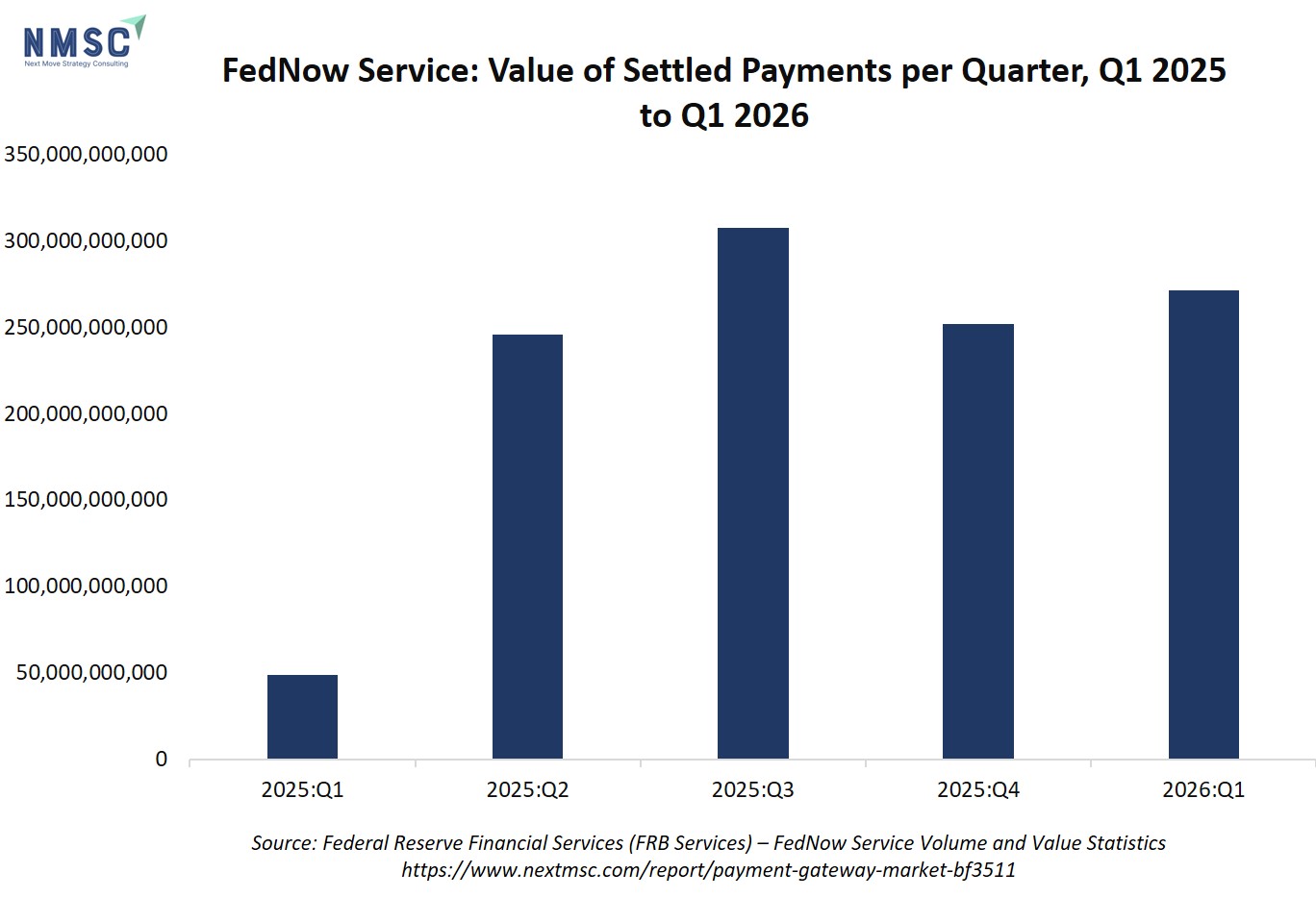
For gateway operators, the expansion of real-time rails creates both a revenue opportunity and a fraud-management obligation. J.P. Morgan's Payments Outlook notes that account-to-account payments — which settle instantly and irrevocably — are predicted to reach USD 195 trillion in global transaction value by 2030, citing Juniper Research's September 2025 analysis. The irrevocability of real-time settlements means that gateways must detect and block fraudulent transactions before authorization rather than relying on post-settlement chargeback mechanisms — a requirement that is directly accelerating investment in AI-powered pre-authorization fraud scoring.
Regulatory Pressure Is Raising the Compliance Floor Across All Major Markets
The regulatory environment for payment gateways has tightened materially across three major jurisdictions in 2025–2026:
United Kingdom: The Financial Conduct Authority's supplementary safeguarding regime (PS25/12) came into force on May 7, 2026, requiring payment firms to implement daily reconciliations, maintain CASS-style resolution packs, and submit to annual audits by Companies Act-qualified auditors. The Payments Association's Q2 2026 Regulation Roadmap notes that only 35% of client funds were returned in payment firm insolvencies between 2018 and 2023 — the failure rate that motivated the FCA's intervention. Additionally, the FCA's regulation of Buy Now Pay Later products took effect on July 15, 2026, bringing creditworthiness checks, Consumer Duty obligations, and Financial Ombudsman access to a product category that gateway providers have increasingly integrated as a checkout option.
European Union: Following political agreement in November 2025, PSD3 and the EU Payment Services Regulation (PSR) are expected to be published in the Official Journal in H1 2026. The PSR introduces mandatory payee name/IBAN verification for all credit transfers, shifts APP fraud liability toward payment service providers, and establishes more prescriptive open banking standards — each of which requires gateway-level infrastructure investment. The UK's open banking infrastructure, which now serves over 16 million active users with payment volumes up 53% in 2025 according to the FCA, provides a reference model for the scale of gateway integration that PSD3's open banking provisions will require across the EU.
United States: Beyond the GENIUS Act, the Troutman Pepper Locke analysis published on Law360 on January 22, 2026, notes that financial institutions are accelerating FedNow and RTP adoption, moving from receive-only to both send-and-receive transaction capability, while AI is being deployed specifically to address the "faster payments, faster fraud" dynamic that real-time settlement creates.
Digital Wallets and BNPL Are Expanding the Gateway's Addressable Transaction Set
Juniper Research's analysis, cited by Mastercard's 2026 payment trends report, projects that digital wallet adoption will surpass 5.2 billion users globally by 2026 — representing over 60% of the world's population. Digital wallets already account for 66% of e-commerce transaction value and 38% of point-of-sale payment value, according to the Worldpay Global Payments Report 2024. For gateway providers, this concentration of transaction volume in wallet-based flows means that wallet integration depth — not card acceptance breadth — is increasingly the primary determinant of gateway conversion rates.
The BNPL segment is adding a structurally distinct transaction category to the gateway stack. The Paypers' Buy Now, Pay Later Report 2025, cited by J.P. Morgan, projects the global BNPL market will grow from USD 560 billion in 2025 to USD 911.8 billion by 2030. As BNPL migrates from online-only to in-store checkout — a trend J.P. Morgan's Payments Outlook identifies as accelerating in 2026 — gateways that support BNPL across both digital and physical channels gain a measurable conversion advantage over those that do not.
NMSC Strategic Perspective: What the 22.79% CAGR Signals About Gateway Market Structure
NextMSC primary research and analysis indicates that the payment gateway market's 22.79% CAGR from 2025 to 2030 is not a uniform growth rate distributed evenly across all gateway segments. The growth is concentrated in three specific areas: API-based gateway integrations that support multi-rail payment orchestration (enabling merchants to route transactions across card networks, real-time rails, and stablecoin channels from a single integration point); AI-embedded fraud and authorization optimization layers that are being sold as premium gateway features rather than standalone products; and gateway solutions purpose-built for the Asia-Pacific region, where mobile-first payment ecosystems — including UPI in India and domestic wallet networks across Southeast Asia — require gateway architectures that differ fundamentally from card-centric Western models.
The market's expansion from USD 52.40 billion in 2025 to USD 146.28 billion by 2030 implies that the average gateway provider's addressable revenue per merchant will increase substantially — not because transaction fees are rising, but because the scope of gateway services is expanding to include fraud AI, tokenization management, stablecoin settlement, and BNPL orchestration. Gateway providers that position themselves as transaction-processing utilities will face margin compression; those that build integrated commerce infrastructure will capture the majority of the market's incremental value.
Section Summary
The regulatory and infrastructure shifts of 2025–2026 are raising the minimum viable capability set for any gateway operating at commercial scale, while simultaneously expanding the revenue opportunity for providers that can deliver integrated, multi-rail, AI-enhanced gateway services.
-
The RTP network processed 128 million transactions totaling USD 480 billion in Q1 2026, making real-time settlement a mainstream gateway requirement rather than a premium feature.
-
The FCA's supplementary safeguarding regime (effective May 7, 2026) and BNPL regulation (effective July 15, 2026) are raising compliance costs for UK-based gateway operators, creating a consolidation incentive that favors larger, better-capitalized providers.
-
Digital wallets account for 66% of global e-commerce transaction value, making wallet integration depth the primary gateway conversion driver in most markets.
-
NMSC analysis identifies API-based multi-rail orchestration, AI-embedded authorization optimization, and Asia-Pacific mobile-first gateway architectures as the three segments capturing a disproportionate share of the market's 22.79% CAGR.
Pros and Cons of Recent Market Developments
|
Recent Development |
Pros |
Cons |
|
Stripe's AI Foundation Model for Fraud (July 2025) |
64% improvement in card-testing attack detection overnight; reduces false positives that block legitimate transactions; scales across Stripe's USD 1.9T annual processing volume without manual rule updates |
Smaller gateway providers without equivalent training data volumes cannot replicate the model's performance, widening the competitive gap between tier-1 and tier-2 operators |
|
GENIUS Act Stablecoin Framework (July 2025) |
Creates regulatory certainty for stablecoin payment rails; enables faster, lower-cost cross-border settlement; opens a new revenue stream for licensed gateway operators |
Compliance costs for reserve segregation, monthly certifications, and independent audits are prohibitive for smaller gateways; effective date of January 2027 creates an 18-month uncertainty window |
|
Adyen–JCB Card-on-File Tokenization (May 2025) |
~3% higher authorization rates vs. traditional card-on-file; reduces fraud exposure for eCommerce merchants; improves customer experience through seamless recurring payment flows |
Limited initially to JCB cardholders; requires gateway-level integration investment; benefits are concentrated in markets with high JCB penetration (primarily Japan and select Asia-Pacific markets) |
|
FCA Supplementary Safeguarding Regime (May 2026) |
Reduces consumer loss risk in payment firm insolvencies; raises governance standards across the UK payments sector; builds long-term institutional trust in non-bank gateway operators |
Daily reconciliation, resolution packs, and mandatory audits impose significant operational overhead; small payment firms face disproportionate compliance costs relative to transaction volumes |
|
EU PSD3 / PSR Political Agreement (November 2025) |
Mandatory payee name/IBAN verification reduces APP fraud; more prescriptive open banking standards create a level playing field for gateway-integrated A2A payment products |
24-month implementation timeline creates prolonged compliance uncertainty; APP fraud liability shift onto PSPs increases gateway operators' financial exposure for fraudulent transactions they did not initiate |
|
Real-Time Payment Rail Expansion (RTP/FedNow, 2026) |
Instant, irrevocable settlement improves merchant cash flow; reduces reliance on card network intermediaries; lowers interchange costs for account-to-account transactions |
Irrevocability eliminates the chargeback safety net, requiring gateways to invest in pre-authorization fraud detection that is more computationally intensive and expensive than post-settlement dispute management |
|
Agentic Commerce Emergence (2026) |
Opens a new transaction category where AI agents execute high-frequency, low-friction purchases; gateways that implement agent authentication standards gain first-mover advantage |
Existing Strong Customer Authentication frameworks were designed for human cardholders; agent-initiated transactions create unresolved liability questions under current PSR/PSD2 authorization rules |
Key Data & Statistics
U.S. Real-Time Payment Rail Performance — Q1 2026
|
Payment Rail |
Operator |
Q1 2026 Transaction Volume |
Q1 2026 Transaction Value |
Quarter-over-Quarter Growth (Volume) |
|
RTP Network |
The Clearing House |
128 million transactions |
USD 480 billion |
— |
|
FedNow Service |
Federal Reserve |
2.73 million transactions |
USD 271 billion |
+10.6% |
|
FedNow (Full Year 2025) |
Federal Reserve |
8.4 million transactions |
— |
+80% (Q2 2026 vs. Q2 2025) |
|
RTP (End of 2025) |
The Clearing House |
1,135 financial institutions connected |
— |
Up from 730 institutions in 2024 |
Future Outlook & Forecast
From Transaction Processor to Commerce Infrastructure: The Gateway's Expanding Role
NextMSC primary research and analysis projects the global payment gateway market will reach USD 146.28 billion by 2030, growing at a CAGR of 22.79% from 2025. This growth is underpinned by four structural forces that will define the market's architecture through the end of the decade.
Blockchain-Enabled Settlement Will Move from Pilot to Production. J.P. Morgan's April 2026 Payments Outlook reports that nearly 60% of Fortune 500 companies are planning blockchain initiatives, with payments and settlements as the primary use case. J.P. Morgan's own Kinexys platform — which enabled EBANX to move funds faster between internal accounts for global merchants operating in emerging markets — illustrates how blockchain-based settlement is being deployed at commercial scale today, not as a future concept. For gateway providers, blockchain settlement capability will become a competitive differentiator in cross-border transaction processing, where traditional correspondent banking chains add 2–5 days of settlement latency and significant FX conversion costs.
ISO 20022 Migration Will Restructure Data Flows Through Gateway Infrastructure. The Bank of England has confirmed ISO 20022 schema changes for the November 2026 CHAPS and RTGS release, with a broader base message upgrade targeted for November 2027. ISO 20022's richer data fields — enabling structured remittance information, legal entity identifiers, and purpose codes to travel with payment messages — will allow gateway operators to offer automated reconciliation services that currently require manual intervention, creating a new revenue layer on top of transaction processing.
Embedded Finance Will Expand the Gateway's Revenue Perimeter. Boston Consulting Group's September 2025 analysis, cited by J.P. Morgan, estimates the potential embedded finance market across the U.S., Canada, and Europe at approximately USD 185 billion, spanning payments, capital solutions, accounts, and card issuing. Gateway providers that build closed-loop banking networks — enabling merchants to process customer payments without an intermediary — will capture a share of this market that is currently held by traditional banking infrastructure.
Asia-Pacific Will Sustain the Fastest Regional Growth Rate. The Asia-Pacific region's payment gateway market is expanding on the back of mobile-first payment ecosystems that have no Western equivalent in terms of scale or integration depth. India's Aadhaar national ID scheme underpins approximately 3 billion payment authentications every month, according to J.P. Morgan's Payments Outlook, providing a biometric authentication infrastructure that gateway providers can integrate to reduce friction in high-volume, low-value transaction flows. The region's combination of high smartphone penetration, government-backed real-time payment infrastructure (UPI, PromptPay, PayNow), and rapidly expanding e-commerce base positions it as the market where gateway innovation will be most concentrated through 2030.
Section Summary
The payment gateway market's path to USD 146.28 billion by 2030 runs through four structural transitions: blockchain settlement moving from pilot to production, ISO 20022 enabling gateway-level automated reconciliation, embedded finance expanding the gateway's revenue perimeter beyond transaction fees, and Asia-Pacific sustaining the fastest regional growth rate on the back of government-backed real-time payment infrastructure.
-
Blockchain-based settlement is already in commercial deployment through platforms like J.P. Morgan's Kinexys, with nearly 60% of Fortune 500 companies planning blockchain payment initiatives.
-
ISO 20022's November 2026 CHAPS/RTGS implementation will enable gateway operators to offer automated reconciliation as a premium service layer.
-
The embedded finance market in the U.S., Canada, and Europe is estimated at approximately USD 185 billion by BCG — a revenue pool that gateway providers with closed-loop banking capabilities are positioned to access.
-
India's Aadhaar system processes approximately 3 billion payment authentications monthly, illustrating the scale of biometric-gateway integration that Asia-Pacific's growth trajectory requires.
Next Steps for Stakeholders
For C-Level Executives at Gateway Providers:
-
Prioritize AI model investment at the network level, not the product level. Stripe's 64% improvement in fraud detection was achieved through a foundation model trained on network-wide data — not a product-specific rule set. Gateway operators without access to comparable transaction data volumes should evaluate data-sharing consortia or AI-as-a-service partnerships with network-scale providers rather than attempting to build proprietary models on insufficient training data.
-
Establish a GENIUS Act compliance roadmap before Q1 2027. The Act's effective date of January 18, 2027 gives gateway operators approximately 15 months to determine whether to pursue a permitted payment stablecoin issuer license, partner with a licensed issuer, or integrate stablecoin acceptance without issuance. Each path carries different capital, compliance, and competitive implications that require board-level decision-making now.
-
Audit your ISO 20022 readiness against the November 2026 CHAPS/RTGS schema changes. Gateway operators processing UK high-value payments must update their XSD schema validation libraries before November 2026. Firms that treat this as a back-office IT project rather than a strategic data infrastructure upgrade will miss the opportunity to build automated reconciliation services on top of ISO 20022's richer data fields.
-
Build agent authentication into your gateway architecture before agentic commerce scales. Mastercard's Merchant Cloud team has identified cryptographic agent identity verification — using standards like Web Bot Auth — as the primary security protocol for agentic commerce. Gateway operators that implement agent authentication frameworks in 2026 will be positioned to serve the segment of the e-commerce market that Bain & Company projects will reach 25% of U.S. e-commerce by 2030.
For Institutional Investors:
-
Evaluate gateway providers on multi-rail orchestration capability, not transaction volume alone. The market's 22.79% CAGR reflects the expansion of gateway services beyond card processing. Providers with API architectures that support simultaneous routing across card networks, real-time rails (RTP/FedNow), and stablecoin channels will capture a disproportionate share of the market's incremental value.
-
Monitor the Asia-Pacific gateway segment for outsized returns. The combination of government-backed real-time payment infrastructure, 5.2 billion projected digital wallet users by 2026, and rapidly expanding cross-border e-commerce creates a gateway market in Asia-Pacific that is growing faster than the global average and is less saturated by incumbent providers than North America or Europe.
-
Assess regulatory compliance infrastructure as a competitive moat. The FCA's supplementary safeguarding regime, EU PSD3/PSR, and the GENIUS Act collectively raise the compliance cost floor for gateway operators. Providers with established compliance infrastructure — daily reconciliation systems, resolution packs, reserve management capabilities — will benefit from the market consolidation that these requirements will accelerate among smaller, undercapitalized operators.
Conclusion
The global payment gateway market is not simply growing — it is being structurally rebuilt. The convergence of AI-native fraud defense (exemplified by Stripe's 64% overnight improvement in attack detection), regulated stablecoin payment rails (established by the GENIUS Act in July 2025), real-time settlement infrastructure (with RTP processing USD 480 billion per quarter in Q1 2026), and agentic commerce (projected to reach 25% of U.S. e-commerce by 2030) is transforming the gateway from a transaction-routing utility into the central nervous system of digital commerce.
NextMSC primary research and analysis projects this market will grow from USD 52.40 billion in 2025 to USD 146.28 billion by 2030 at a CAGR of 22.79% — a trajectory that reflects not just volume growth but a fundamental expansion in the scope of services that gateway providers are expected to deliver. For executives and investors operating in this space, the strategic imperative is clear: the gateway providers that will capture the majority of this market's incremental value are those that invest today in AI model infrastructure, multi-rail orchestration, regulatory compliance capability, and agent authentication frameworks — not those that optimize for transaction fee margins on existing card-processing volumes.
About the Author
 Sanyukta Deb
— Sanyukta Deb is Digital Marketing Team Lead at Next Move Strategy Consulting, where she has led content strategy and technical SEO for the firm's B2B market research publications for over 2 years. Her editorial process translates NextMSC's primary and secondary research — spanning technology, industrial, and consumer sectors — into commercial narratives, backed by search-intent, keyword, and competitive analysis. She brings 5 years of overall experience in digital marketing and content strategy.
Sanyukta Deb
— Sanyukta Deb is Digital Marketing Team Lead at Next Move Strategy Consulting, where she has led content strategy and technical SEO for the firm's B2B market research publications for over 2 years. Her editorial process translates NextMSC's primary and secondary research — spanning technology, industrial, and consumer sectors — into commercial narratives, backed by search-intent, keyword, and competitive analysis. She brings 5 years of overall experience in digital marketing and content strategy.
About the Reviewer
 Debashree Dey
— Debashree Dey is Assistant Manager at Next Move Strategy Consulting, where she supports cross-vertical market content and communications across diverse industries for 6 years. Her professional background includes senior content writing, communications, and published manuscript authorship, with experience developing audience-focused business narratives and maintaining clear, consistent messaging. Her role supports research-led content development and editorial quality across NextMSC publications.
Debashree Dey
— Debashree Dey is Assistant Manager at Next Move Strategy Consulting, where she supports cross-vertical market content and communications across diverse industries for 6 years. Her professional background includes senior content writing, communications, and published manuscript authorship, with experience developing audience-focused business narratives and maintaining clear, consistent messaging. Her role supports research-led content development and editorial quality across NextMSC publications.
















Add Comment