Fixing Common Payment Gateway Integration Mistakes for Good
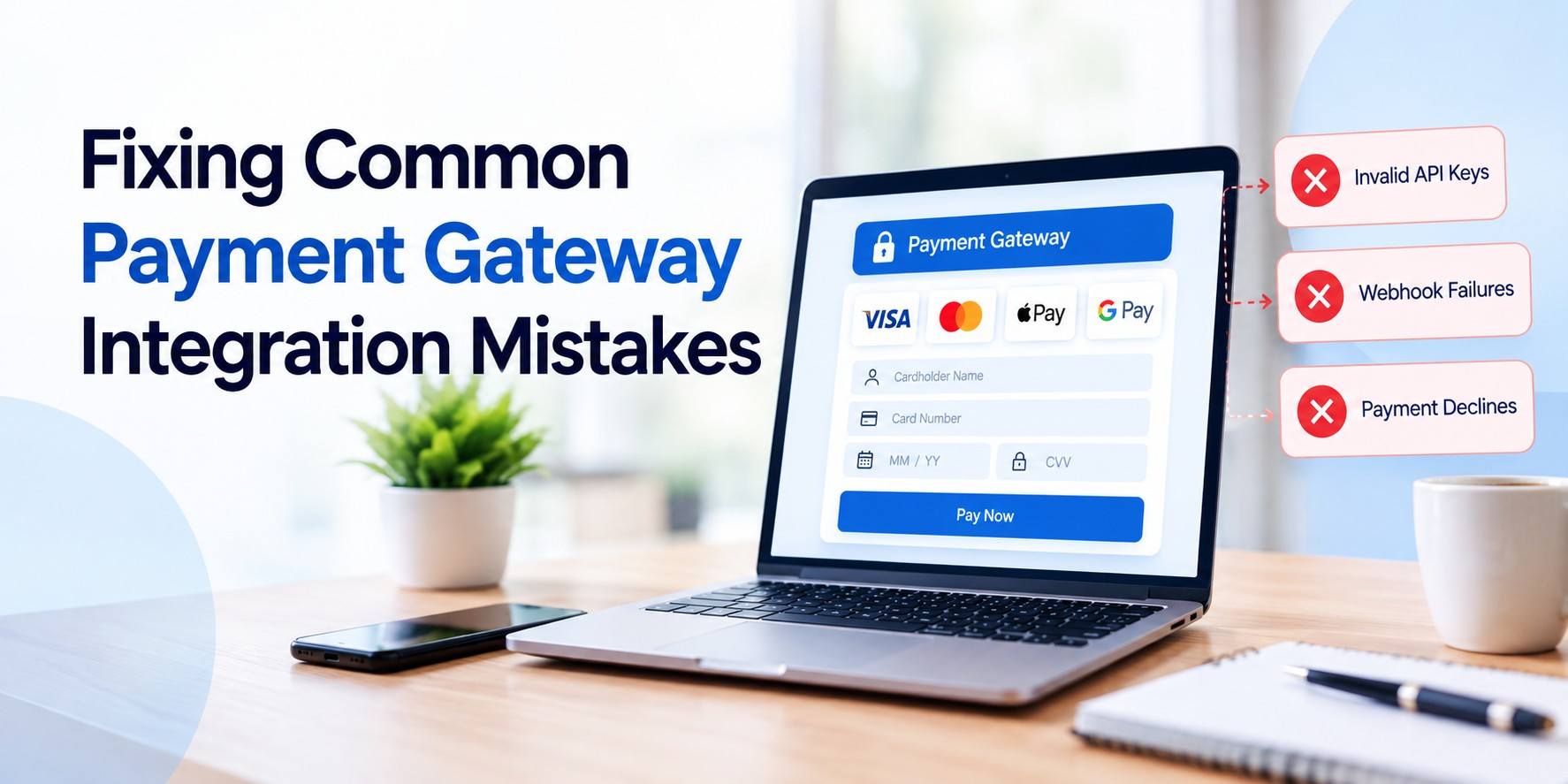
Checkout should be the simplest part of any transaction. In practice, it's often the weakest link. According to the Federal Reserve's 2025 Triennial Payments Study, the total number of noncash payments made by U.S. consumers and businesses reached 236.6 billion in 2024 – the largest three-year jump the study has recorded since it began tracking data in 2000. With that much money moving through digital channels, even a minor flaw in payment gateway integration can translate into real, measurable revenue loss.
This piece breaks down where those flaws usually start, what a stronger setup actually looks like, and how to keep it that way once the initial build is done.
What Is Payment Gateway Integration, and Why Does It Matter?
Payment gateway integration is the technical process of connecting a website or app to a payment processor so it can securely accept, verify, and complete transactions. It sits between the customer's card details and the bank that ultimately approves or declines the charge.
Get it wrong, and the damage isn't abstract. Failed transactions, duplicate charges, and unclear error messages all trace back to gaps in how a gateway was connected in the first place. Get it right, and checkout becomes invisible – which, for payments, is exactly the goal.
Why Businesses Underestimate the Risk
Most teams treat integration as a launch-day task rather than an ongoing responsibility. That assumption tends to fall apart within a year or two, once card network rules shift or a gateway deprecates an older API version without much warning.
Where Payment Gateway Integration Breaks Down First
Problems rarely appear all at once. They build quietly, usually in one of a few predictable places.
Rushed or Incomplete Sandbox Testing
A common shortcut: test with one working card number, confirm "success," and push to production. Real customers, though, use expired cards, mistyped security codes, and billing addresses that don't match – none of which gets caught by a single happy-path test.
Pro tip: run sandbox tests against declined cards, timeout scenarios, and partial refunds before going live – not just the transactions expected to succeed.
Weak Webhook and Callback Handling
Webhooks are the background signals a gateway sends to confirm whether a payment succeeded, failed, or needs manual review. When a server mishandles them, two things tend to happen: orders get marked "paid" when they weren't, or customers are charged without ever seeing confirmation.
A dependable setup logs every webhook event, retries failed deliveries automatically, and reconciles gateway records against internal order data on a fixed schedule – weekly, at minimum.
How to Build Integrated Payment Solutions That Don't Fail Quietly
The strongest setups share one underlying assumption: something will eventually break, whether that's a gateway outage, a card network glitch, or a bug introduced during an unrelated update. Fraud losses tied to broken or exploited payment flows aren't a small concern either – the FTC's Consumer Sentinel Network data shows consumers reported losing more than $12.5 billion to fraud in 2024 alone, a 25% jump from the year before.
Designing for Failure Instead of Hoping It Won't Happen
Good payment integration writes specific, actionable error messages instead of a generic "something went wrong." It includes retry logic for network timeouts and lets customers switch payment methods without losing their cart. None of that is glamorous work, but it's the difference between a shopper who tries again and one who leaves for good.
A few habits consistently separate stable systems from fragile ones:
-
Logging every transaction attempt, not just the successful ones
-
Reconciling gateway records against internal order data monthly
-
Testing refund and chargeback flows with the same rigor as the purchase flow
-
Rotating API keys on a fixed schedule instead of leaving old credentials active
How to Choose the Right Gateway for the Business
There's no universal "best" gateway – the right one depends on what's being sold, where, and to whom. A company selling physical goods internationally has different settlement and currency needs than a subscription software business processing recurring charges domestically.
|
What to Evaluate |
Why It Matters |
|
Settlement speed |
Directly affects cash flow, especially for smaller merchants |
|
Currency and region support |
Determines whether international sales are even viable |
|
Fraud and risk tools |
Cuts chargebacks without adding checkout friction |
|
Documentation accuracy |
Fewer integration bugs reach production |
|
Support responsiveness |
Matters most during outages, not during setup |
Rather than building every connector internally, many merchants rely on established options such as Solidgate payment integrations to shorten the setup process and reduce the number of custom integrations engineering teams need to maintain long-term.
Keeping Payment Gateway Integration Reliable After Launch
Fixing integration issues once is useful. Keeping them fixed is the part that actually protects revenue over time. APIs get versioned, authentication requirements tighten, and gateways occasionally sunset older endpoints with limited notice.
What Ongoing Maintenance Should Look Like
Monitoring dashboards only help if someone reviews them regularly. A recurring monthly check of failure rates, checkout completion time, and gateway uptime reports turns a passive system into an actively managed one – and catches drift long before it shows up as a support ticket.
Signs that a payment integration needs a closer look:
-
Failure rates creeping upward without an obvious cause
-
Support tickets mentioning double charges or missing confirmations
-
Abandonment concentrated at the payment step rather than earlier in checkout
-
Settlement terms or fees that haven't been reviewed in over a year
None of this demands a full rebuild. Most fixes are incremental – tightening webhook logic, updating an outdated SDK, adding a backup payment method for when the primary processor has an outage.
Frequently Asked Questions
What causes most payment gateway integration failures?
Most failures trace back to incomplete testing, particularly skipping edge cases like declined cards or network timeouts during the sandbox phase. Poor webhook handling is the second most common cause, since it often goes unnoticed until a customer reports a charge that never got confirmed.
How often should a payment integration be reviewed?
A monthly review of failure rates, settlement times, and reconciliation reports is a reasonable baseline for most businesses. Higher-volume merchants, or those operating across multiple currencies, generally benefit from weekly checks instead.
Is it safe to store customer card data directly on a company server?
Generally, no – tokenization is the safer standard, letting the gateway hold sensitive card data while the merchant keeps only a reference token. This reduces both security risk and the compliance burden tied to handling raw card numbers.
Do smaller businesses need the same level of integration rigor as larger ones?
Yes, largely because failure rates and fraud exposure don't scale down proportionally with business size. A small store with a broken webhook can lose just as high a percentage of transactions as a large one, even if the total dollar amount is smaller.
What's the fastest way to identify a failing payment gateway integration?
Compare the gateway's own dashboard numbers against internal order records on a regular basis – a growing gap between the two is usually the earliest warning sign. Rising abandonment specifically at the payment step, rather than earlier in the funnel, is another strong signal worth investigating immediately.
About the Author
 Sanyukta Deb
— Sanyukta Deb is Digital Marketing Team Lead at Next Move Strategy Consulting, where she has led content strategy and technical SEO for the firm's B2B market research publications for over 2 years. Her editorial process translates NextMSC's primary and secondary research — spanning technology, industrial, and consumer sectors — into commercial narratives, backed by search-intent, keyword, and competitive analysis. She brings 5 years of overall experience in digital marketing and content strategy.
Sanyukta Deb
— Sanyukta Deb is Digital Marketing Team Lead at Next Move Strategy Consulting, where she has led content strategy and technical SEO for the firm's B2B market research publications for over 2 years. Her editorial process translates NextMSC's primary and secondary research — spanning technology, industrial, and consumer sectors — into commercial narratives, backed by search-intent, keyword, and competitive analysis. She brings 5 years of overall experience in digital marketing and content strategy.
About the Reviewer
 Debashree Dey
— Debashree Dey is Assistant Manager at Next Move Strategy Consulting, where she supports cross-vertical market content and communications across diverse industries for 6 years. Her professional background includes senior content writing, communications, and published manuscript authorship, with experience developing audience-focused business narratives and maintaining clear, consistent messaging. Her role supports research-led content development and editorial quality across NextMSC publications.
Debashree Dey
— Debashree Dey is Assistant Manager at Next Move Strategy Consulting, where she supports cross-vertical market content and communications across diverse industries for 6 years. Her professional background includes senior content writing, communications, and published manuscript authorship, with experience developing audience-focused business narratives and maintaining clear, consistent messaging. Her role supports research-led content development and editorial quality across NextMSC publications.
















Add Comment