Digital Payment Solutions Market: GENIUS Act & AI Agents Drive a $725B Shift

Introduction
The global digital payment solutions market is experiencing a structural transformation of historic proportions. Two forces — one regulatory, one technological — are converging to redefine how money moves across every economy on earth. The first is the U.S. GENIUS Act, signed into law on July 18, 2025, which established the world's first comprehensive federal regulatory framework for payment stablecoins and set the stage for a new era of programmable, blockchain-native settlement infrastructure. The second is the emergence of agentic commerce: AI-initiated purchasing that is compelling card networks, processors, and fintech platforms to rebuild their authentication and settlement architectures from the ground up.
According to Next Move Strategy Consulting, the global Digital Payment Solutions Market was valued at USD 145.80 billion in 2025 and is estimated at USD 169.10 billion in 2026, with projections indicating it will reach USD 725.40 billion by 2035, expanding at a CAGR of 17.6% between 2026 and 2035. The absolute dollar opportunity between 2026 and 2035 stands at USD 556.30 billion — one of the most compelling investment theses in the global technology sector. For C-level executives, institutional investors, and payment infrastructure strategists, the central question is not whether the digital payment solutions market will grow, but which platforms, rails, and business models will capture disproportionate value as stablecoin regulation matures, AI agents become autonomous buyers, and real-time payment infrastructure becomes the global standard.
For More Information: Download FREE Sample on Digital Payment Solutions Market Report
The GENIUS Act, Stablecoin Infrastructure, and Agentic Commerce Reshape the Digital Payment Solutions Market
The GENIUS Act: A Regulatory Foundation for the Next Payment Era
On July 18, 2025, President Donald J. Trump signed the Guiding and Establishing National Innovation for U.S. Stablecoins (GENIUS) Act into law — the first federal legislation in U.S. history to establish a comprehensive regulatory framework for payment stablecoins. The Act requires payment stablecoin issuers to maintain 1:1 reserves in high-quality liquid assets, submit to federal or state regulatory oversight depending on their size, and comply with anti-money laundering and sanctions requirements. The expected effective date of the Act is January 18, 2027, with the U.S. Treasury Department currently seeking public comment on proposed implementing regulations.
The significance of the GENIUS Act for the digital payment solutions market cannot be overstated. For years, the absence of a federal stablecoin framework created legal uncertainty that constrained institutional adoption of blockchain-based payment rails. The Act resolves that uncertainty, creating a regulated pathway for banks, payment processors, and fintech companies to issue and accept payment stablecoins within a defined compliance architecture. The Federal Reserve's March 2026 research note on payment stablecoins and cross-border payments confirmed that stablecoin-based settlement offers material advantages over correspondent banking rails for cross-border transactions, including faster settlement times and reduced intermediary costs — advantages that are now accessible within a regulated framework for the first time.
The scale of stablecoin activity already underway is striking. According to the BIS Annual Economic Report 2026, annual stablecoin transaction volume amounted to an estimated USD 28 trillion in 2025 — equivalent to less than three business days of global payment system activity. This figure underscores both the current scale of stablecoin usage and the vast headroom for growth as regulatory clarity under the GENIUS Act enables institutional-grade adoption.
Mastercard's USD 1.8 Billion BVNK Acquisition: Stablecoin Infrastructure Enters the Mainstream
On March 17, 2026, Mastercard announced a definitive agreement to acquire BVNK, a London-based stablecoin infrastructure platform, for up to USD 1.8 billion — comprising USD 1.5 billion in base consideration and USD 300 million in earnout. The acquisition was completed on August 3, 2026.
BVNK provides the infrastructure that supports fiat and on-chain payments behind the scenes — enabling people, businesses, and machines to hold, move, manage, and convert value across fiat and digital currencies within a framework of security, compliance, and interoperability. "Digital currencies — particularly stablecoins — are increasingly addressing real-world needs in areas like cross-border B2B payments, remittances, payouts, settlement and treasury flows," said Jorn Lambert, Chief Product Officer at Mastercard. "In a multi-money world where fiat, stablecoins and tokenized deposits and other forms of value coexist, the next payments paradigm will be defined by how effectively each rail, network or form of money connects and works together."
The BVNK acquisition is the most consequential M&A transaction in the digital payment solutions market in 2026. It signals that the era of treating stablecoin settlement as a peripheral pilot program is over. Mastercard — a network that processes billions of transactions annually across 200+ countries — has made a USD 1.8 billion commitment to the proposition that stablecoin rails will become a core component of global payment infrastructure, not an alternative to it.
Agentic Commerce: When AI Agents Become the Buyer
Simultaneously, the digital payment solutions market is confronting a demand-side transformation with no historical precedent: the emergence of AI agents as autonomous purchasing entities. In 2026, Visa launched its Intelligent Commerce initiative, introducing Agent Scoring and Agentic Registry capabilities that extend trust signals across devices and channels for AI-initiated transactions. Mastercard launched Agent Pay for Machines in June 2026, supporting high-frequency, low-latency automated payments across cards, accounts, and stablecoins.
"We're heading toward an economy where most transactions never involve a person at all — machines paying each other, constantly, for things too small to bother a human with. That unlocks business models nobody can build today, but only once the payment layer can keep up," said Joe Lau, co-founder and president of Alchemy, at the launch of Mastercard's Agent Pay for Machines.
The volume implications of agentic commerce are significant. Stripe's 2025 annual letter disclosed that businesses on Stripe generated USD 1.9 trillion in total payment volume during 2025 — up 34% year-on-year and equivalent to approximately 1.6% of global GDP — with agentic commerce identified as a key emerging driver of platform growth.
NMSC Strategic Perspective: Three Structural Shifts Defining the Market Through 2035
From Next Move Strategy Consulting's analytical standpoint, the digital payment solutions market in 2026 is being reshaped by three concurrent structural shifts that will define competitive positioning through 2035.
The first shift is rail diversification: The GENIUS Act has legitimized stablecoin settlement as a regulated payment rail alongside traditional card and bank transfer infrastructure. Providers that offer unified platforms spanning card, wallet, bank transfer, and stablecoin settlement will command a decisive competitive advantage over single-rail specialists as enterprise merchants consolidate vendor relationships.
The second shift is authentication architecture redesign: Agentic commerce requires identity, permissions, and behavioral signal infrastructure purpose-built for AI agents rather than human users. Card networks that fail to establish credible agent authentication standards risk ceding the agentic commerce layer to fintech challengers building natively for machine-to-machine transactions.
The third shift is SME digital wallet penetration: NMSC's analysis identifies Small and Medium Enterprises as the fastest-growing enterprise size segment at a 19.8% CAGR from 2026 to 2035, reflecting the rapid expansion of affordable, cloud-native payment gateway and wallet integration solutions into a previously underserved merchant base.
Section Summary: The GENIUS Act, Mastercard's USD 1.8 billion BVNK acquisition, and the simultaneous launch of Visa's Intelligent Commerce and Mastercard's Agent Pay for Machines have collectively established 2026 as the year in which stablecoin settlement and agentic commerce transitioned from speculative pilots to regulated, institutionally-backed infrastructure priorities.
Key Takeaways:
-
The GENIUS Act, signed July 18, 2025, establishes the first U.S. federal regulatory framework for payment stablecoins, with an effective date of January 18, 2027 — removing the primary legal barrier to institutional stablecoin adoption.
-
BIS estimates annual stablecoin transaction volume at USD 28 trillion in 2025, confirming that stablecoin rails are already operating at institutional scale ahead of formal regulatory implementation.
-
Mastercard's completed USD 1.8 billion acquisition of BVNK on August 3, 2026 signals that stablecoin settlement infrastructure is now a core strategic priority for global card networks, not a peripheral experiment.
-
Stripe's USD 1.9 trillion total payment volume in 2025 — up 34% year-on-year — demonstrates the sustained structural migration of enterprise and consumer commerce to digital payment rails.
Industry Impact Analysis
Global Financial Inclusion Accelerates, Expanding the Digital Payment Addressable Market
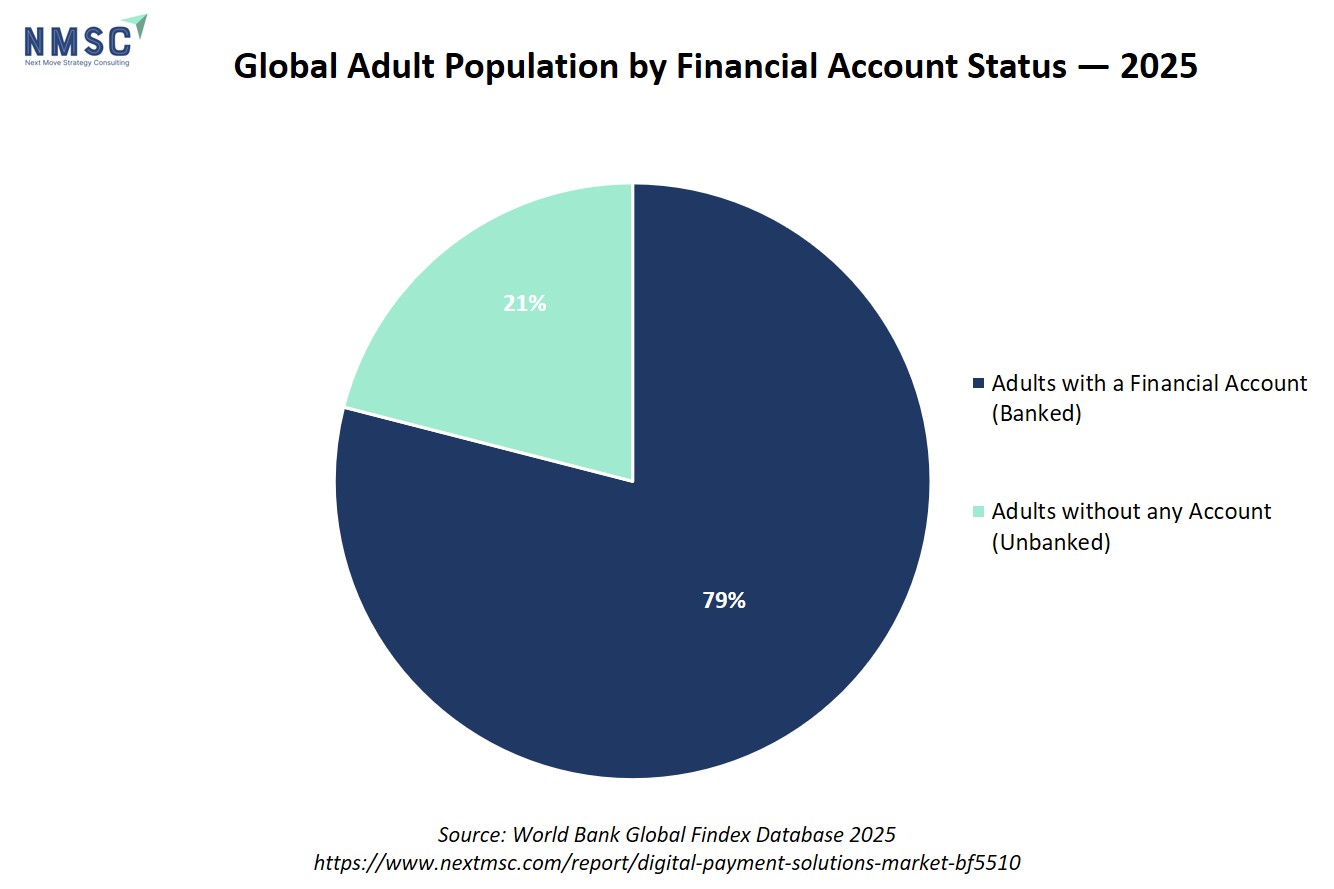
The World Bank's Global Findex Database 2025 — based on nationally representative surveys of approximately 148,000 adults across 141 economies — reveals that 79% of adults globally now have a financial account, up from 51% in 2011. This 28-percentage-point expansion in account ownership over 14 years represents the single most important structural demand driver for the digital payment solutions market: a rapidly expanding global base of financially included adults who are increasingly capable of and willing to transact digitally.
The implications for the digital payment solutions market are direct and material. As account ownership expands — particularly across Sub-Saharan Africa, South Asia, and Southeast Asia — the addressable market for digital wallet platforms, QR code payment infrastructure, and mobile-first payment solutions grows commensurately. NMSC's analysis identifies Middle East & Africa as the fastest-growing region in the digital payment solutions market at a 20.9% CAGR from 2026 to 2035, and India as the fastest-growing individual country market at a 23.0% CAGR — both trajectories directly anchored in the financial inclusion expansion documented by the World Bank Findex data.
BIS CPMI 2024 Red Book: Cashless Payments Accelerate, Fast Payments Gain Ground
The BIS Committee on Payments and Market Infrastructures (CPMI) published its 2024 Red Book statistics commentary on April 27, 2026, providing the most authoritative available snapshot of global retail payment trends. The report's key findings are directly relevant to the digital payment solutions market:
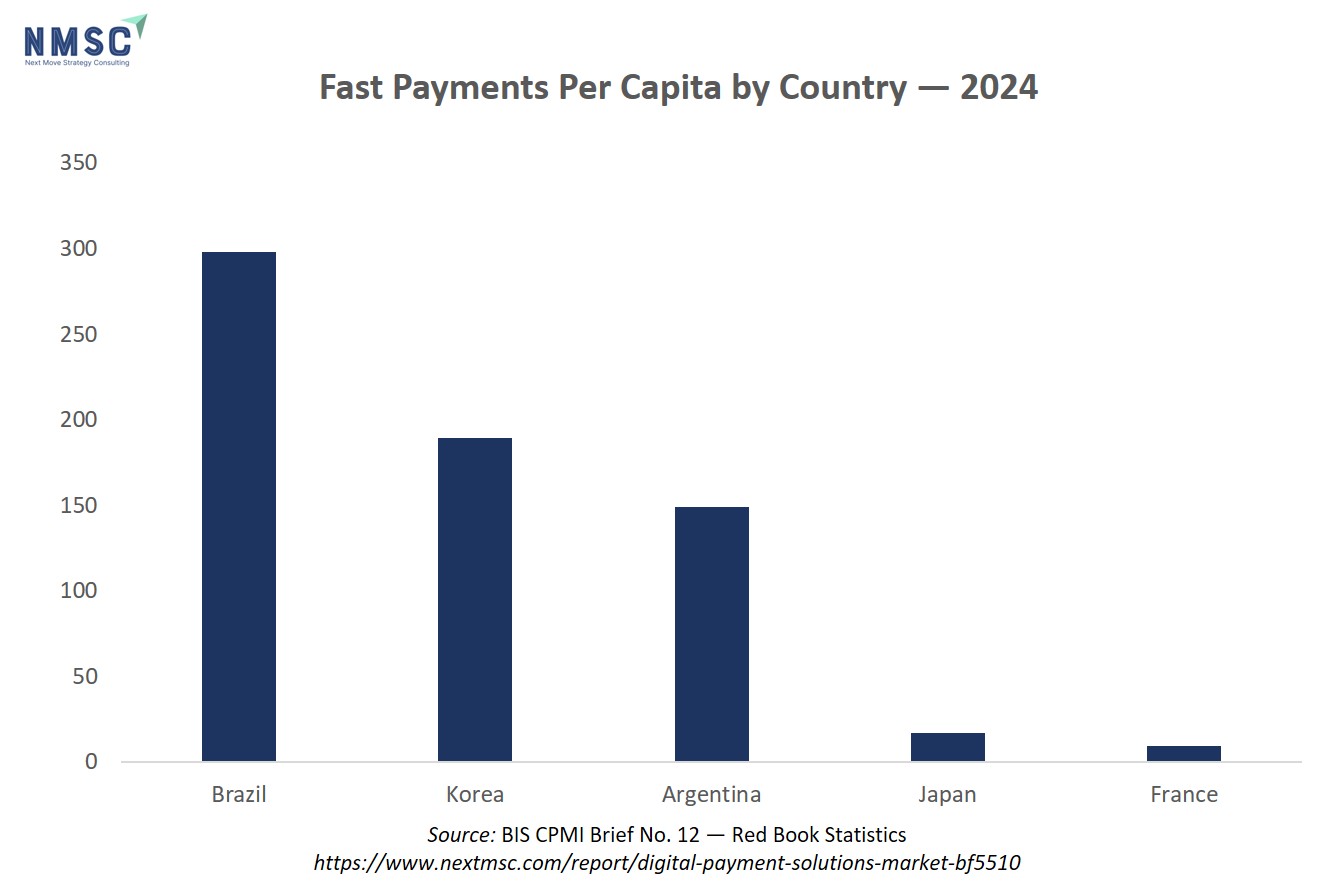
Cashless payments continue to increase globally. Credit transfers are the fastest-growing cashless payment method in emerging market and developing economies (EMDEs), while growth in cashless payments in advanced economies (AEs) is primarily driven by card payments. Fast payments are gaining ground and are a key driver behind the growth of credit transfers in EMDEs, with fast payments increasingly used for small-value transactions in both EMDEs and AEs. Cash withdrawals are declining, though cash in circulation has largely stabilized, underscoring the enduring relevance of cash in economies even as digital alternatives expand.
These findings validate the structural demand thesis for the digital payment solutions market. The acceleration of fast payment adoption in EMDEs — driven by real-time payment infrastructure such as India's Unified Payments Interface, Brazil's Pix, and the EU's SEPA Instant Credit Transfer scheme — is creating sustained demand for payment gateway, processing, and orchestration software capable of routing transactions across multiple real-time rails simultaneously.
EU Instant Payments Regulation: A November 2026 Compliance Deadline Reshapes European Infrastructure
The European Union's Instant Payments Regulation is imposing a structured compliance timeline on payment service providers across the SEPA zone. Following the January 2025 mandate requiring euro-area payment service providers to receive SEPA Instant Credit Transfers, the November 2026 deadline introduces a further requirement: only structured or hybrid payment addresses will be accepted in SEPA Instant Payments after that date, compelling providers to implement verification-of-payee and structured address capabilities across their platforms.
This compliance deadline is generating near-term technology investment demand across European payment service providers, banks, and corporate treasury functions — a dynamic that supports NMSC's projection of a 15.6% CAGR for the European digital payment solutions market from 2026 to 2035.
Section Summary: The digital payment solutions market's demand foundation is being reinforced simultaneously by expanding global financial inclusion, accelerating fast payment adoption in EMDEs, and regulatory compliance investment driven by the EU's Instant Payments Regulation. These are structural, multi-year demand drivers that extend well beyond the current economic cycle.
Key Takeaways:
-
World Bank Findex 2025 confirms 79% of adults globally now hold a financial account — up from 51% in 2011 — directly expanding the addressable market for digital payment platforms across emerging economies.
-
BIS CPMI 2024 Red Book (April 2026) confirms cashless payments are rising globally, with fast payments emerging as the primary growth driver in EMDEs — validating real-time payment infrastructure investment.
-
The EU's November 2026 SEPA Instant Payments structured address deadline is generating near-term compliance technology investment across European payment service providers.
-
NMSC identifies Middle East & Africa (20.9% CAGR) and India (23.0% CAGR) as the highest-growth markets, directly anchored in financial inclusion expansion and real-time payment infrastructure deployment.
Key Data & Statistics
Key External Market Events & Data Points — Digital Payment Solutions Market (2025–2026)
|
Event / Data Point |
Value / Detail |
Date |
|
GENIUS Act signed into law |
First U.S. federal regulatory framework for payment stablecoins |
July 18, 2025 |
|
GENIUS Act effective date |
January 18, 2027 |
— |
|
Annual stablecoin transaction volume (2025) |
USD 28 trillion (est.) |
2025 |
|
Mastercard BVNK acquisition value |
Up to USD 1.8 billion |
Completed Aug 3, 2026 |
|
Stripe total payment volume (2025) |
USD 1.9 trillion (+34% YoY) |
Full Year 2025 |
|
Stripe payment volume as % of global GDP |
~1.6% |
Full Year 2025 |
|
Global adult financial account ownership |
79% (up from 51% in 2011) |
2025 |
|
BIS CPMI: Cashless payments per capita growth — EMDEs |
+21% YoY |
2024 (Red Book) |
|
BIS CPMI: Cashless payments per capita growth — AEs |
+6% YoY |
2024 (Red Book) |
|
EU SEPA Instant Payments structured address deadline |
November 2026 |
Nov 2026 |
|
Visa Intelligent Commerce (agentic commerce initiative) |
Agent Scoring + Agentic Registry launched |
2026 |
|
Mastercard Agent Pay for Machines launched |
High-frequency, low-latency machine payments |
June 2026 |
Future Outlook & Forecast
The Digital Payment Solutions Market's Path to USD 725.40 Billion by 2035
According to Next Move Strategy Consulting, the global digital payment solutions market is projected to generate an absolute dollar opportunity of USD 556.30 billion between 2026 and 2035 — a figure that positions the market as one of the most significant capital allocation opportunities in the global technology sector over the coming decade.
Cryptocurrency Payments is the single fastest-growing payment mode segment, registering a 27.0% CAGR from 2026 to 2035, as GENIUS Act-regulated stablecoin rails gain traction for cross-border and machine-to-machine settlement use cases. QR Code Payments is the second fastest-growing mode at a 20.5% CAGR, driven by mobile-first adoption across Asia-Pacific and Middle East & Africa. Buy Now Pay Later registers a 20.2% CAGR, reflecting sustained demand among younger consumer cohorts across North America, Europe, and Asia-Pacific.
Country-Level Growth Leaders
India is the fastest-growing individual country market at a 23.0% CAGR from 2026 to 2035, with the market projected to expand from USD 10.79 billion in 2025 to USD 85.52 billion by 2035. India's Unified Payments Interface ecosystem — which has established the country as the global benchmark for real-time retail payment infrastructure — provides the demand foundation for this exceptional growth trajectory. China follows at a 20.5% CAGR, with the market projected to reach USD 125.36 billion by 2035, anchored by extensive mobile wallet penetration and dominant domestic super-app payment ecosystems.
The Agentic Commerce and Stablecoin Convergence Through 2035
NMSC's analysis indicates that the convergence of agentic commerce and stablecoin settlement will be the defining structural theme of the digital payment solutions market through 2035. Payment networks and processors are increasingly embedding stablecoin settlement and AI agent authentication directly into core payment rails rather than treating them as adjacent pilots — a shift that favors diversified providers offering unified card, wallet, and blockchain-based settlement capability over single-rail specialists as autonomous commerce scales. The GENIUS Act's effective date of January 18, 2027 will mark the beginning of a multi-year institutional adoption cycle for regulated stablecoin payment infrastructure, with material revenue implications for providers positioned to serve both enterprise and SME demand across this new rail.
Section Summary: The digital payment solutions market's trajectory toward USD 725.40 billion by 2035 is underpinned by durable structural drivers — financial inclusion expansion, real-time payment infrastructure deployment, stablecoin regulatory clarity, and agentic commerce adoption — that are resilient across economic cycles. The GENIUS Act's January 2027 effective date will catalyze a new wave of institutional stablecoin infrastructure investment that will compound market growth through the forecast period.
Key Takeaways:
-
NMSC projects the global digital payment solutions market to reach USD 725.40 billion by 2035, representing a USD 556.30 billion absolute dollar opportunity from 2026 to 2035.
-
Cryptocurrency Payments (27.0% CAGR) is the fastest-growing payment mode, driven by GENIUS Act-regulated stablecoin adoption for cross-border and machine-to-machine settlement.
-
India (23.0% CAGR) and China (20.5% CAGR) are the highest-growth individual country markets, anchored in real-time payment infrastructure and mobile wallet ecosystem depth.
-
The GENIUS Act's January 2027 effective date will catalyze a new institutional adoption cycle for regulated stablecoin payment infrastructure, compounding market growth through 2035.
Next Steps for Stakeholders
For C-Level Executives and Payment Platform Providers:
-
Build unified multi-rail platforms before the GENIUS Act effective date. The January 18, 2027 effective date of the GENIUS Act creates a defined window for providers to develop and certify stablecoin settlement capability within a regulated framework. Providers that launch compliant stablecoin settlement infrastructure in 2026 will be positioned to capture first-mover enterprise relationships as institutional adoption accelerates post-January 2027.
-
Invest in agentic commerce authentication infrastructure now. Visa's Intelligent Commerce initiative and Mastercard's Agent Pay for Machines have established the competitive benchmark for AI-initiated transaction authentication. Providers that do not develop credible agent scoring, permissions management, and behavioral signal infrastructure risk exclusion from enterprise platform shortlists as agentic commerce scales through 2030.
-
Prioritize SME digital wallet onboarding as a growth lever. NMSC identifies SMEs as the fastest-growing enterprise size segment at a 19.8% CAGR. Providers that offer simplified, low-cost digital wallet and payment gateway onboarding for smaller merchants can secure long-term platform relationships as SME digital payment adoption accelerates across emerging markets.
-
Align product roadmaps with EU Instant Payments Regulation compliance timelines. The November 2026 SEPA structured address deadline is generating near-term technology investment demand across European payment service providers. Providers with compliant verification-of-payee and structured address capabilities are positioned to capture this compliance-driven demand.
For Institutional Investors and Financial Analysts:
-
Prioritize exposure to providers with credible stablecoin and agentic commerce infrastructure. NMSC's analysis indicates that providers combining card network scale with stablecoin settlement depth and agentic commerce authentication capability will command the strongest long-term revenue visibility. Mastercard's BVNK acquisition and Visa's Intelligent Commerce initiative are the clearest signals of where institutional capital is flowing.
-
Weight India and Middle East & Africa in portfolio construction. India's 23.0% CAGR and MEA's 20.9% CAGR represent the highest-growth regional opportunities in the digital payment solutions market. Providers with established UPI-linked and mobile-first payment infrastructure in these markets offer above-average growth potential relative to mature North American and European markets.
-
Monitor the GENIUS Act implementing regulations closely. The U.S. Treasury's public comment process on GENIUS Act implementing regulations will define the precise compliance requirements for stablecoin issuers and payment processors. Any acceleration or tightening of these requirements could create near-term compliance cost pressure — and corresponding investment opportunity — for providers building regulated stablecoin infrastructure.
Conclusion
The global digital payment solutions market stands at a structural inflection point defined by two concurrent forces: the regulatory legitimization of stablecoin payment rails through the GENIUS Act, and the technological emergence of AI agents as autonomous purchasing entities. Mastercard's completed USD 1.8 billion acquisition of BVNK, Visa's Intelligent Commerce initiative, and Stripe's USD 1.9 trillion total payment volume in 2025 collectively confirm that the market's most consequential growth drivers are already operational — not theoretical.
According to Next Move Strategy Consulting, the global digital payment solutions market will expand from USD 169.10 billion in 2026 to USD 725.40 billion by 2035 at a 17.6% CAGR, generating a USD 556.30 billion absolute dollar opportunity over the forecast period. The World Bank's confirmation that 79% of adults globally now hold a financial account — up from 51% in 2011 — and the BIS CPMI's documentation of accelerating cashless payment adoption across both advanced and emerging economies provide the demand foundation that makes this forecast credible and durable. For executives and investors who have been monitoring the digital payment solutions market from the sidelines, the strategic window for early-mover positioning in stablecoin infrastructure and agentic commerce authentication is narrowing rapidly.
About the Author
 Sanyukta Deb
— Sanyukta Deb is Digital Marketing Team Lead at Next Move Strategy Consulting, where she has led content strategy and technical SEO for the firm's B2B market research publications for over 2 years. Her editorial process translates NextMSC's primary and secondary research — spanning technology, industrial, and consumer sectors — into commercial narratives, backed by search-intent, keyword, and competitive analysis. She brings 5 years of overall experience in digital marketing and content strategy.
Sanyukta Deb
— Sanyukta Deb is Digital Marketing Team Lead at Next Move Strategy Consulting, where she has led content strategy and technical SEO for the firm's B2B market research publications for over 2 years. Her editorial process translates NextMSC's primary and secondary research — spanning technology, industrial, and consumer sectors — into commercial narratives, backed by search-intent, keyword, and competitive analysis. She brings 5 years of overall experience in digital marketing and content strategy.
About the Reviewer
 Debashree Dey
— Debashree Dey is Assistant Manager at Next Move Strategy Consulting, where she supports cross-vertical market content and communications across diverse industries for 6 years. Her professional background includes senior content writing, communications, and published manuscript authorship, with experience developing audience-focused business narratives and maintaining clear, consistent messaging. Her role supports research-led content development and editorial quality across NextMSC publications.
Debashree Dey
— Debashree Dey is Assistant Manager at Next Move Strategy Consulting, where she supports cross-vertical market content and communications across diverse industries for 6 years. Her professional background includes senior content writing, communications, and published manuscript authorship, with experience developing audience-focused business narratives and maintaining clear, consistent messaging. Her role supports research-led content development and editorial quality across NextMSC publications.


















Add Comment